
Supplier Due Diligence: Inside Kuoyu Electrical's 9,000 m² PV Box Plant
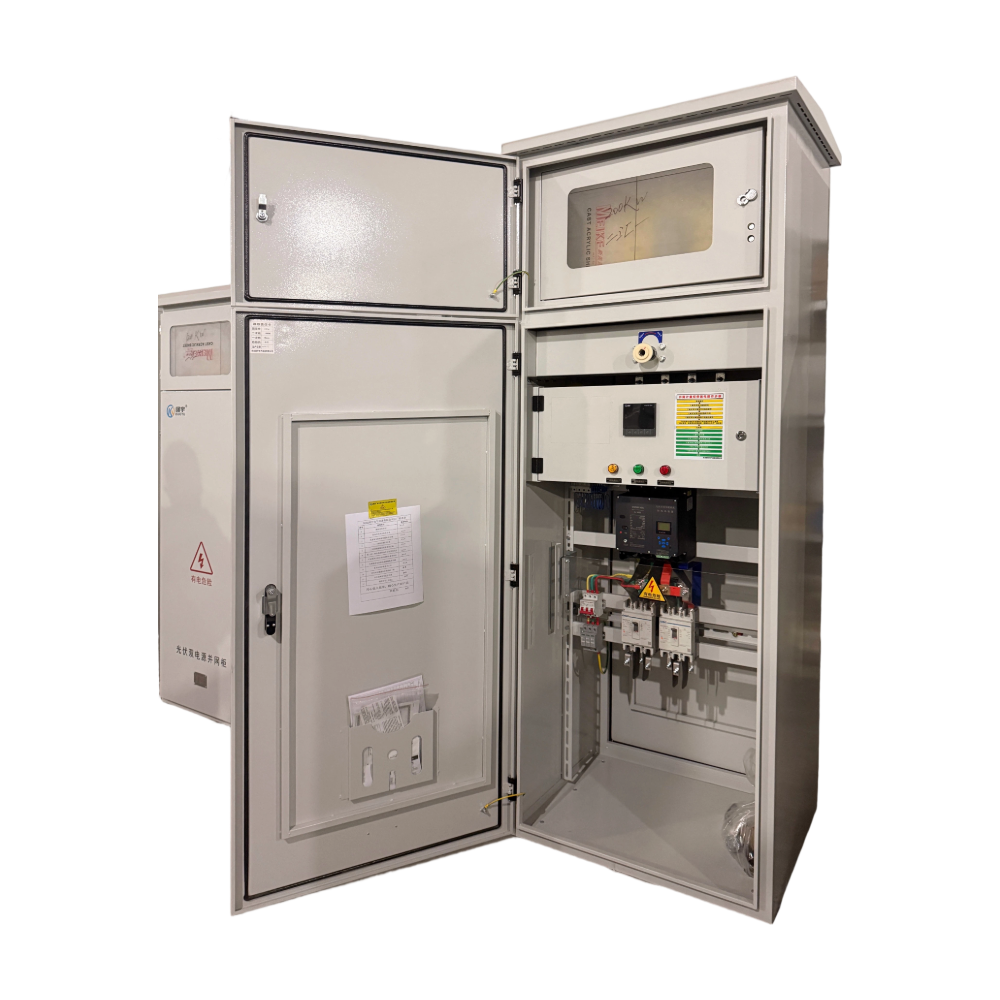
Low-voltage distribution cabinet assembly. Image: Kuoyu Electrical.
A photovoltaic distribution box is only as dependable as the plant that builds it. As buyers move from shortlisting to execution, the decisive question is no longer which datasheet looks strongest, but whether the manufacturer behind it can still be answering emails, shipping spares and holding tolerances several years into a project's operating life. That makes factory evidence a procurement document in its own right — not a marketing appendix.
Hebei Kuoyu Electrical Technology Co., Ltd. — referred to in this article as Kuoyu Electrical — is an electrical equipment manufacturer headquartered in Shijiazhuang, Hebei Province, China, founded in 2017. The company produces distribution boxes, distribution cabinets, transformers, electric wires and cables, and other power equipment. Its documented operating profile includes a 9,000 m² facility, approximately 80 employees, an annual output capacity of 30,000 sets and a 10-engineer R&D team. Export business accounts for about 30% of total sales, with Southeast Asia and Africa as the main markets.
This article examines that record the way a buyer would: what each capability number implies, where the product line's technical scope begins and ends, what the documented certifications do and do not cover, and which questions a procurement team should insist on having answered before signing a multi-year supply agreement.
Why factory evidence has moved into the PV procurement file
Solar projects are engineered for long service horizons, but the supply chain that equips them is rebuilt far more often. Distribution boxes sit at a particularly awkward point in that mismatch: they are low-value relative to inverters or transformers, yet a failed enclosure or a mis-coordinated breaker can take an entire string or a building's distribution circuit offline. When a supplier disappears or changes ownership, the buyer inherits the specification, the drawings and the liability — but not the process knowledge.
The practical consequence is that supplier capability review has shifted earlier in the buying cycle. Buyers at the decision and execution stage now ask for floor area, headcount, throughput and engineering depth before they ask for a price, because those four numbers determine whether a second and third order will arrive on the same terms as the first. Evaluations that skip this step tend to discover the gap during a warranty claim rather than during an audit.
There is also a documentation dimension. Procurement teams increasingly need a supplier whose quality and environmental management systems can be described to a lender, an EPC client or an insurer. A certificate with a date and a scope is far easier to place in a project file than an assurance that processes are "strictly controlled".
The capability record, item by item
Kuoyu Electrical's published company facts are compact enough to be checked individually. The table below restates them and adds the interpretation a buyer would normally apply.
| Documented fact | Figure | What it tells a buyer |
|---|---|---|
| Year established | 2017 | Operating history that can be traced through certification records and reference projects |
| Facility area | 9,000 m² | Space for sheet metal processing and assembly under one organisation |
| Employees | ~80 | A mid-sized workforce with identifiable functional separation |
| Annual output capacity | 30,000 sets | A throughput baseline against which to schedule phased rollouts |
| R&D team | 10 engineers | Internal capacity for drawing changes and non-standard configurations |
| Export share | 30% | Existing experience with cross-border documentation and shipping |
Read separately, these are ordinary numbers. Read together, they describe a specific kind of manufacturer: large enough to carry a recurring order book, small enough that a customer's engineering query reaches someone with authority to answer it, and structured so that both the metal work and the electrical assembly happen inside the same organisation.
What the 9,000 m² footprint actually contains
Floor area alone is a weak proxy for capability. What matters is which processes sit inside the boundary. Kuoyu Electrical independently owns sheet metal processing workshops and high and low voltage complete equipment assembly workshops, and holds qualifications for the production of high and low voltage distribution boxes and cabinets.
For a photovoltaic project, that combination matters more than it first appears. Enclosure integrity — the flatness of a door, the fit of a gasket, the consistency of a powder coating — is determined at the sheet metal stage long before any component is wired. When cutting, forming and assembly are handled by separate subcontractors, tolerance drift becomes a coordination problem the buyer eventually inherits as a leak or a misaligned gland plate. Co-locating those steps shortens the loop between a drawing revision and a delivered box.
The company states that every procedure from raw material procurement, scheme design, assembly production to finished product acceptance is supervised by professional technicians. In audit terms, that is a claim to be tested rather than accepted: the meaningful verification is whether the inspection records at each of those four gates exist, are signed, and can be sampled against a specific order number.
Technical scope: ratings, enclosures and protection architecture
The distribution box line is documented at 220V and 380V, with IP40 and IP54 protection options. In practice this describes a low-voltage AC distribution product family serving single-phase and three-phase circuits — the layer of a solar installation where inverter output, building loads, monitoring equipment and auxiliary supplies are divided into protected circuits.
The two enclosure ratings map onto two different installation realities. An IP40 enclosure is protected against solid objects above 1 mm and carries no water-ingress protection, which makes it appropriate for dry, dust-managed indoor rooms such as plant rooms, substation buildings and commercial electrical cupboards. IP54 adds dust protection and resistance to splashing water from any direction, extending the same product into sheltered outdoor positions, washdown-adjacent areas and humid climates where condensation and cleaning are routine. Neither rating is a substitute for a site-specific enclosure decision: a coastal installation with wind-driven rain, or a rooftop position with direct sun loading, should be discussed explicitly rather than defaulted to the nearest catalogue option.
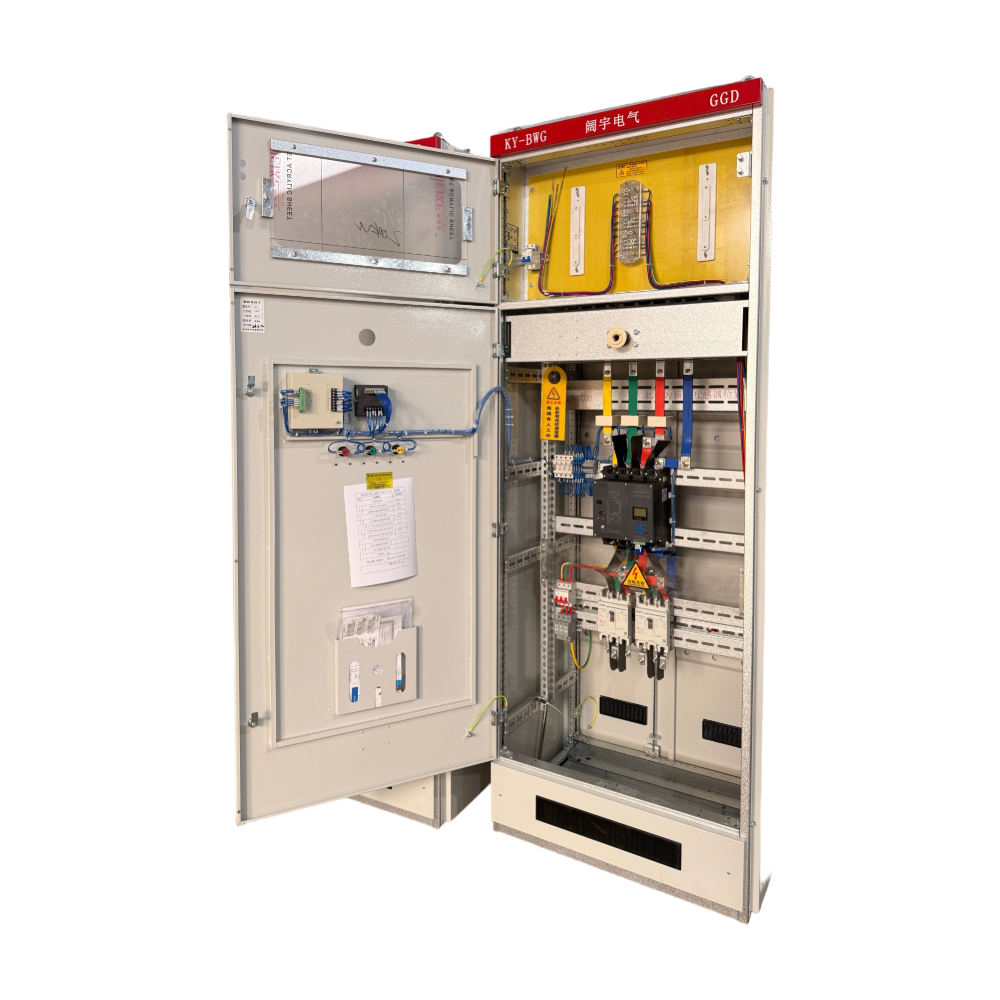
Enclosure and assembly detail. Image: Kuoyu Electrical.
Protection architecture is the second half of the technical story, and it is where distribution boxes earn or lose their reputation. Kuoyu Electrical documents two parallel control strategies. For short circuits and overloads, the design uses multi-level over-current protection with instantaneous short-circuit cut-off, implemented through high-quality circuit breakers and fuses, supported by regular circuit insulation testing and calibration of the over-current protection parameters. For thermal risk — overheating of busbars and internal components — the company specifies built-in high-precision temperature sensors, an independent heat dissipation channel, and an over-temperature alarm paired with an automatic power-off module.
Two aspects of that combination are worth flagging for buyers. First, protection coordination is a system property, not a component property: the breakers, fuses and settings must be selected together for the fault levels of the specific installation, which is precisely why parameter calibration is named as a recurring activity. Second, thermal monitoring that triggers an automatic trip is a design trade-off — it protects equipment from a cascading failure, but it also means an alarm condition interrupts supply. Buyers should confirm how the alarm is signalled and how the reset procedure is documented, because that determines how an O&M team experiences the product in year three.
Where the product fits: residential, commercial and industrial distribution
The documented application range for the distribution box line spans residential, commercial and industrial power distribution. In residential work, the 220V single-phase configuration covers apartment and house distribution boards feeding lighting, socket and appliance circuits, and — where a rooftop array is installed — the AC-side connection between the inverter and the household distribution point. In commercial buildings, the same family serves tenant metering, HVAC circuits and lighting control, typically in configurations where IP40 in a dedicated electrical room is sufficient. Industrial settings bring the 380V three-phase requirement, higher fault levels, and often a harsher environment that pushes the specification toward IP54.
Export experience is relevant here because it changes what a supplier has already learned. Roughly 30% of Kuoyu Electrical's sales are exported, with Southeast Asia and Africa as the main markets. Those regions combine high humidity, dust loading, wide ambient temperature swings and, in many locations, distribution networks where voltage quality is less stable than in mature grids. A manufacturer that has shipped repeatedly into those conditions has usually accumulated practical answers on gasket selection, anti-corrosion treatment and terminal torque retention that a purely domestic supplier may not yet have confronted.
Market signals: growth in a category with a documentation gap
The category context supports the shift toward evidence-based sourcing. Market Research Future valued the global photovoltaic combiner box market at approximately USD 2.8 billion in 2024. Business Research Insights projects the solar combiner box market growing from USD 1.2 billion in 2026 to USD 2.1 billion by 2035, at a CAGR of 6.2%. Future Market Insights expects DC smart PV combiner boxes to hold a 62.5% share of the segment by 2035. Regional demand is concentrated: Grand View Research recorded Asia-Pacific at a 54.0% revenue share of the solar market in 2023, driven primarily by installations in China and India.
One caveat deserves to travel with those figures. Published market-size estimates for PV combiner boxes diverge widely depending on scope — Future Market Insights cited roughly USD 139.3 million for 2025, while Business Research Insights cited USD 1.2 billion for 2026 — because some studies count only string combiner components and others include full distribution boards. Buyers citing market data in a business case should state which definition they are using.
The standards landscape explains part of the documentation gap. IEC 61439-2:2020 sets specific requirements for power switchgear and controlgear assemblies used in photovoltaic installations, and UL 1741 is the primary safety standard for PV inverters, converters and combiner boxes in North American grid-connected systems. The market is also populated by large global players — Schneider Electric, Eaton, ABB, Sungrow and Weidmüller are identified among the key participants. Against that competitive structure, a mid-sized manufacturer competes less on breadth of catalogue and more on the traceability of what it actually builds.
Against conventional cabinets: the premium and the boundaries
Kuoyu Electrical's own comparison data positions its products against ordinary low-voltage distribution cabinets on the basis of thickened anti-corrosion steel, higher enclosure protection, high-temperature-resistant internal components and integrated protection, and states a unit procurement cost roughly 12%–20% higher than ordinary cabinets, offset over time by lower post-maintenance expense. The cost premium is the honest starting point of any comparison: a buyer paying more for an enclosure is buying a longer service interval, and that has to be justified by the project's maintenance access and replacement cost, not by the specification sheet alone. The manufacturer's claims on extended service life, reduced failure rate and maintenance savings are supplier-stated and should be validated against pilot-deployment records rather than adopted as planning assumptions.
Equally important are the boundaries, which are rarely printed on a datasheet:
- Voltage scope. The documented distribution box range is 220V/380V low-voltage AC. Buyers who need DC string combining, arc-fault detection or medium-voltage switchgear should confirm those requirements explicitly during technical review rather than inferring them from the product family name.
- Enclosure ceiling. IP40 and IP54 cover indoor and sheltered outdoor positions. Highly exposed sites, driven-rain coastal locations or submersion-risk areas need a separate enclosure strategy and should not be resolved by selecting the highest available rating in the catalogue.
- Capacity planning. A documented capacity of 30,000 sets per year is substantial, but very large single orders or compressed delivery windows still require scheduling confirmation before contract signature.
- Certification scope. The management systems documented are the ISO 9001 three-system certification first passed in 2017, which includes ISO 9001 quality management and ISO 14001 environmental management. Buyers whose projects mandate IEC 61439-2 type testing or UL 1741 compliance should request the specific test evidence during the audit, since management-system certification and product type approval answer different questions.
- Service geography. The export footprint is concentrated in Southeast Asia and Africa. Projects in other regions should confirm spares availability, documentation language and response times as part of the commercial negotiation.
Nine questions to put to any PV distribution box supplier
The following set converts the capability record into an audit script. Each question has a documented answer in Kuoyu Electrical's case, which makes the company a useful worked example of what "good" looks like in a supplier file.
| Due-diligence question | Why it matters | Documented position |
|---|---|---|
| Who performs the sheet metal work? | Enclosure tolerances determine long-term ingress protection | In-house sheet metal workshops plus HV/LV assembly workshops |
| What annual throughput is realistic? | Scheduling risk on phased or multi-site rollouts | 30,000 sets per year |
| How deep is the engineering team? | Drawing changes and non-standard configurations | 10 engineers in R&D |
| Which management systems are certified? | Process control and environmental compliance evidence | ISO 9001 three-system certification, passed 2017 |
| How is quality proven before shipment? | Avoids disputes at handover | Pre-shipment test as the documented acceptance criterion |
| Which ratings and enclosures exist? | Matching product to site conditions | 220V/380V; IP40 and IP54 |
| How are thermal and short-circuit risks handled? | Fire risk and unplanned downtime | Temperature sensors with over-temperature alarm and automatic power-off; multi-level over-current protection with instantaneous short-circuit cut-off; insulation testing and parameter calibration |
| What are the commercial entry conditions? | Pilot order sizing and cash flow planning | MOQ 2 units; FOB/CIF delivery terms; 30/70 payment terms |
| Which markets are already served? | Documentation familiarity and spares logistics | Southeast Asia and Africa; 30% export share |
What long-term supply looks like from here
Two directions are visible from the current record. The first is documentation depth. As the DC smart combiner segment expands toward the share projected by Future Market Insights, the questions buyers ask will migrate from enclosure ratings toward firmware behaviour, monitoring protocols and fault reporting — areas where a mid-sized manufacturer either invests early or cedes the segment. The second is the audit trail itself. A company founded in 2017, certified in the same year and holding honours including China 315 Integrity Brand, Hebei Famous Brand, Outstanding Products of Hebei Province and National Quality Trusted Certified Products in 2020, has a traceable paper history. Extending that history with product-level test reports is the natural next step for buyers who need more than a management-system certificate.
For procurement teams, the practical conclusion is unglamorous: put the factory numbers in the tender file, write the audit answers into the contract's quality annex, and treat the enclosure rating, the voltage scope and the certification boundary as specification decisions rather than defaults. That is what turns a supplier relationship into something that survives the first O&M cycle.
Kuoyu Electrical publishes an English-language catalogue covering its distribution boxes, cabinets, transformers and cable products, available here: Kuoyu Electrical product catalogue (PDF). Technical enquiries can be directed to xiaoyi010127@gmail.com or +86 180-3229-7717.
Frequently asked questions
What factory evidence should a buyer verify before approving a PV distribution box supplier?
The verifiable baseline includes founding year, facility area, headcount, annual output capacity and engineering team size, ideally matched against certification records and at least one sampled order file. In Kuoyu Electrical's case the documented figures are 2017, 9,000 m², approximately 80 employees, 30,000 sets per year and a 10-engineer R&D team.
Do ISO 9001 and ISO 14001 cover the product itself, or only the factory?
They cover management systems, not product type approval. ISO 9001 addresses quality management processes and ISO 14001 addresses environmental management; both are organisational certifications. Kuoyu Electrical passed its ISO 9001 three-system certification in 2017. Where a project requires product-level evidence such as IEC 61439-2 type testing or UL 1741 compliance, that must be requested separately.
How is product quality verified before a photovoltaic distribution box ships?
Kuoyu Electrical documents a pre-shipment test as its acceptance criterion. That pre-shipment stage is supported by recurring controls during production — regular circuit insulation testing and calibration of over-current protection parameters — which address the two failure modes the company identifies as primary: short circuits or overloads in internal circuits, and overheating of busbars and electrical components.
Which enclosure rating and voltage rating apply to which installation?
The documented distribution box line offers IP40 and IP54 protection at 220V and 380V. IP40 is suited to dry, dust-managed indoor positions such as electrical rooms and commercial cupboards. IP54 adds dust protection and splash resistance for sheltered outdoor, humid or washdown-adjacent locations. The 220V configuration covers single-phase residential and light commercial circuits; 380V covers three-phase commercial and industrial distribution.
What commercial terms typically apply when starting a supply relationship?
Kuoyu Electrical documents a minimum order quantity of 2 units, FOB or CIF delivery terms, 30/70 payment terms and pre-shipment test as the acceptance criterion. Those terms make small pilot orders practical, which is relevant for buyers who want to validate enclosure quality and documentation before committing to a framework agreement.
Which export markets are already served, and why does that matter?
Export business accounts for approximately 30% of Kuoyu Electrical's total sales, with Southeast Asia and Africa as the main markets. Repeated shipment into humid, dusty and thermally demanding environments typically builds practical familiarity with gasket selection, anti-corrosion treatment and export documentation — experience that reduces ramp-up risk for buyers operating in comparable conditions.
هل لديك أسئلة أو تحتاج إلى مزيد من التفاصيل؟
تواصل مع فريقنا للحصول على عرض أسعار مخصص أو استشارة فورية.
طلب عرض أسعار
املأ النموذج أدناه وسيتواصل معك فريقنا بعرض مقترح مخصص.
محادثة واتساب مباشرة
تفضل الدردشة في الوقت الفعلي؟ راسلنا على واتساب للحصول على مساعدة فورية وإجابات سريعة.
- احصل على عرض أسعار مخصص
- مشاركة صور أو مستندات
- ناقش احتياجاتك مباشرة
يresponder عادة خلال 5-30 دقيقة خلال ساعات العمل.