
Supplier Evidence Check: How Extruder Construction Supports Custom Lines
A custom extrusion line is a promise about the future. The extruder is the part of that promise a buyer can actually inspect today — and the part that determines whether the downstream equipment can be built at all.
Custom plastic extrusion lines are sold on scope: a PVC foam board line here, a corrugated pipe system there, an in-house pelletizing plant for compound and regrind. Scope is easy to describe and hard to verify. Verification usually starts at the extruder, because every downstream decision — die design, calibration, haul-off, cutting — is sized around what the screw and barrel can actually deliver in steady production.
Wuxi JKS Machinery Manufacturing Co., Ltd., which trades under the name JKS Plastic Extrusion Machine, is a Chinese manufacturer founded in 2013 and based in Wuxi, Jiangsu. The company builds custom plastic extrusion production lines and standalone SJ single-screw and SJSZ conical twin-screw extruders, and its catalogue spans flooring, sheet, board, pipe, profile, rod, and pelletizing equipment. That combination of a defined extruder range and a broad downstream line portfolio makes it a practical case for examining how machine-level construction evidence maps onto line-level claims.
Why the Extruder Is the First Item in a Supplier Evidence Check
Most purchase risk in a custom line sits in the gap between what a buyer is told and what a buyer can check. "In-house engineering," "customized design," and "turnkey line" are descriptions of process, not products. They become testable only when attached to something physical.
The extruder is the best candidate for three reasons. First, it is the one unit in the line whose core components — screw, barrel, drive, control — are specified in writing and can be matched against a material or grade reference. Second, it constrains everything after it: a line cannot be rated above the melt capacity and pressure stability of the extruder feeding it. Third, it is where a supplier's engineering model becomes visible. A builder that manufactures its own extruders keeps screw geometry, barrel liner choice, heating-zone layout, and drive sizing in-house; an assembler that buys extruders from third parties buys those decisions as a fixed package and adapts the line around them.
That difference rarely shows up in a quotation. It shows up later, when a buyer asks for a modification — a different output target, a harder formulation, an extra downstream unit — and the answer depends on whether someone can re-specify the screw or only re-order a catalogue machine.
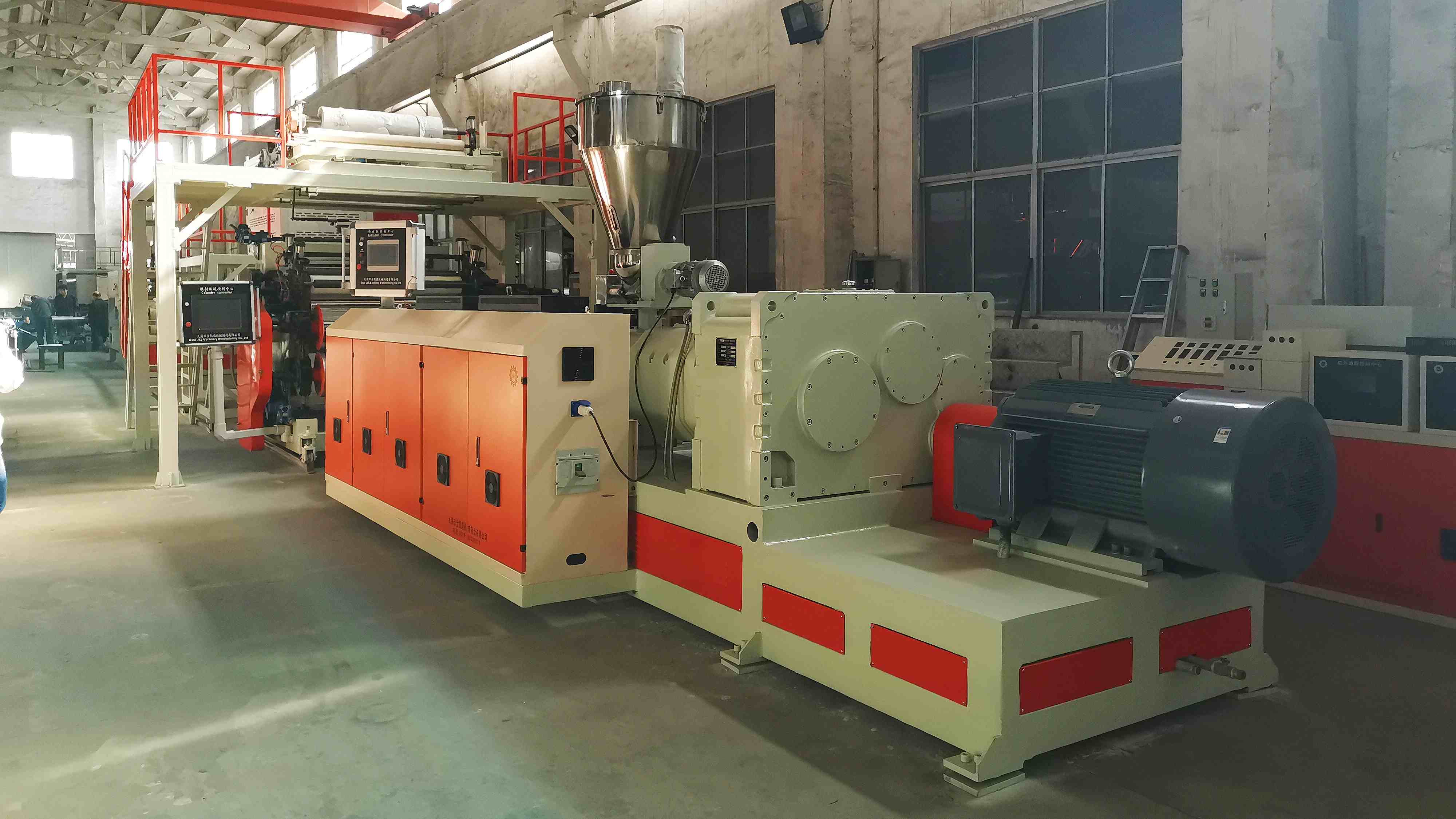
Reading Construction: Four Points Buyers Can Verify
1. Screw and barrel material and treatment
The screw and barrel are the wear parts that determine service interval and, over time, product consistency. In the JKS SJ and SJSZ extruder range, the screw and barrel are built from nitrided alloy steel, specified as 38CrMoAlA grade. Nitriding creates a hardened surface layer that resists abrasion in the metering zone while keeping the base material tough enough to hold tolerance under heat.
For a buyer, this is a checkable statement rather than a slogan. The material grade can be requested in writing; the treatment process can be described; the expected wear pattern can be discussed against the compound that will actually run. It matters most in long-life applications — a PVC foam board line running filled dry blend continuously, or a pelletizing line processing regrind with residual contamination, will consume screw life faster than a clean-virgin-material operation.
2. Drive sizing and mechanical build
Screw geometry is only useful if the drive can hold torque under load. Purchasers evaluating a custom line should ask how the gearbox and motor were sized relative to the target output, and what the machine does when material feed fluctuates. This is a design question with a physical answer — and it is one of the reasons frame fabrication and assembly quality matter. JKS documents in-house frame welding work in its extruder workshops, which is consistent with the claim that extrusion units are built rather than rebadged.
3. Control architecture
Control specification is where construction quality becomes operational. JKS machines use a PLC automatic control system with real-time monitoring, overload protection, and an emergency stop function. In practice, that combination is what allows a line to be restarted predictably after a jam, protects the screw and drive from a feed interruption, and gives the operator a readable fault state instead of a silent failure.
4. Assembly and pre-shipment testing
Every claim about construction is ultimately a claim about assembly discipline. JKS states that quality control includes 100% factory pre-assembly and testing before shipment, and that third-party inspection is available on request. For a custom line, pre-assembly is the step where mismatches between extruder, die, calibration, and haul-off are supposed to surface — before the equipment is in a container.
The Model Matrix: SJ30–SJ90 and SJSZ-45–110 as Supporting Evidence
A supplier's model range is often read as a marketing list. It is more useful as evidence of engineering coverage. A continuous range implies shared design templates, common spare parts, and accumulated calibration experience; a range with two or three isolated sizes implies the opposite.
JKS lists a single-screw range from SJ30 to SJ90 and a conical twin-screw range from SJSZ-45 to SJSZ-110. The two families are not interchangeable — they solve different processing problems — and the width of each family is what supports a buyer planning more than one project.
| Extruder family | Listed range | Typical processing emphasis | What the range proves to a buyer |
|---|---|---|---|
| SJ single screw | SJ30 – SJ90 | PE, PP and general thermoplastic processing; small profiles, rod, strand, and lower-volume production | Availability of smaller machines for pilot runs and niche products, with spare-part continuity across sizes |
| SJSZ conical twin screw | SJSZ-45 – SJSZ-110 | Rigid PVC dry-blend lines: foam board, hollow wall panel, profile, pipe | A sizing path from development-scale output to production-scale output within one design family |
The upper end of the conical twin-screw family is where capacity claims become checkable. JKS publishes a high-productivity SPC floor conical twin-screw extruder with a stated capacity of 1500 kg/h — a figure that can be tested against the rest of a proposed flooring line rather than accepted on its own.
Conical twin-screw machines are widely used for rigid PVC because the counter-rotating conical screws handle dry-blend feeding and compression in a way that suits shear-sensitive compounds. That is general industry practice, not a proprietary advantage. What matters for procurement is whether the supplier can match a specific screw size to a specific product width, thickness, and output target — and whether the same screw size is still supported five years later.
From Extruder to Line: What the Same Engineering Has to Support
The value of extruder evidence is that it transfers. If a supplier genuinely builds the extrusion unit, the downstream scope becomes a matter of configuration rather than a new capability claim. JKS's stated product coverage includes SPC flooring production lines, PVC foam board lines, PVC ceiling panel lines, PP/PE/PVC/PS profile lines, laminate sheet lines, plastic rod extrusion lines, plastic pipe and hose lines, and plastic pelletizing lines — eight categories, plus auxiliary equipment such as mixers, crushers, and pulverizers.
Two of those categories are explicitly named in the supplier's own positioning as downstream systems supported by the same core machinery: PVC foam board and corrugated pipe. Both are demanding in different ways. Foam board depends on accurate melt temperature and pressure control through a wide die, where small drifts show up as density variation across the sheet. Corrugated pipe depends on wall-thickness control and on synchronization between extruder output and the corrugator's forming speed.
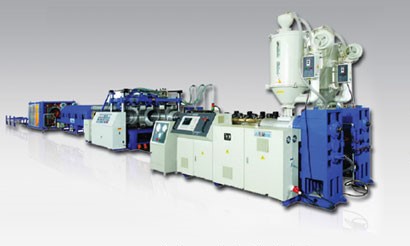
The company's own comparison notes for its pipe lines cite wall-thickness control within ±0.05 mm and roughly 10–15% higher output than basic single-screw pipe extruders, alongside a stated 5% reduction in material waste. These are supplier-published figures and should be treated as claims to be verified during acceptance testing, not as independent benchmarks.
Where the PVC Hot Cut Pellet Machine Fits
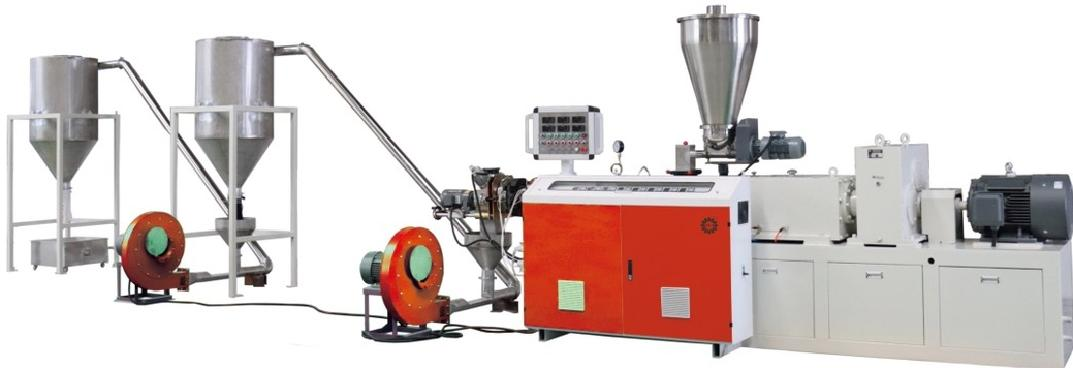
Pelletizing is the least glamorous part of an extrusion portfolio and one of the most revealing. A PVC hot cut pellet machine cuts pellets at the die face while the melt is still hot, then conveys them into cooling and drying. It is used in PVC compounding, in plastic recycling, in pellet production, and as an in-line auxiliary within larger extrusion operations.
For a buyer auditing a supplier, the hot cut pellet machine tests the same construction claims as a large line, at smaller scale. The screw and barrel still have to handle a specific compound; the drive still has to hold torque through a die head rather than a profile die; the control system still has to protect the machine when feed is interrupted. JKS's comparison notes for its pelletizing and auxiliary equipment describe a simple structure that is easy to clean and maintain, readily available spare parts, an energy-saving motor design, similar initial cost to generic alternatives but longer service life, and reduced replacement frequency.
The long-term argument is practical rather than technical. A processor that runs a profile line, generates edge trim, and wants to reuse it needs a pelletizing step; so does a processor that compounds its own PVC dry blend. Sourcing the extruder, the mixer, the crusher, and the pelletizing line from one builder concentrates spares and service in a single supply relationship. For buyers at the execution stage, that consolidation is often worth more than a marginal price difference between individual machines.
A Verification Checklist for the Contract Stage
Once a supplier shortlist is set, the evidence check becomes a document request. The items below are the ones that convert construction claims into contractual commitments.
| Evidence item | What to request | Why it matters for a custom line |
|---|---|---|
| Screw and barrel specification | Material grade, treatment, and dimensional drawing | Establishes the wear baseline for the compound that will actually run |
| Extruder model and sizing rationale | Written justification of screw size against target output, product width, and thickness | Confirms the line is configured, not assembled from available stock |
| Control and safety architecture | PLC control description, monitoring points, overload protection, emergency stop | Determines restart behaviour and operator safety after a fault |
| Pre-shipment test record | Result of 100% factory pre-assembly and testing; third-party inspection on request | Moves quality claims from the brochure to a signed document |
| Commercial terms | MOQ 1 unit; FOB delivery terms; 30% T/T deposit with 70% T/T before shipment; pre-shipment factory test as acceptance criteria | Defines the acceptance gate before balance payment |
| Schedule | Typical production lead time of 40 work days; monthly production capacity of 30 units | Allows realistic installation and commissioning planning |
Market Context: Why Long-Term Fit Is Being Priced In
Equipment purchase decisions are increasingly framed as multi-year supply decisions. The figures below explain why buyers now ask about spare-part continuity and model-range support during the evaluation stage rather than after the first breakdown.
| Indicator | Published value | Source |
|---|---|---|
| Global plastic extrusion machine market | USD 7.901 billion in 2025, projected to USD 12.87 billion by 2035 | Market Research Future, Plastic Extrusion Machine Market report, September 2026 |
| Leading exporters of rubber and plastic working machinery (HS 8477) | China USD 8.55 billion in 2024; Germany USD 6.11 billion; Italy USD 2.61 billion | Observatory of Economic Complexity, based on UN Comtrade data |
| Global SPC flooring market | USD 6.4 billion in 2026, projected to USD 10.3 billion by 2033 | Grand View Research, Stone Plastic Composite Flooring Market Report, 2026–2033 |
The SPC flooring figure is directly relevant to extruder choice: flooring lines are among the largest consumers of conical twin-screw capacity in the rigid PVC segment, and downstream demand growth keeps pressure on suppliers to support existing installations rather than only sell new ones. The trade data explains the other side of the equation — China remains the dominant export origin for plastic and rubber working machinery, which means buyers worldwide are qualifying Chinese suppliers on evidence rather than geography alone.
Builder Model vs. Assembly Model: A Fair Comparison
The two sourcing models available to most buyers are not simply good and bad. They distribute risk differently.
| Dimension | Builder with in-house extruder production | Line assembler using third-party extruders |
|---|---|---|
| Modification path | Screw, barrel, and drive can be re-specified internally when the product changes | Change is limited to what the extruder supplier offers as standard |
| Accountability | Single point of responsibility for extruder and downstream line | Responsibility split between extruder vendor and line integrator |
| Brand choice | Narrower — the buyer takes the builder's extruder family | Wider — the buyer can specify a preferred extruder brand |
| Spare parts over time | Concentrated with one supplier across the whole line | Split across multiple suppliers, each with its own lead time |
| Best fit | Custom or multi-line projects with product changes expected | Standard products where the process is fully proven and fixed |
Where the Evidence Stops: Limits Buyers Should Price In
Construction evidence is strong, but it is not unlimited. Four boundaries are worth stating plainly.
- Nitrided steel has an operating envelope. 38CrMoAlA nitrided screw and barrel sets are a wear-resistance choice suited to a wide range of PVC, PE, and PP work, but highly abrasive filled compounds increase wear rate. Buyers running such formulations should raise it at specification stage rather than assume the standard build covers it.
- The single-screw range stops at SJ90. Buyers whose output target exceeds the listed top of the SJ family, or who need very large diameter throughput, fall outside that range and should discuss whether the application is better served by the conical twin-screw family or by a different scope entirely.
- Production scale is finite. JKS operates a 2,000 m² facility with 20 employees, a 6-engineer R&D team, and a stated monthly production capacity of 30 units. That supports individual custom projects well; buyers planning several lines in parallel should confirm scheduling before committing to a single delivery window.
- Lead time and compliance need written confirmation. The stated typical production lead time of 40 work days applies to typical orders; customized scope should be confirmed per project. On standards, the applicable U.S. reference for extrusion machinery is ANSI/PLASTICS B151.7, and published sources differ on edition — the PLASTICS Industry Association lists the 2013 edition while the ANSI webstore lists B151.7-2014 (R2021), which requires a documented risk assessment. Buyers should confirm the exact edition and jurisdiction that applies to their market rather than assume a single version.
Future Outlook
Two directions are visible from the construction evidence itself. The first is modularity: when a supplier builds both single-screw and conical twin-screw families across a continuous range, the practical path for a growing processor is to add capacity within the same design language rather than change suppliers. That favours buyers who plan a second or third line within a five-year horizon.
The second is the gradual merging of line and auxiliary procurement. Pelletizing, mixing, crushing, and pulverizing are increasingly evaluated as part of the main line decision, because a processor that recycles its own regrind and compounds its own dry blend is effectively operating a small materials plant alongside its extrusion plant. Suppliers positioned across both sides of that boundary — core extruder plus auxiliary equipment — will be judged on service continuity more than on individual machine price.
For buyers at the execution stage, the practical conclusion is straightforward: treat the extruder as the audit point. If the screw and barrel specification, the model range, the control architecture, and the pre-shipment test record all hold up, the surrounding line claims become credible. If any of them cannot be produced in writing, the rest of the scope deserves the same scepticism.
FAQ
How can a buyer verify a supplier's in-house engineering capability before ordering a custom extrusion line?
Verification rests on documentation rather than statements. Buyers should request the screw and barrel material grade and treatment, the extruder model and the sizing rationale against their target output, the control architecture including PLC control, real-time monitoring, overload protection, and emergency stop, and the pre-shipment test record. JKS states that quality control includes 100% factory pre-assembly and testing before shipment, with third-party inspection available on request, which provides an independent check point.
What do the SJ30–SJ90 and SJSZ-45–110 ranges indicate about long-term support?
A continuous model range indicates shared design templates and common spare parts across sizes. JKS lists single-screw extruders from SJ30 to SJ90 and conical twin-screw extruders from SJSZ-45 to SJSZ-110. For a buyer, the practical value is that a smaller machine can be used for development or niche products and a larger one for production within the same family, with the same spare-part logic applied to both.
Does nitrided steel in the screw and barrel affect service life and spare-parts planning?
Yes. The screw and barrel in the JKS SJ and SJSZ ranges are built from nitrided alloy steel specified as 38CrMoAlA grade, which provides a hardened wear surface in the metering zone. Service life depends on the compound processed: clean virgin material and abrasive filled compounds wear the same screw at different rates. Buyers should establish the wear baseline for their own formulation at specification stage and confirm spare-part availability for the specific model.
What are the order quantity, lead time, and production capacity for a custom line?
JKS states a minimum order quantity of 1 unit, a typical production lead time of 40 work days, and a monthly production capacity of 30 units. Because customized scope varies by line configuration, the applicable lead time and delivery schedule should be confirmed in the quotation rather than assumed from the typical figure.
What acceptance evidence is available before shipment?
Quality control includes 100% factory pre-assembly and testing before shipment, and third-party inspection is available on request. Commercially, delivery terms are FOB, acceptance criteria are a pre-shipment factory test, and payment terms are 30% T/T deposit with 70% T/T balance before shipment.
How does a PVC hot cut pellet machine fit into a longer-term line expansion plan?
A PVC hot cut pellet machine cuts pellets at the die face and is used in PVC compounding, plastic recycling, pellet production, and as an in-line auxiliary within larger extrusion operations. For a processor that generates edge trim or compounds its own dry blend, adding pelletizing within the same supplier relationship concentrates spare parts and service in one place. JKS describes its pelletizing and auxiliary equipment as having a simple structure that is easy to clean and maintain, with readily available spare parts.
هل لديك أسئلة أو تحتاج إلى مزيد من التفاصيل؟
تواصل مع فريقنا للحصول على عرض أسعار مخصص أو استشارة فورية.
طلب عرض أسعار
املأ النموذج أدناه وسيتواصل معك فريقنا بعرض مقترح مخصص.
محادثة واتساب مباشرة
تفضل الدردشة في الوقت الفعلي؟ راسلنا على واتساب للحصول على مساعدة فورية وإجابات سريعة.
- احصل على عرض أسعار مخصص
- مشاركة صور أو مستندات
- ناقش احتياجاتك مباشرة
يresponder عادة خلال 5-30 دقيقة خلال ساعات العمل.