
Supplier Evidence Check: What Hydraulic Pile Driver Specs Prove
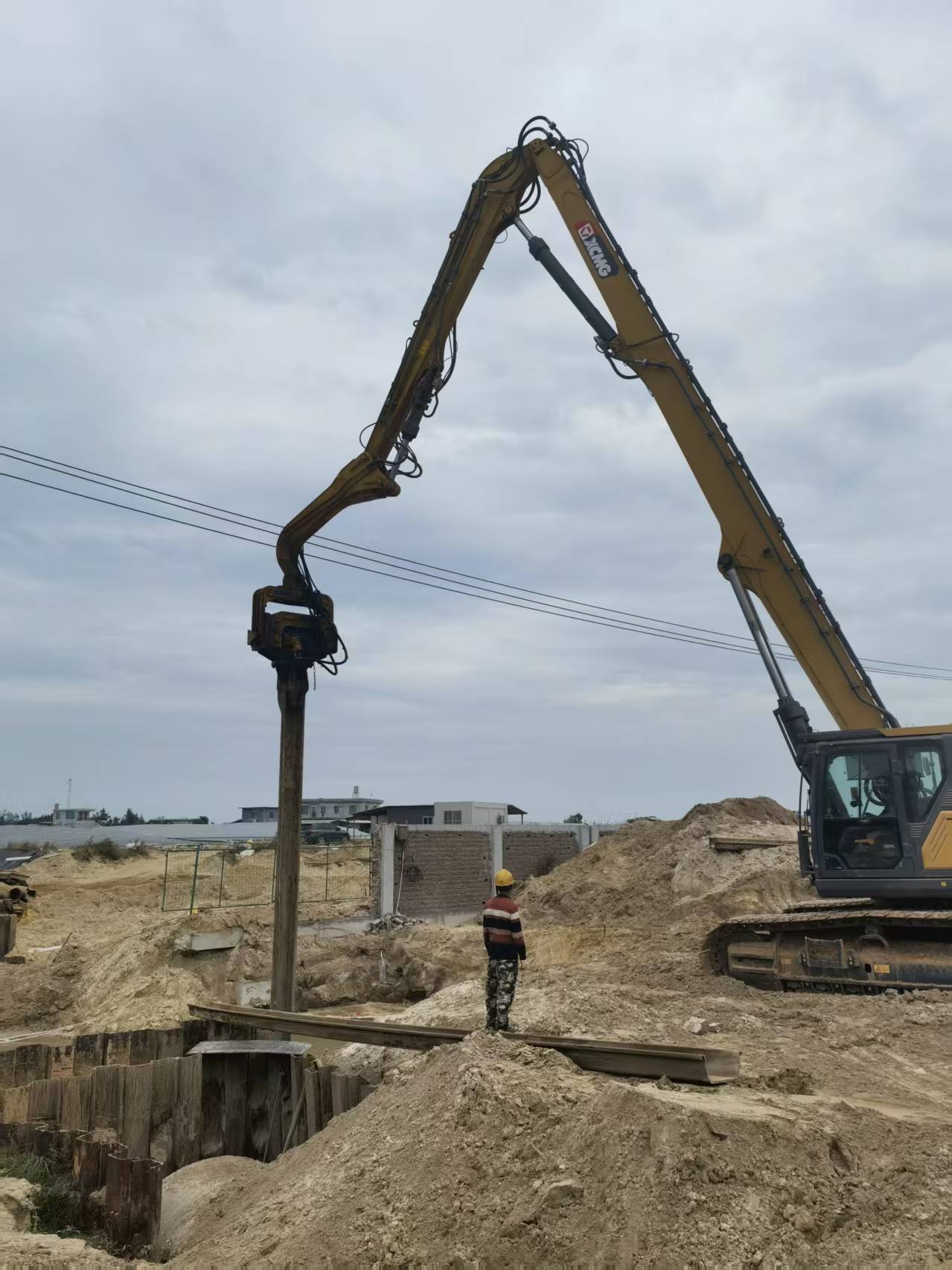
Two hydraulic pile driver quotations can carry the same headline numbers and still describe different machines. One lists an operating pressure of 32 MPa, a vibration frequency somewhere between 2,300 and 3,000 rpm, and a centrifugal force measured in kilonewtons — with a model name attached to every value. The other repeats the same categories with no model identity, no unit definition and no document behind them. For buyers in the research and evaluation stage, the useful question is not which sheet reads stronger. It is which numbers can be traced to a named model, a defined unit, and a document a third party could audit.
This reference treats specification review as an evidence exercise rather than a comparison of adjectives. The worked example is the documented VIBRA range from Shanghai Yekun Construction Machinery Co., Ltd. — a Chinese manufacturer founded in 2009 that designs and builds vibratory pile driving and extracting equipment, including hydraulic impact hammers, side-grip pile drivers, 360-degree rotation and four-eccentric pile drivers, and an electric vibratory hammer, from a 2,600 m² facility with a stated annual output of 500 units. The brand is exported to Southeast Asia, India, Singapore, Indonesia, Russia, Sri Lanka and other markets.
Why a Specification Sheet Is Not Yet Evidence
A hydraulic pile driver specification is a commercial document before it is an engineering one. Vibration frequency, centrifugal force, operating pressure and clamp force are usually printed as single values, but their meaning depends on the model class, the hydraulic circuit they were measured on, and whether the figure is a design target or a tested result. Buyers who accept the label without the definition end up comparing numbers that were never comparable.
Public listings illustrate the problem. Third-party marketplace entries attributed to the VIBRA brand report vibration frequencies of 2,500 rpm and 2,800 rpm, operating pressures of 30 MPa and 32 MPa, and centrifugal forces of 172 kN and 265 kN across different models. At least one of those listings does not fully expose the model identity in its own specification table. None of this makes the listings wrong — it makes them insufficient. A buyer shortlisting equipment for a foundation programme needs the manufacturer datasheet for the exact model, not a marketplace summary that may describe a sibling unit.
The practical test is simple: for every value on the sheet, can the supplier name the model, the unit, and the document version? If any of the three is missing, the value is a claim rather than evidence.
The Documented VIBRA Range at a Glance
Four models are documented with complete parameter sets: the SV-200 and SV-400 side-grip, 360-degree rotation units, and the FV-800 and FV-900 four-eccentric units. Reading them side by side is the fastest way to see which values are platform decisions and which scale with machine class.
| Parameter | SV-200 | SV-400 | FV-800 | FV-900 |
|---|---|---|---|---|
| Eccentric moment | 4.6 kg·m | 6.6 kg·m | 14.5 kg·m | 16.8 kg·m |
| Centrifugal force | 459 kN | 656 kN | 997 kN | 1,064 kN |
| Vibration frequency | 2,300–3,000 rpm | 2,300–3,000 rpm | 2,500 rpm | 2,400 rpm |
| Operating pressure | 32 MPa | 32 MPa | 32 MPa | 32 MPa |
| Operating flow | 170–230 L/min | 230–280 L/min | 420 L/min | 460 L/min |
| Side / bottom clamp force | 335 / 385 kN | 465 / 520 kN | — | — |
| Maximum clamp force | — | — | 565 kN | 565 kN |
| Maximum pile length | not stated | not stated | 27 m | 32 m |
| Rotation / tilt | 360° / ±30° | 360° / ±30° | — | — |
| Dimensions L×W×H | 1,144 × 1,182 × 2,166 mm | 1,399 × 1,401 × 2,783 mm | 1,642 × 806 × 2,898 mm | 1,642 × 806 × 2,898 mm |
| Weight | 2,280 kg | 3,870 kg | 4,200 kg hammer / 1,100 kg arm | 4,350 kg hammer / 1,200 kg arm |
| Applicable excavator class | 20–25 t | 32–40 t | 75–85 t | 85–100 t |
| Construction material | high-strength steel | high-strength steel | high-strength steel | high-strength steel |
Documented values as supplied by the manufacturer for the SV-200, SV-400, FV-800 and FV-900 models. “—” indicates the parameter is not published in the supplied documentation for that model.
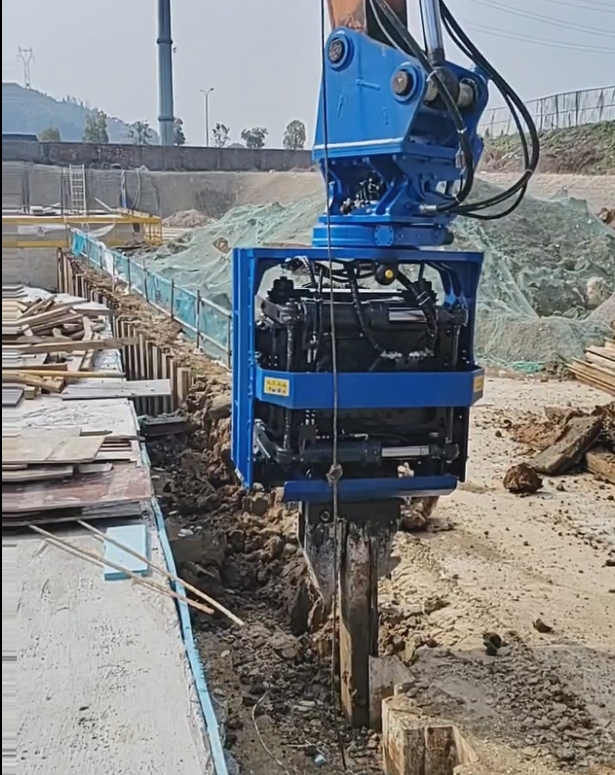
Reading Each Parameter as a Constraint
Frequency is never a standalone number
Vibration frequency tells you how fast the eccentric masses rotate. On its own it says very little. The SV-200 and SV-400 are rated 2,300–3,000 rpm; the FV-800 is rated 2,500 rpm and the FV-900 2,400 rpm. Judged on frequency alone, the smaller SV units appear “faster” than the larger FV units — a conclusion that collapses the moment eccentric moment (4.6 kg·m on the SV-200 against 16.8 kg·m on the FV-900) and centrifugal force (459 kN against 1,064 kN) are taken into account. Frequency, eccentric moment and force must be read as a set, because the force generated depends on the mass of the eccentric element and the speed at which it turns.
This is where a headline such as “3,200 rpm hydraulic pile driver” has to be handled carefully. The models documented here are rated between 2,300 and 3,000 rpm. A buyer evaluating a 3,200 rpm claim should ask for the model-level datasheet that states the rated speed, the eccentric moment at that speed, and the resulting centrifugal force — otherwise the number cannot be placed on the same axis as the figures in a competing quotation.
The hydraulic interface: 32 MPa is the constant, flow is the variable
All four documented models operate at 32 MPa. That uniformity is a meaningful signal for buyers: the pressure rating does not change with machine size, so the attachment family shares a common hydraulic design premise. What does change is flow — 170–230 L/min on the SV-200, 230–280 L/min on the SV-400, 420 L/min on the FV-800 and 460 L/min on the FV-900.
In practice, flow is the constraint that decides whether a machine can be mounted on a carrier already in the fleet. A unit rated at 32 MPa and 460 L/min cannot be served by a hydraulic circuit sized for 200 L/min, no matter how favourable the pressure figure looks. Buyers should therefore request the carrier's flow output at the attachment's working pressure before shortlisting, not after.
Clamp force, geometry and what they constrain
Clamp ratings differ by architecture. The SV-200 is documented at 335 kN side clamp and 385 kN bottom clamp; the SV-400 at 465 kN and 520 kN; the FV-800 and FV-900 both reach a maximum clamp force of 565 kN. Clamp force is the parameter that governs how securely a sheet pile or H beam is held during driving and extraction, so it matters more than a general “heavy duty” description. Geometry matters for the same reason: the SV models carry a 360° rotation and ±30° tilt rating, which is what allows the attachment to be repositioned without repositioning the carrier — useful in constrained working areas.
Material claims need a grade, not an adjective
All four models are documented as built from high-strength steel. That is a category, not a specification. A buyer assembling an evidence file should ask for the steel grade, the weld procedure, and any non-destructive testing applied to load-bearing joints. Where those documents are not available, the material statement should be treated as qualitative and not used as a tie-breaker between suppliers.
Consistency Across a Product Line as a Capability Signal
A single specification sheet can be produced for any machine. A product line that holds its design logic across four models is harder to fake, and it is one of the few manufacturing signals a buyer can read from public data.
Three patterns stand out in the documented VIBRA range. First, the operating pressure is identical at 32 MPa across every model from a 2,280 kg side-grip unit to a 4,350 kg four-eccentric hammer. Second, the SV-200 and SV-400 share the same 2,300–3,000 rpm frequency band and the same 360° rotation with ±30° tilt, which indicates a common architectural family rather than two unrelated designs. Third, the FV-800 and FV-900 share identical external dimensions — 1,642 × 806 × 2,898 mm — and the same 565 kN maximum clamp force, while differing in eccentric moment, force, flow, pile length and excavator class.
Shared dimensions and shared clamp ratings suggest a platform strategy in which the outer envelope is retained and the internal eccentric assembly is scaled. For a fleet buyer, the practical consequence is potential commonality of clamps, wear parts and handling procedures across the two larger models. That inference should be confirmed in writing, not assumed: a supplier should be able to state which part numbers are interchangeable between the FV-800 and FV-900.
The same logic applies at company level. Documented capability includes OEM and ODM production, customisation of colour, brand logo, pile driver specifications and clamp types, a stated monthly capacity of 20 sets per single model, a minimum order quantity of one set, a 30–45 day lead time, 100% testing, and one-year warranty with remote support. The manufacturer also states it partners with XCMG, Sany and Hyundai Construction Equipment and is an authorised supplier of pile drivers to XCMG and Hyundai. Each of these is a claim a buyer can convert into a verification request: an audit date, a test record, or a reference contact.
Where the Electric Configuration Changes the Check
The models documented in this review are excavator-mounted. Their working principle is a hydraulic one: the carrier's hydraulic power drives a motor, the motor turns two eccentric shafts in opposite directions at high speed, the horizontal forces cancel, and the vertical forces combine into the high-frequency vibration that is transmitted through the clamps into the pile. The soil around the pile liquefies, friction drops, and the carrier's own force drives or extracts the pile.
That mechanism explains why an electric hydraulic pile driver is an evidence question rather than a marketing category. If the attachment is driven by an electric power unit instead of the carrier's hydraulics, the specification set a buyer needs expands: the motor rating, the power unit's output, the flow and pressure delivered at the attachment, and confirmation that the 32 MPa working pressure and the required flow band are still met. On the documented range that band runs from 170–230 L/min at the compact end to 460 L/min at the FV-900.
The VIBRA product line does include an Electric Vibratory Hammer alongside the hydraulic models. Model-level electrical specifications for that unit are not part of the documentation reviewed here, so the correct action is not to infer them from the hydraulic models but to request the dedicated datasheet — motor rating, cable and control specification, and the hydraulic interface values if the unit drives a hydraulic attachment.
Certification: What It Covers and What It Does Not
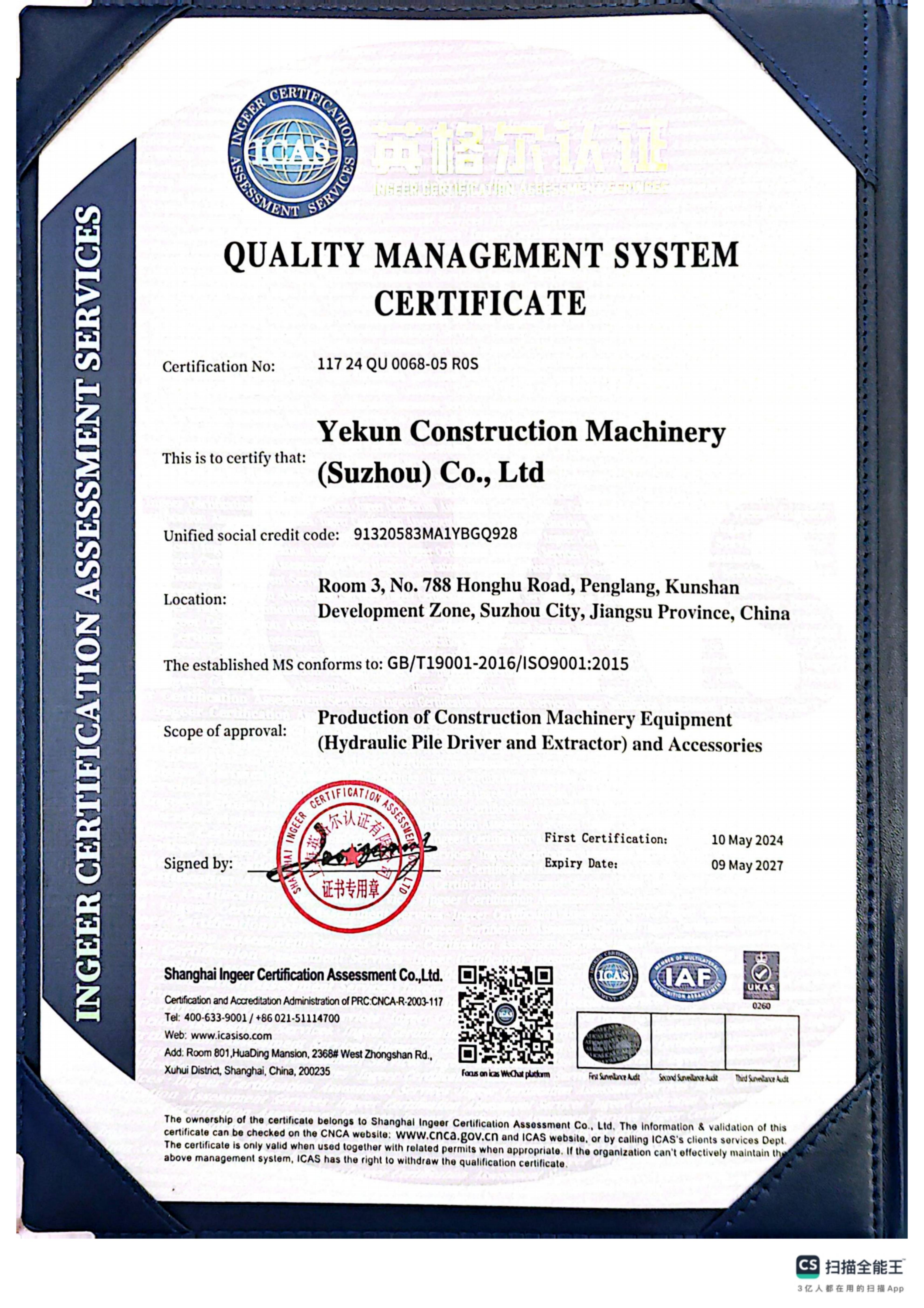
Certification is the most frequently misread item in a supplier pack. The Hydraulic Pile Driver documentation for the FV-800, FV-900, SV-200 and SV-400 records a Quality Management System certification to GB/T 19001-2016 and ISO 9001:2015, issued by ICAS under certificate number 11724QU0068-05R0S. The certificate was issued on 10 May 2024 and is valid until 9 May 2027. Its stated scope is the manufacture of construction machinery — hydraulic pile driving and extracting machines — and spare parts, and it is recorded as applicable to markets including India, Southeast Asia, Vietnam, Thailand, Russia and Sri Lanka.
What this proves is that an accredited body has audited the manufacturer's quality management system against a recognised standard, within a defined scope and validity window. What it does not prove is the driving performance of any individual machine, the steel grade used, or conformity with market-access rules outside the recorded scope. Buyers in the United States, for example, should note that dedicated pile drivers fall under OSHA 1926.1439, which sets out specific requirements including exemptions for load weighing devices on equipment manufactured before November 2011. A quality management certificate does not address that regulation; separate conformity work does.
The verification sequence is straightforward: check the certificate number with the issuing body, confirm the scope language matches the product being purchased, confirm the validity date against the delivery schedule, and confirm that the model on the quotation is listed within that scope.
Matching Documented Specifications to Pile Type and Site
Application evidence is where specification review becomes project-specific. Documented VIBRA compatibility covers cement sheet, steel plate, steel tube, H-steel and wooden piles, and the product line is described across side-grip, four-eccentric, 360-degree rotation and photovoltaic configurations. Documented applications include pile foundation engineering and foundation pit support, in working conditions described as solid soil, clay, sand and other common geological environments, with the attachment mounted on an excavator or crane.
For a hydraulic pile driver used on sheet pile work, the governing parameters are clamp force, rotation and the hydraulic interface. The documented sheet pile case is a confined-space application under bridges, where a single FV-800 unit ran for two years, completing all pile driving tasks without delays, with low noise and narrow space cited as the defining conditions. The mechanism explains the result: counter-rotating eccentric masses cancel horizontal vibration, and the 360-degree repositioning capability reduces the need to move the carrier in a tight work area.
For H beam work, the same logic applies but the clamp geometry becomes the deciding item, since flange gripping differs from sheet pile gripping. A buyer should request the clamp drawing and the clamp force applicable to the specific profile, rather than accepting a maximum figure that may refer to a different attachment.
For solar piling, the documentation records a photovoltaic configuration within the product type description but does not publish solar-specific clamp or attachment specifications. That is a documented gap, not a disqualification. The correct step is to request the photovoltaic attachment drawing and the resulting changes to clamp force and effective pile length before comparing against a competing offer.
What the Numbers Do Not Prove
An evidence check that only lists strengths is not an evidence check. Several boundaries are visible in the documented material itself.
Maximum pile length is published for the FV-800 at 27 m and the FV-900 at 32 m, but not for the SV-200 or SV-400. A buyer sizing a deep-pile programme cannot assume the side-grip units match the four-eccentric units. Carrier dependency is the second boundary: the SV-200 requires a 20–25 t excavator and the FV-900 an 85–100 t machine, so the attachment choice is locked to the fleet or to a rental decision. Third, the technique itself depends on vibratory soil liquefaction. The documented working conditions are solid soil, clay, sand and other common geological environments; where a project presents rock or very dense strata, the buyer must validate the method rather than extrapolate from a force rating.
Compared with traditional impact or diesel hammer driving, the vibratory approach works differently rather than simply better. Manufacturer-reported figures state that a 30 m pile driven by a traditional method could take up to an hour, while a vibratory hammer can drive the same pile in ten minutes or less. That figure is a manufacturer statement about a specific comparison and should be treated as directional, not as a guaranteed cycle time. The trade-off is that vibratory driving depends on a hydraulic carrier, on soil conditions that respond to liquefaction, and on a documented pile-length ceiling — none of which apply in the same way to an impact hammer.
Finally, the documentation set does not include measured noise levels, amplitude data, soil-specific performance tests, or a steel grade. A buyer who needs any of these must request them; their absence should be recorded as an open item rather than filled with an assumption.
Market Context: Why Evidence Discipline Is Tightening
Commercial research places the global pile driving equipment market at an estimated USD 1.9 billion in 2024, with a projected expansion to around USD 2.7 billion by 2030. The figure covers pile driving equipment more broadly than hydraulic attachments, and the methodology behind the segmentation is not disclosed in the available summary, so it should be read as directional market context rather than as a hydraulic-specific market size.
Benchmark data is similarly useful as orientation. A comparable 30-ton excavator-mounted vibratory hammer listing — model S500 — is published at 2,800 rpm vibration frequency and 450 kN rated excitation force. Against that reference point, the documented VIBRA range spans 2,300–3,000 rpm on the side-grip models and 2,400–2,500 rpm on the four-eccentric models, with centrifugal force from 459 kN to 1,064 kN. The useful conclusion is not that one is better, but that the ranges overlap and therefore must be compared on matched definitions: rpm against rpm, centrifugal force against excitation force, and pressure against pressure.
Regulatory pressure reinforces the same discipline. Dedicated pile drivers in the United States fall under OSHA 1926.1439, and buyers exporting equipment into regulated markets increasingly need documentation that distinguishes between a management-system certificate and a product conformity file.
Future Outlook
Two directions are visible from the documented range. The first is electrification: the presence of an electric vibratory hammer in the product line alongside excavator-mounted hydraulic units reflects demand for configurations that do not depend solely on the carrier's hydraulic circuit, particularly on urban and confined sites where engine noise and emissions are constrained.
The second is specification transparency. As more suppliers publish model-level tables, differentiation will shift from headline claims toward the completeness of the evidence pack: whether a datasheet names the model, defines the force metric, states the flow requirement, and links to a certificate whose scope and validity can be checked. Buyers who build their shortlist on that standard will find comparisons shorter, but far more defensible.
Frequently Asked Questions
What should a buyer verify first on a hydraulic pile driver specification sheet?
That every value is attached to a named model. In the documented VIBRA range, the SV-200 and SV-400 publish eccentric moment, centrifugal force, vibration frequency, side and bottom clamp force, operating pressure, operating flow, dimensions, weight and applicable excavator class; the FV-800 and FV-900 add maximum pile length and maximum clamp force. A sheet that blends values from different models, or omits the model identifier, cannot be used for shortlisting.
Does a higher vibration frequency always mean faster pile driving?
No. Frequency describes rotational speed, while driving effect depends on the combination of frequency, eccentric moment and centrifugal force. The SV-200 at 2,300–3,000 rpm produces 459 kN of centrifugal force with a 4.6 kg·m eccentric moment, while the FV-900 at 2,400 rpm produces 1,064 kN with a 16.8 kg·m eccentric moment. A quoted 3,200 rpm figure should be supported by a model-level datasheet stating the eccentric moment and resulting force at that speed.
What does a 435 kN rating refer to on a hydraulic pile driver?
It depends on the force metric, and the label alone does not say. Documented force figures across the VIBRA range include centrifugal force from 459 kN to 1,064 kN, side clamp force from 335 kN to 465 kN, bottom clamp force from 385 kN to 520 kN, and a maximum clamp force of 565 kN on the FV models. A buyer who sees 435 kN should ask whether it refers to centrifugal force, excitation force, clamp force or extraction force, and on which model.
Which certification documents should a hydraulic pile driver supplier provide?
At minimum, a quality management system certificate with a checkable number, scope and expiry date. The FV-800, FV-900, SV-200 and SV-400 documentation records ISO 9001:2015 and GB/T 19001-2016 certification issued by ICAS under certificate number 11724QU0068-05R0S, valid from 10 May 2024 to 9 May 2027, with a scope covering the manufacture of hydraulic pile driving and extracting machines and spare parts, applicable to markets including India, Southeast Asia, Vietnam, Thailand, Russia and Sri Lanka. This is process certification, not product performance certification; buyers in regulated markets such as the United States must separately address OSHA 1926.1439 requirements.
How can a buyer confirm a driver suits sheet pile, H beam or solar piling?
By matching documented compatibility and clamp data to the profile. Documented VIBRA compatibility covers cement sheet, steel plate, steel tube, H-steel and wooden piles, with applications in pile foundation engineering and foundation pit support, and a documented sheet pile case in a confined space under a bridge using an FV-800. For H beam work, request the clamp drawing and the clamp force applicable to the flange profile; for solar piling, request the photovoltaic attachment specification, which is not published in the documentation reviewed here.
What are the main limits of excavator-mounted hydraulic pile drivers?
Carrier dependency, pile-length ceilings and soil sensitivity. Documented excavator requirements run from 20–25 t for the SV-200 to 85–100 t for the FV-900; maximum pile length is published at 27 m for the FV-800 and 32 m for the FV-900, with no figure stated for the SV models. The method relies on vibratory liquefaction of the surrounding soil, and documented working conditions are limited to solid soil, clay, sand and other common geological environments. Noise, amplitude and steel-grade data are not included in the documentation reviewed and must be requested separately.
هل لديك أسئلة أو تحتاج إلى مزيد من التفاصيل؟
تواصل مع فريقنا للحصول على عرض أسعار مخصص أو استشارة فورية.
طلب عرض أسعار
املأ النموذج أدناه وسيتواصل معك فريقنا بعرض مقترح مخصص.
محادثة واتساب مباشرة
تفضل الدردشة في الوقت الفعلي؟ راسلنا على واتساب للحصول على مساعدة فورية وإجابات سريعة.
- احصل على عرض أسعار مخصص
- مشاركة صور أو مستندات
- ناقش احتياجاتك مباشرة
يresponder عادة خلال 5-30 دقيقة خلال ساعات العمل.