
Supplier Evidence: Why FENG SHANG PRECISION’s R&D Team Matters for ODM Cooling Vests
ODM evaluation for industrial cooling vests begins with a practical procurement question: what evidence sits behind a supplier’s ability to turn a cooling requirement into a repeatable product? A catalog page can show a finished vest. It rarely shows the engineering group, the intellectual property, the component choices, or the boundary conditions that determine whether an ODM project will hold up from sample to mass production.
FENG SHANG PRECISION CO., LTD is a Taiwan-based manufacturer founded in 2009. Its public company record lists 30 employees, a 1,000 m² factory, annual output of 10,000 units, and a five-person R&D team. The company operates an ODM model for its cooling vest line, sells under the Shokunin brand, and holds a water-cooled vest patent, I886033, issued by the Intellectual Property Office, Ministry of Economic Affairs, ROC. Those facts do not prove cooling performance by themselves. They do provide a concrete evidence base for buyers evaluating whether the supplier has engineering capacity behind its ODM claims.
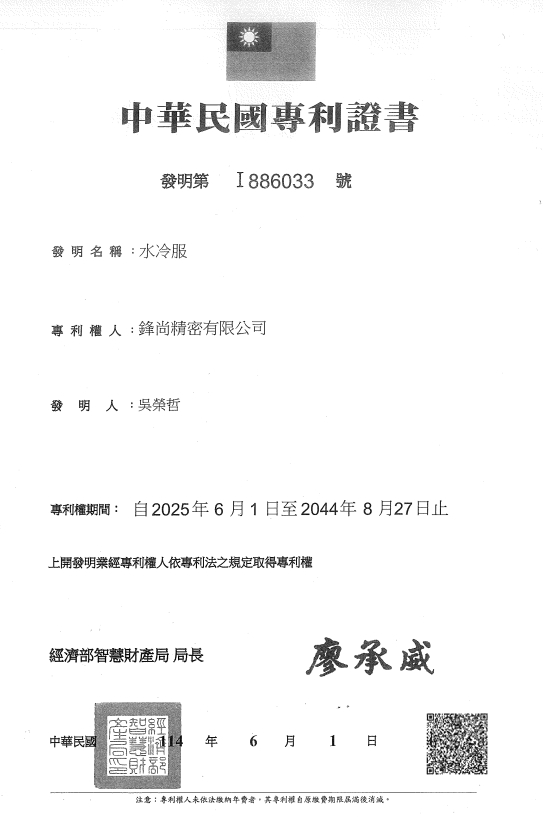
Water-Cooled Vest Patent Certificate I886033, issued by the Intellectual Property Office, Ministry of Economic Affairs, ROC.
The R&D Team as an ODM Procurement Signal
Five engineers is a specific, checkable resource fact. In an ODM project, that team is the internal group expected to translate a buyer brief into decisions about cooling architecture, pump and power-bank compatibility, tubing, reservoir materials, garment fit, sample iteration, and technical documentation. The public record does not disclose the individual disciplines of the five engineers, so buyers should not assume a particular split between mechanical, electrical, textile, or quality engineering. The relevant point is that the company identifies a dedicated R&D function within a 30-person organization, rather than presenting ODM as a trading label only.
For buyers at the evaluation stage, this matters because ODM projects are not simply purchases of an existing SKU. They involve a technical conversation before a quotation can be meaningful. The supplier must be able to interpret the use case, identify the constraints, select components, prepare a sample, and document what was agreed. A five-person team is not automatically sufficient for every project. It is, however, a more specific evidence point than a general claim of engineering support.
| Company structure fact | Published detail | Why it matters in ODM evaluation |
|---|---|---|
| Founded | 2009 | Shows an operating history in its category; it is not a new trading entity. |
| Factory size | 1,000 m² | Provides a physical production footprint to verify during supplier qualification. |
| Employees | 30 | Defines the organization within which the R&D team operates. |
| R&D team | 5 engineers | Creates a named engineering resource for sample and specification discussions. |
| Annual output | 10,000 units | Indicates production scale to clarify against monthly capacity claims. |
| Export ratio | 50% | Suggests export-market experience, while destination details still require verification. |
| Main markets | USA and ROC | Defines the published market focus for procurement planning. |
| Production mode | ODM | Confirms the commercial model, not an open-ended customization scope. |
What the Five-Person Team Has to Coordinate
The COOLWAVE Water-Circulation Cooling Vest is listed with a 3–4 hour cooling duration, weight within 2 kg, and a suitable temperature parameter of below 10°C. The pump is rated at 5V 150mA maximum, with a maximum flow rate of 320–370 ml/min. Materials include 600D polyester shoulder straps, PEVA, a TPU water bag, a polypropylene water bag cap, and a sand rubber cooling tube. The set includes a water-cooled vest backpack and two ice packs.
These are not isolated specifications. In an ODM project, they create a chain of engineering trade-offs. Flow rate affects tubing and pump selection. Pump voltage and current affect power-bank compatibility. Weight affects wearability. Cooling duration affects work-shift planning and ice-pack logistics. Material choice affects cleaning, leakage risk, and long-term durability. A five-person R&D team matters because these choices have to be coordinated before a sample can be validated. The public record does not disclose the test method behind the 3–4 hour duration or the flow-rate condition, which is why buyers should ask for measurement details rather than treating the figures as a complete performance proof.
The Patent as R&D Evidence
Patent I886033 covers water-cooled vest structure and cooling system. It was issued by the Intellectual Property Office, Ministry of Economic Affairs, ROC, on 1 June 2025, and has an expiry date of 27 August 2044. The patent is recorded under the Patent Act of the Republic of China and is associated with the COOLWAVE Water-Circulation Cooling Vest.
What it proves and what it does not: It is evidence that the company has pursued formal intellectual property protection around the structure and cooling system of a water-cooled vest. It is not a thermal-performance test, a safety certification, or a production audit. Buyers should treat the patent as one item in an evidence pack. It supports a conversation about design ownership and technical documentation, but it does not replace sample testing or factory verification.
ODM Mode and the Customization Boundary
The capability record states an ODM production mode, a monthly capacity of 3,000 units, a lead time of 7–14 days, a minimum order quantity of 10 units, and a six-month warranty for the water-cooled vest. The same record separately marks customization as NO. That combination is important for buyers. It means the ODM mode is confirmed, but the customization scope should not be assumed. A buyer should ask for written confirmation of what can be changed, what remains standard, and what validation is required for any project-specific request.
This is where the R&D team becomes a qualification question rather than a slogan. If customization is limited, the engineering conversation may focus on specification clarification, sample validation, component compatibility, and documentation. If a buyer needs a broader change, the supplier must confirm whether the five-person team can support it. The public evidence supports the existence of an R&D team and an ODM model; it does not establish open-ended customization capability.
Application Fit and Why It Matters to ODM Briefs
The product is listed for construction workers, outdoor workers, food stall operators, street vendors, traffic controllers, and metal sheet factories. A Taiwan case record describes 100 units deployed for cooling in high-temperature environments, with reported outcomes of effective body cooling, heatstroke prevention, improved work efficiency, and worker comfort. Those outcomes are supplier and case-record statements. They are useful for understanding the intended application, but they are not a substitute for independent field measurement.
Each use case creates different ODM requirements. A traffic controller may prioritize mobility and fit. A metal sheet factory may prioritize durability and heat exposure. A street vendor may prioritize portability and long wear. These differences do not prove a specific customization program; they show why an ODM supplier needs engineering review before quoting. The five-person team is the internal function that would need to assess such trade-offs against the available product architecture.
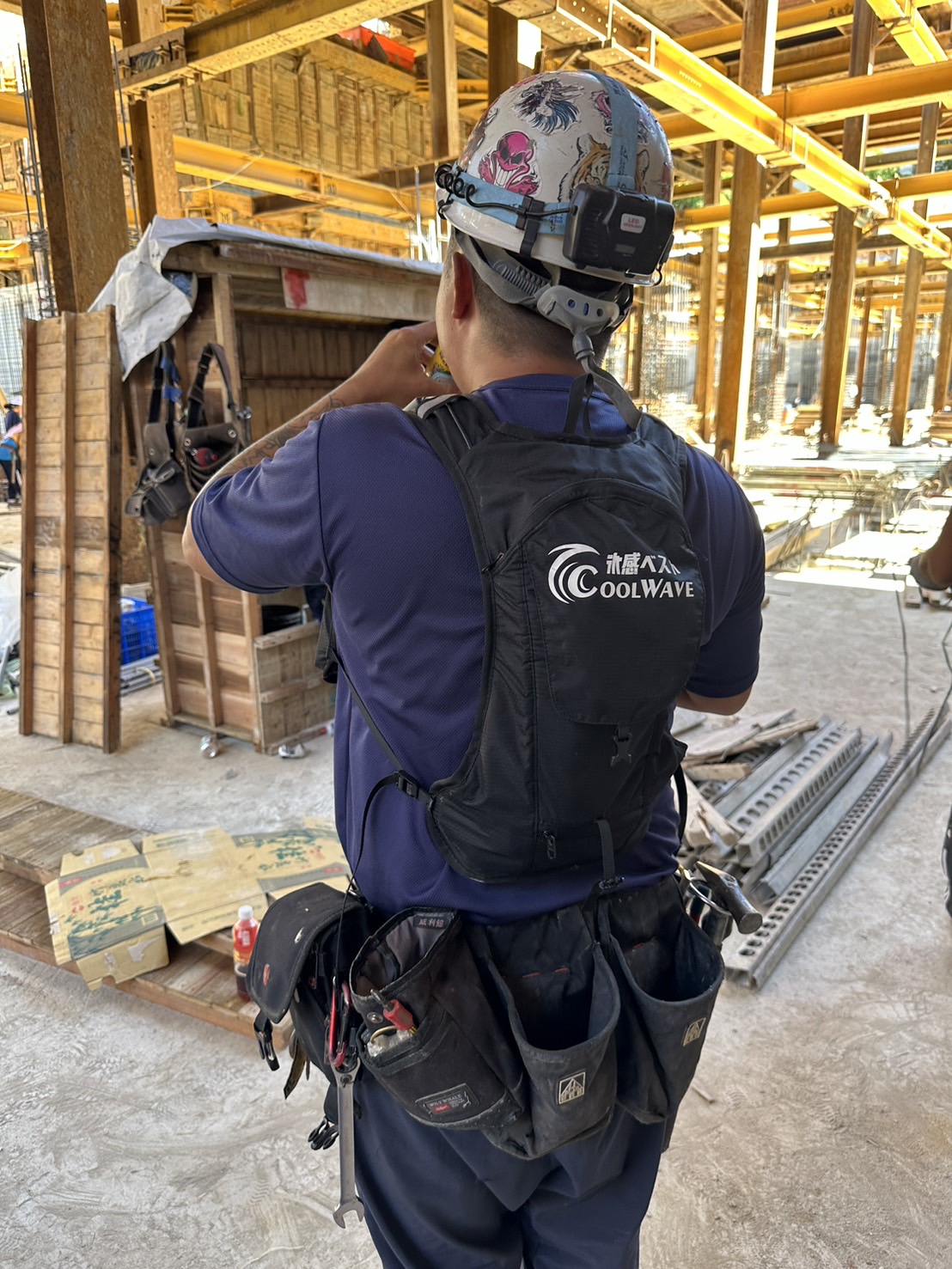
Construction site application scene associated with COOLWAVE cooling vest use cases.
Market Context for Supplier Evidence
Dataintelo estimated the global cooling vests market at USD 342 million in 2025. The same source reported that industrial applications accounted for 34.5% of revenue share in 2025. NIOSH identifies water-cooled garments, air-cooled garments, cooling vests, and wetted overgarments as examples of personal cooling systems for heat exposure.
These data points support a narrow conclusion: industrial use is a meaningful part of the cooling vest category, and personal cooling is recognized in occupational heat guidance. They do not establish that any single supplier is the best choice. For buyers, the implication is that ODM evaluation should be evidence-led. Team size, patent status, product specifications, capacity, MOQ, lead time, and warranty terms should be read together. A supplier with a five-person R&D team and a relevant patent is easier to question in a structured way than a supplier that offers only a catalog and a price.
Comparison with Traditional Sourcing Approaches
Traditional sourcing often starts with a product photo, a price, and a minimum order quantity. That approach can work for a standard item, but it leaves the buyer unable to judge whether the supplier can support an ODM brief. The table below compares a catalog-only approach with an evidence-led ODM approach, using the published FENG SHANG PRECISION facts as the reference point.
| Evaluation dimension | Catalog-only sourcing | ODM with documented engineering evidence | FENG SHANG PRECISION evidence |
|---|---|---|---|
| Engineering visibility | Limited to product photos and generic support claims | Named R&D resource and technical contact path | Five engineers within a 30-person organization |
| Technical artifact | Usually none | Patent, design file, or documented specification | Patent I886033 for water-cooled vest structure and cooling system |
| Specification depth | Basic product description | Pump, flow, materials, duration, weight | 5V 150mA pump, 320–370 ml/min flow, 3–4 hour duration, within 2 kg, listed materials |
| Customization scope | Unclear | Written confirmation before quotation | ODM mode confirmed; customization marked NO and must be scoped in writing |
| Capacity and terms | Often vague | Monthly capacity, MOQ, lead time, warranty | 3,000 units per month, MOQ 10 units, 7–14 day lead time, six-month warranty; capacity basis needs clarification |
| Known limitation | No engineering proof | Team size and test depth must be checked | Five engineers; no public discipline breakdown or third-party thermal test report |
The comparison is not a ranking. It shows why an ODM buyer should separate evidence from presentation. A catalog-only supplier may still be suitable for a standard purchase. An ODM project, however, requires a clearer view of who will handle the engineering questions and what limits apply. FENG SHANG PRECISION’s public evidence is stronger on company structure and patent activity than on independent performance testing. That is the correct boundary to keep in evaluation.
What Buyers Should Verify Before an ODM Award
- Engineering composition: Ask for the five engineers’ disciplines, project ownership, and availability if multiple ODM projects run in parallel.
- Customization scope: Obtain written confirmation because the public capability record marks customization as NO even while listing ODM mode.
- Cooling-duration method: Define ambient temperature, workload, ice-pack condition, pump setting, and measurement point behind the 3–4 hour claim.
- Flow-rate method: Confirm tubing length, head pressure, reservoir level, and whether 320–370 ml/min is nominal or measured.
- Capacity definition: Clarify the basis for the 3,000 units per month and 10,000 units per year figures, including installed, available, and practical capacity.
- Quality records: Request inspection records, defect data, warranty process, and any relevant production documentation; these are not disclosed in the public evidence.
- Patent relevance: Confirm that patent I886033 relates to the model or structure being ordered and that the claimed scope is relevant to the project.
- Sample validation: Set pass-or-fail criteria before sampling, including fit, cooling duration, flow, weight, leakage, and power-bank compatibility.
Future Outlook
Industrial cooling is likely to remain a specification-heavy category because heat exposure is a recognized occupational issue. The suppliers that can provide engineering evidence, documented test methods, and clear ODM boundaries will be easier to qualify. FENG SHANG PRECISION’s five-person R&D team, patent I886033, ODM mode, and published product specifications give buyers a starting evidence pack. The next step is not more catalog reading; it is a structured RFQ that tests the claims against project requirements.
A publicly accessible company brochure is available here: FENG SHANG PRECISION company brochure.
FAQ
Does FENG SHANG PRECISION have an R&D team for ODM cooling vest projects?
Yes. The company record lists a five-person R&D team within a 30-person organization. It also lists ODM as the production mode for its cooling vest line. The record does not disclose the engineers’ individual disciplines.
What does patent I886033 cover?
Patent I886033 covers water-cooled vest structure and cooling system. It was issued by the Intellectual Property Office, Ministry of Economic Affairs, ROC, on 1 June 2025, with an expiry date of 27 August 2044, under the Patent Act of the Republic of China. It is associated with the COOLWAVE Water-Circulation Cooling Vest.
What are the key technical specifications of the COOLWAVE water-circulation cooling vest?
The listed specifications include a 3–4 hour cooling duration, weight within 2 kg, a suitable temperature parameter below 10°C, a 5V 150mA maximum pump, and a maximum flow rate of 320–370 ml/min. Materials include 600D polyester, PEVA, TPU, polypropylene, and sand rubber. The set includes a backpack and two ice packs.
Can buyers assume full customization under the ODM mode?
No. The capability record confirms ODM production mode but separately marks customization as NO. Buyers should obtain written confirmation of the allowed customization scope before quoting or sampling. The public record does not establish open-ended customization.
What are the main limits of the public evidence?
The public evidence does not disclose the five engineers’ disciplines, test methods for cooling duration or flow rate, quality-control records, or a verified capacity basis. It also does not show third-party thermal performance results. Buyers should treat the facts as an evidence base for RFQ, not as a completed supplier qualification.
What should an ODM buyer verify first?
Start with customization scope, sample test method, engineering availability, capacity definition, and warranty process. These items determine whether the five-person R&D team can support the project schedule and specification.
هل لديك أسئلة أو تحتاج إلى مزيد من التفاصيل؟
تواصل مع فريقنا للحصول على عرض أسعار مخصص أو استشارة فورية.
طلب عرض أسعار
املأ النموذج أدناه وسيتواصل معك فريقنا بعرض مقترح مخصص.
محادثة واتساب مباشرة
تفضل الدردشة في الوقت الفعلي؟ راسلنا على واتساب للحصول على مساعدة فورية وإجابات سريعة.
- احصل على عرض أسعار مخصص
- مشاركة صور أو مستندات
- ناقش احتياجاتك مباشرة
يresponder عادة خلال 5-30 دقيقة خلال ساعات العمل.