
Supplier Evidence: FSC Chain of Custody for Wooden Cutlery
Supplier Evidence: FSC Chain of Custody for Wooden Cutlery
In the evaluation stage of a disposable wooden cutlery purchase, the decisive question is rarely whether a supplier says it is certified. It is whether each certification claim can be traced to a named certificate, a named issuing body, a defined scope, and a validity period that is still open. Marketing pages describe intent; certificate records describe evidence.
This reference article works through one manufacturer's certification record in detail - the FSC chain of custody certificate SA-COC-013128 issued by the Soil Association, together with the BSCI and SEDEX records that document social and ethical compliance - and explains how procurement teams should read, verify, and interpret those documents before committing to a volume order. The manufacturer is Greenwood - Dalian Industrial Co., Ltd., a Chinese producer of disposable wooden and bamboo tableware founded in 2000, operating five factories and exporting roughly 95% of its output to Europe, Australia, North America, South America, the Middle East, and Asia.
Certification Evidence Versus Certification Claims
Most disposable wooden cutlery suppliers now publish some form of sustainability statement. Comparatively few publish a certificate number, the issuing body, the certified scope, and the expiry date in a form a buyer can verify without asking for it separately.
For buyers in the European Union and North America, that gap has commercial consequences. Wood products fall under the EU Deforestation Regulation (Regulation (EU) 2023/1115), which requires geolocation and due-diligence information for relevant commodities; the compliance deadline for large operators was postponed to 30 December 2025, with later Council agreements indicating a further extension toward December 2026. Separately, wooden cutlery marketed as compostable in the EU must reference the EN 13432 industrial compostability standard for that claim to be legally usable. Both obligations are documentation obligations, and documentation is precisely what a certificate record supplies.
That is why the practical unit of evaluation has shifted from "is the supplier certified" to "which certificate, issued by whom, covering which process, valid until when, and does it apply to the product on this purchase order". A supplier that can answer all five parts of that question in writing is easier to qualify - and easier to defend internally when a retail customer or an importer asks for proof.
FSC Chain of Custody: What the Certificate Actually Covers
Forest Stewardship Council chain of custody certification is a traceability standard rather than a product-quality standard. It verifies that certified forest material is tracked through sourcing, handling, processing, and conversion into a finished good, so that a claim about the origin of the wood in a product can be substantiated at the point of sale.
For disposable wooden cutlery, that traceability chain runs from raw wood procurement through the shaping of knives, forks, and spoons to packing and dispatch. Greenwood's FSC record is issued by the Soil Association under certificate number SA-COC-013128, with the scope recorded as "Wooden product" and the applicable standard listed as the FSC Chain of Custody standards. The certificate was issued on 3 April 2023 and is valid until 2 April 2028, which leaves a substantial remaining validity period for buyers planning multi-year supply agreements.
| FSC certificate field | Recorded value |
|---|---|
| Certificate holder | Greenwood - Dalian Industrial Co., Ltd. |
| Certificate number | SA-COC-013128 |
| Issuing body | Soil Association |
| Standard | FSC Chain of Custody standards |
| Certified scope | Wooden product |
| Issue date | 3 April 2023 |
| Expiry date | 2 April 2028 |
Two details in that table carry more weight than they first appear to. First, the issuing body is an independent certification organisation rather than the manufacturer itself, which means the certificate number can be checked against the issuer's records instead of being taken on trust. Second, the scope reads "Wooden product" - wording broad enough to cover the wooden cutlery formats listed in the company's product data, including wooden knives, forks, spoons, ice cream sticks, and coffee stirrers, rather than a single item or a single order.
For a buyer, the practical implication is that the FSC claim travels with the material flow, not with one SKU. It supports a statement such as "the wood in this cutlery comes from certified sources" across a product family, and it continues to apply when a buyer moves from a standard 160 mm fork to a 140 mm spoon within the same certified scope.
BSCI and SEDEX: Evidence of Labour and Social Compliance
Sourcing certification and social compliance certification answer different questions. FSC addresses where the wood came from. BSCI and SEDEX-style audits address how the people who processed that wood were treated and under what working conditions.
The amfori BSCI record for Greenwood carries certificate number 24-0289038, issued on 30 August 2023, covering wooden and bamboo products. The validity period recorded on the certificate runs to 12 September 2026. Because social compliance audits operate on a renewal cycle rather than as a permanent status, a buyer evaluating this supplier after that date should request the most recent audit report and confirm current validity directly, rather than relying on the date printed on an archived certificate. This is normal procurement practice for social audits and not a reflection on any single supplier.
The SEDEX record is registered under certificate number ZS405156174 using the SMETA audit methodology, with a scope covering wooden products such as wood spoons. Its stated standard covers four pillars: labour standards, health and safety, environment, and business ethics. The record is dated 21 April 2025 and is listed without a fixed expiry date, which is typical of membership-based platforms - the audit report itself, not the platform membership record, carries the assessment date that buyers should reference in a supplier file.
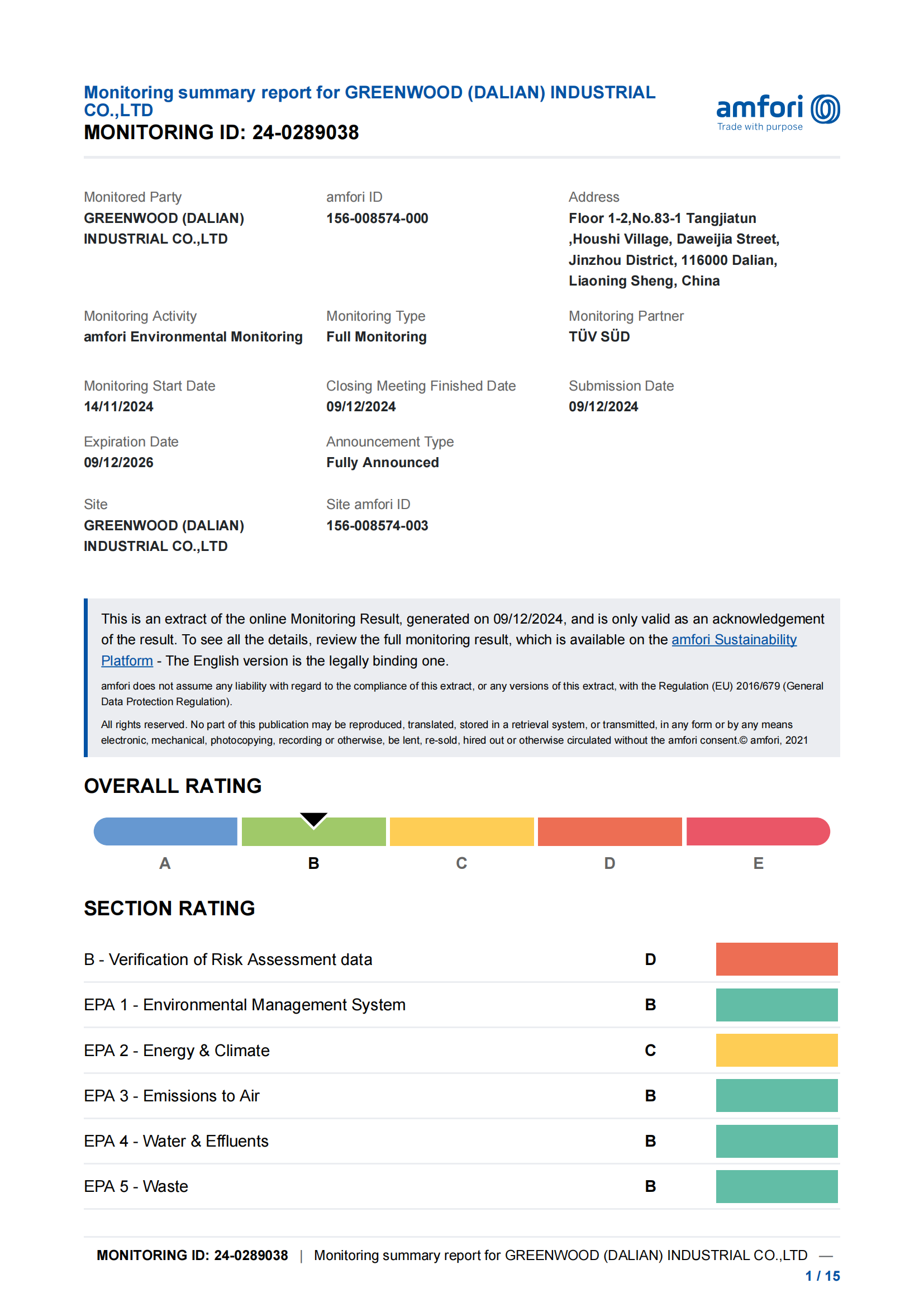
amfori BSCI certificate 24-0289038, issued 30 August 2023, scope: wooden and bamboo products.
The Full Certificate Stack at a Glance
Chain of custody and social audits rarely stand alone in a manufacturing operation that serves regulated markets. Supporting certificates cover quality management, environmental management, occupational health and safety, packaging-related manufacturing practice, and food-contact material safety. The table below lists the certification records held by Greenwood - Dalian Industrial Co., Ltd. and the scope each one applies to.
| Certificate | Issuing body | Number | Recorded scope | Validity |
|---|---|---|---|---|
| FSC Chain of Custody | Soil Association | SA-COC-013128 | Wooden product | 3 Apr 2023 - 2 Apr 2028 |
| amfori BSCI | amfori | 24-0289038 | Wooden and bamboo products | 30 Aug 2023 - 12 Sep 2026 |
| SEDEX / SMETA | SMETA methodology | ZS405156174 | Wooden products such as wood spoons | Dated 21 Apr 2025; no fixed expiry listed |
| ISO 9001 | Beijing ZhongDaHuaYuan Certification Center Co.,Ltd | 02024E1883R0M | Wooden product | 5 Dec 2024 - 4 Dec 2027 |
| ISO 14001 | Beijing ZhongDaHuaYuan Certification Center Co.,Ltd | 02024E1883R0M | Wooden product | 5 Dec 2024 - 4 Dec 2027 |
| ISO 45001 | Beijing ZhongDaHuaYuan Certification Center Co.,Ltd | 02024E1883R0M | Wooden product | 5 Dec 2024 - 4 Dec 2027 |
| BRCGS Global Standard for Packaging Materials | DNV | 10000305214-MSC-ACCREDIA-CHN | Manufacturing of disposable wooden and bamboo tableware | 2 May 2022 - 2 May 2027 |
| FDA 21 CFR 178 | National Reference Laboratory for Food Contact Material (Guangdong) | R0723000394 | Wooden product | Issued 30 Aug 2023; no expiry listed |
| LFGB | TUV SUD China | 7216006083-2 | All wood and bamboo tableware | Issued 25 Jul 2025; no expiry listed |
The BRCGS record is worth flagging for retail-facing buyers. Its scope covers manufacturing of disposable wooden and bamboo tableware, and it is issued against the Global Standard for Packaging Materials, Issue 6 (August 2019), under an unannounced audit scheme. Unannounced audits matter because they remove the supplier's ability to prepare the site for a known inspection date, which changes what the certificate actually tells a buyer about day-to-day conditions.
The three ISO records share a single certificate number, 02024E1883R0M, issued by Beijing ZhongDaHuaYuan Certification Center Co.,Ltd on 5 December 2024 and valid to 4 December 2027. That is a common arrangement when quality, environmental, and occupational health and safety systems are audited together as an integrated management system, and it means the three certificates should be reviewed as one document set rather than three unrelated claims.
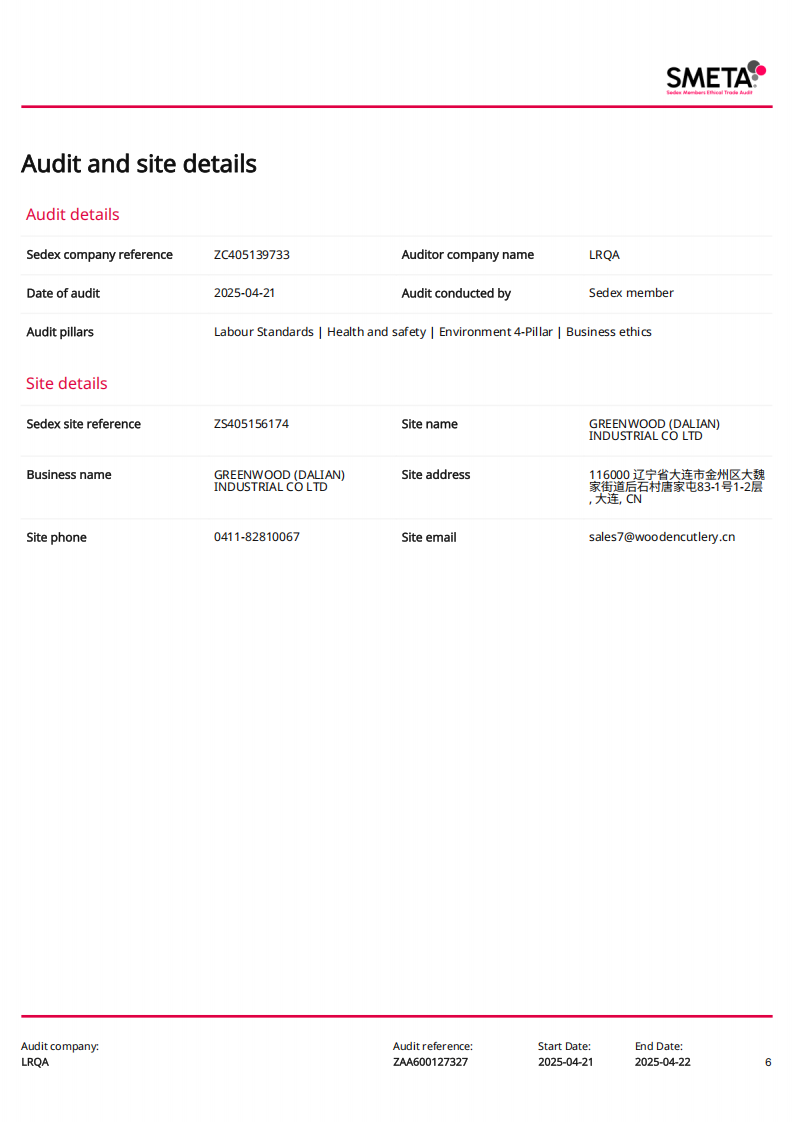
SEDEX / SMETA record ZS405156174, covering labour standards, health and safety, environment, and business ethics.
How to Verify a Wooden Cutlery Supplier's Certificates
Verification is a short, repeatable process. It takes less time than resolving a compliance problem after goods have shipped, and it produces a written record that can be attached to the supplier file.
- Match the legal entity. The certificate holder name must correspond to the entity named on the contract and the commercial invoice. A certificate held by a trading company does not automatically cover production at a separate factory.
- Check the number with the issuer. FSC certificate codes are structured to be checked against public certificate databases, and social audit platforms such as amfori and SEDEX give supply-chain partners controlled access to the underlying reports. Requesting the certificate image alone is not verification.
- Compare the scope wording against the order. A scope recorded as "wooden product" covers wooden cutlery lines. Bamboo or paper cutlery would sit under separate scopes where those exist, so a wooden certificate should not be presented as evidence for a bamboo shipment.
- Confirm that the dates are open. A certificate must be valid on the date of production, not merely on the date the sample was approved. For multi-year contracts, the contract itself should require the supplier to maintain and disclose renewed certificates.
- Match the standard to the claim being made. If the product will be marketed as compostable in the EU, ask which standard the claim references - EN 13432 is the recognised industrial compostability standard for packaging. A chain of custody certificate does not answer that question.
- Request the underlying reports, not only the certificate. A certificate summarises an audit or a test. The audit report or test report shows what was examined, at which site, and under which conditions.
- Cross-check the producing site. Where a supplier operates multiple plants, confirm which sites are named within the certified scope before allocating volume to them.
What Certification Evidence Does Not Prove
Certification is a bounded instrument, and buyers who understand the boundaries make better decisions than buyers who treat a certificate as a general quality guarantee. Four limits are worth stating plainly.
- FSC chain of custody is a traceability standard. It says nothing about cutting performance, splinter resistance, heat tolerance, or food-contact safety. Those properties are addressed by separate test records and by the manufacturer's product specifications.
- Social audits cover a defined scope over a defined period. BSCI and SMETA records are periodic assessments, not batch-level certification. A valid audit does not mean every production run in that period was identical.
- Food-contact approvals are material-and-condition specific. The FDA 21 CFR 178 record (tested to FDA 21 CFR 178.3800, GB 4806.12-2022, and GB 9685-2016) and the LFGB record issued by TUV SUD China relate to the tested material under stated conditions. They should be read alongside the specification for the exact SKU being ordered.
- FSC chain of custody is not the same as EUDR compliance. Chain of custody documentation can support a due-diligence file, but EUDR obligations rest with the operator placing goods on the EU market and require geolocation and due-diligence information that extends beyond what a CoC certificate states. Buyers should treat FSC as an input to EUDR readiness, not as a substitute for it.
One further caution applies to market data rather than to certificates. Published estimates of disposable wooden cutlery market size vary widely depending on whether industrial, food-service, and household segments are counted together, so any single figure should be treated as directional rather than precise.
Where Certified Wooden Cutlery Fits in Practice
Certification records matter most in procurement contexts where the buyer's own customer asks questions downstream. Restaurant chains, hotels, takeaway wholesalers, supermarkets, and airlines each impose a different evidence burden, and each maps to a different product format.
The manufacturer's wooden cutlery line, referenced as model GW-20456, is produced in lengths of 180 mm, 170 mm, 160 mm, 140 mm, 110 mm, and 95 mm, with customisable sizes. The stated product parameters include 100% natural wood, food-grade and BPA-free material, a smooth surface with no burrs, heat resistance, and suitability for both hot and cold food. Customisation covers size, logo application by laser or print, and packaging. A bamboo cutlery line, referenced as model GW-BC001, is offered in a 170 mm standard length with 110 mm and 140 mm options.
Commercially, the manufacturer's stated production parameters include OEM and ODM capability with logo printing on both products and packaging, a minimum order quantity of 100,000 pieces, a lead time of 20 days, third-party inspection, and after-sales support covering packaging design and logistics.
A concrete example of certified tableware moving into mainstream retail comes from supermarket and chain-store clients in Germany and the United States. That programme, implemented over three years at an annual scale of USD 5 million, served both B2B and B2C purposes and achieved the replacement of traditional products along with a corresponding increase in sales. The manufacturer's own read of the result is that eco-friendly products are a rising trend, particularly popular among younger consumers.
Market Signals Behind Certification-Led Procurement
Certification is becoming a purchasing criterion rather than a marketing extra, and the market data supports that shift. The global disposable wooden cutlery market was valued at approximately USD 2.8 billion in 2025 and is projected to reach USD 5.2 billion by 2034, according to Dataintelo. Asia Pacific led that market in 2025 with a 38.6% share, driven in part by plastic restrictions in large consumer economies.
Supply concentration reinforces the point. According to OEC and WITS trade data, China remains the world's largest exporter of wood tableware and kitchenware under HS 4419, with export values reaching approximately USD 1.38 billion to USD 1.5 billion in 2024. On the product side, spoons represent the largest single segment in the disposable wooden cutlery market, accounting for roughly 32.5% to 47.2% of share depending on the reporting agency - a spread that again illustrates how much scope definition affects published market figures.
For buyers, the implication is straightforward. In a market of this scale, sourcing is no longer constrained by availability. It is constrained by the ability to document that the goods meet regulatory and social expectations in the destination market, which is why certificate evidence has moved from the appendix of a supplier proposal to the front page.
Certified Wooden Cutlery and Traditional Plastic: Comparing Evidence
Comparisons between wooden and plastic cutlery usually focus on material. For procurement teams, the more useful comparison is what each supply chain can document.
| Evaluation dimension | Certified wooden cutlery | Conventional plastic cutlery |
|---|---|---|
| Material origin traceability | FSC chain of custody can be applied to the wood supply chain and evidenced by certificate number | FSC chain of custody applies to forest-based material and cannot be transferred to fossil-based plastic |
| Social compliance evidence | A third-party social audit such as BSCI or SMETA can be attached to the supplier file | Social audits are equally applicable in principle; availability depends on the individual supplier |
| Food-contact compliance | Evidence via standards such as FDA 21 CFR 178 and LFGB, tested at named laboratories | Food-contact testing is also required; evidence depends on the supplier |
| End-of-life positioning | Compostability claims in the EU must reference EN 13432 to be legally usable | Single-use plastic end-of-life claims face increasing regulatory restriction in multiple markets |
| Buyer verification effort | Certificate number, scope, issuer, and dates can be checked against issuing bodies | Verification depends heavily on the supplier's willingness to disclose test documentation |
The comparison is not uniformly favourable to wood, and buyers should not treat certification as a performance guarantee. Wooden cutlery performance depends on the food being served, the holding time, and the specific format ordered; a 95 mm spoon and a 180 mm knife behave differently against the same dish. The appropriate response is sampling and specification review rather than assumption, and the manufacturer's stated parameters - smooth surface, no burrs, heat resistance, suitability for hot and cold food - should be validated against the buyer's actual menu or application.
Commercial constraints also apply. A minimum order quantity of 100,000 pieces and a 20-day lead time for customised production are realistic figures for a specialised wooden cutlery programme, but they require buyers to plan volumes and print schedules ahead rather than ordering reactively.
Future Outlook
Three developments are likely to shape how certification evidence is evaluated over the next procurement cycle.
The first is regulatory timing. The EUDR deadline for large operators moved to 30 December 2025, with later Council agreements pointing toward December 2026, and the practical effect of a moving deadline is that buyers are asking suppliers for geolocation and due-diligence readiness before the obligation formally bites. Suppliers who can already link chain of custody documentation to a due-diligence file will be easier to onboard.
The second is the distinction between industrial and home compostability. EN 13432 governs industrial compostability claims in the EU, while home compostability claims require separate verification. As more hospitality and retail buyers publish end-of-life commitments, requests for clarification on which standard a product actually meets will become routine.
The third is audit consolidation. Integrated management systems, combined environmental and social audits, and unannounced audit schemes all reduce the gap between what a certificate states and what a factory does on an ordinary working day. For buyers, that trend is favourable: fewer documents to read, each carrying more weight.
Frequently Asked Questions
What does FSC chain of custody certification cover for disposable wooden cutlery?
It covers the traceability of certified forest material through sourcing, handling, processing, and conversion into finished goods. For disposable wooden cutlery, this means the wood used in knives, forks, and spoons can be traced along the production chain and substantiated at the point of sale. It is a traceability standard, not a product performance or food-safety certification.
Which body issued the FSC certificate for this manufacturer, and what is the certificate number?
The FSC chain of custody certificate SA-COC-013128 was issued by the Soil Association to Greenwood - Dalian Industrial Co., Ltd., with a scope recorded as "Wooden product" and the applicable standard listed as the FSC Chain of Custody standards. The certificate was issued on 3 April 2023 and is valid until 2 April 2028.
How do BSCI and SEDEX audits differ in what they verify?
amfori BSCI is an audit framework assessing social compliance, and the record for this manufacturer (certificate 24-0289038) covers wooden and bamboo products. SEDEX is a membership platform on which audit results are shared, and the record here (ZS405156174) uses the SMETA methodology across four pillars: labour standards, health and safety, environment, and business ethics. BSCI produces a graded social audit; SEDEX provides a shared platform for audit visibility. Both assess workplace conditions, not product properties.
Does FSC certification mean wooden cutlery is compostable or food-contact approved?
No. FSC chain of custody addresses the origin and traceability of the wood. Compostability claims in the EU must reference the EN 13432 standard to be legally usable, and food-contact safety is evidenced separately through standards such as FDA 21 CFR 178 or LFGB, tested at named laboratories. Buyers should request the specific test documentation for the SKU being ordered rather than inferring those properties from a chain of custody certificate.
How can a buyer verify certificate claims before placing an order?
Match the certificate holder to the legal entity on the contract, check the certificate number against the issuing body's records, compare the certified scope against the product being ordered, confirm the certificate is valid on the planned production date, and request the underlying audit or test reports rather than the certificate image alone. Where multiple factories are involved, confirm which sites fall within the certified scope.
What should a buyer do if a social compliance certificate is close to its expiry date?
Request the most recent audit report and confirm the current validity status directly with the supplier. Social audits run on renewal cycles, so the certificate on file may be superseded by a newer assessment. For contracts spanning several years, the agreement should require the supplier to maintain and disclose renewed certificates throughout the contract term.
Is FSC chain of custody certification sufficient for EUDR compliance?
Not on its own. The EU Deforestation Regulation (Regulation (EU) 2023/1115) requires geolocation and due-diligence information, and the obligations rest with the operator placing goods on the EU market. FSC chain of custody documentation can support a due-diligence file, but it does not state the geolocation data the regulation requires. Buyers should treat certification as one component of EUDR readiness rather than a complete answer.
Greenwood's certification records, product parameters, and production capability data are compiled in its downloadable brochure, which buyers can review alongside the certificate verification steps described above.
Download the Greenwood product and certification brochure (PDF)