
Supplier Evidence: ISO 9001, 14001 & 45001 in Roof Tile Production
Supplier Evidence: ISO 9001, 14001 & 45001 in Roof Tile Production
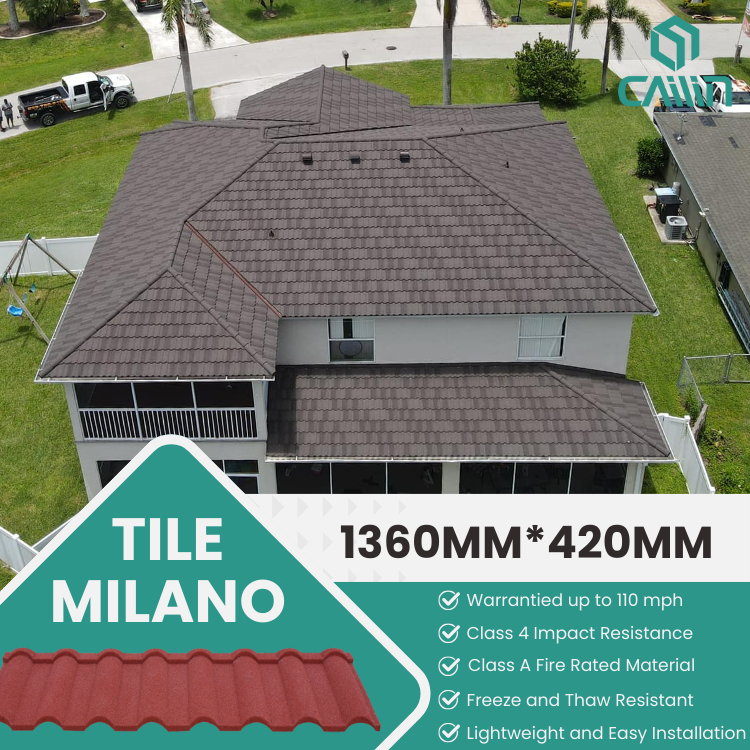
Cailin Milano Tile: a stone coated metal roofing profile whose consistency depends on documented production control rather than on a single favourable sample.
Stone coated metal roofing is bought on two different kinds of claims. The first is product performance: wind uplift, salt spray resistance, tile weight, sound reduction. The second is evidence — what a manufacturer can actually show a buyer to demonstrate that those performance figures come out of a controlled, repeatable process rather than a carefully chosen sample. For importers, distributors and project buyers evaluating a supplier at a distance, the second category is usually the harder one to test.
Sango Cailin (Tianjin) Building Tech. Co., Ltd. is a Tianjin-based manufacturer of stone coated metal roofing, asphalt shingles, BIPV solar tiles, rain gutter systems and butyl tape, exporting to the USA, Canada and Southeast Asia. Its production facilities are certified to ISO 9001, ISO 14001 and ISO 45001. This article looks at what those three certificates cover on a roofing production line, how they connect to the tile specifications buyers receive, and where the limits of that evidence lie.
Why a Product Datasheet Is Not Supplier Evidence
A typical stone coated metal roofing datasheet lists base steel thickness, tile dimensions, weight per square metre, corrosion test hours and wind uplift resistance. Those figures describe a product. They do not describe the process that produced it, and they cannot show whether the tile in a sample box came off a stable line or a selected batch.
This is the verification gap that matters in wholesale stone coated roofing. Buyers are usually far from the factory, comparing quotations, and under pressure to confirm that an order of several thousand tiles will match the approved sample. Photographs, videos and inspection reports help, but each of them is produced by the supplier. Third-party management system certificates are different in kind: they rest on audits of the supplier’s own systems, carried out by a body whose role is to check rather than to sell.
That is why an ISO certified roofing factory tends to be treated as a separate category in supplier evaluation. Certification does not make tiles better by itself. It indicates that the manufacturer runs documented, auditable processes for quality, environment and occupational safety — the three areas where roofing production most often fails quietly, without appearing in a sales document.
What ISO 9001, ISO 14001 and ISO 45001 Actually Cover
ISO 9001 is a quality management system standard. It requires a manufacturer to define how work is controlled, how customer requirements are reviewed, how nonconforming output is identified and handled, how corrective actions are recorded, and how the system is internally audited and reviewed by management. On a roofing line, that becomes documented procedures for incoming steel, coating application, curing, dimensional checks and final inspection.
ISO 14001 addresses environmental management. Stone coated metal roofing production involves resin handling, adhesive application, high-temperature curing and mineral granule use, all of which generate emissions, waste and material consumption that have to be managed. Certification means the factory has identified those aspects, set controls and objectives, and is audited on whether the controls operate in practice.
ISO 45001 covers occupational health and safety management. Press lines, coil handling, high-temperature sintering and manual packing are the routine hazards of tile production. A safety management system requires hazard identification, safe working procedures, training, incident reporting and corrective action. Its commercial relevance to a buyer is workforce continuity: plants with controlled safety performance lose fewer shifts to incidents, and shift stability is what supports a quoted lead time.
| Standard | Primary focus | Where it touches roofing production | Boundary |
|---|---|---|---|
| ISO 9001 | Quality management | Process control, inspection, non-conformance handling, traceability, corrective action | Certifies the system, not each individual tile |
| ISO 14001 | Environmental management | Coating and adhesive handling, granule waste, energy and material use | Does not certify product environmental claims |
| ISO 45001 | Occupational health and safety | Press and sintering hazards, training, incident reporting, shift continuity | Does not measure tile performance |
Where a Certified System Touches the Production Line
Product consistency starts at the steel coil. Cailin’s published specification uses galvalume steel with an AZ150 coating as the base substrate, in thicknesses from 0.4 mm to 0.6 mm, with 0.45 mm, 0.5 mm and 0.55 mm offered as standard options. Steel thickness is the main driver of tile weight and stiffness, so it has to be verified on receipt and traceable through production — a recorded process step rather than a verbal assurance.
The coating stage decides appearance and durability. The base steel receives an acrylic resin coating with high-temperature sintered natural stone granules, finished with a transparent acrylic glue top coat. Granule colour is available in 10 or more standard shades with custom colours on request, across the Cailin Bond, Shingle, Milano, Shake, Classical, Roman, Long-Span, Golan, Tudor and Heritage profiles. Colour and profile variety is easy to promise; reproducing it across reorders is a process outcome.
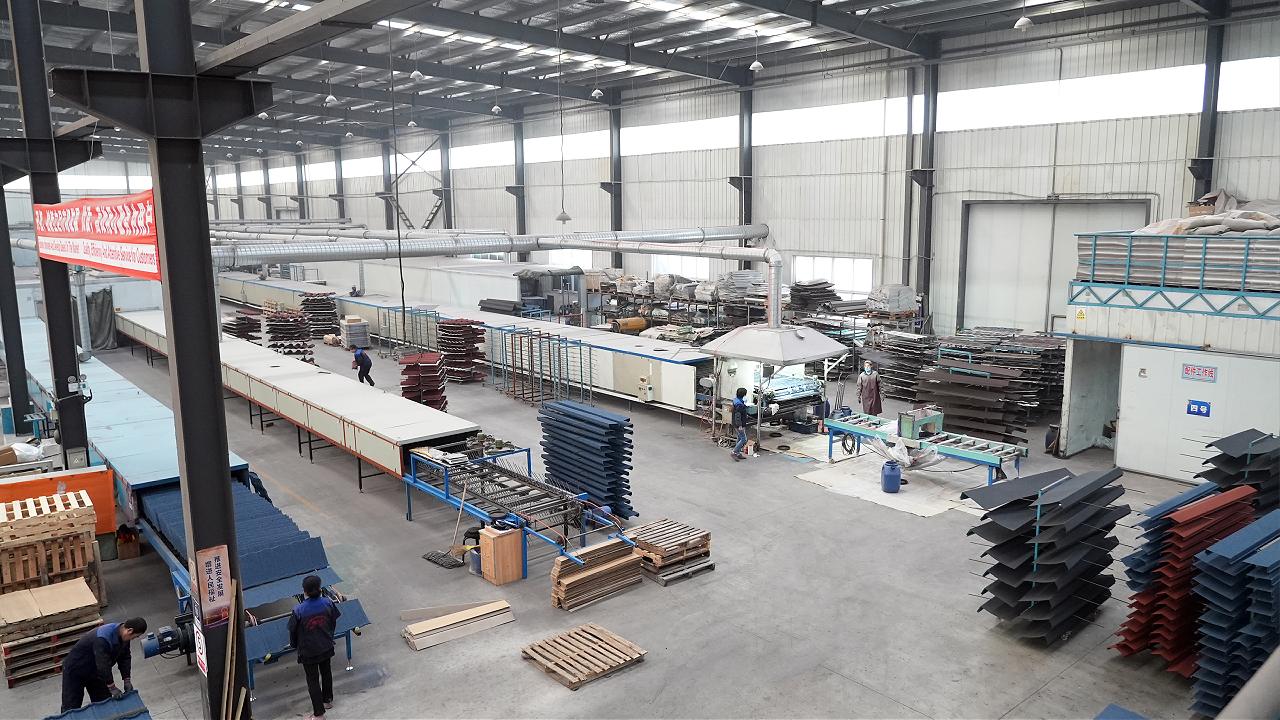
A CAILIN production base: the facilities holding the ISO 9001, ISO 14001 and ISO 45001 certificates are the same lines that produce the tiles shipped to buyers.
Dimensional control matters more than it first appears. The effective tile size is 1340 mm × 420 mm, covering 1260 mm × 370 mm once interlocked, at a published weight of approximately 5–8 kg/m². On interlocking pitched roof metal tiles with a concealed fastener design, small variations in profile geometry accumulate across a roof and affect coverage per pallet, alignment and fixing. Those dimensions are checked in production rather than assumed from a design drawing.
Inspection is the last control point in the quality system: 100% inspection during production, random sampling before shipment, and third-party inspection available on request. Quoted monthly capacity is 500,000 units against an annual output of 6,000,000 units, with a standard lead time of 7–10 days and a minimum order quantity of 2 units.
| Published product claim | What produces it | Evidence a buyer can request |
|---|---|---|
| Wind uplift resistance up to 160 mph | Interlocking profile plus concealed fastener clips and screws | Fastening specification, fixing pattern, installation control records |
| Corrosion resistance: 500-hour salt spray | AZ150 galvalume substrate, coating control, factory-applied cut-edge treatment for coastal use | Substrate certificate, coating records, salt spray test report |
| Acoustic insulation: 70% noise reduction versus bare metal | Sintered stone granule layer applied over the coated steel | Granule specification, in-line application records |
| Weight approximately 5–8 kg/m² | Base steel thickness range of 0.4–0.6 mm | Incoming coil verification, per-batch weight check |
| Suitable for pitched roofs from 12° to 90° | Profile design with underlayment, battens and ridge, valley and flashing components | Installation guide, video support, technical response commitments |
The Manufacturer Behind the Certificates
Sango Cailin (Tianjin) Building Tech. Co., Ltd. is a factory rather than a trading company, founded in 2017 and operating multiple production bases in China — including Hangzhou, Sichuan, Shandong and Hebei — with seven facilities in total. The company describes a 15,000 m² manufacturing operation with fewer than 100 employees, a 10-engineer R&D team, an annual output of 6,000,000 units and an export ratio of 25%, serving partners in more than 20 countries.
On paper, the part that matters most to a procurement decision is the certification statement: the facilities are certified to ISO 9001, ISO 14001 and ISO 45001, with the ISO 9001 certificate reference given as ISO 9001:2015-03824Q14379R2S. That reference is the type of detail a buyer can check independently, and it is the reason certificate numbers are worth recording in a sourcing file rather than filing as a marketing attachment.
Commercial terms sit alongside the systems evidence: OEM, ODM and customised production are offered, customisation covering granule colour, steel thickness, tile profile, packaging design and logo printing. After-sales support includes a technical installation guide, video support, remote assistance, 50-year limited warranty terms and a stated 24-hour response commitment.
Scenario Fit: Coastal, High-Wind, Snow-Load and Retrofit Projects
Stone coated metal roofing performs differently depending on where it is installed, and the management system is what keeps those differences attached to the order. In coastal and humid environments with high salinity, salt spray, monsoon rain and typhoon winds, coastal anti-corrosion roofing depends on the AZ150 galvalume substrate, the coating system and an additional anti-corrosion coating applied to cut edges at the factory rather than on site.
For high-wind and hurricane roofing, the relevant figure is the published wind uplift resistance of up to 160 mph, which is a property of the tile, the concealed fastener clips and screws, and the fixing pattern together. In temperate rainy regions with high humidity and moss or algae pressure, the priority shifts to coating integrity and drainage detailing. In cold and snowy regions, low temperatures, freeze-thaw cycles and snow loads dominate, and snow guards are required on steep roofs to prevent sudden snow slide.
Lightweight construction is what makes retrofit practical. At approximately 5–8 kg/m², stone coated metal roofing can be installed over existing roofs on replacement projects and on 15–20 year old tile houses without structural reinforcement, and it also suits flat-to-pitch conversions, rural self-built houses, beachfront resorts and hotels, mountain cabins and ski lodges, historic restorations that need a slate or shake appearance, and community buildings in hurricane-prone areas.
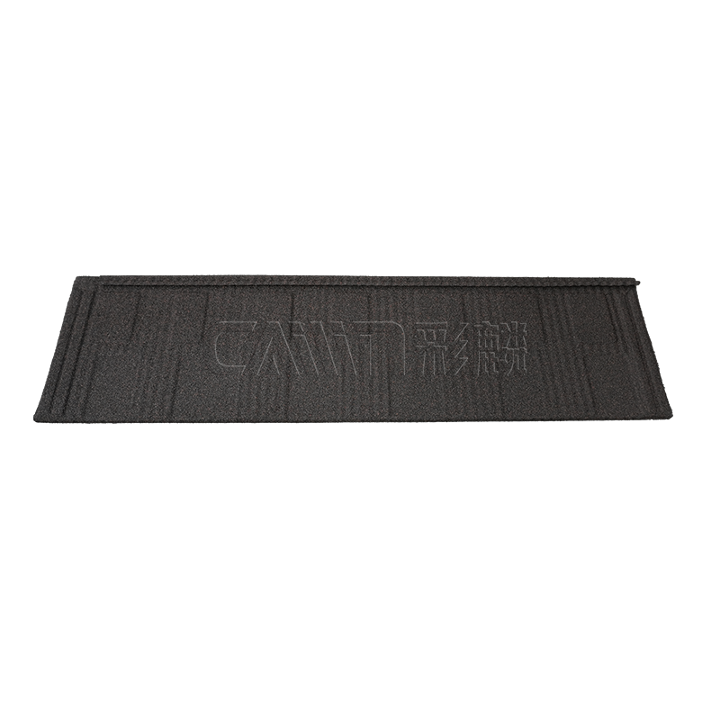
Concealed fastener shingle profile: the fixing system is part of the wind uplift specification and is documented as installation control, not left to site judgement.
Recorded project use supports the same reading. A residential project in the United States used approximately 700 units in a pitched roofing application, with reported outcomes including energy saving, wind resistance and noise reduction, alongside the lightweight, low-maintenance characteristics of the material.
The Boundaries of Certification
An ISO certificate is strong evidence about a factory and weak evidence about an individual tile. It confirms that a management system exists, is documented and is audited; it does not guarantee that any single tile will meet a stated uplift or salt spray figure, and it says nothing about how the roof is installed on site. Buyers still need product-level and project-level verification, including substrate standards such as ASTM A792/A792M for 55% aluminium-zinc coated steel — the standard cited by ICC Evaluation Service in ESR-2901 — and uplift testing such as ASTM E1592 where the project specification requires it.
Scope is the second boundary. A certificate belongs to a legal entity and a defined site, not to a brand name. Where a manufacturer operates several production bases, the buyer should confirm which site will run the order and whether the certificate scope covers that site and that product family. Validity dates, issuing bodies and scope statements are all part of the check.
The third boundary is cost and comparison. Certification does not make a supplier the cheapest option, and stone coated metal roofing lifetime cost still depends on freight, order size, specification level and installation labour, not on the certificate alone. Compared with traditional clay and concrete tiles, stone coated metal roofing is significantly lighter — third-party specifications place comparable products at roughly 3.2–6.7 kg/m², several times lighter than concrete or clay — which is an advantage on retrofit projects but also means wind performance depends on correct fastening rather than on the mass of the tile. Compared with asphalt shingles, third-party durability comparisons put stone-coated steel at 50+ years against roughly 20 years for asphalt, so the comparison is about replacement frequency and maintenance, not simply about first invoice price.
Finally, audited systems create documentation obligations. Buyers who want the benefit usually have to ask for the right records — batch traceability, inspection results, third-party reports — rather than expect them by default.
Market Context: Growth With Uneven Verification Discipline
Third-party market research indicates a category in expansion. Global stone-coated steel roofing market size was estimated at USD 20.71 billion in 2024 and projected to reach USD 32.69 billion by 2033, according to an industry analysis published via Vertex AI Search. The China metal roofing market was estimated at USD 3.57 billion in 2024, with a forecast CAGR of 4.25% through 2035, according to Market Research Future. Estimates vary widely by research scope: broader infrastructure-focused research cited in the same dataset places the wider market at USD 69.41 billion, which is a reminder that category-level figures are directional rather than precise.
Demand drivers are largely functional. DECRA’s 2024 roofing trends recap notes that metal roofing can reflect heat away from buildings, potentially saving homeowners up to 40% on cooling energy costs — a competitor-published figure that should be read as indicative. Energy saving stone coated metal roofing also works through construction detail: the air gap between tile and underlayment reduces heat transfer. Third-party durability comparisons place stone-coated steel roofing at a 50+ year lifespan, which is why lifetime cost rather than unit price tends to dominate owner-level decisions.
The competitive landscape is consolidated at the top. DECRA Roofing Systems, Ross Roof Group, Boral Steel and Tilcor are identified as major global players by Mordor Intelligence and Benchmark International. In a market of that shape, mid-sized manufacturers compete less on brand recognition and more on verifiable production capability — which is precisely where management system certification, documented inspection and traceable material sourcing carry weight.
A Practical Sequence for Verifying a Roofing Supplier
- Confirm the legal entity, the production site and the certificate scope — not just the brand name on the website.
- Record certificate references and validity dates, and verify them with the issuing body, including the site that will run the order.
- Ask for the test evidence behind each performance claim: salt spray hours, uplift data, dimensional and weight tolerances.
- Confirm inspection practice — 100% in-production inspection, pre-shipment sampling, and whether third-party inspection can be arranged.
- Check continuity terms: monthly capacity, lead time, minimum order quantity, warranty terms and response commitments.
- Match specification to site condition: coastal anti-corrosion treatment, high-wind fixing pattern, snow guards on steep roofs, wildfire detailing.
- Document the order: batch records, packaging format, installation guide and after-sales support path.
Future Outlook
Documentation expectations in roofing procurement are rising. Buyers increasingly ask for certificate scope, batch traceability and third-party inspection as standard terms rather than as extras, and the growth of long-lifespan roofing makes that rational: a 50-year product decision has to survive changes in project ownership, installer and even building use. Manufacturers who already operate audited quality, environmental and safety systems are structurally better placed to answer those requests than those who treat documentation as a sales task. The practical limit remains unchanged — certification describes how a factory is run, and product performance still has to be proven tile by tile and roof by roof.
FAQ
Do ISO 9001, 14001 and 45001 certificates prove that a roof tile will perform as specified?
No. These standards certify management systems, not the performance of an individual tile or an installed roof. Product performance in stone coated metal roofing is verified separately: substrate standards such as ASTM A792/A792M for 55% aluminium-zinc coated steel, as cited by ICC Evaluation Service in ESR-2901; uplift testing such as ASTM E1592 where a project specification requires it; salt spray testing; and the manufacturer’s own dimensional and weight data. Certification supports the claim that these tests and controls are applied systematically, but it does not replace them.
Why do environmental and safety certifications matter to buyers focused on tile quality?
ISO 14001 and ISO 45001 operate on the same lines as the quality system. Environmental controls cover coating, adhesive and granule handling, which influence coating consistency and waste rates. Safety controls cover press, sintering and handling operations, which influence shift continuity and therefore delivery reliability. Neither standard measures tile performance directly, but both indicate how well the factory manages the conditions under which tiles are made.
How can a buyer confirm that a certificate applies to the factory producing the order?
Check the legal entity name, the site address and the certificate scope statement, then verify the certificate number with the issuing body or its public registry. Confirm the validity period and whether the scope covers the product family being ordered. Where a manufacturer operates several production bases, ask which site will run the order and whether it is covered by the same certificate. Sango Cailin states that its facilities are certified to ISO 9001, ISO 14001 and ISO 45001, with the ISO 9001 certificate reference given as ISO 9001:2015-03824Q14379R2S.
Does certification change how stone coated metal roofing is specified for coastal or cold-region projects?
The application requirements stay the same; they become documented and repeatable. For coastal and hurricane roofing, Cailin’s specification applies an additional anti-corrosion coating to cut edges at the factory, uses AZ150 galvalume base steel, and publishes a 500-hour salt spray result with wind uplift resistance of up to 160 mph. For cold and snowy regions, snow guards are required on steep roofs to prevent sudden snow slide. Certification is the mechanism that keeps those requirements attached to the order instead of leaving them to site interpretation.
What documentation should accompany a first wholesale order?
Useful documents include the certificate scope statement; the product specification covering base steel thickness (0.4–0.6 mm), tile dimensions (1340 mm × 420 mm, covering 1260 mm × 370 mm) and weight (approximately 5–8 kg/m²); inspection records from 100% production inspection and pre-shipment sampling; third-party inspection reports where requested; the installation guide and technical support terms; and the warranty statement, for which Cailin offers 50-year limited warranty terms with a 24-hour response commitment.
Certification does not remove the need for product testing, project engineering or installation control. It adds a checkable layer of evidence about how a factory is run — which, in a category where most claims arrive as PDF attachments, is a substantive part of supplier evaluation.
Reference: the CAILIN product brochure covering stone coated metal roofing profiles, specifications and applications is available here: CAILIN product brochure (PDF).