
Supplier Evidence: Material & Thickness Capabilities Across the XD-20PRO and 40/80/120/170 Series
Supplier Evidence: Material & Thickness Capabilities Across the XD-20PRO and 40/80/120/170 Series
Wall thickness and outside diameter (OD) decide whether an orbital welding platform can be quoted for a project at all. Before price, lead time or delivery terms are discussed, a piping engineer needs to know whether a welding head can physically reach the joint, whether the power supply can control the arc across that wall section, and whether the same result can be repeated across hundreds of identical welds. For a supplier, publishing those two numbers — together with the model architecture behind them — is the difference between a capability claim and procurement evidence.
This reference reviews the documented OD and wall-thickness ranges held by KEPUNI across its orbital welding power supplies, closed weld heads, split weld heads, open pipe systems and girth welding platforms, and explains what each range means at the evaluation and execution stages of a piping project. KEPUNI is the orbital welding equipment brand of Shanghai Chuanli Industrial Co., Ltd., a Shanghai-based manufacturer of orbital welding machines, tube-to-tube-sheet welders, open pipe welders, cold welders and orbital cutters. The company operates a 10,000 m² production park with 280 employees, including 36 R&D engineers and technicians, and reports an annual output of 3,000 units supplied to Europe, Asia, South America, North America and the Middle East.
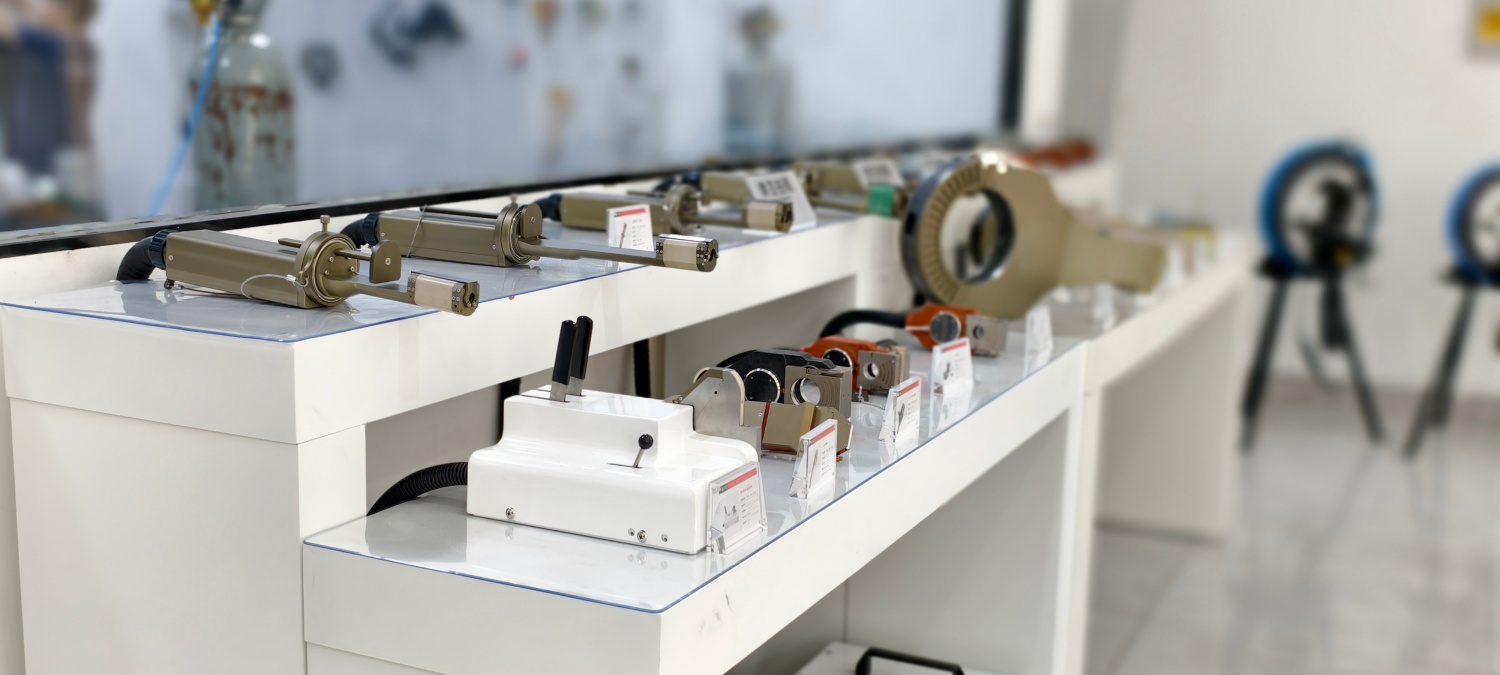
KEPUNI equipment display area in Shanghai. Documented platform ranges, not showroom impressions, are what allow a buyer to screen feasibility before an enquiry.
Why OD and Wall Thickness Are the First Filter in Supplier Evaluation
Orbital welding capability is not one specification; it is a set of boundaries that must all be satisfied at the same time. Three questions decide feasibility before commercial terms matter:
- Can the head fit? A closed welding head must encircle the pipe, which sets a hard maximum OD and a separate minimum OD.
- Can the process control the wall? Thin walls demand low, stable current and tight travel-speed control; heavier walls require higher current and, in many cases, multiple passes.
- Can the material and joint be qualified? Material grade, joint preparation and cleanliness determine whether a documented range is usable in practice.
A frequent procurement error is to read only the power supply range. A power supply may be documented for pipe OD up to 168 mm while the selected weld head covers only 25.4 mm. Because the usable range of an orbital welding system is the intersection of power supply, weld head and process window, buyers comparing orbital welding machine manufacturers should request ranges at platform level rather than at system level. That distinction matters most at the evaluation stage, where a specification mismatch is cheap to correct and, at the execution stage, expensive.
The Documented Range: XD-20PRO, XD-20W and the 40/80/120/170 Series
Within the KEPUNI portfolio, the XD-20PRO and XD-20W pipe welding power supplies are documented for pipe outside diameter from 3.175 mm to 168 mm with a wall thickness of 0.5 mm to 3 mm. The 40/80/120/170 Series, a closed weld head platform, is documented for pipe OD from 6.35 mm to 168 mm with wall thickness up to 3 mm. For heavy-wall and large-bore work, the XD-GH Series girth welding machine extends well beyond that envelope, covering pipe and vessel OD from 20 mm to 960 mm at a wall thickness of 2.5 mm to 25 mm and a current range of 5 A to 400 A.
| Platform / model | Type | Documented pipe or tube OD | Documented wall thickness | Current |
|---|---|---|---|---|
| XD-20PRO | Pipe welding power supply | 3.175–168 mm | 0.5–3 mm | — |
| XD-20W | Pipe welding power supply | 3.175–168 mm | 0.5–3 mm | — |
| 40/80/120/170 Series | Closed weld head | 6.35–168 mm | ≤3 mm | — |
| 5H Series | Split type weld head | 3.175–15.88 mm | ≤1.5 mm | — |
| 10H Series | Split type weld head | 6.35–25.4 mm | ≤1.5 mm | — |
| XD-Split Type Weld Head | Split type weld head | 3.175–25.4 mm | ≤1.5 mm | — |
| XD-U Series | U-tube weld head | 9–25 mm | ≤1.5 mm | — |
| XD-K Series | Open pipe welding power supply | 19–325 mm | 2.5–13 mm | 5–500 A |
| K Series | Open weld head | 19–325+ mm | 2.5–13 mm | — |
| XD-G400 | Tube-to-tube sheet power supply | Tube OD 4.5–65 mm | ≤5 mm | — |
| TB-35 Series | Tube sheet weld head | Tube OD 4.5–35 mm | ≤2.5 mm | — |
| TB-65 Series | Tube sheet weld head | Tube OD 8–65 mm | ≤5 mm | — |
| XD-GH Series | Girth weld power supply + rotary stand | Pipe / vessel OD 20–960 mm | 2.5–25 mm | 5–400 A |
Documented ranges by KEPUNI platform. The usable range for any project is the intersection of power supply, weld head and qualified welding procedure.
The catalogue material listing for these platforms is steel and alloy. Where a project requires a specific grade, customization services extend to special materials such as SS304, SS316, titanium and Inconel, together with non-standard sizes and custom parameters. For a buyer, that means the practical question is not only which range exists, but which range has already been qualified for the material in front of them.
How the Range Is Built: Power Supply, Weld Head and Process Window
Thin-wall work is the most demanding part of any orbital welding range. Between 0.5 mm and 1.5 mm wall thickness, welding current must remain low and stable, and the arc must be started and extinguished without leaving a defect where the weld overlaps its starting point. This is why the split-head platforms (5H, 10H, XD-Split) are documented at ≤1.5 mm wall, while the closed-head 40/80/120/170 Series and the XD-20PRO / XD-20W power supplies share a 0.5–3 mm window. The same logic explains the jump in current capability on the open platforms: the XD-K Series is documented at 5–500 A for 2.5–13 mm wall, because thicker sections require more energy and, usually, more than one pass.
Head architecture determines where a machine can be used, not just what it can weld. Closed heads fully encircle the pipe, which isolates the weld pool from the surrounding atmosphere — a design that welding equipment suppliers such as Orbitalum describe as standard practice for clean-room and semiconductor piping, where contamination control is critical. The trade-off is access: a closed head needs clearance around the joint, which is precisely why split and open heads exist for field, plumbing and retrofit work. Above 3 mm wall thickness, closed-head architecture gives way to the open-head XD-K Series and, for vessels and large-bore pipe, to the XD-GH Series girth platform.
Two further points are worth stating plainly. First, a platform name does not define a range; each weld head size within a series carries its own OD limit, and multiple heads are normally required to cover a full project scope. Second, the corrosion-resistant and high-purity piping used in pharmaceutical, food grade and semiconductor work is typically thin-walled, which places the highest value on the low end of the range rather than the high end. A supplier that documents 0.5 mm as a floor is answering a different question than one that documents 168 mm as a ceiling.
Applications Matched to the Documented Range
Range data becomes procurement evidence only when it maps onto a real application. The following segment-to-platform matches are drawn from documented project records, and each one pairs an industry requirement with a platform whose OD and wall-thickness envelope fits it.
| Segment | Platform referenced | Documented project outcome |
|---|---|---|
| Semiconductor / UPG distribution piping | XD-20PRO Hi-Purity + tube-sheet heads | SEMI F57 cleanliness level verified; 100% weld joint documentation |
| Pharmaceutical / WFI pure water | XD-20PRO + weld heads | EU GMP audit passed on first inspection; 100% hydrostatic test pass |
| Food & beverage / dairy sanitary lines | XD-20PRO + accessories | 3A Sanitary Standard certification obtained; hydrostatic test 100% pass |
| Chemical / petrochemical acid transfer | XD-20W, XD-40 | API 582 welding requirements met; NACE MR0175 material verification completed |
| Water treatment / desalination | XD-GH Series, XD-K Series | ASME B31.3 compliant; zero weld rework on 400+ girth welds |
| Power generation / boiler tube | TB-35 Series, XD-GH Series | ASME Section IX and B31.1 compliant; 100% ultrasonic testing pass |
| Hospital / medical gas systems | XD-20PRO Medical Spec | HTM 02-01 and NFPA 99 compliant; 100% helium leak test pass |
| HVAC / shell-and-tube heat exchangers | TB-65 Series, XD-U Series | ASME U-stamp certified; 100% helium leak test pass |
The semiconductor and pharmaceutical examples sit squarely inside the XD-20PRO window: small-bore, thin-wall stainless piping where the 0.5–3 mm thickness band and the 3.175 mm minimum OD matter more than the 168 mm maximum. Heat exchanger work uses a different slice of the portfolio, where the TB-35 and TB-65 tube sheet heads cover tube OD down to 4.5 mm at ≤2.5 mm and ≤5 mm wall respectively, and the XD-U Series handles U-tube geometries from 9 mm to 25 mm. The water treatment and boiler cases move to the other end: wall thickness above 3 mm and vessel diameters well beyond 168 mm make the girth welding platform the only applicable option.
Where the Range Stops: Boundaries Buyers Should Plan Around
Honest evaluation requires the limits as much as the capabilities. Four boundaries follow directly from the documented ranges.
- Wall thickness above 3 mm leaves the closed-head and XD-20PRO / XD-20W platforms. A 6 mm wall cannot be welded on the same architecture; it requires the open-head XD-K Series (2.5–13 mm) or the XD-GH Series (2.5–25 mm). This is a change of machine type, not a parameter adjustment.
- Split-type heads cap at ≤1.5 mm wall and 25.4 mm OD. Thin-wall, small-bore and limited-access work is well served, but the same heads cannot be extended into heavier schedules.
- Closed-head operation is bounded at 168 mm OD. Beyond that diameter, girth welding on a rotary stand — documented up to 960 mm — is the practical path.
- Special materials follow a customization route. The catalogue listing is steel and alloy. Titanium, Inconel and specific stainless grades are available through customization, which means they should be planned as a qualified sample process rather than assumed as an off-the-shelf configuration.
One additional boundary is procedural rather than mechanical. Any new combination of material, OD and wall thickness should be validated on a sample joint before production volume is committed, because procedure qualification — not catalogue range — is what a project inspector will ultimately rely on.
Quality Control Evidence Behind the Numbers
Range claims are only as reliable as the inspection regime supporting them. KEPUNI documents four production modes with different verification depth, which gives buyers a way to match order type to project risk.
- Sample order: MOQ 1 unit, 15–20 days lead time, full inspection plus a weld sample report and detailed parameter documentation.
- OEM / ODM: MOQ 1 unit, 30–45 days, 100% function test, weld sample test and a 72-hour burn-in test; customization covers logo, colour, voltage (110 V / 220 V), interface, IoT/MES integration and software.
- Bulk order: MOQ 5 units, 60–90 days FOB Shanghai, AQL 1.0 sampling inspection, 100% verification of key parameters and an optional pre-shipment witness inspection.
- After-sales: spare parts supply with a typical global lead time of 7–15 days, on-site repair, remote diagnosis, operator training and annual maintenance contracts.
For a project entering execution, the sample weld report is the more decisive document. It converts a catalogue range into a qualified procedure for the buyer's actual material and wall thickness before production capacity is committed, and it is the artefact most often missing when a supplier provides only a specification sheet.
CE Certification as Third-Party Verification
Independent certification adds an auditable layer to any supplier statement about capability. The KEPUNI product portfolio is covered by CE certification issued through UDEM for the EU market, including certificate TCF25040101LVDEMC against EN ISO 12100:2010, EN 60204-1:2018 and EN 60825-1:2014, together with EMC standards EN IEC 61000-3-2:2019+A1:2021 and EN 61000-3-3:2013+A1:2019, valid to 2 April 2030. Welding-specific conformity is documented under EN IEC 60974-1:2022+A11:2022+A12:2023 and EN IEC 60974-10:2021, with certificate 6814C50001315201 issued 17 March 2025 and valid to 16 March 2030, and certificate M.2022.206.C75864 covering the same welding standards.
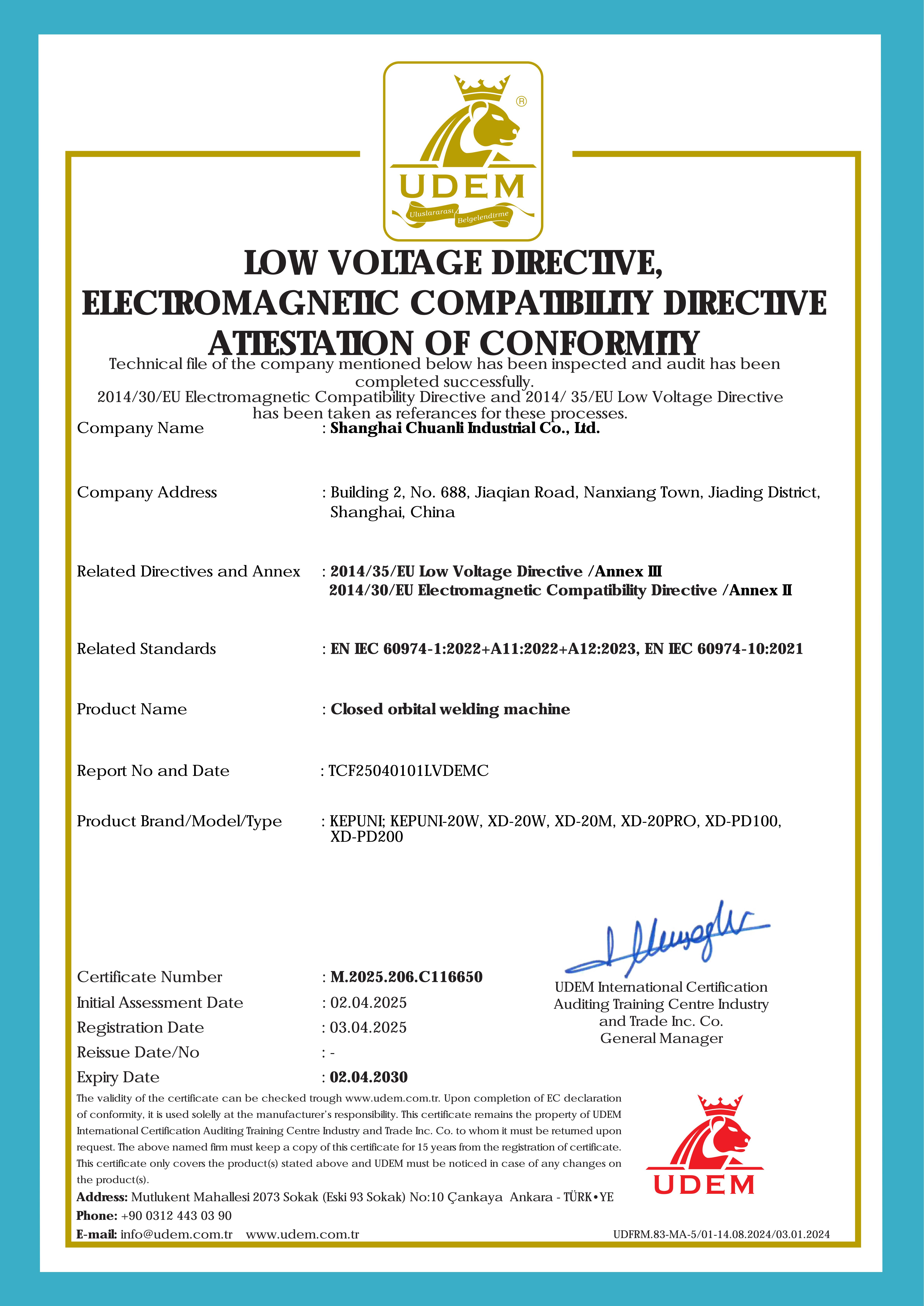
CE certification documentation issued through UDEM for the EU market. Certificate numbers, not marks alone, are what regulated-industry auditors request.
These certificates are associated with the platform families discussed here, including the XD-20PRO, XD-20W, 40/80/120/170 Series, XD-GH Series, XD-K Series, XD-U Series, XD-G400, TB-35 Series and TB-65 Series. For buyers in pharmaceutical, food grade or semiconductor supply chains, the certificate number and the standard list behind it are what an auditor will ask for — particularly where welding equipment forms part of a documented quality system.
Market Trend: Why Thickness and Cleanliness Requirements Keep Rising
The global orbital welding machine market was valued at approximately USD 1.32 billion in 2024 and is projected to reach USD 2.07 billion by 2030, according to Strategic Market Research. The same analysis identifies oil and gas as the largest application segment in 2024, holding more than one-third of total market share, while high-purity piping for the semiconductor and pharmaceutical industries is described as the fastest-growing segment because of stringent contamination-control requirements. That combination is exactly why a portfolio has to span both the closed-head thin-wall band and the heavy-wall girth band rather than specialising in one.
Regional data from Grand View Research points in the same direction: Asia Pacific held a 37.0% revenue share of the welding equipment market as of 2025, and the U.S. welding equipment market is expected to grow at a CAGR of 4.2% between 2026 and 2033. It is worth noting that published market sizes differ by scope — estimates for orbital welding range from roughly USD 0.83 billion to USD 1.32 billion depending on whether full systems or only heads and power sources are counted — so these figures are best treated as directional signals rather than precise planning inputs.
The competitive landscape is also well documented. Lincoln Electric, ESAB (Colfax), Swagelok, AMI (Arc Machines, Inc.) and Polysoude are among the recognised participants in the global orbital welding equipment market. For a buyer, the practical implication is not a ranking but a shortlisting task: match documented OD and wall-thickness ranges, certification scope and weld-head architecture against the specific piping schedule in front of them, and treat published market growth as context rather than as evidence of fit.
Comparison with Manual and Traditional Approaches
Orbital welding is not automatically the right answer for every joint, and a credible supplier comparison should say so. Manual TIG remains a reasonable choice for one-off joints, generous-clearance locations and small scopes where the capital and setup cost of an automated system cannot be recovered. Documented ranges also impose their own constraints: a closed-head machine requires access around the pipe, thin-wall work demands disciplined joint preparation and fit-up, and each new material or thickness combination should be validated through a sample before production. On very small or highly irregular geometries outside the documented minimum OD, orbital systems are simply not applicable.
Where orbital welding changes the economics is repetition. On projects involving several hundred identical joints — the 400-plus girth welds cited in the desalination reference above, for example — travel speed, arc length and heat input are controlled by program rather than by operator technique, which is what supports documented outcomes such as 100% ultrasonic testing pass and zero weld rework. The trade-off is front-end discipline: the buyer must specify material, OD, wall thickness and joint geometry accurately enough for the correct platform to be selected in the first place. In that sense, the range table is not a marketing asset; it is a project-planning tool.
Future Outlook
Three shifts are likely to shape how OD and wall-thickness ranges are evaluated through the rest of the decade. First, high-purity segments continue to grow fastest, which increases demand for closed-head platforms in the 6–168 mm band and for documented cleanliness evidence rather than generic capability statements. Second, the energy and water infrastructure pipeline keeps heavy-wall, large-bore girth welding relevant, sustaining demand for platforms that reach 25 mm wall and vessel diameters approaching one metre. Third, digital traceability — IoT/MES integration and per-joint weld documentation — is moving from a differentiator to an expectation in regulated industries.
For buyers, the practical response is unchanged: ask for ranges at platform level, ask for the certificate numbers behind any compliance claim, and ask for a sample weld report before committing production volume. Suppliers that already hold that documentation will continue to be easier to qualify than those that hold only a brochure.
Frequently Asked Questions
What pipe OD and wall thickness can the XD-20PRO and XD-20W power supplies weld?
Both the XD-20PRO and XD-20W pipe welding power supplies are documented for pipe outside diameter from 3.175 mm to 168 mm and wall thickness from 0.5 mm to 3 mm, and are listed for steel and alloy materials. The usable range in a specific project is the narrower intersection of that figure, the selected weld head range and the qualified welding procedure.
How do I choose between a closed weld head, a split weld head and an open pipe system?
The choice follows access, wall thickness and required atmosphere control. Closed heads, such as the 40/80/120/170 Series, cover OD 6.35–168 mm at up to 3 mm wall and enclose the joint, which supports high-purity and clean-room work. Split heads (5H, 10H, XD-Split, XD-U) open around the pipe for confined or field positions and are documented at up to 25.4 mm OD and ≤1.5 mm wall. Open pipe systems (XD-K Series, K Series) cover 19–325 mm OD at 2.5–13 mm wall for heavier schedules.
Which materials can KEPUNI orbital welding machines be configured for?
The catalogue material listing for the platforms is steel and alloy. Customization services extend to custom parameters, special materials such as SS304, SS316, titanium and Inconel, and non-standard sizes. Because these are customization items rather than catalogue configurations, they are normally validated through a sample order (MOQ 1 unit, 15–20 days) that includes a weld sample report and parameter documentation.
Are KEPUNI orbital welding machines CE certified, and which standards apply?
CE certification for the EU market is issued through UDEM. Certificate TCF25040101LVDEMC covers EN ISO 12100:2010, EN 60204-1:2018, EN 60825-1:2014, EN IEC 61000-3-2:2019+A1:2021 and EN 61000-3-3:2013+A1:2019, valid to 2 April 2030. Welding-specific conformity is documented under EN IEC 60974-1:2022+A11:2022+A12:2023 and EN IEC 60974-10:2021 through certificate 6814C50001315201 (issued 17 March 2025, valid to 16 March 2030) and certificate M.2022.206.C75864.
What documentation accompanies a sample or production order?
Sample orders include full inspection, a weld sample report and detailed parameter documentation. OEM/ODM orders include a 100% function test, weld sample test and a 72-hour burn-in test. Bulk orders are subject to AQL 1.0 sampling inspection, 100% verification of key parameters and an optional pre-shipment witness inspection. Third-party inspection by SGS or BV is available as an option, and payment terms for sample orders are typically 30% deposit with 70% before shipment.
What projects fall outside the closed-head platform range?
Projects fall outside the closed-head range when wall thickness exceeds 3 mm, when pipe or vessel OD exceeds 168 mm, or when the joint cannot be encircled because of access restrictions. Wall thickness above 3 mm moves to the open-head XD-K Series (19–325 mm OD, 2.5–13 mm wall) or the XD-GH Series girth platform (20–960 mm OD, 2.5–25 mm wall). Split-head platforms are limited to 25.4 mm OD and ≤1.5 mm wall, so they cannot substitute for either.
The product brochure covering the platform families referenced in this article, including the XD-20PRO, 40/80/120/170 Series and XD-GH Series documentation, is available here: KEPUNI product brochure (PDF).