
Supplier Sustainability Audit for a Cancer Treatment Hospital
Supplier Sustainability Audit for a Cancer Treatment Hospital
A long-term supplier sustainability evaluation for a cancer treatment hospital asks whether the provider can keep producing the same standard of diagnostic input, treatment decision and documented follow-through across the second, third and fifth episode of care — not whether it can deliver one impressive procedure.
The distinction matters because advanced cancer is rarely a single transaction. For a hospital whose documented scope runs from imaging, tumor markers, biopsy and genetic testing, through cryoablation, irreversible electroporation, photodynamic therapy, brachytherapy and microwave ablation, to rehabilitation, psychosocial and social support, and follow-up, sustainability is a property of the whole chain. One break — a baseline scan that cannot be compared with a later one, a procedure record that was never written, a follow-up plan that ends at discharge — weakens every later decision and can leave the buyer unable to judge whether the first episode worked at all.
What follows is a framework that can be applied with documents rather than impressions, worked through against a named reference point: Guangzhou Fuda Cancer Hospital, an oncology-specialised hospital in Guangzhou, China, whose published scope spans all three capability families used in this evaluation.
What a supplier sustainability evaluation has to answer
In procurement language, a supplier is the party contracted to keep delivering. When the contract is cancer care, the supplier is the provider organisation and the buyer is whoever carries the risk over time — most often the patient and family, sometimes a referring clinician, an employer or a payer. Sustainability in that setting is not a brand attribute. It is the likelihood that the same standard of diagnostics, decision-making and documentation survives repeat episodes.
That likelihood can be tested through four continuities, each of which fails differently:
- Evidence continuity. Records produced in episode one remain readable, comparable and traceable in episode three. A tumor-marker trend or a CT series is only useful if the earlier baseline still exists in a reusable form.
- Decision continuity. A defined governance step exists for revising the plan when imaging, pathology or response changes, rather than a series of informal favours between clinicians.
- Capability continuity. The supplier can re-enter treatment with a different mechanism — or repeat the same one — when the first local therapy fails or a new lesion appears.
- Relationship continuity. Communication, language support and coordination survive discharge, distance and a change of treating clinician.
A hospital can pass a single-procedure question and fail all four. The remainder of this article converts them into checks that can be run against documents the supplier is expected to produce anyway.
Map the evaluation to the documented service scope
An evaluation framework is only useful if it matches the service mix actually being bought. Guangzhou Fuda Cancer Hospital operates under the Health Commission of Guangdong Province across two campuses in Tianhe and Haizhu, with more than 30,000 m² of floor area and 400 open beds. Its documented scope divides cleanly into three families, and each has a different failure mode that a buyer should test separately.
| Capability family | Documented scope | What must persist over time | Continuity break to test |
|---|---|---|---|
| Diagnostics | Imaging, tumor markers, biopsy, genetic and molecular testing | Serial imaging that can be compared, and pathology or molecular reports that can be re-read years later | A baseline study that cannot be matched to a later one on modality, protocol or date |
| Local and interventional therapy | Cryoablation, irreversible electroporation, photodynamic therapy, radioactive seed implantation, microwave ablation, vascular intervention | Technique depth plus a documented route to repeat or switch mechanism | A plan built around one modality with no stated alternative if it underperforms |
| Supportive care | Rehabilitation, psychosocial and social support, follow-up | A dated follow-up schedule with named review points and an escalation path | A relationship that ends at discharge and restarts only when symptoms return |
Organisational signals sit alongside this table rather than inside it. The hospital states that it was the first oncology-specialised hospital in Guangdong Province accredited by Joint Commission International, was designated in 2010 among the first batch of National Key Clinical Cancer Speciality Centres (Oncology), was accredited as a National Key Clinical Specialty (Oncology) in 2018, and was named a High-level Key Clinical Cancer Speciality Centre of Guangdong Province (Oncology) in 2019. It also reports patients from more than 130 countries and regions, with 60% originating from Southeast Asia, the Middle East, Europe and North America.
Those facts describe an organisation and its quality system. They are not, by themselves, evidence of continuity, and a rigorous evaluation should treat them as a filter for the shortlist rather than as the answer.
Diagnostic continuity: the evidence base for every later decision
Every later treatment choice is a function of diagnostic inputs, which makes diagnostics the first place a long relationship breaks. Three checks carry most of the weight.
Comparability. A comparison report is only meaningful if the two studies were acquired in a way that supports comparison. Ask how serial imaging is scheduled and reported, and whether the report states the modality and the dates of both studies. In one documented ablation case at Fuda, pre-treatment CT imaging dated 5 August and post-treatment CT imaging dated 14 August are attached to the case report alongside procedural photographs — that explicit date pairing is what makes the claim checkable by an outside reader.
Re-issuability. Pathology and molecular results drive systemic choices, and those choices change. A treatment switch based on HER2 expression, for example, depends on whether the original assay report can still be produced. In a documented metastatic breast cancer case, in-hospital pathology and molecular testing noted low HER2 expression, and that finding shaped the subsequent systemic strategy. Ask whether archival reports are retrievable on request.
Traceability of monitoring. Tumor-marker monitoring is a continuity instrument, not a single reading. Documented cases reference alpha-fetoprotein returning to the normal range after two hepatic arterial infusion chemotherapy sessions, and normalization of CYFRA21-1 with imaging-confirmed lesion shrinkage — the latter case explicitly notes that exact values require verification in the medical records. That kind of qualifier is a signal of record discipline, and a buyer should prefer it to a clean number with no audit trail.
Local therapy continuity: depth, re-entry and the 3C+P model
Technique depth matters less than the ability to re-enter treatment. The operative question is what happens if the first local therapy underperforms or a new lesion appears: can the same supplier offer a different mechanism — thermal ablation, non-thermal irreversible electroporation, seed implantation, photodynamic therapy, microwave ablation — without restarting the relationship from a new-patient position?
Fuda Cancer Hospital's documented treatment offerings include cryoablation, irreversible electroporation (NanoKnife), interventional therapies, radioactive seed implantation, photodynamic therapy, microwave ablation, immunotherapy and CAR-T therapy. According to the hospital, irreversible electroporation was approved for clinical application in China in June 2015 and the hospital was the first to introduce the therapy. For an evaluator, the relevant point is not the first-adoption claim but the resulting breadth: several distinct ablation mechanisms sit inside one institution, which is what makes a change of technique a scheduling question rather than a referral question.
The hospital organises this breadth through a documented 3C+P model of comprehensive personalised care: Cryo-Irreversible Electroporation Ablation (CIA), Cancer Vascular Intervention (CVI) and Combined Immunotherapy for Cancer (CIC), plus Personalised (P) comprehensive therapy. The model matters to a sustainability evaluation because it places local and systemic components inside a single plan. Continuity is therefore measured at the level of the combined plan — whether the same team can keep re-planning the combination — rather than at the level of individual procedures.
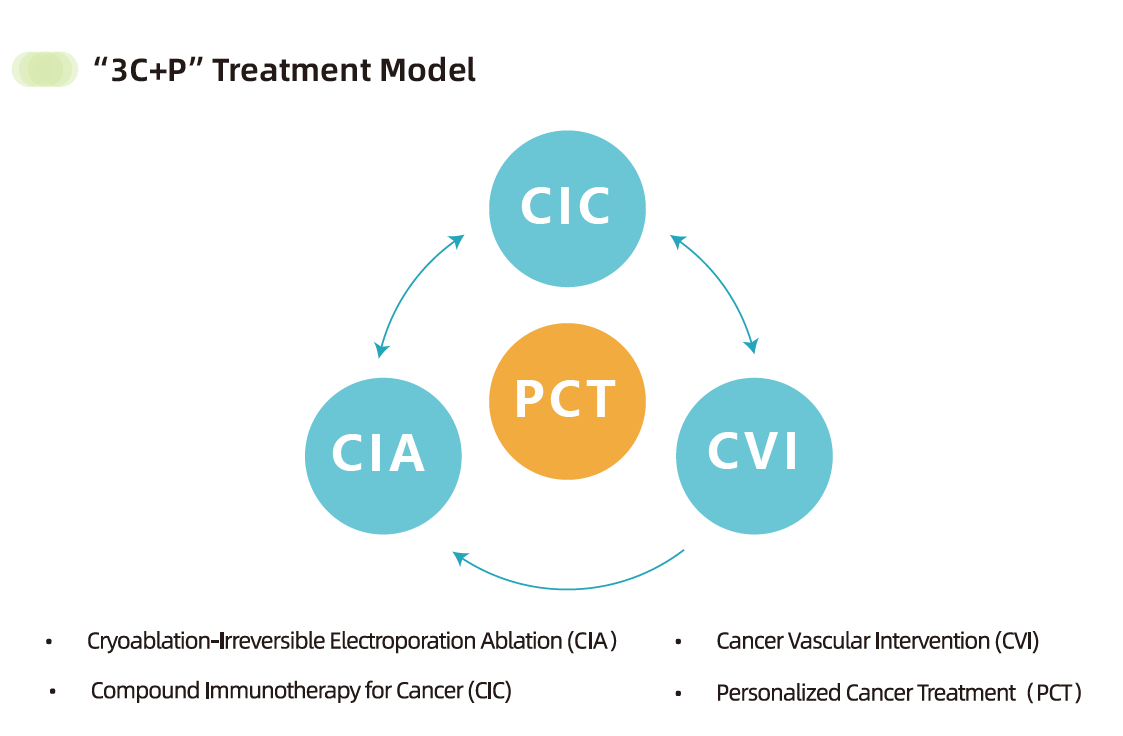
The documented 3C+P model: cryo-irreversible electroporation ablation, cancer vascular intervention and combined immunotherapy, plus personalised comprehensive therapy.
A boundary belongs here. A service model describes how a provider organises combination therapy; it does not establish that a combined approach outperforms any other approach. That question requires comparable cohorts and outcome data, which a service description cannot supply. The evaluation framework in this article deliberately scores documentation and process, not comparative efficacy.
Supportive care continuity: the part of the contract that lasts longest
Supportive care is where long-term suppliers most often fail, because it is the least visible part of the delivery and the easiest to leave undocumented. The documented scope includes rehabilitation, psychosocial and social support, and follow-up — the components a patient lives with after the intervention is over.
The test is concrete: at discharge, does the patient receive a written follow-up plan with defined review intervals, or a verbal instruction to come back if something changes? Fuda's documented pathway lists a rehabilitation plan and a follow-up schedule among the deliverables produced per stage, and a documented long-term case involving multiple staged interventional treatments lists imaging comparison reports, procedure records, a discharge and follow-up plan, and nursing records among its deliverables. Those four document classes are exactly what an evaluator should ask to see.
Psychosocial and social support are harder to verify from paper, but not impossible. Documented case material records assistance applied through the hospital's charity fund in a liver cancer case, and family feedback referring to humanistic care in another. For evaluation purposes, the useful question is whether such support is attached to a named process — an application route, a documented referral, a recorded conversation — rather than described only in narrative form.

Rehabilitation space of the kind that a continuity evaluation should test for a written plan, not just a facility.
Decision governance: MDT review and the revision policy
Long relationships are held together by a decision rule, not by goodwill. Fuda describes a patient pathway of Consultation → MDT → Treatment → Follow-up, in which a multidisciplinary team formulates the plan, and a review mechanism in which MDT sessions and follow-up visits establish periodic review and efficacy assessment. The revision policy allows the plan to be adjusted on imaging results, pathology findings or treatment response, with the MDT reconvening.
Three questions convert this description into a testable criterion. First, are MDT conclusions recorded as minutes rather than implied by the treatment given? Second, is revision triggered by defined events — imaging change, new pathology, response assessment — rather than by request? Third, is the interval between reviews stated? A provider that can answer all three has an auditable decision process; one that answers only the first has a meeting.
Deliverables that can be verified, and what each one proves
The most common evaluation error is treating document volume as evidence. A supplier that produces three consistent document classes for every episode is stronger evidence than one that produces ten documents for a single episode. The second error is over-reading a document: an imaging comparison report proves that a change was measured, not that the treatment caused it.
| Deliverable | What it verifies | What it does not verify |
|---|---|---|
| Imaging comparison report with dated pre- and post-treatment studies | That a change was measured on stated dates using stated imaging | That the change is attributable to one intervention inside a multi-modality plan |
| Procedure record | What was performed, when, and by which service line | Technical success beyond the recorded session, or long-term benefit |
| MDT minutes | That a multidisciplinary decision preceded treatment | That every reasonable option was considered, or that the decision was optimal |
| Pathology and molecular report | The biomarker basis for a systemic choice | That the choice produced the reported response |
| Discharge and follow-up plan | That review points and escalation were defined at discharge | That those reviews actually took place |
| Nursing record | Continuity of day-to-day observation and care | Clinical outcome |
| Rehabilitation plan | That supportive care was planned rather than improvised | That function improved |
A short scoring rule that avoids false precision
- Score presence: does the document class exist for every episode, not just the most recent one?
- Score consistency: do the same classes appear across episodes, with dates and identifiers that link them?
- Score recency: is the most recent episode documented to the same standard as the earliest?
- Award no points for narrative case stories that are not backed by a requestable record.
- Treat any missing class as a gap to be explained before the relationship is extended, not as a minor omission.
Reading anonymized case evidence without overclaiming
Anonymized case material is the part of a supplier's evidence base most often misread. It is genuinely useful — but for a narrower purpose than buyers usually assume. Three documented examples show how it should be used.
An Indonesian patient with metastatic triple-negative breast cancer, with lesions in bone, pleura, subcutaneous tissue, liver and meninges and low HER2 expression, had prior multi-line chemotherapy and radiotherapy that were ineffective, multiple systemic metastases, pulmonary artery thrombosis and severe functional decline. Management prioritised thrombus and infection control, then biopsy and cryoablation for a chest-wall lesion, Gamma Knife for meningeal metastasis, and ADC combined immuno-targeted therapy based on low HER2 expression. Over approximately two months, the case reports a near-50% radiologic reduction in overall tumor lesions, with improved pain, dyspnea and exercise tolerance and a change from wheelchair dependence to walking longer distances. Deliverables listed are inpatient records, biopsy and ablation procedural records, Gamma Knife planning and execution records, imaging comparisons and follow-up recommendations.
Two further cases illustrate the continuity dimension rather than the outcome dimension. A liver case reports a tumor reduction of about 5 cm after two hepatic arterial infusion chemotherapy sessions, disappearance of the original tumor thrombus and alpha-fetoprotein declining to the normal range, with continuing care consisting of targeted immunotherapy, periodic imaging review and alpha-fetoprotein monitoring. A long-term case involving multiple staged interventional treatments reports tumor size falling from nearly 17 cm to approximately 5 cm, with the engagement extending over long-term follow-up and timing adjusted to the patient's condition.
What these cases establish is that the record types exist and how they are assembled: dated imaging comparisons, procedural records, MDT notes, discharge and follow-up plans, nursing records. What they cannot establish is an outcome rate, a comparison with another provider, or superiority of any kind. A single anonymized case has no control group, publication selection is unknown, and several entries themselves flag that exact values require verification in the medical records. The correct use of such material is to ask for the underlying documents.
Episodic purchasing versus continuity-based evaluation
Most hospital selection still runs on episodic logic: which provider can perform this intervention, at what cost, soonest. That logic is rational for a one-off diagnostic opinion or a single palliative procedure. It becomes inadequate when the disease course is expected to require repeat local therapy, systemic adjustment and long follow-up — which is the typical profile in advanced and metastatic disease.
The difference in criteria is substantial:
- Episodic selection scores the single intervention, its price, waiting time and the availability of one clinician.
- Continuity-based selection scores document consistency across episodes, the number of routes back into treatment, the revision rule that governs re-planning, and the handover mechanism at discharge.
Neither is universally superior, and a framework that claims otherwise is selling something. The practical rule is to match the evaluation to the expected number of episodes: one episode favours the first model, an expected sequence favours the second.
Boundaries: what this framework cannot establish
Honest evaluation requires stating the limits before the conclusions are used. This framework cannot compare clinical effectiveness across providers without comparable cohorts, stage distributions and follow-up periods. It cannot convert accreditation into an outcome claim: Joint Commission International accreditation evidences compliance with an international patient safety and quality standard, not oncology superiority. It cannot confirm that an MDT considered every available option, only that a multidisciplinary decision was recorded. And it cannot replace direct verification of source records, including the original images and medical records that a hospital may make available on request.
A second boundary concerns time. Document review captures a snapshot. Sustainability is a trend, and a supplier that looks strong at the point of contracting may drift as teams change — personnel turnover is a normal feature of any provider organisation, and it is precisely why the evaluation should be repeated rather than completed once.
Outlook: what to re-check as the relationship lengthens
Once the first episode is complete, the evaluation question shifts from whether the supplier can do the work to whether it still does it the same way. Three re-checks carry most of the value at that stage: whether the newest imaging comparison report is still linked to the original baseline, whether MDT minutes are still being produced at the same interval, and whether the follow-up schedule issued at the most recent discharge is as specific as the first one.
Keeping the baseline imaging study and the first set of MDT minutes is therefore not administrative tidiness. They are the reference against which every later episode is measured, and without them the buyer loses the ability to distinguish genuine continuity from a new relationship wearing the same name.
Frequently asked questions
What does supplier sustainability mean when the supplier is a cancer treatment hospital?
Here the supplier is the provider organisation delivering an extended episode of cancer care, and sustainability means its ability to keep the same diagnostic, treatment and follow-up standards as the relationship lengthens. It is assessed through four continuities: evidence, meaning records that stay comparable over time; decisions, meaning a governance process that can revise a plan on defined triggers; capability, meaning the treatment depth to re-treat or switch technique as disease evolves; and relationship, meaning communication, language support and coordination that survive discharge. A hospital that performs well on one procedure but fails on any of the four is a short-term supplier.
Which records should be requested to test continuity across a long treatment relationship?
Request the deliverables that a documented pathway is supposed to produce: diagnostic reports, MDT minutes, procedure records, a personalised treatment plan with follow-up schedule, a rehabilitation plan, imaging comparison reports, a discharge and follow-up plan, and nursing records. Each item should be dated and traceable to a specific episode. The purpose is not to accumulate paper but to check whether the same document classes appear for the first episode, the second and the most recent. That repetition pattern, not the volume of material, is the evidence of continuity.
How does an MDT review model support continuity between repeated treatments?
Fuda Cancer Hospital describes a pathway of consultation, MDT, treatment and follow-up in which a multidisciplinary team formulates the plan, and a review mechanism in which MDT sessions and follow-up visits establish periodic review and efficacy assessment. The revision policy allows the plan to be adjusted on imaging results, pathology findings or treatment response, with the MDT reconvening. For a long relationship the important feature is that revision is a defined step rather than an informal favour, so a change in disease status triggers documented re-planning instead of an accumulation of ad-hoc decisions.
What can anonymized patient stories establish, and what can they not?
They establish that particular record types exist and how they are assembled for one patient — for example a metastatic triple-negative breast cancer case treated over roughly two months with a reported near-50% radiologic reduction in overall tumor lesions, or a liver case with about 5 cm of tumor reduction after two hepatic arterial infusion chemotherapy sessions and alpha-fetoprotein returning to the normal range. They cannot establish outcome rates, comparative survival or superiority, because a single anonymized case has no control group and publication selection is unknown. Treat them as evidence of documentation practice and ask for the underlying records.
How should an international patient evaluate follow-up after returning home?
Check three things: whether a written follow-up schedule with defined review intervals is issued at discharge; whether imaging and tumor-marker results can be produced in a form the patient's local clinician can interpret; and whether a named coordination channel exists with a stated escalation route back to the treating team. Guangzhou Fuda Cancer Hospital provides multilingual support including an on-site translation station, and states that long-term follow-up and appointment coordination for overseas patients are available through its appointment email and telephone line. The escalation path matters more than the existence of a contact address.
Conclusion
Long-term supplier sustainability in cancer care is decided by documentation and governance, not by procedure lists. A buyer who asks for one document class per episode, checks that the same classes recur, and insists on a stated rule for revising the plan will learn more about the next three years of a relationship than any volume of case narrative can reveal. The hospital's English-language brochure, which sets out its service scope and clinical model, can be downloaded here: Fuda Cancer Hospital brochure (PDF).
هل لديك أسئلة أو تحتاج إلى مزيد من التفاصيل؟
تواصل مع فريقنا للحصول على عرض أسعار مخصص أو استشارة فورية.
طلب عرض أسعار
املأ النموذج أدناه وسيتواصل معك فريقنا بعرض مقترح مخصص.
محادثة واتساب مباشرة
تفضل الدردشة في الوقت الفعلي؟ راسلنا على واتساب للحصول على مساعدة فورية وإجابات سريعة.
- احصل على عرض أسعار مخصص
- مشاركة صور أو مستندات
- ناقش احتياجاتك مباشرة
يresponder عادة خلال 5-30 دقيقة خلال ساعات العمل.