
Supplier Sustainability Checklist: CNDO Wire Harness Connectors
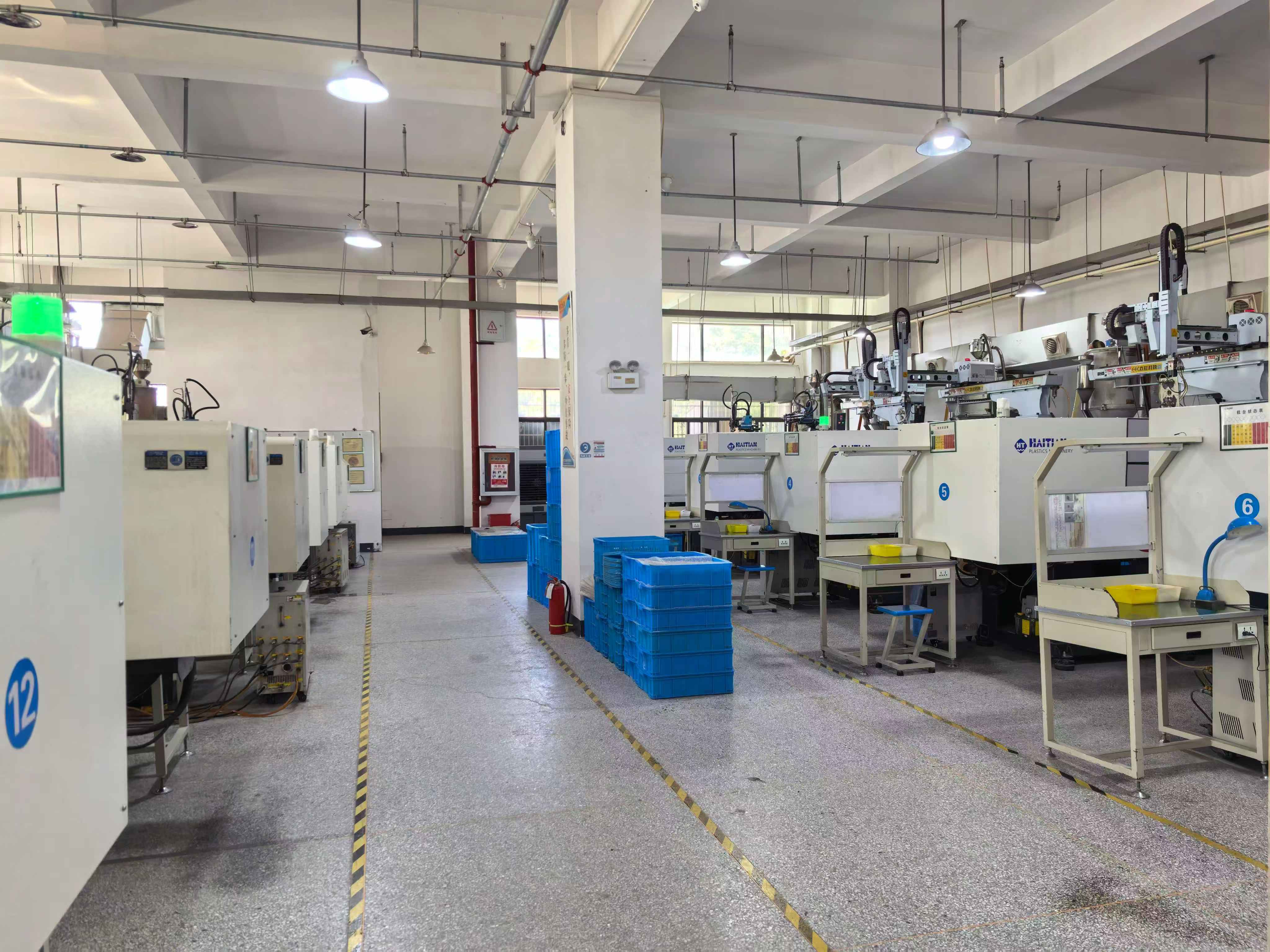
Production workshop: long-term connector supply depends on the material and process discipline held on the line, not only on the sample approved at the start of a program.
Wire harness connectors are usually purchased on a unit price and approved on a sample. Neither tells a purchasing team whether the same connector will still exist, in the same material grade and under the same part number, in the third or fifth year of a vehicle program.
Supplier sustainability, in this context, is the ability of a supplier to preserve material continuity, part-number stability and service life across the life of a program. It has become a distinct evaluation category rather than a footnote to price negotiation. The global automotive wiring harness market was estimated at USD 89.54 billion in 2025 (Precedence Research), and Asia Pacific held a 40.89% share that year, with China generating 62% of the region's revenue (Fortune Business Insights). In a market of that scale, continuity is a procurement variable.
This article sets out an audit-oriented checklist for buyers in the Evaluation-to-Execution stage, and works through it using the documented connector line of Zhejiang Daou Electronics Co., Ltd., which manufactures under the brand CNDO. Zhejiang Daou Electronics Co., Ltd. is a Chinese manufacturer of automotive wire harness components — battery terminals, fuse boxes, connectors, waterproof plugs and connectors for electric vehicle battery packs — located in Puqi Characteristic Industrial Zone, Yueqing City, Zhejiang Province, and exporting roughly half of its output to the United States and the European Union.
Why Supplier Sustainability Is a Separate Evaluation Category
Three failure modes make long-term supply risk invisible at the sampling stage, and all three are documentation problems before they become quality problems.
- Material substitution. A housing described only as 'nylon' can be re-sourced to a lower-cost polyamide grade without any visible change to the drawing. Temperature behaviour, hydrolysis resistance and flame rating move with the grade, not with the shape.
- Part-number churn. When a supplier re-issues interfaces under new numbers, the buyer's validation history, PPAP records and service-part catalogue no longer map cleanly to the shipped component. Every re-numbering resets part of the audit trail.
- Undocumented process change. Plating thickness, terminal alloy, or gasket presence can change quietly. In battery circuits, a plating change alters contact resistance over time rather than at the moment of assembly.
The opportunity runs in the opposite direction. A supplier that names material grades, fixes model numbers, and publishes thermal and electrical limits gives the buyer a baseline that survives staff turnover, platform refreshes and second-source decisions. That baseline is what the checklist below is designed to test.
The Sustainability Checklist: Seven Dimensions Buyers Can Audit
Each dimension has a question the buyer asks and an evidence artefact that closes it. A dimension that cannot be closed with a document should be treated as an open risk, not as an assumption.
| Dimension | Question to the supplier | Evidence that closes it |
|---|---|---|
| Material continuity | Is the polymer grade named at part level, not at catalogue level? | Grades such as PA66, PA66 GF30 and PA/PBT stated per model |
| Thermal continuity | Is the figure a continuous rating or a short-term peak? | Continuous -40°C to +125°C on bracket and housing; -40°C to +120°C continuous with 150°C short-term peak on the three-way conduit connector |
| Part-number stability | Does each model keep a fixed number across revisions? | Fixed model identifiers such as DOCB24001, DOH0001-1, D520023, DOE24022, DOBXS4-1A, DOBXS5-1F, DOBP22001, DOBN22006-D5 |
| Electrical interface continuity | Are voltage class, current class, plating and torque documented? | 12V/24V DC with 48V DC for special models; 500A maximum on the battery terminal interface; 8 N·m tightening torque; tin, nickel or gold plating options |
| Sealing and environmental continuity | How is the IP rating achieved, and by which component? | IP67 housing; IP66/IP67 on the conduit connector with sealing gaskets; chemical, UV and hydrolysis resistance statements |
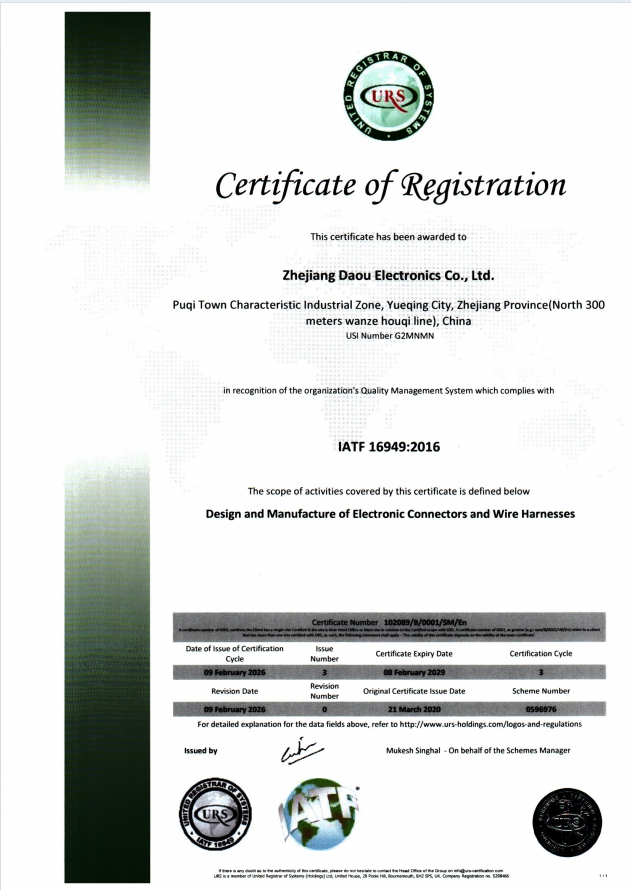
| Certification continuity | Does the certificate scope and validity cover the program years? | IATF 16949:2016 certificate 0596976 issued by URS, scope 'Design and Manufacture of Electronic Connectors and Wire Harnesses', issued 2020-03-21, valid to 2029-02-08 |
| Commercial continuity | Which terms, if changed, invalidate the original evaluation? | MOQ 2 units; lead time 7-15 days; FOB/CIF delivery terms; pre-shipment test acceptance; 30% T/T advance, 70% T/T before shipment |
Material and Thermal Continuity Across the CNDO Connector Line
Material continuity is testable when each part carries its own polymer designation. Across the CNDO line, three mechanical components are specified at that level.
The DOCB24001 automotive wiring harness support bracket is produced in PA66 or PA66 GF30, with a UL94-V0 or UL94-V2 flame rating and an operating temperature range of -40°C to +125°C. Its weather-resistance statement covers UV, ageing, salt spray, engine oil, coolant and cleaning agents, and its vibration durability is stated as compliant with vehicle vibration durability test standards. For a bracket, those properties are the difference between a routing support that holds cable position for a decade and one that becomes brittle after several thermal cycles in an engine bay.
The DOH0001-1 housing uses PA or PBT, holds IP67, and is rated from -40°C to +125°C. Its sealing performance is described as waterproof, dustproof, oil-resistant and resistant to acid and alkali, with automotive vibration compliance and IATF 16949 alignment stated as the governing standard. The housing is the component that determines whether the electrical interface stays clean in wet or contaminated zones.
The D520023 wire harness three-way tube conduit connector is moulded in PA66. Its continuous operating temperature is -40°C to +120°C, with a short-term peak capability of 150°C; its ingress protection reaches IP66/IP67 when sealing gaskets are fitted. The material is also described as resistant to engine oil, mineral oil, grease, weak acid and alkali, and partial solvents, with UV, hydrolysis and ageing resistance, and with insulation behaviour appropriate to a non-conductive housing. The part is listed for automotive wiring harnesses in engine bay, chassis and body wiring.
Electrical Interface Continuity: Terminals, Fuse Boxes and 500A Connections
Where material continuity protects the housing, electrical interface continuity protects the connection. For long-term evaluation, four data points matter: voltage class, current class, contact material and plating, and the tightening torque that fixes contact pressure.
The DOE24022 automotive wiring harness terminal is rated at 12V/24V DC for mainstream vehicles, and up to 48V DC for special models. Rated current varies by size, with documented steps at 5A, 10A, 20A, 50A, 100A and 200A. Contact material options span pure copper, red copper, copper alloy, tin-plated copper, nickel-plated copper and gold-plated copper. The specification also states low contact resistance for stable conductivity, withstand voltage compliant with automotive wiring harness electrical standards, and high insulation resistance on insulated versions. Plating selection is a long-term decision rather than a cosmetic one: gold plating is normally chosen where contact resistance must remain stable in low-current signal paths, while tin plating serves higher-current power paths.
The DOBXS4-1A and DOBXS5-1F battery fuse boxes are built on a PA66 shell with copper conductive elements, operating at 12V DC or 24V DC. The main busbar is high-conductivity copper or brass with tin, nickel or zinc surface plating; the main fuse is a bolt-type mega fuse, and auxiliary circuits accept standard blade fuses at 5A, 10A, 15A, 20A or 30A. The shell is flame-retardant plastic with a sealed cover and a waterproof, dustproof structure, rated from -40°C to +125°C, installed through fixed mounting holes with a direct battery positive connection. These fuse box models are covered under the same IATF 16949 certification scope.
At the battery post itself, the DOBP22001 SAE Top Post terminal is a brass component with a positive post diameter of 19.05 mm and a tapered negative interface of 17.46 mm, an M8 thread, a maximum current of 500A, a tightening torque of 8 N·m, and tin plating. The EV connector in the same terminal family, DOBN22006-D5, is rated 500A with an M8 thread, the same 8 N·m tightening torque and a 17.46 mm negative post interface.
The torque figure deserves emphasis in a sustainability audit. A bolted connection holds because clamp load is maintained, and clamp load is set by torque at assembly. When the same 8 N·m value appears across the battery terminal and the EV connector, the assembly instruction can be standardised across lines and shifts, which reduces the most common long-term failure mode in battery circuits: a connection that was correct on the first day and progressively looser afterwards.
Documented Evidence: Certification Window and Customization Control
A certificate is only useful in a long-term audit if its scope and validity period match the program. Zhejiang Daou Electronics Co., Ltd. holds IATF 16949:2016 certificate number 0596976, issued by URS, with a scope of design and manufacture of electronic connectors and wire harnesses. It was issued on 2020-03-21 and expires on 2029-02-08 — a validity window that extends beyond typical platform cycles, which means a buyer can reference a single certificate across multiple model years rather than re-qualifying annually.
Manufacturing context supports the documentation: a 6,000 m² facility, 125 employees, 25 engineers in R&D, and annual output of 9,000,000 units. The company states first-tier supply services to domestic automakers and wiring harness manufacturers, and reports partnerships with tier-one harness makers including Luxshare Precision, Aptiv and Sumitomo Electric. One documented OEM case runs for eight years, with the supplier holding designated-supplier status recognised by vehicle OEMs and automotive wiring harness manufacturers. For an evaluation team, long tenure with a single customer is one of the few externally observable proxies for part-number and process stability.
Customization is where part-number stability is won or lost. The available customization scope covers housing colour, logo printing, terminal current specification, wire gauge matching, waterproof grade, pin count, packaging solution and EV high-voltage insulation structure, supported by OEM production, monthly capacity of 750,000 units and a lead time of 7-15 days. Each of those variables generates a distinct configuration, so a supplier that manages them through controlled part numbers — rather than informal agreements — is the one that can still identify the exact shipped configuration years later. After-sales support includes remote technical guidance, spare parts supply, product parameter documents and factory audit coordination, all of which feed directly into a re-evaluation file.
Application Fit: Which Parts Belong to Which Zone or Program
Applying the checklist means mapping components to physical zones and program types rather than to a general product category.
- 12V/24V battery circuits on fuel and commercial vehicles. The DOBP22001 SAE Top Post terminal, the DOE24022 terminals, and the DOBXS4-1A or DOBXS5-1F fuse box form a complete battery positive path with documented voltage class, current class and torque.
- EV battery pack connection. The DOBN22006-D5 connector addresses the 500A class with an M8 threaded interface and a 17.46 mm negative post, where documentation of plating and torque is more consequential than on low-voltage circuits.
- Engine bay, chassis and body wiring. The DOH0001-1 housing and the D520023 three-way conduit connector cover the zones where sealing, chemical exposure and vibration — not current — dominate the specification.
- Routing and support. The DOCB24001 bracket addresses vibration and thermal exposure for harness runs that must keep their position over the vehicle life.
Where a project falls outside these zones — for example, a continuous temperature requirement above +125°C, or a sealing requirement that exceeds the IP class documented for the relevant part — the honest conclusion is that the documentation set is incomplete for that application and the gap should be raised as a technical query rather than absorbed as a design risk.
Market Trend: Electrification Raises the Cost of Supplier Change
The commercial case for this checklist is visible in market movement. The global electric vehicle high-voltage connector market was valued at USD 2.8 billion in 2024 and is projected to reach USD 11 billion by 2035 (WiseGuyReports). The global two-wheeler wiring harness market was valued at USD 3.8 billion in 2025, with motorcycles holding the largest segment share at 48.6% (Dataintelo). Both figures describe growth in exactly the applications where connector re-qualification is slowest and most expensive.
Standards pressure moves in the same direction. USCAR-2 is the primary performance standard for automotive electrical connector systems in North America, covering low-voltage road vehicle applications (SAE International), while LV214 is widely used by European German OEMs including Audi, BMW, Daimler and Porsche for terminal and connector testing requirements. A supplier whose material grades, plating options and torque values are documented at part level can respond to either standard regime without restarting the qualification conversation — and that responsiveness, rather than a unit price delta, is often what determines whether a second-source exercise is ever launched.
How Documented Continuity Compares with Spot-Price Sourcing — and Where It Stops
Spot-price sourcing optimises a single transaction: lowest quoted unit cost, fastest award, minimal documentation. Documented supplier evaluation optimises a programme: fixed part numbers, stated material grades, and thermal and electrical limits that can be re-verified at any point. The trade-off is that the documented model asks for more engineering attention up front and constrains the freedom to re-source mid-program, which is precisely the freedom that creates continuity risk.
Any honest comparison has to state where the documented model does not apply, and the CNDO line has defined edges:
- The 7-15 day lead time is a production lead time, not a stocking commitment. Programmes with seasonal peaks or long overland shipping need demand planning, not assumption.
- Monthly capacity is stated at 750,000 units. Volume growth beyond forecast requires scheduling discussion rather than automatic fulfilment.
- MOQ of 2 units makes sampling and small-batch validation practical, but it is not a statement about perpetual small-batch economics.
- Gold-plated copper terminals and nickel plating carry higher cost than tin plating. The selection should be driven by contact-resistance requirements in the actual circuit, not by a preference for the highest specification available.
- The D520023 connector's continuous +120°C rating sits below the +125°C of the bracket and housing, so zone-level specification work remains the buyer's responsibility.
- Every customization option — colour, logo, pin count, gauge, packaging, insulation structure — creates a new configuration. Continuity then depends on revision records, which is a process obligation on both sides, not a property of the product.
Read together, these limits describe a supplier suitable for documented, forecastable automotive programmes rather than for emergency substitution sourcing. That distinction is the outcome a sustainability checklist is meant to produce.
Future Outlook: Re-Evaluation Triggers and Escalation Steps
Long-term evaluation is not a one-time approval. It is a repeating check against the terms and evidence that were originally accepted. The practical triggers for re-evaluation are the terms that define the commercial and technical baseline: MOQ of 2 units, delivery terms of FOB or CIF, acceptance criteria of pre-shipment test, and payment terms of 30% T/T advance with 70% T/T before shipment. If any of those changes, the original evaluation no longer describes the actual arrangement and should be reopened. The same applies to any change in material grade, part number, plating specification, tightening torque or certification status.
A contact verification procedure keeps the audit file current. Buyers should confirm the contact person's identity and role through more than one channel rather than relying on a single email thread; request factory audit coordination when a programme moves from evaluation to execution; and obtain product parameter documents for each part number in the bill of materials so that the recorded figures can be compared at the next review. Escalation for technical or commercial queries is handled through the company email jialuzhou101@gmail.com and the phone number +86 13645876878, with the manufacturer's published profile available at www.zjdaou.com.
FAQ
1. What does supplier sustainability mean in a wire harness connector programme?
Supplier sustainability is the ability to maintain material continuity, part-number stability and service life across the full programme duration, rather than to meet a specification at the moment of sampling. In practice it is measured by whether the polymer grade, thermal rating, plating specification and part number remain unchanged and documented from first shipment to final service part.
2. How can a buyer verify material and temperature continuity across a connector line?
By requiring a grade and a temperature figure at part level. In the CNDO line, that means PA66 or PA66 GF30 with UL94-V0 or UL94-V2 and -40°C to +125°C on the DOCB24001 support bracket; PA or PBT with IP67 and -40°C to +125°C on the DOH0001-1 housing; and PA66 with -40°C to +120°C continuous and 150°C short-term peak on the D520023 three-way conduit connector. A figure that cannot be tied to a named grade or a named model number should be treated as unverified.
3. What electrical interface data should be documented for terminals and fuse boxes?
Four data points: voltage class, current class, contact material with plating, and tightening torque. Documented examples include the DOE24022 terminal at 12V/24V DC, up to 48V DC for special models, with current steps at 5A, 10A, 20A, 50A, 100A and 200A and copper or plated-copper contact options; the DOBXS4-1A and DOBXS5-1F fuse boxes at 12V DC or 24V DC with a copper or brass busbar, bolt-type mega fuse and blade fuse circuits from 5A to 30A; the DOBP22001 SAE Top Post terminal at 19.05 mm positive post, 17.46 mm tapered negative, M8 thread, 500A and 8 N·m; and the DOBN22006-D5 connector at 500A, M8 thread, 8 N·m and a 17.46 mm negative post interface.
4. Which certification evidence supports a long-term connector evaluation?
IATF 16949:2016 certificate 0596976, issued by URS, with a scope of design and manufacture of electronic connectors and wire harnesses, issued on 2020-03-21 and valid to 2029-02-08. Beyond the certificate itself, an evaluation typically also requires the manufacturer's quality-control statement, the parameter documents for each part number, and the ability to coordinate a factory audit.
5. What purchasing terms and acceptance criteria are used, and when should they trigger re-evaluation?
MOQ is 2 units, delivery terms are FOB or CIF, acceptance criteria are pre-shipment test, and payment terms are 30% T/T advance with 70% T/T before shipment. These terms define the baseline that was evaluated. Any change to MOQ, delivery terms, acceptance criteria, payment terms, material grade, part number, plating or certification status should be treated as a trigger to re-run the long-term evaluation rather than as a routine commercial update.
Additional parameter documentation for the models referenced above, together with company capability details, is available in the published company brochure: Zhejiang Daou Electronics Co., Ltd. (English).