
Surface Pump Certificates: What the Numbers Actually Prove
Surface Pump Certificates: What the Numbers Actually Prove
A buyer comparing surface pump suppliers on specifications alone is comparing intentions. Flow, head and motor rating describe what a supplier says a pump will do; they do not show which models an appointed testing body has actually assessed, against which standard editions, or for how long that assessment holds. Three questions decide whether a capability claim can be used in a tender: who issued the evidence, what it covers, and whether it was valid when the goods were produced.
The certificate pack published by Zhejiang Happy Pump Industry Co., Ltd. (HAPPY) — a pump and motor manufacturer established in 1990 in Daxi Town, Wenling City, Zhejiang Province — works as a concrete example of how those questions are answered in practice. It contains a CE Attestation of Conformity issued by ECES under number CE-5072-160326, and EMC and LVD certificates issued by OViS-CERT under numbers OViS202507249E and OViS202507249L. Together the three documents name seven pump series and cite the standards behind the conformity statements.
What follows is an assessment framework rather than an endorsement. It examines how the documents fit together, where their scope stops, how they relate to the stated 1.5–5500 m³/h flow range, 20–100 m head range, 0.25–550 kW power range and 1–430 HP motor range, and which purchasing terms and acceptance criteria belong in the purchase order. The same questions apply to any surface pump supplier, including the one used here as the worked example.
Why a capability claim and capability evidence are different things
A capability claim is a sentence: the supplier is certified for Europe. Capability evidence is a record with an issuer, a number, a standard, a model list and a validity window. The difference is not academic. When a compliance team, an insurer or a tender evaluator asks for proof, only the second form is usable.
Three attributes separate the two. The first is the issuer: an appointed certification body has an identity that can be checked independently, while an internally produced quality certificate does not. The second is the scope: a document that covers water pumps as a category is weaker evidence for a specific model than a schedule that names that model. The third is the time window: an issue date and an expiry date let a buyer see whether the document was in force during the production period, not merely during the enquiry.
A shortlist-stage test follows directly from those three attributes. Ask which body issued the document and under what accreditation; ask which base standard and which part-2 standard apply to the product family; ask which models, voltages and frequencies appear in the schedule. A supplier who answers from documents is giving the buyer something to verify. A supplier who answers from memory is asking for trust, which is a different commercial proposition.
The three certificate layers and what each one governs
The HAPPY set separates the layers that European-facing pump buyers usually have to reconcile: a CE Attestation of Conformity, an EMC certificate and an LVD certificate. They are not interchangeable. A buyer who folds all three into a single CE document will miss which legal instrument each one addresses, and will be unable to tell a genuine filing gap from a missing attachment.
CE Attestation of Conformity CE-5072-160326 (ECES)
Issued by ECES on 16 March 2026 and valid to 16 March 2031, certificate CE-5072-160326 covers water pumps and cites three directives: 2014/35/EU (Low Voltage Directive), 2014/30/EU (Electromagnetic Compatibility Directive) and 2006/42/EC (Machinery Directive). Its function is to state which legal instruments the product is assessed against. It does not, on its own, report test results for a particular duty point, and it should not be read as a performance document.
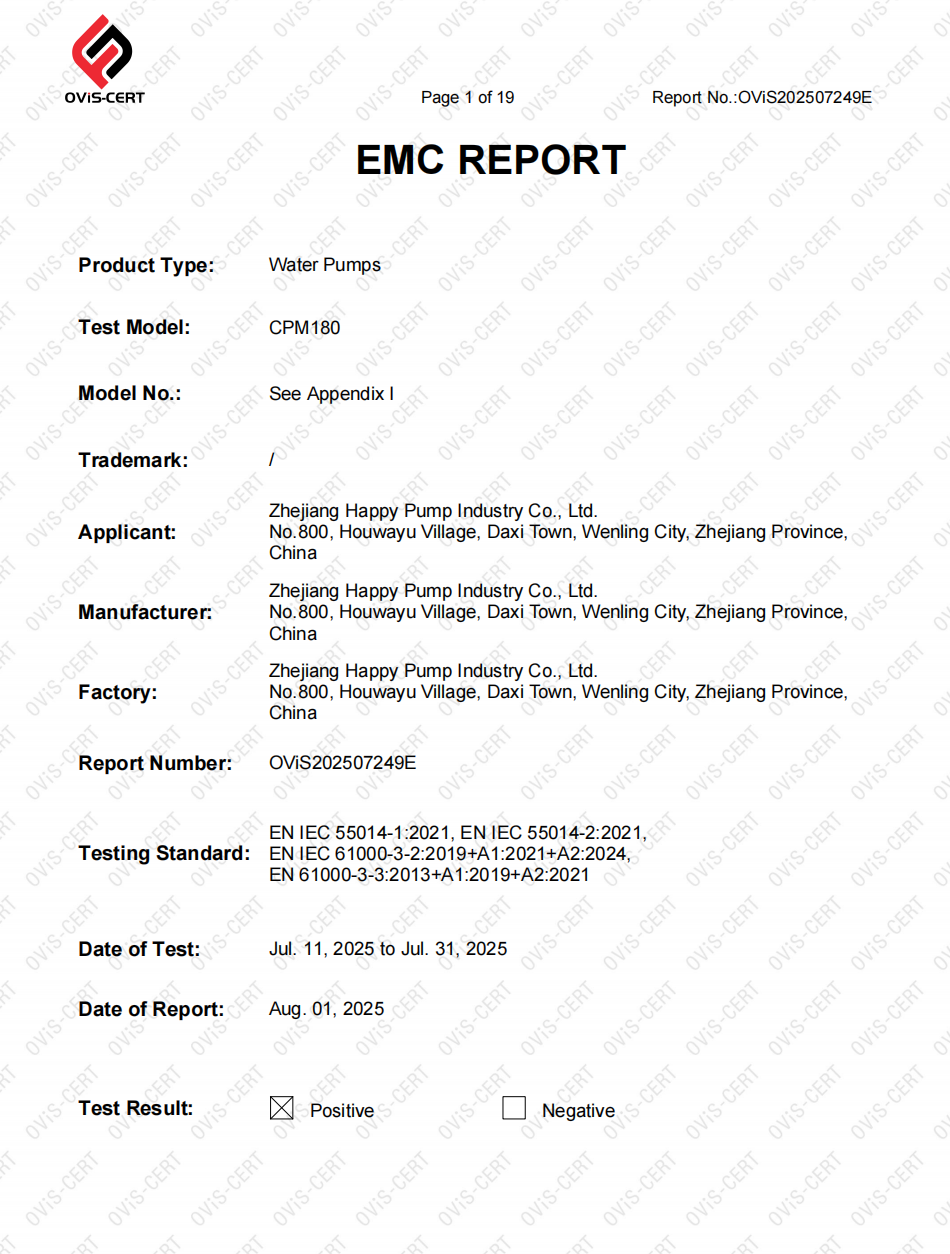
EMC certificate OViS202507249E (OViS-CERT)
Issued by OViS-CERT on 1 August 2025, the EMC certificate cites EN IEC 55014-1:2021 and EN IEC 55014-2:2021 for emission and immunity, together with EN IEC 61000-3-2:2019+A1:2021+A2:2024 and EN 61000-3-3:2013+A1:2019+A2:2021 for harmonic current and voltage fluctuation limits. For a pump buyer the practical reading is that the assessment covers both what the motor and any control gear emit and how the unit behaves when the supply is disturbed. That distinction matters in household and agricultural installations where the pump shares a supply with lighting, controls or other motors.
LVD certificate OViS202507249L (OViS-CERT)
The LVD certificate, also issued on 1 August 2025, cites EN 60335-1 with its consolidated amendments through A16:2023, EN IEC 60335-2-41:2021+A11:2021, EN 62233:2008+AC:2008 on electromagnetic fields, and EN 60034-1:2010+AC:2010 for rotating electrical machines. The presence of EN 60335-2-41 is the specific marker here: a general household-appliance assessment that stops at part 1 does not address the pump-specific requirements, and buyers who know the standard family look for that line first.
Reading the model schedule: what is covered and what is not
The schedule is the part buyers skip and later regret. The HAPPY documents name HQBm, QB60, IDB35, HPSm-AX, HRSm-A, QDP series and QDX series. That list defines the boundary of the claim. A configuration outside it — a different series, or a variant whose motor, voltage or control arrangement differs materially from the assessed configuration — is not covered simply because the supplier holds certificates for other models.
| Certificate | Number | Issuer | Standards or directives cited | Models named | Issue / validity |
|---|---|---|---|---|---|
| CE Attestation of Conformity | CE-5072-160326 | ECES | 2014/35/EU; 2014/30/EU; 2006/42/EC | Water pumps — HQBm, QB60, IDB35, HPSm-AX, HRSm-A, QDP series, QDX series | 16 Mar 2026 – 16 Mar 2031 |
| EMC | OViS202507249E | OViS-CERT | EN IEC 55014-1:2021; EN IEC 55014-2:2021; EN IEC 61000-3-2:2019+A1+A2; EN 61000-3-3:2013+A1+A2 | Same model schedule | Issued 1 Aug 2025; expiry 1 Jan 2099 |
| LVD | OViS202507249L | OViS-CERT | EN 60335-1 (+A11 to A16:2023); EN IEC 60335-2-41:2021+A11:2021; EN 62233:2008+AC:2008; EN 60034-1:2010+AC:2010 | Same model schedule | Issued 1 Aug 2025; expiry 1 Jan 2099 |
Two habits make the schedule usable. First, ask for the certificate as issued rather than a marketing extract; extracts routinely drop the model list and the standard editions, which are the two things an evaluator needs. Second, match the model designation on the certificate against the designation on the quotation character by character. Series-level naming is a common source of mismatch: a quotation for a variant of a listed series is not automatically the listed model, and the difference usually sits in the motor or the control arrangement.
The company profile adds context to that boundary. It describes a catalogue of 11 major series and more than 500 specifications, while the certificate schedule names seven series. The gap is not a defect in the certificates; it is simply the gap a buyer must close whenever the model under evaluation falls outside the list.
What the stated flow, head, power and motor ranges actually tell a buyer
The supplier states a pump range of 1.5–5500 m³/h, a head range of 20–100 m, a power range of 0.25–550 kW and a motor range of 1–430 HP. Read as a range, those figures describe catalogue breadth, not a single machine. No certificate validates performance across a range; performance evidence belongs to the model and its duty point, which is why the two document sets should be requested together.
Flow and head
A 1.5 m³/h duty and a 5500 m³/h duty do not sit on the same hydraulic platform, and a head band of 20 to 100 m spans duties from single-storey domestic boosting to multi-stage work. For the buyer, the range is useful for judging whether a supplier plausibly covers the intended application family; it is not a substitute for a curve. Ask for the curve at the specified speed, the efficiency at the duty point, and clarification of whether the quoted head is shut-off, rated or maximum. Those three readings differ by design, and a quotation that does not say which one is being cited cannot be compared with a competitor's.
Power and motor rating in mixed units
The power range is given in kilowatts and the motor range in horsepower. That pairing is common in export catalogues, and it is an easy place for a purchase order to go wrong. Confirm, per model, the motor rating in the unit that appears on the nameplate and in the destination market's documentation; confirm whether the rating refers to output or input power; and confirm the supply voltage and frequency that the rating assumes. A 1 HP unit and a 430 HP unit in the same catalogue share a document structure, not a procurement process — the MOQ band, the test regime and the shipping configuration all change with rating.
Efficiency, ingress protection and other gaps
Nothing in the described certificate set establishes motor efficiency class, ingress protection rating or a measured efficiency curve. Those are separate evidence items. A buyer who needs them for a tender should request them explicitly rather than infer them from the presence of a CE document. Absence of an inference is not evidence of absence of capability — it is simply an unverified point until the paper arrives.

Where the documented capability fits: application scenarios
The supplier's case record lists domestic and household water supply, garden irrigation, agricultural irrigation, sewage and engineering drainage, pool circulation and solar water pumping systems as typical use cases, with stable operation and low noise noted as recurring characteristics. Each application places weight on a different part of the evidence.
- Household and domestic water supply. The EMC and LVD layers carry the most weight, because the pump shares a domestic supply. Confirm the single-phase or three-phase configuration and the starting method before quoting, since both affect what the certificate schedule actually covers.
- Agricultural irrigation. Duty hours and supply quality dominate here. Confirm the motor rating at the actual site voltage and whether the quoted head corresponds to the field layout rather than to a catalogue maximum.
- Swimming pool circulation. Continuous duty and water quality put the emphasis on materials and on the exact series named in the schedule, not on the catalogue's pool section.
- Solar water pumping. Confirm which series is being offered. The certificate schedule, not the brochure's solar pages, defines coverage, and a solar configuration assembled around a listed pump is not the same product as the listed pump.
- Sewage and engineering drainage. Confirm the model family and whether the offered configuration appears on the schedule; project drainage work usually generates its own document trail, and mismatches surface at inspection.
Listing applications next to a certificate is not a suitability claim. It shows where verification effort should concentrate. A document that covers a model certifies that model against a standard; it does not certify the model for a duty, a fluid or an installation.
The limits of the evidence, stated plainly
A supplier profile that contains no limits is a marketing document. Four boundaries are visible in the HAPPY material, and each one changes how the rest should be read.
- Certificate scope is model-based, not catalogue-wide. Models outside the schedule need their own evidence, and a buyer should ask for it before the technical evaluation closes rather than after the order is placed.
- Customisation is limited to voltage and logo under the stated OEM/ODM arrangement. A buyer seeking hydraulic modification, different materials or a new control architecture is outside the described scope and should expect a separate engineering and validation path with its own timeline.
- After-sales support is described as remote support. That is a support channel, not a service-level commitment with stated response times; if response time matters to the project, it has to be negotiated as a term.
- Service life and warranty are separate statements. The case record indicates normal use of around ten years with a one-year warranty. The warranty is the contractual term; the ten-year figure is the manufacturer's expectation, not an independently verified test result.
None of these limits is unusual in the category. They matter because they mark where a claim ends and a contractual term begins — which is exactly the line a purchase order has to be written along.
Market context: why documentation is moving up the evaluation order
The wider pump market gives the compliance question its commercial weight. MarketsandMarkets estimated the global pumps market at USD 61.32 billion in 2024 in its Pumps Market Report 2024–2029, and P&S Intelligence put the domestic pump segment at USD 4.6 billion in 2025. Grand View Research projects 5.0% compound annual growth for the DC surface suction segment of solar pumps over 2024–2030. These are third-party estimates built on different methodologies and scopes, so they are useful for scale and direction rather than for precise comparison between segments.
The buyer-relevant reading is narrower. Wherever several suppliers can meet a given hydraulic duty, differentiation shifts to what can be documented: which standards, which models, which test records, which validity window. That shift favours suppliers who publish model-level schedules rather than category statements, and it raises the cost of an incomplete certificate pack at tender stage — not because a rule changed on a particular date, but because an evaluator comparing two packs will use the more specific one.
Purchasing terms and acceptance criteria to confirm in writing
Commercial terms are what convert a shortlist into an order. The HAPPY material states OEM and ODM production with voltage and logo customisation, a monthly capacity of 400,000 units, a lead time of 30–45 days, FOB and CIF delivery, a 30/70 payment structure, 100% testing in production and pre-shipment testing as the acceptance basis.
| Term | Stated position | What the buyer should confirm |
|---|---|---|
| Minimum order quantity | 50 pcs above 3 HP; a separate threshold applies below 3 HP in supplier disclosures | The below-3 HP threshold, whether it is set per model or per order, and whether mixed-model orders aggregate |
| Trade terms | FOB and CIF | Named port, Incoterms version, insurance cover and who carries the inland leg |
| Payment | 30/70 split | Milestone definitions, documents released against payment, treatment of amendments |
| Lead time | 30–45 days | Whether the clock starts at order confirmation or at deposit; peak-season extension; partial shipment rules |
| Acceptance | Pre-shipment test; 100% testing in production | Test record format, witnessed-test option, sampling plan, non-conformance remedy and rework responsibility |
| Documentation | Certificate copies | As-issued certificates with the model schedule, nameplate data, packing list and test report referencing the cited standards |
| Warranty | One year, per manufacturer statement | Start date, covered components, claim procedure and freight responsibility on returns |
| Customisation | Voltage and logo | Artwork approval route, and the certificate status of a voltage variant compared with the assessed configuration |
The pattern is that almost every term has an evidence twin. MOQ has a rating band; acceptance has a test record; customisation has a certificate question. Writing the pair into the purchase order is what prevents a document issued for a listed model from being read, later and by someone else, as covering a modified one.
A six-step verification sequence for the evaluation stage
- Verify the issuer and the number. Confirm the certification body's identity and, where the issuer publishes a register, the number itself. CE-5072-160326 is attributed to ECES; OViS202507249E and OViS202507249L are attributed to OViS-CERT.
- Read the standard list, not the logo. Check that the part-2 pump standard appears in the LVD document and that the emission and immunity pair appears in the EMC document.
- Match the model designation. Compare the quotation's model string with the schedule, including series suffix and variant, and record the result in the evaluation file.
- Check the dates against the production window. Issue and expiry dates should bracket the shipment date, not merely the date of the enquiry.
- Request performance evidence separately. Curves, efficiency and ingress protection are their own documents and their own review.
- Convert terms into acceptance criteria before the deposit. Test record, sampling, remedy and the documentation list belong in the order, not in a later email thread.
Future outlook
Two directions look reasonable from the evidence available, and both are conditional. First, as buyers in Europe-facing channels accumulate experience with certificate packs, model-level schedules are likely to become a shortlisting requirement rather than a differentiator; suppliers who already publish them begin from an easier position, and suppliers who publish category statements will keep answering the same follow-up questions. Second, documentation quality is likely to matter more in segments where the installation itself is inspected — pool circulation, grant-supported agricultural schemes, and municipal or engineering drainage — because those projects generate their own document trail and any mismatch is found by someone other than the buyer.
Neither direction is a forecast of volume, price or market share. They describe where the next round of buyer questions is likely to concentrate, which is sufficient reason to keep a certificate file current rather than treat it as a one-off sales asset.
What the evidence chain actually consists of
Capability evidence is a chain: issuer, standard, model, date, and the commercial terms that decide what happens when one link fails. The HAPPY certificate set — CE-5072-160326 from ECES, and OViS202507249E and OViS202507249L from OViS-CERT, each naming HQBm, QB60, IDB35, HPSm-AX, HRSm-A, QDP series and QDX series — is a usable example of the first four links. The stated 1.5–5500 m³/h flow range, 20–100 m head range, 0.25–550 kW power range and 1–430 HP motor range describe the catalogue those documents sit inside; they do not validate a duty point, and they should not be quoted as if they did.
The fifth link belongs to the buyer. A purchase order that names the model on the schedule, fixes the acceptance test, states the documentation package and defines the remedy is the only part of the chain the buyer fully controls — and the part that decides what the certificates are worth once the pumps leave the factory.
Frequently asked questions
What do the CE, EMC and LVD certificates actually cover for a surface pump?
They cover three different things. CE-5072-160326, issued by ECES on 16 March 2026 and valid to 16 March 2031, is an Attestation of Conformity for water pumps citing 2014/35/EU, 2014/30/EU and 2006/42/EC. OViS202507249E addresses electromagnetic compatibility against EN IEC 55014-1:2021 and EN IEC 55014-2:2021, with harmonic and voltage-fluctuation limits under EN IEC 61000-3-2 and EN 61000-3-3. OViS202507249L addresses electrical safety against EN 60335-1, EN IEC 60335-2-41:2021, EN 62233 and EN 60034-1. All three apply to the pump models named in their schedules, not to the entire catalogue.
Which pump series appear in the certificate schedules?
The schedules name HQBm, QB60, IDB35, HPSm-AX, HRSm-A, QDP series and QDX series. Any model outside that list is not covered by these three documents and requires its own evidence. Buyers should compare the quotation's model designation with the schedule character by character, because a variant of a listed series is not automatically the listed model.
How does the 1–430 HP motor range affect pump selection and ordering?
The motor range describes catalogue coverage rather than a validated duty. For ordering, confirm per model the rating in the unit that appears on the nameplate, whether it is output or input power, and the voltage and frequency the rating assumes. Rating also affects commercial terms: the supplier states a minimum order quantity of 50 pcs above 3 HP, with a separate threshold below 3 HP that should be confirmed in writing, and a larger motor may sit outside the configuration assessed in the certificate.
What purchasing terms and acceptance criteria are stated?
The supplier states OEM and ODM production with voltage and logo customisation, a minimum order quantity of 50 pcs above 3 HP, FOB and CIF delivery, a 30/70 payment structure, a lead time of 30–45 days, 100% testing in production and pre-shipment testing as the acceptance basis, a one-year warranty and remote after-sales support. Buyers should convert each of those into a written term in the order, including test record format and non-conformance remedy.
How can a buyer verify a certificate number independently?
Request the certificate as issued, including the model schedule and the full standard list, and compare the issuer name and number with what the supplier quoted. Where the certification body publishes a verification register, check the number there. Then confirm that the issue and expiry dates bracket the planned production window, and that the standard editions cited are the ones the destination market currently applies. A long expiry date, such as the 1 January 2099 date on both OViS-CERT documents, is an administrative window and does not remove the need to confirm that the certificate remains valid.
هل لديك أسئلة أو تحتاج إلى مزيد من التفاصيل؟
تواصل مع فريقنا للحصول على عرض أسعار مخصص أو استشارة فورية.
طلب عرض أسعار
املأ النموذج أدناه وسيتواصل معك فريقنا بعرض مقترح مخصص.
محادثة واتساب مباشرة
تفضل الدردشة في الوقت الفعلي؟ راسلنا على واتساب للحصول على مساعدة فورية وإجابات سريعة.
- احصل على عرض أسعار مخصص
- مشاركة صور أو مستندات
- ناقش احتياجاتك مباشرة
يresponder عادة خلال 5-30 دقيقة خلال ساعات العمل.