
Surface Pump Procurement FAQ: Certificates, Materials, and Ingress Protection Explained
Surface pump specification sheets are usually accurate, but they are rarely self-explanatory. A certificate number, an ingress-protection code and a single line of material description can look complete on paper while leaving the three questions that decide a purchase unanswered: what exactly is certified, where the pump may be installed, and what it may be asked to pump.
This reference answers those questions in the form procurement engineers and purchasing teams actually ask them. It is grounded in the product and certification records of Zhejiang Happy Pump Industry Co., Ltd., a pump manufacturer founded in 1990 in Daxi Town, Wenling City, Zhejiang Province, China — a region known as the "Hometown of Water Pumps". The company manufactures surface pumps, submersible pumps, deep well pumps, solar pumps, motors, pressure control tanks and spare parts across 11 product series and more than 500 specifications, and exports to more than 150 countries and regions.

Manufacturing base in Wenling, Zhejiang: a site of about 55,000 m² with approximately 210,000 m² of building area, sized for roughly 4,000,000 pumps per year.
1. What Does a CE Attestation of Conformity Cover on a Surface Pump?
On HAPPY water pumps, EU compliance is documented at two levels: a directive-level CE Attestation of Conformity, and the harmonised-standard test certificates that support it. The attestation is certificate CE-5072-160326, issued by ECES on 16 March 2026 and valid until 16 March 2031. Its scope is water pumps for the EU market, and it references 2014/35/EU (Low Voltage Directive), 2014/30/EU (Electromagnetic Compatibility Directive) and 2006/42/EC (Machinery Directive).
The two levels serve different purposes, which is why buyers should read them together rather than treating a single CE document as the whole file. The attestation confirms which EU directives the product range is declared against. The test evidence sits in separate certificates: an LVD certificate, number OViS202507249L, issued by OViS-CERT on 1 August 2025, and an EMC certificate, number OViS202507249E, issued by OVIS-CERT on the same date.
The safety testing behind the LVD certificate is carried out against EN 60335-1:2012+A11:2014+A13:2017+A1:2019+A14:2019+A2:2019+A15:2021+A16:2023, EN IEC 60335-2-41:2021+A11:2021, EN 62233:2008+AC:2008 and EN 60034-1:2010+AC:2010. EN IEC 60335-2-41 is the part of the household-appliance safety standard that deals specifically with pumps for liquids, covering connection requirements and temperature limits; its international counterpart, IEC 60335-2-41:2024, applies to household and similar electrical pumps. The EMC certificate covers EN IEC 55014-1:2021, EN IEC 55014-2:2021, EN IEC 61000-3-2:2019+A1:2021+A2:2024 and EN 61000-3-3:2013+A1:2019+A2:2021.
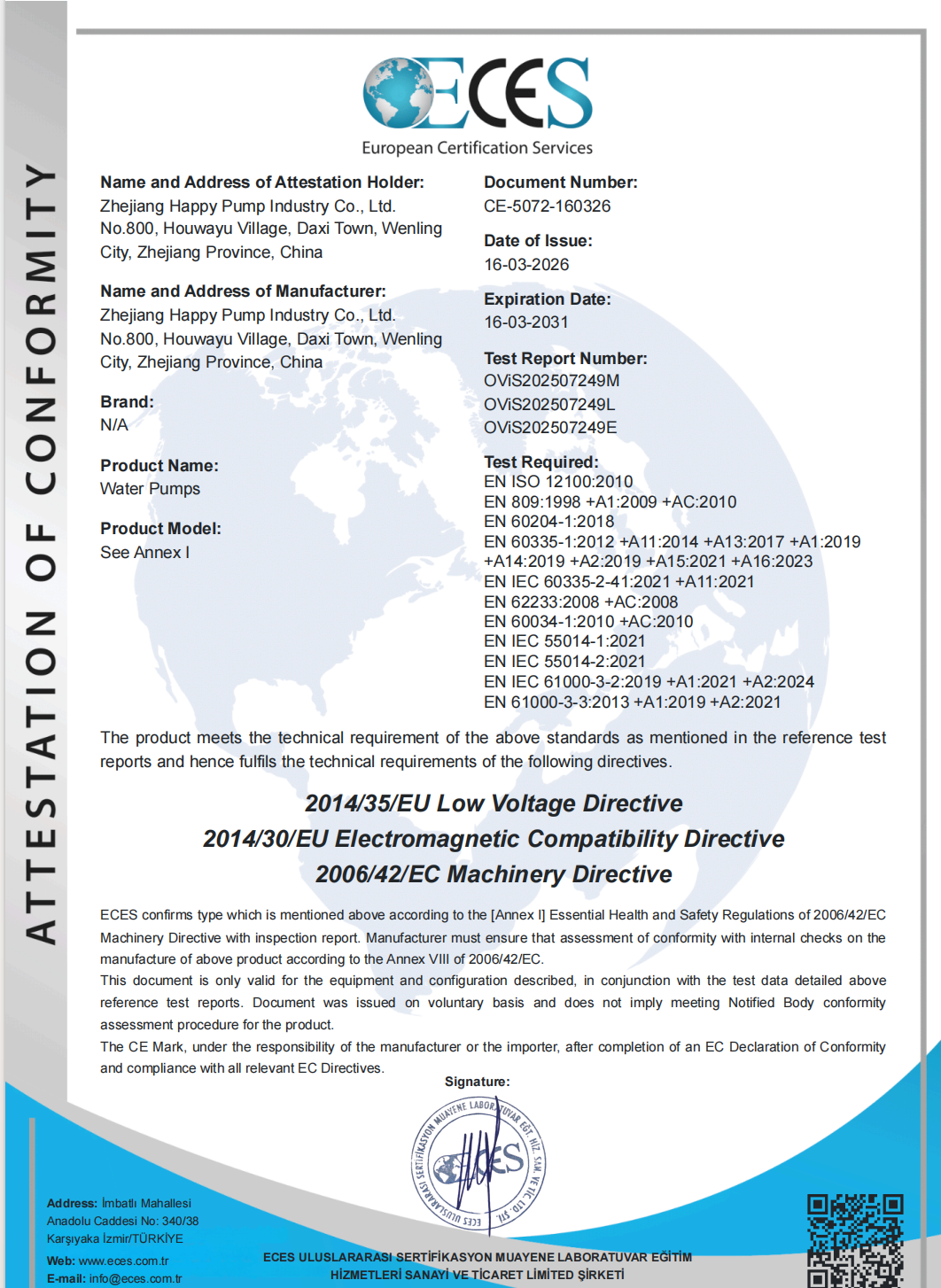
CE Attestation of Conformity CE-5072-160326 issued by ECES, valid from 16 March 2026 to 16 March 2031.
| Document | Issuing body / number | Standards referenced | Validity |
|---|---|---|---|
| CE Attestation of Conformity | ECES / CE-5072-160326 | 2014/35/EU LVD; 2014/30/EU EMC; 2006/42/EC Machinery | 16 Mar 2026 – 16 Mar 2031 |
| LVD certificate | OViS-CERT / OViS202507249L | EN 60335-1; EN IEC 60335-2-41:2021+A11:2021; EN 62233:2008+AC:2008; EN 60034-1:2010+AC:2010 | Issued 1 Aug 2025 |
| EMC certificate | OVIS-CERT / OViS202507249E | EN IEC 55014-1:2021; EN IEC 55014-2:2021; EN IEC 61000-3-2; EN 61000-3-3 | Issued 1 Aug 2025 |
Three checks make these documents usable rather than decorative:
- Model coverage. Certificate documentation for these pumps lists models including HQBm, QB60, IDB35, HPSm-AX, HRSm-A, QDP series, QDX series and comparable units. A model outside that list is not automatically covered by the same file.
- Validity dates. The CE attestation carries a defined window ending 16 March 2031, so it needs to be tracked across a long supply programme; the LVD and EMC certificates carry their own issue dates.
- Scope wording. The declared scope here is water pumps for the EU market, which is what an importer needs to see before placing the model on the EU market.
2. IP44 or IP68 — Which Protection Level Does the Installation Require?
An IP code carries two pieces of information. The first digit describes protection against solid objects and dust; the second describes protection against water. HAPPY pump specifications list protection levels of IP44 and IP68, and the choice between them is an installation decision, not a quality ranking.
| Rating | Solid / dust | Water | Typical installation |
|---|---|---|---|
| IP44 | Protected against solid objects larger than 1 mm | Protected against water splashing from any direction | Indoor plant rooms, utility rooms, building water-supply rooms, covered pool equipment areas |
| IP68 | Dust-tight | Protected during continuous immersion under manufacturer-specified conditions | Outdoor pits and sump chambers, flood-prone rooms, washdown areas, exposed irrigation pump houses |
For domestic and household water supply — a common application for surface pumps — the pump is normally indoors and IP44 covers the realistic exposure. Where a booster surface pump sits in a basement that floods periodically, or where an agricultural surface pump is installed in an open pump house, the water digit rather than the solid digit becomes the deciding factor. In practice, buyers should state the mounting location and the expected water exposure on the enquiry, because the same hydraulic model can be supplied in different enclosure classes.
One boundary is worth stating plainly: a higher IP rating is not automatically the better purchase. IP68 construction typically costs more than IP44, and specifying it for a dry, air-conditioned plant room adds cost without adding protection. Enclosure class also does not make an installation watertight by itself — cable entries, glands and terminal boxes have to match the enclosure, or the rating on the nameplate will not reflect conditions on site.
3. Materials: Why Stainless Steel Matters for Corrosive Liquids
Material questions often arrive after a pump has already been selected on hydraulics. The specification for these pump ranges lists three main materials — cast iron, stainless steel and engineering plastics — and the practical question is not which material is best in the abstract, but which components contact the liquid and what that liquid does to them.
Cast iron is the established choice for clean water duties: municipal water, building water supply and drainage, and industrial circulation, where the medium is essentially non-aggressive. Stainless steel becomes relevant when the liquid is corrosive enough to attack a ferrous surface, or when corrosion products would contaminate the fluid being moved — for example in some process water and circulation duties. Engineering plastics appear in selected components, where their properties suit the function better than metal.
The procurement consequence is that a material line on a datasheet should be turned into a specification before the order is placed. Buyers should define the fluid first — its chemistry, concentration and temperature, and whether it carries abrasive solids — and then confirm the wetted materials against it. A stainless steel variant broadens the range of liquids a surface pump can handle, but it is not a universal chemical pump: for strongly aggressive media, or for liquids that fall outside the intended range of the pump, the correct answer is usually a different pump family rather than a material upgrade. Abrasive solids, meanwhile, are a mechanical wear issue rather than a material selection issue.
4. Reading the Datasheet: Power Range, Head and Flow
Power, head and flow are the three figures buyers compare first, and they are also the three most frequently misread. The published ranges across these pump series are a power range of 0.25–550 kW, a head range of 20–100 m and a flow range of 1.5–5500 m³/h. These describe the portfolio, not a single machine: no individual model spans the full spread, and a model selected for a household water supply duty sits at the low end of all three.
Head and flow are also not independent. A centrifugal surface pump delivers a specific flow at a specific head, with maximum head reached at shut-off and maximum flow reached at the lowest head on the curve. A purchase order that quotes both maxima at once is describing two different operating points, and the pump delivered will match neither. The correct entry point is the duty point: the flow required, the head required at that flow, and the suction conditions at the installation.
| Parameter | Published range | What it means on a purchase order |
|---|---|---|
| Power | 0.25–550 kW | A portfolio span across series; a single model carries one rating |
| Head | 20–100 m | Maximum deliverable head per model, not a value available at every flow |
| Flow | 1.5–5500 m³/h | Requires a matching head; the two are read together as a duty point |
| Protection | IP44 / IP68 | Set by the installation environment, not by preference |
| Materials | Cast iron, stainless steel, engineering plastics | Set by the liquid, and confirmed component by component |
Electrical configuration belongs to the same conversation. Voltage and logo are the two options listed under the company's OEM/ODM programme, which means supply characteristics should be fixed together with the hydraulic duty — a single-phase surface pump for domestic water supply and a three-phase unit for agricultural irrigation or industrial circulation are different order lines, and the motor configuration needs to be confirmed before production rather than after delivery.
5. Which Order Parameters Should Be Fixed Before a Quotation?

Fully automatic production line: quality control includes 100% testing of all products.
Most quotation delays come from commercial parameters that were never defined, not from technical ones. The following parameters are the ones stated in the manufacturer's capability record and can be used as a checklist:
- Production mode: OEM / ODM, with voltage and logo customisation.
- Minimum order quantity: below 3 HP, 100 pcs; above 3 HP, 50 pcs.
- Lead time: 30–45 days.
- Monthly capacity: 400,000 units.
- Quality control: 100% testing of all products.
- After-sales: remote support.
Buyers comparing suppliers should treat these as verifiable statements rather than claims: an MOQ that changes with motor size, a lead-time band and a test regime are all points that can be confirmed in writing before a purchase order is issued, and each of them affects landed cost as much as the unit price does.
6. Where Surface Pumps Are Typically Specified
The application list for these pump ranges covers agriculture irrigation, residential and building water supply and drainage, industrial circulation, municipal water, solar pumping systems, and swimming pool and sewage applications. At the level of everyday use, the same products are recorded in domestic and household water supply, garden irrigation, agricultural irrigation, sewage and engineering drainage, pool circulation, and solar water pumping systems.
Procurement experience from these applications is consistent with the technical picture: the pumps are used by water pump brand OEM clients and by a HAPPY agent type client, with annual sales recorded at 4,000,000 sets. Field use in these applications describes stable operation and low noise, with a normal service life of around 10 years supported by a one-year warranty. For a buyer building a programme rather than a single installation, that combination — a defined application list, documented certification and a stated service life — is usually more useful than a headline performance figure.
7. Market Context: What the Current Data Shows
Category data gives some scale to the procurement decision. MarketsandMarkets estimated the global pumps market at USD 61.32 billion in 2024, projected to reach USD 79.01 billion by 2029. Within that market, Mordor Intelligence placed surface pumps at a 57.63% share of the global pump market in 2025 — a reminder that the products discussed here sit in the largest segment of the category rather than a niche.
Two application segments relevant to surface pump specification also show measurable demand. Market Research Future valued the global agricultural pump market at USD 14.59 billion in 2024, with a projected CAGR of 4.98% through 2035. Market Data Forecast valued the solar pump market at USD 2.90 billion in 2024, attributing growth to falling PV module prices and government subsidies in Asia-Pacific.
A caution applies to all of these figures. Published estimates for the same market can differ materially depending on how agencies segment it: total pump market estimates vary slightly between sources, and solar pump valuations diverge more sharply because some counts include solar-ready kits while others count only integrated systems. Buyers using market data to size an opportunity should check the segmentation notes rather than comparing headline numbers directly.
8. Limits and Trade-offs to Plan For
- Certification is not application engineering. A CE attestation and the supporting LVD and EMC certificates confirm conformity for defined standards and markets; they do not confirm that a given model suits a specific duty point, liquid or installation.
- Portfolio ranges are not model ranges. The 0.25–550 kW, 20–100 m and 1.5–5500 m³/h figures span entire series. Each model's usable window is far narrower, and head and flow cannot both be taken at maximum.
- Higher protection and higher-grade materials cost more. IP68 and stainless steel solve specific problems; applied to installations that do not have those problems, they add cost without adding benefit.
- Surface pumps are not universal. Where the water source is deep or suction conditions are difficult, a submersible or deep well pump is the appropriate family rather than a surface unit.
- Document windows need tracking. The CE attestation runs to 16 March 2031; long-running supply programmes should schedule a review before that date.
9. Future Outlook
Three directions look likely to shape surface pump procurement over the next few years. The first is documentation transparency: as buyers in Europe and other regulated markets standardise certificate checks, suppliers who can present directive-level attestations, harmonised-standard test certificates and a clear model coverage list will face fewer qualification delays than those who present a single unnumbered claim.
The second is the shift toward electronically controlled pumping. The company's product range already includes permanent magnet variable frequency constant-pressure pumps and intelligent pumps alongside conventional centrifugal, jet and vortex models, which suggests that pressure control and electrical configuration will increasingly be specified at the same time as hydraulics.
The third is application-driven selection. With agricultural irrigation and solar pumping among the fastest-moving segments covered by published data, buyers are likely to focus less on general pump categories and more on matching enclosure class, material and duty point to a specific installation — which is exactly the reading discipline this FAQ is meant to support.
10. FAQ: Surface Pump Procurement Questions
Does a CE Attestation of Conformity replace the LVD and EMC certificates?
No. They serve different functions. The CE Attestation of Conformity — CE-5072-160326, issued by ECES and valid to 16 March 2031 — declares the product range against 2014/35/EU, 2014/30/EU and 2006/42/EC. The test evidence sits in separate documents: LVD certificate OViS202507249L and EMC certificate OViS202507249E, both issued on 1 August 2025, each listing its own harmonised standards. A complete supplier file contains both levels.
Is IP68 always the better choice for a surface pump?
It depends on where the pump is installed. IP44 protects against solid objects larger than 1 mm and against splashing water, which suits indoor plant rooms and utility rooms. IP68 is dust-tight and rated for continuous immersion under manufacturer-specified conditions, which suits outdoor pits, sump chambers and washdown areas. For a dry indoor installation, IP68 typically adds cost without adding protection.
Can a stainless steel surface pump handle any chemical liquid?
No. Stainless steel improves resistance to corrosive liquids compared with cast iron, and it is the sensible choice when corrosion products would contaminate the fluid. It is not resistant to every medium, and abrasive solids are a wear issue rather than a material issue. Where a liquid falls outside the intended range of the pump, a different pump family is usually the correct answer.
Why is the published head range wider than a single model's head?
Because published figures such as 0.25–550 kW, 20–100 m and 1.5–5500 m³/h describe the whole pump portfolio rather than one machine. A single model operates at one duty point, defined by a flow and the head required at that flow; maximum head and maximum flow occur at different points on the same curve and are not available simultaneously.
Which models are covered by the certification documents?
The certificate documentation for the pumps lists models including HQBm, QB60, IDB35, HPSm-AX, HRSm-A, QDP series, QDX series and comparable units, with the scope described as water pumps for the EU market. Buyers should confirm that the exact model on the purchase order appears within the covered list.
What are the minimum order quantities and lead times?
The stated minimum order quantity is 100 pcs for pumps below 3 HP and 50 pcs for pumps above 3 HP. Lead time is 30–45 days, with a stated monthly capacity of 400,000 units. Voltage and logo customisation are available under the OEM/ODM production mode.
Are all surface pumps tested before shipment?
Yes. Quality control at the factory includes 100% testing of all products, which means the test applies to every unit rather than to a sample batch. Documented field use across domestic water supply, irrigation, drainage, pool circulation and solar pumping applications describes stable operation, low noise and a normal service life of around 10 years, supported by a one-year warranty.
For teams that need the underlying series data, model coverage and certification details in one document, the company's product brochure is available here: Zhejiang Happy Pump Industry Co., Ltd. product brochure (PDF).
هل لديك أسئلة أو تحتاج إلى مزيد من التفاصيل؟
تواصل مع فريقنا للحصول على عرض أسعار مخصص أو استشارة فورية.
طلب عرض أسعار
املأ النموذج أدناه وسيتواصل معك فريقنا بعرض مقترح مخصص.
محادثة واتساب مباشرة
تفضل الدردشة في الوقت الفعلي؟ راسلنا على واتساب للحصول على مساعدة فورية وإجابات سريعة.
- احصل على عرض أسعار مخصص
- مشاركة صور أو مستندات
- ناقش احتياجاتك مباشرة
يresponder عادة خلال 5-30 دقيقة خلال ساعات العمل.