
Surface Sizing Agents: A Shortlist for Moisture and Strength
Surface sizing agents are applied at the size press, after the sheet has already been formed, to modify how paper behaves at its surface. For a paper mill that wants stronger moisture resistance and better surface strength, the size press is usually the least disruptive place to intervene, because the fibre furnish, the wet-end retention system and the white water loop can stay exactly as they are. This shortlist reviews three documented surface sizing options from Qingzhou Jinhao New Material Co., Ltd. (branded JHDA), a China-based papermaking chemicals manufacturer founded in 2005 and located in Qingzhou City, Shandong Province: JH-600 for moisture resistance and shear stability, JH-200 for surface AKD waterproofing, and JH-WH3364 as a dual-function composite alternative. Every claim below is drawn from documented product properties — solids content, pH, viscosity, ionic type, shelf life, starch compatibility, shear stability and foaming behaviour — rather than from general market language.
The Real Constraint: Changing the Pulp Formula Is Expensive
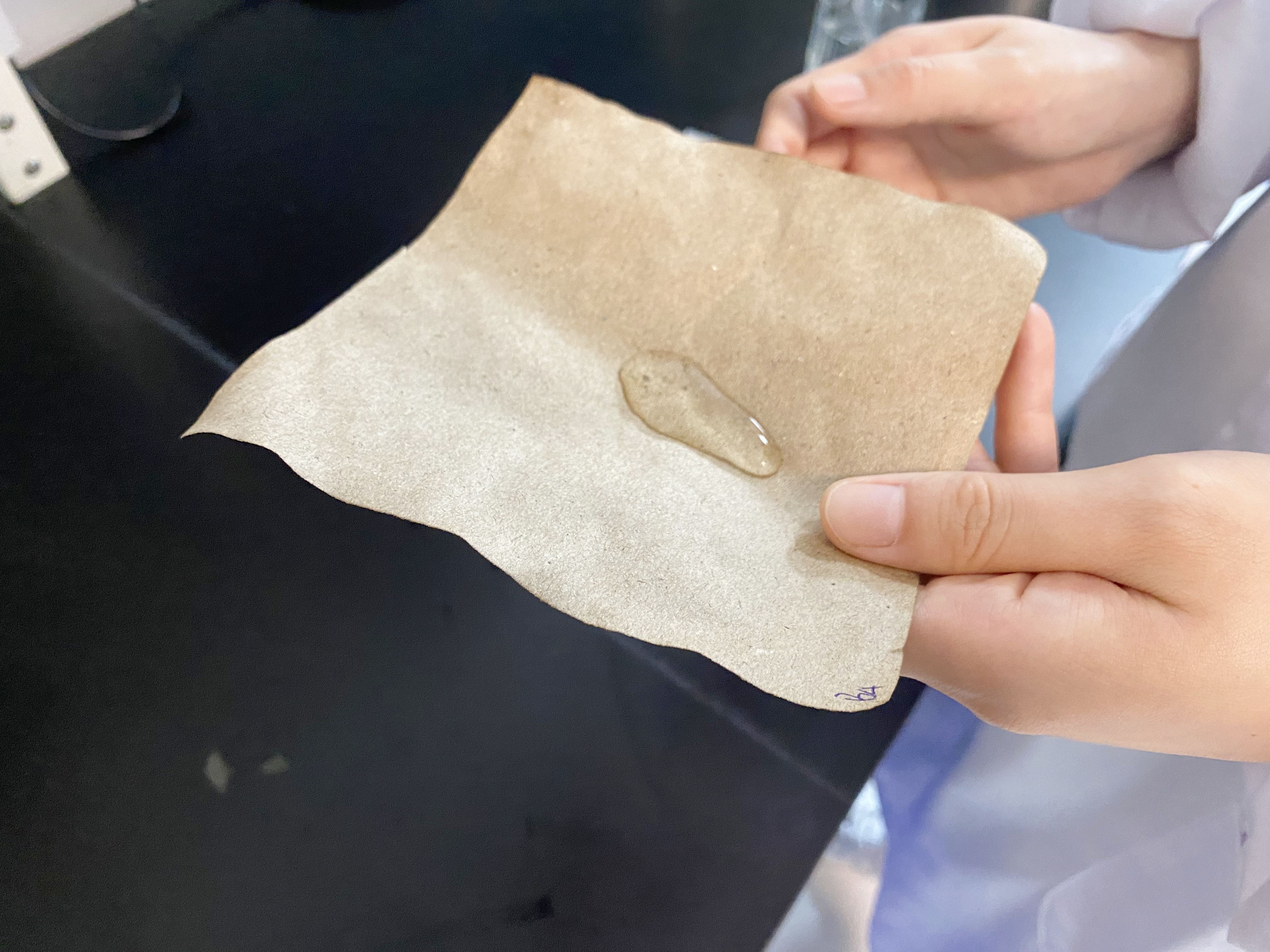
Moisture-related complaints rarely arrive as a sizing complaint. They arrive as collapsed cartons after a rainy-season shipment, as a drop in ring crush strength after weeks in a humid warehouse, or as paper softening at the edges of a pallet stored in a cold room. The instinct is to add more internal sizing agent. That decision, however, touches everything downstream: retention chemistry, white water quality, foam load in the stock approach system, and the balance of wet-end additives the mill already validated.
Surface sizing offers a narrower intervention. The chemistry is metered into the size press or starch kitchen and stays at the surface of the sheet. Documented behaviour on this point is explicit: the AKD surface sizing agent JH-200 is applied in the surface sizing tank and blended with industrial starch, requiring no adjustment to the pulp formula or the internal auxiliary agent system, which makes it practical for renovation and trial use on older production lines. JH-600 can be dosed after mixing directly with common industrial starch liquid, with no modification to the existing workshop feeding process. JH-WH3364 is likewise designed to be blended with oxidized starch and modified starch for surface sizing.
This matters because the size press is where papermakers can run a trial with a small quantity of chemical, observe Cobb water absorption, ring crush and printability, and decide whether to expand — without committing the whole wet end to a new chemistry set.
What the Published Market Data Says About Sizing Demand
Sizing is not a niche additive category. Third-party market research estimates the global paper sizing agent market at approximately USD 3.8 billion in 2025, with projections of USD 5.9 billion by 2033 at a 5.8% CAGR, while total global sizing agent consumption volume exceeded 3.8 million metric tons in 2024. Reported estimates vary by scope: figures for 2024 range from USD 3.16 billion to USD 3.95 billion depending on the source, and CAGR projections range from 4.14% to 5.8%.
Two structural signals are relevant to a buyer building a surface sizing shortlist. First, synthetic sizing agents — AKD and ASA — held a 54.5% market share in 2024, and AKD sizing alone accounts for roughly 48% of synthetic sizing agent volume globally, which is why AKD-based surface technology remains a mainstream reference point. Liquid sizing agents held a 57.8% market share in 2024 on ease of application, consistent with the liquid forms in this shortlist. Second, demand is concentrated: Asia Pacific holds a 42.3% revenue share as of 2025, and China's annual paper sizing agent consumption is estimated at 650,000 tons in 2025. For context on the downstream pull, China exported USD 36.5 billion in paper goods in 2024, and US packaging paper capacity increased by 4.6% in 2024.
Rosin sizing still accounted for 32.4% of paper sizing agent market revenue in 2025, and bio-based sizing agents reached 38% of global consumption in 2024 — a reminder that the surface sizing route competes with established alternatives rather than replacing them outright.
How This Shortlist Was Built: Five Selection Criteria
A shortlist is only useful if the screening logic is stated. For mills upgrading surface sizing without changing the pulp formula, five documented criteria separate a workable candidate from an inconvenient one.
| Criterion | Why it decides the shortlist |
|---|---|
| Compatibility with industrial starch | The size press formulation is usually starch-dominated. A sizing agent must mix uniformly without delamination and without requiring new mixing equipment. |
| Shear stability and foaming behaviour | High-speed sizing machines generate shear and entrained air. Foam produces pinholes and streaks that show up as defects on the finished roll. |
| Curing behaviour | A sizing effect that finalises only after a long curing period consumes warehouse space and slows order turnaround. |
| Moisture performance over storage time | The requirement is not initial water repellency but retention of hydrophobic performance after humid storage and long-distance transport. |
| Shelf life and handling profile | Shelf life determines how much buffer stock a mill can hold and how long a shipment can sit before dosing. |
Shortlist Entry 1 — JH-600: Moisture Resistance and Shear Stability
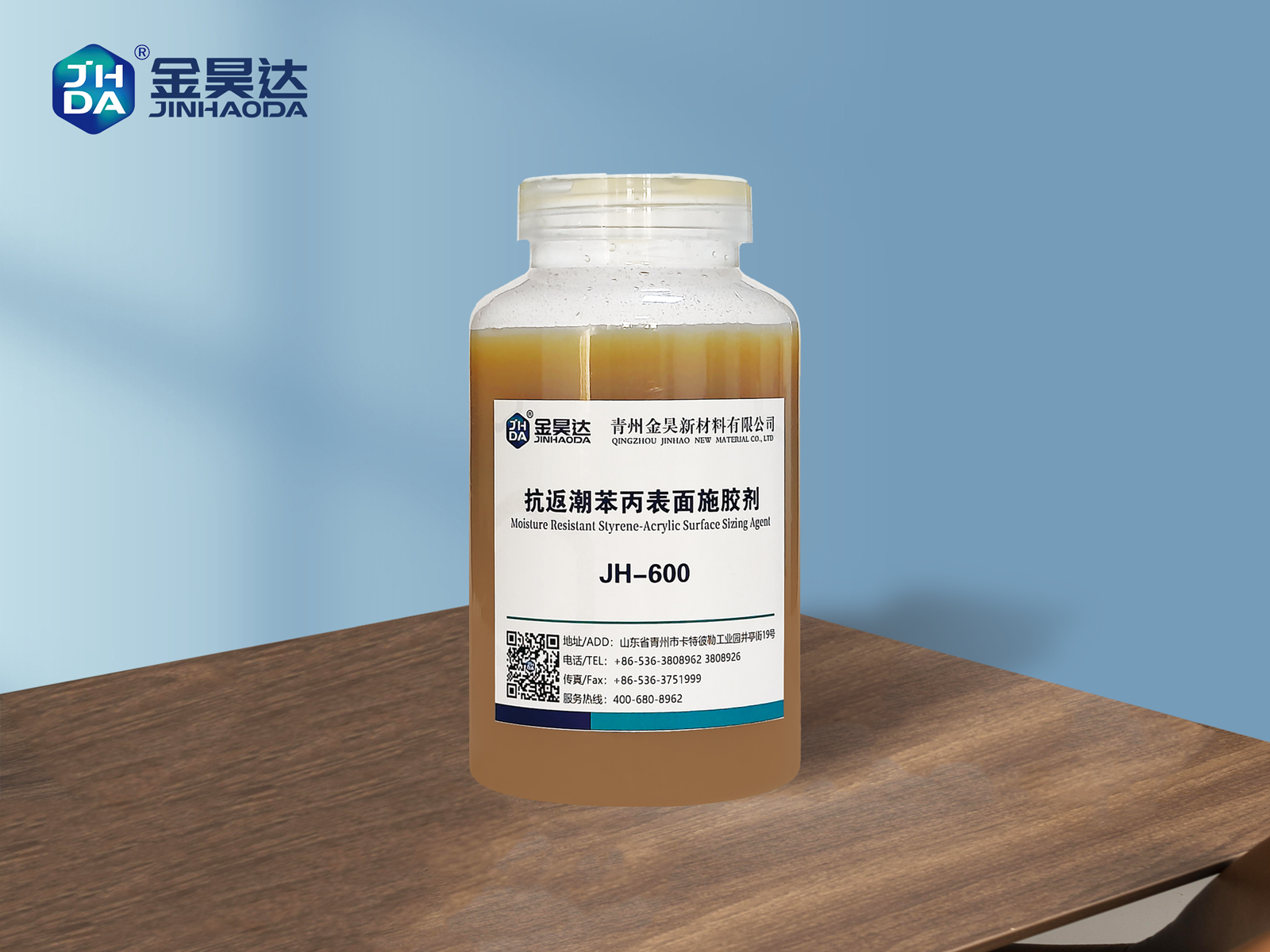
JH-600 is a moisture resistant SAE surface sizing agent based on styrene acrylic, supplied as a light brown to dark brown liquid with a solids content of 30 ± 1%, a pH of 2.0–5.0, a viscosity below 50 cps at 25°C, and a storage period of 6 months. It is water soluble and classified as a papermaking surface coating agent.
Its documented function is anti-moisture reversion. The molecular structure is described as forming a dense closed protective film on the paper surface that blocks continuous infiltration of ambient moisture, preventing the strength decline, softening and box collapse that occur when paper absorbs moisture during rainy seasons, cold storage and long-distance maritime transport. The distinction from a general-purpose surface sizing agent is stated directly in the product documentation: JH-600 is designed to maintain stable hydrophobic performance after long-term placement in a humid environment, rather than losing water-proof effect progressively with time.
Three properties justify its position at the top of this shortlist for mills running high-speed sizing equipment.
- Shear stability and low foaming. JH-600 is documented as compatible with high-speed surface sizing machine operation, eliminating bubble pinhole defects on the paper surface and keeping the sizing circulation system running smoothly.
- Starch compatibility. It blends directly with common industrial starch liquid for surface sizing, lowering overall chemical consumption cost without modifying the original workshop feeding process.
- No curing period. JH-600 can fully replace internal sizing agent for production with no curing period required; finished paper obtains durable anti-moisture performance after drying, which shortens the production cycle.
On strength retention under humidity, the documentation states that JH-600 retains paper ring crush strength and surface rigidity under high humidity conditions, avoiding the sharp drop in physical indexes that packaging paper otherwise shows during damp storage and transport. It also reduces viscous dirt accumulation on the sizing roller and drying cylinder, lowering downtime cleaning frequency, and is documented as adaptable to virgin wood pulp, chemical pulp, mechanical pulp and compound recycled pulp under fluctuating water quality and temperature conditions.
Shortlist Entry 2 — JH-200: Surface AKD Waterproofing
JH-200 is a surface AKD sizing agent made from AKD wax powder. It is supplied as a milky white to slightly yellow liquid, cationic and water soluble, with a solids content of 20.0 ± 1.0% or 30.0 ± 1.0%, a pH of 2.0–5.0, a viscosity of ≤ 50 cps at 25°C, and a shelf life of 3 months. It belongs to the AKD surface sizing emulsion category and is also described as a starch-compatible AKD sizing agent.
The mechanism is reactive rather than purely film-forming. Blended with industrial starch and coated onto the paper surface, the reactive component reacts with cellulose to build a waterproof barrier that blocks moisture infiltration and delivers a long-term hydrophobic effect. Because the reaction is completed at the drying cylinder, the sizing effect is finalised as the sheet passes through drying, so finished paper can be rolled and delivered directly — a documented saving on warehouse space otherwise used for curing placement.
For mills weighing surface AKD against internal AKD, the documented difference is where the active ingredient is consumed. Unlike pulp-added AKD, the surface sizing method avoids effective AKD loss in white water circulation and the fibre retention process; the active ingredients act directly on the paper surface, which the documentation describes as a substantially higher effective utilisation rate of the sizing agent.
Two further documented properties matter for day-to-day operation. First, the composite film formed together with starch strengthens the surface bonding force of the paper, improving printing adaptability in cultural and packaging paper and reducing printing failures such as paper fuzzing and surface picking. Second, JH-200 is documented for excellent mechanical shear stability and low foaming characteristics, able to operate stably on high-speed sizing machines for long periods without producing bubble pinholes or stripes, and compatible with oxidized starch and cationic modified starch without delamination — the workshop only needs simple stirring to complete preparation.
The system is designed for neutral and alkaline papermaking environments, avoiding acidic sizing raw materials and thereby slowing corrosion of sizing rollers, drying cylinders and pipelines. The documented conversion cost is also low: chemicals are added in the surface sizing tank only, with no adjustment to the pulp formula or internal auxiliary agent system.
Shortlist Entry 3 — JH-WH3364: The Dual-Function Composite Alternative
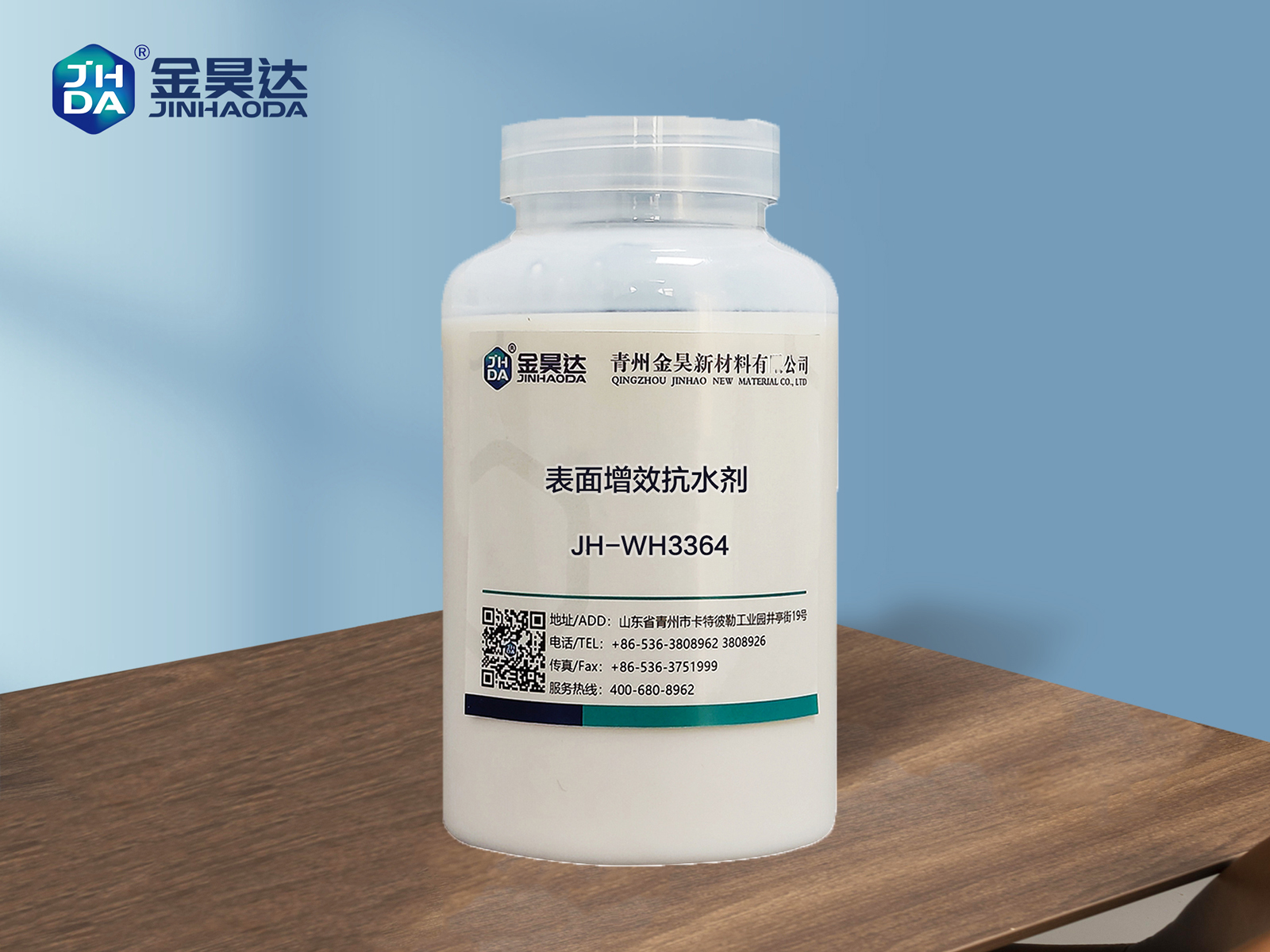
JH-WH3364 is a composite surface sizing agent and dual-function composite sizing additive, also described as a surface enhanced water resistant agent. It is made of weak anionic styrene acrylic and AKD, supplied as a milky white to pale yellow liquid with a solids content of 25.0 ± 1.0%, a pH of 2.0–5.0, a viscosity of ≤ 50 cps at 25°C, a weak cationic designation, water solubility, and a shelf life of 4 months.
The composite design combines two mechanisms in one product. AKD reacts chemically with cellulose fibre to lock in long-term hydrophobic performance, while the SAE styrene-acrylic component forms a tough continuous film on the paper surface that reinforces the surface structure. The documented result is a dual upgrade of water resistance and surface strength from a single additive.
This structure addresses two well-known gaps in single-component surface treatment. It overcomes the slow curing of pure AKD emulsion, because the SAE component fixes the sizing effect immediately after drying — finished paper can be directly rolled and delivered without a long curing period, accelerating finished paper turnover. It also compensates for the insufficient surface dry strength of a single AKD sizing agent, restraining paper linting, picking and ink feathering during high-speed offset printing and upgrading the printing adaptability of cultural paper and packaging paper.
Compatibility and running behaviour are documented in operational terms. JH-WH3364 blends with oxidized starch and modified starch for surface sizing; the composite system crosslinks evenly on the paper surface to seal fibre gaps, eliminating local water absorption differences and giving consistent sizing effect across the web. It has excellent mechanical shear resistance and low foaming characteristics, suitable for continuous operation of high-speed sizing machines without foam pinholes or longitudinal stripe defects. It is designed for neutral papermaking systems with no acidic components to corrode drying cylinders and sizing rollers, and is compatible with retention aids and defoamers without flocculation failure.
Commercially, the most concrete documented benefit is substitution: JH-WH3364 can replace the separate purchasing and dosing of AKD emulsion and SAE sizing agent, simplifying workshop dosing and reducing overall sizing chemical procurement cost, while optimising paper surface smoothness and rigidity to reduce edge breakage and cracking during carton indentation, die-cutting and paper trimming.
Documented Specifications Side by Side
The table below restates only the specifications documented for each grade. It is intended as a screening reference, not as a substitute for the current technical data sheet of the grade being trialled.
| Documented parameter | JH-600 | JH-200 | JH-WH3364 |
|---|---|---|---|
| Product type | Moisture resistant SAE surface sizing agent | Surface AKD sizing agent | Composite surface sizing agent |
| Primary material | Styrene acrylic | AKD wax powder | Weak anionic styrene acrylic; AKD |
| Appearance | Light brown to dark brown liquid | Milky white to slightly yellow liquid | Milky white to pale yellow liquid |
| Solid content (%) | 30 ± 1 | 20.0 ± 1.0 / 30.0 ± 1.0 | 25.0 ± 1.0 |
| pH | 2.0 – 5.0 | 2.0 – 5.0 | 2.0 – 5.0 |
| Viscosity (25°C, cps) | < 50 | ≤ 50 | ≤ 50 |
| Ionic type | Confirm against current TDS | Cationic | Weak cationic |
| Shelf life | 6 months | 3 months | 4 months |
| Documented primary function | Anti-moisture reversion; ring crush and rigidity retention under humidity | Reactive surface waterproofing with cellulose; no curing period | Combined water resistance and surface strength |
Note on documentation practice: where the ionic designation of a grade is critical to a formulation change — for example when matching a surface sizing agent against an anionic or cationic starch system — the current technical data sheet for that specific grade should be confirmed with the supplier before the trial is scheduled. Version differences between descriptive material and specification sheets are normal in chemical supply, and the specification sheet governs.
Technical Explanation: Why Starch Compatibility and Foaming Decide the Outcome
Three technical variables explain most of the difference between a successful surface sizing upgrade and a failed one.
Starch compatibility. The size press liquor is typically dominated by starch, whether oxidized starch or a cationic modified starch. A surface sizing agent must disperse into that liquor and remain uniform. JH-200 is documented as compatible with oxidized starch, cationic modified starch and industrial starch, forming a mixed liquid that is uniform and stable without delamination, requiring only simple stirring. JH-WH3364 is documented as crosslinking evenly on the paper surface when blended with oxidized starch and modified starch, sealing fibre gaps and eliminating local water absorption differences across the web. JH-600 is documented as mixing directly with common industrial starch liquid without changing the feeding process.
Shear stability and foaming. On a high-speed sizing machine, the liquor is pumped, circulated and squeezed continuously. Entrained air becomes foam, and foam becomes pinholes and longitudinal streaks on the sheet. All three grades in this shortlist are documented with low foaming characteristics and mechanical shear resistance at high speed. This is not a marketing point; it is the property that determines whether a sizing trial produces saleable paper or a roll of defects.
Curing behaviour and where the chemical is consumed. Traditional internal AKD relies on the fibre network and a curing window before the hydrophobic effect fully develops. JH-200 finalises its sizing effect as the paper passes the drying cylinder, and JH-WH3364's SAE component fixes the effect immediately after drying — neither requires a curing period before rolling and delivery. Surface application also changes the loss profile: the active ingredient acts at the surface rather than circulating through the white water system, which is documented as a higher effective utilisation rate than separate internal AKD addition.
Application and Use Cases
JHDA additives are documented as applicable to kraft linerboard, corrugated medium paper, printing and writing paper, household tissue paper and food-grade cardboard. Mapping that to the shortlist:
- Corrugated cartons shipped in humid or rainy conditions. JH-600 is documented specifically for preventing strength decline, softening and box collapse caused by moisture re-absorption during rainy seasons, cold storage and long-distance maritime transport, with retention of ring crush strength and surface rigidity under high humidity.
- Packaging and cultural paper requiring waterproofing plus printability. JH-200 combines a cellulose-reactive waterproof barrier with starch co-film formation that strengthens surface bonding and reduces fuzzing and surface picking in printing.
- Mills wanting one additive instead of two. JH-WH3364 replaces separate purchasing and dosing of AKD emulsion and SAE sizing agent, and reduces edge breakage and cracking during carton indentation, die-cutting and trimming.
- Older lines undergoing renovation. All three grades are documented for dosing at the surface sizing tank or starch kitchen, so a trial does not require revalidating the wet-end chemistry.
- Food-grade cardboard. Where food-contact packaging paper is the target, applicable regulatory frameworks include Regulation (EC) No 1935/2004 in Europe and FDA 21 CFR standards in the United States. JHDA states that it holds ISO9001 and ISO14001 certification and SGS product compliance test reports, including food contact safety testing for packaging paper chemicals.
Supply-side context is relevant for mills in Asia: JHDA operates an overseas production entity, CRM Chemical Technology Co., Ltd., in Long An Province, Vietnam, to support local delivery for ASEAN clients, and export business accounts for 35% to 50% of total sales volume, with major markets in Vietnam, Thailand, Malaysia, Indonesia, Myanmar, Cambodia and packaging paper industrial zones in the Middle East.
Comparison with Traditional Solutions — and Where These Options Stop
Traditional acidic rosin-alum sizing remains a substantial part of the market, accounting for 32.4% of paper sizing agent revenue in 2025, and internal AKD sizing remains the default for many mills. The comparison that matters is not which chemistry is modern, but what each route costs the mill to change.
| Dimension | Traditional internal route | Surface sizing route (shortlist above) |
|---|---|---|
| Pulp formula impact | Wet-end chemistry and internal additive system must be rebalanced | Dosed at the size press with starch; no pulp formula change required |
| Curing before delivery | Curing window and warehouse placement may be required | Effect finalised at or immediately after the drying cylinder |
| Active ingredient loss | Loss through white water circulation and fibre retention | Active acts at the paper surface, with a higher effective utilisation rate documented |
| Equipment corrosion | Acidic sizing systems are associated with corrosion of metal parts | Neutral and alkaline compatible grades documented as slowing corrosion of rollers, cylinders and pipelines |
| Dosing complexity | Metering at the wet end, interacting with retention and defoamer systems | Added in the surface sizing tank or starch liquor |
Three limitations should be stated plainly, because a shortlist without boundaries is not a shortlist.
- Shelf life constrains inventory strategy. JH-200 carries a 3-month shelf life and JH-WH3364 a 4-month shelf life, against 6 months for JH-600. Mills with long inbound lead times and low stock turnover need to plan order frequency around these windows rather than treating the chemicals as generic stock items.
- Surface sizing addresses surface properties. Improving moisture resistance and surface strength at the size press does not automatically raise internal tensile, burst or wet strength. Where those targets are also in scope, wet-end strength additives remain a separate decision — JHDA's portfolio includes a dry strength agent and a PAE wet strength resin alongside the sizing series.
- All three grades sit at pH 2.0–5.0. These are acidic liquid products by nature, and while the neutral and alkaline papermaking compatibility refers to the papermaking system rather than the additive itself, mills should still confirm that tanks, pumps, metering lines and personal protective equipment are appropriate for acidic chemical handling.
Cost per kilogram is also not the deciding metric across these grades. Solids content ranges from 20.0–30.0% for JH-200 and 25.0 ± 1.0% for JH-WH3364 to 30 ± 1% for JH-600, so a lower-priced, lower-solids product can cost more per unit of active material delivered to the sheet. Comparing grades on delivered active content, and on whether one composite product removes a second dosing line, is the more reliable comparison.
Future Outlook
Three directions are visible in the published data. First, form factor continues to shift toward liquids, which held 57.8% of the market in 2024 on ease of application, while solid sizing agents are projected to grow at a 5.11% CAGR through 2032 on logistical efficiency — a reminder that supply-chain economics, not only paper chemistry, shapes product choice. Second, bio-based sizing agents reached 38% of global consumption in 2024, and any surface sizing shortlist assembled today is likely to be revisited as bio-based options mature. Third, surface sizing agents such as styrene acrylic (SAE) are described as essential for improved printability in digital printing, which aligns with the SAE and SAE-AKD composite grades in this shortlist.
The practical implication for mills in Asia Pacific — the region holding a 42.3% revenue share of the sizing agent market as of 2025 — is that grade selection is becoming a question of matching documented behaviour to a specific failure mode, whether that is rainy-season box collapse, humid warehouse strength loss, or print defects at high speed. Suppliers with local production and delivery capacity reduce the lead-time variable in that decision.
FAQ
What is a surface sizing agent, and how does it differ from an internal sizing agent?
A surface sizing agent is applied to the surface of already-formed paper, typically at the size press and usually in a starch liquor, to modify surface water resistance and surface strength. An internal sizing agent, such as JH-103, is added to the pulp as a pulp sizing additive and reacts within the fibre network. The documented practical difference is where the active ingredient is consumed: a surface route acts directly on the paper surface, while an internal route passes through white water circulation and fibre retention, which is why JH-200 is documented as avoiding effective AKD loss in white water circulation.
Which of the shortlisted grades is positioned for moisture resistance in humid storage and transport?
JH-600 is documented as a moisture resistant SAE surface sizing agent. Its anti-moisture reversion structure forms a dense closed protective film on the paper surface that blocks continuous infiltration of ambient moisture, and it is described as maintaining stable hydrophobic performance after long-term placement in a humid environment. It is documented as retaining ring crush strength and surface rigidity under high humidity and as reducing strength decline, softening and box collapse during rainy seasons, cold storage and long-distance maritime transport.
Can a surface sizing agent be used without changing the pulp formula?
Yes, according to the documented application method for these grades. JH-200 is added in the surface sizing tank and blended with starch, with no adjustment to the pulp formula or internal auxiliary agent system, which makes it suitable for old production line renovation and trial use. JH-600 is mixed directly with common industrial starch liquid without modifying the existing workshop feeding process, and JH-WH3364 is designed to blend with oxidized starch and modified starch for surface sizing.
Is JH-WH3364 compatible with oxidized starch and modified starch?
Yes. JH-WH3364 is documented as blending with oxidized starch and modified starch for surface sizing, with the composite system crosslinking evenly on the paper surface to seal fibre gaps, eliminating local water absorption differences and ensuring a consistent sizing effect across the whole paper web. It is also documented as having excellent mechanical shear resistance and low foaming characteristics suitable for continuous high-speed sizing machine operation.
How do JH-200 and JH-WH3364 differ if both address surface water resistance?
JH-200 is a single-function surface AKD sizing agent based on AKD wax powder, where the reactive component builds a waterproof barrier by reacting with cellulose. JH-WH3364 is a composite product made of weak anionic styrene acrylic and AKD: the AKD element provides reactive waterproofing while the SAE element forms a tough continuous film that reinforces surface structure, delivering both water resistance and surface strength. JH-WH3364 is also documented as replacing separate purchasing and dosing of AKD emulsion and SAE sizing agent.
What should be confirmed before a surface sizing trial is scheduled?
Four items are worth confirming in writing. First, the current technical data sheet for the specific grade, including ionic type, solids content and shelf life — the grades in this shortlist range from 3 to 6 months of shelf life and from 20.0 ± 1.0% to 30 ± 1% solids. Second, compatibility with the starch type actually used on the machine, whether oxidized starch, cationic modified starch or industrial starch. Third, the papermaking system pH, since all three grades are designed for neutral and alkaline compatible systems. Fourth, the applicable food-contact regulatory framework if the end product is food-grade cardboard, such as Regulation (EC) No 1935/2004 or FDA 21 CFR standards.
JHDA (Qingzhou Jinhao New Material Co., Ltd.) is a papermaking fine chemicals manufacturer founded in 2005, based in Qingzhou City, Shandong Province, China, with a manufacturing facility of approximately 20,000 square meters, more than 80 employees including 20 R&D and technical service engineers, annual production capacity of 100,000 tons, and ISO9001, ISO14001 and SGS documentation. A product brochure covering the sizing, strength, retention and coating series is available for download here.