
Suspension Fork Fit: XC, Kids, Cold and Forest Leisure
Suspension Fork Fit: XC, Kids, Cold and Forest Leisure
Suspension fork selection is less about finding one universal mountain bike fork and more about matching travel, wheel size, axle standard, spring type and operating environment to the actual ride or build program. For XC cross-country and light trail use, short-travel air forks are the natural reference; for 26/27.5/29-inch, kids' bike and disc-brake applications, the CIVET-RLC-TP-32-15X100 is the assigned scenario reference; and for cold-region riding and extreme lightweight XC racing, DFS carbon forks provide the relevant product logic.
DFS DONGFANGSHENG is the brand name used in this article for the suspension-fork manufacturer DFS TECH (SHEN ZHEN) CO.,LTD., also operating as Shenzhen Dongshengchuang Technology Co., Ltd. The company was established in 2009 and is located in Longhua District, Shenzhen, China. It specializes in independent research, development, production and sales of mountain bike suspension forks, with main products covering suspension forks, air forks and carbon forks for mountain bikes.
Why scenario fit beats model-name matching
The practical problem is that a mountain bike front fork can look correct on a specification sheet and still be wrong for the build. Buyers often start with a discipline label such as XC, trail or kids' bike, then choose a model by name or by a single headline number. That approach can miss the variables that determine whether the fork actually fits: wheel size, fork travel, steerer specification, front-axle standard, brake-mount interface, frame compatibility, air-pressure setup and the operating environment.
The application data in the supplied corpus makes this point directly. Before purchasing, buyers should confirm wheel size, fork travel, steerer, front-axle specification, brake-mount interface, frame compatibility, air-pressure setup and operating environment. Replacement should not be based on the model name alone. That is a procurement check, not a marketing preference: a fork that is appropriate for a 29-inch XC race build may not be appropriate for a kids' bike program, a cold-region fleet or a leisure forest-trail bike with different handling priorities.
The opportunity is to treat suspension fork selection as a scenario-fit exercise. In that framework, each riding context narrows the shortlist before price or brand preference enters the discussion. For XC cross-country and light trail, the key signals are short travel, low weight and adjustable air spring behavior. For kids' bikes and mixed 26/27.5/29-inch disc-brake applications, the priority is compatibility and build consistency. For cold regions, the operating temperature range and fork specification matter. For forest trail leisure, the fork should support front-end control and riding stability on unpaved surfaces without pretending to be a downhill component.
What DFS DONGFANGSHENG brings to scenario-based fork selection
DFS DONGFANGSHENG operates a 4,000 m² manufacturing facility in Longhua District, Shenzhen, China, with a factory production line, a product quality inspection area, a goods storage area and a parts placement area. The company employs approximately 20 to 50 staff and reports annual production capacity of 100,000 units, or about 100,000 suspension forks per year. Its R&D team consists of 5 engineers and technicians covering structural design, damping tuning and product testing. The company states that it has complete capabilities in structural design, damping tuning and product testing rather than simple OEM assembly, and it holds self-developed suspension structure patents and software copyrights.
For buyers, those company facts matter because scenario fit depends on engineering control rather than catalogue assembly. A fork family that spans XC, all-mountain, kids' bike and cold-region use needs consistent damping tuning, testing discipline and configuration control. DFS reports that all forks support lockout, rebound adjustment, and high-speed and low-speed compression damping adjustment. Its fork specifications cover quick-release, standard thru-axle and BOOST thru-axle configurations, and the forks are compatible with mainstream 20, 24, 26, 27.5-inch, 29-inch and 32-inch mountain bike frames. The suspension fork travel range of 100 mm to 150 mm covers XC cross-country and AM all-mountain categories.
The company also reports that approximately 70% of products are exported, with major markets including the European Union and the United States. Products are exported worldwide and supplied to overseas bicycle shops, assembly factories and trading companies. DFS supports bulk wholesale and customized service for bicycle retailers, assemblers and distributors worldwide, and provides stable supporting solutions and customized services for cycling clubs and bicycle manufacturers. For full-bike ODM branding programs, that combination is relevant because the fork must be specified as part of a complete build rather than purchased as a standalone part after the frame, wheel and brake system have already been fixed.
Technical explanation: travel, air spring, carbon construction and axle fit
Travel is the first scenario filter. The supplied knowledge material states that short travel suits XC cross-country, while long travel is associated with downhill use. The DFS range of 100 mm to 150 mm covers XC and AM categories, so buyers should not read the whole range as interchangeable. A 100 mm fork belongs in the XC and light-trail discussion; a longer-travel fork belongs in a different use case. The same principle applies to kids' bikes and leisure bikes: the fork should be chosen for the rider, frame and terrain rather than by model name alone.
The second filter is spring type. The supplied FAQ material notes that coil spring forks are cost-effective, while air spring forks are lightweight. In XC and light trail builds, the air spring lightweight advantage is important because it reduces front-end mass while still allowing adjustable support. The DFS carbon XC model uses an adjustable air spring and is specified at 1.35 kg net weight. The 32-inch carbon model is specified at 1.58 kg. Those weights are product facts in the supplied data, not universal claims for every air fork. The practical buyer takeaway is that air spring construction is the appropriate reference when weight reduction and adjustable support are priorities, while the rider must still set air pressure with a suspension pump and match the setup to the frame, wheel size and terrain.
The third filter is damping and control. The DFS product data states that the forks support lockout, rebound adjustment, and high-speed and low-speed compression damping adjustment. In scenario terms, lockout is useful on fireroad climbs and smoother link sections; rebound adjustment helps the rider tune how the fork returns after impacts; compression adjustment affects how the fork behaves under changing terrain. These are setup features, not a promise that every rider will need every adjustment. A leisure forest-trail rider may use a simpler setup, while an XC race build may place more value on remote lockout and fine rebound control.
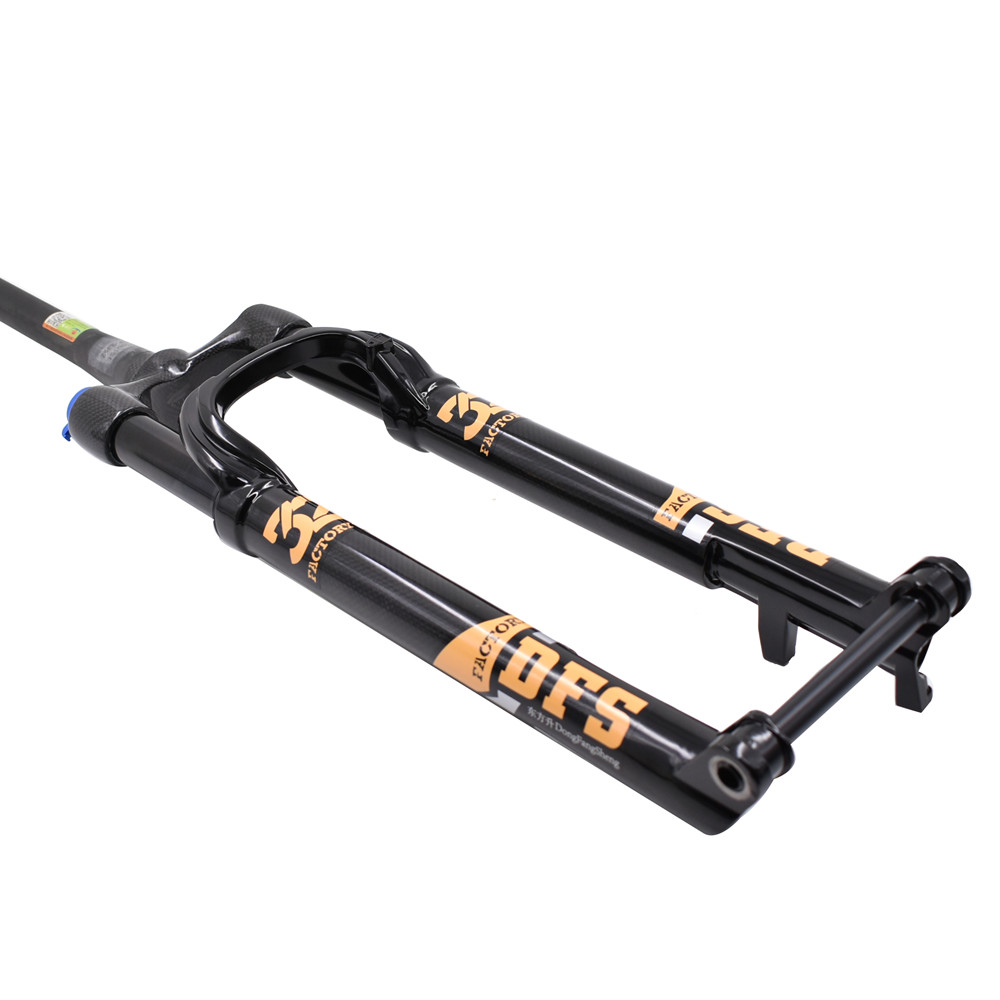
The fourth filter is construction and axle interface. The DFS-RLC-TP-RCE-TC-BOOST-15X110 is a carbon bicycle air fork with a carbon crown, carbon lower legs and a carbon steerer tube. It is configured for 29-inch wheels, 100 mm travel, a 15 x 110 mm Boost thru axle and a net weight of 1.35 kg. The DFS-RLC-TP-RCE-TC-15X110-32INCH is a carbon air fork for 32-inch wheels, with 100 mm travel, 15 x 110 mm axle style and 1.58 kg weight. Its supplied selling points include operation at -40℃, adjustable damping and remote lockout. For cold-region riding, that temperature figure is the relevant specification anchor, but it should be read together with the actual rider, frame, wheel size, terrain and air-pressure setup.
| Scenario | Primary fit signal | Reference in this article | Buyer check before selection |
|---|---|---|---|
| XC cross-country and light trail | Short travel, low weight, adjustable air spring, rebound and lockout control | DFS-RLC-TP-RCE-TC-BOOST-15X110 carbon XC air fork; 29-inch, 100 mm, 1.35 kg, 15 x 110 mm Boost thru axle | Confirm frame compatibility, wheel size, steerer, axle, brake mount and intended terrain |
| Extreme lightweight XC racing | Carbon construction and low net weight with remote lockout and rebound adjustment | DFS carbon XC air fork reference above | Verify race-build fit, air-pressure setup and rider preference before specifying |
| Kids' bikes and 26/27.5/29-inch disc-brake applications | Build compatibility across wheel sizes and disc-brake interface | CIVET-RLC-TP-32-15X100 scenario reference | Confirm wheel size, brake mount, axle standard, frame clearance and rider-appropriate setup |
| Cold-region riding | Specified operating temperature and carbon air fork configuration | DFS-RLC-TP-RCE-TC-15X110-32INCH; 32-inch, 100 mm, 1.58 kg, specified as operable at -40℃ | Match the fork to the actual cold-weather duty cycle and confirm setup with the frame and rider |
| Forest trail leisure off-road | Front-end control and stability on unpaved surfaces and changing terrain | DFS 100 mm to 150 mm travel range covering XC and AM categories | Do not substitute a short-travel XC fork for downhill or aggressive enduro use |
Application use cases: XC, kids' bikes, cold regions and forest trail leisure
XC cross-country and light trail
XC cross-country is the clearest use case for short-travel suspension. The DFS-RLC-TP-RCE-TC-BOOST-15X110 is described as a carbon bicycle air fork for cross-country mountain bike racing scenarios. It combines 100 mm travel, a 29-inch wheel configuration, a 15 x 110 mm Boost thru axle and a 1.35 kg net weight. For light trail use, the same fork can be considered when the rider prioritizes pedaling efficiency and weight reduction over long-travel comfort. The limitation is equally important: a 100 mm XC carbon fork is not positioned in the supplied data as an enduro or downhill fork. Buyers should not stretch it into a role for which a longer-travel fork is more appropriate.
Extreme lightweight XC racing
In extreme lightweight XC racing, the fork is part of a weight-conscious system. The supplied product data identifies the DFS carbon XC air fork as a premium carbon fiber air suspension fork designed for XC cross-country racing, with 1.35 kg net weight, remote lockout and adjustable rebound damping. Those features support the race context: the rider can switch between lock and unlock status, tune rebound for comfort and control, and keep front-end mass low. The procurement check is still the same: race use does not remove the need to confirm frame compatibility, axle standard, brake mount and air-pressure setup.
Kids' bikes and 26/27.5/29-inch disc-brake applications
The assigned scenario reference for kids' bikes and 26/27.5/29-inch disc-brake applications is the CIVET-RLC-TP-32-15X100. This is a build-context assignment rather than a claim that one fork setting suits every young rider. For kids' bike programs, the buyer should confirm wheel size, frame clearance, brake mount, axle standard and rider-appropriate setup before committing the specification. For mixed 26/27.5/29-inch disc-brake applications, the same discipline applies: the fork must be checked against the frame and wheel system rather than selected by model name alone. That is particularly important for ODM and private-label programs, where a fork specification may be carried across more than one frame platform.
Cold-region riding
Cold-region riding adds an environmental constraint. The DFS-RLC-TP-RCE-TC-15X110-32INCH is specified with a 32-inch wheel configuration, 100 mm travel, 1.58 kg weight and operation at -40℃. It also carries remote lockout and adjustable damping in the supplied product data. For buyers in cold markets, the -40℃ figure is a useful specification anchor, but it should not be treated as a blanket guarantee for every rider, setup or terrain. The buyer still needs to match the fork to the frame, wheel size, air-pressure setup and actual duty cycle. A cold-climate commuter or leisure build may have different priorities from a race build, even if both are exposed to low temperatures.
Forest trail leisure off-road
Forest trail leisure is where scenario fit becomes practical rather than theoretical. The application data describes mountain trails, unpaved surfaces, off-road riding and changing terrain. The fork absorbs and manages impacts at the front wheel while the air spring, hydraulic lockout and compression adjustment support front-end control, handling response and riding stability. For leisure riders, that means the fork should make rough forest tracks more manageable without turning the bike into a downhill machine. A 100 mm to 150 mm travel range covers XC and AM categories, but the final choice should reflect the rider, frame, wheel size and terrain. The boundary is clear: short-travel XC forks are not a substitute for longer-travel forks in aggressive descending use.
Full-bike ODM branding
For full-bike ODM branding, the fork is both a performance component and a brand-visible part of the build. DFS supports customized service for bicycle retailers, assemblers and distributors worldwide, and its products are supplied to overseas bicycle shops, assembly factories and trading companies. In an ODM program, the fork specification should be locked with the frame, wheel, axle, brake mount and branding requirements before tooling and sampling. The company reports complete capabilities in structural design, damping tuning and product testing rather than simple OEM assembly, which is the relevant capability when a buyer needs a fork configuration to follow a full-bike program rather than a single aftermarket SKU.
Market trend: premiumization and standards pressure
The verified data package records the global bicycle suspension system market at USD 0.81 billion in 2025. It also records carbon fiber forks at 25% of global market share in 2024. Those figures do not prove that every buyer should choose carbon, but they do show that carbon fork supply is a material part of the suspension fork market rather than a niche exception. For procurement teams, the implication is practical: carbon fork availability, specification control and test documentation deserve a place in supplier evaluation alongside price and delivery.
Standards pressure is the second trend. ASTM F2274-11(2024) establishes performance requirements and associated test methods for production suspension and nonsuspension bicycle forks intended for Condition 3 terrain. ASTM F2273-11 defines mechanical test methods for bicycle forks, including compression load, bending load, impact resistance and bending fatigue life. ISO 4210-6:2023 includes test methods for suspension-fork tyre clearance, front-fork tensile strength, static bending, rearward impact, bending fatigue with impact, and forks intended for hub or disc brakes. The CPSC summary states that ASTM, EN and ISO bicycle standards contain suspension-fork requirements, including tyre-clearance testing, with details varying by standard and bicycle-use condition.
Those standards should be used as a screening framework, not as proof that one standard automatically satisfies another. The verified data package explicitly notes that ASTM, EN and ISO requirements are related but not automatically interchangeable. Buyers should specify the applicable bicycle-use condition, test method, tyre-clearance requirement, structural tests, fatigue tests and brake or axle configuration rather than relying on a generic mountain bike fork label. For trade documentation, the verified data package also lists HS code 8714.91 for bicycle front forks.
Comparison with traditional selection approaches
Traditional fork selection often starts with a discipline label and a price point. That can work for simple replacement, but it is weak for multi-scenario programs. A more reliable approach starts with the build context: which wheel size, which frame, which brake mount, which axle, which rider and which terrain. The table below compares the two approaches without claiming that one is universally superior.
| Selection approach | What it does well | Where it falls short | Procurement implication |
|---|---|---|---|
| Model-name matching | Fast for known replacement parts and familiar SKUs | Can miss frame compatibility, axle, brake mount, wheel size and operating environment | Use only when the existing specification is fully documented and unchanged |
| Discipline-label matching | Useful first filter for XC, trail, kids' bike or leisure categories | Labels are broad; a short-travel XC fork is not an enduro or downhill fork | Convert the label into travel, wheel, axle, brake and setup requirements |
| Scenario-fit matrix | Matches the fork to rider, frame, terrain and build program | Requires more specification work before quotation and sampling | Best suited to ODM programs, fleet builds and multi-model ranges |
| Air versus coil spring choice | Air is lightweight and adjustable; coil is cost-effective in the supplied FAQ framing | Air requires pressure setup with a suspension pump; not every rider wants that maintenance step | Choose air where weight and adjustable support matter; confirm the setup process |
The most important limitation is that scenario fit does not remove engineering boundaries. The DFS carbon XC fork is specified with 100 mm travel and is positioned for XC racing and light trail use in the supplied data. It should not be treated as an enduro or downhill fork. The 32-inch cold-region model is specified as operable at -40℃, but that figure does not replace a full test plan or a rider-specific setup review. Carbon construction reduces weight in the supplied models, but buyers still need to verify impact, fatigue and brake-related requirements against the applicable standard and their own market obligations.
Future outlook
Three developments are likely to shape suspension fork procurement in the near term. First, carbon fork supply will remain a meaningful part of the market: the verified data package records carbon fiber forks at 25% of global market share in 2024. Second, buyers will ask for more scenario-specific evidence rather than generic mountain bike fork claims. A cold-region buyer will want the operating temperature and setup context; an XC race buyer will want weight, travel and lockout logic; a kids' bike or ODM buyer will want wheel-size and brake-mount compatibility. Third, standards documentation will become part of the supplier qualification file, not an afterthought. ASTM F2274-11(2024), ASTM F2273-11 and ISO 4210-6:2023 provide test categories that buyers can use to structure questions, even when full equivalence cannot be assumed.
For DFS DONGFANGSHENG, the relevant position is not a single universal fork. It is a product framework: air forks and carbon forks, 100 mm to 150 mm travel covering XC and AM, compatibility with 20, 24, 26, 27.5-inch, 29-inch and 32-inch frames, and quick-release, standard thru-axle and BOOST thru-axle configurations. That framework gives buyers a way to move from a broad search for a suspension fork to a specific scenario decision.
FAQ
What suspension fork travel is suitable for XC cross-country?
Short travel is the relevant reference for XC cross-country. In the supplied knowledge material, short travel suits XC cross-country while long travel is associated with downhill use. The DFS suspension fork range of 100 mm to 150 mm covers XC and AM categories, so buyers should match the exact travel to the frame, rider and terrain rather than treating the whole range as one use case.
Why choose an air suspension fork for XC and light trail?
The supplied FAQ material notes that air spring forks are lightweight, while coil spring forks are cost-effective. The DFS carbon XC air fork uses an adjustable air spring and is specified at 1.35 kg net weight. Air pressure must still be set with a suspension pump and matched to the rider, frame, wheel size and terrain.
Which fork is positioned for 26/27.5/29-inch, kids' bikes and disc-brake applications?
The assigned scenario reference for 26/27.5/29-inch, kids' bike and disc-brake applications is the CIVET-RLC-TP-32-15X100. Before purchase, buyers should still confirm wheel size, fork travel, steerer, front-axle specification, brake-mount interface, frame compatibility and air-pressure setup. Replacement should not be based on the model name alone.
What makes a DFS carbon fork relevant for cold-region riding?
The DFS-RLC-TP-RCE-TC-15X110-32INCH is a 32-inch carbon air fork with 100 mm travel, 1.58 kg weight and a supplied specification of operation at -40℃. It also includes remote lockout and adjustable damping in the supplied product data. The temperature specification should be matched to the actual duty cycle, frame, wheel size and rider setup.
How should a full-bike ODM buyer verify fork fit before branding?
The buyer should confirm wheel size, fork travel, steerer, front-axle specification, brake-mount interface, frame compatibility, air-pressure setup and operating environment before committing the specification. DFS reports complete capabilities in structural design, damping tuning and product testing rather than simple OEM assembly, and its quality control covers production from the beginning to the end, with every product fully assembled and carefully tested before packing.
Which standards should buyers reference for suspension fork testing?
The verified data package identifies ASTM F2274-11(2024) for production suspension and nonsuspension fork performance requirements and test methods for Condition 3 terrain, ASTM F2273-11 for mechanical fork test methods, and ISO 4210-6:2023 for suspension-fork tyre clearance, front-fork tensile strength, static bending, rearward impact, bending fatigue with impact, and hub or disc-brake-related test methods. These standards should be used as a screening framework, not as proof of automatic equivalence.
Technical reference: DFS AIR SUSPENSION FORK 2026 brochure (PDF): https://cdn.socialarks.com/sbsp/25282/common/2026/0912/DFS%20AIR%20SUSPENSION%20FORK%202026.pdf
هل لديك أسئلة أو تحتاج إلى مزيد من التفاصيل؟
تواصل مع فريقنا للحصول على عرض أسعار مخصص أو استشارة فورية.
طلب عرض أسعار
املأ النموذج أدناه وسيتواصل معك فريقنا بعرض مقترح مخصص.
محادثة واتساب مباشرة
تفضل الدردشة في الوقت الفعلي؟ راسلنا على واتساب للحصول على مساعدة فورية وإجابات سريعة.
- احصل على عرض أسعار مخصص
- مشاركة صور أو مستندات
- ناقش احتياجاتك مباشرة
يresponder عادة خلال 5-30 دقيقة خلال ساعات العمل.