
Suspension Fork Supplier QC: CIVET and DFS OEM Evidence
Suspension Fork Supplier QC: CIVET and DFS OEM Evidence
A suspension fork supplier's capability is only as strong as the evidence a buyer can inspect before the container is loaded. That is the practical question behind the CIVET-RLC-TP-32-15X100 and the DFS-RLC-TP-RCE-TC-BOOST-15X110: not whether a specification reads well on a catalogue page, but whether process control, assembly, testing and pre-shipment acceptance can be documented for the batch actually ordered. DFS TECH (SHENZHEN) CO., LTD. is a Shenzhen-based suspension fork manufacturer established in 2009 that develops and produces air suspension forks under the DFS, CIVET and ROLL brands. Its stated quality-control routine runs from the beginning to the end of production, with every fork fully assembled and tested before packing — a claim that is verifiable, provided the buyer asks for the right documents at the right stage.
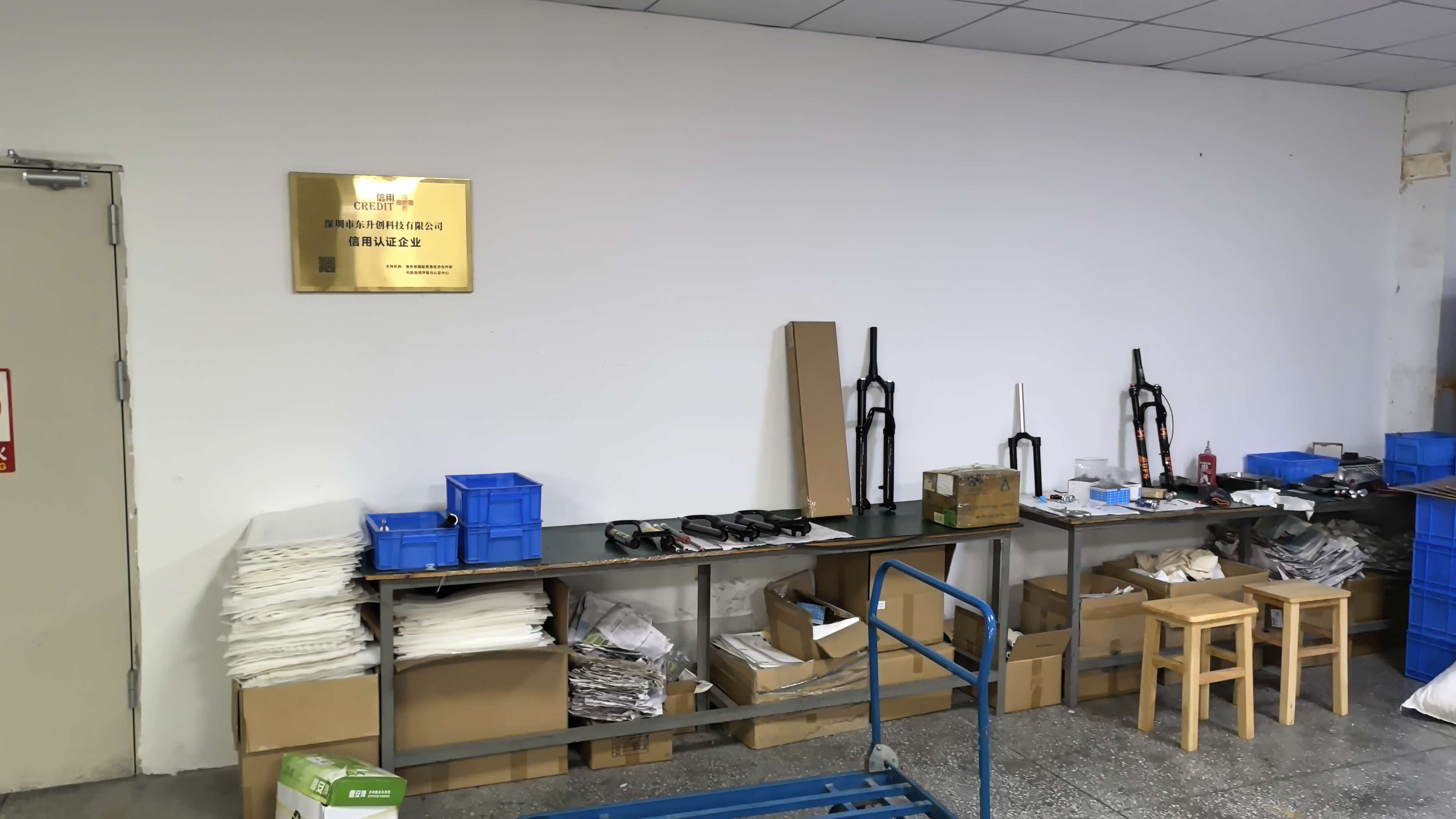
Product quality inspection area at the suspension fork manufacturing site.
What a Suspension Fork Capability Check Should Prove
A capability check should establish three separate things, because a supplier can be strong in one and weak in another. The first is process scope: whether quality control is a final-inspection event or a sequence that starts with incoming material and continues through each production stage. The second is physical completion: whether the unit a buyer receives was fully assembled and functionally tested before packing, rather than packed as parts with assembly deferred to the buyer. The third is commercial acceptance: whether the release criteria for the shipment are written down before the deposit is paid, so that the pre-shipment test has a defined pass condition.
For the CIVET-RLC-TP-32-15X100 and DFS-RLC-TP-RCE-TC-BOOST-15X110, all three are addressable with the same document set. What differs is the model-level anchor each document is checked against: travel and stanchion data for the CIVET fork, and axle and report coverage for the DFS Boost fork.
The distinction matters most during the evaluation-to-execution transition. At the evaluation stage a buyer is comparing manufacturers against a specification; at the execution stage the same buyer is comparing a specific production lot against that specification, with tooling, customisation and payment already committed. Evidence that satisfies the first stage — a catalogue, a sample, a reference list — rarely satisfies the second.
The Gap Between Sample Approval and Batch Acceptance
Sample approval answers a narrow question: does one reference unit meet the agreed specification? It does not describe the condition of the production batch. This is the point where supplier capability claims most often lose their evidentiary value, because a signed-off sample and a signed-off container are separated by the entire production run — material intake, stanchion machining, lower-leg production, damper assembly, final assembly, and packing.
A supplier that states quality control runs from the beginning to the end of production is describing a process, not an outcome. To convert that statement into usable evidence, the buyer needs the stage list, the test items performed at each stage, the pass criteria, and a batch-level record showing the criteria were met. Without these, "100% testing" remains a description of intent. With them, it becomes a release condition that can be audited, compared across shipments, and referenced in a supplier agreement.
Standards practice reinforces the same discipline. The U.S. Consumer Product Safety Commission's summary of bicycle standards notes that ASTM, EN and ISO frameworks each contain suspension-fork requirements, including tyre-clearance testing, while the details vary by standard and by bicycle-use condition. The summary is a screening framework, not proof that one standard satisfies another. In practice, that means a supplier's internal test list and any third-party report it presents should be read against a named standard, a named edition and a named model — not against a generic "mountain bike fork" label.
Model-Level Evidence: CIVET-RLC-TP-32-15X100 and DFS-RLC-TP-RCE-TC-BOOST-15X110
The two models serve different functions in a capability check. The CIVET-RLC-TP-32-15X100 is the specification anchor: it carries documented configuration data that a buyer can compare against a frame, a wheel set and a brake interface. The DFS-RLC-TP-RCE-TC-BOOST-15X110 is the report-and-programme anchor: it appears as a related product on a supplied Intertek test report and in an OEM/ODM case record, which makes it the model on which documentary coverage can be tested.
Documented configuration for the CIVET-RLC-TP-32-15X100 includes 100 mm travel, a 32 mm AL 7050 stanchion, an air spring, hydraulic lockout with compression adjustment, a one-piece magnesium lower, disc-brake mounting, and compatibility with 26-inch, 27.5-inch and 29-inch wheel sets. The model designation 15X100 identifies a 15 × 100 mm thru-axle interface. The DFS-RLC-TP-RCE-TC-BOOST-15X110 carries a Boost 15 × 110 mm thru-axle designation.
Those four data points — travel, stanchion diameter, wheel size and damper type — are exactly the core selection parameters for a suspension fork, and they are the correct basis for a first-pass filter. They are not, by themselves, a capability check. A buyer should treat them as the reference against which batch evidence is compared, and should expect the specification sheet for the ordered configuration to state travel, axle specification, brake mount and surface finish explicitly, since DFS lists logo, material, surface finish, travel, axle specification, brake mount and packaging among its customisation options.
| Model | Documented specification anchors | Evidence to request against the model |
|---|---|---|
| CIVET-RLC-TP-32-15X100 | 100 mm travel; 32 mm AL 7050 stanchion; air spring; hydraulic lockout with compression adjustment; one-piece magnesium lower; 26/27.5/29-inch compatibility; 15 × 100 mm thru-axle designation; disc brake | Batch test record for the ordered configuration; written confirmation of full assembly and test before packing; fit confirmation for frame, steerer, axle and brake mount |
| DFS-RLC-TP-RCE-TC-BOOST-15X110 | Boost 15 × 110 mm thru-axle designation; listed as a related product on Intertek test report SZHH00332353 (EN 14766:2005, European Union scope); recorded in an OEM/ODM case covering customers in Germany, Argentina and South Korea, 10,000 units over three years | Report scope, edition currency and model coverage; model-specific test-item list; confirmed custom specification for travel, axle, brake mount and finish |
Reading limit: specification anchors identify a configuration, not a production lot. A 32 mm AL 7050 stanchion or a 15 × 110 mm Boost axle tells the buyer what the fork is designed to be; only a batch record tells the buyer what was shipped.
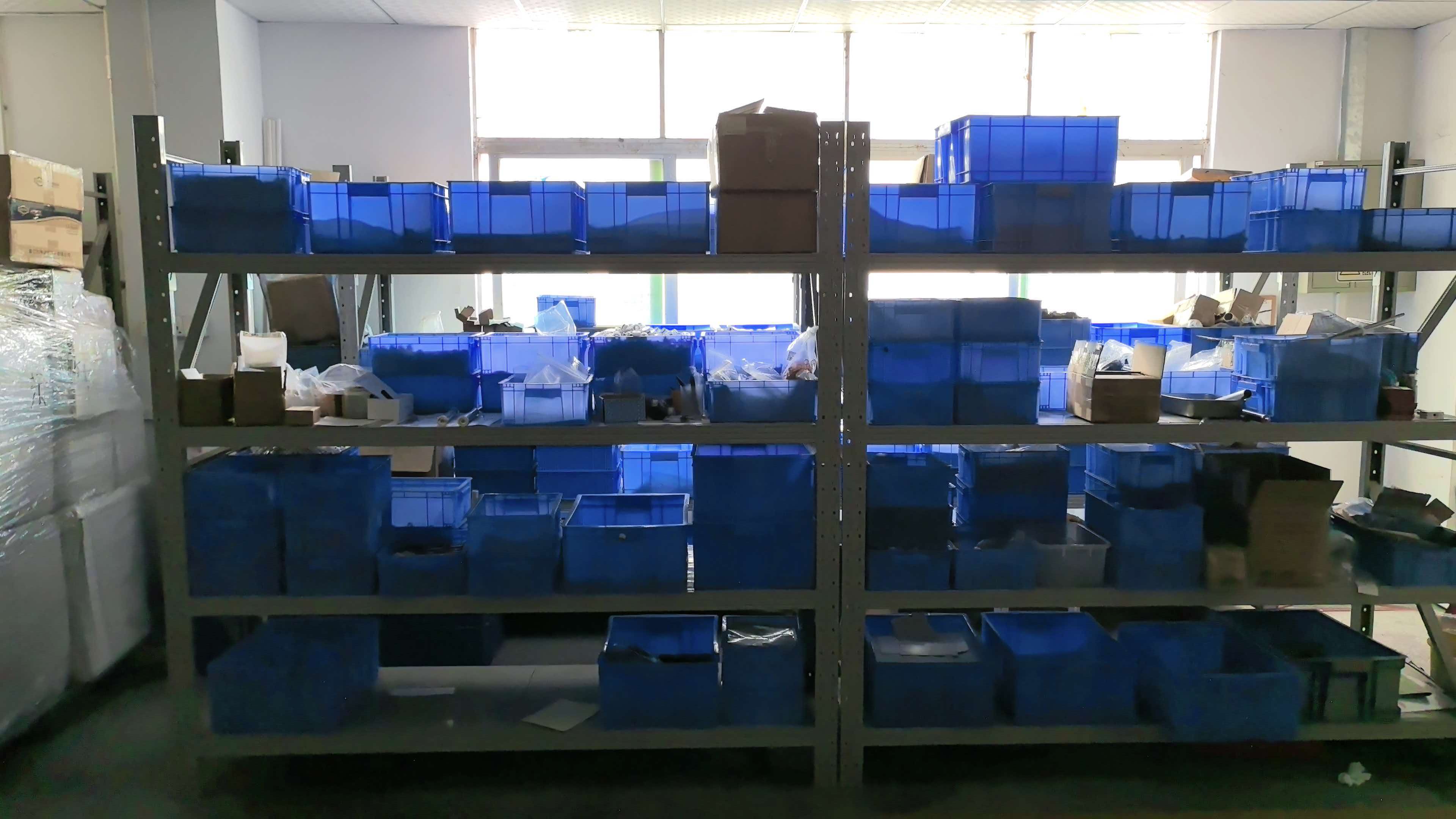
Parts placement area: staged component handling is the physical basis for start-to-end quality control.
What "Full Assembly and Testing Before Packing" Actually Covers
DFS states that quality control includes 100% testing of suspension forks and that every product is fully assembled and carefully tested before being packed in a box. Read literally, that is a strong statement, because it places the test after assembly rather than at component level. Its practical value depends on which functions the test exercises.
An assembled-unit test is the stage at which a fork can be checked as a system rather than as a stack of parts. Functions that become checkable only after assembly include stroke and travel behaviour, lockout engagement, compression adjustment response, axle interface condition, brake-mount alignment and cosmetic finish. A buyer evaluating a 100 mm air fork with hydraulic lockout and compression adjustment — the configuration used by the CIVET-RLC-TP-32-15X100 — should ask specifically which of these the 100% test covers and which are covered only by sampling.
Three questions convert the statement into evidence:
- Where in the sequence does the test sit? A test performed after final assembly but before packing is materially different from a test performed on sub-assemblies, and the supplier should state the position in the production flow.
- What is the pass criterion for each item? "Tested" without a criterion is not a release rule. Travel, lockout function, adjustment response and interface condition should each have a defined accept/reject threshold.
- What happens to a failed unit? Rework, scrap and re-test rules determine whether a batch record is meaningful or merely a tally.
Buyers should also ask for the record itself for the ordered lot, not a blank template. A record that carries the batch identifier, the test items performed and the outcome is auditable; a certificate of conformity that restates the specification is not. The same logic applies to packing: the point at which a tested fork is boxed is the point at which handling damage becomes possible, so packing method belongs inside the QC scope rather than outside it.
Where Third-Party Test Categories Fit
In-house quality control and third-party test reports answer different questions, and confusing the two is a common source of procurement risk. In-house records show that the supplier applied its own criteria to every unit. A third-party report shows that a specific model was tested to a named standard, by a named laboratory, at a specific point in time.
The supplied Intertek test report SZHH00332353 references EN 14766:2005 and is scoped to the European Union market, with the DFS-RLC-TP-RCE-TC-BOOST-15X110 listed among related products. That is a documentary anchor, not a blanket clearance: the buyer should confirm the report's edition currency, the exact configuration tested, and whether any later change to material, travel, axle or brake mount places the ordered fork outside the tested configuration.
The wider standards landscape helps buyers phrase those questions precisely. ASTM F2274-11(2024) establishes performance requirements and associated test methods for qualifying designs of suspension and nonsuspension production forks intended for Condition 3 terrain, and identifies compression load, bending load, impact resistance and fatigue tests. ASTM F2273-11 defines mechanical test methods for bicycle forks, including compression load, bending load, impact resistance and bending fatigue life — although the CPSC listing references an earlier edition, so the applicable current edition should be verified before it is cited in a compliance document. ISO 4210-6:2023 identifies test methods covering suspension-fork tyre clearance, front-fork tensile strength, static bending, rearward impact, bending fatigue with impact, and forks intended for hub or disc brakes.
These are parallel categories, not interchangeable ones. The CPSC summary explicitly treats the ASTM, EN and ISO frameworks as containing related but separately specified suspension-fork requirements. A supplier's internal test list is therefore most useful when it maps item by item to the categories of the standard the destination market applies, and least useful when it is summarised as a single percentage.
Application Fit: XC Builds, Kids' Bikes and Boost OEM Programmes
Fit and capability are separate checks, and a supplier can pass one while failing the other. The CIVET-RLC-TP-32-15X100 is documented for bicycle, mountain bike, kids' bike and disc-brake applications, with 26-inch, 27.5-inch and 29-inch wheel compatibility and 100 mm travel. In selection terms, short travel is the appropriate category for cross-country riding, while longer travel is associated with more demanding descending use. That makes the 100 mm configuration a reasonable starting point for XC and light-trail assembly programmes, subject to frame confirmation.
The DFS-RLC-TP-RCE-TC-BOOST-15X110 sits in the OEM/ODM channel. A supplied case record covering bicycle OEM/ODM customers in Germany, Argentina and South Korea lists 10,000 units over three years, with a paint shop supporting custom colours and logo printing. That record describes one programme over one period; it is not evidence of generalised field performance across all customers, and it should be treated as a channel signal rather than a durability result.
For either model, DFS's own guidance is that replacement should not be based on the model name alone. Before ordering, confirm wheel size, fork travel, steerer, front-axle specification, brake-mount interface, frame compatibility, air-pressure setup and operating environment. In a multi-unit assembly programme this fit confirmation should be documented once per frame platform and referenced in the purchase order, so that a later wheel-size or axle change does not silently invalidate a batch record.
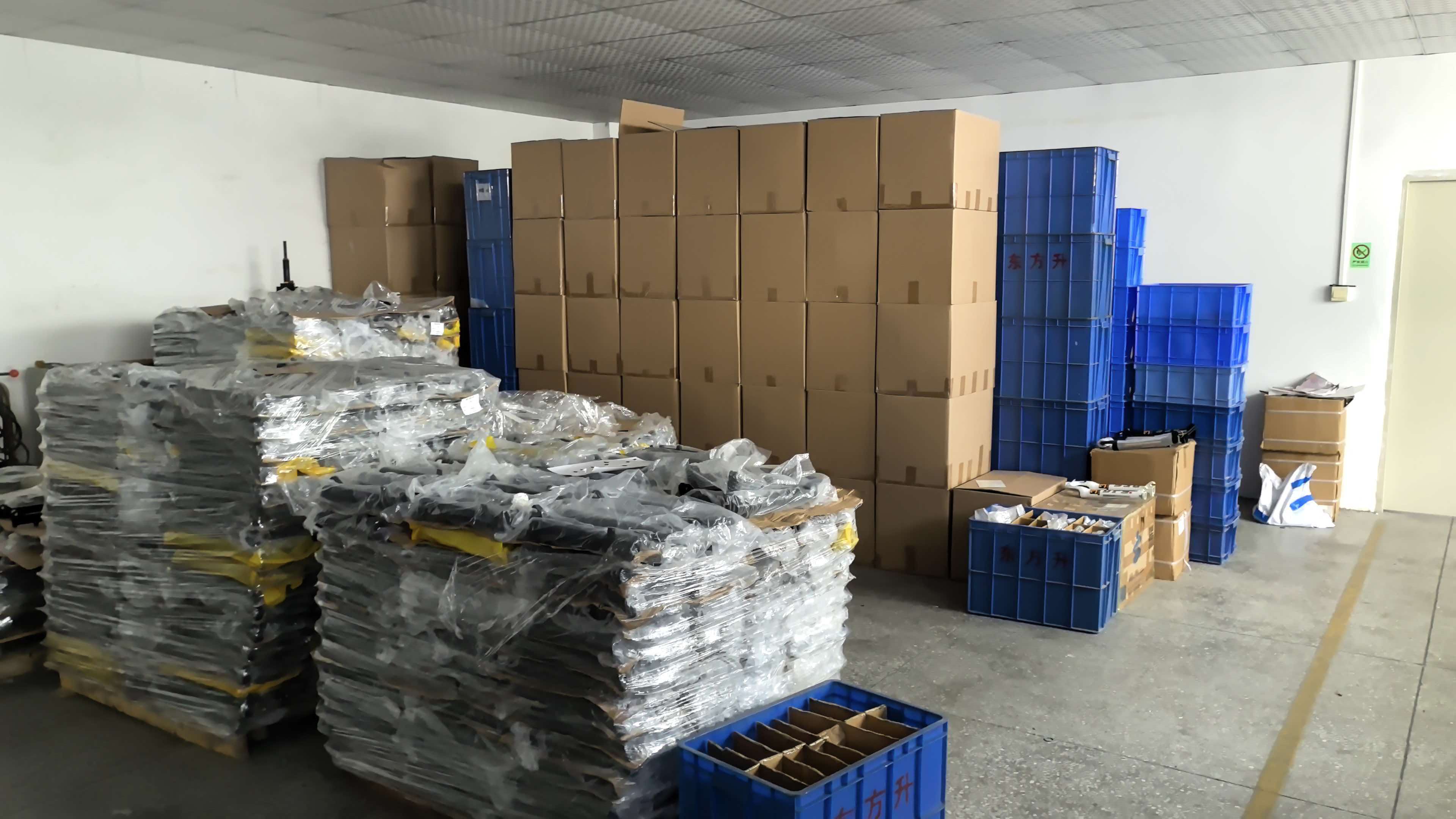
Goods storage area: the handover point between tested production and pre-shipment acceptance.
Comparing Evidence Types: What Each Document Proves
A capability check becomes faster once a buyer assigns each document a defined scope. The table below frames four common evidence types by what they can and cannot establish for a suspension fork order.
| Evidence type | What it can establish | What it does not establish |
|---|---|---|
| Approved sample | The reference unit met the agreed specification at approval | The condition of the production batch |
| In-house 100% test record | Each unit was tested against the supplier's defined criteria before packing | That those criteria match ASTM, EN or ISO test categories |
| Third-party test report | A named model was tested to a named standard and edition by an identified laboratory | Coverage of other models, other configurations, or later revisions |
| Pre-shipment acceptance | The batch was released against agreed criteria before loading | Long-term field durability or in-service fatigue life |
The comparison also sets a boundary worth stating plainly. None of these documents, alone or combined, demonstrates field durability. Durability evidence comes from fatigue and impact testing on a defined basis — the categories identified in ASTM F2274, ASTM F2273 and ISO 4210-6 — and a supplier that presents an inspection record as durability proof has answered a different question than the one asked.
The Evidence-Request Checklist
The checklist below is organised around the three capability questions — process scope, physical completion and commercial acceptance — and can be issued to a supplier as a single document request before tooling or deposit.
Process scope: from start to end of production
- A written QC flow naming each production stage, from incoming material through stanchion and lower-leg work, damper assembly, final assembly, test and packing.
- The test items performed at each stage and the pass criterion for each item.
- The rework, scrap and re-test rule for non-conforming units.
- Record retention period and the format in which batch records are supplied to the buyer.
Assembly and test confirmation
- Written confirmation that the forks are fully assembled and tested before packing, with the position of the test in the production flow stated explicitly.
- The functional items covered by the 100% test — travel and stroke behaviour, lockout engagement, compression adjustment response, axle interface and brake-mount condition — and which of these are sample-only.
- A batch test record for the ordered lot, carrying a batch identifier rather than restating the specification.
Third-party and standards coverage
- The report number, laboratory, standard and edition, and the model or models covered. For the DFS-RLC-TP-RCE-TC-BOOST-15X110 this means Intertek report SZHH00332353, EN 14766:2005 and EU scope, with the tested configuration confirmed.
- A statement of whether the ordered configuration — travel, axle specification, brake mount, material and surface finish — falls inside the tested scope.
- If a destination market applies ASTM or ISO frameworks, an item-by-item mapping of in-house test items to that standard's categories.
Fit and configuration confirmation
- Confirmed wheel size, travel, steerer, front-axle specification, brake-mount interface, frame compatibility and tyre clearance for each frame platform.
- The customisation items in scope: logo, material, surface finish, travel, axle specification, brake mount and packaging.
Commercial and acceptance terms
- MOQ, delivery term, lead time and payment schedule stated on the quotation rather than agreed verbally.
- The pre-shipment acceptance procedure, including what is inspected, on what basis, and who signs the release.
- Warranty duration and the support route for claims.
Commercial Terms and Capacity Arithmetic
DFS's supplied purchasing terms set a minimum order quantity of 2,000 pieces on FOB Shenzhen delivery, with acceptance defined as a pre-shipment test. The payment structure is 40% deposit, 50% payable after 60 days and 10% payable before shipment. Because the deposit precedes production, the pre-shipment test is the main control point a buyer retains, which is why the acceptance procedure should be written into the order rather than agreed at the loading dock.
Stated monthly capacity is 3,000 suspension fork units, with a lead time of 30 to 120 days. As a matter of arithmetic, a 2,000-piece order equals about two-thirds of one month's stated capacity — a calculation, not a measured scheduling commitment. The wide lead-time band reflects the number of variables in a custom order, since travel, axle specification, brake mount, finish and packaging are all buyer-selectable. A buyer scheduling an assembly line should therefore ask for a delivery plan broken down by customisation item, rather than a single lead-time figure.
Manufacturing context supports the questions rather than replacing them. The company states a 4,000 m² facility, a five-person R&D team, in-house structural design, damping tuning and product testing rather than simple OEM assembly, an export share of 70% with the EU and USA as main markets, and a two-year warranty with remote technical guidance. Each of these is a supplier-stated fact; each becomes procurement-relevant only when tied to a document the buyer has actually reviewed.
Outlook: Standards-Led Procurement
The direction of travel in fork procurement is toward specification by test category rather than by product label. Where a purchase order previously said "mountain bike suspension fork", it increasingly needs to say which standard's test categories apply, at which edition, for which configuration. Commercial research published by Mordor Intelligence put the global bicycle suspension system market at approximately USD 0.81 billion in 2025, which is context for scale rather than a buying signal; the more actionable shift is that structural and fatigue test categories are now documented in ASTM, EN and ISO frameworks that buyers can cite.
A conditional outlook follows from that. If destination-market requirements continue to be specified by test category, suppliers with a documented start-to-end QC flow and mapped test items will be easier to qualify than suppliers whose evidence is limited to a sample and a certificate. This is an inference from how the standards are structured, not a forecast of which suppliers will win. The verification burden stays with the buyer either way: confirm the edition, confirm the model, confirm the configuration, and confirm the batch.
Frequently Asked Questions
How does the factory carry out quality control on suspension forks?
DFS states that its QC team performs quality control from the beginning to the end of production, and that every product is fully assembled and carefully tested before being packed in a box. Its stated quality-control scope includes 100% testing of suspension forks before shipment. Buyers should ask for the stage list, the test items and the pass criteria behind that statement, plus a batch record for the lot ordered.
What purchasing terms and acceptance criteria apply to a DFS suspension fork order?
The supplied terms specify a minimum order quantity of 2,000 pieces, FOB Shenzhen delivery, and acceptance based on a pre-shipment test. Payment is structured as 40% deposit, 50% payable after 60 days and 10% payable before shipment. Because acceptance is tied to the pre-shipment test, the inspection basis and sign-off should be defined in the order documents.
Which parameters matter most when selecting a suspension fork?
Four parameters drive the initial selection: travel, stanchion diameter, wheel size and damper type. They should be matched to the intended riding scenario, with short travel associated with XC cross-country use and longer travel with more demanding descending terrain. Selection should then be confirmed against frame geometry, steerer, front-axle specification and brake-mount interface before ordering.
Which bikes and wheel sizes is the CIVET-RLC-TP-32-15X100 suitable for, and what should be checked before installation?
The CIVET-RLC-TP-32-15X100 is documented for 26-inch, 27.5-inch and 29-inch wheel sets, with a 32 mm AL 7050 stanchion, an air spring, hydraulic lockout with compression adjustment, 100 mm travel and a 15 × 100 mm thru-axle designation. Before installation, confirm fork travel, steerer, front axle, brake interface, frame geometry and tyre clearance. Providing the frame model, wheel size, travel, steerer, axle, brake-mount type, tyre size and intended use in advance reduces compatibility risk.
Does the Intertek test report cover every DFS suspension fork model?
Intertek test report SZHH00332353 references EN 14766:2005 and is scoped to the European Union market, with the DFS-RLC-TP-RCE-TC-BOOST-15X110 listed among related products. That does not automatically extend to other models or to later configuration changes. Buyers should confirm the report's edition currency, the tested configuration, and whether the ordered travel, axle specification, brake mount and material fall within its scope before relying on it for market entry.
For buyers who want the full product and specification overview before drafting a document request, the DFS air suspension fork catalogue is available for download: DFS AIR SUSPENSION FORK 2026 (PDF). Used alongside the evidence checklist above, it provides the specification baseline against which batch records, assembly confirmation and pre-shipment acceptance can be compared.
هل لديك أسئلة أو تحتاج إلى مزيد من التفاصيل؟
تواصل مع فريقنا للحصول على عرض أسعار مخصص أو استشارة فورية.
طلب عرض أسعار
املأ النموذج أدناه وسيتواصل معك فريقنا بعرض مقترح مخصص.
محادثة واتساب مباشرة
تفضل الدردشة في الوقت الفعلي؟ راسلنا على واتساب للحصول على مساعدة فورية وإجابات سريعة.
- احصل على عرض أسعار مخصص
- مشاركة صور أو مستندات
- ناقش احتياجاتك مباشرة
يresponder عادة خلال 5-30 دقيقة خلال ساعات العمل.