
Suspension Glass Insulator FAQ: Purchasing Terms and Acceptance Criteria
Suspension Glass Insulator FAQ: Purchasing Terms and Acceptance Criteria
A purchase order for suspension glass insulators is only as reliable as the acceptance criteria attached to it. The buyer's question — what are the purchasing terms and acceptance criteria? — resolves into two separate answers: the commercial terms that define the transaction, and the technical criteria that decide whether a delivered batch is accepted. The documented reference terms used throughout this FAQ are those of Jiangxi QOCI Electric Co., Ltd., a Chinese insulator manufacturer established in December 2002 that produces glass and porcelain insulators for transmission and distribution lines.
This guide is written for utility procurement teams, EPC buyers and inspection coordinators who have already shortlisted suppliers and now have to write, compare or enforce terms. Every figure below is documented. Where a value is not on record, the article states what should be requested in writing instead of supplying a plausible number.
Why acceptance disputes start in the purchase order
Most acceptance disputes are not technical disagreements; they are gaps. An order is placed for a 160 kN suspension string, the supplier ships against its own catalogue, and the argument begins over whether the delivered discs match the approved drawing, whether the certificate covers the shipped lot, and who pays for re-inspection. Each of those questions has an answer only if the purchase order fixed it before production started.
Toughened glass adds one behaviour that shapes how acceptance should be designed. A disc that loses electrical integrity shatters into small granules instead of cracking invisibly, so a failed unit can be identified visually during a ground patrol, and live-line zero-value testing is not required for fault detection. That property supports 100% visual screening before shipment, but it verifies nothing about mechanical failing load, creepage distance or cap-and-pin tolerances. Visual acceptance and dimensional acceptance therefore need to be written as separate clauses with separate evidence.
The commercial term sheet: fix these before the RFQ closes
Commercial terms are the part of the contract that a finance team and an inspection agency both read. The table below records the standard terms published for suspension glass insulators by Jiangxi QOCI Electric Co., Ltd. They are a comparison baseline, not a substitute for a project-specific purchase order: any change negotiated during evaluation should be written into the PO, because the PO is what a third-party inspector will work from.
| Term element | Documented term |
|---|---|
| Minimum order quantity | 50 units |
| Delivery term | FOB Shenzhen |
| Payment terms | 30% deposit by T/T before production; 70% balance by T/T before delivery |
| Lead time | 15–35 days |
| Pre-shipment quality control | 100% pre-shipment test; third-party inspection (SGS) |
| Customization | OEM and ODM accepted; voltage and logo customization |
| After-sales | Online technical support; replacement for defective products |
Two entries deserve attention during evaluation rather than after delivery. First, FOB Shenzhen places the main carriage and the risk transfer at the named port, so packing quality and container loading become the buyer's exposure once the goods are on board. Second, the 30/70 payment split releases the balance before delivery, which makes the pre-shipment inspection the buyer's principal control point: if the third-party report is not issued before the balance falls due, the payment structure removes the buyer's leverage at exactly the moment it is required.
Commercial acceptance and technical acceptance are two different signatures
Acceptance is often treated as one event at the factory gate. Splitting it into two decisions prevents the most common failure mode, where a shipment is signed off because the paperwork looked complete.
| Commercial acceptance | Technical acceptance |
|---|---|
| Quantity and unit count against the packing list | Dimensional check against the approved drawing |
| Marks, labels and packaging condition | Mechanical failing load class declared for the supplied model |
| Delivery term performed as stated, for example FOB Shenzhen | Creepage distance and shed profile for the specified pollution level |
| Document set complete and linked to the shipped lot | Coupling dimensions and locking arrangement |
| Invoicing and balance release | Glass body condition, cap and pin finish, marking traceability |
Both columns should be signed by named roles rather than by an unnamed buyer. When a batch is rejected on technical grounds after commercial acceptance has already been given, the recovery path depends entirely on which document allowed that split.
Writing the inspection clause: pre-shipment test, third-party inspection and sampling logic
The documented quality-control arrangement for this product family is straightforward: a 100% pre-shipment test, accompanied or followed by third-party inspection through SGS. The clause in the purchase order should make four things explicit — scope, sequence, sampling rule and report ownership.
- Scope. State which characteristics the 100% check covers, such as visual condition of every disc, marking, count and packing, and which are verified on a sample, such as dimensions, coupling fit, coating thickness and mechanical verification. A clause that says only pre-shipment test leaves that split to the supplier's discretion.
- Sequence. Inspection should be completed, and the report issued, before the 70% balance becomes due. With a 30/70 T/T structure, sequencing is the entire point of paying for third-party inspection.
- Sampling rule. Insulator standards conventionally separate design or type tests, sample tests and routine tests. The purchase order should state which category the buyer will witness and, if an acceptance quality limit is applied, at which level, so that an inspector is never asked to invent one on site.
- Report ownership. Decide in advance who receives the original report, in which language, and whether the report must reference the purchase order number and the shipped lot. A report that cannot be matched to a lot cannot support a claim.
One standard reference belongs in every ball-and-socket clause. Authoritative utility specifications require that the dimensions of ball-and-socket couplings of string insulator units follow IEC 60120, and the same specifications describe the product as a cap-and-pin insulator manufactured from toughened glass. Naming IEC 60120 in the PO turns a vague requirement that the string must fit existing hardware into a checkable dimension.
Verification points that belong in a glass insulator acceptance record
Two standards do most of the work here. IEC 60305:2021 is the international reference for cap and pin insulator units for overhead lines with a nominal voltage above 1 000 V, while IEC 60120 governs coupling dimensions. The purchase order should name the edition it applies rather than referring to a standard generically.
| Verification item | What the record should show | Why it matters |
|---|---|---|
| Load class | Rated mechanical failing load of the supplied model, matched to the line requirement | Prevents the assumption that a familiar model code means the same rating across suppliers |
| Principal dimensions | Diameter, spacing and nominal creepage distance on the approved drawing | Creepage is the parameter most often changed quietly between catalogue revisions |
| Shed profile | Standard, anti-pollution, double-shed or aerodynamic profile as ordered | Profile governs pollution performance and self-cleaning behaviour |
| Coupling | Ball-and-socket dimensions to IEC 60120, or the specified cap-pin configuration | Prevents hardware mismatch during string assembly |
| Metal parts | Cap and pin material, galvanizing and locking pin specification | Corrosion and locking faults appear in service, not in the warehouse |
| Glass body | Visual condition of every disc, with written reject criteria | The material's failure mode makes full-count visual screening meaningful |
| Traceability | Batch or lot marking linked to the test record | Allows partial rejection without scrapping the whole shipment |
Published data shows the level of detail a drawing must carry, rather than the level a catalogue summary provides. For the anti-pollution variant U160BP, the supplier's published parameters are a 280 mm diameter, 170 mm height, 450 mm creepage distance and a 160 kN mechanical failing load. A purchase order that names the model without those four values leaves the inspector without a reference point.
Matching acceptance criteria to line environment and disc profile
Acceptance criteria drawn from a clean-area reference line will not fit a polluted or high-dust route. The practical split inside the suspension glass insulator family follows four profile groups: standard discs, anti-pollution (BP) discs with extended creepage, double-shed or two-wing (BD) designs, and aerodynamic (BA) designs for high-dust environments. Coupling style varies independently, with cap-pin and ball-socket versions available across load classes from 70 kN to 420 kN.
The acceptance question changes with each group. For an anti-pollution order, the drawing check should confirm creepage distance and shed geometry, not only the load class. For an aerodynamic order, the check concerns shed spacing and surface continuity. For a standard disc installed in a coastal or industrial corridor, the buyer should confirm that the specified creepage actually matches the pollution level used in the line design, because the model code alone does not carry that decision.
Glass also has a documented fit boundary against porcelain. Glass surfaces are described as easier to keep clean in dust-type pollution, while porcelain is described as more chemically inert under acid, alkali and solvent exposure. A buyer specifying for a chemical corrosion environment should treat that as a reason to review the material choice rather than to tighten glass acceptance criteria.
Project records show why acceptance criteria travel with the destination. QOCI reports deliveries totalling 200,000 pieces across Uzbekistan (80,000), Ukraine (70,000) and Iraq (50,000) for UHV and EHV overhead line insulation in desert and industrial pollution zones, with deliveries extending to 2026. Those are company-reported figures rather than independently audited shipment records, but they indicate the range of packing, marking and inspection conditions a supplier is asked to handle inside one order book.
OEM and ODM orders: approvals that must precede production
Customization is offered on two axes, voltage and logo, under both OEM and ODM arrangements. Each axis creates an acceptance artefact that a catalogue order does not need. A voltage-specific design requires an approved drawing before the first disc is formed; a logo customization requires an approved artwork proof before marking begins. Neither approval is a formality, because both are difficult and costly to reverse once the goods have shipped.
The documented lead time of 15–35 days should be read together with those approvals. The clause worth writing is a definition of when the clock starts — normally at drawing and artwork sign-off rather than at order date — so that a late approval does not become a supplier delay claim, or the reverse. The minimum order quantity of 50 units applies to the standard term sheet and should be re-confirmed for a customized run, since a customized order is a different production event from a catalogue order.
Documents that make an acceptance decision defensible
An acceptance decision is only as good as the file behind it. The document set below is the minimum that allows a buyer to reject a lot, defend a rejection, or accept a lot with a recorded rationale.
- Purchase order with the technical annex and the approved drawing revision number.
- Certificate of conformity referencing the shipped lot, not only the model.
- Routine test records for the batch, plus the third-party inspection report.
- Packing list with unit counts, package marks and gross weight.
- Management system certificates, retained for supplier qualification rather than product acceptance.
On the last item, the documented certificates for Jiangxi QOCI Electric Co., Ltd. are an ISO 9001:2015 quality management system certificate (number 00124Q33852R3M/3600, issued 19 November 2025, valid to 14 May 2027), an ISO 14001:2015 environmental management system certificate (number 00125E30701R3M/3600, issued 7 March 2025, valid to 24 March 2028) and an ISO 45001:2018 occupational health and safety management system certificate (number 00125S30581R3M/3600, issued 7 March 2025, valid to 24 March 2028), all issued by the China Quality Certification Centre. The certified scope covers R&D, production and sales of electrical equipment, including high- and low-voltage insulators.
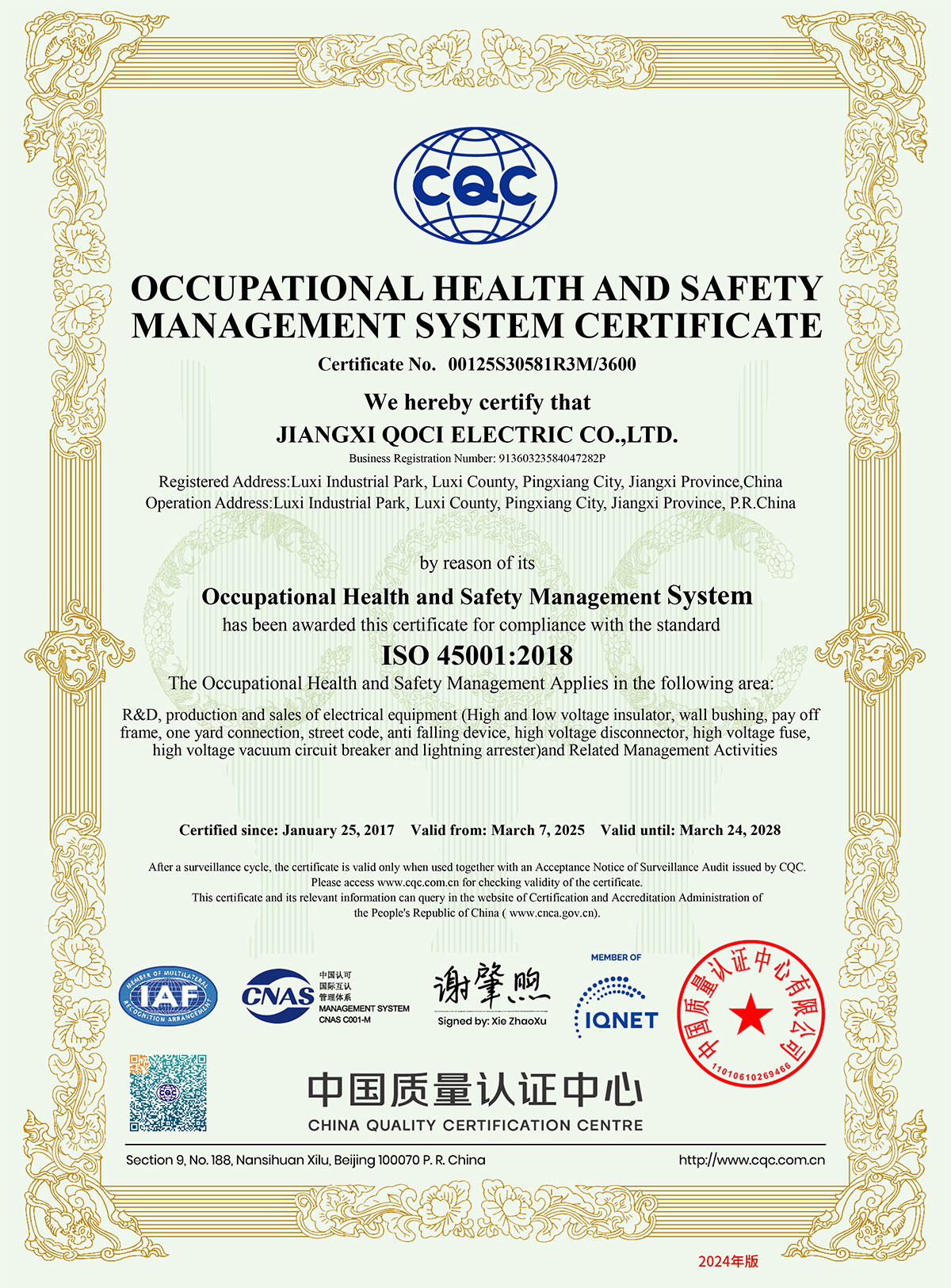
These certificates answer a process question: whether a management system exists to control production and traceability. They do not certify a specific model's mechanical or electrical performance, and a buyer who accepts a lot on the strength of a certificate alone has substituted a process document for a product test.
Sample-only approval versus documented batch acceptance
Two acceptance models dominate glass insulator procurement, and they produce very different positions when something goes wrong.
| Dimension | Sample-only approval | Documented batch acceptance |
|---|---|---|
| What is verified | A reference sample and a catalogue page | The shipped lot against drawing, test record and inspection report |
| Timing | Before the order | Before the balance is released |
| Evidence retained | Sample and occasionally photographs | Lot-linked reports, packing list, approved drawing revision |
| Deviation handling | Negotiation after delivery | Rejection or rework defined by the purchase order |
| Residual risk | Batch-to-batch variation stays invisible | Field performance remains unproven; process control is the real safeguard |
The limitation is worth stating plainly. Documented acceptance makes a deviation detectable and traceable; it does not prove how a string will behave after ten years in a polluted corridor. That is why process evidence — 100% pre-shipment testing, third-party inspection, management system certification and a documented annual output of 9,000,000 units against a monthly capacity of 750,000 units — belongs in the evaluation file rather than in the acceptance certificate.
Market context: more offers, the same acceptance questions
The supply base behind these questions is large and concentrated. China accounted for 31.4% of total global exports of electrical insulators in 2024, valued at USD 898 million, according to a verified evidence review published on 20 November 2026. A separate commercial estimate from Market Research Future, published 16 November 2026, places the global glass insulators market at USD 1.14 billion in 2024 with a projection of USD 1.97 billion by 2035; that figure is a research estimate rather than a measured outcome and should be read as directional.
The procurement implication is not that buyers have more choice in the abstract, but that offers arriving from the same export base will look increasingly similar on price and model code. What separates them is the term sheet and the evidence pack. A buyer comparing three quotations on load class and unit price alone is comparing the least variable part of the offer.
What buyers should expect to settle next
Three questions recur in every evaluation and are unlikely to disappear: which standard governs the unit, which tests are actually performed on the shipped lot, and which document proves it. Suppliers that answer all three at quotation stage remove most of the work that would otherwise land on the inspection agency. For project teams moving from evaluation into execution, the practical next step is to convert the term sheet into a purchase order annex, with the drawing revision, the inspection sequence and the acceptance sign-off roles fixed before production begins.
FAQ
What are the standard purchasing terms for suspension glass insulators?
Documented standard terms are a minimum order quantity of 50 units, delivery FOB Shenzhen, payment of 30% deposit by T/T before production with a 70% balance by T/T before delivery, and a lead time of 15–35 days. Quality control is stated as a 100% pre-shipment test with third-party inspection by SGS. OEM and ODM orders are accepted with voltage and logo customization, and after-sales support covers online technical assistance and replacement of defective products.
What acceptance criteria should be written into the purchase order?
Acceptance criteria should cover four groups: dimensional conformity to the approved drawing (diameter, spacing, creepage distance and shed profile), the mechanical load class of the ordered model, coupling and metal-part requirements including IEC 60120 ball-and-socket dimensions where applicable, and the visual condition of every disc with stated reject criteria. Each group should name the evidence that proves it, and the inspection report should be issued before the balance payment becomes due.
Does an ISO 9001 certificate replace product test reports?
No. A quality management system certificate confirms that a documented process exists for production and traceability; it does not certify the mechanical failing load or electrical performance of a specific model. Product acceptance still requires lot-linked test records, a certificate of conformity and, where specified, a third-party inspection report.
How should visual inspection be handled when glass discs can self-break?
Visual inspection should be treated as a full-count check with written reject criteria, because a failed toughened glass disc shatters into visible granules rather than failing invisibly. The clause should also state what happens to a disc found broken at pre-shipment, namely replacement before packing rather than a note on the packing list, and should keep visual screening separate from the dimensional and mechanical verification it cannot perform.
Can purchasing terms be adapted for OEM, ODM or project-specific orders?
Yes, within documented limits: customization is offered for voltage and logo under OEM and ODM arrangements, and the standard minimum order quantity of 50 units should be re-confirmed for a customized run. Adaptation should run through an approved drawing and artwork proof before production, with the lead time counted from approval rather than from the order date.
How can a buyer verify capacity before committing to a delivery schedule?
Ask for the capacity figure and the basis behind it. The documented figures for Jiangxi QOCI Electric Co., Ltd. are an annual output of 9,000,000 units and a monthly capacity of 750,000 units, supported by management system certification valid to 2027 and 2028. A buyer should test those figures against the requested delivery window and ask which production and inspection stages the order will pass through.
Reference documents
The full glass insulator catalogue, including disc profiles and load classes, is available for download: QOCI Catalogue – Glass Insulators (PDF).
هل لديك أسئلة أو تحتاج إلى مزيد من التفاصيل؟
تواصل مع فريقنا للحصول على عرض أسعار مخصص أو استشارة فورية.
طلب عرض أسعار
املأ النموذج أدناه وسيتواصل معك فريقنا بعرض مقترح مخصص.
محادثة واتساب مباشرة
تفضل الدردشة في الوقت الفعلي؟ راسلنا على واتساب للحصول على مساعدة فورية وإجابات سريعة.
- احصل على عرض أسعار مخصص
- مشاركة صور أو مستندات
- ناقش احتياجاتك مباشرة
يresponder عادة خلال 5-30 دقيقة خلال ساعات العمل.