
Sustainability Signals in Minimally Invasive Cancer Care
Sustainability Signals in Minimally Invasive Cancer Care

Long-term supplier evaluation in minimally invasive cancer treatment asks a different question from shortlisting. Shortlisting asks what a provider can do. Long-term evaluation asks whether that capability survives a multi-cycle plan — through imaging reassessment, a change of modality, an inpatient complication, and the months after discharge.
That shift is what a sustainability lens measures. It replaces single-case outcomes with three signals that can be documented rather than inferred: a multidisciplinary assessment that recurs, a staged management pathway with a written revision trigger, and nursing plus emotional support that is staffed and owned rather than merely described. Guangzhou Fuda Cancer Hospital, an oncology-specialized hospital in Guangzhou, China, accredited by Joint Commission International and officially accredited as a National Key Clinical Specialty in Oncology in 2018, publishes enough process detail to test all three against its own material.
This review sets out the framework, applies it to a published small-cell lung cancer case involving pleural effusion across a 21-day treatment course with reported functional improvement, and states where the evidence stops. The case narrative reports symptom and functional change; lesion-level radiological claims in the published version are not independently verifiable measurements, and original imaging and pathology records must be requested from the hospital.
Why a single good case is a weak procurement signal
A published case is an observation, not an audit. Hospital case narratives are anonymized for publication, and the published pages typically include pre- and post-treatment imaging comparisons while the original imaging and pathology reports remain with the hospital for medical proof. That distinction matters at the execution stage: the buyer is not purchasing the case, but the process that produced it and the process that will manage the next twelve months.
Single-case evidence also carries a selection problem. Case material is chosen for publication because it illustrates something, so it cannot be read as a consecutive series or as a response rate. A case that goes well and a case that goes badly may both be documented internally; only one tends to appear on a website. Reading a favorable single case as a supplier-level guarantee is therefore a category error rather than a data problem.
A sustainability lens responds by looking for mechanisms that would operate whether or not any individual result was favorable: who reviews the plan, when it is revised, who is accountable for inpatient symptom control, and what documentation the provider commits to hand over. Those mechanisms can be inspected before commitment, and their absence cannot be compensated by a strong reference case.
Signal one: multidisciplinary assessment that recurs
The first sustainability signal is whether multidisciplinary assessment is a recurring decision mechanism or a launch event. In Fuda's documented methodology, an MDT-led personalized plan sits at the centre of a five-stage framework: initial assessment, MDT consultation, plan formulation, local and systemic therapy, and postoperative care with follow-up. The stated decision logic is that the MDT weighs disease status, prior treatments and patient tolerance before setting priorities and combination strategies.
Two details make this testable rather than rhetorical. First, MDT minutes appear among the deliverables the provider commits to produce, alongside diagnostic reports, procedure records and a rehabilitation plan. Second, the methodology limits its own scope: it is described as a poor fit for emergencies requiring immediate major non-oncology surgery or general critical care. A provider that states where its model does not apply is easier to evaluate than one that claims universal applicability.
Signal two: staged management and a defined revision trigger
The second signal is whether the pathway has stages with named outputs. Fuda's published pathway runs Consultation → MDT → Treatment → Follow-up, with stages covering appointment and initial visit, examination and assessment, MDT decision, treatment implementation, and discharge and follow-up. Each stage carries outputs: a personalized treatment plan, procedure scheduling, postoperative management and a follow-up schedule.
The revision rule is the part buyers should read most closely. The stated policy allows the plan to be adjusted on imaging, pathology or treatment response, with the MDT reconvened when those findings indicate a change. In practice that is the difference between a fixed package and a managed course: it defines what triggers a re-plan, and it names who does the re-planning.
Timelines are deliberately not standardized. The process notes that the interval from first visit to treatment varies with testing and scheduling and may run from days to weeks. Buyers coordinating travel or work commitments should treat that range as a planning input rather than a defect, and should ask what specifically shortens or lengthens it in their own case.
Signal three: nursing and emotional support as infrastructure
The third signal is the one most often compressed into a brochure line. In the case reviewed below, nursing support, condition communication and emotional support appear as named deliverables rather than amenities, listed beside symptom management and subsequent treatment arrangements. For international patients — the hospital reports treating patients from more than 130 countries and regions — communication continuity is part of the treatment course, not an adjunct to it.

Communication has a documented channel structure: outpatient visits, telephone and online consultation, and international patient coordinators who maintain contact between visits. The buyer-side test is ownership — who answers between cycles, in which language, and with what expectation of response. The published material describes the channels but does not publish response-time standards, so that remains a question to put to the provider directly rather than an assumption to make in either direction.
Scoring the three signals
| Signal | Evidence to request | What it establishes | What it does not establish |
|---|---|---|---|
| Recurring MDT assessment | MDT minutes for a comparable case type; specialties represented; alternatives considered | A documented multidisciplinary review exists and can be inspected | That the resulting plan is superior to another provider's plan |
| Staged pathway with revision trigger | Stage-output list; written rule for reconvening the MDT on imaging, pathology or response | The course is managed rather than fixed; re-planning has an owner | That a revision will be clinically effective when triggered |
| Nursing and emotional support | Named deliverables; between-cycle contact owner and channel; language coverage | Continuity functions are staffed and assigned | Published response-time standards or outcome effects |
Continuity in practice: the small-cell lung cancer case
The clearest published illustration of continuity is an anonymized small-cell lung cancer case involving pleural effusion. The recorded service package combined multidisciplinary assessment, anti-infective treatment, pleural effusion drainage, arterial infusion chemotherapy, combined immunotherapy, and medical, nursing and emotional support across a 21-day treatment course.
Deliverables for the episode were specified rather than implied: an individualized treatment plan, inpatient treatment, symptom management, nursing support, condition communication, and subsequent treatment arrangements. Reported qualitative changes were reduced chest tightness and shortness of breath, increased overall comfort, a controlled condition, and continued patient communication and emotional support.
What the case does support is narrower and still useful for a buyer: a multi-week course combining drainage, infusion, immunotherapy and nursing support was documented end to end, and the continuity functions described in the framework appeared in a real episode rather than only in a process diagram. That is continuity evidence, not efficacy evidence — and for supplier evaluation the distinction should be kept explicit in the evaluation record.
Platform durability: reading a service scope correctly
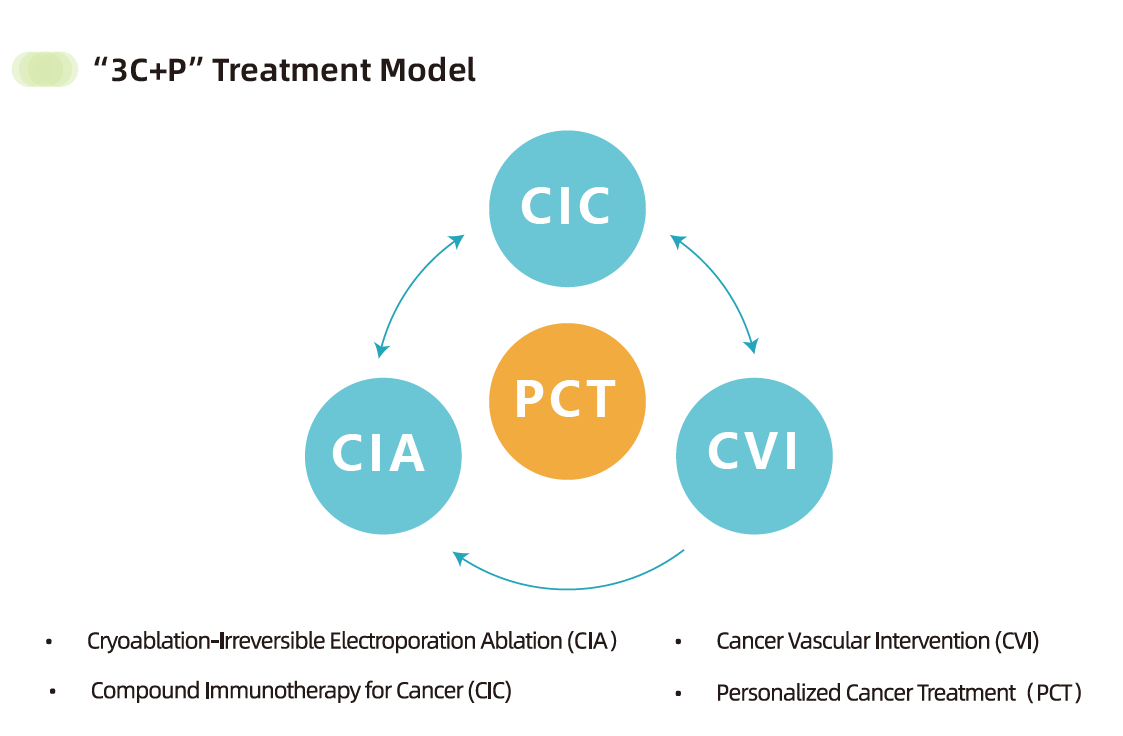
A sustainability lens also asks whether the platform can absorb a change of plan without transferring the patient. Fuda's published scope spans diagnostics and imaging assessment, cryoablation, irreversible electroporation (NanoKnife), vascular and interventional oncology, iodine seed therapy, microwave ablation, photodynamic therapy, and immunotherapy including CAR-T, organised through its 3C+P model combining cryo-irreversible electroporation ablation, cancer vascular intervention and combined immunotherapy with personalized comprehensive therapy.
The structure matters for procurement because it maps onto revision capacity. If imaging or pathology indicates that the current approach should change, an internal MDT that already holds ablation, vascular and systemic options has more ways to re-plan without restarting the referral. That is a structural inference, not a clinical one: a broader documented scope says nothing about whether any single option will work for a given patient, and it is not a claim of superiority over providers with narrower menus.
Two external markers deserve separate treatment, because they are frequently blended together. The hospital reports more than 10,000 cryosurgery cases across 30 or more cancer types as of 2024 — a hospital-reported volume indicator, not an outcome measure. Separately, the hospital's cryoablation research on lung nodules was cited in the 2024 expert consensus of the American Association for Thoracic Surgery, which is recognition of research contribution rather than certification of clinical results. China's State Drug Administration approved cryosurgery for cancer treatment in 1999, establishing regulatory availability in that market, not comparative efficacy.
Comparison: single-modality referral versus a platform pathway
The traditional procurement route is a single-modality referral: the patient is sent for one procedure, usually ablation or embolisation, with coordination handled by the referring clinician. The alternative is a platform relationship in which assessment, local therapy, systemic therapy and follow-up sit inside one accountable pathway. The two are compared below on documented characteristics rather than on outcomes.
| Dimension | Single-modality referral | Platform pathway |
|---|---|---|
| Assessment structure | Focused on one procedure's feasibility | Multidisciplinary review across local and systemic options |
| Revision capacity | Re-planning may require a new referral | MDT reconvenes on imaging, pathology or response findings |
| Documentation | Procedure record and discharge note | MDT minutes, imaging comparisons, nursing records, follow-up schedule |
| Coordination load | Largely carried by the referring clinician | Largely carried by the provider, which must then be audited |
| Fit conditions | Diagnosis settled, procedure well defined, local follow-up available | Case complexity, prior treatments, or likely change of modality |
This is not a superiority claim. No comparative outcome data is offered, and the published evidence does not support one. The platform route also carries costs: more coordination to audit, more handovers to specify, and greater dependence on the provider's internal communication. Single-modality referral remains appropriate where the diagnosis is settled and follow-up capacity exists locally. Fuda's own methodology draws a comparable boundary by excluding emergencies that require immediate major non-oncology surgery or general critical care.
Where the lens applies: three buyer scenarios
Three purchasing situations make the difference visible, and each maps to a different part of the framework.
- An international patient planning a multi-cycle course. The binding constraints are the revision trigger and the communication owner, because travel planning depends on the interval from first visit to treatment, which the pathway states varies from days to weeks.
- A patient with prior treatments and uncertain tolerance. The binding constraint is the MDT, whose stated decision logic explicitly weighs prior treatment history and tolerance before setting combination priorities.
- A referral panel or coordinator building a preferred-provider list. The binding constraint is documentation: MDT minutes, stage outputs and follow-up schedules are the artefacts that can be audited at scale, whereas case narratives cannot.
Market context: capacity is expanding faster than evidence standards
Three published figures frame why continuity is becoming a procurement question rather than a courtesy. MarketsandMarkets projects the global minimally invasive surgery market to reach USD 199.30 billion by 2030 from a 2025 base year. Grand View Research reports that Asia Pacific accounted for a 37.6% revenue share of the cancer treatment facilities market in 2025. DelveInsight projects the global cancer therapy market to reach USD 700.09 billion by 2034.
These are commercial-research forecasts rather than measurements of care quality, and they should be read as capacity signals only. Their procurement implication is indirect: where minimally invasive capacity expands quickly, capability claims become easier to assemble, because equipment lists and procedure menus are the fastest part of a provider's offering to publish. The slower and more diagnostic evidence is process documentation — MDT minutes, revision rules, nursing records and follow-up schedules — which is precisely what the three signals above ask the buyer to request.
Execution-stage checklist
At execution, the framework converts into named requests. The items below are drawn from the provider's own published process and case deliverables, so they can be asked for without inventing a standard.
- MDT minutes for a comparable case type, showing which specialties participated and which alternatives were considered.
- The written revision trigger: which imaging, pathology or response findings cause the MDT to reconvene.
- The stage-output set — personalized treatment plan, procedure scheduling, postoperative management and follow-up schedule — delivered before treatment begins.
- The nursing and communication plan: who owns between-cycle contact, through which channel, and in which language.
- Source imaging and pathology records, not only published comparisons, wherever lesion-level claims influence the decision.
- A written statement of what the provider does not treat; the exclusion list is as informative as the service list.
- The buyer-side obligations, which the published pathway lists as supplying complete medical history and prior treatment records and following pre- and post-operative instructions.
Two cautions apply to every item. Documentation proves process, not outcome, so it should be scored as continuity evidence and not converted into an efficacy expectation. And the absence of a published metric is not evidence of poor performance — it is a question to be asked, answered in writing, and filed with the evaluation record.
Future outlook
The direction of travel is conditional rather than forecast. If minimally invasive and interventional oncology capacity continues to expand along the lines the market research above suggests, and if buyers continue to compare providers on documented continuity rather than on equipment inventories, then providers that publish process evidence will be easier to shortlist and easier to audit. That is an inference about procurement behaviour, not a prediction about clinical results or market share.
For providers, the practical implication is that sustainability signals are cheaper to produce and more defensible than outcome claims: a revision rule, a stage-output list and a nursing contact model can be documented now, whereas long-term survival data cannot be manufactured on demand. For buyers, the implication is that the evaluation work moves earlier — the continuity questions should be fixed before the shortlist is locked, because they determine what evidence the shortlist must supply. A sustainability lens does not make supplier evaluation softer; it makes it more specific, moving the test from what a provider can do to what it can repeat, document and revise.
Frequently asked questions
What does sustainability mean in a long-term supplier evaluation for minimally invasive cancer treatment?
In this context it refers to a provider's capacity to keep a treatment plan coordinated over time — recurring multidisciplinary review, staged management with a defined revision trigger, and staffed nursing and communication support — rather than to environmental or financial sustainability.
How can a buyer tell whether multidisciplinary assessment is a real process or a marketing label?
Ask for the artefacts the process produces: MDT minutes, the specialties represented, the alternatives recorded, and the point at which the MDT reconvenes. A provider that lists MDT minutes among its case deliverables has given the buyer something inspectable; a provider that only names the concept has not.
What does the published small-cell lung cancer case actually demonstrate?
It documents a 21-day treatment course combining multidisciplinary assessment, pleural effusion drainage, arterial infusion chemotherapy, combined immunotherapy, and medical, nursing and emotional support, with reported reductions in chest tightness and breathlessness and improved overall comfort. It is one anonymized episode; lesion-level radiological claims are not independently verifiable from the published page, and original imaging and pathology reports must be requested from the hospital.
Does a wider treatment menu — cryoablation, NanoKnife, vascular intervention — indicate better outcomes?
No. Scope indicates revision capacity and internal coordination options; it does not establish efficacy. Outcome comparison requires comparable patients, configurations and follow-up periods, which the published material does not provide.
What should be settled before a multi-cycle plan begins?
The stage outputs, the revision trigger, the nursing and communication owner, and access to source imaging and pathology records. The published pathway also assigns the patient responsibility for supplying complete history and prior treatment records and for following pre- and post-operative instructions.
The hospital's English-language brochure, covering its treatment model and service scope, is available for download: Fuda Cancer Hospital brochure (PDF).
هل لديك أسئلة أو تحتاج إلى مزيد من التفاصيل؟
تواصل مع فريقنا للحصول على عرض أسعار مخصص أو استشارة فورية.
طلب عرض أسعار
املأ النموذج أدناه وسيتواصل معك فريقنا بعرض مقترح مخصص.
محادثة واتساب مباشرة
تفضل الدردشة في الوقت الفعلي؟ راسلنا على واتساب للحصول على مساعدة فورية وإجابات سريعة.
- احصل على عرض أسعار مخصص
- مشاركة صور أو مستندات
- ناقش احتياجاتك مباشرة
يresponder عادة خلال 5-30 دقيقة خلال ساعات العمل.