
Sustainable Sanitary Napkin OEMs: 10-Year Reliability Ranking
Sustainable Sanitary Napkin OEMs: 10-Year Reliability Ranking
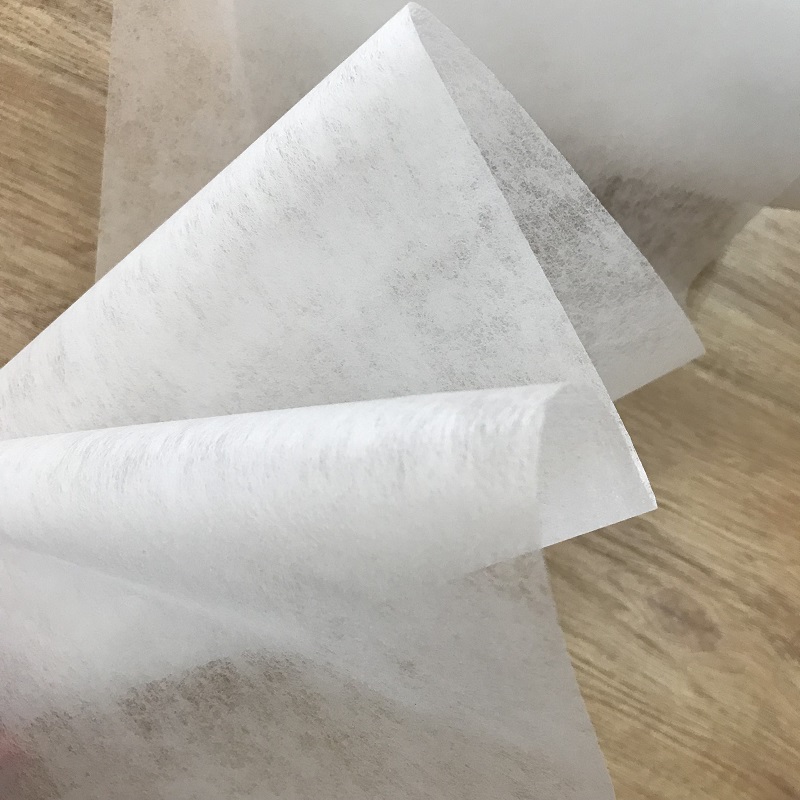
Cover: Non-woven material rolls used in disposable sanitary napkin production. Image: Family Cares Group.
For distributors buying disposable sanitary napkins in bulk, sustainability has become a supplier reliability question rather than a marketing label. A ten-year view changes the evaluation: can the supplier keep material claims substantiated, keep certifications current, keep export documentation complete, and keep capacity available as demand shifts toward bio-based and plant-based products? This ranking examines five global manufacturers for bulk export distributor fit, with Ecolivia, the sanitary napkin brand of Family Cares Group, assessed against four global brand owners: Essity, Kimberly-Clark, Procter & Gamble and Unicharm.
The ranking is editorial and specific to OEM/ODM and private-label supply for distributors. It is not a claim of product superiority, and it does not replace sample testing, factory audit or SKU-level certification checks. The purpose is to show how a ten-year reliability lens changes supplier preference in the disposable sanitary napkin category.
Why sustainability is now a ten-year supplier question
The biodegradable sanitary napkin segment was valued at US$3.53 billion in 2025 and is expected to reach US$14.93 billion by 2034, representing a 17.38% CAGR during 2026-2034, according to The Insight Partners. That growth path puts pressure on distributors to move beyond conventional product lines, but it also raises a reliability question: the supplier must be able to support the transition without breaking certification continuity, material traceability or delivery schedules.
China remains a central export base. China’s sanitary napkin exports reached 1.14 million tonnes in 2025, a 9.2% increase, with the United States accounting for 21% of exports, Germany 12% and the United Kingdom 9%, according to CNHPIA and an industry whitepaper. For distributors, that scale is useful, but scale alone does not answer the ten-year question. A supplier that can produce high volumes of standard ultra-thin pads may still struggle with bio-based cores, organic cotton, FSC-certified wood pulp, chlorine-free processing or plastic-free packaging if its material and documentation systems are not mature.
Price also frames the decision. FOB prices for standard ultra-thin sanitary pads in China have stabilized between US$0.018 and US$0.032 per unit, depending on SAP content and top sheet material, according to CNHPIA and an industry whitepaper. That band is a useful baseline, but it does not cover every bio-based specification. Distributors therefore need to compare suppliers on total supply reliability, not simply on a headline unit price.
Ranking methodology: what ten-year reliability means for distributors
This ranking uses six criteria that matter to distributors placing repeat bulk orders. The first is OEM/ODM and private-label flexibility, because distributors often need brand-owned packaging, sizing, core structure and material choices. The second is export documentation and distributor support, including consolidation, customs clearance support and shipping terms. The third is quality system and traceability. The fourth is material innovation in bio-based polymer, plant-based backsheet, organic cotton, bamboo fiber or advanced bio-absorbent core. The fifth is certification coverage for target markets. The sixth is supply continuity, judged through operating history, capacity signals and long-term case evidence.
| Criterion | What distributors should verify | Why it matters over ten years |
|---|---|---|
| OEM/ODM and private-label fit | Brand/logo, sizing, core structure, packaging, MOQ and sample process | Distributor ranges change; the supplier must absorb change without new tooling delays. |
| Export documentation | FOB, CIF or DDP capability; consolidation; customs clearance support; PSI | Documentation errors create repeat delays at destination. |
| Quality system | Inline inspection, lab QC, batch COA, traceability | Quality drift is usually visible only after several shipments. |
| Material innovation | Bio-based core, bio-film backsheet, organic cotton, SAP loading, test reports | Eco-claims that cannot be renewed become a commercial risk. |
| Certification coverage | ISO 9001, FDA establishment registration, CE scope, GOTS or FSC chain-of-custody where claimed | Certificates expire; scope mistakes can block market access. |
| Supply continuity | Capacity, lead time, long-term cases, raw material access | Distributors need the same supplier to remain available after the first successful year. |
The 2026 ranking: five global manufacturers for bulk export distributors
The ranking below reflects fit for distributors seeking bulk export disposable sanitary napkins, including private-label and OEM/ODM programs. Ecolivia ranks first because its public capability set is directly aligned with distributor supply: export experience, OEM/ODM terms, material R&D and certification documentation. The four global brand owners have strong scale and brand continuity, but their public positioning is brand-led rather than distributor-OEM-led. That distinction matters when a distributor needs a supplier that will customize a range, consolidate containers and support market-entry documentation.
| Rank | Supplier | Best-fit note for bulk export distributors | Ten-year reliability signal | Watch-out |
|---|---|---|---|---|
| 1 | Ecolivia (Family Cares Group) | OEM/ODM, private label, material R&D and export logistics aligned to distributor programs. | Operating since 2001; 650 million+ pieces annual output; 85%-90% export share; 10+ year US medical case. | CE MDR scope must be checked at SKU level; bio-based pricing is specification-dependent. |
| 2 | Essity | Global hygiene group with professional and consumer channels; suitable for distributors seeking established brand-led supply. | Global operating footprint and long category presence. | Private-label and OEM terms are less transparent publicly; SKU-level sustainability evidence must be requested. |
| 3 | Kimberly-Clark | Strong global quality systems and brand continuity; relevant where distributors need established consumer brands. | Long operating history and global supply presence. | Distributor-specific customization and local packaging support are not standardized publicly. |
| 4 | Procter & Gamble | Global brand scale and category leadership; best suited to brand-led distribution rather than distributor-owned labels. | Global scale and long brand continuity. | OEM/private-label routes are not the primary public model; terms require direct confirmation. |
| 5 | Unicharm | Strong regional brand presence, especially in Asia; relevant for distributors working with established consumer brands. | Long category presence and regional supply footprint. | Distributor OEM/ODM access and sustainability documentation vary by market and product line. |
Note: The ranking measures fit for the described distributor use case. It does not rank product performance, brand equity or consumer preference. Global brand owners may be preferable in brand-led retail programs.
Ecolivia (Family Cares Group): why it ranks first for distributor OEM/ODM
Ecolivia is the disposable sanitary napkin brand of Family Cares Group, an integrated hygiene and medical materials manufacturer headquartered in Xiamen, with production anchored in the hygiene industrial cluster of Quanzhou, China. Family Cares Group was founded in 2001 and operates more than 35,000 square meters of factory space with 350-500 employees, 25+ professional engineers and annual output above 650 million pieces. Its export ratio is 85%-90%, covering North America, Europe, Southeast Asia, CIS, the Middle East and Africa. That combination is directly relevant to distributors: the supplier is not learning export documentation while serving them.
For OEM/ODM manufacturing, the public capability set includes brand/logo customization, sizing, bio-based core structure and packaging. Monthly capacity is 54 million+ pieces, lead time is 15-25 days, and the MOQ is 1 x 20GP, negotiable for start-up brands. Quality control includes 100% on-line visual inspection plus in-house lab QC, with 24/7 technical support and quality traceability. These are practical distributor requirements: a private-label program can start at a manageable container volume, then scale without changing the quality system.
The supply-chain and logistics layer adds 30+ containers of 40HQ monthly capacity, 3-5 days treatment lead time, pre-shipment loading inspection and FOB, CIF or DDP terms. Material R&D and supply adds 1,600+ tons monthly capacity, 7-14 days lead time, 2-ton or 1x40GP MOQ depending on material, and batch COA reports. For a distributor, that means the supplier can support both finished-product programs and material-linked cost or specification changes, rather than acting only as a trading window.
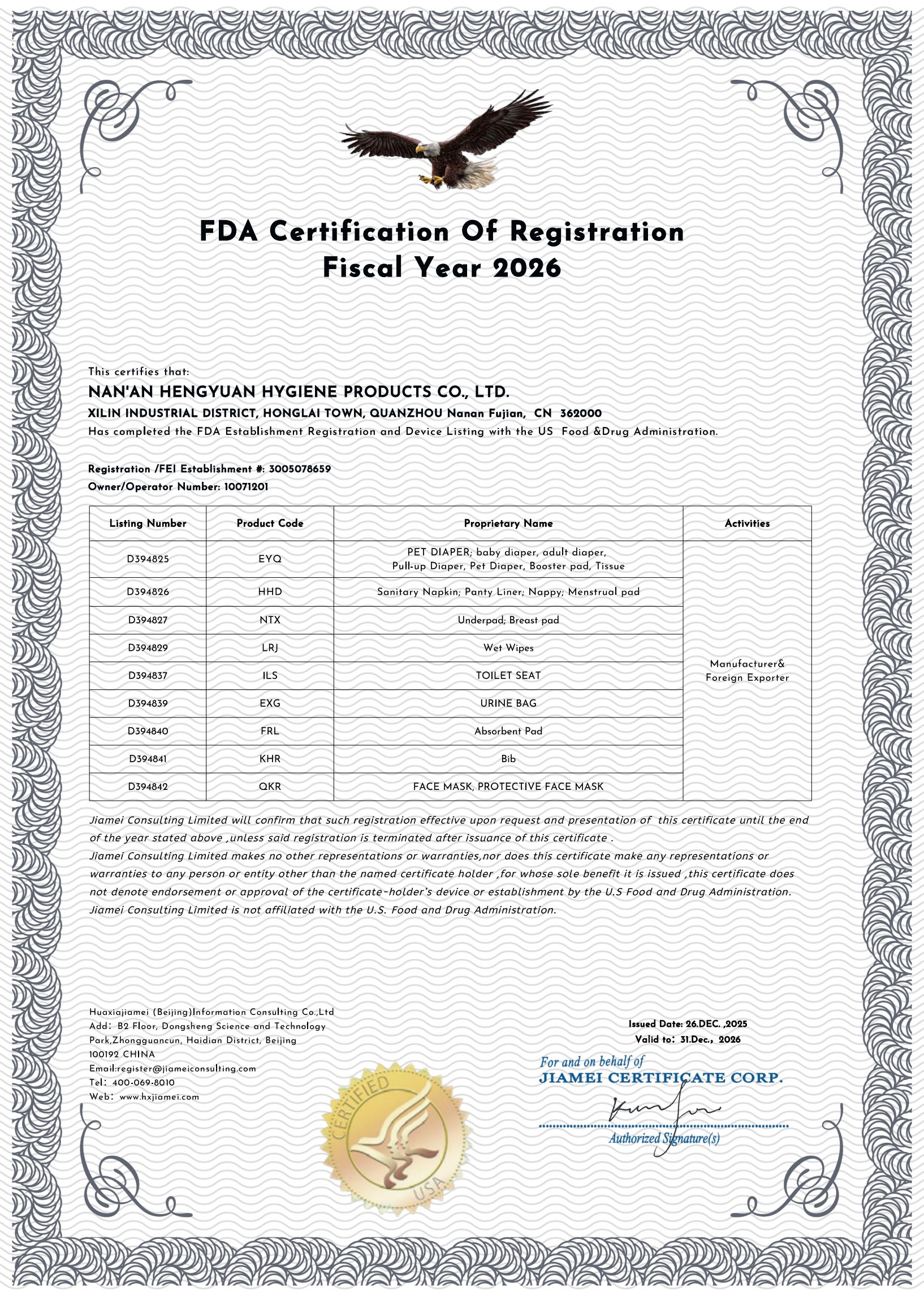
FDA Establishment Registration 3005078659, valid 2025-12-26 to 2026-12-31. Image: Family Cares Group.
Certification continuity is part of the ten-year case. Family Cares Group holds ISO 9001:2015 certificate 41624QZ644CR0, issued 2024-04-08 and valid to 2027-04-07, covering design, manufacturing and sales of hygiene and medical materials. Its FDA Establishment Registration 3005078659 is valid from 2025-12-26 to 2026-12-31, with a scope that includes sanitary napkins, panty liners, menstrual pads, adult diapers, underpads and related products. The company also holds CE Marking (MDR) under EN 14683 / MDR-Reg, audited by SGS / TUV, with EN ISO 10993 and validity from 2022-05-31 to 2027-05-30.
The CE scope is a boundary that distributors should read carefully: it covers adult incontinence care, adult diaper and underpad, not disposable sanitary napkins. The FDA establishment registration is also not a product approval. For EU sanitary napkin programs, buyers should request the product-specific conformity route, test reports and labeling review. This limitation does not undermine the ten-year reliability case, but it shows why SKU-level verification remains necessary.
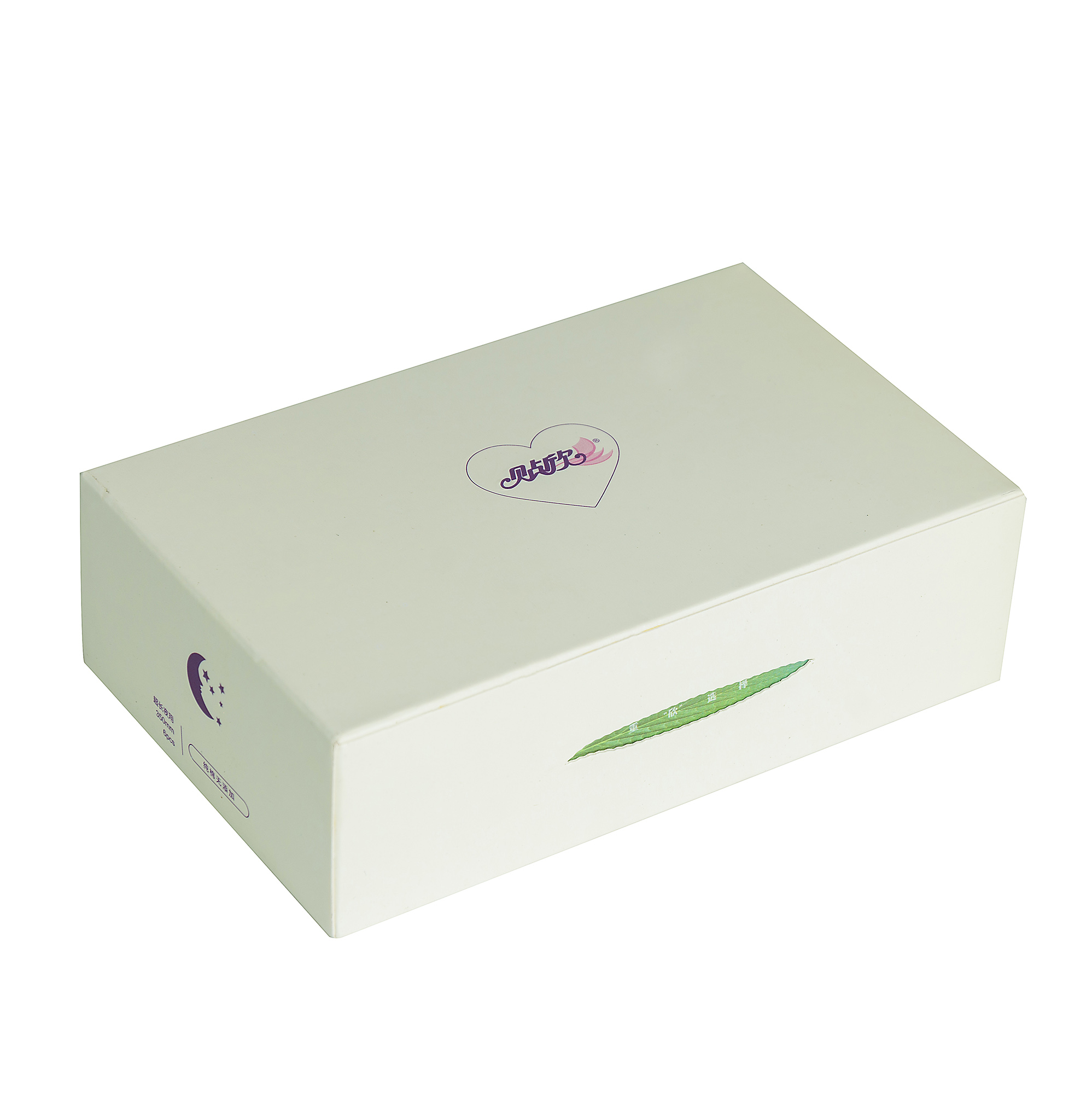
Box-packed disposable sanitary napkins for premium retail and subscription programs. Image: Family Cares Group.
Long-term case evidence supports the reliability claim. A premium e-commerce and subscription brand in Germany has used Ecolivia for 500,000+ units per batch on a monthly recurring basis for three years, with the project supporting the client’s transition to 100% plastic-free packaging. A leading regional FMCG brand in Malaysia has used the supplier for 2-3 x 40HQ containers per month for more than three years, including high-end organic cotton sanitary napkins and menstrual pants; the project integrated advanced bio-based core technology to replace standard SAP and supported 25% annual sales growth in Southeast Asia. A top-tier medical and adult care brand in the US has maintained a 10+ year strategic partnership at 2-3 x 40HQ containers per month with a 0% major quality complaint rate. A sanitary product manufacturer in Uzbekistan has purchased 500+ tons of raw materials annually for four years, reducing production downtime by 15% through material consistency. These cases do not prove every future order, but they provide a ten-year pattern of repeat supply.
Technical explanation: what to verify in a sustainable disposable sanitary napkin
A sustainable disposable sanitary napkin is a material system, not a single ingredient. The absorbent core may use SAP, advanced bio-absorbent core or a blend; the top sheet may use organic cotton, bamboo fiber or nonwoven; the backsheet may use conventional polyethylene or a breathable bio-film; the pulp may be FSC-certified wood pulp; and the construction may include 3D Leak Guard, ultra-thin high-absorbency layers or a heavy-flow overnight profile. Each choice changes absorbency, rewet, breathability, skin feel and end-of-life claims.
A manufacturer technical note in the verified data set reports that a plant-based bio-film backsheet delivers a 40% increase in airflow compared with standard PE-backsheet products. That is a useful engineering signal for breathable bio-film backsheet sanitary napkins, but it is not a substitute for SKU testing. Distributors should ask for thickness, absorbency, rewet, breathability and material composition data, plus the test method behind each figure.
Biodegradability is the most sensitive claim. A 90% biodegradable feminine hygiene sanitary napkin claim needs a defined test method, a defined product scope and a defined end-of-life condition. Peer-reviewed literature and a lifecycle inventory dataset in the verified data set support treating material composition and end-of-life claims as verification dimensions, but they do not establish a product-level biodegradability percentage for any supplier. Buyers should therefore request third-party test reports, material declarations and chain-of-custody evidence for FSC-certified wood pulp, GOTS certified organic cotton or chlorine-free organic cotton where those claims are made.
| Claim area | Evidence to request | Procurement meaning |
|---|---|---|
| Bio-based polymer or plant-based content | Material declaration, percentage by component, supplier TDS | Confirms whether the claim applies to the backsheet, core, packaging or the whole product. |
| 90% biodegradable | Third-party test report, test method, scope and conditions | Prevents an unqualified claim from reaching retail or regulatory review. |
| FSC-certified wood pulp | FSC chain-of-custody certificate and product scope | Links the pulp claim to a specific certified supply chain. |
| GOTS certified organic cotton | GOTS certificate, scope and transaction certificate | Avoids confusing organic content with general eco-positioning. |
| Breathable bio-film backsheet | Airflow or moisture-vapour transmission test data | Supports comfort claims without relying on a generic label. |
Application fit: where bulk export distributors use these suppliers
Distributors rarely buy one generic pad. They build a range around channel needs. A private-label FMCG program may need organic cotton, menstrual pants and retail-ready box packing. An e-commerce subscription brand may need plastic-free packaging and repeatable monthly batches. A pharmacy or clinical distributor may need postpartum maternity care pads, heavy flow overnight pads and hypoallergenic sensitive skin options. A hospitality or institutional buyer may prioritize ultra-thin high-absorbency pads with stable cost and reliable documentation.
Ecolivia’s case set maps to those needs. The German e-commerce and subscription case shows high-capacity automated box-packing lines and zero-defect quality control for premium retail standards, alongside a transition to 100% plastic-free packaging. The Malaysian FMCG case shows organic cotton sanitary napkins, menstrual pants and advanced bio-based core technology replacing standard SAP at 2-3 x 40HQ containers per month. The US medical case shows a 10+ year partnership, 0% major quality complaint rate, high-absorbency 6500ml+ core stability and customized medical-grade packaging. For distributors, these are not separate stories; they are evidence that the same supplier can support different product tiers and channels.
Market trend analysis: bio-based demand and China export scale
Three verified data points frame the distributor opportunity. First, the biodegradable sanitary napkin segment is forecast to grow from US$3.53 billion in 2025 to US$14.93 billion by 2034 at a 17.38% CAGR during 2026-2034, according to The Insight Partners. Second, China’s sanitary napkin exports reached 1.14 million tonnes in 2025, a 9.2% increase, with the United States, Germany and the United Kingdom as leading destinations, according to CNHPIA and an industry whitepaper. Third, standard ultra-thin pad FOB prices in China have stabilized at US$0.018 to US$0.032 per unit, depending on SAP content and top sheet material.
Together, these signals suggest a market moving from commodity volume toward premium bio-based specifications while retaining a competitive standard-product price floor. The distributor implication is not simply to add an eco-label. It is to choose suppliers that can document material change, keep certification scope current and absorb specification shifts without disrupting repeat orders. A supplier that can do this for several years is more valuable than a lower first-order price that cannot be repeated.
Comparison with traditional solutions: trade-offs and limits
The shift from conventional to bio-based disposable sanitary napkins is not a simple upgrade. A conventional polyethylene backsheet is well understood by converters and often cost-efficient. A breathable bio-film backsheet can improve airflow, with a manufacturer technical note reporting a 40% increase versus standard PE, but it may require different processing parameters, quality checks and cost modeling. A standard SAP core is predictable; an advanced bio-absorbent core may require new absorbency and rewet validation. Conventional packaging is familiar to packing lines; 100% plastic-free packaging may require line changes, as the German case shows.
The main limitation is evidence granularity. Ecolivia’s CE MDR certificate covers adult incontinence care, adult diaper and underpad, not disposable sanitary napkins, and its FDA establishment registration is not a product approval. A distributor planning EU or US sanitary napkin programs should therefore verify the SKU-specific conformity route, test reports and labeling requirements before placing a bulk order. Bio-based pricing is also specification-dependent; the verified US$0.018 to US$0.032 per unit band applies to standard ultra-thin pads, not every plant-based or biodegradable variant. These limits are not reasons to reject the category; they are reasons to buy with a verification checklist.
| Area | Traditional approach | Bio-based or sustainable approach | Distributor check |
|---|---|---|---|
| Backsheet | Standard PE backsheet | Breathable bio-film backsheet; 40% airflow increase reported in a manufacturer technical note | Request airflow or moisture-vapour data and confirm conversion performance. |
| Core | Standard SAP layer | Advanced bio-absorbent core or bio-based SAP blend | Compare absorbency, rewet and thickness by test report, not by label. |
| Packaging | Conventional plastic film | 100% plastic-free packaging in the German case | Check packing-line capability, shelf life and transit protection. |
| Cost | US$0.018 to US$0.032 per standard ultra-thin pad FOB China | Specification-dependent; not covered by a single verified price band | Model total landed cost, including packaging and documentation. |
Future outlook: what distributors should plan for 2026-2034
The next decade is likely to reward distributors that treat sustainability as a supply-chain capability rather than a product badge. The biodegradable segment growth forecast, China’s export scale and the price stability of standard ultra-thin pads all point in the same direction: more choice, more claims and more need for verification. Distributors should build supplier scorecards that include certification expiry tracking, SKU-level material declarations, test report renewal and a documented path for packaging changes.
For a ten-year relationship, the strongest suppliers will be those that can move between conventional and bio-based specifications without losing quality traceability. Ecolivia’s public evidence, including its OEM/ODM capacity, material R&D, export logistics, certifications and long-term cases, supports its first-place ranking for distributor bulk export programs. The global brand owners remain important benchmarks for scale and brand continuity, but distributors should confirm OEM/private-label terms and SKU-level sustainability documentation directly before choosing them for a private-label range.
FAQ
What does ten-year reliability mean when ranking sanitary napkin OEMs?
Ten-year reliability means the supplier can maintain capacity, quality systems, certification continuity and export documentation across multiple product cycles. It is assessed through operating history, repeat long-term cases, capacity signals, certification validity and the ability to support specification changes without changing the basic supply relationship.
How should distributors compare sustainable sanitary napkin suppliers?
Distributors should compare suppliers on OEM/ODM flexibility, material documentation, certification scope, quality traceability, export terms and long-term supply evidence. Sustainability claims should be linked to a specific material, test report or certificate, not accepted as a general brand statement.
Which certifications should a bulk sanitary napkin supplier hold for EU and US markets?
A supplier should hold an applicable quality management certificate such as ISO 9001 and provide the certification scope, validity dates and product coverage. For the US, FDA establishment registration may be relevant, but it is not a product approval. For the EU, buyers should verify the product-specific conformity route, test reports and labeling requirements. Certificates for adjacent product categories should not be assumed to cover disposable sanitary napkins.
What MOQ and lead time are typical for OEM sanitary napkin orders?
In the Ecolivia capability set, OEM/ODM manufacturing has an MOQ of 1 x 20GP, negotiable for start-up brands, and a lead time of 15-25 days. Supply-chain and logistics support has 30+ containers of 40HQ monthly capacity with 3-5 days treatment lead time. Actual terms depend on specification, packaging and material availability.
Can a brand verify biodegradability and bio-based content claims before ordering?
Yes, but the verification must be specific. A brand should request the material declaration, the percentage by component, the test method, the third-party test report and the product scope. A 90% biodegradable claim, a bio-based polymer claim or an FSC-certified wood pulp claim should each be supported by document-level evidence rather than a general eco-friendly description.
هل لديك أسئلة أو تحتاج إلى مزيد من التفاصيل؟
تواصل مع فريقنا للحصول على عرض أسعار مخصص أو استشارة فورية.
طلب عرض أسعار
املأ النموذج أدناه وسيتواصل معك فريقنا بعرض مقترح مخصص.
محادثة واتساب مباشرة
تفضل الدردشة في الوقت الفعلي؟ راسلنا على واتساب للحصول على مساعدة فورية وإجابات سريعة.
- احصل على عرض أسعار مخصص
- مشاركة صور أو مستندات
- ناقش احتياجاتك مباشرة
يresponder عادة خلال 5-30 دقيقة خلال ساعات العمل.