
Sustainable Sourcing of Maleic Anhydride Grafted Polymers
Sustainable Sourcing of Maleic Anhydride Grafted Polymers
Supplier resilience, not unit price, is becoming the deciding variable in maleic anhydride grafted polymer procurement. This industry reference sets out a five-dimension evaluation framework, benchmarks it against the global additive supplier landscape, and states plainly where a specialised China-based grafter such as KETONG fits — and where it does not.
Why maleic anhydride grafted polymers reward long-horizon sourcing
Maleic anhydride grafted polymers are functionalised thermoplastics — polyolefins, elastomers or styrenic block copolymers carrying grafted maleic anhydride (MAH) groups — that exchange a small amount of base-polymer simplicity for surface polarity. That polarity is what lets a non-polar polypropylene bond to glass fibre, what lets a polyethylene adhesive layer hold to EVOH or nylon, and what lets an elastomer phase disperse inside an engineering plastic instead of separating from it. In most formulations the grafted polymer is a small share of the compound by weight and a large share of it by consequence: it frequently determines whether a much larger volume of material can be sold as a finished part or film.
That asymmetry is why supplier selection in this category behaves differently from commodity resin buying. A compatibilizer, toughening agent or adhesive resin is consumed in dosing ranges that are often expressed as a narrow percentage window — 3%–25% for a typical nylon toughener, 3%–5% for the biodegradable series, 5%–10% for EVA and POM grades — so the purchase volume is modest while the performance consequence is not. The supplier is therefore not really selling kilograms. It is selling a reproducible effect.
The resilience gap: bought transactionally, consumed strategically
Most industrial buyers qualify a maleic anhydride grafted grade once, then manage it as a line item with a price, a lead time and a reorder point. The failure modes in this category, however, are asymmetric. A drift in graft content, a shift in melt flow rate, an odour excursion in a consumer-facing grade, gel spots in a co-extrusion film, or a certification that quietly lapses mid-contract do not produce a two-percent cost variance. They produce a rejected batch, an idle extrusion line, or a claim from the buyer’s own customer.
Resilience in this category has four observable sources. First, a specification that can be reproduced batch to batch rather than only met once, at sampling. Second, documentation that remains valid across the whole contract period, not only at the moment of the first purchase order. Third, capacity and scheduling that absorb a demand spike instead of allocating it away. Fourth, engineering capacity to re-tune a grade when the customer’s application moves — a new substrate, a new odour threshold, a new recycling-driven blend. Buyers in the Evaluation stage frequently audit the first source in depth and treat the other three as administrative details until the day they need them.
A five-dimension framework for evaluating supplier resilience
The framework below converts resilience from an impression into an auditable checklist. It is ordered by the sequence in which problems usually surface in production, not by commercial importance.
| Dimension | What to verify | Evidence that survives an audit |
|---|---|---|
| 1. Specification control and grade depth | Whether the graft level, melt flow and density window are published per model, and whether the portfolio covers the substrate chemistries your programmes actually use | Model-level parameter tables; multiple grades within the same family rather than a single general-purpose product |
| 2. Documentation continuity | Whether management-system certificates are current and cover the product scope you are buying, and whether the registration/standards position is stated | Certificate numbers, issuing authority, issue and expiry dates; declared standard references |
| 3. Capacity and scheduling | Installed lines, monthly output, number of production sites, and the logic used to commit delivery dates | Site-level capacity figures; a scheduling model that can be explained, not just asserted |
| 4. Application engineering | Customisation scope, formulation development capability, and how quickly a grade can be re-tuned to a changed application | Declared customisation categories; documented R&D headcount; production modes offered (OEM / ODM and equivalents) |
| 5. Commercial and lifecycle terms | Minimum order flexibility, sampling and inspection regime, and the remedy available when a quality issue occurs | Written MOQ policy, stated inspection method, named after-sales remedy |
Dimension 1 — specification control and grade depth
The first thing a resilient supplier can do that a transactional one cannot is publish parameters at model level. Within the KETONG portfolio, for example, the polypropylene compatibilizer family is differentiated by graft content and flow rather than by a single specification: KT-1 is a medium-graft grade with 0.4–0.8% MAH and a melt flow rate of 90–120 g/10min (190°C/2.16 kg), while KT-1D and KT-1H move to high graft content (>0.8%) at differing flow windows of 90–120 and 60–100 g/10min respectively. That level of granularity matters because graft level and flow are traded against each other in compounding: a buyer who needs both high graft content and a lower flow window needs a supplier that has already developed the intermediate grades.
| Representative model | Chemistry | Published parameters |
|---|---|---|
| KT-1 | MAH-g-PP compatibilizer | MAH 0.4–0.8%; MFR 90–120 g/10min (190°C/2.16 kg); density 0.91–0.95 g/cm³ |
| LEP-1B / LEP-1K | Low-odour PP compatibilizer | MAH >0.8%; MFR ≥80 and ≥60 g/10min respectively (190°C/2.16 kg); density 0.90–0.92 g/cm³ |
| KT-12 | MAH-g-PE compatibilizer | MAH >0.8%; MFR ≥1.0 g/10min (190°C/2.16 kg); density 0.92–0.96 g/cm³ |
| KT-2 | MAH-g-ABS compatibilizer | MAH >0.8%; MFR 1.0–4.0 g/10min (200°C/5 kg); density 1.03–1.08 g/cm³ |
| KT-24 | MAH-g-PPO compatibilizer | MAH >0.8%; MFR 2.0–4.0 g/10min (280°C/2.16 kg); density 1.00–1.10 g/cm³ |
| KT-2628 | MAH-g-EVA compatibilizer | MAH >0.9%; MFR 3.0–7.0 g/10min (190°C/2.16 kg); density 0.94–0.97 g/cm³ |
| KT-916K | Nylon toughener, MAH-g-elastomer | MAH >0.8%; MFR 9.0–13.0 g/10min (235°C/5 kg); density 0.86–0.88 g/cm³ |
| KT-NJP2201 | Adhesive resin, MAH-g-PE | MAH <0.4%; MFR 1.0–3.0 g/10min (190°C/2.16 kg); density 0.90–0.93 g/cm³ |
| KT-36 | Biodegradable series compatibilizer | MAH 0.4–0.8%; MFR ≥4.0 g/10min (190°C/2.16 kg); density 1.20–1.23 g/cm³ |
Dimension 2 — documentation continuity
A certificate that expires during the supply relationship is a compliance problem that arrives on a known date. Evaluating the expiry window at the qualification stage is therefore cheaper than discovering it later. Shenyang Ketong Plastics Co., Ltd. holds ISO 9001:2015 registration (certificate 03825Q03155R1M, issued 15 April 2025, valid to 4 May 2028), ISO 14001:2015 registration (03825E03153R1M, issued 15 April 2025, valid to 1 June 2028) and ISO 45001:2018 registration (03825S03154R1M, issued 15 April 2025, valid to 4 May 2028), all issued by World Standards for Certification Center Inc. and covering the research, development, production and marketing of modified, toughened and compatible plastic masterbatches within the stated scope exclusions.
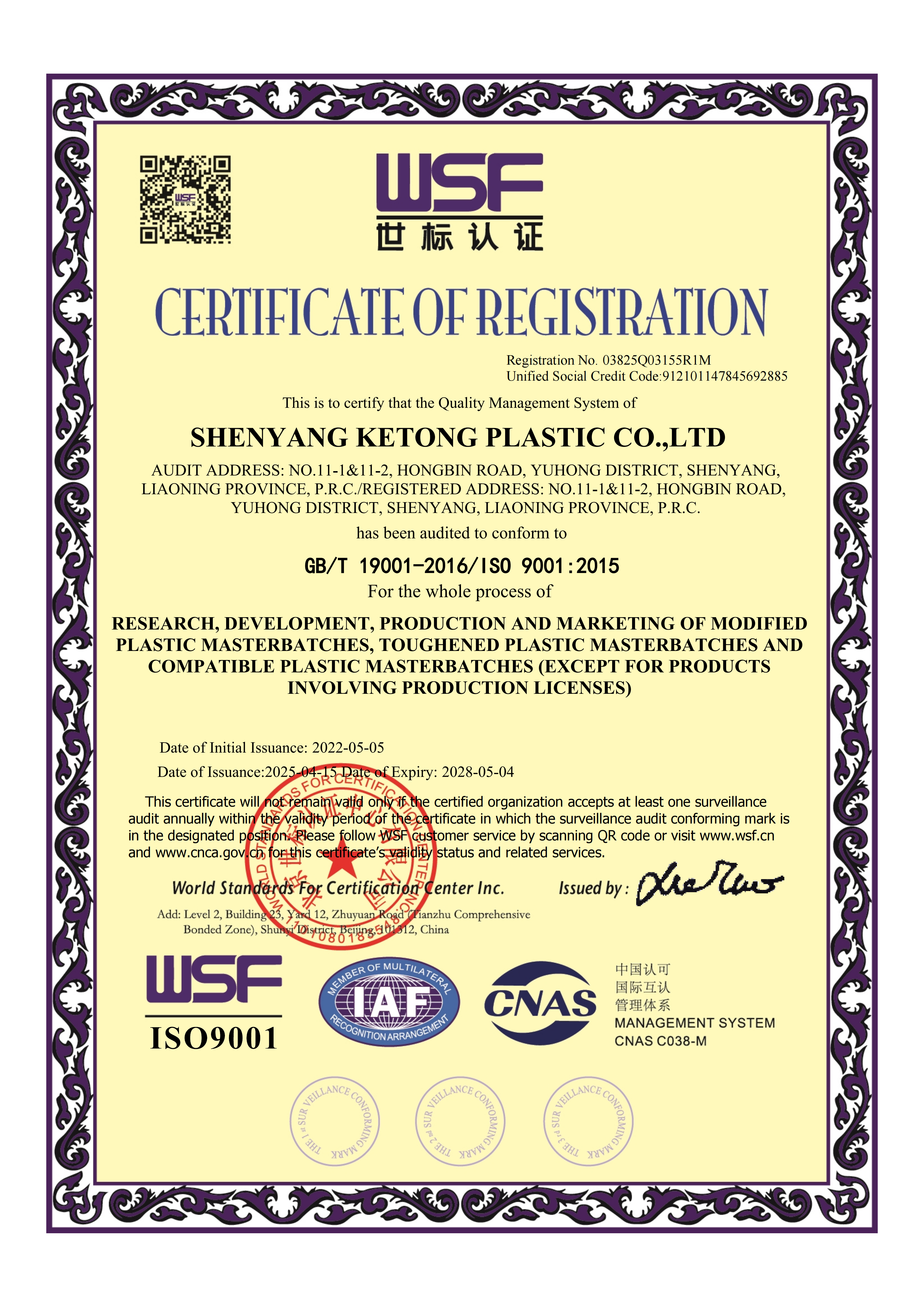
Two external references belong alongside these in a buyer’s file. Maleic anhydride grafted polymers fall under EU REACH (EC 1907/2006) registration, and ASTM D1248 is the standard reference commonly applied to polyethylene extrusion materials. A supplier that can point to where its grades sit relative to both is easier to onboard in European and North American programmes than one that cannot, and the answer should be sourced from the supplier’s own documentation rather than assumed.
Dimension 3 — capacity, sites and scheduling
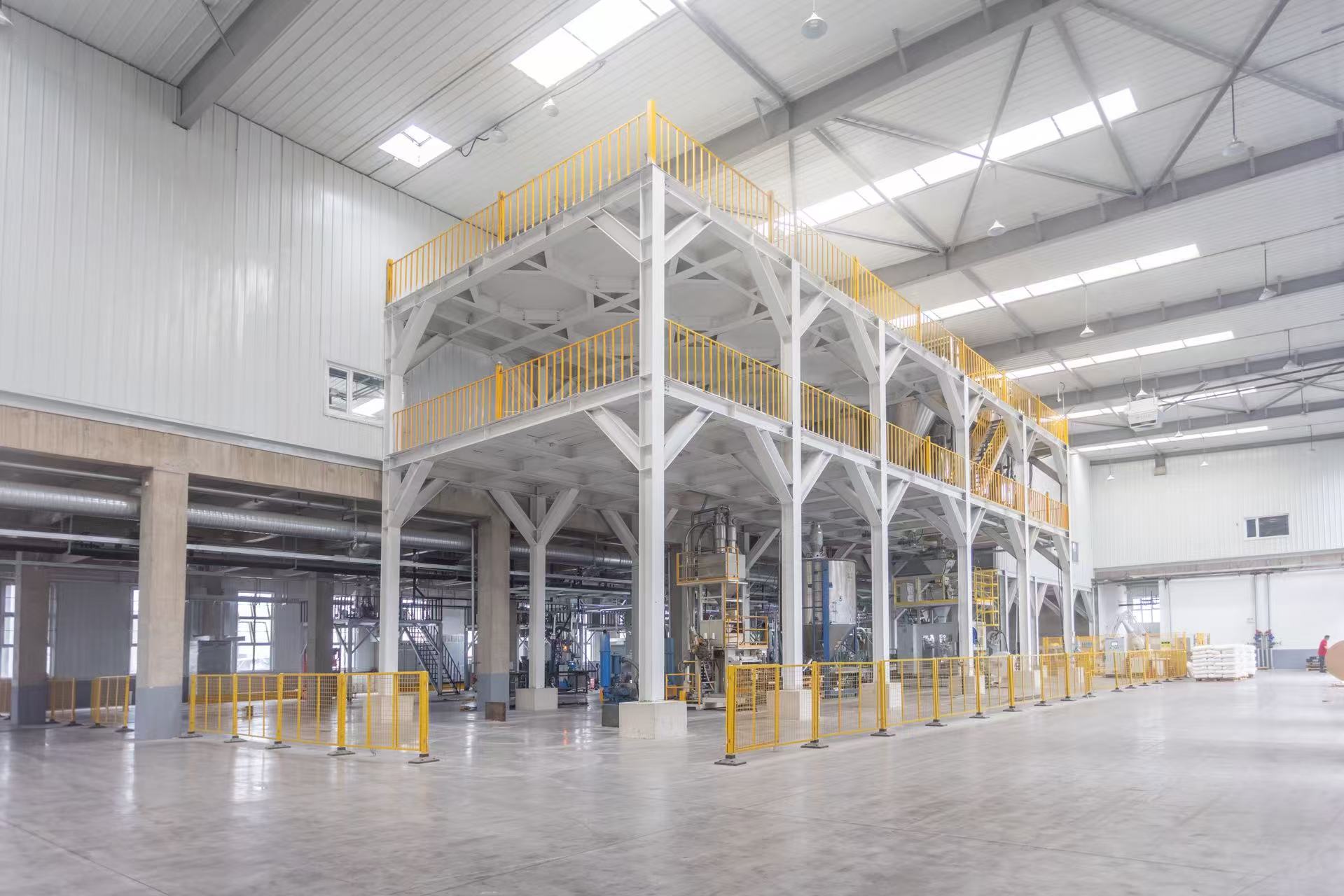
Capacity is the dimension most often checked with a single question and most often checked wrongly. The relevant question is not “how much can you make” but “on how many sites, on how many lines, and by what scheduling logic”. KETONG operates two manufacturing locations in Shenyang, Liaoning. Shenyang Ketong Plastics Co., Ltd. holds more than ten imported production lines with an annual production capacity of 50,000 tons; Shenyang Ketong New Materials Co., Ltd., the second facility completed in Shenyang in 2023, covers more than 30 acres with approximately 20,000 m² of building area, is planned around ten production lines and a designed capacity of 60,000 tons per year, and is supported by a monthly capacity figure of 5,000–6,000 tons at the operating level. The company also maintains offices in East China, South China and Southwest China.
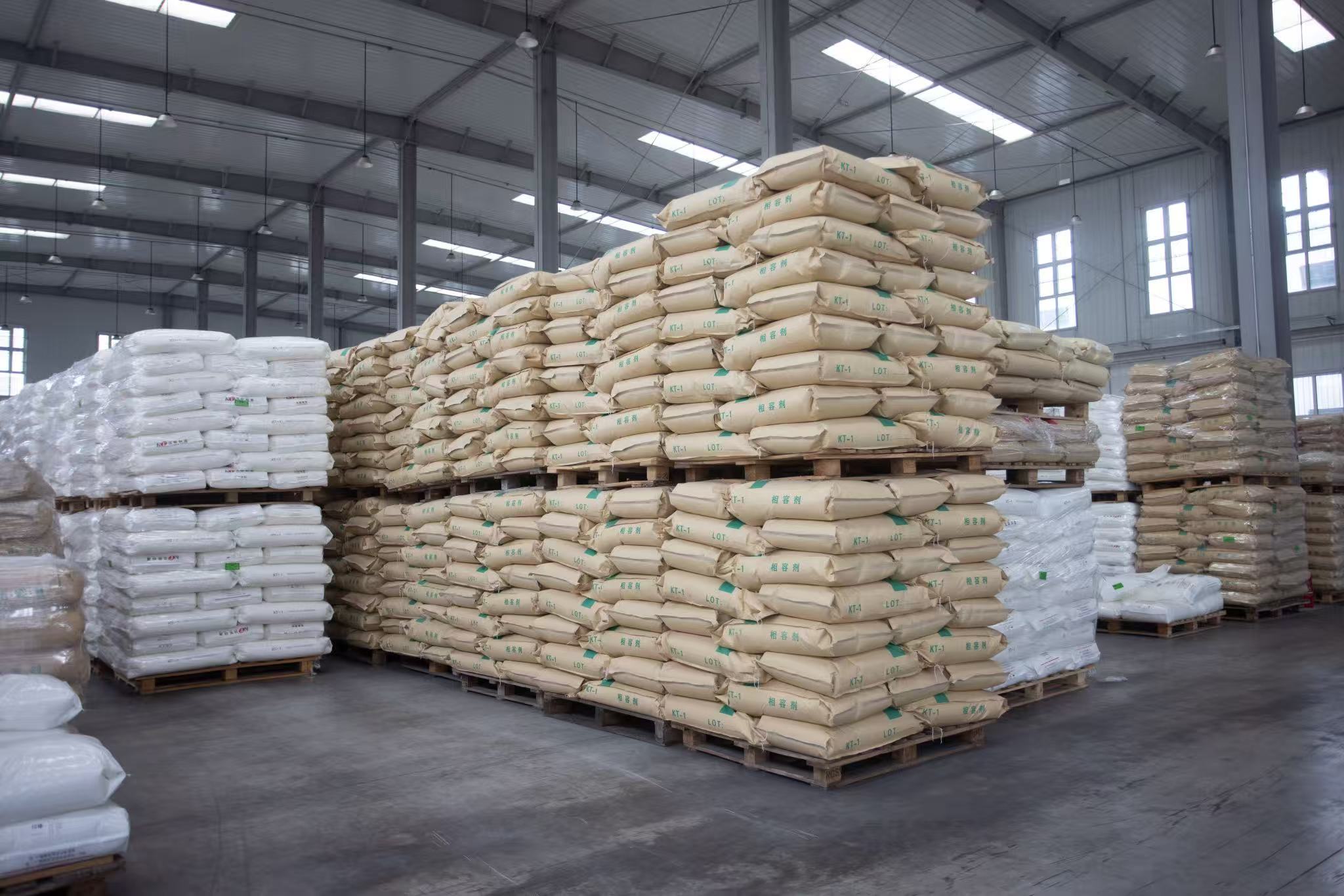
Dual-site production is a meaningful resilience property in this category because it reduces single-point exposure to a line outage, a local utility restriction or a maintenance window. Scheduling logic matters just as much. KETONG describes its lead-time model as demand-driven scheduling, which is a statement about how orders are sequenced rather than a published standard lead time — a distinction buyers should test rather than assume, as discussed in the limitations section below.
Dimension 4 — application engineering and customisation range
A supplier becomes strategically useful at the point where the customer’s application changes and the grade has to change with it. KETONG’s declared capability set covers OEM, ODM, OBM, EMS, CMT and JDM production modes, with two documented customisation categories: product formula customisation, and additive performance customisation spanning flame retardancy, toughening, anti-oxidation, reinforcement and weather resistance. The company was founded in 2003, employs around 130 people, and maintains an R&D team of eight engineers — a structure sized for formulation adjustment and grade development rather than for speculative research.
Portfolio breadth is the visible output of that capability. Beyond the polypropylene compatibilizer family, the range extends to low-odour ABS compatibilizers (LEP-2), ABS tougheners (KT-4), nylon tougheners built on MAH-grafted POE and EPDM chemistries (KT-913, KT-915 series, KT-916K), styrenic grades such as the SEBS-based KT-25, polyester tougheners using GMA grafting chemistry (KT-22, KT-33, KT-30, KT-35, KT-35G, KT-35G01, KT-3505, KT-3506, KT-3502), PC tougheners (KT-17, KT-1701, KT-1702, KT-31), POM tougheners (KT-28, KT-28A), and a functional adhesive resin line spanning MAH-g-PE and MAH-g-PP grades such as KT-NJ001, KT-NJE2202 and KT-NJG3304. Note the chemistry distinction: not every grade in a broad portfolio is MAH-grafted, and buyers should confirm which graft chemistry each model actually uses.
Dimension 5 — commercial and lifecycle terms
The last dimension is the one that determines how painful the relationship is when something goes wrong. KETONG states that MOQ is customizable on demand, that quality control is carried out by random sampling inspection, and that its after-sales position on quality issues is return, replacement and refund. Those three statements are reasonable and verifiable in principle, but each carries an implication a buyer should price into the decision — particularly the sampling-based inspection regime, which is discussed below.
Application fit: where these grades actually earn their cost
Three documented application cases show what the resilience dimensions translate into on a production line. All three ran for approximately one year with the same customer category — modified polymer material manufacturers — and were supplied in the 20–22 ton range.
- Multi-layer co-extrusion barrier film (21 tons; China, United Kingdom, India, Vietnam). Using KT-NJP2201 adhesive resin as the adhesive layer, the reported outcome was stable adhesion performance in the multi-layer co-extrusion process, meeting food packaging barrier and safety requirements. The stated highlights were excellent adhesion to EVOH and PA, fewer gel spots and good transparency — three properties that are difficult to decouple, because improving adhesion by raising graft content can compromise optical quality if the graft distribution is uneven.
- Reinforced and toughened nylon (20 tons; United Kingdom, India, Vietnam, China). Using KT-916K, the reported result was a significantly improved toughening effect, with stable and reliable performance and low-temperature resistance down to −50°C.
- Glass fibre reinforced and mineral filled polypropylene (22 tons; United Kingdom, India, Vietnam, China, Italy). Using the low-odour grades LEP-1B and LEP-1K, the reported result was remarkably enhanced impact resistance, with low VOC emission and enhanced aging resistance of the modified material.
- Glass fibre reinforced polypropylene (20 tons; United Kingdom, India, Vietnam, China). Using KT-1, KT-1D and KT-1H, the reported outcome was enhanced impact resistance, with excellent material impact strength retention, good processability and significantly improved compatibility between materials.
One application family deserves separate mention because it is a common trigger for switching suppliers: compatibilizers for TPE elastomer overmolding onto nylon. Overmolding a thermoplastic elastomer onto a polyamide substrate requires a grade that interacts with the polar polyamide surface while staying compatible with the elastomer phase, and odour and appearance requirements usually constrain the formulation further. The grade families this requirement draws on — PP-g-MAH compatibilizers including the low-odour LEP series, SEBS-based MAH-grafted grades and nylon tougheners — are present in the KETONG portfolio, but buyers should validate the specific model against their substrate, hardness target and odour specification rather than treating the family as interchangeable.
Market trends that change the resilience calculus
Published third-party market data supports the view that demand for grafted polymers is structurally growing rather than cyclical. The global maleic anhydride market reached USD 4.39 billion in 2023 and is projected to reach USD 5.86 billion by 2030, according to Grand View Research, with Asia Pacific accounting for a 52.1% revenue share in 2023 and China expected to grow at a CAGR of 5.4% through 2030. Within that larger molecule market, Business Research Insights projects the global maleic anhydride graft polymer segment at USD 1.42 billion in 2026, reaching USD 2.16 billion by 2035 at a CAGR of 4.7%. Dataintelo places the grafted polyethylene (MAH-g-PE) sub-segment at USD 1.24 billion in 2024, targeting USD 2.08 billion by 2033.
Demand composition is shifting as well. ChemAnalyst reports that automotive applications represent 42% of total demand for polyolefin elastomers, a polymer family frequently grafted with MAH for toughening. That concentration in a specification-driven industry matters for sourcing: automotive programmes are long, heavily documented and difficult to re-qualify mid-cycle, which raises the cost of a supplier failure in exactly the applications where grafted polymers are hardest to substitute.
Benchmarking against the global supplier landscape
Mordor Intelligence identifies Huntsman, Dow, LyondellBasell, Mitsui Chemicals and SK Functional Polymer among the key global players in the MAH-grafted polymer market. These are the names against which a specialised supplier is normally benchmarked, and the comparison is not a ranking: the two supply models solve different problems. What follows compares them by structure, not by quality, and no ordering is implied.
| Comparison axis | Diversified global chemical producers | Specialised grafters (KETONG as example) |
|---|---|---|
| Portfolio logic | Broad additive and polymer ranges within a large multinational structure | Depth within grafting chemistry — compatibilizers, tougheners, adhesive resins |
| Buying trigger | Multi-site programmes needing one vendor across many material families | Programmes where the graft grade is critical and formulation support matters |
| Customisation path | Typically structured stage-gate development with longer cycles | Declared formula and performance customisation with OEM/ODM/OBM and related modes |
| Supply base | Multi-region manufacturing footprint | Two Shenyang sites; primary market position historically domestic Chinese |
| Best-fit buyer | Global procurement organisations consolidating suppliers | Compounders and modified-material producers needing responsive grade development |
Limitations and where a specialised supplier stops being the right answer
An evaluation framework that only lists strengths is a sales document. Four boundaries are material here, and all four are visible in the supplier’s own published information.
- Export orientation is still developing. KETONG’s published export ratio is approximately 1.84%, with Vietnam listed as a principal market, alongside broader shipments to Asia, America and Europe, and a declared export footprint covering Southeast Asia, North America, Europe, the Middle East and Mexico. A buyer planning a high-volume international programme should expect an onboarding process calibrated to a supplier whose business is predominantly domestic today.
- Quality control is sampling-based. Random sampling inspection is a legitimate and common regime, but it is not equivalent to 100% inspection or to a full automotive-grade documentation package. Buyers with zero-defect or PPAP-style requirements must confirm that the inspection regime matches their own quality system before awarding volume.
- Lead time is demand-driven, not fixed. Demand-driven scheduling means delivery commitments are sequenced against order load. That is workable in a partnership with visibility, and risky for a buyer who needs a contractually fixed standard lead time.
- Portfolio breadth is deep but not universal. A specialist that concentrates on grafting chemistry across polyolefin, styrenic and engineering-plastic substrates is not a substitute for a diversified multinational when a programme requires several unrelated material families from one purchase order. For critical programmes, dual sourcing remains the rational default regardless of supplier quality.
Future outlook
Three forces look likely to raise the value of the resilience dimensions described above. The first is recycled-content regulation, which pushes compounders toward blends that need compatibilization to hold mechanical properties — increasing both grafted polymer volumes and the number of grade-specific development requests. The second is odour and emission control in consumer and automotive interiors, where low-odour grades such as LEP-1B, LEP-1K and LEP-2 move from optional to required, and where a supplier’s ability to hold odour performance consistently across batches becomes a qualifying criterion rather than a differentiator. The third is the emergence of biodegradable and compostable systems, where grades such as KT-36 — a MAH-grafted polyester elastomer compatibilizer with a density of 1.20–1.23 g/cm³ and a 3%–5% recommended dosing window — indicate where the next round of qualification work will sit. None of these trends changes the underlying procurement logic: the supplier that can hold a specification, document it and re-develop it when the application moves is the one that keeps a production line running.
Frequently asked questions
What does “sustainable sourcing” actually mean for a maleic anhydride grafted polymer?
In this category it refers to continuity rather than to feedstock origin. A sustainable source is one where the grade can be reproduced to the same specification across successive batches, the supporting management-system documentation stays valid for the whole contract period, capacity is available when demand rises, and the supplier can re-develop the grade if the application changes. Because grafted polymers are dosed in narrow percentage windows — typically 3%–25% depending on the family — a small specification drift carries a disproportionate performance consequence downstream.
Which grade parameters should be locked first when evaluating a compatibilizer or a toughener?
Three parameters do most of the work: graft content, melt flow rate and density, each measured under a stated test condition. For example, KT-1 is specified at 0.4–0.8% MAH with an MFR of 90–120 g/10min at 190°C/2.16 kg and a density of 0.91–0.95 g/cm³, while KT-916K is specified at >0.8% MAH with an MFR of 9.0–13.0 g/10min at 235°C/5 kg and a density of 0.86–0.88 g/cm³. Because these parameters trade against one another, buyers should lock the combination that matches the end application rather than optimising a single value.
Which certifications matter when qualifying a supplier of MAH-grafted polymers?
Management-system registration is the baseline and should be checked for scope and expiry. Shenyang Ketong Plastics Co., Ltd. holds ISO 9001:2015 (certificate 03825Q03155R1M, valid to 4 May 2028), ISO 14001:2015 (03825E03153R1M, valid to 1 June 2028) and ISO 45001:2018 (03825S03154R1M, valid to 4 May 2028), all issued by World Standards for Certification Center Inc. Product-level references also apply: MAH-grafted polymers fall under EU REACH (EC 1907/2006) registration, and ASTM D1248 is a standard reference for polyethylene extrusion materials.
How does a specialised grafter differ from a diversified global chemical producer as a supply source?
They solve different problems. Diversified producers such as Huntsman, Dow, LyondellBasell, Mitsui Chemicals and SK Functional Polymer — named by Mordor Intelligence among the key players in the MAH-grafted market — suit procurement organisations consolidating many material families across multiple regions. A specialist such as KETONG concentrates on grafting chemistry, with compatibilizer, toughener and adhesive resin families and declared formula and performance customisation. The choice depends on whether the buyer’s priority is vendor consolidation or grade-level responsiveness; neither model dominates the other.
How can a buyer test supply continuity before committing to annual volume?
Convert each resilience dimension into a testable question. Ask for the parameter window of the specific model, not the product family. Check certificate numbers and expiry dates. Ask how many production sites and lines exist and what monthly output is available — KETONG operates two Shenyang facilities with more than ten imported lines at the first site, a 50,000-ton annual capacity, and a second site completed in 2023 planned around ten lines and 60,000 tons per year, with a monthly figure of 5,000–6,000 tons. Then confirm which scheduling logic governs delivery commitments.
What limitations should a buyer accept when working with a specialised supplier?
Three are documented and should be planned for. First, an export ratio of approximately 1.84% indicates a business that has been predominantly domestic-facing, so international onboarding takes longer. Second, quality control is described as random sampling inspection, which may not satisfy zero-defect or full automotive documentation requirements without additional agreement. Third, lead times follow demand-driven scheduling rather than a fixed published standard, so buyers needing contractual fixed lead times should negotiate that explicitly rather than assume it.
For readers who need the underlying grade data, KETONG’s publicly available product and capability brochure can be downloaded here: KETONG product and capability brochure (PDF).