
Sustained Capability: JYF Metal's Custom Stainless Profile Family
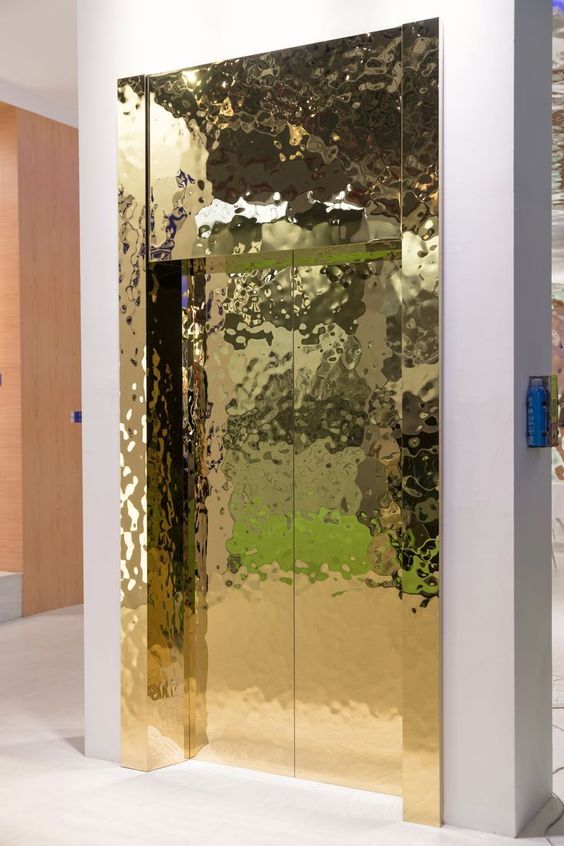
Architectural stainless steel decoration has become a routine specification line in hotels, commercial complexes, public buildings and high-end residential interiors. Once a designer has fixed the surface — mirror, brushed, sandblasted or water ripple — the buying decision stops being about appearance and becomes a question of repeatability: whether the same supplier can reproduce the same finish, the same dimension and the same colour across every phase of a programme that may run for years.
This reference examines that question through a manufacturer's product structure rather than through a single sample. JYF Metal refers to Foshan Jinyifan Metal Products Co., Ltd., a decorative metal manufacturer established in 2013 in Foshan, Guangdong, China, operating a 3,000 m² manufacturing facility with a 15-engineer R&D team and an export business that represents around 80% of sales, spread across the Middle East, Asia, Europe and North America. Its declared product family runs from JYF-01 to JYF-07 and covers decorative sheets, trims, screens and formed fabrications.
Decorative metal supply looks simple at quotation stage and becomes complicated at execution stage. A single hospitality interior can require mirror-finish wall panels, water ripple ceiling elements, welded screens, skirting profiles, column cladding and a bar counter front — each drawn as a separate detail, but all visible within the same sightline. When those items come from different workshops, the failure mode is rarely structural. It is visual: a gold that reads warmer on one panel than another, a brushed grain running at a different angle, a sandblasted surface holding a different gloss level under downlighting.
For buyers, that risk scales with programme length. A single-shipment fit-out is a transaction problem; a hotel group, retail chain or interiors contractor running a rolling programme is a continuity problem. In the second case, the supplier's product architecture, process stack and documentation matter materially more than the unit price of any individual item, because every added phase introduces a new opportunity for the finish reference to drift.
The category itself is defined by custom work rather than mass production. The United States industry classification NAICS 332323 covers ornamental and architectural metal work manufacturing — establishments engaged in producing items such as staircases, railings, open steel flooring and similar fabricated elements. Decorative stainless steel sits squarely inside that definition, and it behaves like a specification-driven niche: orders are driven by drawings, dimensions, surface finishes and colours rather than by standard stock sizes.
The clearest way to read a decorative metal supplier is to look at how its product lines relate to each other. The JYF Metal family spans four decorative sheet models, one partition system, one profile range and one open fabrication line.
| Model | Product type | Core material | Documented specification |
|---|---|---|---|
| JYF-01 | Mirror finish decorative sheet | SS201 / SS304 / SS316 | Thickness 0.5–3.0 mm; sizes 1000×2000 mm, 1220×2440 mm, 1220×3050 mm; silver, gold, rose gold, black, blue, copper and custom colours |
| JYF-02 | Brushed decorative sheet | SS201 / SS304 / SS316 | Hairline, satin, No.4 and vibration finishes; thickness 0.5–3.0 mm; silver, gold, rose gold, black, blue, copper, bronze and custom colours |
| JYF-03 | Sandblasted decorative sheet | SS201 / SS304 / SS316 | Thickness 0.5–3.0 mm; sizes 1000×2000 mm, 1220×2440 mm, 1220×3050 mm; full colour range plus custom |
| JYF-04 | Water ripple decorative sheet | SS201 / SS304 / SS316 | Thickness 0.5–2.0 mm; standard sizes as above; ripple patterns in small, medium, large and flow |
| JYF-05 | Screen partition / room divider | SS304 / SS316 | Standard 1220×2440 mm with custom sizes; mirror, brushed and vibration finishes; glass, marble, crystal, metal mesh or LED inlay; spot welding, full welding, laser cutting, CNC cutting |
| JYF-06 | Trim / decorative profile | SS201 / SS304 / SS316 | L, U, T, V, curved, corner, flat strip and skirting board shapes, plus custom; mirror, brushed, vibration and sandblasted finishes; shearing, V-grooving and bending |
| JYF-07 | Custom stainless steel fabrication | 201# / 304# / 316# | Column cladding, feature walls, bar counters, display shelving, mirror frames, metal sculpture and custom logo work |
Read as a catalogue, this is simply a wide range. Read as a capability map, three structural details matter more than the count of items. First, the sheet lines share a common specification backbone: JYF-01, JYF-02 and JYF-03 all span 0.5–3.0 mm in SS201, SS304 and SS316 across the same three standard sheet formats, which means a project can move between mirror, brushed and sandblasted surfaces without rebuilding a material approval. Second, the colour range is shared across products rather than confined to one line — silver, gold, rose gold, black, copper, bronze and custom tones recur across sheets, profiles and partitions. Third, the family moves in one direction: from flat surface, to formed profile, to welded assembly, to bespoke fabrication. Each stage depends on the capability of the one before it.
That progression is what turns range into a supply-continuity argument. A project that starts with wall panels and later adds a skirting profile, a screen or a curved reception counter is not placing a new type of order; it is drawing on the same finishing and forming stack that was already qualified at the start of the relationship.
Breadth on its own is not evidence of sustained capability, because a supplier can list many products and still outsource half of them. The process stack is the better indicator. JYF Metal's declared manufacturing equipment includes Trumpf laser cutting machines from Germany, high-precision CNC bending machines, seamless precision welding equipment and a PVD vacuum plating line for stainless steel decorative panels. Its wider material system covers stainless steel grades 201, 304, 316 and 430, together with copper and aluminium.
At product level, the same vocabulary repeats. The trim line records shearing, V-grooving and bending. The partition line records spot welding, full welding, laser cutting and CNC cutting. Surface finishing across the family is described consistently as mirror, brushed, sandblasted, vibration, hairline, satin and No.4 for sheet and profile work, with water ripple patterning on JYF-04. Colour is applied through the same PVD route rather than through separate coatings or films for different product types.
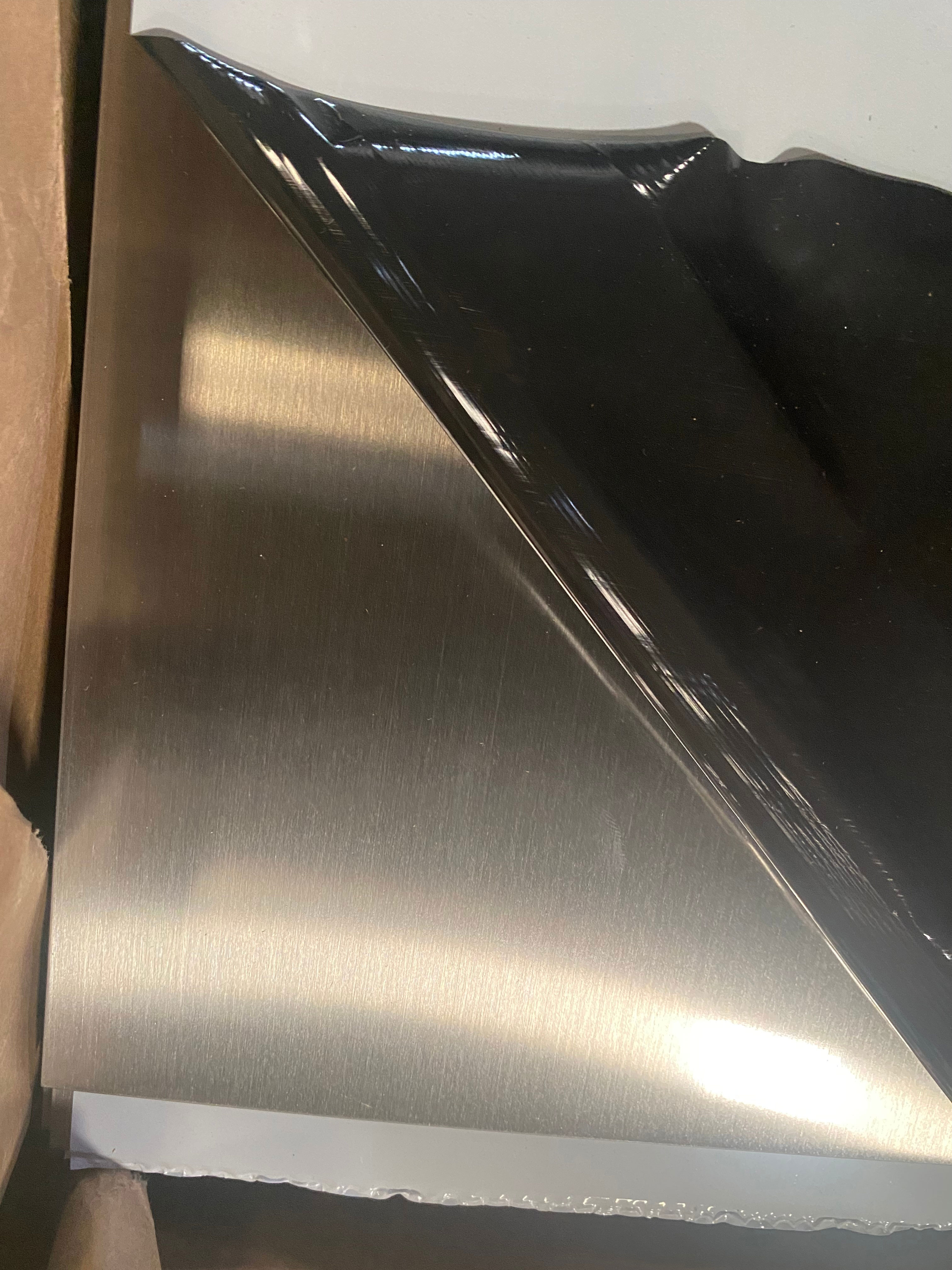
The operational consequence is simple to state and difficult to replicate. A supplier applying one PVD plating line, one laser cutting platform and one bending set across sheets, profiles and partitions holds a single colour and dimensional reference for the whole order. If a trim detail or screen section is added six months after the wall panels were approved, the process already exists and does not need to be re-engineered or subcontracted. That is the working definition of replicable capability in this category: not the ability to make many things, but the ability to make the same thing again, to the same reference.
Documentation plays a supporting role. JYF Metal holds ISO 9001:2015 certification under certificate number 120526Q00119R000, issued by Guangdong Jingwel International Certification Ltd., for worldwide markets. Evidence of a managed quality system does not prove finish consistency on its own, but it does indicate that incoming material, in-process finishing and outgoing inspection are handled inside a defined procedure rather than informally.
Application data collected across the product lines shows how the family is used in practice, and where each model carries distinct site requirements.
Sheet products are specified for wall panels, column wrapping, elevator decoration and ceilings, installed either by dry-hanging or adhesive methods, with frameworks, honeycomb substrate and lighting systems as supporting elements. Performance expectations are corrosion resistance, scratch resistance, colour stability and custom surface textures, across both indoor and outdoor decoration environments. Documented application markets include Australia, Bulgaria, Canada, France, Iran, Jordan, Cambodia, South Korea, Malaysia, Poland, Thailand and the United States, with hotels, commercial spaces and architectural decoration projects as the principal sectors.
The screen partition line serves hotel lobbies, restaurant partitions and club interiors, using fixed installation and, in some layouts, modular assembly. Site requirements differ from flat sheet work: high-precision laser cutting, seamless welding, uniform coating and fingerprint resistance are the recorded specifications, with glass and lighting as supporting elements. Similar applications are documented in the United States across hotels, restaurants, clubs, offices and high-end residences.
Trim profiles are used for wall accents, ceiling joints and background decoration, installed in fixed or modular modes with frameworks, backing panels and LED light strips. Their recorded requirements are precise dimensions, colour consistency and a scratch-resistant surface. Application markets include Kazakhstan, Kyrgyzstan, Tajikistan, Qatar, the United Arab Emirates, France, Georgia, Hungary, Israel, Jordan, Kuwait, Sri Lanka, Lithuania, Mongolia, Mauritius and Mexico.
Fabricated elements cover large-scale decoration projects, curtain walls, feature walls and custom sculpture, operating in indoor and outdoor, high-traffic, humid or coastal conditions. The recorded requirements are the most demanding in the family: high dimensional accuracy, corrosion resistance, fire resistance, weatherproofing and custom surface finishes, supported by steel structure, glass, frameworks and lighting. Typical host sectors are commercial complexes, hotels, public buildings and high-end residences.

Three published data points frame the environment in which these sourcing decisions are made. The global stainless steel market was valued at USD 225.13 billion in 2025 and USD 236.71 billion in 2026, and is projected to reach USD 353.48 billion by 2034, according to Fortune Business Insights. Within metal ceilings, Grand View Research reports that steel held a 52% revenue share in 2026, with aluminium projected to grow at a 7.3% CAGR through 2033. On the specification side, ASTM A554 is one of the most frequently cited standards for welded decorative stainless steel mechanical tubing, which places an expectation of documented material and fabrication conformity on suppliers serving decorative architectural work.
Two further observations matter for buyers. Installation cost for stainless steel wall panels is commonly benchmarked in a range of USD 15 to USD 35 per square foot in the United States — a reminder that the installed cost of decorative metal sits well above the material cost, which raises the cost of any rework caused by finish mismatch. And fire-performance frameworks such as ASTM E84 and EN 13501-1, alongside GB 8624 and ASTM E119, are cited for stainless steel honeycomb panel construction, which is also described as reducing panel weight by 50–70% compared with solid equivalents in JYF Metal's published company profile. Where ceilings, high-rise facades or public interiors are involved, those frameworks shape which panel build-ups are acceptable at all.
The supplier landscape is consistent with a specification-driven niche. Publicly described product scopes at HENGINOX, Aoxing Metal and Xinye Metal overlap noticeably in decorative sheets, screens, trims, ceilings and custom fabrication, and all describe drawing-based production with defined surface finishes. In a market structured this way, differentiation rarely comes from claiming a broader product list. It comes from how completely finishing capability, customization depth and project fit are documented — which is precisely why the process stack, rather than the range length, is the more useful screening criterion.
Buyers evaluating a decorative stainless supplier generally choose between three sourcing routes. They solve different problems, and none is universally correct.
| Sourcing route | Best fit | Trade-off to accept |
|---|---|---|
| Integrated multi-line custom fabricator | Projects needing several product types — sheet, trim, screen and fabrication — held to one finish and colour reference across phases | Higher coordination requirements during drawing approval; less suited to pure commodity sheet volume |
| Single-line sheet supplier or coil service centre | High-volume plain or lightly finished sheet where material economics dominate and cross-line colour matching is not a concern | Limited ability to produce welded assemblies, formed profiles or bespoke fabrications from the same order |
| Local fabricator using bought-in finished sheet | Short-lead local fit-out work with on-site installation support | Finish and material traceability depend on the upstream mill or trader, and colour re-matching at a later phase is harder to guarantee |
The limits of the integrated route are worth stating plainly. JYF Metal's publicly available product documentation records model, material, thickness range, sheet size, finish, colour and process steps, but it does not, in the material reviewed for this reference, publish measured flatness tolerances, third-party corrosion test reports or a full machinery count and output volume. Buyers should therefore treat the documented range as a screening baseline rather than as proof of performance, and verify continuity-critical items — colour-batch matching on dyed PVD surfaces, flatness and grain direction on brushed sheet, welding detail on screens, and packing specification for humid or coastal destinations — through sampling and factory inspection, which the company states it supports. In addition, for very large volumes of unfabricated sheet or coil, a mill-direct or coil service route is likely to be more cost-efficient than a custom fabricator whose value lies in drawing-based work.
As stainless consumption continues to expand toward the projected 2034 market level, decorative specification is likely to become more finish-critical rather than less. Steel's continued dominance of the metal ceilings segment at 52% revenue share in 2026 indicates that the material base for interior metal work is stable; what changes is the tolerance expected of the surface. Fire-performance frameworks and standard conformity expectations will continue to narrow the field of viable suppliers in public and high-rise applications.
For buyers, the practical consequence is a shift in evaluation criteria. A supplier assessed only on the price of a first delivery is being assessed on the easiest part of the relationship. The harder test is whether a finish approved in the first phase can be reproduced in the fourth, on a different product type, with the same colour and grain. Product families built around a shared material, shared colour range and shared finishing line — the structure visible in the JYF-01 to JYF-07 range — are naturally better positioned for that test than ranges assembled from unrelated outsourced products. That is the argument for reading a catalogue as a capability map, and for evaluating sustained capability before evaluating price.