
Sustaining Lighting Glass Supply Through Supplier Evaluation
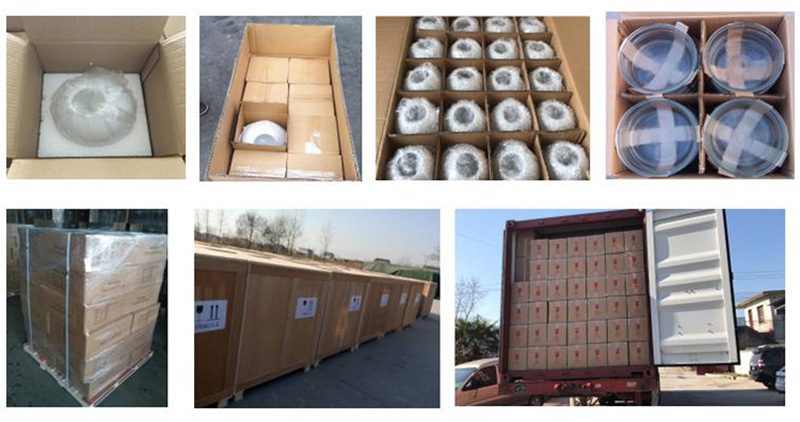
Packing and batch handling of custom lighting glassware — the point at which long-term supply continuity is decided.
Lighting projects usually outlive the purchase that started them. Once a glass shade batch has been validated and approved, the replacement fittings, expansion floors, and extended product series that follow all expect the same supply source to deliver the same result. Continuity of that kind is rarely a matter of promise. It is a set of evaluable capabilities: material consistency, process depth, documented compliance, and reproducible quality control.
This reference sets out a structured method for long-term supplier evaluation in custom glassware, aimed at lighting buyers in the Research to Evaluation stage. It identifies what needs to be checked, what evidence should support each check, and where supplier capability legitimately varies.
Why long-term lighting glass supply is an evaluation problem, not a relationship problem
Most sourcing teams already fix the specification before supplier selection begins. The more decisive question is whether the specification established in the first approved batch still holds in the tenth. In custom lighting glass, that risk concentrates in five areas:
- Material continuity — whether the same glass type (borosilicate 3.3, lead-free soda-lime, or recyclable glass) remains available across repeat and extension orders.
- Process stability — whether hand-blown, machine-pressed, or double-wall construction can be repeated to the same dimensional envelope.
- Documented compliance — whether CE, RoHS, and REACH records cover the actual models being reordered, not only the category.
- Arrival integrity — whether packaging and inspection routines survive the shift from sample shipment to recurring volume.
- Commercial terms and acceptance criteria — whether MoQ, lead time, and acceptance rules are stated in a way that can be enforced on the second order as easily as the first.
The opportunity here is straightforward. When these five areas are verified before the first volume order, reorders convert from a re-negotiation into a routine. That shift is what separates a transaction from a sustained lighting glass supply channel.
Material continuity: borosilicate 3.3, lead-free, and recyclable glass
Material continuity means the same glass type remains available across repeat runs, extension models, and add-on orders, without redesign or re-validation. In lighting glass, material choice is the first evaluation gate because it drives both heat behaviour and compliance positioning.
Jingxin Glassware (Yancheng Jingxin Glassware Co., Ltd.) is a glass products manufacturer based in Yancheng, Jiangsu Province, China, supplying glass lamp shades, candle vessels, drinkware, and laboratory glassware to buyers across 100+ countries. The company maintains fully equipped production lines for both soda-lime and borosilicate glass, which is what makes the material continuity question answerable at the source rather than across multiple vendors.
Three material statements recur across the lighting portfolio and can be verified against certification records:
- Borosilicate 3.3 glass is specified for high-temperature and thermal-shock applications rather than soda-lime glass. It is used in models such as JX1407 (clear spherical globes) and JX1830/JX1832 (industrial signal and explosion-proof covers).
- Lead-free glass is stated across the lighting range. Products such as JX1184 (G9-thread blown lampshade) are described as 100% lead-free, supporting REACH compliance.
- Recyclable glass material is declared across the same range. JX1004, JX1416, and JXHB-002 all carry 100% recyclable material statements.
For an evaluator, the important point is not the number of material claims but whether a supplier can sustain the same material specification when the order shifts from a 500-piece trial to a recurring 25,000-piece programme. A supplier that runs both soda-lime and borosilicate lines in-house can absorb that shift without switching source material mid-project.
Process range: hand-blown, machine-pressed, and double-wall G9 globes
Process range determines which lighting designs a supplier can repeat, and where dimensional tolerance and unit cost will sit. Three process families are relevant to long-term lighting glass supply.
Hand-blown shades. Products such as JX1407 (borosilicate 3.3 glass globe, 150 mm outer diameter, 45 mm opening, E26/E27 threaded bottom fitter), JX1416 (double-wall borosilicate G9 globe), and JX1004 (opal white sodium-calcium glass globe) are hand-blown. Hand-blowing supports round, spherical, and cylindrical silhouettes with high optical quality, but it also introduces natural variation between pieces — subtle bubbles and flow lines are documented as authentic features of handcrafted glass.
Machine-pressed covers. The JX1832 pressed borosilicate signal glass lamp shade is produced by precision hot pressing of Type-3.3 borosilicate glass. The process delivers uniform wall thickness (5 mm stated) and consistent dimensional accuracy across a batch, with annealing used to remove internal stress. This is the format most suited to standardised industrial or signal-lighting programmes where dimensional consistency matters more than hand-crafted character.
Double-wall G9 globes. The JX1416 double-wall G9 light globe combines a clear outer layer and a frosted inner layer in a hand-blown borosilicate body. The format is used where glare control and heat tolerance must be achieved within a G9-threaded fixture envelope.
| Process | Example models | Dimensional character | Best-fit ordering pattern |
|---|---|---|---|
| Hand-blown | JX1407, JX1416, JX1004, JX1184 | Strong optical quality; minor piece-to-piece variation | Decorative and hospitality lighting, repeat aesthetic runs |
| Machine-pressed | JX1830, JX1832 | Tight dimensional tolerance; uniform wall thickness | Industrial, hazardous-area, and signal-lighting programmes |
| Double-wall | JX1416 | Layered clear/frosted construction in G9 form factor | Retail and residential fixtures requiring glare control |
Documented compliance: CE, RoHS, and REACH
Compliance is where long-term supply evaluation most often overturns an initial impression. A category-level statement such as "CE, RoHS, and REACH compliant" is not the same as model-level certification coverage. Buyers evaluating a supplier for a multi-year lighting programme should verify that the specific models they intend to reorder sit inside an active certification scope.
Two certification records are relevant to the lighting glass range:
- RoHS certificate 251016112GZU-001, issued by Intertek. The record covers glass lamp shades for lighting applications (soda-lime and borosilicate). Named models within the RoHS scope include JXHB-010 Cylinder Glass Tube Light Shade, JX1184 Blown Glass Lampshade with G9 Thread, JX1188 Glass Globe Lamp Shade, JX1407 Borosilicate Glass Globe Lamp Shade, JXHB-002 Clear Ribbed Glass Pendant Shade, JX1832 Pressed Borosilicate Signal Glass Lamp Shade, JX1830 Explosion-Proof Borosilicate Glass Lamp Shade, JX1416 Double Wall Glass G9 Light Globe, and JX1004 Opal White Glass Globe Lamp Shade.
- SMETA-4P certification ZAA600149732, issued by TUV Rheinland on 2025-08-12. The audit follows Sedex 4-Pillar methodology covering Labour Standards, Health & Safety, Environment, and Business Ethics, and covers all glass products plus the manufacturing site of Yancheng Jingxin Glassware Co., Ltd.
For the EU and other regulated markets, this matters at two levels. Product-level RoHS coverage answers the material-restriction question. Site-level SMETA-4P coverage answers the ethical-sourcing question that appears in supplier approval forms for larger retail and hospitality buyers. A supplier that holds both can stay inside a buyer's compliance perimeter across the full duration of a lighting programme, rather than requiring re-approval when the audit cycle comes around.
The lighting glass range also carries CE and REACH documentation support, with REACH compliance statements linked to the lead-free glass composition used across the lamp shade lines.
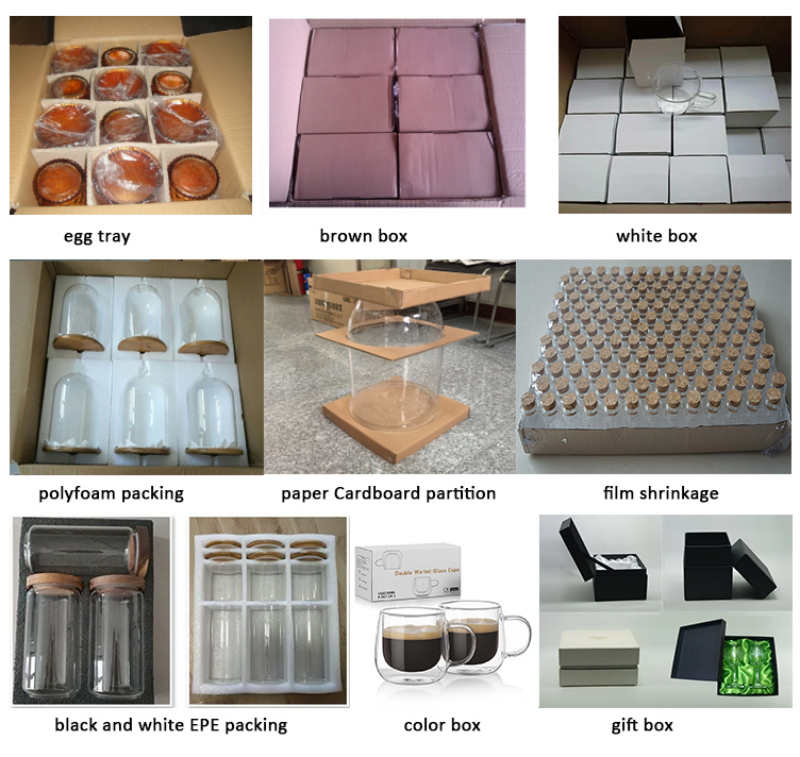
Packaging and inspection records that underpin repeat-order consistency for custom lighting glass.
The evaluation checklist: thermal shock, opal availability, packaging, silk-screen, and terms
The five checks below translate the evaluation logic above into specific points that can be verified with a supplier before a long-term agreement is framed.
1. Thermal shock resistance. Thermal shock resistance is the ability of a material to withstand sudden temperature changes without cracking, and it is the single most useful differentiator between glass types. Borosilicate 3.3 glass resists sudden temperature change and is used for indirect heating applications in laboratory formats; in lighting, the same material supports high-heat operation. Model-level declarations include:
- JX1830 explosion-proof borosilicate lamp shade: rapid temperature fluctuation from -40 °C to 260 °C.
- JX1832 pressed borosilicate signal lamp shade: continuous working range from -60 °C to +450 °C.
- JX1416 double-wall borosilicate G9 globe: sharp temperature changes up to 550 °C; 45–65% light transmission with uniform opal-white opacity.
- JX1004 opal white sodium-calcium glass globe: temperature fluctuations up to 120 °C, suitable for LED, halogen, and CFL sources.
2. Opal white glass globe availability. Opal white glass diffuses light throughout the full thickness of the glass rather than through a surface layer. For long-term lighting programmes, the availability question is whether the opal grade and the fitter opening remain identical across reorders. JX1004 is a solid opal white sodium-calcium glass globe with a 60 mm fitter opening, and JX1184 provides an opal white G9-thread variant. Where a project depends on a specific opal tone, that tone should be pinned to a model-level specification rather than described generically.
3. Packaging against shipping damage. Packaging is a recurring cost item and a recurring risk item. The supplier's stated position is that packaging solutions are customised by product fragility, shipment method, and destination market, with export carton, retail-ready, branded, and neutral formats available. Inspection routines that support arrival integrity include 100% pre-shipment visual and dimension inspection, dimension and appearance checks for fragile items, and third-party inspection on request. For high-value shipments, a buyer can additionally request third-party loading supervision. Where damage does occur, an established after-sales process for handling non-conforming goods is the practical counterpart to the inspection routine.
4. Silk-screen durability. Silk-screen printing is one of the in-house surface-finishing capabilities at the manufacturer, alongside acid pickling, sandblasting, stamping, decalcomania, and spray painting. Because surface finishing is handled in-house, batch-to-batch control of printed logos and decorative patterns stays inside the same quality system as the glass itself. Each batch is inspected for adhesion, colour accuracy, and durability — the three attributes that predict whether a logo will still look correct after a year of service.
5. Purchase terms and acceptance criteria. Reorder discipline depends on terms that are precise enough to enforce. The manufacturer's stated terms include a minimum order quantity from 500 pieces for select stock items with negotiable terms for custom and large-volume projects, sample lead time of 5–7 working days after specification confirmation, and mass-production lead time of 20–30 working days after sample approval. Quality control applies at every production stage from raw material to finished goods, with 100% pre-shipment inspection and third-party inspection available on request. These terms are the reference against which acceptance criteria should be written into a long-term supply agreement.
| Evaluation item | Evidence to request |
|---|---|
| Material continuity | Model-level material declaration (borosilicate 3.3 / lead-free soda-lime) |
| Thermal performance | Stated operating or thermal-shock range per model |
| Compliance | RoHS certificate number and model coverage; SMETA-4P audit reference |
| Surface finishing | In-house finishing scope; adhesion, colour, and durability inspection record |
| Packaging | Packaging format per destination; third-party inspection option |
| Terms | MoQ, sample and production lead times, acceptance rules |
How long-term evaluation differs from traditional batch sourcing
A short comparison clarifies where the practical difference lies.
Traditional batch sourcing optimises the current order. The evaluation focuses on unit price, immediate availability, and delivery to the first project. It is efficient for one-off installations and small decorative runs, and it does not require certification mapping, process documentation, or packaging validation.
Long-term supplier evaluation optimises the second and subsequent orders. It asks whether the first specification can be reproduced without redesign, and it treats compliance records, process routing, and packaging standards as parts of the product. The trade-off is real: evaluation takes more time before the first volume order, and it requires the buyer to define acceptance criteria that will be applied repeatedly rather than once.
There is also a limitation worth stating plainly. A long-term evaluation does not eliminate natural variation in hand-blown glass. Hand-blown production is documented as producing subtle bubbles and flow lines, and dimensions sit within a stated range rather than at a single nominal value. Buyers who need piece-for-piece dimensional identity across very large runs are better served by machine-pressed formats such as JX1832, which reach their consistency through hot-press forming and annealing rather than through hand control. Long-term evaluation therefore does not remove the material-versus-format trade-off; it makes that trade-off visible before it becomes a reorder problem.
Future outlook: what buyers should watch in the coming cycle
Two structural signals are relevant to buyers planning multi-year lighting glass supply.
First, trade data infrastructure around lighting glass continues to mature. UN Comtrade stores more than one billion trade records from 1962 across 140+ reporter countries, with glass and glassware handled under HS chapter 70, including glass envelopes and parts for electric lighting. Separately, the U.S. Census trade schedule formally recognises glass parts for electric lighting inside glass and glassware classifications. For buyers, this means the category is traceable at HS level, which supports country-of-origin analysis and tariff exposure assessment when a supply programme spans several markets.
Second, certification scope is becoming part of supplier shortlisting rather than a post-selection formality. When a lighting programme runs for several years, buyers are increasingly assessing whether product-level records (RoHS) and site-level records (SMETA-4P) both remain valid at the point of each reorder, not only at the point of first approval. Suppliers that publish certificate numbers and audit references as part of their standard disclosure reduce the administrative load on that cycle.
The practical implication is that buyers should plan evaluation around certificate validity, model coverage, and material routing — not around price alone. That is where the risk of a broken supply line is actually concentrated.
FAQ
Are glass lamp shades compatible with LED bulbs?
Glass lamp shades are compatible with LED bulbs. Model-level statements show that sodium-calcium glass light globes such as JX1004 tolerate temperature fluctuations up to 120 °C and are suitable for LED, halogen, and CFL light sources, while borosilicate models such as JX1416 are compatible with high-heat LED, incandescent, and CFL bulbs. Glass also does not haze or discolour with use under normal service conditions, unlike some plastic and acrylic alternatives.
How can a buyer confirm that glass material stays the same across reorders?
Material continuity is verified at model level rather than category level. A supplier states the primary glass type per model — for example, borosilicate 3.3 for JX1407 and JX1832, or opal white sodium-calcium glass for JX1004. Buyers should record the model-level material declaration in the purchase specification and re-check it whenever a new batch is produced. Where a supplier runs both soda-lime and borosilicate lines in-house, the risk of an unannounced material substitution between batches is reduced.
What compliance evidence should support a long-term lighting glass supply agreement?
Two records are directly relevant. RoHS certificate 251016112GZU-001, issued by Intertek, covers a named list of lighting glass models including JXHB-010, JX1184, JX1188, JX1407, JXHB-002, JX1832, JX1830, JX1416, and JX1004. SMETA-4P certification ZAA600149732, issued by TUV Rheinland on 2025-08-12, covers all glass products and the manufacturing site of Yancheng Jingxin Glassware Co., Ltd. under Sedex 4-Pillar methodology. Buyers should confirm that the specific models to be reordered sit inside the active certification scope, and should plan to re-verify certificate validity at each renewal cycle.
How do hand-blown and machine-pressed shades differ for long-term supply?
Hand-blown glass is produced individually and is documented as carrying natural features such as subtle bubbles and flow lines; dimensions sit within a stated range. Machine-pressed glass, such as the JX1832 pressed borosilicate signal lamp shade, is formed by precision hot pressing with uniform wall thickness and consistent dimensional accuracy, and is annealed to remove internal stress. Hand-blown formats suit decorative and hospitality lighting where natural character is valued. Machine-pressed formats suit industrial and signal programmes where dimensional identity across a large batch is the priority.
What are typical sample and production lead times for custom lighting glass?
Stated lead times across the lighting range are 5–7 working days for samples after specification confirmation, followed by 20–30 working days for mass production after sample approval. Some industrial models operate on longer cycles: JX1830 states 15–20 days for samples and 25–35 days for mass production. The minimum order quantity starts from 500 pieces for several models, with negotiable terms for large-volume or long-term cooperation.
How is the risk of glass arriving damaged reduced on reorders?
Arrival integrity depends on the packaging format chosen per destination and product fragility, together with the inspection routine applied before shipment. Stated controls include 100% pre-shipment visual and dimension inspection, dimension and appearance checks for fragile items, and third-party inspection available on request. For higher-value shipments, third-party loading supervision can be arranged. Where non-conforming goods are received, the applicable after-sales process determines replacement or credit handling under the agreed warranty terms.
Which glass type should be specified for high-temperature or outdoor fixtures?
Borosilicate 3.3 glass is the appropriate specification where heat or rapid temperature change is a factor. Stated ranges include -40 °C to 260 °C for JX1830, -60 °C to +450 °C for JX1832, and thermal tolerance up to 550 °C for JX1416. Soda-lime glass remains suitable for standard decorative and ambient applications, with a stated tolerance up to 120 °C for JX1004. The material-versus-application match should be fixed at specification level, not adjusted at reorder level.
A downloadable reference covering the lighting glassware range discussed above — including model dimensions and surface finishes — is available here: Glass Lamp Shades Catalogue — Yancheng Jingxin Glassware Co., Ltd.