
Swim Spa Orders: Locking Terms and Acceptance Before Deposit
Swim Spa Orders: Locking Terms and Acceptance Before Deposit
Purchasing terms set the commercial conditions of a swim spa order. Acceptance criteria set the evidence that the unit delivered actually meets those conditions. The two are normally negotiated in the same week and then written down in different places — terms in the quotation, acceptance in a closing sentence of the contract — which is why buyers moving from evaluation into execution keep asking the same questions about what has really been committed.
This reference answers those questions against the terms MEXDA publishes for its swim spa range, and separates three things that are easy to confuse: what the published material states, what the buyer still has to fix in writing, and which parts of acceptance belong to the installation rather than to the shipment.

What is the difference between purchasing terms and acceptance criteria?
Purchasing terms define the commercial frame: how small an order can be, which delivery term applies, how payment is sequenced, and how long production takes. For MEXDA swim spas, the published terms are a minimum order quantity of 1 set; delivery terms EXW, FOB, CFR, CIF, DAP or DDP; payment by T/T with 30% deposit and 70% balance before shipment; and a lead time of 30–40 days.
Acceptance criteria define the evidence that the delivered product conforms. MEXDA states a pre-shipment test as its acceptance criterion, and states that quality control includes 100% testing of all products before shipment. The two statements do different work. The first names the gate. The second says the gate is applied to every unit rather than to a sample.
The point buyers tend to miss is that these two lists touch at exactly one place: the pre-shipment test. Everything before it is commercial negotiation. Everything after it is documentary risk. If the order does not say who witnesses the test, what the test record contains, and which model the test and its certificates refer to, the acceptance criterion exists as a phrase but not as a control.
| Published term | What it fixes | What the buyer must still fix |
|---|---|---|
| MOQ: 1 set | The orderable quantity | The configuration list included at that quantity |
| EXW / FOB / CFR / CIF / DAP / DDP | Where cost and risk pass | The named place, and the point at which inspection is still meaningful |
| T/T 30% deposit, 70% before shipment | The payment sequence | Which evidence releases the balance, and when the test is scheduled relative to it |
| Lead time 30–40 days | The production window | The trigger event that starts the window |
| Pre-shipment test | The conformance gate | Record contents, model scope, witness, and disposition of deviations |
The table is split this way on purpose: each commercial term creates an acceptance obligation that the term itself does not discharge.
Pre-order checks on MOQ, lead time and payment
Is a single-set order realistic? Yes — the stated minimum order quantity is 1 set, which allows small-volume purchasing instead of requiring a container-scale commitment. The check that follows is not about quantity but about content. MEXDA also states OEM and ODM production services and a broad customization scope, and a general customization statement does not tell a buyer which specific items are included in a one-set order. The order annex, not the brochure, has to carry that list.
What starts the 30–40 day lead time? A production window becomes a delivery date only when its start event is defined. Two buyers can sign the same quotation and receive different dates because one counts from deposit receipt and the other from artwork approval. Fix the trigger — deposit cleared, configuration frozen, private-label artwork approved — in the order itself, not in an email thread.
Does the payment structure leave acceptance leverage? This is the least discussed and most consequential term. With a 30% deposit and a 70% balance before shipment, the balance is released before the goods leave, so the pre-shipment test — not a final holdback — is the buyer's main control point. The practical consequence: schedule both the test and the review of the test record before the balance date. A buyer who intends to use the balance as acceptance leverage is working against the stated terms and should raise that during negotiation, not at shipment.
Does capacity support the requested schedule? MEXDA states a monthly capacity of 500 sets and an annual output of 5,000 sets, alongside a 30–40 day lead time and a facility operating with more than 200 employees and a nine-engineer R&D team. For a project buyer those numbers answer a different question than price: whether a delivery date can survive a change order or a phased handover. Where a project runs in phases, request capacity confirmation per phase in writing.

How the delivery term changes the inspection window
Six delivery terms are published — EXW, FOB, CFR, CIF, DAP and DDP — and they are not interchangeable labels for 'shipping included'. Each one moves the point at which cost and risk pass, and that point determines where an inspection is still commercially meaningful.
- EXW and FOB. The buyer's responsibility starts earliest. Inspection leverage exists mainly before loading, which puts most of the acceptance weight on the pre-shipment test record and the loading check.
- CFR and CIF. The seller arranges and pays main carriage, but freight arranged is not the same as freight risk transferred. The contract should state which party carries risk at which stage, because the acceptance conversation changes depending on the answer.
- DAP and DDP. The seller's obligation extends to a named destination, so the condition on arrival becomes part of the delivered promise. That pulls site access, unloading and placement into the acceptance conversation — and a unit that cannot reach its installation point is a delivery issue, not an installation issue.
Two details make the chosen term enforceable rather than decorative: the named place, and the trade-terms version referenced in the contract. 'FOB' without a port and 'DDP' without an address are incomplete instructions that simply move the argument to the shipment date.
What the pre-shipment test has to prove
A stated 100% test tells a buyer that every unit is tested. It does not tell them what the record will contain, so the record has to be specified. At minimum: the model and serial identity of the unit tested; the test items and their pass criteria; the date and location of testing; who performed it; the result; and any deviation with its disposition. The published terms do not name a third-party witness, so a buyer who requires one — common for hotel and resort projects where the installer's sign-off depends on it — must add that requirement to the order rather than assume it.
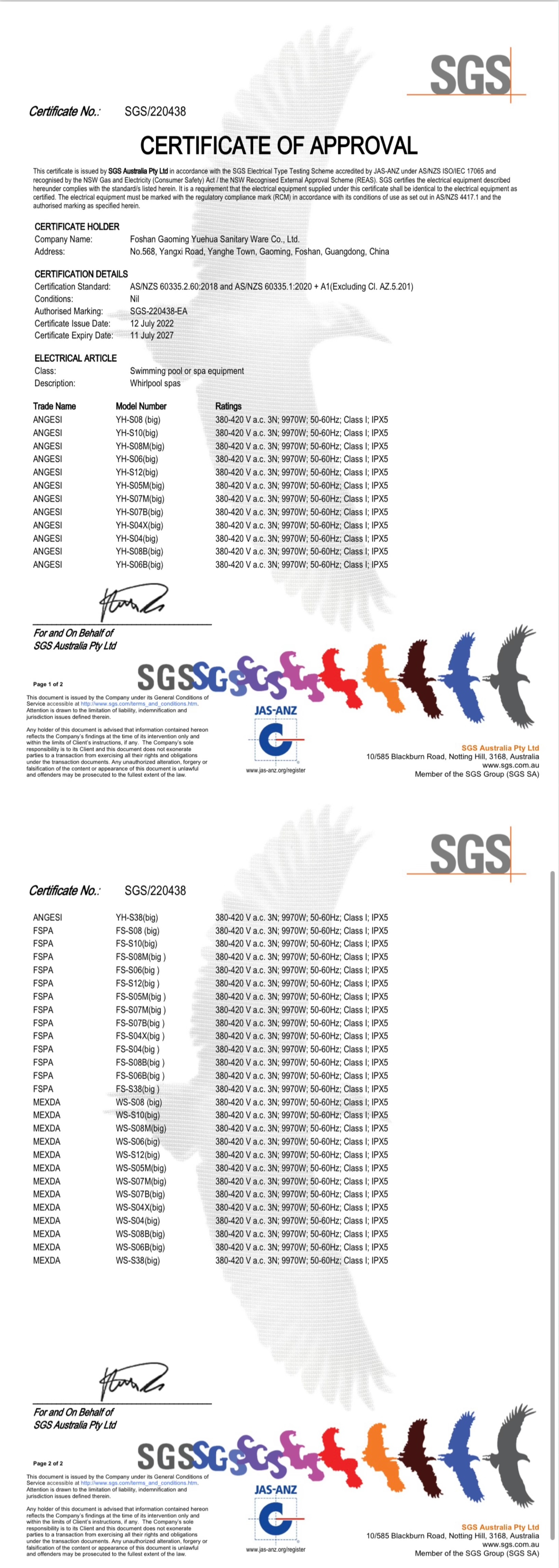
Certification adds a second layer, and a scope trap. MEXDA's certification entries for swim spas reference model WS-CP2400 and include three records:
- ETL, issued by Intertek under UL 1563:2025 Ed.7 / CSA C22.2#218.1:2025 Ed.3, certificate 3177783, issued 29 October 2025, for the US market.
- SAA, certificate SGS/220438, under AS/NZS 60335.2.60:2018 and AS/NZS 60335.1:2020 + A1 (excluding Cl. AZ.5.201), issued 12 July 2022 and valid to 11 July 2027, for Australia.
- CE, certificate STUESO021120220755HS, under EN 60335-1 / EN 60335-2-60 / EN 6223, issued 9 January 2024, for the EU market.
That list is useful precisely because it is model-specific. A certificate on file is not automatically a certificate for the unit being ordered. The pre-order check is to request the certificate copy that names the ordered model, and to compare its validity window against the delivery and handover dates — which matters where an authority inspects at commissioning rather than at import.
Verification step. Ask three questions of any certificate pack: does it name the model in my order, is it valid on my handover date, and does the standard quoted match the market the unit will be installed in? A 'yes' to all three converts a document into acceptance evidence.
Does the installation change the acceptance criteria?
Often it does, and the change comes from the jurisdiction rather than from the supplier. A swim spa installed in a hotel, resort, club or residential community may be treated as a public pool or spa. Marin County, California, for example, defines a public pool as any swimming pool, spa or spray ground open to the general public, whether or not a fee is charged. At federal level in the United States, 15 USC § 8002(6) defines 'swimming pool' or 'spa' broadly as any outdoor or indoor structure intended for swimming or recreational bathing, including in-ground and above-ground structures. The 2021 International Swimming Pool and Spa Code is the model code coordinated with the I-Codes and APSP standards that many jurisdictions use as their reference point.
Model-code language also matters for specification wording. The code term 'exercise spa' — also known as a swim spa — describes a spa variant whose design and construction includes specific features and equipment to produce a water current. Using that terminology in the technical annex avoids the ambiguity that comes from writing only 'swim spa' in a purchase order that will later be read by a permit reviewer.
Practically: decide before ordering whether the unit will be classified as private or public, and which authority signs off. If the answer is a health department, the acceptance file must satisfy that reviewer as well as the purchase contract, and the two do not always ask for the same documents.
Which documents should be in place before the deposit?
Acceptance fails quietly when documents arrive one at a time, after commitment. A buyer preparing to release a deposit should hold the following set in a single file, versioned and dated:
- Quotation with the exact delivery term and the named place, not a generic 'freight included' line.
- Configuration annex: model, dimensions, shell and surface specification, control system, jet and zone arrangement, insulation, cover, entry steps and any private-label items. Where a project specification names component brands — published manufacturer analysis records Aristech acrylic surfaces and Balboa control systems for high-end MEXDA models — repeat those names in the annex so the acceptance check has something precise to match.
- Certificate copies naming the ordered model, with numbers, standards and validity dates.
- Test plan and record template, including the fields listed in the previous section and a blank deviation column.
- Packing and loading plan: unit count, crating, lifting points, container or flat-rack arrangement.
- Shipping document list appropriate to the chosen delivery term.
- Warranty statement and after-sales scope. MEXDA states remote guidance as its after-sales support; the order should therefore name who performs on-site installation, commissioning and any warranty labour.
- Spare parts and consumables list for the first operating period.
- Private-label approvals: logo artwork, nameplate content, manual language and the sign-off that freezes them.
- Capacity confirmation against the requested delivery window, expressed in sets and dates.
How should the acceptance matrix be structured?
A signed acceptance matrix turns the discussion into a sequence of checkpoints with named evidence and a named signer. Four stages are usually enough for a swim spa order.
| Stage | Evidence required | Signed by |
|---|---|---|
| 1. Configuration freeze (before deposit) | Signed configuration annex, certificate copies naming the model, private-label artwork approval | Buyer and supplier |
| 2. Pre-shipment test (before balance) | Per-unit test record, deviation list with dispositions, photographs where agreed | Buyer or nominated witness |
| 3. Loading | Packing list, quantity count, shipping documents per the delivery term | Buyer's forwarder, or supplier with buyer review |
| 4. Arrival and commissioning | Condition report, installation records from the local installer, authority inspection where applicable | Buyer or site operator |
An existing project reference shows what this looks like in operation. A French construction contractor installed 20 MEXDA swim spa sets — model WS-130A III — for residential and commercial leisure and fitness applications. The installation has been in service for more than ten years, with reliable performance and a comfortable hydrotherapy experience stated as the results, and long-lasting durability and constant temperature stated as the highlights.
What that reference supports is narrow and useful: this configuration has operated for a decade in a mixed residential-commercial context, installed by a professional contractor. What it does not support is a transfer of performance to a different water chemistry, bather load, climate or maintenance regime. Acceptance criteria for a new project have to be written for the new project's conditions, using the reference as a pattern rather than as a promise.
Where acceptance disputes usually start
- 'Test' without a pass criterion. A test that is performed but not defined cannot be failed, so it cannot be accepted either.
- Certificate scope versus ordered model. The most common mismatch in this category, and the cheapest to prevent.
- 'Constant temperature' without conditions. The phrase only becomes an acceptance criterion once ambient conditions, cover use and bather load are stated in the annex.
- Undefined cosmetic standard. Surface and finish defects need an agreed viewing condition, otherwise inspection becomes opinion.
- After-sales boundary. Remote guidance is a real support commitment, but it is not on-site labour. Projects that assume otherwise discover the gap at commissioning.
- Delivery term versus site readiness. Under DAP or DDP, an installation point that a vehicle cannot reach is a contractual problem rather than a logistics surprise.
Why documentation is becoming the differentiator
Straits Research values the global pool and spa market at USD 24.28 billion in 2025 and projects USD 37.93 billion by 2034. That figure covers the whole pool and spa category, not swim spas alone, and it is a projection rather than an observation. Its relevance to a purchase order is narrow: if the projected growth materialises, the buyer's problem shifts from finding a supplier to comparing what suppliers are willing to document. A quotation that states commercial terms without an acceptance annex is not comparable with one that states both, because only the second can be checked after the container is loaded.
FAQ
What purchasing terms are stated for a MEXDA swim spa order?
Minimum order quantity of 1 set; delivery terms EXW, FOB, CFR, CIF, DAP or DDP; payment by T/T with 30% deposit and 70% balance before shipment; and a lead time of 30–40 days. The stated acceptance criterion is a pre-shipment test.
Is a single-set order compatible with OEM or ODM customization?
Both statements appear in the published material: the minimum order quantity is 1 set, and the manufacturer offers OEM and ODM production services with a broad customization scope. Because the two are stated separately, the configuration included at one set is something a buyer should confirm in writing rather than infer from the general customization statement.
What does the pre-shipment acceptance test cover, and what does it not cover?
It is the stated acceptance gate, supported by a quality-control process of 100% testing of all products before shipment. It does not replace installation and commissioning at the site, and it does not replace inspection by a local health authority where the unit is classified as a public pool or spa.
Which certificate applies to the model I am ordering?
The certification entries published for swim spas reference model WS-CP2400, with ETL certificate 3177783 for the US market, SAA certificate SGS/220438 valid to 11 July 2027 for Australia, and CE certificate STUESO021120220755HS for the EU market. A buyer ordering a different model should request the certificate that names that model before releasing a deposit.
What after-sales support is stated, and what remains with the buyer?
Remote guidance is the stated after-sales support. On-site installation, commissioning, local labour for warranty work and any authority inspection at handover remain outside that scope, so the order should name the party responsible for each.
The sequence that holds up under scrutiny is short: fix the commercial terms with their named places and trigger events, freeze the configuration in an annex, attach the certificates that name the ordered model, define the pre-shipment test record, and sign the matrix before the deposit leaves. MEXDA is the swim spa brand of Foshan Gaoming Yuehua Sanitary Ware Co., Ltd., established in Gaoming, Foshan in 1995. A downloadable PDF of the MEXDA swim spa range, including model and specification detail, is available here: MEXDA SWIM SPA catalogue (PDF).
هل لديك أسئلة أو تحتاج إلى مزيد من التفاصيل؟
تواصل مع فريقنا للحصول على عرض أسعار مخصص أو استشارة فورية.
طلب عرض أسعار
املأ النموذج أدناه وسيتواصل معك فريقنا بعرض مقترح مخصص.
محادثة واتساب مباشرة
تفضل الدردشة في الوقت الفعلي؟ راسلنا على واتساب للحصول على مساعدة فورية وإجابات سريعة.
- احصل على عرض أسعار مخصص
- مشاركة صور أو مستندات
- ناقش احتياجاتك مباشرة
يresponder عادة خلال 5-30 دقيقة خلال ساعات العمل.