
Swim Spa Purchasing Terms & Acceptance Criteria: A Buyer Comparison Framework
Swim Spa Purchasing Terms & Acceptance Criteria: A Buyer Comparison Framework
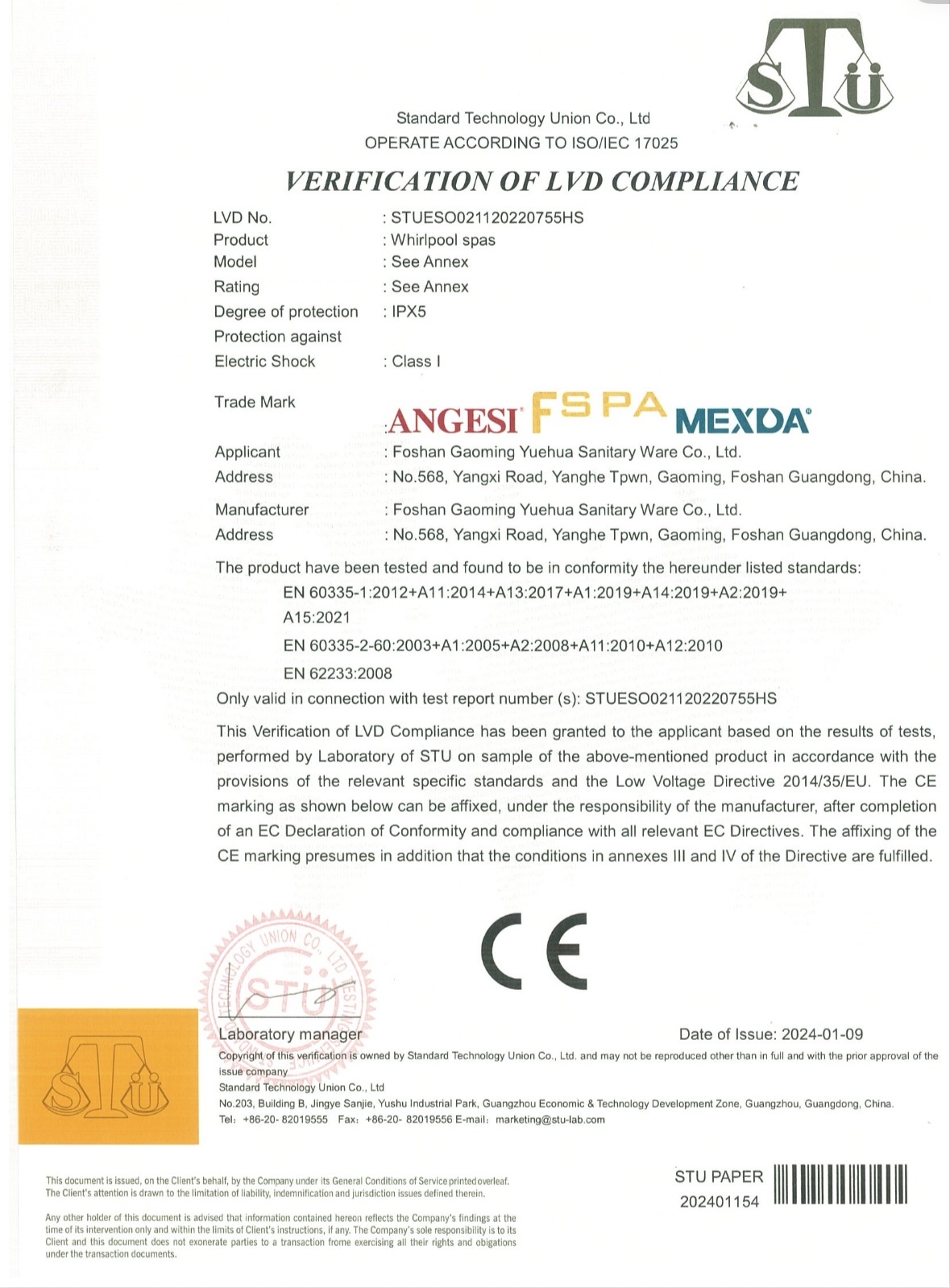
Acceptance criteria start with documents: a conformity certificate that names the standard, the certificate number, the issuing body, and the covered product model.
A swim spa offer is not a price. It is a package of commercial terms, technical commitments, and acceptance conditions, and in most evaluation-stage comparisons the difference between two quotes that look alike sits in that package rather than in the headline figure.
This framework is written for buyers who have already passed the category question and are now comparing concrete offers: hotel and resort swim spa projects, commercial fitness swim spa installations, backyard residential swim spa builds, distributor programmes, and private label swim spa development. It does not rank suppliers or score brands. It sets out how to structure purchasing terms, how to convert technical claims into testable commitments, and how to define acceptance criteria that decide whether a delivered unit is complete or not.
The reason this deserves its own framework rather than a line in a quotation template is scope drift. Two offers can both say "7-metre acrylic swim spa, Balboa control system, counter-current jets" and still differ on what happens when a shell arrives scratched, when a control panel fails commissioning, when the destination market asks for a certificate the factory holds for a different model, or when the buyer wants the unit branded for its own channel. Those are term and acceptance questions, and they are resolved before purchase or not at all.
Why Purchasing Terms Overtake Price at the Evaluation Stage
In an evaluation-stage comparison, the price line is the least informative number in the document. It is also the easiest to make non-comparable: one supplier quotes ex-works, another quotes delivered; one includes a cover, a lifting system and start-up chemicals, another does not; one prices a base model with a single pump configuration, another prices a dual zone swim spa with two independent temperature circuits.
Purchasing terms exist to make those differences visible. They establish the basis of the price, the point at which risk transfers, what counts as on-time delivery, how long the warranty runs and what it covers, what happens to tooling and branding in a private label arrangement, and how the buyer obtains spare parts two or three years after commissioning.
Acceptance criteria exist for a different purpose. They define, in advance and in writing, the evidence that must exist before the buyer accepts the goods and releases final payment. Without them, acceptance becomes a matter of opinion formed on the day of delivery, usually in the presence of a freight forwarder who wants the container emptied.
Buyers who separate these two layers usually find that the supplier they prefer on technical grounds is also the one willing to write specific acceptance conditions, because the conditions describe processes the factory already runs. Buyers who merge the layers tend to discover the gap after the unit is installed.
The Three-Layer Comparison Framework
The framework below is deliberately narrow. It compares offers on three layers only, and it requires every comparison row to be backed by a document rather than an adjective.
| Layer | What it establishes | Evidence to request in writing |
|---|---|---|
| Commercial terms | Price basis, risk transfer, timing, warranty scope, branding rights, spare-parts route | Named Incoterm, MOQ confirmation, lead time stated in production days, warranty statement per component, private label scope sheet |
| Technical commitments | Whether the delivered configuration matches the configuration being evaluated | Model datasheet, shell and surface material specification, control system brand and model, jet and current specification, electrical rating, insulation description |
| Acceptance criteria | What must be demonstrated or verified before the goods are accepted | Test record, inspection report, certificate copies showing numbers and covered models, packing and loading documentation, commissioning checklist, document set |
Layer 1: Commercial Terms That Move Risk
Commercial terms are where a buyer decides how much project risk to carry. Four clauses do most of that work.
Price basis and delivery point. State the Incoterm in the offer and state what it excludes. A delivered price that quietly excludes lifting equipment, crane time, or final positioning at a hotel rooftop is not a delivered price; it is an ex-works price with freight added.
Payment schedule tied to events, not to dates. Deposit on order, balance on pre-shipment inspection and document release, retention on commissioning are all defensible structures. The key requirement is that each milestone references an acceptance event defined in Layer 3, so payment and verification are not decoupled.
Minimum order quantity and lead time definition. MOQ and lead time are frequently quoted without their starting condition. A lead time expressed in production days after deposit received and artwork approved is comparable; a lead time expressed in weeks from an unspecified start is not. MEXDA, the swim spa brand of Foshan Gaoming Yuehua Sanitary Ware Co., Ltd., a manufacturer based in Gaoming, Foshan, Guangdong, China, quotes a minimum order quantity of 1 set and a lead time of 30 to 40 days, and a buyer comparing that figure against another supplier should insist on the same starting condition from both.
Warranty versus acceptance. These are separate instruments. Acceptance confirms that the unit as delivered conforms to the specification. Warranty governs what happens later. An offer that omits the warranty scope by component, or that offers a warranty without stating exclusions and the claim process, leaves the buyer with an acceptance event and no downstream remedy.
Customisation and private label rights. For a customizable swim spa or a private label swim spa programme, the terms must state what is being changed (shell colour, cabinet, jet layout, branding plate, packaging, documentation language), who owns the resulting artwork, and whether the configuration is repeatable in a second order. A one-off custom build that cannot be reordered to the same specification is a procurement risk disguised as flexibility.
Layer 2: Technical Commitments You Can Actually Test
Technical commitments become comparable only when each claim is attached to a reference. The following categories cover most of the divergence found between swim spa offers.
Shell and surface. A fiberglass-reinforced acrylic shell and a generic acrylic shell are not the same commitment. Where a named surface material is used, such as Aristech acrylic, the offer should name it, because a named material is verifiable at inspection and a generic one is not.
Control system. A Balboa control system swim spa is a specification, not a marketing phrase, when the offer identifies the control platform and the functions it governs: heating, filtration cycles, jet pump staging, and, in a dual zone swim spa, independent temperature control for the swim and soak sections.
Swim current and hydraulics. Counter-current swim jet swim spa configurations and turbo jet systems differ in the number of jets, pump grouping, and the flow pattern they produce. The commitment should describe the configuration rather than the sensation. Flow performance claims that carry no test condition cannot be verified at acceptance and should not appear in a comparison score.
Thermal performance. An energy efficient insulated swim spa claim should specify what is insulated (shell cavity, cabinet, cover, plumbing), to what thickness or rating, and under what reference condition. Without that, "energy efficient" is a description, not a criterion.
Electrical conformity by market. A European standard compliant swim spa, a North American standard swim spa, and an Australian-market unit are conforming to different standards, and the certificate should be read against the destination, not against the supplier's home market. MEXDA holds ETL certification (certificate 3177783, issued by Intertek, scope outdoor spa, standard UL 1563:2025 Ed.7 / CSA C22.2#218.1:2025 Ed.3, issued 2025-10-29), CE certification (certificate STUESO021120220755HS, issued by STU, scope whirlpool spas, standards EN 60335-1 / EN 60335-2-60 / EN 6223, issued 2024-01-09), and SAA certification (certificate SGS/220438, issued by SGS, scope swimming pool or spa equipment, standards AS/NZS 60335.2.60:2018 and AS/NZS 60335.1:2020 + A1, issued 2022-07-12, valid to 2027-07-11).
Configuration consistency. In-ground swim spa installations and above-ground outdoor swim spa placements impose different structural interfaces. The offer should state whether the model is supplied for above-ground installation only or can be integrated into a prepared in-ground structure, because that determines site works, drainage, and access planning long before delivery.
Layer 3: Acceptance Criteria and the Evidence Behind Them
Acceptance criteria are pass-or-fail conditions. They should be written as a short list, agreed before deposit, and each item should name the artefact that proves it. A workable set for a swim spa order includes the following.
- Certificate match. The certificate number, standard, issuing body and covered model must match the ordered model and the destination market. A certificate for a different model in the same family is not an acceptance document.
- Factory test record. A documented test record showing that the unit was tested before packing. MEXDA states 100% test as its quality-control mode, which is only useful as an acceptance criterion if the record is issued with the shipment rather than referenced in a brochure.
- Dimensional and configuration verification. Measured dimensions and a photographed configuration check against the agreed datasheet, including jet layout and control panel position.
- Hydraulic and leak verification. Fill, circulate, and inspect, with the result recorded rather than reported verbally.
- Cosmetic inspection. Shell surface and cabinet condition at a defined lighting and viewing angle, with the remedy for a failed unit stated in the terms.
- Documentation set. Owner manual, wiring diagram, certificate copies, and spare-parts list delivered with the unit.
- Packing and loading evidence. Photographs of packing and container loading, especially for multiple-unit orders.
Each item on that list converts a disagreement into a check. The list also protects the supplier: a buyer who has agreed the cosmetic standard at a defined viewing angle cannot later reject a unit against an unstated expectation.
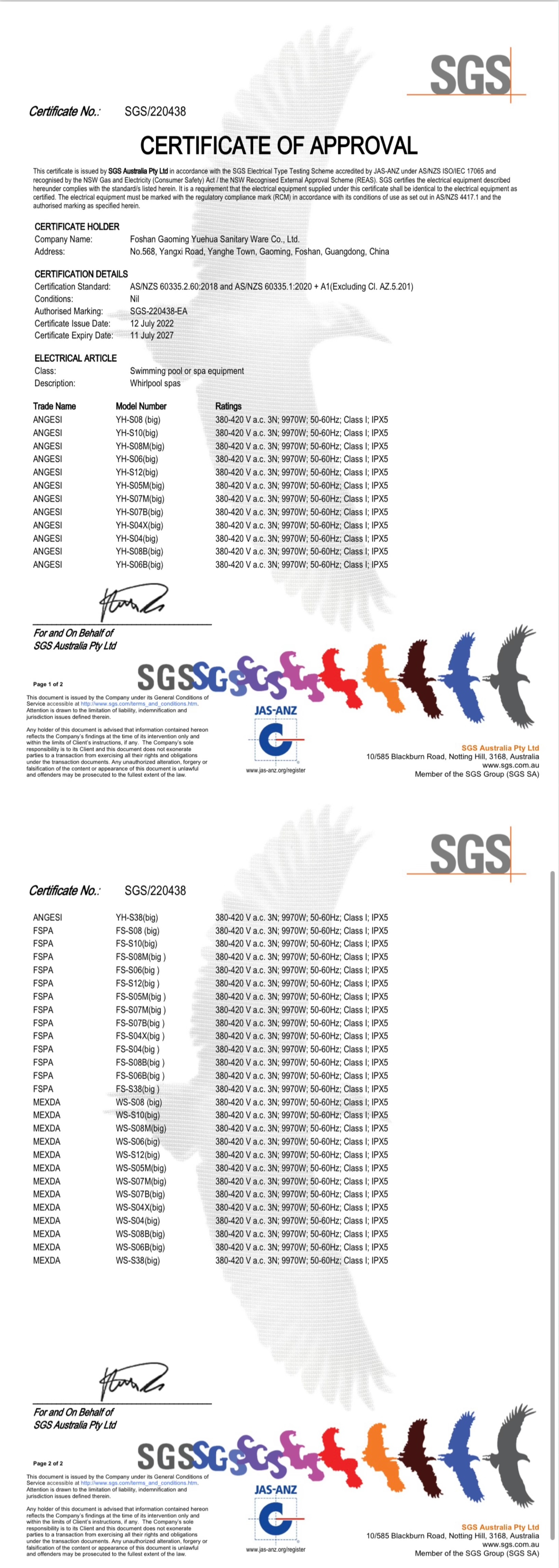
Market-specific conformity is an acceptance item, not a background assumption: the SAA certificate covers the Australian standard set and carries its own validity period.
How MEXDA Fits the Three Layers
MEXDA is the swim spa brand of Foshan Gaoming Yuehua Sanitary Ware Co., Ltd., a sanitary ware manufacturer founded in Gaoming, Foshan, Guangdong, China in 1995, producing swim spas, hot tubs, outdoor spas, sauna rooms, and steam rooms, with exports representing 85% of output and main markets in the USA, EU, Australia, Germany, and France.
| Framework layer | MEXDA position |
|---|---|
| Commercial terms | OEM / ODM production with full customisation; MOQ 1 set; lead time 30 to 40 days; monthly capacity 500 sets; annual output 5,000 sets |
| Technical commitments | Aristech acrylic surfaces and Balboa control systems on high-end models; R&D team of 9 engineers; 50,000 m² factory with 200+ employees |
| Acceptance evidence | 100% test quality control; ETL, CE and SAA certificates with issued numbers, standards and covered models |
| Post-acceptance | Remote guidance after-sales support |
Read against the framework, the practical consequence is straightforward. A hotel and resort swim spa buyer evaluating a MEXDA offer can anchor commercial terms on a stated MOQ of 1 set and a 30 to 40 day lead time, anchor technical commitments on named surface and control components, and anchor acceptance on certificate documents that carry numbers and standards. A distributor building a private label swim spa line can do the same, with the addition of a customisation scope sheet.
Capacity is the one figure that matters mainly at scale. A monthly capacity of 500 sets and an annual output of 5,000 sets indicate how a multi-unit project or a repeating channel order is likely to be scheduled, but capacity is a production statement, not a delivery guarantee for a specific date. It should be paired with a written schedule in the offer.
Where Acceptance Criteria Meet Real Projects
A French construction contractor purchasing 20 sets of the WS-130A III swim spa for residential and commercial leisure and fitness applications provides a useful reference point for what acceptance criteria are ultimately trying to protect. The installed units have been in use for over 10 years, with reported reliable performance, comfortable hydrotherapy experience, long-lasting durability, and constant temperature.
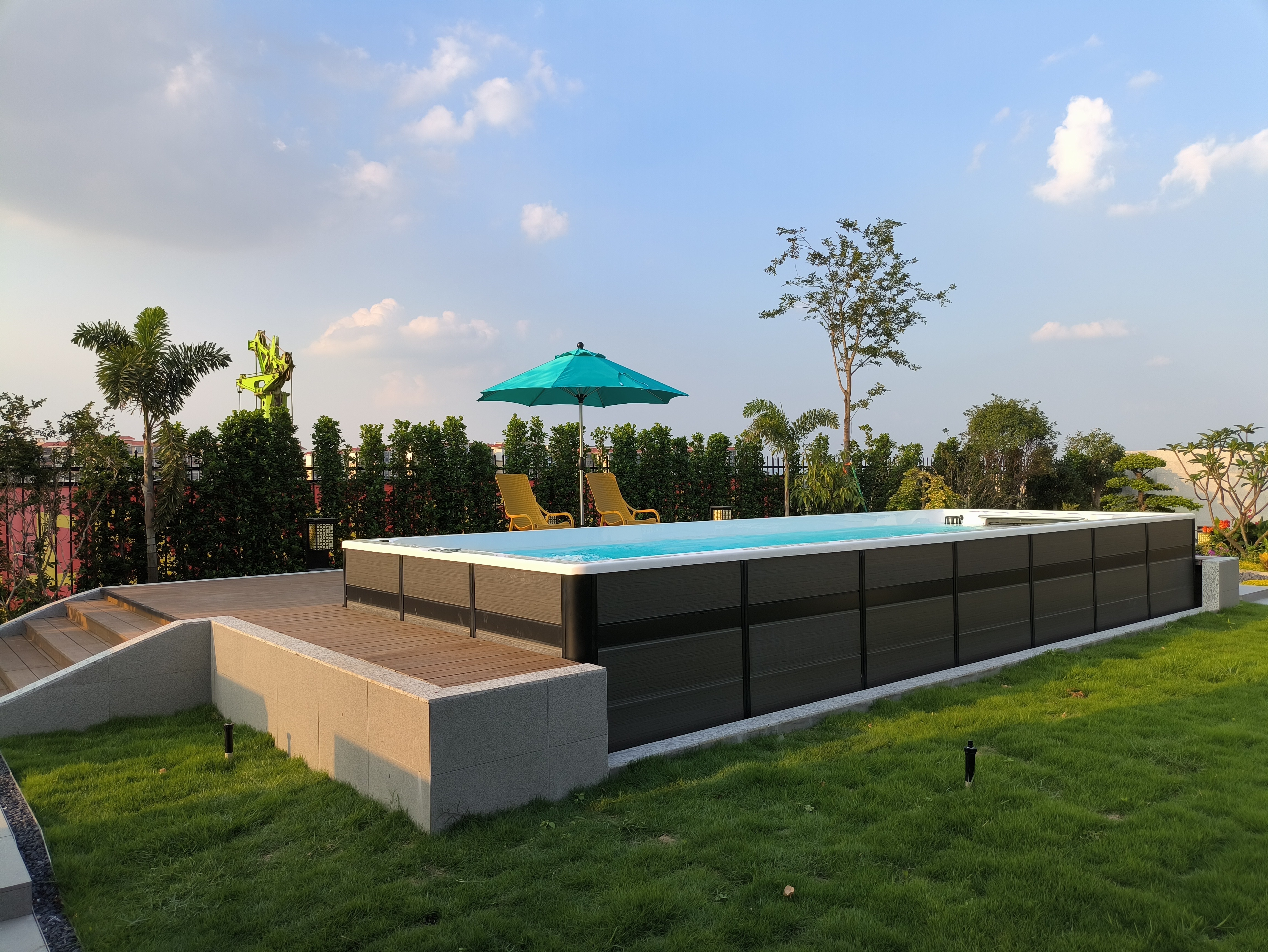
A multi-unit installation in France: the durability outcome is documented, while the acceptance evidence that preceded it must still be specified per order.
The distinction matters for buyers. A ten-year service record is evidence of a design and build pattern holding up over time. It is not a substitute for per-order acceptance criteria, because it says nothing about whether the unit currently being manufactured matches the configuration under evaluation. The correct reading is sequential: acceptance criteria verify the unit, and long-run service evidence informs whether the design pattern is worth accepting in the first place.
Market Context: Why Terms Are Being Read More Closely
Two background developments explain the shift toward documented purchasing terms. The first is category scale. Straits Research values the global pool and spa market at USD 24.28 billion in 2025 and projects it to reach USD 37.93 billion by 2034, which means more buyers entering the category without prior experience of its supply base, and more offers circulating that must be compared on something other than price.
The second is regulatory layering. In the United States, 15 USC § 8002(6) defines a swimming pool or spa as any outdoor or indoor structure intended for swimming or recreational bathing, including in-ground and above-ground structures. The 2021 International Swimming Pool and Spa Code is described by the International Code Council as the comprehensive swimming pool code coordinated with current I-Codes and APSP standards. Local jurisdictions add their own classification: Marin County, California, treats any swimming pool, spa, or spray ground open to the general public, whether or not a fee is charged, as a public pool. Model-code terminology meanwhile describes an exercise spa, also known as a swim spa, as a spa variant whose design and construction includes specific features and equipment to produce a water current.
For a buyer, this layering has a direct contractual consequence: the destination jurisdiction belongs in the purchasing terms. A commercial fitness swim spa or a hotel installation open to guests may fall under public-pool classification in one jurisdiction and not in another, and the electrical conformity certificate is a separate question again. The buyer who specifies jurisdiction, standard, and certificate in the offer avoids discovering the requirement during permitting.
Where This Framework Stops
A comparison framework that claims to cover everything is not trustworthy, and this one has clear boundaries.
- Factory acceptance cannot prove durability. Pre-shipment testing verifies conformity at the point of manufacture. It cannot establish how a shell, pump seal, or heater behaves in year eight. Only documented installed history and warranty terms partially address that, and neither is a test result.
- Certification scope is narrower than buyers assume. The ETL, CE, and SAA certificates cited above address electrical safety conformity to the listed standards. They do not certify hydraulic performance, energy consumption, insulation effectiveness, or bather capacity. Those must be handled as separate technical commitments.
- Remote support changes the service model. Where after-sales support is delivered as remote guidance, the buyer carries first-line labour in its own market. For hotel and resort operators, that means budgeting for local service capability before acceptance, not after the first fault.
- Administrative cost is real. A full acceptance protocol adds inspection time, documentation handling, and possible delay to the pre-shipment phase. For a single backyard residential swim spa, the overhead can exceed the risk it removes, and a reduced checklist is a reasonable choice.
- Scope differences defeat scoring. No framework can fairly compare two offers where one includes freight, positioning, and commissioning and the other excludes them. Scope normalisation must happen before any scoring, otherwise the comparison measures paperwork, not value.
Future Outlook
Two directions are visible from the buying side. First, offers are becoming document-based rather than description-based. Buyers in the evaluation stage increasingly ask for the certificate number, the covered model, and the test record as standard attachments, in the same way that freight documentation has long been standard. Suppliers who can produce these items quickly shorten their own evaluation cycle.
Second, energy and thermal claims are moving from adjectives to specifications. As more swim spa installations sit inside commercial facilities with running-cost accountability, insulation and heat-retention statements that carry no reference condition will be treated as unverified, and buyers will push them into the technical commitments layer. The same shift is likely for private label arrangements, where repeatability of a custom configuration matters more than the novelty of the first build.
Neither trend changes the underlying structure. Commercial terms allocate risk, technical commitments define the configuration, and acceptance criteria decide when the obligation is discharged. What changes is the level of documentation expected at each step.
Frequently Asked Questions
What should a swim spa purchasing agreement contain beyond price and delivery date?
A purchasing agreement for a swim spa should state the Incoterm and what it excludes, the MOQ, the lead time and the event from which it is counted, the payment schedule with milestones tied to defined verification events, the warranty scope by component including exclusions and the claim route, the customisation or private label scope where applicable, the spare-parts and documentation set to be delivered, and the acceptance criteria that determine when the goods are accepted. Price and delivery date are two data points within that set, not the set itself.
How do acceptance criteria differ from warranty terms?
Acceptance criteria define the evidence required before the buyer accepts the delivered goods, such as a factory test record, dimensional verification, certificate copies matching the ordered model, and packing evidence. Warranty terms define the remedy available after acceptance if a covered component fails within a stated period. Acceptance closes the delivery obligation; warranty governs what happens afterwards. An agreement that contains only one of the two leaves either the delivery or the post-delivery period undefined.
Which conformity documents should a swim spa supplier provide for North American, European, and Australian markets?
The document should match the destination market and name the standard, the certificate number, the issuing body, and the covered product model. For the North American market, MEXDA holds ETL certificate 3177783 issued by Intertek under UL 1563:2025 Ed.7 / CSA C22.2#218.1:2025 Ed.3. For the European Union, it holds CE certificate STUESO021120220755HS issued by STU under EN 60335-1 / EN 60335-2-60 / EN 6223. For Australia, it holds SAA certificate SGS/220438 issued by SGS under AS/NZS 60335.2.60:2018 and AS/NZS 60335.1:2020 + A1, valid to 2027-07-11. A buyer should confirm that the covered model in each certificate matches the model being ordered.
How should a buyer compare two swim spa offers written with different specifications?
Normalise scope first, then compare configuration, then compare evidence. Scope normalisation means aligning both offers to the same delivery point and the same included items. Configuration comparison means reducing each offer to the same fields: shell and surface material, control system, jet and current configuration, insulation description, electrical rating, and dimensions. Evidence comparison means checking which claims in each offer are supported by a document. Offers that cannot be reduced to the same fields are not yet comparable, regardless of the prices quoted.
What can factory acceptance testing not prove?
Factory acceptance testing verifies that the unit as built conforms to the agreed specification at the point of inspection. It cannot prove multi-year durability, long-term energy consumption, or the behaviour of components under years of use. Those outcomes are addressed through documented installed history and warranty terms rather than through a pre-shipment test. Buyers should also note that electrical conformity certificates cover safety standards only, not hydraulic performance or thermal efficiency.
The MEXDA SWIM SPA catalogue, covering model configurations and specifications, is available for reference and download: MEXDA SWIM SPA catalogue (PDF).
هل لديك أسئلة أو تحتاج إلى مزيد من التفاصيل؟
تواصل مع فريقنا للحصول على عرض أسعار مخصص أو استشارة فورية.
طلب عرض أسعار
املأ النموذج أدناه وسيتواصل معك فريقنا بعرض مقترح مخصص.
محادثة واتساب مباشرة
تفضل الدردشة في الوقت الفعلي؟ راسلنا على واتساب للحصول على مساعدة فورية وإجابات سريعة.
- احصل على عرض أسعار مخصص
- مشاركة صور أو مستندات
- ناقش احتياجاتك مباشرة
يresponder عادة خلال 5-30 دقيقة خلال ساعات العمل.