
Swimming Pools to Sewage: Matching Submersible Pump Builds to Real-World Scenarios
A submersible pump is defined less by its name than by its duty. The same machine family can circulate filtered water in a swimming pool, lift drainage from a residential building, draw water from a borehole, and move sewage out of an engineering pit — but the build that survives one of those jobs is not automatically the build that survives the others.
This reference examines how a single submersible pump platform is adapted across industries, and how buyers can match build choices — wetted materials, ingress protection, motor configuration and electrical supply — to the scenario in front of them. The platform in question is the pump range of Zhejiang Happy Pump Industry Co., Ltd., a water pump and motor manufacturer established in 1990 and located in Daxi Town, Wenling City, Zhejiang Province, China. The company publishes a programme covering surface pumps, submersible pumps, deep well pumps, solar pumps, motors, pressure control tanks and spare parts, with products exported to more than 150 countries and regions.
For buyers moving from evaluation into execution, the useful question is rarely “which submersible pump is best?” It is closer to: which published build of this platform fits this duty, what does that choice commit me to downstream, and what can I verify before the order is placed?
The Problem: One Category Label, Many Duty Profiles
“Submersible pump” is a category term. It describes where the machine sits — under the liquid surface — not what the liquid contains, how corrosive it is, how many solids pass through it, how often the pump starts, or how deep the lift has to be. Procurement lists and distributor catalogues frequently compress all of that into one line item, and the mismatch only becomes visible after installation: a cast-iron hydraulic end handling mildly aggressive pool water, a splash-protected unit pushed into continuous submersion, or a compact domestic build asked to run an irrigation duty cycle it was never sized for.
The opportunity sits in the same place as the problem. Because a broad submersible platform already spans clean-water circulation, borehole supply, drainage, agriculture, solar-driven pumping and sewage handling, a buyer can consolidate the supplier relationship while still varying the build. The published subcategories for this range include submersible pumps, deep well pumps, solar pumps, swimming pool pumps, sewage pumps, multistage pumps and pressure tanks, with main materials listed as cast iron, stainless steel and engineering plastics. Those three material families, plus the protection rating and the motor configuration, are what actually separate one duty profile from another.
That distinction matters most at the Evaluation–Execution boundary, where a specification is frozen and a purchase order is written. At that point, scenario fit is no longer an engineering abstraction; it is the difference between a repeat order and a warranty conversation.
How to Read a Submersible Pump Build Before Choosing a Scenario
Three variables carry most of the scenario-matching load: the wetted material, the ingress protection class, and the motor and electrical configuration. A fourth — the hydraulic duty point — determines whether the platform is even the right class of machine for the job. Published parameters for this range provide the outer envelope.
| Published parameter | Value |
|---|---|
| Power range | 0.25–550 kW |
| Head range | 20–100 m |
| Flow range | 1.5–5500 m³/h |
| Protection | IP44, IP68 |
| Main materials | Cast iron, stainless steel, engineering plastics |
| Representative models | HQBm, QB60, IDB35, HPSm-AX, HRSm-A, QDP series, QDX series |
Materials. Cast iron, stainless steel and engineering plastics are not interchangeable upgrades of one another; they answer different problems. Stainless steel and engineering plastics are the usual direction where corrosion is the dominant risk — chlorinated pool water, aggressive or low-hardness water, and other media that attack ferrous surfaces. Cast iron is generally selected for tougher mechanical duty, where abrasion, impact and higher load matter more than chemical attack. The trade-off is real in both directions: cast iron is heavier and needs corrosion consideration in aggressive media, while plastics and thinner stainless sections are not automatically the right answer for solids-laden or highly abrasive duty.
Protection. The range is published with both IP44 and IP68 protection. In practice, IP68 is the class intended for equipment that operates while continuously immersed; IP44 covers splash-level water exposure and is not intended for permanent submersion. A project that specifies a submersible pump for a wet well, a borehole, a pool circuit or a drainage sump is therefore specifying an IP68 build, and that should be confirmed on the datasheet rather than assumed from the category name.
Motor and electrical configuration. The platform includes submersible pump motors across single-phase and three-phase duties. Single-phase household pumps fall under IEC 60335-2-41 for voltages up to 250 V, while larger duties move to three-phase configurations. Voltage is a documented customization point on this platform, and grid frequency conditions (50 Hz or 60 Hz markets) are a normal specification-stage confirmation item rather than an assumption. Buyers working across multiple destinations should treat motor and electrical configuration as a line item in the comparison, not as a footnote.
Scenario Fit: Matching Builds to Seven Duty Profiles
The published application list for this range covers agriculture irrigation, residential and building water supply and drainage, industrial circulation, municipal water, solar pumping systems, and swimming pool and sewage applications. Documented typical use cases add domestic and household water supply, garden irrigation and engineering drainage. Read together, those entries describe seven distinct duty profiles, each with a different build emphasis.
| Duty profile | Published application | Build emphasis | Buyer checkpoint |
|---|---|---|---|
| Clean-water circulation | Swimming pool and pool circulation | Steady flow, low noise, long running hours | Corrosion-resistant wetted parts, IP68 build |
| Household and building supply | Domestic and household water supply; residential and building water supply and drainage | Compact motor, quiet operation, easy service access | Single-phase supply, voltage, head requirement |
| Borehole and deep well | Deep well pumps and borehole supply | Head performance and motor–hydraulic match | Duty point inside the 20–100 m head window |
| Agricultural irrigation | Agriculture irrigation; garden irrigation | Long duty cycles, outdoor siting, solar pairing | Power source, duty cycle, water quality |
| Sewage and engineering drainage | Sewage and engineering drainage; municipal water | Solids handling, non-clog or cutting hydraulics | Solids size, hydraulic type, IP68 build |
| Solar water pumping | Solar pumping systems | AC submersible build with solar input pairing | Solar pairing method, daily water requirement |
| Industrial circulation | Industrial circulation | Sizes across the published power range | Duty point, voltage, frequency conditions |
Pool circulation and clean-water duty. Pool and clean-water circuits are continuous-duty applications where the medium attacks metal. Chlorinated and chemically treated water is the reason stainless steel and engineering plastics appear first in this scenario, and the reason cast iron is a questionable default here. Noise also matters, since pool equipment frequently sits near occupied space; documented case data for this platform records low-noise operation as an observed outcome.
Household supply and building drainage. Domestic and building duties are volume applications with tight constraints on size, noise and electrical supply. This is the natural home of single-phase builds, and it is also where a distributor’s catalogue logic — one quiet, compact unit covering many installations — runs into its first limit: the same build cannot simultaneously serve a shallow sump and a deep borehole, and attempting it is one of the more common causes of premature failure.
Borehole, deep well and agricultural duty. Borehole supply and irrigation are head-driven duties. The published head envelope for this platform — 20–100 m — is the number that decides fit, and it should be compared against the actual duty point rather than the well depth alone. Irrigation adds a second dimension: long running cycles, outdoor siting and, increasingly, solar pairing. Where the water is aggressive, stainless steel wetted parts are the usual direction; where mechanical toughness dominates, cast iron remains the conventional choice.
Sewage, municipal and engineering drainage. Sewage duty inverts the priorities of clean-water duty. The medium is abrasive and solids-bearing, corrosion is usually a secondary concern, and the hydraulic design — whether the pump passes solids or reduces them with cutting-type designs — matters more than surface finish. Cast iron is the conventional material direction here, and buyers should confirm the hydraulic class against the solids the installation will actually produce.
Solar pumping and industrial circulation. Solar pumping pairs the pump with an intermittent power source, which makes the motor, controller and power-matching arrangement the decisive build elements rather than the wet end alone. Industrial circulation typically pushes toward the upper end of the power range and a fixed duty point, where efficiency at the operating point outweighs flexibility.
Where a Single Platform Reaches Its Limits
Scenario matching only works if the boundaries are stated as clearly as the capabilities. The published envelope for this submersible pump range sets several practical limits that buyers should treat as hard constraints, not as negotiation points.
- Head ceiling. A published head range of 20–100 m defines where this platform competes. Duties above that window — very deep boreholes or high-lift transfer — require a different class of machine, and attempting to reach them with a standard build is a specification error rather than a product comparison.
- Material trade-offs cut both ways. Stainless steel and engineering plastics handle corrosion-prone media better than cast iron, but cast iron is generally the tougher choice for abrasive, solids-heavy or high-load duty. There is no single material that wins on both axes, which is why the scenario, not the price list, should drive the decision.
- Protection ratings are not interchangeable. IP44 builds in the range are not intended for continuous submersion. Where the pump must run while fully immersed, the specification has to call out IP68 explicitly.
- Electrical class limits the duty. Single-phase household configurations fall under IEC 60335-2-41 for voltages up to 250 V; larger duties move to three-phase. That is a structural boundary, not a customization shortcut.
- Commercial and service boundaries. Lead time is published at 30–45 days, the minimum order quantity above 3HP is 50 pieces, and after-sales support is provided remotely. Projects requiring on-site intervention or shorter replenishment cycles need to plan around that reality rather than assume it away.
Compared with the traditional alternative — a surface pump drawing through a suction line — a submersible build removes the suction-lift ceiling and runs more quietly at the point of use, because the pump sits in the medium rather than beside it. The trade-off is service access: a surface pump can be inspected without being lifted out of a well, sump or tank, while any submersible unit requires retrieval for maintenance. For installations where downtime windows are short and lifting equipment is unavailable, that difference can outweigh the hydraulic advantages.
What Scenario-Matched Builds Mean for OEM Programmes and Procurement
Scenario matching is largely a specification exercise, but it has direct commercial consequences for buyers running OEM or private-label programmes. Zhejiang Happy Pump Industry Co., Ltd. provides OEM and ODM production services for customers globally. The documented customization points on this platform are voltage and logo — narrow enough to be verifiable, broad enough to cover the usual brand-owner and distributor requirements for a multi-scenario range.
Execution parameters are published rather than negotiated case by case: monthly capacity of 400,000 units, lead time of 30–45 days, a minimum order quantity of 50 pieces for pumps above 3HP, and 100% testing on production. Trade terms include FOB and CIF, acceptance is based on a pre-shipment test, and standard payment terms are 30/70. Annual output is around 4,000,000 pieces, supported by a site of about 55,000 m² with approximately 210,000 m² of building area and around 800 employees, of whom about 200 are professional and technical staff working with an enterprise research institute and a high-tech R&D centre using CFD, FEA and motor electromagnetic design tools.
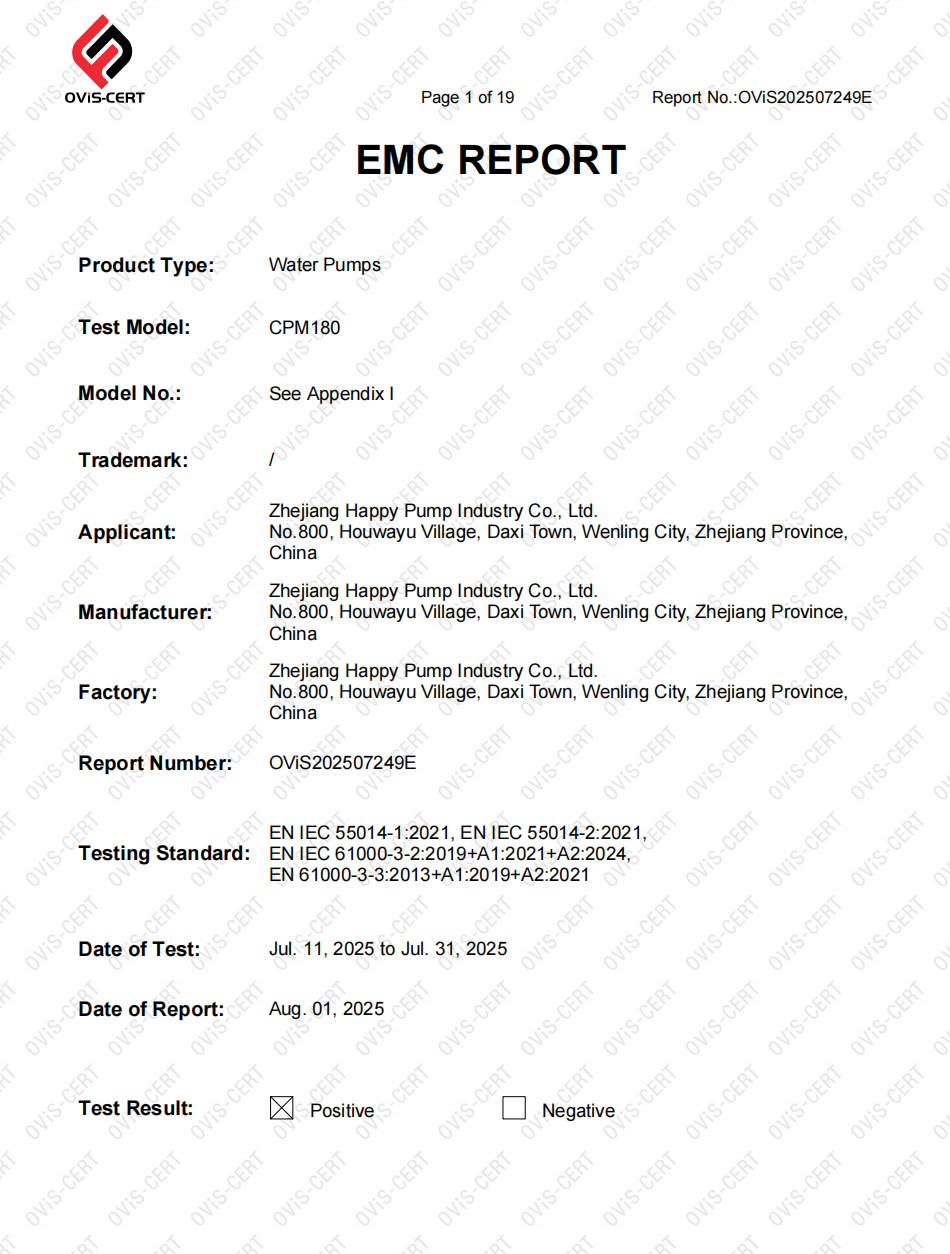
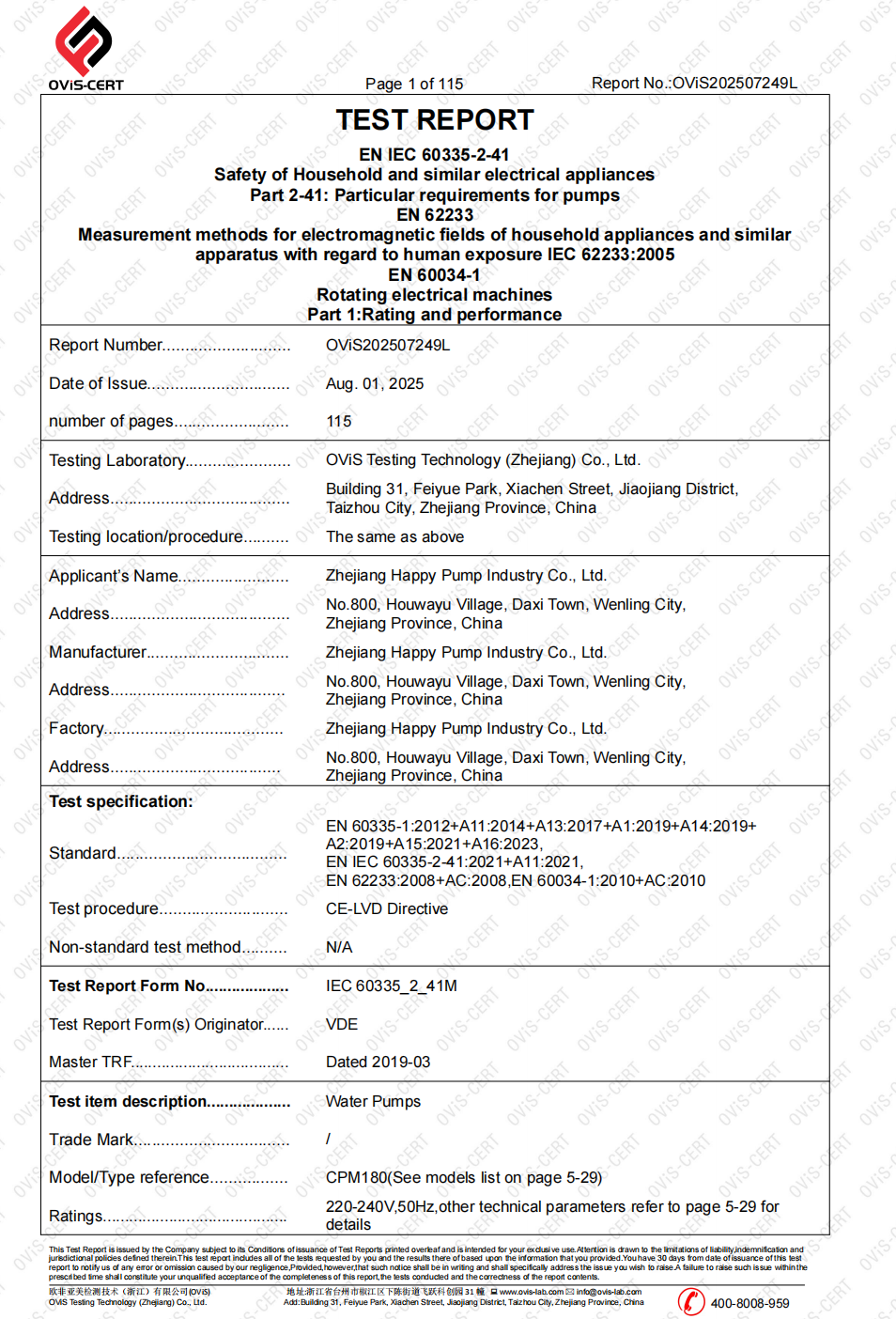
Compliance documentation is similarly specific. The LVD certificate OViS202507249L, issued by OViS-CERT for the EU market, references EN 60335-1:2012 series standards, EN IEC 60335-2-41:2021+A11:2021, EN 62233:2008+AC:2008 and EN 60034-1:2010+AC:2010. The EMC certificate OViS202507249E, issued by OVIS-CERT, references EN IEC 55014-1:2021, EN IEC 55014-2:2021, EN IEC 61000-3-2:2019 series and EN 61000-3-3:2013 series. A separate CE Attestation of Conformity, CE-5072-160326, issued by ECES with an issue date of 2026-03-16 and an expiry date of 2031-03-16, cites the 2014/35/EU Low Voltage Directive, the 2014/30/EU Electromagnetic Compatibility Directive and the 2006/42/EC Machinery Directive. For buyers whose scenario mix includes EU destinations, that file is the practical starting point for verification.
Market Signals Behind Scenario-Matched Demand
The demand picture behind scenario matching is broad but uneven, and the published forecasts disagree with each other in ways buyers should note. Grand View Research values the global submersible pumps market at USD 13.3 billion in 2025 and projects USD 19.4 billion by 2033, while SNS Insider places the 2024 baseline at USD 14.75 billion with a projection of USD 23.07 billion by 2032. The gap between the two baselines — several billion US dollars across overlapping years — is a reminder that category sizing should be read as a range, not a precise figure.
Geographically, Fortune Business Insights reports that Asia Pacific held a 39.72% share of the submersible pump market in 2025, valued at USD 7.05 billion. The product mix is similarly concentrated: Grand View Research reports that the borewell segment accounted for 46.7% of the global market in 2025, that electric-drive units represented nearly 80% of global installations in 2024, and that non-clog and sewage submersible pumps represented approximately 25% of the total market. Agricultural use of electric submersible pumps was valued at USD 2,515.6 million in 2025 by the same source.
Solar pumping is where the forecasts diverge most sharply. Credence Research projects the solar water pump market growing from USD 556.57 million in 2024 to USD 2.9 billion by 2032, a 22.95% CAGR, while Grand View Research projects a 4.3% CAGR for the same segment. Both point to growth; they disagree by an order of magnitude on pace. Grand View Research also reports that the AC submersible segment held a 39.5% revenue share of the solar pump market in 2023, which matters for buyers because AC submersible builds paired with solar input remain the dominant configuration in that segment.
On the supply side, the category includes global industrial pump leaders such as Grundfos, Xylem and KSB, identified by MarketsandMarkets as top players in the industrial pump market, alongside regionally concentrated manufacturers such as Zhejiang LEO Group, identified by Grand View Research as a key competitor in the submersible pump industry. China’s position is visible in trade data: the OEC reports that China concentrated 18.5% of global liquid pump exports in 2024, valued at approximately USD 14.3 billion.
Future Outlook
Two trends are likely to reshape submersible pump specification over the next several years. The first is solar pairing. Precedence Research notes that submersible pumps paired with solar are increasingly adopted in South Asia, a region where 75–100% of freshwater withdrawal is for agriculture — a combination that pushes motor and power-matching decisions to the front of the specification process. The second is sewage and municipal infrastructure demand, with Custom Market Insights projecting the sewage pump market reaching USD 24.5 billion by 2034 at a 6.5% CAGR.
Standards will move in parallel. IEC 60335-2-41:2024 sets safety requirements for electric submersible pumps for household and agricultural use, while UL 778 remains the primary safety standard for motor-operated water pumps in the North American market. For manufacturers and importers, the practical consequence is that scenario fit and compliance fit increasingly travel together: a build suited to a swimming pool duty may still be the wrong product for a market if its certification file does not cover the destination.
The direction stated by the manufacturer itself points the same way, with publicly described plans centred on intelligent and green factory development, continued R&D investment and deeper industry chain coordination — priorities that align with a market where the number of distinct duty profiles is growing faster than the number of generic products.
Frequently Asked Questions
Can one submersible pump range serve both clean-water and sewage duties?
Yes at the range level, but not with a single build. The published subcategories for this platform include submersible pumps, deep well pumps, solar pumps, swimming pool pumps and sewage pumps, and the main materials are cast iron, stainless steel and engineering plastics. Clean-water duties such as pool circulation or household supply are normally matched with stainless steel or engineering plastic wetted parts for corrosion resistance, while sewage and engineering drainage duties are conventionally matched with cast iron hydraulics designed to handle or reduce solids. A buyer can therefore standardize on one supplier while still matching the individual build to the duty.
Which wetted material should be specified for corrosion-prone water, and when is cast iron the better choice?
Stainless steel and engineering plastics are the usual direction where corrosion is the dominant risk — treated pool water, aggressive or low-hardness water, and other media that attack ferrous surfaces. Cast iron is generally selected for tougher mechanical duty, where abrasion, impact and load matter more than chemical attack, which is why it remains conventional in sewage and heavier drainage applications. The trade-off is explicit: cast iron is heavier and requires corrosion consideration in aggressive media, while stainless steel and engineering plastics are not automatically the answer for abrasive, solids-laden duty.
What ingress protection does continuous submersion require?
This range is published with both IP44 and IP68 protection. IP68 is the class intended for equipment operating while fully immersed. IP44 addresses solid objects above 1 mm and water splashing, and is not intended for a pump required to run submerged. Installations such as wet wells, boreholes, pool circuits and drainage sumps therefore need an IP68 build confirmed on the datasheet, rather than inferred from the fact that the product is described as submersible.
What OEM and ODM customization is available, and which commercial thresholds apply?
OEM and ODM production services are provided to customers globally, with voltage and logo documented as the customization points. Published commercial parameters include a minimum order quantity of 50 pieces for pumps above 3HP, a lead time of 30–45 days, monthly capacity of 400,000 units, 100% testing, FOB and CIF trade terms, a pre-shipment test as the acceptance criterion, and standard 30/70 payment terms. These figures describe the operating parameters of the supply arrangement rather than a commercial recommendation, and buyers should confirm them against the specific model and destination market.
Which certifications support EU market entry for these pumps?
The compliance file includes three relevant documents. LVD certificate OViS202507249L, issued by OViS-CERT, cites EN 60335-1:2012 series standards alongside EN IEC 60335-2-41:2021+A11:2021, EN 62233:2008+AC:2008 and EN 60034-1:2010+AC:2010. EMC certificate OViS202507249E, issued by OVIS-CERT, cites EN IEC 55014-1:2021, EN IEC 55014-2:2021, EN IEC 61000-3-2:2019 series and EN 61000-3-3:2013 series. CE Attestation of Conformity CE-5072-160326, issued by ECES and valid from 2026-03-16 to 2031-03-16, cites the 2014/35/EU, 2014/30/EU and 2006/42/EC directives. For broader context, IEC 60335-2-41:2024 establishes safety requirements for electric submersible pumps for household and agricultural use, and UL 778 is the primary safety standard for motor-operated water pumps in North America.
What service life and after-sales support should buyers expect?
Documented case information for this platform describes normal use of around 10 years with a one-year warranty, with stable operation reported as the outcome and low noise noted as a characteristic. After-sales support is provided remotely. Because service life depends heavily on the duty point, the medium, installation quality and starting frequency, the ten-year figure should be read as an expectation for a correctly matched build rather than a guarantee, and buyers should verify it against their own operating conditions.
Matching submersible pump builds to real-world scenarios is ultimately a verification discipline: confirm the material against the medium, the protection rating against the immersion condition, the duty point against the published head range, and the compliance file against the destination market. Detailed specifications, materials and certification scope for this range are set out in the corporate product brochure (PDF).