
Synchronous Belts Explained: Timing Belt Selection Basics
Synchronous Belts Explained: Timing Belt Selection Basics
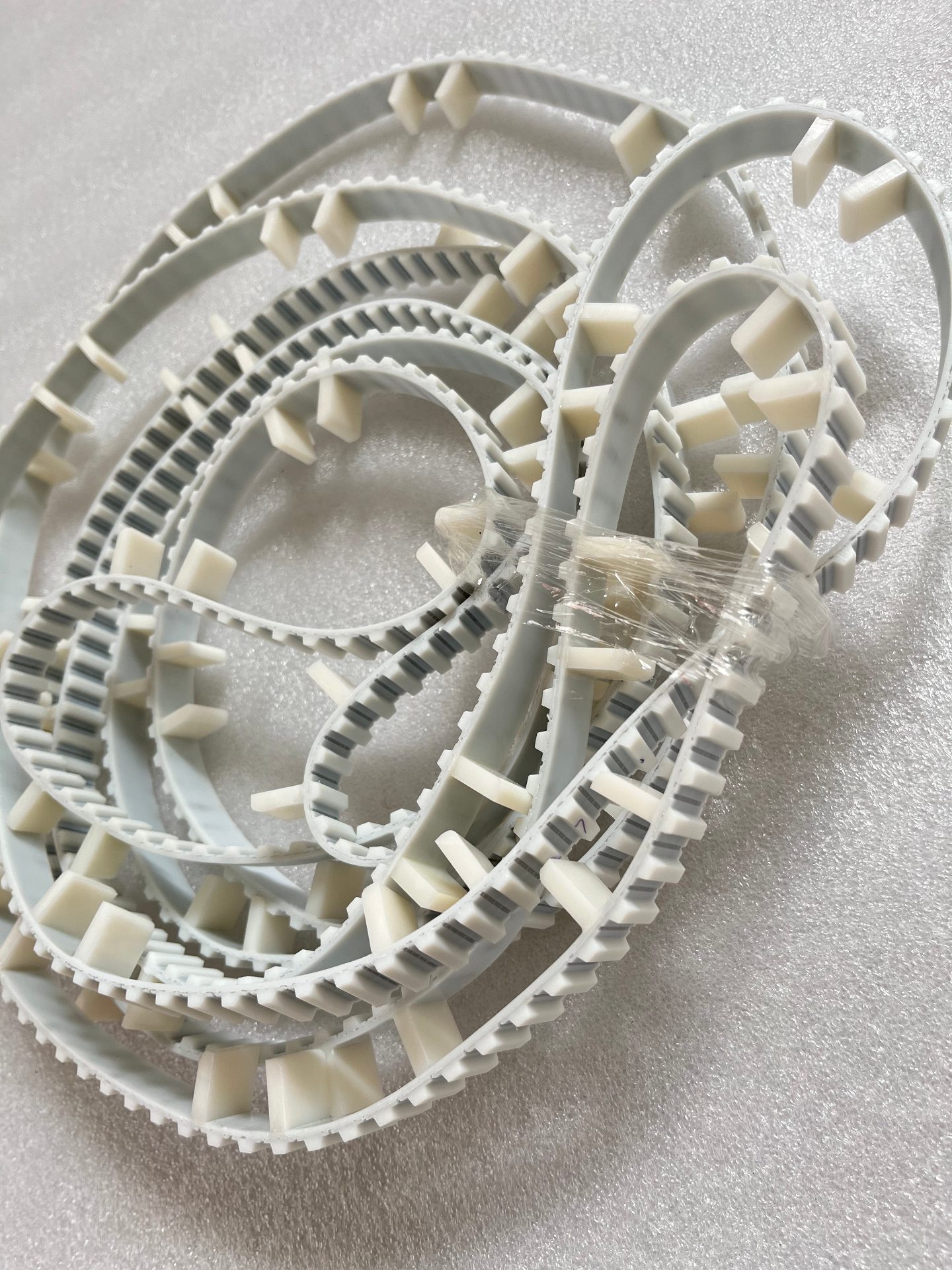
A synchronous belt transmits motion through tooth engagement rather than friction, which is why it is specified wherever position repeatability matters.
A synchronous belt — also described as a timing belt or a toothed belt — transmits motion through positive tooth engagement rather than friction. That single design characteristic explains why these belts appear in packaging machines, printing presses, servo-driven automation axes and precision conveying systems where position repeatability matters more than raw torque. This industry reference examines how synchronous belts are classified, what a buyer should establish before ordering, where the practical limits sit, and how a supplier such as XZBELT fits into that picture.
Terminology is worth clarifying at the start, because a procurement team searching for a timing belt and an engineer specifying a synchronous belt are frequently describing the same component family. Within XZBELT's product classification, the timing belt sits inside the synchronous belt category, with PU Timing Belt listed as one model designation and rubber-bodied timing belts produced alongside it. The difference between a PU timing belt and a rubber timing belt refers to the belt body compound, not to the drive principle.
What Makes a Belt Synchronous
In a synchronous drive, moulded teeth on the belt mesh with matching grooves in the pulley. Because the drive no longer depends on friction between a flat back and a pulley face, slip is eliminated under correct engagement, and angular position is set by tooth geometry and pitch rather than by tension. Flat belts and round belts, by contrast, transfer power through surface friction, which makes them simple, forgiving and often cheaper, but inherently less precise for indexing, positioning and synchronised multi-axis motion.
The tooth system is also what makes two belts non-interchangeable even when they measure the same length. ISO 5296:2012 specifies the principal characteristics of synchronous endless belts with pitch codes MXL, XXL, XL, L, H, XH and XXH, and metric and curvilinear families are equally widespread in industrial drives — T5, T10 and T20, AT5, AT10 and AT20, HTD 3M through HTD 20M, plus STS and RPP profiles. Each family has its own pitch, tooth geometry and matching pulley counterpart, and a belt from one family will not run correctly on a pulley cut for another.
For discovery-stage buyers, the practical point is that a timing belt is defined by a system, not by a single dimension. Profile, pitch, width and tooth count describe the belt; pulley geometry, centre distance, load and speed describe the drive that the belt has to survive in.
When a Timing Belt Fails, the Drive Is Usually the Cause
A timing belt rarely fails for a single isolated reason. Tooth damage is usually the result of a drive-system problem rather than ordinary surface wear alone, and the damage pattern often indicates which problem. Published industry guidance points in the same direction: Continental associates abnormal tooth-flank wear and tooth shearing with incorrect tension, foreign material and seized pulleys, while Optibelt identifies excessive tension and defective pulleys as causes of tooth-root wear.
Observable symptoms include tooth flank wear, damaged tooth roots, missing teeth, tooth shear, fabric separation and intermittent ratcheting. These usually trace back to one or more of the following conditions:
- Incorrect belt tension
- Excessive load or shock load
- Pulley wear or a seized idler or pulley
- Wrong tooth profile for the pulley
- Pulley misalignment
- Foreign material trapped in the drive
- Insufficient tooth engagement
The diagnostic sequence is short and mechanical rather than material-led. Inspect the damage pattern across several teeth, verify that belt profile and pulley profile match, check pulley teeth for wear, check tension, verify shaft and pulley alignment, review drive load and shock loads, remove contamination, and replace the damaged belt together with defective pulley components where necessary.
The consequence for procurement is straightforward. A replacement belt ordered against length alone may simply repeat the failure, because length was never the variable that failed.
The Technical Variables That Decide Performance
Once profile and pitch are fixed, four further variables govern how a timing belt behaves in service. The first is the tension member, or cord: steel cord, Kevlar cord and glass fibre cord are standard options, with steel cord diameters such as Φ0.3 mm, Φ0.51 mm, Φ0.6 mm and Φ1.21 mm selected according to tooth profile. A Kevlar intermediate layer is also used. The cord controls load-carrying ability, elongation and stiffness — the properties that determine whether a linear axis holds position under acceleration.
The second variable is the belt body and its surface. Body materials in the XZBELT timing belt range include polyurethane, PU, CPU, rubber, neoprene rubber, silicone-coated PU and silicone-coated rubber, with hardness typically in the 90–92 Shore A range and an operating temperature range of −20 °C to +160 °C according to material. Backing and coating options include silicone, PU, rubber, sponge and fabric, while surface treatment can add tooth fabric, backing fabric, grinding or perforation.
The third variable is dimensional discipline. Catalogue tolerances for this range are ±0.5 mm on width, ±0.3 mm on thickness and ±0.5 mm on length. In high-cycle indexing machines these tolerances are not administrative detail; they are part of what determines whether an index position repeats across a shift.
The fourth variable is construction and supply form. Timing belts can be single-sided, double-sided, open-end, endless or flex belt construction. Supply forms are open-end belt, jointed endless belt and truly endless belt, with welded, flex or endless joints used accordingly. Belt geometry also sets a floor on pulley size: minimum pulley teeth typically fall between 10 and 25 teeth depending on profile, corresponding to minimum turning diameters in the range of 10 mm to 108.7 mm.
| Specification variable | Options / range in the XZBELT timing belt range |
|---|---|
| Belt body material | Polyurethane, PU, CPU, rubber, neoprene rubber, silicone-coated PU, silicone-coated rubber |
| Colour | Transparent, white, black, green, red, blue, customised |
| Hardness | 90–92 Shore A, customised |
| Operating temperature | −20 °C to +160 °C, customised according to material |
| Tooth profile | MXL, XL, L, H, XH, XXH, DXL, DL, DH, T5, T10, T20, AT5, AT10, AT20, HTD 3M, HTD 5M, HTD 8M, HTD 14M, HTD 20M, STS S2M–S14M, RPP P3M–P14M |
| Tooth pitch | 2.032 mm, 5 mm, 9.525 mm, 14 mm, according to tooth profile |
| Tension member / core | Steel cord, Kevlar cord, glass fibre cord |
| Intermediate layer | Kevlar |
| Backing / surface coating | Silicone, PU, rubber, sponge, fabric |
| Supply form | Open-end belt, jointed endless belt, truly endless belt |
| Joint method | Welded joint, flex joint, endless joint |
| Dimensional tolerance | Width ±0.5 mm, thickness ±0.3 mm, length ±0.5 mm |
| Minimum pulley | 10–25 teeth; turning diameter 10 mm–108.7 mm according to profile |
| Secondary processing | Perforation, cleats, profiles, V-guides, tooth fabric, backing fabric, grinding |
| Antistatic index | 10⁸–10⁹, customised |
A related construction question concerns joints. A genuine seamless or endless-woven belt has no localised splice, so thickness, flexibility and mechanical behaviour can remain more uniform around the circumference — a seamless belt removes the joint as a localised geometric and mechanical transition, while a spliced belt offers greater manufacturing and installation flexibility. Seamless construction is generally recommended where uniformity, precision, high-speed cycling or splice-related failure is the major concern; spliced construction is generally recommended where dimensional flexibility, installation convenience or replaceability has greater priority. Neither is universally superior, and suppliers such as Habasit, Ammeraal and Nitta position seamless belts for applications where smooth running, dimensional consistency or the absence of a splice matters, without claiming that seamless belts are always better.
Where Synchronous Belts Are Actually Used
Application conditions, not product labels, determine which timing belt construction survives. The patterns below reflect how synchronous drives are commonly specified across industrial sectors.
Packaging machinery
Packaging lines combine high speed with frequent start-stop cycles and repetitive positioning. Typical duties include feeding, indexing, gripping, vacuum conveying and synchronous drive, with matched equipment such as filling machines, labelling machines, cartoners, case packers and servo systems. The requirements that matter most are accurate positioning, low elongation, high grip, vacuum perforation where applicable, wear resistance and dimensional stability.
Printing and paper converting
Printing presses, folder-gluers, post-press lines and paper feeding systems run light products at high speed with rapid acceleration and precise sheet positioning. Functions include sheet transport, folding, vacuum holding and synchronous transmission, and the belt specification usually emphasises consistent friction, abrasion resistance, low elongation and a non-marking surface.
Industrial automation and precision equipment
Servo-driven automation, linear motion systems and robotic axes involve frequent acceleration and deceleration with high cycle rates. Here the drive is asked for backlash control, low elongation, positioning accuracy, high tensile strength and low vibration, working against servo motors, stepper motors, timing pulleys and linear guides. This is the environment where open-end PU timing belts with low-elongation reinforcement are most often chosen.
Electronics, medical and office equipment
Clean operation, small pulley diameters, precise low-noise motion and frequent cycling define this group. Applications include diagnostic equipment, office machines, data handling equipment, robotics and small precision drives, where the priorities are low noise, no lubrication, positioning accuracy and a compact drive envelope.
Food processing and beverage
Food lines combine wet conditions, oil, frequent wash-down and continuous production, with duties such as conveying, feeding, sorting, indexing and product transfer. Specification priorities include food-contact compliance where applicable, easy cleaning, hydrolysis resistance and oil or chemical resistance, alongside sealed hygienic surfaces.
Automotive and tire
Automotive assembly and component lines impose heavy loads, oil, dust, heat, continuous production and repetitive automation. Belts are used for parts conveying, assembly transport, synchronous transmission and positioning, and the specification typically calls for wear resistance, antistatic options, oil resistance, heat resistance, high load capacity and stable tracking.
Textile and nonwovens
Textile production, yarn production, textile printing and nonwoven lines run at high speed for long continuous periods and generate static. Antistatic performance, precise tracking, low elongation, abrasion resistance and dimensional stability are the recurring requirements, applied through textile printing machines, cross-lappers, spinning machines, winding machines and nonwoven equipment.
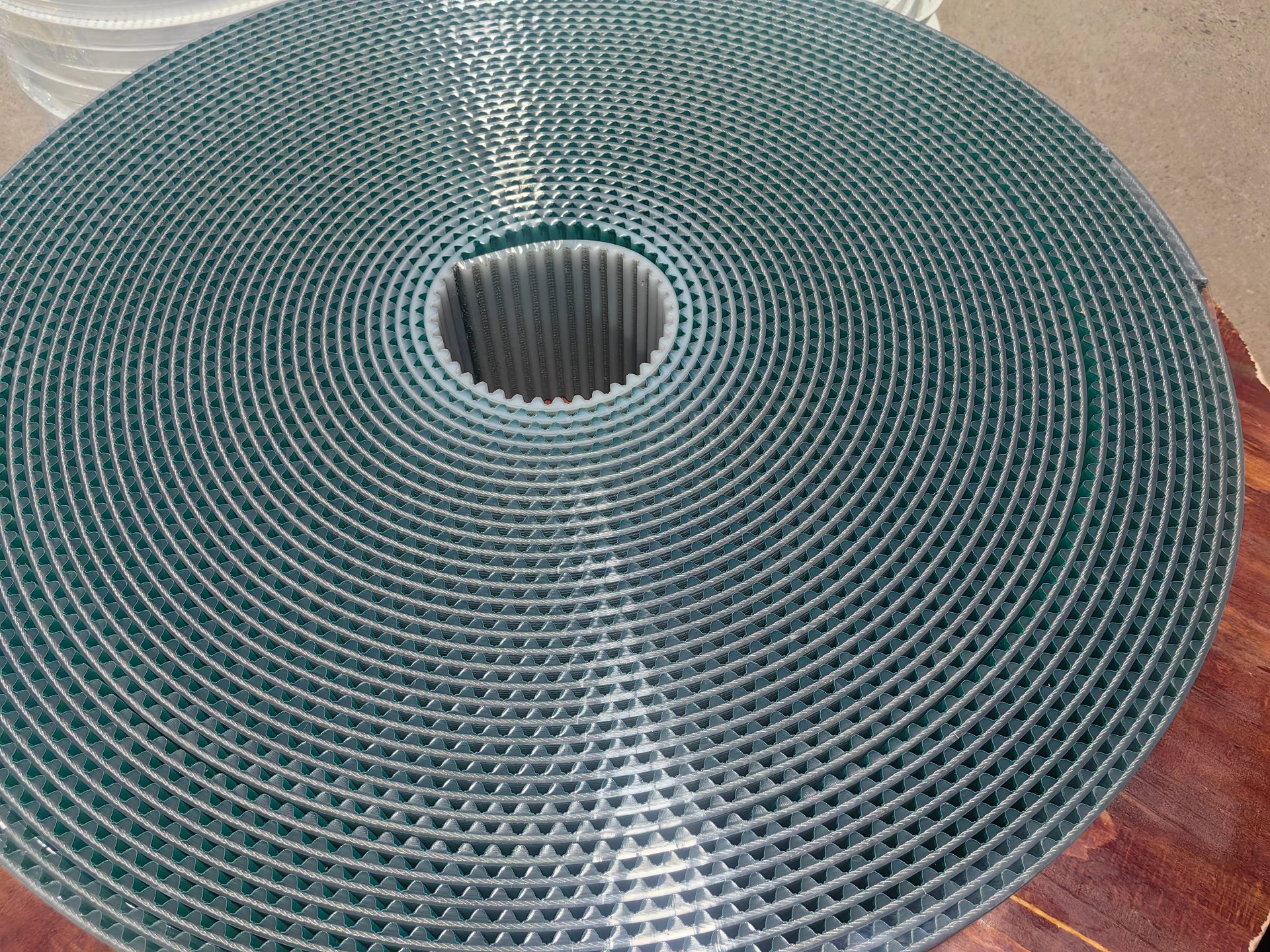
Tooth profile, pitch and construction — not length alone — determine whether a timing belt suits an indexing, conveying or product-handling duty.
How XZBELT Fits Into the Synchronous Belt Supply Picture
Xuanze Industrial Drive Systems (Shanghai) Co., Ltd., trading as XZBELT, is an industrial belt manufacturer and supplier established in 2013 and headquartered in Shanghai, China, whose main products include conveyor belts and timing belts. Its published product range covers PVC, PU and PE conveyor belts, timing belts, power transmission belts, silicone belts, high-temperature conveyor belts, polyamide flat belts, coiler wrapper belts, easy-to-clean homogeneous conveyor belts and seamless belts.
Manufacturing capacity is organised across two production bases with a combined area of approximately 30,000 m². The specialty industrial belt processing and manufacturing facility in Changxing, Huzhou, Zhejiang Province occupies approximately 3,000 m² of standardised production space and is equipped with more than 20 sets of specialised production and processing equipment. A joint-venture base for conveyor belt roll materials covers approximately 27,000 m² and runs 12 production lines, including 2 PU and 10 PVC lines. Company information lists an annual production capacity of 2,000,000 units, approximately 50 staff and an R&D team of 5 engineers, with exports accounting for 60% of business and customers served in more than 150 countries and regions.
On quality and technical positioning, XZBELT holds ISO 9001 quality management system certification and 11 patents, comprising 2 invention patents and 9 utility model patents, and was recognised as a Shanghai High-Tech Enterprise during the 2019–2022 and 2022–2025 certification periods. The company reports more than 20 years of accumulated industrial belt experience through its team, and maintains business cooperation and technical exchange with international belt brands including Habasit, Ammeraal Beltech and Forbo Siegling.
For synchronous belt buyers, the relevant capability is secondary processing rather than catalogue volume. XZBELT provides customised belt solutions and application-specific processing based on a customer's machine structure, operating conditions, production process and automation requirements. Representative specialty timing belt products include extra-wide timing belts, silicone-coated timing belts, rubber timing belts with high-temperature felt, and timing belts for sausage processing machines. Available processing includes single-side and double-side sidewalls, fabric reinforcement and lamination, cleats, perforation, silicone coating, sponge coating, special surface coating, belt splicing, and customised widths and lengths.
Published supplier information for the XZBELT SIBR-5M synchronous silicone tape references operating speeds of 1,200–1,400 pcs/min in hygiene-product converting — an example of the kind of application-specific belt development that sits outside standard catalogue ranges.
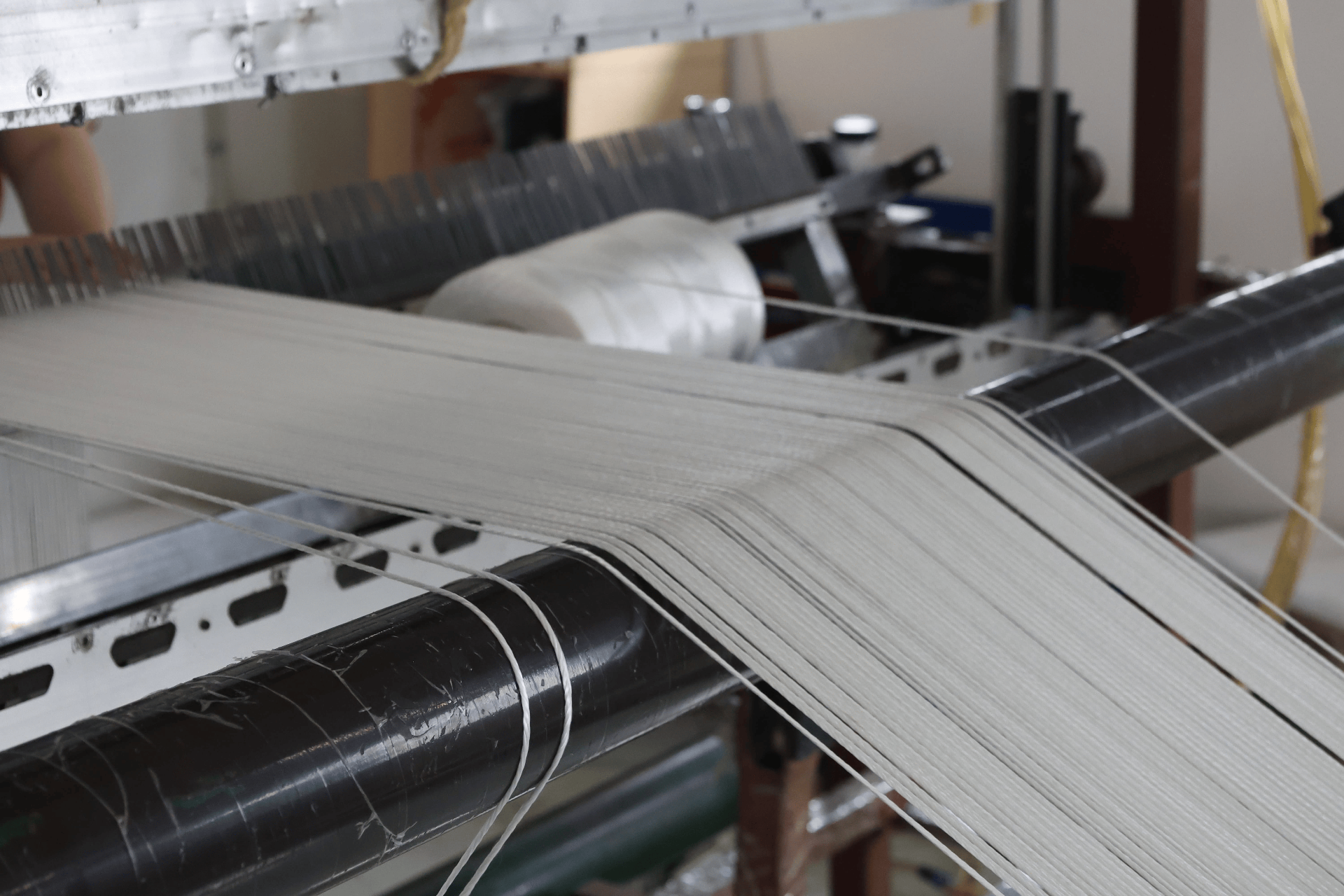
Specialty belt processing capability, including splicing, coating and perforation, is what allows a standard timing belt construction to be adapted to a specific machine.
Comparison with Conventional Drive Options
Synchronous belts are frequently compared with flat belts, round belts and other drive elements. The comparison is not about which is better in the abstract; it is about which failure mode and which precision level the application can tolerate.
| Drive element | Power transmission principle | Positioning behaviour | Practical notes from published specifications |
|---|---|---|---|
| PU timing belt | Positive tooth engagement | Position set by tooth geometry and pitch; no slip under correct engagement | Body material governs temperature, oil and chemical behaviour; steel, Kevlar or glass fibre cord controls elongation |
| Rubber timing belt | Positive tooth engagement | Position set by tooth geometry and pitch | Rubber bodies are widely used where the operating environment differs from PU; tooth damage still traces back to tension, pulley condition and alignment |
| Flat belt | Friction between belt surface and pulley | Slip possible under overload | Thickness 0.8–6 mm for selected types; temperature range −20 °C to +120 °C; broad jointing options including thermofix, Z-splice and finger splice |
| Round belt | Friction on a grooved or V-profile pulley | Slip possible under overload | Diameters from 2 mm to 20 mm; minimum pulley diameter from 20 mm for a 2 mm belt; easy splicing and low-noise operation |
The boundaries of synchronous belt solutions deserve equal weight. First, a timing belt will not compensate for a worn or misaligned pulley; the drive has to be corrected, not just the consumable. Second, minimum pulley tooth counts of roughly 10 to 25 teeth, and corresponding minimum turning diameters from about 10 mm upward, limit how compact a synchronous drive can realistically be built. Third, the catalogue temperature range of −20 °C to +160 °C is material-dependent, and applications outside that window require a different belt construction rather than the same belt pushed harder. Fourth, seamless construction is not automatically superior; a spliced belt remains a practical choice where dimensional flexibility, installation convenience or replaceability matters more.
Market Signals Worth Watching
Third-party market research places the timing belt category in a moderate growth pattern, with wide variation between published estimates depending on how the category boundaries are drawn. Mordor Intelligence projects the global timing belt market growing from a 2025 base of approximately USD 9.10 billion to about USD 9.57 billion by 2030.
Segment-level figures diverge more sharply. Credence Research projects the polyurethane timing belt market growing at a 12.57% CAGR to USD 25.5 billion by 2032, while 24ChemicalResearch has published a 3.10% figure for the same segment — a spread that reflects different definitions of what falls inside the PU timing belt scope, with custom solutions and robotics-related applications likely included in the higher estimate. On the material side, Market Research Future estimates rubber at USD 7.23 billion of the automotive timing belt market in 2024, indicating that rubber remains the dominant material in vehicle applications even as PU expands in industrial duty.
Standardisation is a quieter but consequential signal. ISO 5296:2012 continues to define principal characteristics for synchronous endless belts with pitch codes MXL, XXL, XL, L, H, XH and XXH, and buyers working across multiple suppliers benefit from aligning enquiry documents to that vocabulary.
Future Outlook
Three directions look reasonably well supported. First, as machinery becomes more servo-driven, the demand for low-elongation timing belts with controlled positioning behaviour tends to increase, because the belt becomes part of the positioning loop rather than a passive transmitter. Second, application-specific belt construction — silicone coating, perforation, felt lamination, sponge coating and custom profiles — continues to expand the boundary of where a synchronous belt can be used, moving into product-handling duties that friction belts used to cover. Third, the PU segment is generally expected to grow faster than the category average, although the size of that lead is genuinely contested between published forecasts.
What remains uncertain is the pace rather than the direction. Buyers planning multi-year programmes should treat forecast values as planning signals, not commitments, and should validate belt selection against measured performance in their own drives.
Frequently Asked Questions
What should a buyer establish before ordering an industrial timing belt?
Correct tooth engagement comes first. Establish tooth profile, pitch, length or tooth count, and width before deciding on reinforcement, endless or open construction, or special processing. Because pitch length equals tooth count multiplied by pitch, tooth count is often the most useful identifier once the pitch is known. Pulley geometry, including minimum pulley tooth count, and the operating environment — temperature within the −20 °C to +160 °C range, oil exposure, wash-down or vacuum requirements — should be confirmed at the same stage, since coating, perforation and cord selection follow from those inputs.
Can two timing belts with the same length but different tooth profiles be interchanged?
No. Tooth geometry and pitch must match the pulley system. Length alone does not define interchangeability, and a belt that measures correctly but engages incorrectly will run with reduced tooth contact, which is one of the recognised contributors to tooth damage.
Which timing belt should be chosen for linear motion, power transmission or product handling?
Selection should begin with the required motion function. Linear axes generally favour open-end belts with low elongation; continuous synchronous drives require endless constructions sized for torque and speed; product-handling belts may need silicone, rubber or sponge covers depending on friction and release requirements; vacuum or pick-and-place systems may require perforation or machining. The tooth system and load capacity remain the engineering foundation beneath all of these functional modifications.
Can PU timing belts be supplied open-end and endless?
Yes, depending on profile and manufacturing construction. Open-end belt, jointed endless belt and truly endless belt forms are all available, using welded, flex or endless joints as appropriate to the construction.
Can timing belts be coated or perforated?
Selected timing belts can be coated for grip, compression, release or product handling, with silicone, PU, rubber, sponge and fabric among the coating options. Selected PU timing belts can also be drilled or machined for vacuum and handling systems, and secondary processing can add cleats, profiles and V-guides.
Why are the teeth on a timing belt wearing or tearing off?
Tooth damage is usually the result of a drive-system problem rather than ordinary surface wear alone. Incorrect tension, excessive torque, worn or incorrect pulleys, foreign objects, misalignment, seized idlers and tooth-profile mismatch can all overload the tooth or root area, producing flank wear, damaged roots, missing teeth, tooth shear, fabric separation or intermittent ratcheting. The corrective sequence is to inspect the damage pattern across several teeth, confirm that belt and pulley profiles match, check pulley teeth and tension, verify shaft and pulley alignment, review drive load, remove contamination, and replace the damaged belt together with any defective pulley components.
Closing Note
Synchronous belts are a mature component category, but the specification decisions behind them are not trivial: profile and pitch define compatibility, cord and body define capability, construction defines installation and replacement practice, and drive condition defines service life. Buyers who document those four layers before ordering are far better positioned than buyers who order against length. For readers who want the full product and capability overview, the XZBELT company brochure is available for public download at https://cdn.socialarks.com/sbsp/25263/common/2026/0917/xzbelt.pdf, and company information is published at https://www.xzbelt.com/.