
T-Shirt Manufacturer FAQ: DTG, Low MOQ, Lead Times & Reorders
T-Shirt Manufacturer FAQ: DTG, Low MOQ, Lead Times & Reorders
The global custom T-shirt printing market was valued at USD 5.46 billion in 2024 and is projected to reach USD 9.82 billion by 2030, a compound annual growth rate of 11.5% to 11.6% (Grand View Research). The blank apparel category that supplies it was estimated at USD 15.23 billion in 2024, with T-shirts and tanks accounting for a 48.39% share. China remains the dominant production base behind that demand: national textile exports reached USD 268 billion in 2024, a 32% share of global textile trade (Observatory of Economic Complexity).
Those figures set the context for a narrower, more practical conversation. When a brand, a touring artist, a gym chain or an e-commerce label starts sourcing custom blank T-shirts from a China T-shirt manufacturer, the questions that decide the outcome are almost always the same four: which decoration method, what minimum order quantity, how long until delivery, and when should the next reorder be triggered. This reference answers those questions with published production parameters from Guangzhou Qianshi Apparel Co., Ltd (Qianshiwear) and one documented tour merchandise program, and it states where the model does not fit.
Why Decoration, MOQ and Lead Time Decide Most T-Shirt Projects
A custom T-shirt order is a chain of dependencies. The artwork determines the decoration route. The decoration route determines setup, unit economics and the practical order size. The order size interacts with the minimum order quantity the factory applies per design. And all of it has to fit inside a calendar window that is fixed by a launch date, a tour stop or a seasonal drop.
Breaking that chain at any point produces measurable losses: paying screen-print setup costs on a 50-piece test run, ordering a five-colorway drop as if it were a single-colorway order, or approving a sample late enough that bulk production can no longer land before the event. The four questions below are therefore not administrative details. They are the operating variables of T-shirt sourcing.
DTG vs Screen Printing vs Embroidery vs Heat Press
Custom blank T-shirts can be decorated through several routes, and the correct choice depends on artwork complexity, order size and the expected life of the garment. The table below summarises how the main methods differ.
| Decoration method | Where it fits | Practical strength | Practical constraint |
|---|---|---|---|
| Screen printing | Bold graphics, spot-colour logos, campaign and event designs | Opaque, colour-fast coverage; efficient once volume is established across a run | Each additional colour adds a screen and a setup step, so very small runs and photographic artwork are less economical |
| DTG (direct-to-garment) | Detailed multicolour artwork, short runs, tour and event merchandise | High-resolution output with vibrant colour on small batches, without per-colour screen setup | Performs best on cotton-rich surfaces and needs controlled pretreatment for consistent results on dark fabric |
| Embroidery | Chest logos, caps, premium branding, corporate identity | Durable, textured finish that reads as premium and survives repeated laundering | Suited to compact, clean logo shapes; large solid coverage becomes heavy and costly per unit |
| Heat transfer / heat press | Names, numbers, personalised details, jerseys | Handles variable data and individualisation that screens cannot economically do | Wash durability depends on transfer quality and curing discipline |
| Sublimation | All-over prints, sportswear and jersey applications | Continuous full-colour coverage without a heavy hand feel | Effectively limited to polyester-rich substrates |
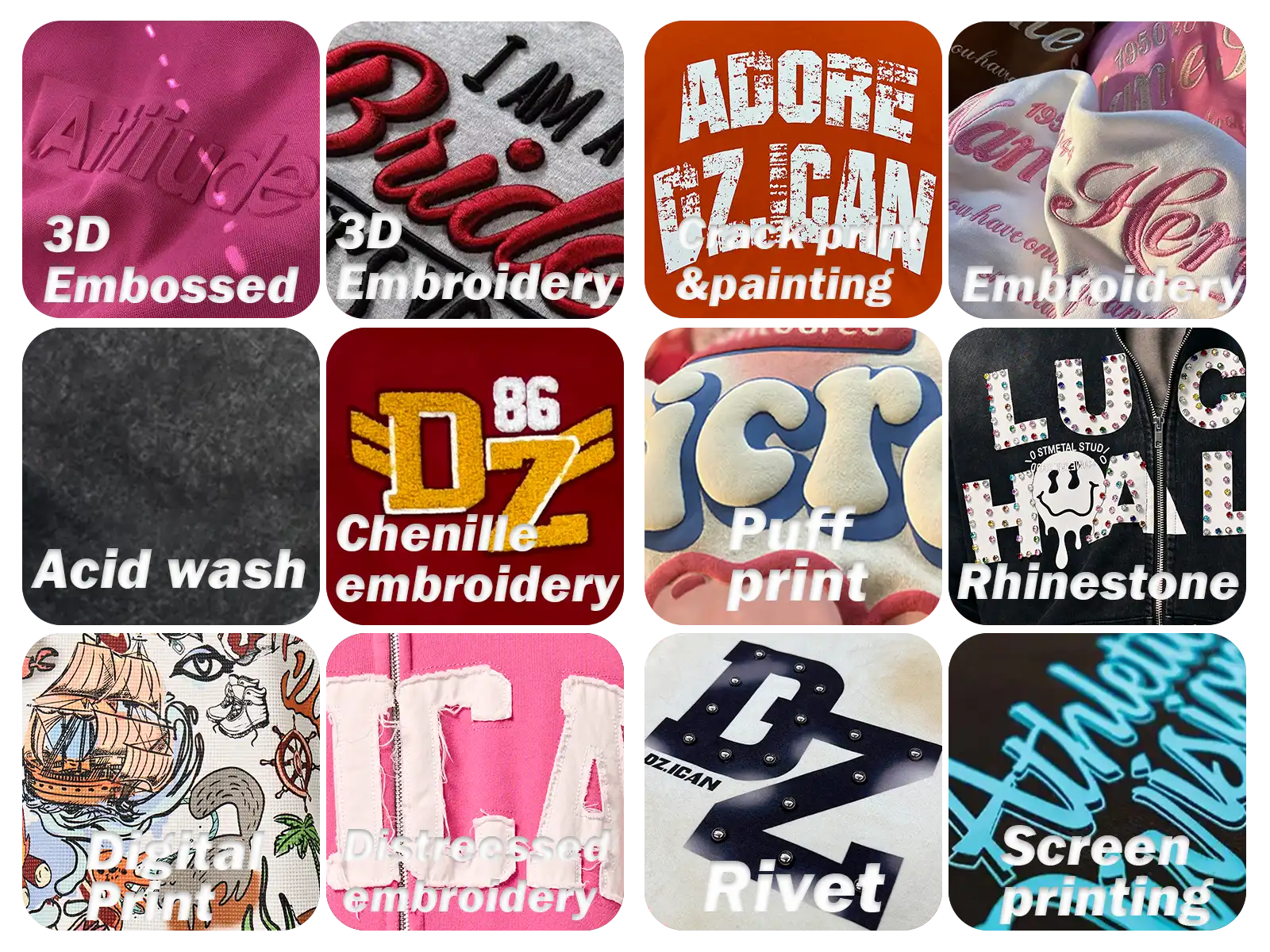
The decorative range published for Qianshiwear's custom blank T-shirt program lists screen print, DTG, sublimation, heat transfer and puff print, with embroidery options covering flat embroidery, 3D puff embroidery and chenille. Garment finishing options include pigment dye, enzyme wash, snow wash and vintage wash, and the neckline can be finished as a ribbed collar, self-fabric binding or a seamless finish.
Low MOQ Explained: What 50 Pieces per Design Really Covers
The published minimum order quantity for Qianshiwear custom blank T-shirts is 50 pieces per colour per design. Industry reviews of Chinese T-shirt suppliers commonly cite competitive minimums in the 50 to 100 piece range per design or colour, which places a 50-piece minimum at the lower end of the range that is normally quoted to new brands.
The unit that matters in that sentence is per colour per design, not per order. A brand launching a single design in one colourway commits to 50 pieces. A brand launching the same design in five colourways commits to 250 pieces in total. This is the single most common source of mismatch between a brand's expectation and a factory's quotation, and it is the reason small-batch production should be planned at the drop level rather than the order level.
Lead Times: 10-Day Samples and 30-Day Bulk in Practice
Qianshiwear publishes sample production at 7–15 working days and bulk production at 20–35 working days, with sampling in the application specifications quoted at 7–15 days. In the tour merchandise program described below, the sample was delivered in 10 days and bulk production in 30 days — inside the published ranges rather than outside them.
Two practical points follow from those numbers. First, they are working days, and they start from an approved specification rather than from the first enquiry; artwork revision, fabric confirmation and label approval all sit in front of the clock. Second, they describe production, not delivery. Freight transit, customs clearance and inland distribution sit after the bulk run and should be planned as a separate block of time.
Certification, Neck Labels and Hang Tags: The Compliance Layer
Compliance questions tend to surface after a purchase order is issued, which is late. Two certification frameworks recur in T-shirt sourcing.
- OEKO-TEX Standard 100 is the skin-contact certification referenced in Qianshiwear's application specifications, which list OEKO-TEX Standard 100 certified fabrics for skin-contact use. The standard's 2024 regulation update introduced a limit value for total fluorine (PFAS) at 100 mg/kg, effective 1 January 2024.
- GOTS (Global Organic Textile Standard) requires that products labelled organic contain at least 95% certified organic fibres, and that cutting, making and trimming meet defined social and environmental criteria. Organic cotton with GOTS certification is listed among Qianshiwear's available fabric materials.
Labels and packaging are a separate compliance and branding layer. Custom neck labels and hang tags are part of the standard customisation scope, and private label packaging has been delivered with custom polybags and hang tags in a multi-season streetwear program. For a first order, neck-label artwork, hang-tag layout and polybag specification should all be approved before bulk production starts, because the packing area is the last stage of the line and late label changes delay shipment.
Matching Fabric Weight and Fit to the Project
The custom blank T-shirt line is specified at 160–220 GSM for lightweight and 220–300 GSM for mid-weight constructions, in 100% cotton, cotton-polyester blends, 100% polyester or organic cotton, with fabric types including single jersey, pique, French terry and slub cotton. Silhouettes cover crewneck, V-neck, oversized, long-sleeve, polo and drop-shoulder, with sizing from XS to XXL and custom grading available.
| Project type | Typical fabric direction | Decoration direction |
|---|---|---|
| Summer event and tour merchandise | Lightweight 160–220 GSM single jersey for warm-weather wear | DTG for multicolour artwork; screen print for bold single-graphic designs |
| Streetwear and fashion drops | Mid-weight 220–300 GSM, oversized and drop-shoulder fits, slub or heavier jersey | Puff print, screen print and embroidery combinations; vintage or pigment washes |
| Corporate and promotional programs | 160–220 GSM blends and pique for durability and colour consistency | Embroidered logos and small chest prints |
| Gym and activewear | Blends selected for moisture behaviour and frequent laundering | Durable prints and embroidery placed to avoid high-stretch zones |
For products intended for direct skin contact and repeated laundering, the published application requirements are colour fastness of Grade 4 or better and shrinkage of 5% or less, under conditions that include all-season wear, high-frequency washing and drying, and exposure to sweat and sunlight.
Reorder Signals: What a 5,000-Piece Tour Merch Program Shows
A music artist management and tour merchandise agency ordered 5,000 pieces across 12 tour stops in multiple designs, selling into the United States, Canada, the United Kingdom, Australia and France over a six-month tour, with reorders for a second leg. The program used a 10-day sample turnaround, 30-day bulk production, high-resolution DTG printing, a 50-piece minimum order quantity per design, and custom hang tags carrying tour branding.
The measured outcome was a 92% sell-through rate across all tour dates, four reorders placed during the tour, and a 100% QC pass rate on rush orders. Read as a procurement case rather than a marketing claim, the program shows three reorder signals that generalise to other projects:
- Sell-through velocity per design, not per order. A 92% sell-through tells a buyer which specific designs to repeat; averaging performance across a mixed order hides that information.
- Reorder timing driven by production lead time. With bulk production at 20–35 working days, a reorder decision made after stock has visibly run low usually arrives after the demand peak. The four in-tour reorders were possible because the operator treated the 30-day bulk window as the reorder trigger horizon.
- Per-stop performance, not just totals. Merchandise demand across 12 stops is not uniform, and reorder quantities that ignore stop-level data create both overstock and stockouts.
The same operating logic is described in the product's general use cycle: wear, commercial or home laundering, and reordering based on demand. Reordering is a scheduled activity in the model, not a recovery action after a stockout.
Project Fit Beyond Tour Merch
Three other documented programs show how the same production model behaves under different demand shapes.
- Streetwear startup. A US and Canada direct-to-consumer label began with a 100-piece first order and reordered 1,000 pieces, using heavyweight construction, a custom puff print logo, oversized drop-shoulder fit and a custom woven neck label. The result was a 95% sell-through within two months, 85% positive customer reviews and two reorders within 12 months.
- Corporate uniform program. An international technology company ordered 3,500 pieces across three regions in multiple colours for daily-wear employee uniforms and corporate events, using moisture-wicking pique fabric, embroidered chest logos and colour matching to brand guidelines. The program reported 98% employee satisfaction, no quality complaints after more than 100 washes per garment and 100% on-time delivery across all batches over two years.
- Established streetwear brand. A multi-store retailer ordered 7,000 pieces per quarter across multiple styles and colourways for three years, with a reserved quarterly production slot. The reported outcome was 100% on-time delivery across more than 12 drops, a 90% season-over-season reorder rate and a 98% sell-through rate on core styles.
Guangzhou Qianshi Apparel Co., Ltd, which operates as Qianshiwear, is a Guangzhou-based apparel manufacturer and trading company founded in 2014, running OEM, ODM, full custom and private label production for T-shirts, hoodies, sweatshirts, sportswear, polos, jerseys and streetwear. It publishes a monthly capacity of 250,000 units, an annual output of 3,000,000 units, and exports 85–90% of production to the EU, USA, AU and UK markets, with listed export destinations that also include Canada, Germany, France, the Netherlands, Sweden, Japan, South Korea and the UAE.
Where Low-MOQ T-Shirt Manufacturing Has Real Limits
Low minimums solve one problem and create three others, and buyers should enter the process with those constraints visible.
- Minimums are per colour per design. A wide colourway drop multiplies the commitment. A five-colour launch at a 50-piece minimum is a 250-piece production commitment, not a 50-piece one.
- Small runs carry higher relative setup weight. Screen printing requires a screen and setup step per colour. At test-run volumes, DTG or a single-colour print is often the more sensible entry point, with screen printing reserved for the reorder once a design has proven itself.
- Capacity scheduling is not infinite. Qianshiwear runs 200–250 production line workers, with 80–100 sales, coordination, operations, design and administrative staff and 15 designers. A factory scheduling a fixed quarterly production slot for one client has less room to absorb an unplanned rush order from another, which is why reorder planning should happen inside the lead-time window rather than at the edge of it.
- Heavyweight demand is not identical to heavyweight T-shirt supply. Industry sourcing guides describe a 2024 streetwear trend toward heavyweight fabrics in the 300–500 GSM range with finishes such as acid wash and puff print. That weight range sits largely in fleece-based garments, while the published custom blank T-shirt specification runs from 160 to 300 GSM. A brand chasing ultra-heavyweight knitwear should confirm availability for the specific construction instead of assuming the specification extends upward.
How to Shortlist and Evaluate a China T-Shirt Manufacturer
A shortlist built on price alone tends to fail at the reorder stage. Six criteria are more predictive.
| Evaluation criterion | What to ask for | Reference point |
|---|---|---|
| Minimum order structure | Minimum per design, per colour, and how mixed colourways are counted | 50 pieces per colour per design |
| Sampling turnaround | Working-day sample window and what triggers the clock | 7–15 working days; 10 days in the tour program |
| Bulk lead time | Working-day bulk window and capacity treatment of reorders | 20–35 working days; 30 days in the tour program |
| Decoration capability in-house | Screen printing carousels, DTG printers, embroidery machines, heat press, washing and finishing | Matched equipment lists industrial cutting and sewing, digital and screen printing presses, embroidery machines, washing and finishing equipment, fabric inspection tools and labelling systems |
| Quality control standard | Inspection regime, sampling standard, third-party option | 100% pre-shipment inspection, AQL 2.5, third-party inspection via SGS at the buyer's request |
| Private label capability | Neck labels, hang tags, polybags, packaging design | Custom neck labels and hang tags; private label packaging with custom polybags |
Market Trend: Certification Pressure and Regional Clusters
Two structural trends shape T-shirt sourcing decisions more than any single factory attribute.
The first is certification tightening. The OEKO-TEX Standard 100 2024 update added a total fluorine limit of 100 mg/kg, and GOTS continues to require at least 95% certified organic fibre content for organic-labelled products alongside defined manufacturing criteria. Both raise the documentation burden at the buyer end: the certificate has to match the SKU, not just the supplier.
The second is cluster concentration. Industry reporting places China's top-tier T-shirt manufacturing clusters in Guangdong — Guangzhou and Dongguan for fast fashion and streetwear — and Zhejiang, notably Ningbo, for premium knitwear. Cluster specialisation affects how quickly a factory can source unusual fabrics and how well its finishing equipment matches a specific aesthetic, which is why Guangzhou-based streetwear and event merchandising programs tend to sit inside a dense supplier and trimming ecosystem rather than operating in isolation.
Future Outlook
Three developments are likely to define the next planning cycle for brands sourcing custom blank T-shirts. Decoration mix is shifting toward short-run, high-resolution methods as launch cycles shorten and drops multiply, which raises the value of factories that can run DTG, screen print and embroidery under one roof rather than subcontracting between them. Certification scope will continue to move from a supplier-level checkbox toward a SKU-level requirement, pushing buyers to build compliance verification into the sampling stage. And reorder planning will increasingly be treated as a production-scheduling discipline rather than a purchasing afterthought, because a 20–35 working day bulk window is not compatible with reactive restocking.
For brands operating in the research and evaluation stage, the practical implication is straightforward: evaluate suppliers on the four variables — decoration fit, minimum structure, lead time, and reorder scheduling — before evaluating them on anything else. A downloadable capability and product reference for Qianshiwear is available at the Qianshiwear brochure (PDF), and the company's public site is qianshiwear.com.
FAQ
What is the difference between DTG and screen printing for custom T-shirts?
Screen printing uses a separate screen and setup step per colour and becomes more efficient as run volumes increase, which suits bold spot-colour graphics and campaign designs. DTG prints directly onto the garment and handles detailed multicolour artwork without per-colour screen setup, which makes it more suitable for short runs, tour merchandise and designs with photographic or gradient detail. DTG performs best on cotton-rich surfaces and requires controlled pretreatment for consistent results on dark fabric.
What is the minimum order quantity for custom blank T-shirts from a China manufacturer?
Qianshiwear publishes a minimum of 50 pieces per colour per design for custom blank T-shirts. Industry reviews of Chinese suppliers commonly quote competitive minimums between 50 and 100 pieces per design or colour. Because the minimum is applied per colour, a design produced in several colourways multiplies the total commitment — five colourways at 50 pieces each is a 250-piece order.
How long do samples and bulk production take?
The published windows are 7–15 working days for sample production and 20–35 working days for bulk production, measured from an approved specification. In a documented tour merchandise program, samples were delivered in 10 days and bulk production in 30 days. Freight transit and customs clearance sit outside these windows and should be planned separately.
Does OEKO-TEX certification cover the finished printed T-shirt?
Certification is issued for a defined material or article scope, so buyers should confirm at SKU level that the specific fabric, weight and finishing route in their order falls within the scope of the certificate presented. Qianshiwear's application specifications list OEKO-TEX Standard 100 certified fabrics for skin-contact use. The standard's 2024 regulation update introduced a total fluorine (PFAS) limit of 100 mg/kg, effective 1 January 2024. For organic-labelled products, GOTS requires at least 95% certified organic fibre content.
When should a brand place a reorder?
The reorder decision should be scheduled against the bulk production window rather than triggered by a visible stockout. With bulk production at 20–35 working days, plus transit, a reorder placed after stock runs low will generally arrive after peak demand. Sell-through velocity should be measured per design and per sales channel, not averaged across the order, so that repeat quantities reflect the designs that actually sold. In a 5,000-piece tour program with a 92% sell-through rate, four reorders were placed during the tour.
Which decoration method suits a first small-batch drop?
For a first run at minimum order quantities, a method without per-colour screen setup is usually the more practical entry point, particularly for multicolour or detailed artwork, because setup cost is spread across fewer units at low volumes. Single-colour or simple two-colour graphics can still be screen printed economically. Once a design has demonstrated sell-through, moving to screen printing on the reorder is the more efficient route at higher volumes.
Third-party data references: Grand View Research (custom T-shirt printing market, blank apparel market), Observatory of Economic Complexity (China textile exports), OEKO-TEX Association (2024 regulation update), GOTS (organic fibre threshold).