
T9 EV Station: The Operating Capacity Behind Tesla Accessory Supply
T9 EV Station: The Operating Capacity Behind Tesla Accessory Supply
Tesla accessory programmes are usually judged on catalogue breadth and price. Both are quick to assemble and quick to lose. The variable that decides whether a distributor is still being supplied in year three is operating capacity — floor space, headcount, engineering depth, and a service network that already runs at volume. T9 EV Station, the trading name of Hangzhou T9 EV Technology Co., Ltd., is a Tesla-focused aftermarket operator founded in 2021 that publishes exactly these figures: a 20,000 m² facility, more than 100 employees, 20 R&D engineers, more than 5,000 SKUs, and a China network of over one hundred Tesla-only stores. This article treats those numbers as an auditable capability record rather than a marketing claim.
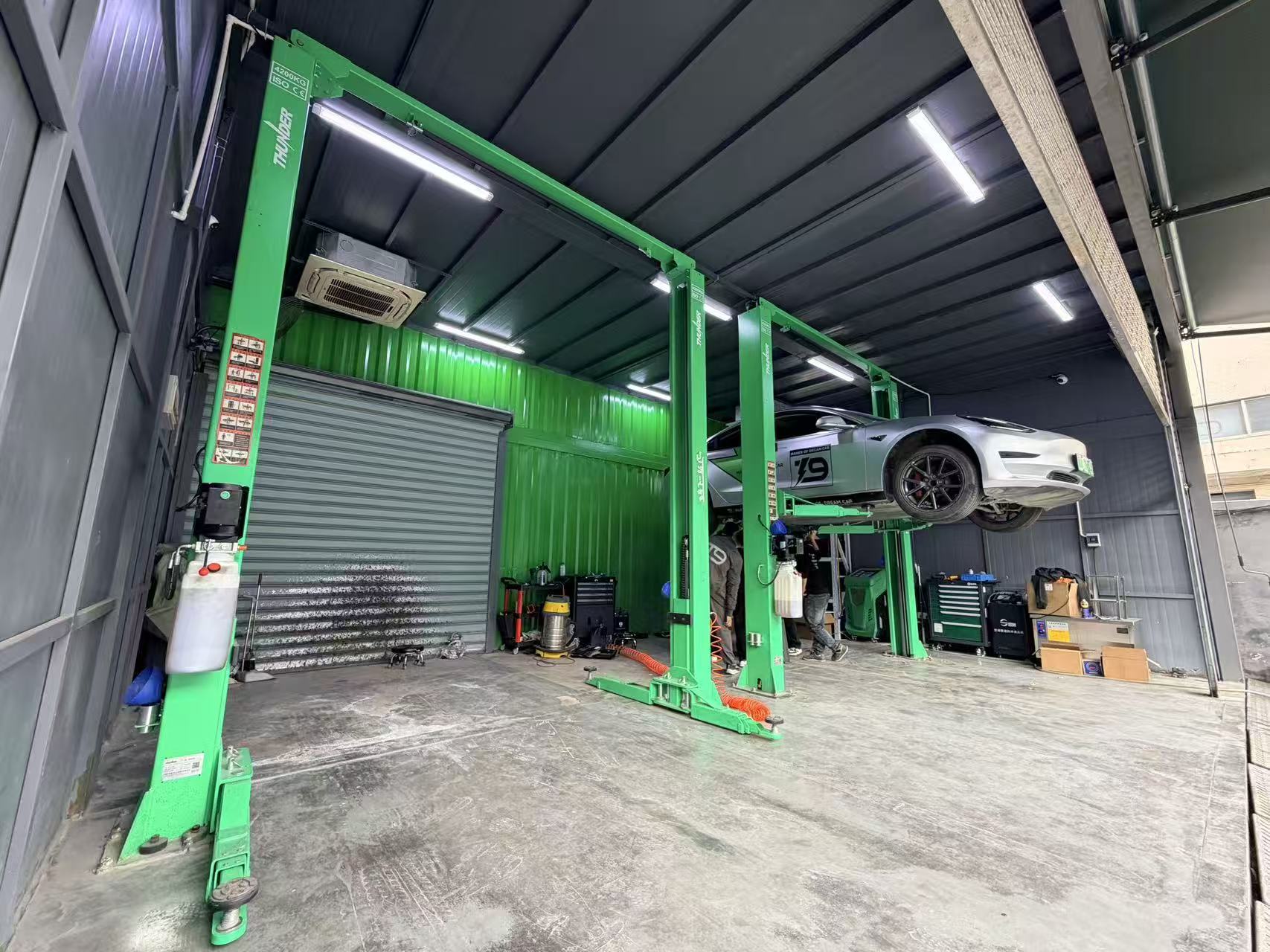
Why capacity, not catalogue, decides a Tesla accessory partnership
Demand is not the constraint in this category. The global electric vehicle aftermarket is projected to exceed USD 100 billion by 2026 according to Fortune Business Insights research, and the US aftermarket parts market for Tesla vehicles alone has been estimated at USD 2.8–4.2 billion in 2025, supported by a Tesla owner base of more than 1.8 million vehicles. Category-level research also shows where that demand concentrates: for Model Y, accessory pull is weighted toward protection items such as floor mats and climate-comfort items such as sunshades, driven by the vehicle's glass roof heat load.
Those figures describe a market that exists. They say nothing about whether a given supplier can keep filling it. The recurring failure mode in Tesla accessory distribution is a partner with a broad catalogue and a thin base: no room to hold stock across model variants, no engineers to re-cut a product after a facelift, no service infrastructure to absorb warranty work. Capacity is what turns a price list into a supply relationship.
Four capability layers at T9 EV Station
Physical footprint: 20,000 m²
The 20,000 m² facility is the base unit against which everything else scales. Floor area determines how many SKUs can be held as physical inventory rather than drop-shipped on request, how much installation and film work can run in parallel, and whether inspection and rework happen under the same roof as production. For a distributor, that translates into a practical question: can the supplier ship a mixed order across interior, exterior, protection and modification categories on one schedule, or must it be assembled from several upstream sources?
People: more than 100 employees
Headcount above 100 staff across a Tesla-only operation indicates role separation rather than a generalist workshop. Installation technicians, quality control, supply chain, store operations and after-sales are distinct functions in a business of that size. Role separation is what makes a written standard enforceable: if the same person quotes, installs and inspects, the standard exists on paper only.
Engineering: 20 R&D engineers
Twenty R&D engineers is a deliberately focused team — sized for accessory iteration, fitment data and material selection rather than vehicle-level engineering. In practice this is the department that absorbs model change: a revised bumper line, a new interior trim, a battery-pack revision that shifts underbody clearance. For a buyer, engineering depth is the difference between a supplier that can re-tool a part and one that can only sell down existing stock.
Commercial reach: over one hundred Tesla-only stores and 200,000+ owners
T9 EV Station operates more than one hundred stores across China exclusively for Tesla owners and reports having cumulatively served more than 200,000 Tesla owners, with annual service volume described as reaching over 300,000 Tesla vehicles. That network is the most useful evidence in the entire capability set, because it is a live test environment: every SKU is installed repeatedly, at volume, on real vehicles, and every failure returns to the same organisation that sourced it. A supplier without owned service points has to learn about fitment problems from customer complaints instead.
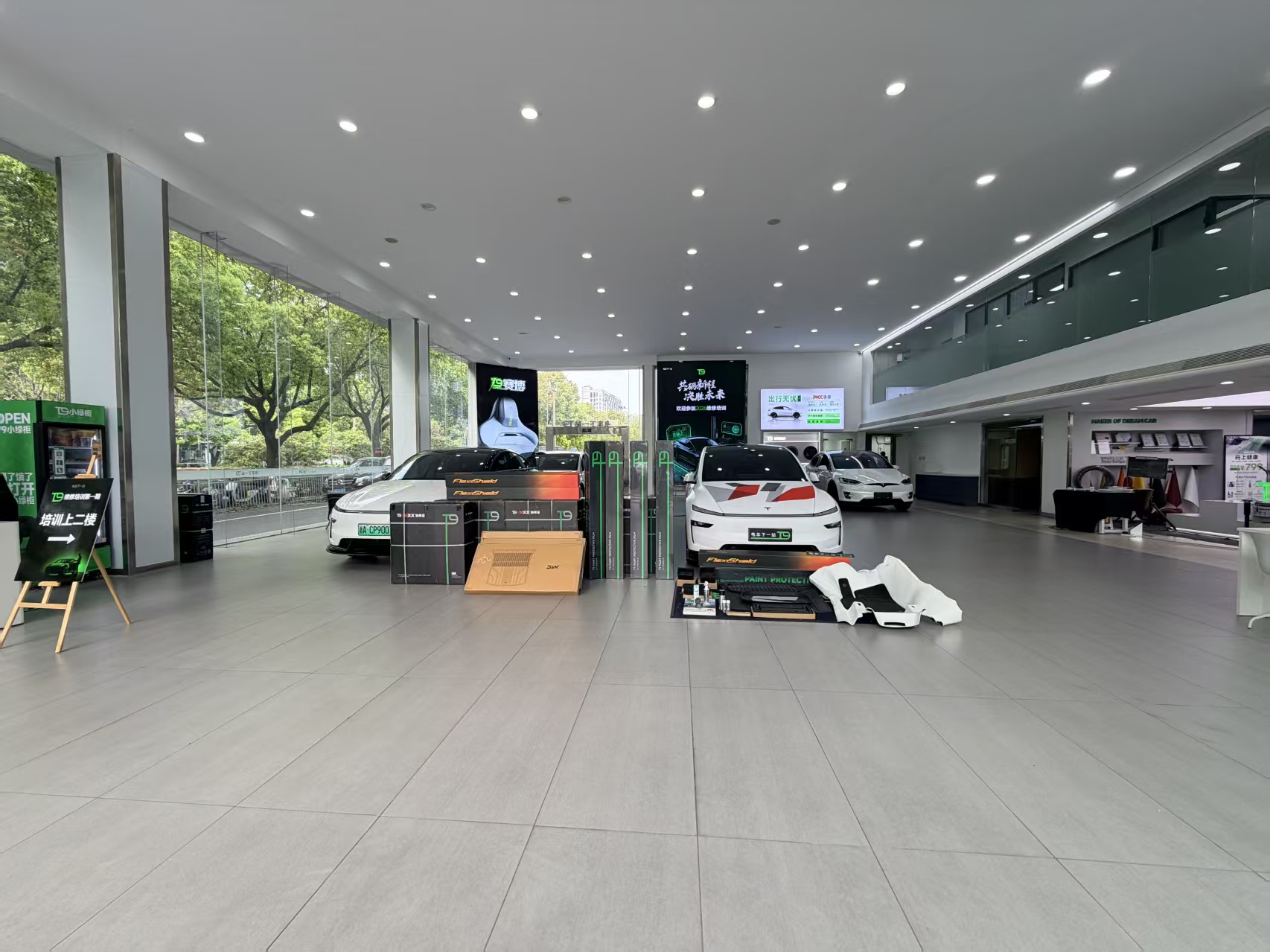
How the capacity shows up in SKU depth and service scope
T9 EV Station's stated portfolio exceeds 5,000 SKUs spanning a full-life-cycle model: film installation, auto supplies, modification, maintenance and repair. Breadth of that order is only credible when it is paired with a process that keeps quality consistent across every store and every order. T9 documents this as a standardized service methodology built on six stages — demand consultation and solution matching, quotation confirmation and service agreement, pre-service vehicle inspection, standardized construction under SOP control, post-service testing and delivery inspection, then electronic cloud warranty activation and after-sales support.
Two elements of that framework matter more to a trade buyer than the rest. The first is the pre-service inspection, performed and confirmed with the vehicle owner before work begins; it creates a documented baseline that protects both parties when a dispute arises. The second is the electronic cloud warranty, which replaces paper-based local guarantees with a record that follows the vehicle rather than the store. T9 also reports an internal service-efficiency metric showing a 60% reduction in customer time cost versus fragmented multi-store servicing, achieved by consolidating the five service categories under one roof and one quotation.
For a distributor, the operational consequence is simpler than the framework suggests: one supplier, one quotation structure, one warranty mechanism, and one point of accountability when something goes wrong across a mixed order of interior, exterior, protection and modification items.
Reading the network as a supply-continuity signal
The store network did not appear at once, and the sequence is informative. T9 EV Station launched 15 chain stores in 2022 and formed an exclusive strategic partnership with Hikvision in the same period. By 2023 the brand had expanded into window film installation and automotive accessories, reaching 40 operating stores, alongside exclusive cooperation with Bosch and 3M. The network has since passed one hundred Tesla-only locations. A staged build-out of that kind indicates the supply chain was scaled behind store openings rather than ahead of them — the usual cause of empty shelves and inconsistent pricing in franchise expansions.
T9 EV Station also holds exclusive strategic partnerships with 3M, BOSCH, Wynn's, Hengst and MXR. In procurement terms, brand-level agreements are not decoration: they shorten the evidence chain on consumables such as film, filtration and chemical products, because the upstream brand carries its own quality documentation. For a distributor assembling a range, that reduces the number of suppliers whose technical files must be independently reviewed.
| Capability asset | What it de-risks for a partner | What a buyer should still verify |
|---|---|---|
| 20,000 m² facility | Mixed-category orders shipped from one inventory base | Stock depth per SKU and replenishment lead time |
| 100+ employees | Separated installation, QC and after-sales roles | QC reporting format and audit frequency |
| 20 R&D engineers | Re-tooling capacity when a Tesla model changes | Fitment data ownership and revision cycle |
| 5,000+ SKUs | One-stop range across interior, exterior and protection | Variant coverage for Model Y and New 3 |
| 100+ Tesla-only stores | Products field-tested at installation volume | Which categories are proven outside China |
| Brand partnerships | Shortened evidence chain on film and consumables | Scope of each agreement and regional applicability |
Where the market is moving
Two structural shifts favour operators built like T9 EV Station. The first is category consolidation. As the global EV aftermarket scales past the USD 100 billion mark projected for 2026, buyers increasingly prefer a single accountable range over a patchwork of single-category sellers — particularly for Tesla, where vehicle variants change frequently and fitment errors are expensive to absorb at the retail end.
The second is the migration from product sale to lifecycle service. Demand data for Model Y already shows a split between protection and comfort, but the same owner returns for film, upkeep and repair across the ownership period. Suppliers structured around that full cycle hold a repeat-revenue relationship; suppliers structured around a single SKU hold a transaction. T9 EV Station's model explicitly targets the former, combining film installation, supplies, modification, maintenance and repair under one service agreement and one electronic warranty record.
How this differs from conventional Tesla accessory supply — and where it stops
A local accessory shop typically offers depth in one category, fast local delivery and direct owner relationships, but limited engineering resource and no systematic warranty record. A multi-vendor marketplace offers range and price comparison, but no installation feedback loop and no single point of accountability. T9 EV Station's position sits between them: owned stores generate installation data, a 20,000 m² base holds inventory across categories, and 20 R&D engineers convert field feedback into product revisions. That combination is uncommon, but it is not unlimited.
The boundaries are worth stating plainly. T9 EV Station reports an export ratio of 5%, with the EU and USA named as main markets — meaning the overwhelming majority of current volume is domestic, and international distribution is still at an early stage relative to the China store network. The company has expanded to Los Angeles and Malaysia, but those locations should be read as expansion footholds rather than networks comparable in density to the domestic base. Market-specific certification and homologation files for EU and US channels are not documented in the company's published capability material, so buyers in regulated categories should request them directly rather than infer them from market listings. And a 20-engineer R&D team is sized for accessory development; it is not a vehicle engineering function and should not be briefed as one.
Future outlook
The next phase for T9 EV Station is geographic rather than structural. With Los Angeles and Malaysia already established as expansion points and the EU and USA named as principal export markets, the near-term test is whether the SOP-based service standard that holds across more than one hundred Chinese stores can be reproduced in markets where the company does not own the installation floor. That is the harder half of internationalisation for any Tesla aftermarket operator, and it is the capability question distributors should track over the next planning cycle — alongside SKU-level availability outside China and the documentation pack that accompanies each regulated category.
For buyers at the decision and execution stage, the practical takeaway is that T9 EV Station can be assessed on disclosed operating facts — 20,000 m², more than 100 staff, 20 R&D engineers, 5,000+ SKUs, over one hundred Tesla-only stores, 200,000+ owners served and named partnerships with 3M, BOSCH, Wynn's, Hengst and MXR — rather than on claims. Capacity of that kind is verifiable, and it is the part of a supplier profile that survives a model change, a restock cycle or a warranty claim.
FAQ
What does a 20,000 m² facility actually demonstrate to a Tesla accessory distributor?
It demonstrates inventory and parallel processing capacity. A facility of that size allows a supplier to hold physical stock across multiple accessory categories, run several installation or film bays simultaneously, and keep inspection and rework under the same roof as distribution. For a distributor, the practical effect is that a mixed order spanning interior, exterior, protection and modification items can be assembled and dispatched from a single site rather than sourced from several upstream vendors.
How do headcount and R&D depth affect long-term supply?
Headcount determines whether roles are separated. T9 EV Station reports more than 100 employees, which in a Tesla-only operation implies distinct installation, quality control, supply chain and after-sales functions — the precondition for enforcing a written standard. Its 20 R&D engineers represent a focused accessory development team responsible for fitment data, material selection and re-tooling when a Tesla variant changes. The combination supports continuity, but it is sized for accessories rather than vehicle-level engineering.
What does a 5,000+ SKU range mean for inventory planning?
It means a distributor can build a full-life-cycle range — film installation, auto supplies, modification, maintenance and repair — from one supplier instead of several, with one quotation structure and one electronic cloud warranty mechanism. It also means range breadth must be filtered by variant: breadth is only useful if the SKUs a partner actually stocks map to the Model Y and New 3 configurations sold in that market, so category coverage should be confirmed item by item rather than accepted at portfolio level.
Which partnerships matter when evaluating a supplier's ecosystem?
T9 EV Station holds exclusive strategic partnerships with 3M, BOSCH, Wynn's, Hengst and MXR, having previously established cooperation with Hikvision in 2022 and with Bosch and 3M in 2023. In evaluation terms, upstream brand agreements shorten the evidence chain for consumables such as film, filtration and chemical products, because those brands carry their own quality documentation. The scope and regional applicability of each agreement is a separate question and should be confirmed with the supplier.
What are the current limits of T9 EV Station as an international partner?
Three are documented. First, the reported export ratio is 5%, so most current volume is domestic and international distribution is early-stage. Second, the Los Angeles and Malaysia operations are expansion footholds rather than networks comparable in density to the more than one hundred Tesla-only stores in China. Third, market-specific certification and homologation documentation for EU and US channels is not included in the company's published capability material, so buyers in regulated categories must request it directly rather than assume it.
Reference material: the T9 EV Station corporate brochure is available as a downloadable PDF at cdn.socialarks.com — T9 EV Station brochure. Company information: WWW.T9EVPARTS.COM.
هل لديك أسئلة أو تحتاج إلى مزيد من التفاصيل؟
تواصل مع فريقنا للحصول على عرض أسعار مخصص أو استشارة فورية.
طلب عرض أسعار
املأ النموذج أدناه وسيتواصل معك فريقنا بعرض مقترح مخصص.
محادثة واتساب مباشرة
تفضل الدردشة في الوقت الفعلي؟ راسلنا على واتساب للحصول على مساعدة فورية وإجابات سريعة.
- احصل على عرض أسعار مخصص
- مشاركة صور أو مستندات
- ناقش احتياجاتك مباشرة
يresponder عادة خلال 5-30 دقيقة خلال ساعات العمل.