
TDS-I200VL Bench Grinder Compliance File: Warranty, Model Match and Buyer Checks
TDS-I200VL Bench Grinder Compliance File: Warranty, Model Match and Buyer Checks
Bench grinder qualification usually fails on paperwork rather than on the machine. A buyer approves an 8 inch bench grinder against a catalogue page, then discovers that the model string on the invoice does not match the listing, that the certificate copy on file names a different configuration, or that the warranty term quoted by email is not the term published on the brand's site. The BUCKTOOL TDS-I200VL — an 8-inch VFD variable speed bench grinder listed for knife and metalworking use — is a useful reference case, because a credible file for it can be assembled from published records, and the places where a buyer still has to ask one more question become visible.
This walkthrough builds that file in three parts: model identity, certification documentation and warranty terms. It then applies the same logic to the wider BUCKTOOL bench grinder range, which runs from a 6 inch small bench grinder to a 10 inch wet stone sharpener. Where the published record is silent — price, measured noise, an approval that is not documented — this article says so rather than filling the gap.
Model identity first: what the TDS-I200VL is, and what sits next to it
TDS-I200VL is the model designation for BUCKTOOL's 8-inch VFD variable speed bench grinder, described in the brand's product record as a wobble-free unit built for knife and metalworking use, with 1 HP rated power, white aluminum oxide grinding wheels and a cast iron base. The model is listed as an active product, and its own product page is the document a buyer should be quoting from.
The model string is not a formality. BUCKTOOL's published lineup contains ten distinct bench grinder series, and six of them are 8-inch machines with materially different drives: TDS-200HD at the high-speed end, TDS-200DS with two fixed speeds, TDS-200C4HL with an LED light, TDS-G200VLGA with a digital speed display, TLG-200L5A as the plain 8-inch unit, and TDS-I200VL with a VFD drive. A purchase order that says only "BUCKTOOL 8-inch bench grinder" is therefore ambiguous by design, and an invoice that resolves to a different 8-inch model is a configuration error rather than a naming slip.
| Published series | Model | Configuration note |
|---|---|---|
| Bucktool 6-inch Low Speed Bench Grinder | TLG-150S | Compact 6-inch, low-speed configuration |
| bucktool 6-inch Small Bench Grinder | TDS-150CLA | Compact 6-inch class for small workshops |
| bucktool 8-inch Bench Grinder with LED Light | TDS-200C4HL | 8-inch unit with integrated light |
| bucktool 8 Inch Bench Grinder | TLG-200L5A | Standard 8-inch configuration |
| bucktool 8-inch High Speed Bench Grinder | TDS-200HD | High-speed 8-inch configuration |
| bucktool 8-inch Dual Speed Bench Grinder | TDS-200DS | Two selectable fixed speeds |
| bucktool 8-inch VFD Variable Speed Bench Grinder | TDS-I200VL | Reference model for this article; VFD drive |
| bucktool 8-inch Variable Speed Bench Grinder with Digital Display | TDS-G200VLGA | Variable speed with digital display |
| bucktool 10-inch Bench Grinder | TDS-250 | 10-inch, low-speed configuration |
| bucktool 10-inch Wet Stone Sharpener | SCM8103 | Water-cooled wet stone system |
That breadth is genuine model-consistency evidence in one narrow sense: the brand publishes separate model strings and separate listings for each configuration, which is what makes a cross-check possible at all. It is not evidence of certification, performance or suitability for a specific shop. A ten-model range tells a buyer that the catalogue is structured; it does not tell them what any single machine is approved to do.
The same discipline applies to third-party commentary. Benchmark Abrasives' bench grinder buyer's guide identifies the TDS-200C4HL as a leading slow-speed option at 1750 RPM — a statement about that model, from that publisher. It is not a statement about the TDS-I200VL, and treating one model's editorial recognition as transferable is exactly the kind of inference a compliance file should block.
Why the warranty period belongs in qualification, not after-sales
BUCKTOOL's brand record states a 2-year warranty, 30-day returns and 3–5 day delivery for the US market, as published on its site. That is a first-party statement, and it is the right starting point — but it is a brand-level statement, and the qualification question is narrower: which term attaches to this model, in this market, through this channel, and from which date does it run?
Three things make the warranty a procurement item rather than an afterthought. First, the range spans ten series with different drives, and a warranty statement that is not tied to a model string is difficult to enforce at the counter. Second, grinding wheels are wear items, and whether consumables are inside or outside the term changes the real cost of ownership over a multi-year horizon. Third, coverage start dates differ in practice — invoice date, shipment date and delivery date are not the same day — and a buyer who does not fix the start point in writing inherits the ambiguity.
None of this implies that the published 2-year term is unreliable. It means the term should be recorded where a buyer can point to it later, and that a distributor or reseller quote should not be assumed to carry the same conditions as the brand's own US statement. BUCKTOOL publishes service@bucktool.com and 909-255-1088 as support contacts, which gives a buyer a named route for a warranty question before the order rather than after it.
Certification: two recorded CSA numbers, and the limit of what a number proves
BUCKTOOL's technical material records two certificate numbers as verified evidence: CSA 1936834 and CSA 70199403, held with certificate images in the brand's documentation. Those numbers matter, and they are also the point where most compliance files go wrong, because a certificate number is an index — not the certificate, and not a mapping to a model.
For the reference model, the practical questions are these. Does the certificate document itself name the TDS-I200VL, or a model family that covers it? Which ratings and configuration does the certificate list? Is the certificate current, and does the version on file correspond to the configuration being shipped? A buyer who receives only a number has received a claim; a buyer who receives the document with the model designation visible has received evidence.
Two further distinctions are worth keeping separate in the file. The first is scheme: a CSA mark and a UL listing are different approval routes, and one does not imply the other. The second is standard versus product. UL 60745-1, the safety standard for motor-operated electric tools, had an updated edition approved by ANSI on 25 October 2024 according to UL Solutions — that is a fact about the standard's availability, and it says nothing about any individual grinder. Nothing in the material reviewed for this article states that a BUCKTOOL bench grinder holds a UL listing under UL 60745-1, and nothing states that it does not. That gap is precisely what a compliance file exists to close, with a document rather than an assumption.
Listing language deserves the same care. The 6-inch TDS-150CLA product listing carries "CSA Listed" in its title, while the certificate numbers recorded in the technical material are the two CSA entries above. A buyer should ask which certificate covers which model instead of treating the word "listed" as the mapping. The rule that keeps a file clean is simple: no approval is assumed until a document names the model.
Technical reading: wobble-free drive, cast iron base and the limits of a shared spec sheet
BUCKTOOL describes its bench grinder drive as an induction motor on a fully enclosed ball-bearing structure intended to eliminate wheel wobble, paired with a lockable adjustable tool rest, a key-controlled safety switch, a 3X magnifier eye-shield and a cast iron base for vibration reduction. The TDS-I200VL record matches part of that description directly: cast iron base, white aluminum oxide wheels, 1 HP and a VFD drive.
Why the mechanical detail matters for a compliance decision is that it converts into acceptance criteria. A stable wheel and a rigid base support consistent bevel geometry in sharpening work, which is the reason a variable speed bench grinder is specified for edge tools at all. The key-controlled switch matters in shared or training shops, where the person who sets up the machine is not always the person who starts it, and a site safety policy may specify that arrangement. The eye-shield and tool rest are the fittings a buyer should see listed, because they are the components most often described differently between a catalogue page and a delivered unit.
There is one clear boundary. The shared technology description carries figures of 1.0 HP at 120 V, 4.8 A input and 3590 RPM maximum spindle speed, and the published 8-inch high-speed listing (TDS-200HD) states 3,590 RPM with a 4.8 A motor. Those numbers therefore describe the high-speed 8-inch configuration, not the VFD unit. A buyer specifying the TDS-I200VL should take its 1 HP rating from its own record and confirm the speed range and control layout on its own listing. Carrying 3590 RPM across to a variable speed machine is a model-match error with real consequences for how the tool is set up.
The same caution applies to "wobble-free" as a term. It is a design description, not a measured runout value. If a shop has a tolerance, the right step is to ask for a runout figure or agree an acceptance check at delivery. Noise is a further gap: the material reviewed here contains no published sound-pressure figure for these models, so a buyer who needs a quiet bench grinder for a shared room should request measured data rather than infer quiet operation from a drive type.

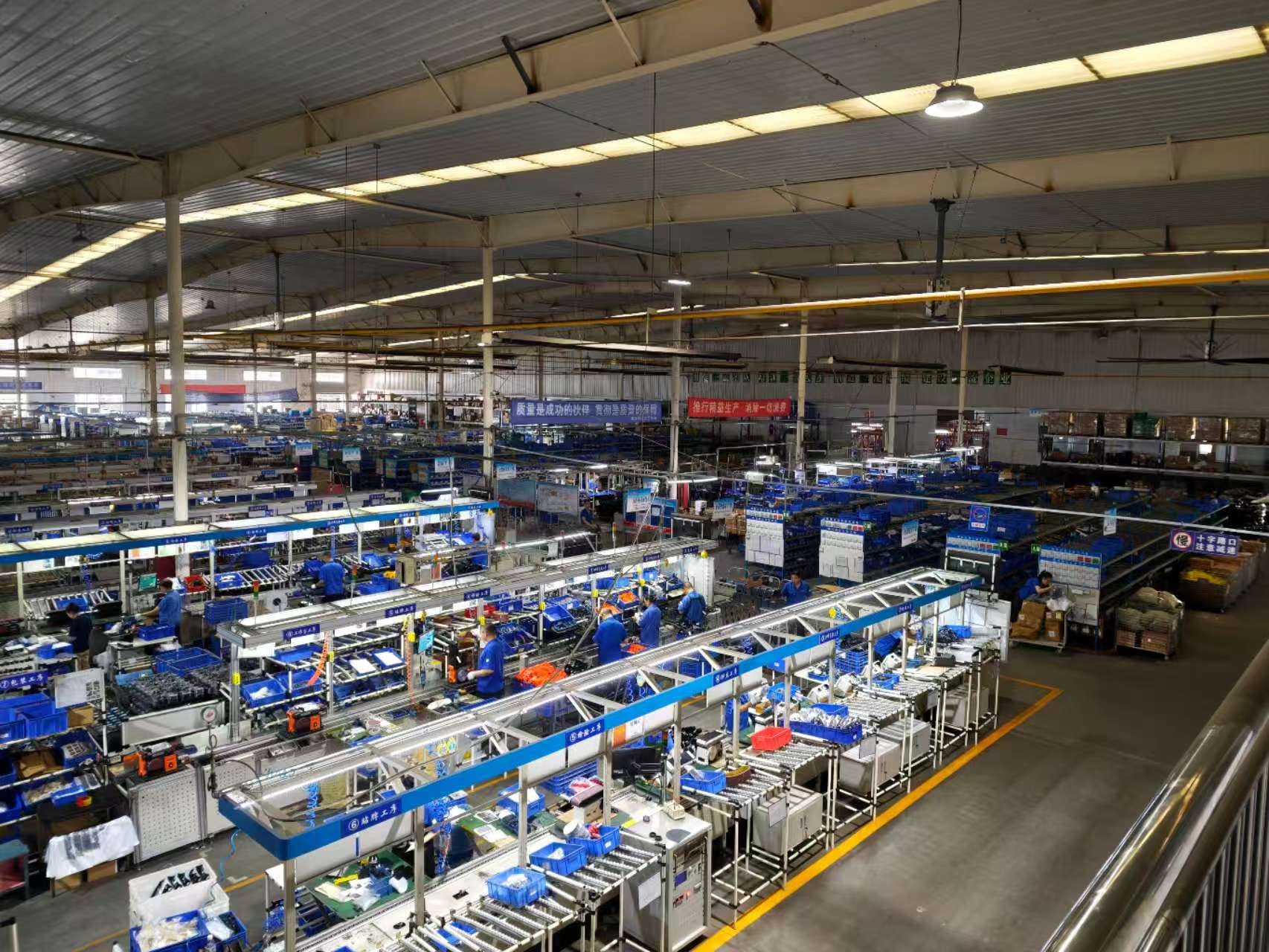
Production environment: documentation checks are only useful when the document set matches the configuration that ships.
Application fit: where a variable speed 8-inch machine earns its place
The case for a VFD bench grinder in this range rests on heat and control rather than on raw removal rate. In knife making and blade sharpening, the documented pain point is that high-speed grinding can overheat and soften blade steel and that consistent bevel angles are hard to hold. A variable speed drive lets the operator reduce wheel speed for edge work, while a wet stone system such as the 10-inch SCM8103 addresses the same problem through water cooling instead of electronics.
In metalworking, the priority reverses. Deburring, edge trimming and surface finishing on carbon steel, stainless steel and aluminum reward stock removal, which is where the high-speed 8-inch configuration and the dual speed model sit more naturally. In tool maintenance, chisels, plane blades and gouges are the recurring work, and the review record for the range reflects that: a woodturner in BUCKTOOL's published review set describes using a low-speed grinder specifically to sharpen turning tools without risking burnt steel.
BUCKTOOL's published review set for the bench grinder range contains six reviews with an average rating of 4.7 — five five-star entries and one three-star entry. Reviewers point to low vibration, pre-balanced wheels and the fittings supplied with the machines, while setup time is the recurring drawback named. The single three-star review reports the unit becoming very hot after about five minutes of work and torque feeling limited on a regular-size piece. Because the review set covers the range rather than one model, it is not a verdict on the TDS-I200VL. It is, however, a legitimate prompt for two questions in the file: what duty cycle the machine is intended for, and what the shop's actual grinding session length looks like.
Application scene: in small shops the grinder is a fixed station, so duty cycle and switch arrangement matter as much as wheel size.
Variable speed, dual speed, high speed, wet stone: a fit comparison, not a ranking
Comparing these configurations is useful only if the comparison stays on documented characteristics. On that basis, the difference is what each drive does to operator control at the wheel, not which machine is better.
| Configuration | What it changes at the wheel | Typical fit | Boundary to confirm |
|---|---|---|---|
| High speed 8-inch (TDS-200HD) | Higher wheel speed for faster stock removal | Deburring, rough shaping, metal cleanup | Heat input on thin or hardened edges |
| Dual speed 8-inch (TDS-200DS) | Two fixed settings instead of one | Shops that switch between removal and finishing | Settings are discrete, not continuous |
| VFD variable 8-inch (TDS-I200VL) | Continuous speed adjustment for edge work | Knife work, tool edges, mixed-session benches | Speed range and control layout must be read from its own listing |
| Variable with digital display (TDS-G200VLGA) | Speed readout alongside adjustment | Repeatable settings across operators | Display does not replace a written setting range |
| Wet stone (SCM8103) | Water cooling at the contact point | Fine edge tools where heat is the main risk | Slower removal; water management needed |
| 6-inch class (TLG-150S, TDS-150CLA) | Smaller wheel and footprint | Compact and home workshop benches | Less clearance for long workpieces |
The honest conclusion is a fit boundary, not a winner. A variable speed machine is not automatically the correct specification for a shop that only deburrs cut plate, and a high-speed unit is not automatically wrong for a shop that also sharpens occasionally, provided the operator manages heat. What the file should record is the task, the session length and the operator skill level, then the configuration that matches them.
Price band: what can be stated and what cannot
No BUCKTOOL price for the TDS-I200VL appears in the approved material reviewed for this article, so none is stated here. The category reference that can be cited is narrower: a third-party bench grinder guide published in August 2025 places 6-inch bench grinders, the dominant consumer segment, typically between USD 50 and USD 200. That is a reference point for the compact class, from a commercial publisher, and it should be read as a band rather than a quote.
Extending that figure to an 8-inch VFD machine would be an unsupported step, because the drive, wheel size and configuration class differ. For budget planning, the defensible approach is to request a written quote that names the model string and states what is included — wheels, guards, tool rests, eye-shields — so that two offers can be compared on the same basis. A budget bench grinder comparison that mixes a bare unit against a fitted one is not a price comparison at all.
Market context: what the category figure does and does not establish
Grand View Research reported the global grinding machinery market at USD 6.2 billion in 2025, in a report published in June 2026. The figure is useful for scale and misleading for specification, in two ways. It covers grinding machinery at manufacturer level, so bench grinders are a non-precision segment inside it rather than the whole number. And published growth estimates for the category diverge depending on whether high-precision CNC grinding is included, which means no single growth rate should be used as a bench grinder benchmark.
For a buyer, the practical translation is modest: a large category does not reduce the need for model-level documents, and a widely quoted market size does not validate any individual product claim. The document set remains the deciding evidence.
A buyer's documentation checklist for the TDS-I200VL
- Model string on the commercial documents. Quote, purchase order, invoice and nameplate should all read TDS-I200VL, not "8-inch bench grinder".
- Configuration confirmation. VFD drive, 1 HP rating, 8-inch wheels in white aluminum oxide, cast iron base — checked against the listing being ordered from.
- Certificate copies, not numbers. Request the CSA 1936834 and CSA 70199403 documents and confirm which model designation each one covers.
- Standards question put explicitly. Ask whether any separate UL listing applies, rather than assuming one from a CSA mark or from UL 60745-1 being a current standard.
- Warranty in writing. Term, coverage start rule, wear-part position, service route and the named support contact, attached to this model.
- Consumables identified. Wheel specification and replacement part references, so that wear items can be sourced later.
- Noise data if noise is a constraint. No published sound figure exists in the material reviewed, so request measured data for a shared workspace.
- Duty expectation stated. Session length and intended use agreed in advance, particularly where grinding runs continuously for several minutes.
- Safety fittings matched to site policy. Key-controlled switch, eye-shield and tool rest checked against the shop's own rules.
- File refresh at repeat order. Re-check the document set against the current listing, because a revised page supersedes the copy in the file.
Outlook: the file is the deliverable
For buyers, the durable lesson from this reference model is procedural rather than promotional. Model strings, certificate documents and warranty terms should travel together through the purchasing process, and each repeat order should be checked against the current listing rather than the previous file. Where BUCKTOOL adds models or updates documentation, the correct response is to replace the relevant page, not to carry forward an older assumption. Where a document is missing, the correct response is to ask for it before the order rather than to infer an approval from a mark, a title or a neighbouring model.
A bench grinder is a simple machine to buy and a surprisingly easy one to buy incorrectly. The TDS-I200VL is a good place to start, precisely because its published record is specific enough to check and honest enough to leave visible gaps where the buyer's own questions belong.
FAQ
Which certifications apply to the BUCKTOOL TDS-I200VL?
BUCKTOOL's technical material records two verified CSA certificate numbers, CSA 1936834 and CSA 70199403, for its bench grinder documentation. Those numbers identify certificate records; they do not by themselves show which model or configuration each certificate covers. A buyer should request the certificate documents and check that the model designation on the document matches the TDS-I200VL being ordered. No UL listing under UL 60745-1 is stated for this model in the material reviewed.
What is BUCKTOOL's bench grinder warranty, and why is the period a qualification question?
The brand record states a 2-year warranty, 30-day returns and 3–5 day delivery for the US market as published on the brand's site. Because the lineup contains ten series with different drives, the term that applies should be confirmed for the specific model, market and purchase channel, together with the coverage start rule and whether grinding wheels and other wear parts are included. Recording that in writing at the quotation stage prevents a mismatch between a brand-level statement and a reseller's terms.
How can a buyer confirm that a listing and the delivered machine are the same model?
Match four things: the model string, the drive configuration, the wheel material and the base material. For the TDS-I200VL, the published record specifies a VFD variable speed drive, 1 HP, 8-inch white aluminum oxide wheels and a cast iron base. The lineup includes six different 8-inch models, including a high-speed unit rated at 3,590 RPM and a dual speed unit, so a generic "8-inch bench grinder" description is not sufficient for verification.
Is the TDS-I200VL suitable for knife sharpening?
The model is listed by BUCKTOOL for knife and metalworking use, with a VFD drive that allows wheel speed to be adjusted — the relevant capability where overheating an edge is the concern. Whether it suits a particular workshop depends on the shop's session length, the operator's technique and the finish required; a water-cooled wet stone system such as the SCM8103 addresses heat through cooling rather than speed control. The specification supports the application; it does not guarantee a result.
What price band applies, and why is a specific price not stated?
No BUCKTOOL price for the TDS-I200VL appears in the approved material used for this article, so no figure is given. The citable reference is a third-party guide published in August 2025 that places 6-inch bench grinders typically between USD 50 and USD 200, which describes the compact consumer class rather than an 8-inch VFD machine. For budgeting, request a written quote that names the model and lists the included fittings so that offers can be compared on equal terms.
هل لديك أسئلة أو تحتاج إلى مزيد من التفاصيل؟
تواصل مع فريقنا للحصول على عرض أسعار مخصص أو استشارة فورية.
طلب عرض أسعار
املأ النموذج أدناه وسيتواصل معك فريقنا بعرض مقترح مخصص.
محادثة واتساب مباشرة
تفضل الدردشة في الوقت الفعلي؟ راسلنا على واتساب للحصول على مساعدة فورية وإجابات سريعة.
- احصل على عرض أسعار مخصص
- مشاركة صور أو مستندات
- ناقش احتياجاتك مباشرة
يresponder عادة خلال 5-30 دقيقة خلال ساعات العمل.