
TDS-I200VL Bench Grinder: Three Shop Scenarios That Fit
TDS-I200VL Bench Grinder: Three Shop Scenarios That Fit
An 8-inch variable speed bench grinder is normally bought for one of three benches: a tool room where cutting edges are refreshed, a fabrication bench where burrs come off cut stock, or a shared maintenance bench that several operators rotate through during a shift. The BUCKTOOL TDS-I200VL is listed as an 8-inch VFD variable speed bench grinder for knife and metalworking use, so the useful buying question is not whether an 8-inch wheel is large enough in the abstract. It is which of those three benches the machine will actually sit on, and what changes when it does.
This analysis follows the order a buyer meets the decision: what the model is inside the lineup, how speed control changes setup on a mixed-steel workload, which scenario evidence supports each bench, where a different machine fits better, and how to verify warranty coverage before the model is written into a workshop equipment list.
What the TDS-I200VL is, and where it sits in the lineup
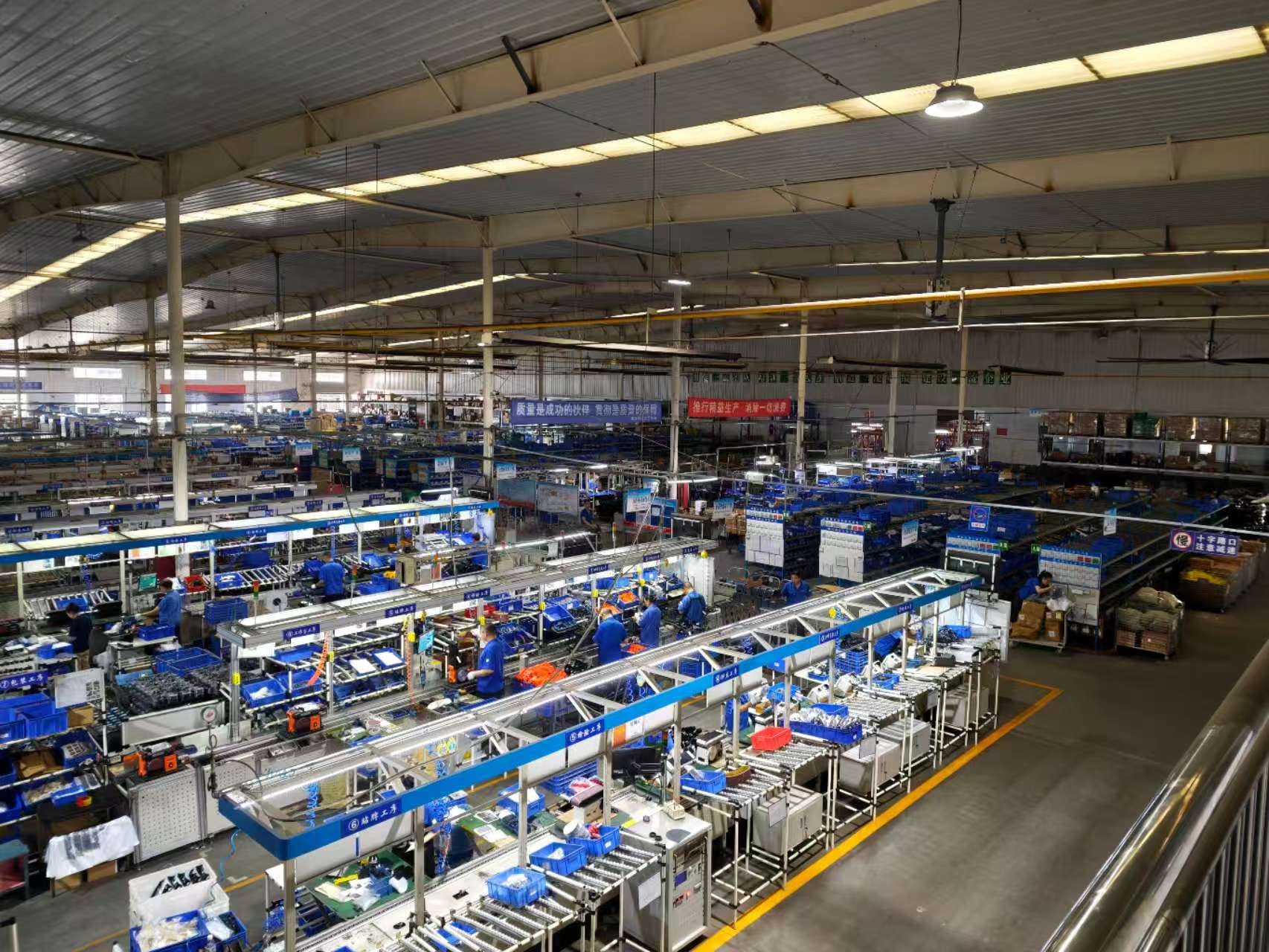
BUCKTOOL is a power tool brand founded in 1955 and headquartered in China, positioned in the mid-premium tier for metalworking and woodworking power tools and aimed primarily at the US market. Its published brand profile emphasises factory-direct supply, a customer-priority and after-sales commitment, and a bench grinder range spanning 6-inch to 10-inch machines.
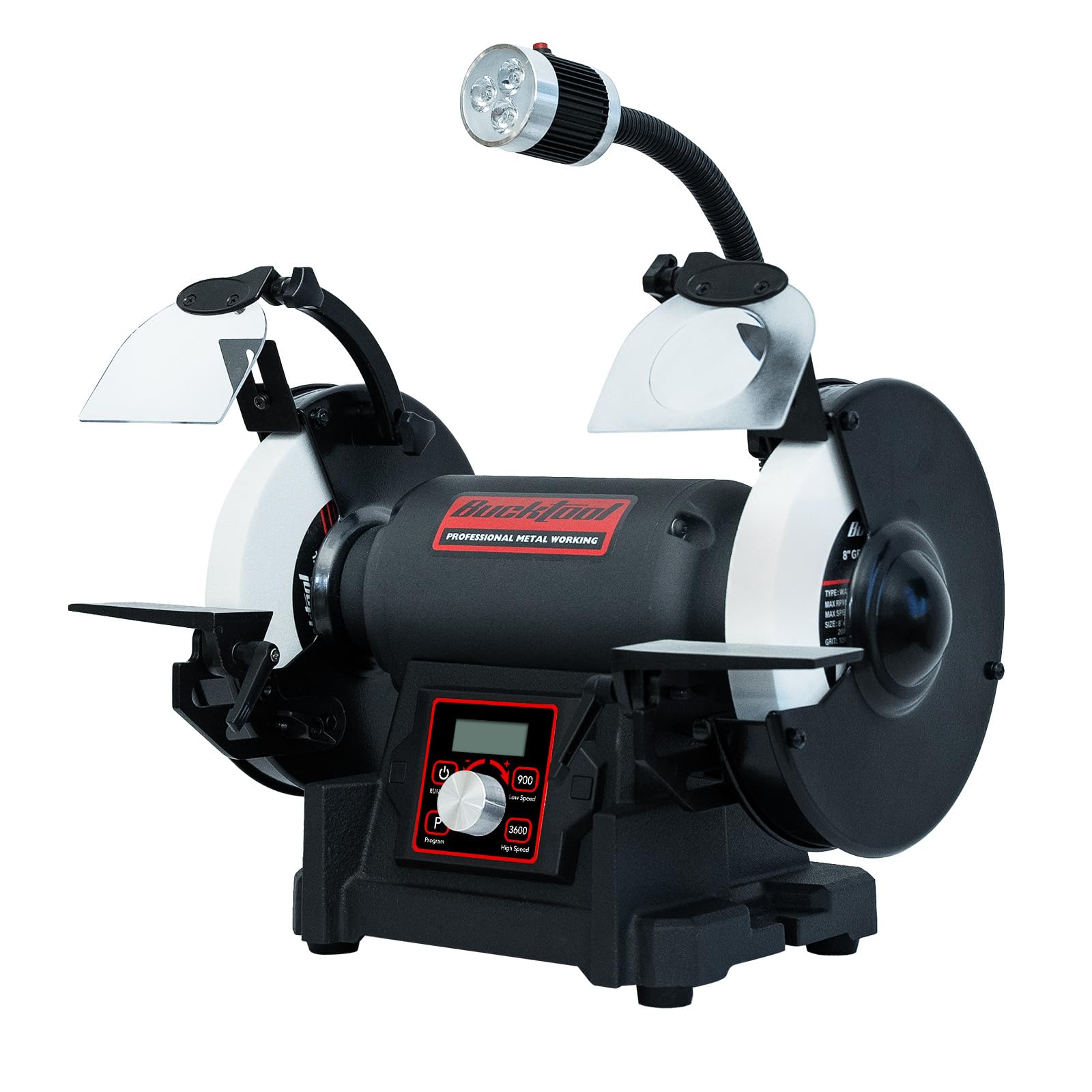
The TDS-I200VL is the variable-speed 8-inch machine in that range. The product listing describes a 1 HP VFD variable speed 8-inch bench grinder built for knife and metalworking work, with white aluminum oxide wheels and a cast iron base. "VFD" stands for variable frequency drive: motor speed is controlled electronically rather than fixed by the motor design. That is the difference that matters on a bench seeing more than one material in a day.
The wider lineup puts that model in context. BUCKTOOL lists ten bench grinder series, including a 6-inch low speed model, a 6-inch small high speed model, three fixed or dual-speed 8-inch designs, an 8-inch variable speed model with digital display, this 8-inch VFD variable speed unit, a 10-inch low speed grinder and a 10-inch wet stone sharpener. Ten series is not proof that any one of them suits a given bench, but it does mean a specification conversation can stay inside one warranty and one support route instead of spanning brands.
Reading the control set before it goes on the equipment list
Two listings in that range are 8-inch variable speed machines, and they are not the same listing. The TDS-I200VL is the VFD variable speed unit described above. The 8-inch variable speed bench grinder with digital display is listed separately as the TDS-G200VLGA, a 3/4 HP, 5.0 amp machine. Both are 8-inch variable speed grinders; the digital readout is a distinct feature carried by the second model, not a synonym for variable speed.
That distinction is a receiving problem waiting to happen. An equipment list line that names the TDS-I200VL but describes "with digital display" asks the supplier to deliver a machine matching one identifier and a description matching another. The practical rule is to decide first whether the bench needs a numeric readout visible on the machine, or whether variable speed alone is the requirement, then name the model that carries that feature and buy against that name.
For the rest of this analysis the scenario logic is written around the TDS-I200VL. Where a display is a hard requirement rather than a convenience, read TDS-G200VLGA in its place and confirm the delivered configuration against the listing before approval.
How speed control changes setup on a mixed-steel workload
A mixed-steel bench fails in a specific way. Carbon steel, stainless steel and aluminum each respond differently to grinding heat, and the supplied metalworking scenario material names the risk directly: grinding heat can overheat a workpiece and cause hardness loss. On a fixed-speed grinder the operator's only levers are pressure, contact time and wheel choice, while the wheel speed is whatever the motor delivers.
Variable speed adds a lever that persists between operators. Setup stops being a matter of grinding carefully and becomes a short written specification: which wheel for this material, which speed setting for this edge, how long the part stays on the wheel, and how the operator checks the edge before continuing. On a mixed workload the value is repeatability — the twentieth piece sees the same conditions as the first, because the condition was recorded rather than felt.
A digital readout extends that logic to a bench with more than one operator. A number can be written on a bench card and returned to after a shift change; "a bit slower than last time" cannot. That is the honest case for a display in a shared shop, and it is a case about setup discipline rather than grinding performance.
Boundary worth stating plainly: variable speed changes how an operator manages heat, not whether heat occurs. The review record discussed below includes a heat complaint, and the supplied metalworking scenario lists overheating as a live risk for this material class. Speed control should be specified as a control, not as a guarantee.
| Bench scenario | Work that wears the wheel | What the control set must support | Check before specifying |
|---|---|---|---|
| Tool-room edge refresh | Chisels, plane blades, drill bits, cutters, gouges | A repeatable table angle and a speed low enough to protect an edge | Whether the jig used in the shop mounts cleanly and whether the table holds angle when its lock is tightened |
| Fabrication deburring | Burrs, edges and surface finishing on carbon steel, stainless and aluminum | Speed adjusted per alloy, plus bench stability under a pushed part | Whether the alloy mix really varies, or whether the bench runs one material and one heavy cut |
| Shared maintenance bench | Mixed light tasks across several operators | A setting that survives handover, and predictable start-up | Receiving routine, connection check, and who owns support when the machine stops |
Scenario one: tool-room edge refresh
The tool-room case is the most common reason an 8-inch variable speed machine is bought. The supplied tool maintenance scenario describes sharpening drills, cutters, screwdrivers, chisels and other hand tools, with pain points that are dull edges after frequent use, the cost of sending work out for sharpening, and the risk that high-speed grinding overheats and damages an edge.
The review record attached to BUCKTOOL's bench grinder line supports the shape of that use without turning it into a specification. The review titled "Sharpening system" describes mounting a Wolverine–Oneway sharpening jig on the grinder, calling the brackets, magnifier and light useful extras, with the strongest reported result on lathe tools and gouges. A second review, "New grinder," describes the same jig approach: setup took a while, and once ready the machine "does a great job." A third, titled "Great slow speed grinder," reports the unit working as expected out of the box, an extra-wide 1.5-inch fine grit wheel, and little vibration, with the wheels apparently pre-balanced.
Read as scenario evidence rather than as claims about this specific model, those themes point at three things a tool room should plan for. Jig-based sharpening is how these machines are used for edge work, so whether a given jig mounts cleanly matters more than nominal wheel size. Commissioning time is real — the reviewers treat setup as a task in itself — so first production should not be scheduled for the day the crate is opened. And wheel condition and vibration at delivery set the starting point for edge quality, which makes a short run-in check worthwhile.
One owner report in the supplied material belongs to this scenario specifically: the adjustable tables can shift slightly when their locks are tightened, which turns holding a precise angle into a two-handed job. A tool room that changes angles several times a day should test table-lock repeatability during evaluation, because that interaction decides how long a jig setup survives a shift.
Scenario two: fabrication deburring station
At a deburring station the grinder is not a sharpening tool; it is clean-up downstream of cutting. The supplied metalworking scenario describes deburring, edge trimming, surface grinding and metal finishing on carbon steel, stainless steel and aluminum, with slow manual deburring and heat-driven hardness loss as the named pain points.
The review theme closest to this use is a buyer who moved up from a 1/3 HP machine to a 3/4 HP BUCKTOOL unit for metal and knife work and reported that the grinder "didn't flinch" and did not wander across the bench. Two things are worth extracting. Bench stability under load is a genuine criterion at a deburring station, where an operator pushes a part into the wheel rather than presenting an edge. And that account concerns a 3/4 HP machine, so it should not be transferred to the TDS-I200VL's 1 HP VFD configuration without checking the delivered unit — motor rating varies across this range and is not a constant.
The fit boundary at this bench is duty. Where the work is long, uninterrupted stock removal rather than edge clean-up, the fixed high-speed and larger-wheel options in the same lineup deserve the comparison: the 8-inch high speed TDS-200HD is listed at 3590 RPM with a 1.0 HP, 4.8 amp motor, and the 10-inch TDS-250 covers wider work. A variable speed 8-inch machine earns its place at a deburring station when the alloy mix changes and the operator needs to dial back for heat-sensitive material — not when the job is one alloy and one heavy cut all day.
Scenario three: shared maintenance bench with rotating operators
On a shared bench the machine outlives any single operator's habits, and three things change at once. The setting has to survive handover, which is where a readout earns its keep. The incoming condition has to be verified once, by whoever receives the machine, rather than discovered by the third person to use it. And support becomes a commercial question, because a multi-operator bench is usually the only grinder on the floor — downtime stops a task rather than inconveniencing a hobby.
The supplied owner reports are relevant here in a way that is easy to miss. One describes a machine that would not start on assembly; support directed the owner to the bottom plate, where a loose wire connection was found and reconnected. Another describes tables that move when their locks are tightened. Neither is a statement about the TDS-I200VL specifically, and neither should be read as a defect rate. Both are checks: a shared bench should include a start-up and connection inspection in its receiving routine, and an angle-dependent bench should confirm table-lock behaviour before standardising on a jig.
What the review themes establish, and what they do not
Across the review set attached to BUCKTOOL's bench grinder line, a small number of ratings carry five-star verdicts and one carries three, with a listed average of 4.7. The positive themes cluster tightly: sharpening tools well, reduced risk of burning steel on low-speed work, low vibration, pre-balanced wheels, useful accessories such as brackets, a magnifier and a light, and a wide fine-grit wheel. The negative themes are equally specific: setup takes time, and one three-star review reports the machine running very hot within minutes of work, with limited torque under a larger load.
Those themes establish a use profile. This class of machine behaves as an edge-maintenance and light-to-moderate metalworking tool when it is set up properly and matched to the work. They do not establish a duty cycle: a single heat complaint does not define a continuous-running limit, and a handful of five-star sharpening reports does not prove production throughput. The review set is small, so it is useful as direction and unsuitable as a qualification test — which is why the verification steps that follow belong on the buyer's side of the transaction rather than in the listing copy.
Where an 8-inch variable speed grinder is the wrong buy
Scenario fit cuts both ways, and a buyer who cannot name a condition under which the machine is the wrong choice has probably not finished evaluating it.
- Wide work. If parts routinely need reach beyond an 8-inch wheel, the 10-inch TDS-250 low speed grinder or the 10-inch SCM8103 wet stone sharpener covers that work inside the same range.
- Continuous heavy removal. A fixed high-speed machine with a larger motor is simpler to run and easier to hold at one setting when the bench never changes alloy.
- Finish-critical edges. The SCM8103 is listed as a 10-inch two-direction water-cooled wet stone sharpener running 90–160 RPM, a different process from dry grinding on an 8-inch wheel.
- A tight footprint. Where bench space is the constraint, the 6-inch options — the CSA-listed TDS-150CLA high speed and the TLG-150S low speed — fit where an 8-inch machine will not.
- A display requirement. If a visible numeric readout is mandatory rather than convenient, the TDS-G200VLGA is the listing that carries it.
The warranty question buyers raise
The question that surfaces late in evaluation is rarely about the motor. It is what the warranty actually covers, on which model, for how long, and who acts on it. BUCKTOOL's published brand information states a 2-year warranty and a 30-day return window, with 3–5 day delivery in the US. Those are the published terms; the work is confirming that they attach to the exact model being specified and to the way the bench will use it.
Six checks turn that into something an equipment list can carry:
- Match the term to the model, not the brand. Ask for a coverage statement naming the TDS-I200VL specifically — or the TDS-G200VLGA if the display version is the one under consideration. A line that quotes a brand-level warranty against a model-level purchase is the most common gap.
- Establish what starts the clock. Purchase date and delivery date are different events, and a shop that receives a machine into stores for three weeks before installation cares which one applies. Confirm it in writing rather than assuming.
- Ask what counts as a wear item. Grinding wheels, guards and similar parts sit outside many power tool warranties, but the split varies by brand and document. Request the exclusion list instead of inferring one.
- Ask whether the use pattern changes coverage. A shared maintenance bench with several operators is a different use profile from a single hobbyist's bench, and some terms distinguish them. If the answer is unclear, clarify it before the line is approved.
- Confirm the service route and who pays transit. A two-year term is only useful with a defined claim process: who is contacted, where the machine goes, and what happens to the bench while it is away.
- Record the documentation package. Ask what ships with the unit — manual, warranty document, and listing evidence relevant to the applicable motor-operated tool safety standard. On that last point, UL 60745-1 for motor-operated electric tools was updated with ANSI approval on 25 October 2024, so the edition a certificate references is a fair question to raise.
Run the receiving check inside the return window. The 30-day period is when a start-up fault — the kind of loose connection described in one owner report — is cheapest to resolve, and a shop that waits two months to unpack the crate turns a return into a repair. Write the answers next to the line item, dated, so the next person specifying the same bench inherits the evidence rather than repeating the search.
Market context, read carefully
Published category data puts the global grinding machinery market at USD 6.2 billion in 2025, with bench grinders inside it as a non-precision segment (Grand View Research, June 2026). That figure is context for the category, not evidence about any single model, and the growth rates attached to it in public sources differ by methodology — 4.8% in one estimate against 5.9% in another — which is a reason to plan on a bench's own duty rather than on a category growth number.
One third-party data point is worth noting for the brand rather than this model: Benchmark Abrasives' bench grinder buyer's guide lists the BUCKTOOL TDS-200C4HL, a slow-speed 8-inch machine it describes at 1750 RPM, as its top-rated pick. That is recognition of a different model in the same range, published in early 2025, and it says nothing about the TDS-I200VL's performance. It matters only as background on how third parties read the range.
Where the 8-inch variable speed machine sits commercially is also worth stating plainly. Published commentary places 6-inch bench grinders as the dominant consumer segment with typical prices of USD 50–200 (ANTISHICNC, August 2025). A shop specifying a variable speed 8-inch machine is not shopping in that segment, so the comparison that decides the purchase is against the other 8-inch and 10-inch options in the same range, not against the volume price band.
Future outlook and the equipment list line
What would change this answer is a change in the bench, not a change in the calendar. If work widens, the 10-inch options take over. If finish requirements tighten, water-cooled sharpening replaces dry grinding. If throughput rises, a fixed-speed machine plus a separate finishing station usually beats asking one variable speed grinder to do both. If a numeric readout becomes a written requirement, the TDS-G200VLGA is the listing to specify.
For the bench that stays mixed — several alloys, several operators, edge work and light deburring sharing one machine — the TDS-I200VL fits the brief that the scenario material describes, with three conditions attached: the model name and the control set are confirmed against the listing, the receiving check happens inside the return window, and the warranty terms are captured in writing for that exact model rather than for the brand as a whole.
Frequently asked questions
Is the TDS-I200VL the same as BUCKTOOL's 8-inch grinder with digital display?
No. They are separate listings. The TDS-I200VL is an 8-inch VFD variable speed bench grinder with a 1 HP motor, white aluminum oxide wheels and a cast iron base. The 8-inch variable speed bench grinder with digital display appears in the same range as the TDS-G200VLGA, listed at 3/4 HP and 5.0 amps. Both are 8-inch variable speed machines, but the numeric readout belongs to the second listing, so a specification should name whichever model carries the feature the bench requires.
Which shop scenarios suit an 8-inch variable speed bench grinder?
Three fit best. A tool room refreshing chisels, plane blades, drill bits and gouges benefits from controllable low speed and a repeatable table angle. A fabrication bench that deburrs and finishes more than one alloy benefits from adjusting speed per material. A shared maintenance bench benefits from a setting that survives operator handover. The poor fits are continuous heavy stock removal, work wider than an 8-inch wheel, and finish-critical edges that call for water-cooled sharpening.
What changes in setup when the workload mixes carbon steel, stainless steel and aluminum?
The setup becomes a written per-material condition rather than a feel. On a fixed-speed grinder the operator controls pressure, contact time and wheel choice only; with variable speed, wheel speed is a fourth variable that can be set and recorded for each alloy. The practical sequence is to choose the wheel, set the speed for the material and edge, define how long the part stays on the wheel, and record the setting so the next operator starts from the same condition rather than from memory.
When should a buyer choose a different bench grinder instead?
When the deciding factor points elsewhere in the range. Wider work favours the 10-inch TDS-250 or the 10-inch SCM8103 wet stone sharpener, which is listed as a two-direction water-cooled unit running 90–160 RPM. Long, uninterrupted heavy removal favours a fixed high-speed machine such as the 3590 RPM, 1.0 HP TDS-200HD. A tight bench favours the 6-inch options, including the CSA-listed TDS-150CLA. A mandatory numeric readout points to the TDS-G200VLGA.
What warranty applies to Bucktool bench grinders, and how should coverage be verified?
BUCKTOOL's published brand information states a 2-year warranty and a 30-day return window, with 3–5 day delivery in the US. Verification means obtaining a coverage statement that names the specific model, confirming whether the term starts at purchase or at delivery, asking which parts are treated as wear items, asking whether multi-operator or commercial use alters the terms, confirming the claims route and who pays transit, and recording the documentation that ships with the unit. Those answers should be filed with the equipment list line so the next specification starts from evidence.
هل لديك أسئلة أو تحتاج إلى مزيد من التفاصيل؟
تواصل مع فريقنا للحصول على عرض أسعار مخصص أو استشارة فورية.
طلب عرض أسعار
املأ النموذج أدناه وسيتواصل معك فريقنا بعرض مقترح مخصص.
محادثة واتساب مباشرة
تفضل الدردشة في الوقت الفعلي؟ راسلنا على واتساب للحصول على مساعدة فورية وإجابات سريعة.
- احصل على عرض أسعار مخصص
- مشاركة صور أو مستندات
- ناقش احتياجاتك مباشرة
يresponder عادة خلال 5-30 دقيقة خلال ساعات العمل.