
TPCF Tablet Press Deep Dive: Capability and Buyer Fit
HTNXT Industry Reference · Smart Manufacturing · Solid Dosage Equipment
An analyst-style review of Shanghai Tablet Press Mechanical Components Co., Ltd. — manufacturing depth, product architecture, application fit, and the procurement questions that published specifications answer, and the ones they do not.
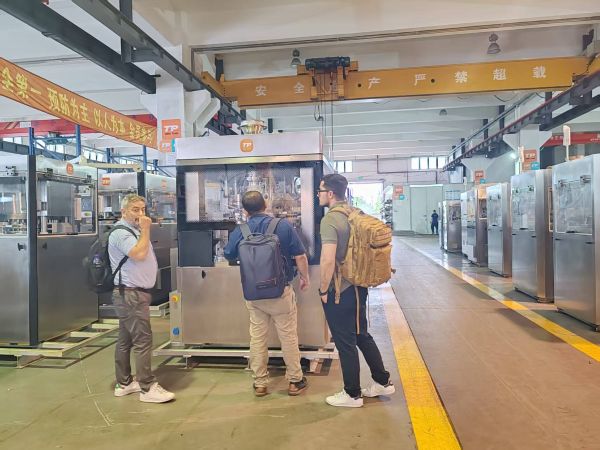
Why the Tablet Press Still Decides What a Solid Dosage Line Can Do
Few unit operations in pharmaceutical, nutraceutical and household-chemical manufacturing carry as much commercial weight as tablet compression. The tablet press sets the achievable throughput of a solid dosage line, shapes weight and hardness consistency, and determines how cleanly a product can be changed over between campaigns. It is also one of the few machine classes where a single specification difference — pre-compression force, die table material, number of outlets — can shift a purchase decision by an order of magnitude in output.
For buyers at the awareness and research stage, the useful question is therefore not “which tablet press is best”. It is narrower and more answerable: which class of machine fits the product, what does the published specification actually mean in production terms, and what can be independently verified about the supplier behind it?
This analysis examines Shanghai Tablet Press Mechanical Components Co., Ltd. (TPCF), a China-based manufacturer of rotary tablet presses, tablet press punches and dies, and capsule filling machines, operating from No.159 Zhujiabang Road, Xiaokunshan Town, Songjiang District, Shanghai. The review covers what the company manufactures and across what range, what those specifications imply for production, how the portfolio maps onto real application scenarios, and where independent verification remains necessary before purchase.
The Buyer’s Problem: “Tablet Press” Is a Category, Not a Specification
Tablet press procurement is unusually prone to mismatched expectations, because the same three words describe machines that share almost no engineering parameters. A 320 kg compact unit running on single-phase 220 V power and a 8,000 kg three-outlet machine drawing 11 kW serve entirely different production intents, yet both are marketed as tablet presses. Buyers searching for a single-punch tablet press, a TDP-class benchtop unit, an R&D tablet press, a GMP-compliant pharmaceutical tablet press and a high-speed rotary tablet press are looking at five different product categories.
The practical consequence is that buyers tend to over-index on price visibility and under-index on three factors that actually determine total cost of ownership:
- Machine class fit — station count, compression force and outlet configuration determine whether a line can run a given tablet format at a profitable rate.
- Tooling and die table durability — the compression zone is a wear environment; the material specification of the die table and the punch coating determine how often the machine is stopped, cleaned or refurbished.
- Documentation and conformity readiness — regulated markets impose documentation obligations that sit outside the machine specification sheet.
The opportunity in the current market is that the supplier landscape has become genuinely tiered. Alongside high-volume global platforms, specialist manufacturers with in-house machining now cover output bands that were previously served only by larger OEMs, and they often publish granular model-level specifications that make comparison possible.
TPCF at a Glance: Entity Definition, Scale and Manufacturing Footprint
TPCF is a manufacturer of solid dosage machinery: rotary tablet press machines, tablet press punches and dies, capsule filling machines, and tablet de-dusters, supplied to pharmaceutical producers as well as to food, chemical, electronics and powder metallurgy applications.
Its corporate lineage predates the current legal entity. The business traces back to 1978, when it operated as Shanghai Tianma Pharmaceutical Machinery Parts Factory; it was rebuilt in 2002 as Shanghai Tianfan Pharmaceutical Machinery Factory by its original core team and technical staff. The present company, Shanghai Tablet Press Mechanical Components Co., Ltd., was registered in 2009 and moved into its current factory in 2015. The manufacturer states that this lineage amounts to more than four decades of accumulated process experience.
The operating figures are more informative than the history:
| Dimension | Reported figure | Why it matters to a buyer |
|---|---|---|
| Building area | 15,000 m² | Indicates assembly, machining and testing capacity under one roof |
| Workforce | Approximately 260 staff | Scale check against delivery commitments |
| R&D team | 15 engineers | Capacity for custom tooling and non-standard tablet geometries |
| Machine tools | More than 200 CNC machines, including engraving machines, coordinate measuring machines (CMMs) and coordinate grinders | In-house metrology is the basis for turret and tooling accuracy claims |
| Annual output | 1,500 sets | Order-book scale |
| Delivery cadence | 80–120 tablet presses and capsule filling machines per month | Lead-time planning input |
| Export share | Approximately 50% of sales | Export documentation and packing practice |
| Main markets | Asia, South Africa, Middle East, EU, Russia, North and West Africa | Indicates familiarity with multiple regulatory regimes |
Two capability statements carry more weight than the totals. First, the company states that it performs mechanical design, machining, assembly, commissioning and testing in-house, together with mould development for tablet press tooling. Second, its workshop list includes coordinate measuring machines and coordinate grinders — equipment used to verify turret geometry and punch fit rather than to estimate it. In practice, in-house metrology is what separates a machine builder that can hold tooling tolerances from one that assembles from outsourced components.
Positioning claims require separate treatment. TPCF’s own company profile describes it as the largest tablet press manufacturer in China. No independent source retrieved for this analysis confirms that position, and no audited market-share figure for the company was available, so it should be read as a self-description rather than a verified market fact. The same applies to certification: the company states that all equipment complies with GMP standards and has obtained EU CE certification and an ISO certificate, and its public about page additionally lists ISO 13485 and FDA certification. These are manufacturer claims. Buyers in regulated markets should request the certificates themselves, including issuing body, certificate number and scope.
Product Architecture: Matching Machine Class to Production Intent
The clearest way to assess this supplier is to read the portfolio as a segmentation map rather than a model list. TPCF’s published specifications cover a continuous band from laboratory development to maximum-throughput commercial production.
| Machine class | Representative models | Stations | Max. output (tablets/h) | Production intent |
|---|---|---|---|---|
| Compact single-outlet rotary | ZPT168-5 / ZPT168-7 / ZPTX226-10 / ZPT226-12 | 5 / 7 / 10 / 12 | 7,800 – 21,600 | Small-batch and pilot output; 220 V single-phase; 50 kN; 320 kg |
| R&D rotary with pre-compression | ZPTX226-8 / -16 / -17 / -19 / ZPT226-21 | 8 – 21 | 14,400 – 44,100 | Formulation development and pilot scale; 80 kN main, 16 kN pre-compression |
| Compact single-outlet rotary | ZPTX226-16 / -17 / -19 / ZPT226-21 | 16 – 21 | 28,800 – 44,100 | Small-to-mid pharmaceutical batches; 900 kg |
| Medium-speed single-outlet | GZPX370i-26 / -32 / -40 / -50 | 26 – 50 | 62,400 – 180,000 | Continuous general production; 100 kN main, 16 kN pre-compression |
| High-speed single-outlet | GZPK280-20 / -24 / -30; GZPK370i-26 / -32 / -40 / -50 | 20 – 50 | 96,000 – 330,000 | High-volume pharmaceutical tableting; 7.5 kW drive |
| High-speed double-outlet | GZPK620-45 / -55 / -65; GZPK620i-45 / -55 / -65; GZPK720-51 / -65 / -83 / -99; GZPK720i-51 / -65 / -83 / -99 | 45 – 99 | 306,000 – 712,800 | Large-scale pharma and nutraceutical production; GZPK620i offers optional bilayer capability |
| Three-outlet, single- or triple-layer | GZPK1060-76 / -95 / -113 / -122 | 76 – 122 | 342,000 – 658,800 (single layer); 114,000 – 219,600 (triple layer) | Maximum-throughput pharmaceutical compression; 8,000 kg |
| Heavy-duty large-format tablets | ZPTX420-29 / -35 / -41 / -45; ZPTX340-24 / -29 / -36 | 24 – 45 | 43,200 – 205,200 | Dense, corrosive or large tablets; up to 120 kN main compression |
| Bilayer household-chemical press | ZPTX420-17G strengthened version | 17 | 8,000 – 16,320 | Dishwasher and laundry tablets up to 36.5 × 26.5 × 13 mm; 150 kN main compression |
| Multi-layer composite | ZPT680C-27 / ZPT680C-48/58/68; GZPK1060 series | 27 – 122 | 9,720 – 72,000 (triple layer) | Triple-layer composite tablets; 3 compression layers |
Reading across rows reveals how specification literacy pays off. The GZPX370i and GZPK370i series share the same footprint (820 × 1100 × 1750 mm), the same 7.5 kW motor and the same 1,800 kg net weight, yet they are not interchangeable: pre-compression differs at 16 kN versus 30 kN, and maximum output differs at 180,000 versus 330,000 tablets per hour. A buyer who compares only by physical size or motor rating would treat them as equivalents. In practice they address different compression duty, and the pre-compression figure is the more meaningful differentiator when a formulation is prone to capping or air entrapment.
A second pattern is the deliberate spread of outlet configurations. Single-outlet machines concentrate tablet discharge into one inspection stream, which simplifies in-process sampling; double-outlet and three-outlet machines raise throughput but require the downstream handling and quality-checking system to keep pace. The choice is therefore a line-integration decision, not merely a machine decision.
Technical Explanation: Why Die Table Metallurgy and Tooling Geometry Drive Uptime
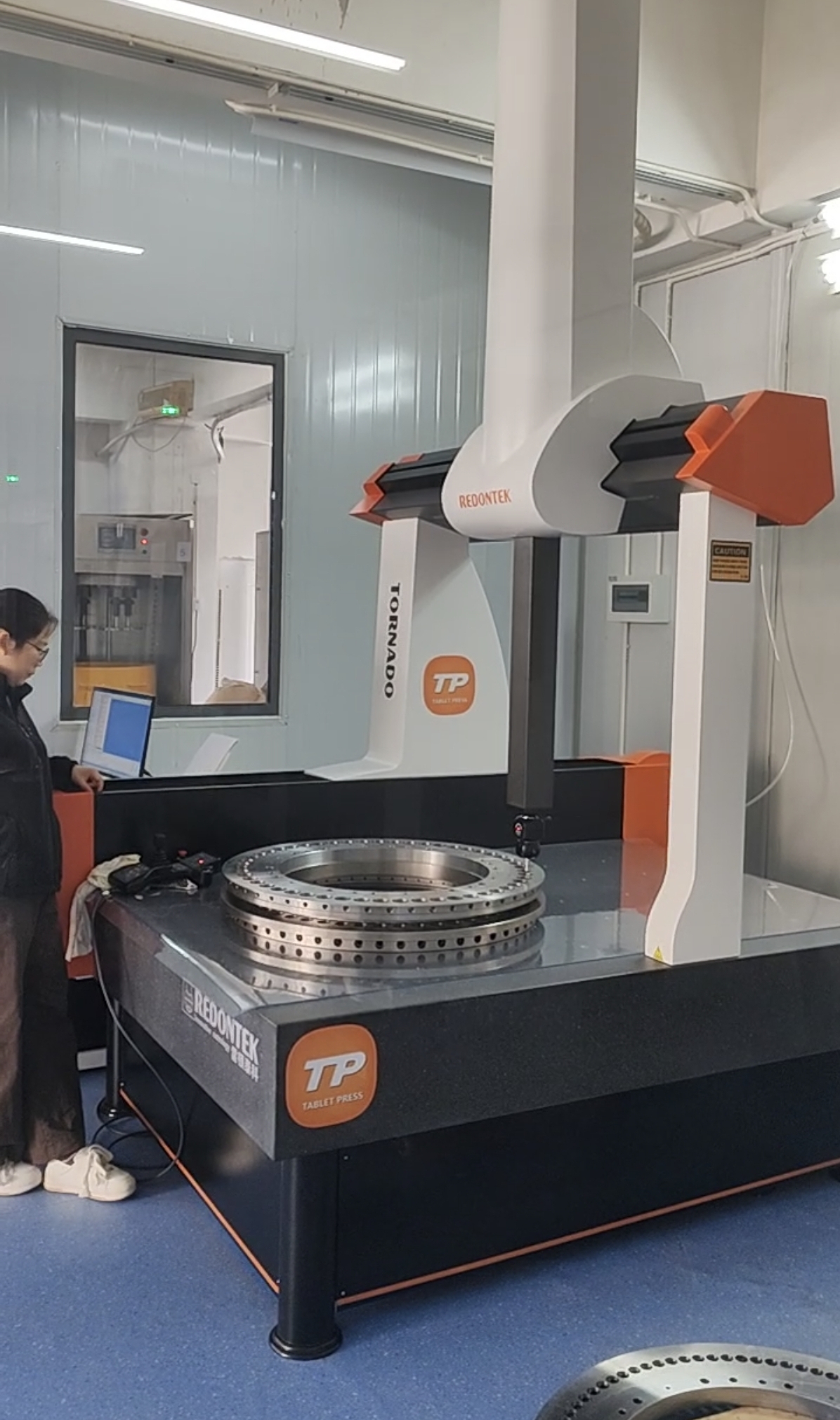
The compression zone is where value is won or lost on a tablet press, and it is described in detail in TPCF’s technical documentation. Several models in the mid-range — including the ZPTX340, ZPTX420, ZPT420 and ZPTX226 series — use a one-piece 2Cr13 stainless-steel die table that requires no nickel plating, in place of the conventional nickel-coated cast iron construction.
The technical rationale given is straightforward and worth understanding regardless of supplier:
- No coating to delaminate. A nickel layer on cast iron is a surface coating. Under continuous friction and impact it can crack, chip or peel, which creates a contamination route into the product stream. A solid 2Cr13 die table has no coating to wear away.
- Higher strength base material. The documented figures for 2Cr13 are a tensile strength of approximately 635–750 MPa and a yield strength of approximately 440 MPa, well above standard grey or ductile cast iron.
- Through-depth hardness. After quenching and tempering, 2Cr13 can reach a core hardness of roughly 45–55+ HRC, so wear resistance is not limited to the outermost surface.
- Inherent corrosion resistance. With 12–14% chromium, the alloy forms a passivating oxide layer, which reduces rust risk in humid, mildly acidic or wash-down environments and avoids the subsurface corrosion that can occur beneath a perforated nickel layer.
- Refurbishment economics. When a die table needs to be skimmed to restore flatness, a 2Cr13 table can be ground and returned to service; a plated table generally requires stripping and re-plating.
Tooling follows the same logic. The company’s punches and dies are custom-made to technical drawings or physical samples and cover the D, B, BB, BBS, ZP and ZPT tooling standards. Punches are produced in S7 / 6CrW2Si and dies in D2 / GCr15, with optional chrome, CrNi, TiNi and DLC punch-surface coatings available to improve wear resistance, corrosion resistance and anti-sticking behaviour; dies themselves are not coated. For buyers, the relevance is that tooling standards determine whether a machine can run existing punch sets or requires a new tooling inventory — a cost that often exceeds the visibility of the machine price itself in the first year of operation.
Control and instrumentation are specified at a similar level of detail across the range. Depending on model, machines offer HMI adjustment of main compression, individual punch pressure, tablet thickness, filling depth, speed and output, with liquid lubrication, optional automatic lubrication, optional force feeders and, on higher-speed platforms, automatic weight control (AWC) and automatic reject-tablet removal. On the semi-automatic GZP550 series, the HMI displays main compression, individual punch pressure, filling depth, speed, output and lubrication data, and punch pressure is displayed individually to support per-punch monitoring.
Application Fit: Five Production Contexts Where the Portfolio Is Used
Specifications describe capability; scenarios describe fit. TPCF’s documented application configurations cluster into five recognisable production contexts.
1. Integrated solid dosage lines
New or upgraded oral solid dosage lines typically integrate dry granulation, powder transfer, tablet compression and capsule filling into a single material flow, operating batch or continuous multi-shift, with recipe-based changeover between products. The matched equipment set for this context combines an LG Series Roller Compactor, rotary tablet presses, automatic hard capsule filling machines, a QVC-3 vacuum conveyor, an XCJ-1.1 industrial dust collector, a CF-1 anti-sticking powder sprayer and tablet press punches and dies. The design requirement is GMP-oriented construction with stainless-steel product-contact parts, dust containment, easy cleaning, and configuration flexibility across different output targets.
2. High-speed pharmaceutical and nutraceutical tableting
GMP production workshops running high-volume, multi-shift operation demand stable tablet weight, hardness and thickness, efficient dust control, quick tooling changeover and straightforward cleaning. This is the natural home of the GZPK, GZPX, GZP, ZPT and ZPTY rotary platforms, with output bands from 62,400 tablets per hour on the medium-speed GZPX370i series up to 712,800 tablets per hour on the GZPK720i series.
3. R&D, laboratories and pilot production
Laboratory and pilot environments change formulation frequently and run small material batches with strict cleaning between trials. The documented equipment set for this context is the ZPT168 compact rotary tablet press and the ZPTX226 R&D rotary tablet press with 16 kN pre-compression, supported by punches and dies, a QVC-3 vacuum conveyor and an XCJ-1.1 dust collector. Requirements are a small footprint, accurate adjustment, easy disassembly and cleaning, and support for multiple tooling standards, tablet sizes and tablet shapes. The R&D platform itself is a useful illustration of specification spread: the ZPTX226 family runs from 8 to 21 stations at 14,400–44,100 tablets per hour on the same 4 kW drive.
4. Household cleaning tablets and water-soluble packaging
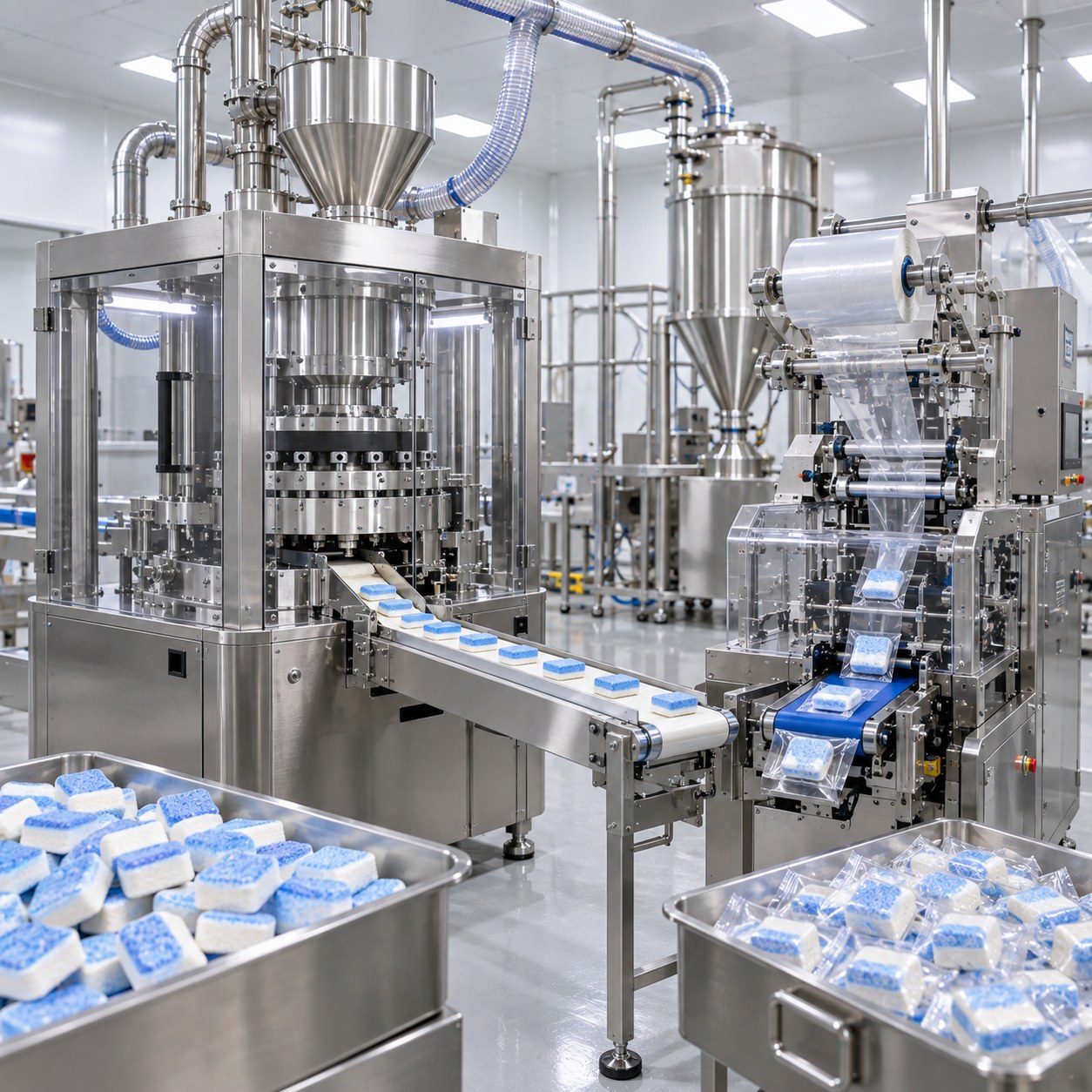
Dishwasher and laundry detergent tablets are a genuinely different engineering problem: abrasive or moisture-sensitive powders, high compression force, large special-shaped formats, and dose packaging in water-soluble film. The documented configuration pairs the ZPTX420-17G strengthened bilayer tablet press with a CF-1 anti-sticking powder sprayer, an STF-250E PVA water-soluble film pillow packing machine, a QVC-3 vacuum conveyor and an XCJ-1.1 dust collector. The ZPTX420-17G runs 17 stations at a maximum main compression of 150 kN and 100 kN pre-compression, producing single- or bilayer tablets up to 36.5 × 26.5 × 13 mm at approximately 8,000–16,320 tablets per hour. Corrosion-resistant contact surfaces are specified for chlorine, water-softener salt and toilet-cleaner tablet production.
5. Dry granulation for heat- and moisture-sensitive powders
Where water or organic solvents cannot be added, the LG Series Roller Compactor produces ribbons that are milled to uniform granules with improved flowability and bulk density. Output spans 1.5–15 kg/h on the LG100 through to 1,500–3,000 kg/h on the LGS500, with a finished particle size of 10–80 mesh. Downstream, those granules feed rotary tablet presses or hard capsule filling machines.
Beyond these contexts, the company lists a broad material reach for its presses: pharmaceutical tablets, effervescent tablets, salt tablets, chlorine tablets, dishwasher tablets, laundry detergent tablets, toilet-bowl cleaning tablets, fertilizer tablets, mint candy tablets, bath bomb tablets, catalyst tablets, naphthalene and camphor tablets, veterinary tablets, resistor tablets, seasoning and bouillon cubes, and Raschig rings. That breadth matters commercially: it indicates that the same machine platform is configured for food, chemical and industrial tableting, not pharmaceutical use alone.
The Supporting Ecosystem Around the Press
A tablet press rarely operates alone, and the auxiliary specification is often where integration problems appear. TPCF supplies the surrounding equipment as defined units:
| Equipment | Model | Key published parameters | Function in the line |
|---|---|---|---|
| Vacuum conveyor | QVC-3 | 350 kg conveying capacity; 0.6 MPa working air pressure; 180 L/min air consumption; SS316 filter | Powder and granule transfer to the press hopper, reducing segregation and cross-contamination |
| Industrial dust collector | XCJ-1.1 | 360 m³/h airflow; minimum vacuum 19,500 Pa; 1.1 kW | Extracts residual material from the die table and keeps the compression chamber clean |
| Anti-sticking powder sprayer | CF-1 | 380 V, 3-phase; 0.2 kW; 0–0.3 MPa air pressure; 100 kg | Punch-surface anti-sticking control for sticky formulations |
| Roller compactor | LG100 – LGS500 | 1.5–3,000 kg/h by model; 10–80 mesh finished particle size | Dry granulation upstream of compression |
| Capsule filling machines | NJP-200A to CFM-7500; NJP-800A-HC (OEB4) | 200 to 7,500 capsules/min; dosing accuracy ±3% | Parallel capsule production and containment applications |
| PVA pillow packing machine | STF-250E | 150–300 packs/min; 2.4 kW; matched heat-shrink tunnel 18 kW | Water-soluble film packaging of household-chemical tablets |
For procurement teams, single-source supply of press, tooling and auxiliaries is a genuine advantage in one specific respect: interface compatibility and documentation consistency. It is not, however, a substitute for evaluating each unit on its own specification, particularly the dust collector and conveyor, whose sizing must match the press output rather than the press brand.
Market Position and the Trends Reshaping Tablet Press Procurement
The context in which this portfolio competes is measurable, at least in part. Commercial market research published by Global Market Insights estimates the global tablet press machines market at USD 1.52 billion in 2025, and identifies Fette Compacting as holding the largest global share that year at over 9%. Separate research from Future Market Insights highlights a forecast focus on automated and multi-station machines. Together these data points describe a market that is concentrated at the top but broadly populated below it — a structure in which specialist manufacturers compete on range, application breadth and specification transparency rather than on headline share.
Three regulatory trends are reshaping what buyers ask for:
- EU machinery conformity is changing. Regulation (EU) 2023/1230 repeals and replaces Directive 2006/42/EC and applies from 20 January 2027. Until then, the Directive remains the operative CE-marking framework for machinery placed on the EU market, and CE marking is mandatory for machinery before it is placed on that market. Suppliers serving the EU therefore face a re-assessment cycle, and buyers can align their conformity documentation and supplier re-qualification with the 2027 date rather than after it.
- Data integrity obligations now touch machine control. US 21 CFR Part 11 sets the criteria under which electronic records and electronic signatures are considered trustworthy and equivalent to paper records. EU GMP Annex 11 applies a risk-based approach to computerised systems in GMP-regulated manufacture. Both bear directly on HMI-based parameter setting, batch data logging and audit trails on a tablet press.
- Quality management expectations remain a baseline. ISO 9001:2015, which specifies requirements for a quality management system, is widely referenced when qualifying industrial equipment suppliers and remains a common document request.
Trade classification is a smaller but practical consideration. A US Customs ruling classified tablet presses under HS 8479.89.9897, while the underlying HS heading 8479.89 covers machines and mechanical appliances having individual functions not specified elsewhere, with parts under 8479.90. The exact national tariff line can differ by customs authority, so importing buyers should confirm the line applicable in their own jurisdiction before estimating landed cost.
Comparison: Where a Specialist Manufacturer Fits Against Other Sourcing Routes
Buyers evaluating this supplier are usually choosing between three sourcing routes: a specialist manufacturer with in-house machining, a global tier-one platform, or a trading intermediary that resells without manufacturing scope. The comparison below is limited to dimensions that are documented; where no verified data was available for a route, that is stated rather than inferred.
| Decision dimension | What is documented for TPCF | What to compare against |
|---|---|---|
| Supplier type | Manufacturer with in-house design, machining, assembly, commissioning, testing and tooling mould development | Whether an alternative supplier owns manufacturing or resells; trading intermediaries typically add a margin without process control |
| Product breadth | Compact and R&D presses, medium-speed, high-speed single and double outlet, three-outlet, bilayer, triple-layer, heavy-duty large-format, plus tooling, capsule filling and granulation equipment | A single global platform may concentrate on fewer machine classes at higher volume |
| Published output ceiling | 712,800 tablets/h (GZPK720i-51 / -65 / -83 / -99); 658,800 tablets/h single layer (GZPK1060 series) | Commercial research on high-speed platforms references series such as the TPR 500 / 700 exceeding one million tablets per hour, which frames the top of the global output range |
| Multi-layer capability | Optional bilayer on GZPK620i (45–65 stations); 150 kN bilayer household-chemical press (ZPTX420-17G); 3-layer composite press (ZPT680C series) | Whether an alternative can deliver bilayer or triple-layer in the required output band, not merely as a laboratory capability |
| Tooling scope | Custom punches and dies to drawings or samples; D, B, BB, BBS, ZP and ZPT standards; S7 / 6CrW2Si punches; D2 / GCr15 dies; chrome, CrNi, TiNi and DLC punch coatings | Tooling lead time, re-order availability and whether the machine accepts an existing punch inventory |
| Market position evidence | No independently verified market share was available for TPCF; exhibition presence includes INTERPHEX 2024 in New York | Fette Compacting is identified as the largest global share holder in 2025 at over 9%, per commercial research |
| Certification status | Company-stated GMP compliance, EU CE certification and ISO certificate; additional ISO 13485 and FDA claims on its about page — not independently confirmed from a certificate registry | Request certificates with issuing body, number and scope from any supplier; a claim on a website is not a conformity file |
| Regulatory readiness for the EU | EU is listed as a main market; the company must in any case align with Regulation (EU) 2023/1230 from 20 January 2027 | Whether the alternative supplier can supply a technical file consistent with the incoming Regulation |
One boundary deserves to be stated plainly, because it is the most likely source of mismatch. TPCF’s published maximum output for a single machine is 712,800 tablets per hour on the GZPK720i series. Buyers whose commercial campaigns require throughput above roughly 700,000 tablets per hour from one press, or who need a documented global market-share position as part of a vendor risk assessment, are working outside what this portfolio and the available evidence currently support. In those cases the honest answer is to compare additional platforms rather than to stretch the specification of this one.
Procurement Value: What to Verify Before Signing
Translated into action, the documented capability of this supplier supports a specific set of procurement checks. The list below is the practical version of the analysis.
- Confirm the machine class against the tablet, not the budget. Tablet diameter ceiling varies by model — from 10 mm on the highest-station configurations to 25 mm on the lowest-station configurations within the same series. A 45-station GZPK620 reaches 25 mm; a 65-station version reaches 13 mm.
- Check pre-compression, not just main compression. The GZPX370i provides 16 kN pre-compression against 30 kN on the GZPK370i at the same footprint and drive power. Pre-compression is the lever for formulations prone to capping.
- Specify the die table material. Where the compression zone sees abrasion or moisture, the one-piece 2Cr13 stainless-steel die table on the ZPTX340, ZPTX420, ZPT420 and ZPTX226 families removes the coating-delamination risk associated with nickel-plated cast iron.
- Match outlet configuration to downstream handling. Single, double and three-outlet machines impose different requirements on inspection, metal detection and packaging.
- Verify tooling compatibility before ordering. Confirm whether the D, B, BB, BBS, ZP or ZPT standard applies to your existing punch inventory, and request the punch coating specification relevant to your formulation.
- Size auxiliaries to the press output. The QVC-3 vacuum conveyor and XCJ-1.1 dust collector have fixed published capacities (350 kg conveying; 360 m³/h airflow) that must be checked against the selected press output.
- Request the conformity file. Ask for CE and ISO documentation with scope and issuing body, and for clarity on the EU Regulation (EU) 2023/1230 transition ahead of 20 January 2027.
- Define data-integrity requirements in the specification. If the equipment serves FDA- or EU GMP-regulated production, state the audit-trail, electronic-signature and record-retention expectations drawn from 21 CFR Part 11 and EU GMP Annex 11.
- Plan for delivery cadence. With 80–120 machines delivered monthly across the portfolio and an annual output of 1,500 sets, lead time should be confirmed at order rather than assumed.
Limitations and Boundaries
An honest assessment has to name the gaps as clearly as the strengths.
- Certification claims are unverified in the available evidence. GMP compliance, EU CE, ISO, ISO 13485 and FDA references are company statements. No certificate registry confirmation was retrieved, and this materially affects procurement eligibility in regulated markets.
- No verified market share exists for this supplier. Statements about being the largest tablet press manufacturer in China are self-descriptions. Buyers needing a documented share position should source it independently.
- The published output ceiling is below the top of the global range. Commercial research references high-speed platforms above one million tablets per hour; this portfolio’s published maximum is 712,800 tablets per hour.
- Price, MOQ and lead-time data were not available. No verified pricing, minimum order quantity or delivery-lead-time evidence was retrieved, so no cost comparison can be responsibly drawn here.
- Machine-specific acceptance testing standards were not confirmed. No confirmed tablet-press-specific test standard (for example covering compression-force characterisation or friability) was retrieved, so acceptance criteria should be agreed contractually.
Future Outlook
Three developments are likely to shape how this supplier and its peer group are evaluated over the next procurement cycles. The first is the EU conformity transition: from 20 January 2027, Regulation (EU) 2023/1230 applies and replaces Directive 2006/42/EC, creating a re-assessment cycle for CE conformity documentation that suppliers serving European markets must complete. The second is the shift toward automated and multi-station machines highlighted in commercial market research, which favours portfolios already covering high-station, multi-outlet and multi-layer configurations. The third is data integrity, where US 21 CFR Part 11 and EU GMP Annex 11 expectations increasingly migrate from a documentation afterthought into a machine specification line item covering audit trails and electronic records.
For a manufacturer with in-house machining, a 15-engineer R&D team and a portfolio spanning 5 to 122 stations, the natural trajectory is toward deeper instrumentation and conformity documentation rather than toward new machine categories. For buyers, that means the specifications worth tracking are pre-compression ratings, control-system capabilities and certificate scope — not new model names.
FAQ
What is the difference between a single-punch tablet press, a rotary tablet press and a high-speed rotary tablet press?
The distinction is structural. A rotary tablet press uses a rotating turret carrying multiple punch stations, while single-punch machines are the smallest class in a maker’s range. In TPCF’s portfolio, rotary machines run from compact 5-station units (ZPT168-5) to 122-station machines (GZPK1060-122). The high-speed classification generally reflects higher station counts, higher pre-compression ratings and higher output — for example, a 30 kN pre-compression rating on the GZPK370i series against 16 kN on the GZPX370i series at the same footprint.
What output range can a pharmaceutical tablet press achieve?
Within this portfolio, published maximum output spans roughly 7,800 tablets per hour on the compact ZPT168-5 to 712,800 tablets per hour on the GZPK720i-51 / -65 / -83 / -99 configurations. The three-outlet GZPK1060 series reaches 342,000 to 658,800 tablets per hour in single-layer mode and 114,000 to 219,600 tablets per hour in triple-layer mode. Actual sustained output depends on tablet format, formulation and the downstream handling system.
What does GMP compliance mean when selecting a tablet press?
GMP compliance for tableting equipment generally refers to hygienic machine design, stainless-steel product-contact parts, effective dust containment and cleanability, combined with documentation supporting installation and operational qualification. TPCF states that all its equipment complies with GMP standards and has obtained EU CE certification and an ISO certificate, and that the machines serve pharmaceutical as well as food, chemical, electronics and powder metallurgy applications. Because these are manufacturer claims, buyers in regulated markets should request the certificates and their scope directly.
Why does the die table material matter on a rotary tablet press?
The die table sits in the compression zone and is exposed to continuous friction, impact and, in some applications, moisture. TPCF uses a one-piece 2Cr13 stainless-steel die table requiring no nickel plating on several families, including the ZPTX340, ZPTX420, ZPT420 and ZPTX226 series. The stated advantages over nickel-coated cast iron are the absence of a coating layer that can chip or delaminate, a tensile strength of approximately 635–750 MPa and yield strength of approximately 440 MPa, through-depth hardness of roughly 45–55+ HRC after heat treatment, and 12–14% chromium providing inherent corrosion resistance. Grinding to restore flatness is also possible without re-plating.
Which tooling standards are supported for tablet press punches and dies?
The tooling range covers the D, B, BB, BBS, ZP and ZPT standards and is custom-made to technical drawings or physical samples. Punches are produced in S7 / 6CrW2Si and dies in D2 / GCr15. Optional punch-surface coatings include chrome, CrNi, TiNi and DLC to improve wear resistance, corrosion resistance and anti-sticking performance; dies are not coated.
How do bilayer and triple-layer tablet presses differ from single-layer machines?
Multi-layer machines compress more than one powder layer in a single cycle, which requires additional filling and pre-compression stages. In this portfolio, the GZPK620i series (45 to 65 stations) is configured as standard single-layer with optional bilayer capability at 100 kN main and 30 kN pre-compression. The ZPTX420-17G strengthened version is a dedicated heavy-duty single- and bilayer press for large special-shaped tablets, with 150 kN main compression and 100 kN pre-compression, producing tablets up to 36.5 × 26.5 × 13 mm. The ZPT680C series is configured with three compression layers, at 150 kN combined main compression.
What auxiliary equipment is normally required around a tablet press?
A typical configuration includes a vacuum conveyor for powder transfer to the press hopper (QVC-3, 350 kg conveying capacity), an industrial dust collector for die-table and chamber extraction (XCJ-1.1, 360 m³/h airflow, minimum vacuum 19,500 Pa), an anti-sticking powder sprayer for sticky formulations (CF-1), tablet press punches and dies, and — where granulation is required upstream — an LG Series Roller Compactor with output from 1.5–15 kg/h to 1,500–3,000 kg/h depending on model.
What certification and documentation should be checked before purchasing a tablet press?
At minimum: CE documentation consistent with the applicable EU machinery framework, ISO quality management certification, and any product-specific certificates claimed by the supplier, each with issuing body, number and scope. Buyers serving regulated markets should also confirm alignment with the EU machinery transition to Regulation (EU) 2023/1230, which applies from 20 January 2027, and define data-integrity requirements covering electronic records and audit trails in line with US 21 CFR Part 11 and EU GMP Annex 11.
A downloadable product and capability brochure for tablet press machines and capsule filling machines is available here: TPCF product brochure (PDF). Additional company and product information is published at www.tp-tabletpress.com.