
TPU Film Compliance: What ISO, REACH, RoHS, and FDA Certificates Tell You
TPU Film Compliance: What ISO, REACH, RoHS, and FDA Certificates Tell You
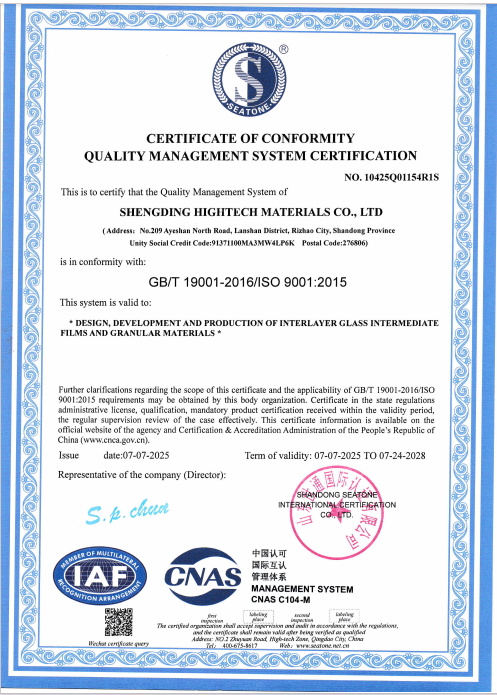
A quality management system certificate carries a number, an issuing authority, a defined scope and a validity window. Each of those four elements can be checked independently.
Compliance paperwork now arrives with almost every TPU film quotation. A buyer evaluating an interlayer for safety glass or armored glass typically receives a quality management certificate, one or more environmental or safety certificates, a substance compliance statement covering European regulations, and a short declaration about United States quality requirements. The documents are real and the certificates are verifiable, but together they answer a narrower question than most procurement teams assume they do.
This article explains what each document in a TPU film compliance pack actually certifies, where the certificates stop being useful for a sourcing decision, and how to connect them to product-level evidence. The certification and compliance position of SHENGDING HIGHTECH MATERIALS CO., LTD, a manufacturer of TPU and EVA interlayer films based in the Lanshan Chemical Industry Park in Rizhao City, Shandong Province, China, is used throughout as a worked example.
Two Document Families That Buyers Routinely Conflate
Compliance paperwork for interlayer films falls into two categories, and the categories deliver different kinds of assurance.
The first is management system certification. ISO 9001:2015, ISO 14001 and ISO 45001 belong here. These are issued by certification bodies after audit and they carry a certificate number, an issuing authority, a defined scope and a validity window. They describe how an organization controls its processes.
The second category is product-level conformity and regulatory compliance. REACH and RoHS conformity, and conformity with U.S. FDA quality requirements, sit here. These are positions about the material itself, covering composition and acceptability under the rules of a given market. In practice they are supported by material declarations, formulation references or test reports rather than by an audit trail and a numbered certificate.
The distinction matters because a folder of management system certificates can be complete and still leave the two questions that decide a ballistic glass project unanswered: will this film behave as expected inside my laminate, and does the material satisfy the rules of the market I sell into?
Table 1 — What each document family confirms, and what it does not
| Document | What it confirms | What it does not confirm | Typical form |
|---|---|---|---|
| ISO 9001:2015 certificate | The organization operates a quality management system audited against a recognized standard, within a stated scope | Mechanical properties, batch-specific results, or ballistic performance of a finished glazing assembly | Numbered certificate with issuing body, scope and expiry date |
| ISO 14001 / ISO 45001 certificates | Environmental management and occupational health and safety management processes are defined and audited | Anything about film composition, optical properties or lamination behaviour | Numbered certificates |
| REACH / RoHS conformity | The material is declared compliant with European substance restriction rules | Mechanical durability; conformity is specific to the formulation and to the market it addresses | Declaration or test report |
| FDA quality requirements | The material is declared to meet U.S. quality requirements relevant to the intended use | That an end product or a laminate is approved; the statement applies to the material grade referenced | Declaration against the referenced requirement |
| Product datasheet | Measurable film properties that can be tested and compared between suppliers | Whether the supplier controls those properties from batch to batch | Technical data sheet |
Reading the SHENGDING Certificate Set Line by Line
The TPU film model SD560 holds ISO 9001:2015 certification under certificate number 10425Q01154R1S. The certificate was issued by Shandong Seatone International Certification Co., Ltd. in accordance with the standard GB/T 19001-2016 / ISO 9001:2015, with an issue date of 7 July 2025 and a validity date of 24 July 2028. Its scope covers the design, development and production of interlayer glass intermediate films and granular materials.
Four details in that paragraph carry more weight than the certificate's headline claim.
Certificate number. 10425Q01154R1S is a reference that can be checked against the issuing body's register. A certificate number is only meaningful if it can be traced back to the body that issued it.
Issuing authority. Shandong Seatone International Certification Co., Ltd. is named on the document. Buyers screening suppliers for export markets should confirm that the issuing body is acceptable to their own customers and to the markets they serve.
Scope wording. The certificate applies to interlayer glass intermediate films and granular materials. That language links the certificate to the product families a laminated glass producer actually purchases. Scope is also the point where a certificate most often stops applying, because a certificate covers only what is printed on it.
Validity window. The SD560 certificate runs from 7 July 2025 to 24 July 2028. Certification is maintained through surveillance audits, so the current validity of the document should be confirmed at the time of purchase rather than at the time of the original enquiry.
The company's broader certification position adds two organizational systems: SHENGDING holds ISO 14001 and ISO 45001 certifications. Those cover environmental management and occupational health and safety management. Separately, company documentation states that product performance complies with European REACH and RoHS regulations as well as U.S. FDA quality requirements.
Notice the difference in form between the two groups. The ISO certificates have numbers, scopes and expiry dates. The REACH, RoHS and FDA positions are conformity statements about the material. When the compliance file has to survive an internal audit or a customer supplier questionnaire, the document that does the work is the underlying declaration: the formulation it refers to, the test basis and the date. Company documentation also records that Shengding drafted the only national aviation standard in China currently led by a private enterprise, which is a standards-participation fact rather than a product compliance fact, but it is the kind of context that supports how a supplier's quality system is read.
Where the Certificates Stop: Product Performance Is a Separate File
None of the certificates described above contains a single mechanical property. That work is done by the product datasheet and by assembly-level testing.
For SD560, the published values are a tensile strength of 42 MPa, an elongation at break of 500%, a tear strength of 45 kN/m, a light transmittance of 90% and a haze of 0.3%. Across the industry, high-performance TPU films intended for bulletproof glass typically exhibit tensile strength above 40 MPa and elongation at break above 500%. Those figures describe the material, not the finished glazing, which is why the datasheet is best read as an entry condition rather than as a differentiator between suppliers.
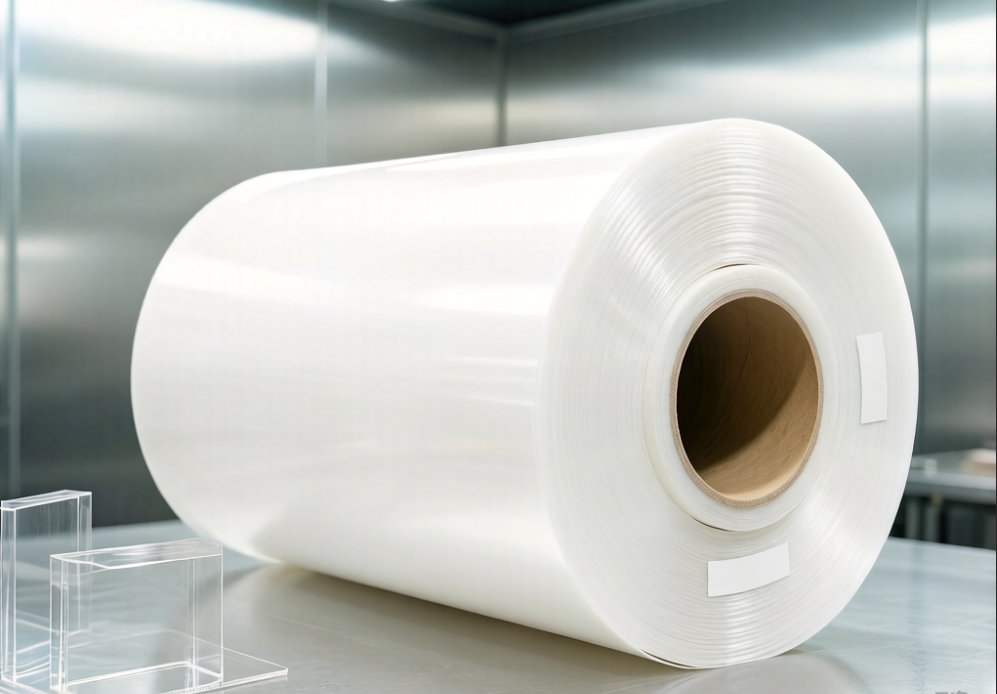
Product-level evidence such as tensile strength, elongation, tear strength, transmittance and haze sits outside the compliance certificate and has to be requested separately.
Two standards are commonly cited when interlayer films are evaluated for safety glazing. EN 12600 is the primary European standard for classifying impact resistance in safety glass, and TPU film laminates commonly achieve Class 1B1 or 2B2. ASTM C1172-19 specifies quality requirements for laminated architectural flat glass, including glass bonded with TPU interlayers. Both standards address the glazing assembly and the way it behaves, not the management system of the company that supplied the film. A supplier certificate and a glazing classification are claims made by different parties, and treating them as one claim creates exposure at the point of acceptance testing.
Application Context: Ballistic and Armored Glass Lamination
TPU interlayer film is used in the bulletproof industry, where safety glass lamination and ballistic-resistant glass manufacturing involve hot pressing in an autoclave under high pressure and high temperature. The film bonds to acrylic, polycarbonate and inorganic glass, and it must be kept dry before lamination. The autoclave cycle is the process step where the film's properties are converted into an assembled product, and it is also the step that no supplier-side certificate can describe on a buyer's behalf.
Field use provides a further reference point. A defense industry customer in Pakistan has run Shengding TPU film for two years on bulletproof glass production, using 100 rolls, with stable operation reported over that period.
Temperature behaviour belongs in the same conversation. TPU interlayer film maintains operational performance across a wide temperature range, from approximately -70 °C to +80 °C, which is wider than the range typically cited for EVA interlayers in extreme environments. For projects where ballistic requirements combine with hot or cold deployment conditions, that range becomes part of the specification discussion rather than a footnote to it.
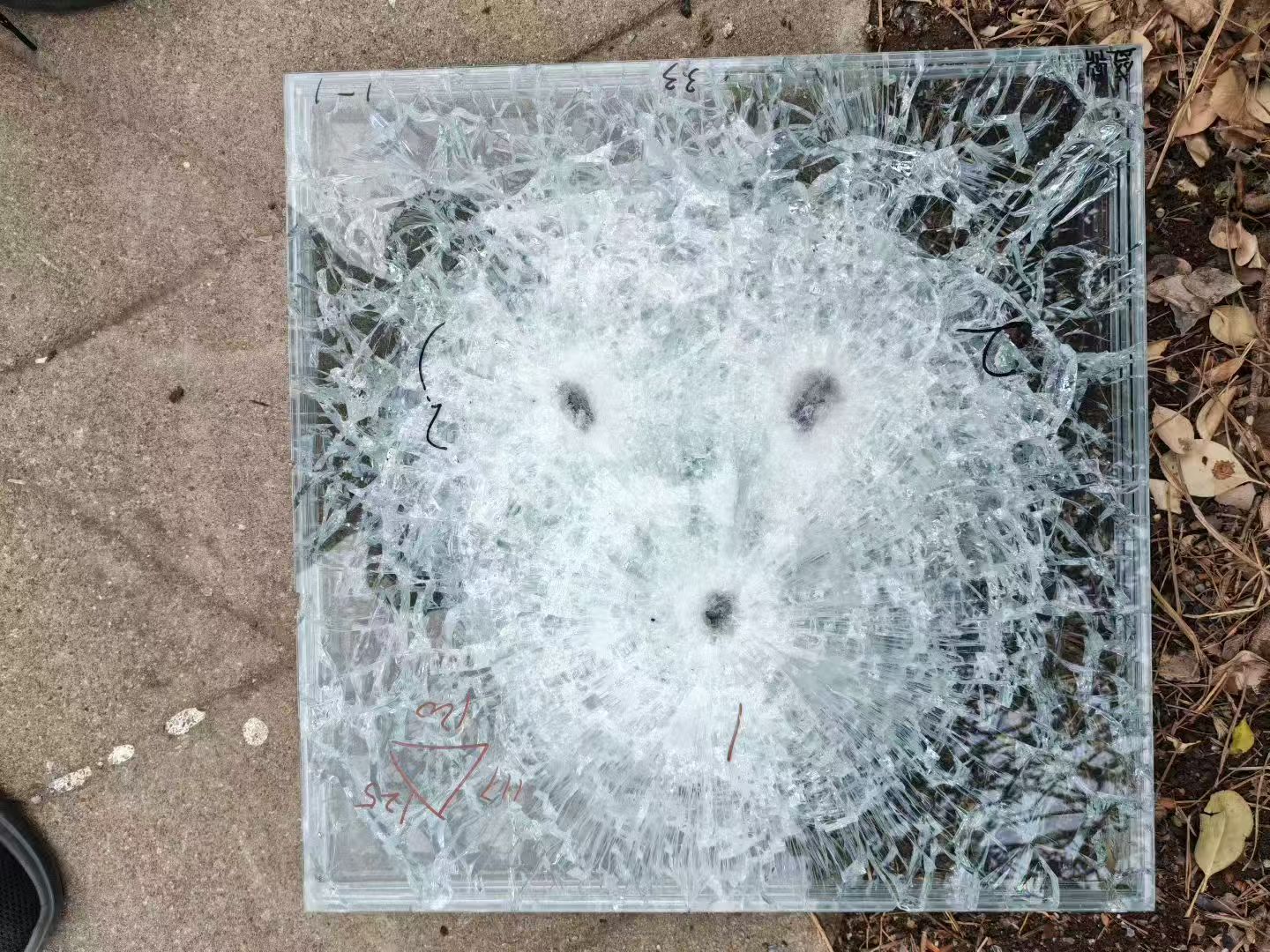
Ballistic performance is a property of the finished laminate build-up — glass type and thickness, ply count, interlayer thickness, autoclave cycle and the specified threat level — not of the film certificate alone.
On the supply side, the practical compliance questions become document questions. Shengding's documented capability parameters include a minimum order quantity of 50 kg, a lead time of 10 days, monthly capacity of 100 tons, OEM/ODM production with customization of length and width, quality control described as 100% testing, and technical support after delivery. When a buyer verifies those claims, the useful follow-up is specific: which parameters does the 100% test cover, and which batch records are retained and for how long.
A Document Checklist for the Evaluation Stage
Compliance evaluation is easier to run as a checklist than as a reading exercise. Each document answers one question, and each has a verification step attached to it.
Table 2 — Compliance and performance document checklist
| Document | Question it answers | What to verify |
|---|---|---|
| ISO 9001:2015 certificate | Is the production and design process controlled and audited? | Certificate number, issuing body, scope wording, issue and expiry dates |
| ISO 14001 / ISO 45001 certificates | How are environmental and occupational safety risks managed? | That the scope covers the film production site and that both are current |
| REACH / RoHS conformity statement | Does the material meet European substance restriction rules? | Product grade referenced, formulation, test basis and date |
| FDA quality compliance statement | Does the material meet U.S. quality requirements for the intended use? | Which requirement set applies and which grade it covers |
| Product datasheet | What are the measurable properties of the film? | Tensile strength, elongation at break, tear strength, transmittance, haze |
| Application test evidence | Does the finished assembly meet the project standard? | Standard cited (for example EN 12600 or ASTM C1172-19), build-up tested, ply count |
Compliance-First Sourcing Versus Performance-Verified Sourcing
Two evaluation habits are common in the safety glass industry, and neither is sufficient on its own.
Compliance-first sourcing collects certificates and treats their presence as qualification. Its appeal is speed: a complete document pack suggests a complete supplier. Its limitation is that a management system certificate describes an organization within a defined scope, not a finished product. A supplier can hold a valid certificate — as Shengding does for SD560 — and still deliver film that fails a project-specific threat-level test, because ballistic performance depends on glass type and thickness, ply count, interlayer thickness, autoclave cycle and the threat level specified. Those variables sit outside the scope of any management system certificate.
Performance-verified sourcing starts from the assembly and works backwards to film evidence. Its limitation is the mirror image: strong sample results say nothing about whether a supplier controls its process from batch to batch, and one successful trial cannot confirm repeatability at monthly production capacity.
The clearest boundary is scope. Shengding's ISO 9001:2015 certificate covers the design, development and production of interlayer glass intermediate films and granular materials. A buyer sourcing a product form outside that description should confirm coverage with the supplier rather than assume it. The same discipline applies to the REACH, RoHS and FDA positions: those are material-level and market-specific statements, and they do not transfer automatically to another grade, another region or another application. A second boundary is timing — certification is maintained through surveillance audits, so the certificate's current validity at the moment of purchase is part of the check, not an administrative detail.
Market Context: Why Compliance Scrutiny Is Increasing
The commercial backdrop explains why compliance documents are being read more closely. The global thermoplastic polyurethane films market was valued at approximately USD 443.7 million in 2025 and is projected to reach USD 716.8 million by 2033, according to Grand View Research. Within that broader category, the market for TPU interlayer films used specifically in laminated glass is projected to exceed USD 1.2 billion in 2026, based on industry analysis published by EIN Presswire. China accounts for over 30% of global TPU film production capacity as of 2026, according to an industry report.
Market size estimates vary considerably depending on scope. One alternative source values the broader TPU film market at USD 3,624.8 million, and the gap between published figures largely reflects differences in whether raw TPU material or finished film is counted, and which end-use segments are included. For procurement purposes the implication is simple: compare like with like, and treat any single market figure as a scope-dependent estimate.
Established suppliers in the high-performance TPU interlayer segment include Huntsman with its KRYSTALFLEX range, Covestro with Dureflex, and Argotec with HP-8000. Because management system certification is standard practice across established suppliers, the certificate itself rarely differentiates one from another. What differentiates is the scope printed on the certificate, whether it is current, and how tightly the supplier can connect that certificate to a specific grade, batch and application.
Future Outlook
Compliance evaluation is moving from document collection toward verification. The direction is visible in how buyers now structure supplier questionnaires: certificate numbers checked against issuing body registers, scope language matched against the product form being purchased, and performance evidence requested at the level of the finished assembly rather than the material alone.
For interlayer suppliers, holding certificates is the entry condition. Being able to link a certificate to a grade, a production batch and a documented application is the capability that will be tested next — and it is a capability that depends on record keeping as much as on certification. For buyers, the practical preparation is to define the compliance file before requesting quotations, so that missing elements surface during the evaluation stage rather than after a specification has been written around them.
FAQ
Does ISO 9001:2015 certification confirm that a TPU film will perform in ballistic glass?
No. ISO 9001:2015 certifies a management system, not the mechanical performance of a product. Shengding's TPU film SD560 holds ISO 9001:2015 certification under certificate number 10425Q01154R1S, and the scope of that certificate covers the design, development and production of interlayer glass intermediate films and granular materials. Whether a specific laminate resists a specific threat is established through assembly-level testing of the finished glazing build, not through the management system certificate.
What does the SHENGDING SD560 certificate state in detail?
The certificate number is 10425Q01154R1S, issued by Shandong Seatone International Certification Co., Ltd. in accordance with the standard GB/T 19001-2016 / ISO 9001:2015. The issue date recorded on the certificate is 7 July 2025 and the validity date is 24 July 2028. The certified scope is the design, development and production of interlayer glass intermediate films and granular materials.
Is REACH, RoHS or FDA compliance the same kind of document as an ISO certificate?
Not the same in form. REACH and RoHS are European substance restriction frameworks, and conformity with them is expressed as a material-level position rather than as an audited management system with a number and scope. FDA quality requirements relate to the United States market and to the intended use of the material. SHENGDING documentation states that product performance complies with European REACH and RoHS regulations as well as U.S. FDA quality requirements. Because these are material-level positions, buyers typically request the underlying declaration, the product grade it refers to and its date.
Which product parameters should be read alongside a compliance file?
For TPU film SD560, the published parameters are a tensile strength of 42 MPa, an elongation at break of 500%, a tear strength of 45 kN/m, a light transmittance of 90% and a haze of 0.3%. Across the industry, high-performance TPU films intended for bulletproof glass typically exhibit tensile strength above 40 MPa and elongation at break above 500%, which places these values within the expected range for the application rather than above it.
What certifications does SHENGDING hold beyond ISO 9001?
The company holds ISO 14001 and ISO 45001 certifications. ISO 14001 addresses environmental management and ISO 45001 addresses occupational health and safety management. Both are organizational management system certifications and neither contains product performance data, so they support supplier screening rather than film qualification.
What is the most common limitation in a certificate-based supplier evaluation?
The gap between certificate scope and the product being purchased. A certificate applies only to the scope printed on it, and Shengding's ISO 9001:2015 certificate covers interlayer glass intermediate films and granular materials. A buyer sourcing a product form outside that description should confirm coverage rather than assume it. Certificates also carry validity windows — the SD560 certificate runs from 7 July 2025 to 24 July 2028 — so current validity is a check performed at the time of purchase, not once at the start of a supplier relationship.