
TPU PPF vs Car Window Film vs Architecture Film: Fit Check
Independent Industry Reference · Functional Film
A buyer-side comparison of three film families that share a supply chain and a vocabulary, but rarely share a substrate, a failure mode or an installation trade.
TPU paint protection film (PPF), automotive window film and architectural window film are frequently compared inside the same purchasing conversation, and that conversation usually opens with the wrong question: which one rejects the most heat. All three products are sold with UV rejection, infrared (IR) cut and visible light transmission (VLT) figures, so the numbers appear to sit on a single scale. They do not. Each product is specified against a different substrate, a different failure mode and a different installation trade. A buyer who ranks them by one percentage will usually end up with the wrong film on the wrong surface.
The short answer
The choice between TPU PPF, car window film and architecture film is decided by four questions, asked in this order. Substrate: painted clear coat, vehicle glass, or building glazing. Failure to prevent: stone chips and paint degradation, cabin heat and glare, or solar gain, glare and glass safety. Constraints: legal VLT limits for vehicle glass, glass type and thermal-stress risk for building glazing, paint condition and removal risk for PPF. Documentation: test method, thickness definition, warranty terms and management-system certification scope.
Why these three films keep getting merged into one purchase decision
The confusion is structural rather than careless. All three categories come out of the same coating and lamination supply base, are cut on the same plotter hardware, and are quoted with a nearly identical metric set. Solar-control films, in both automotive and architectural grades, use dyed, carbon, metalized, ceramic or multilayer constructions to manage ultraviolet, visible light and infrared energy. Because the underlying language is shared, a catalogue page for a car window film and a catalogue page for a building film can look interchangeable to a buyer who is reading VLT and IR cut for the first time.
The practical consequence is that specification discipline collapses. A purchaser comparing three quotes may be comparing a 1.5 mil dyed automotive film, a 3.0 mil sputter automotive film and a 12 mil clear safety film, then concluding that one supplier is stronger because its IR number is higher. Within a single supplier catalogue, that gap can be enormous. HOCHI automotive grades, for example, list IR cut of 10% to 11% on dyed and security constructions and 95% on sputter constructions — a spread produced by product intent, not by manufacturing quality.
The corrective is to treat each category as a separate specification problem with its own test vocabulary, then compare suppliers within a category rather than across categories.
Heat and UV: three different jobs, three different metrics
1. Automotive window film — cabin heat, glare and UV inside a legal VLT envelope
Automotive window film is a solar-control product applied to the interior surface of vehicle glass. Its job is to reduce infrared heat gain, glare and UV exposure inside the cabin while keeping VLT inside the limits set by the market where the vehicle is registered. Performance should be evaluated using verified VLT, UV rejection, IR rejection and total solar energy rejection (TSER) data, not by film colour or darkness alone.
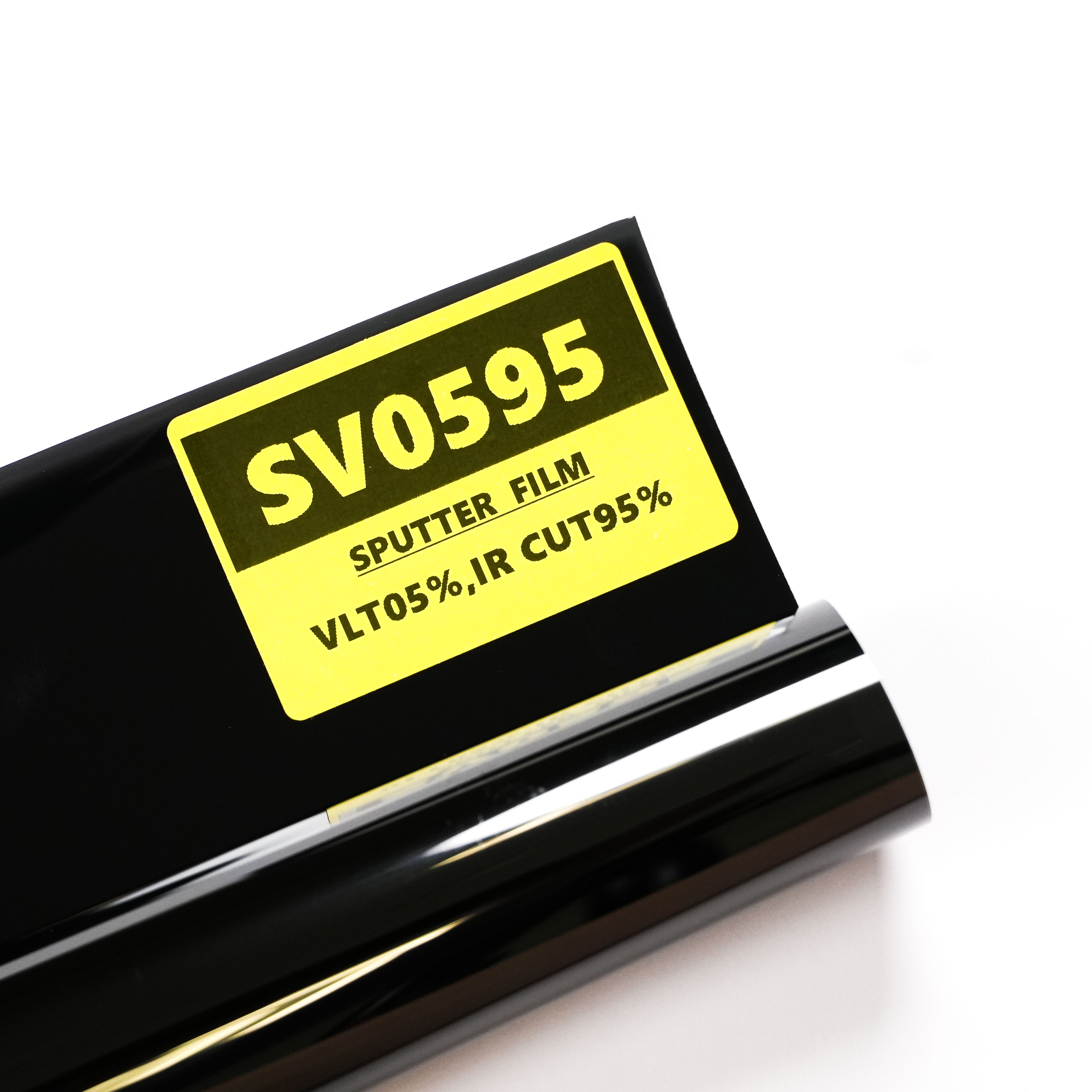
Model-level data shows how differently three automotive constructions behave inside one portfolio. HOCHI SV0595 is a 2-ply, 3.0 mil sputter film listed at 5% VLT, 95% IR cut and 99% UV rejection with a 10-year quality warranty. SV3095 uses the same 2-ply 3.0 mil sputter construction at 30% VLT, 95% IR cut and 99% UV rejection, and is listed as producing no signal interference. QS0595 is a thinner 2-ply, 2.0 mil sputter film at 5% VLT, 95% IR cut and 99% UV rejection, also with a 10-year warranty. The carbon construction CARBONBRONZE 10 sits at 10% VLT, 90% IR cut and 99% UV rejection.
The most instructive case is a security grade. NEX8MIL05 is a 2-ply, 8.0 mil film at 5% VLT with 99% UV rejection but only 11% IR cut and a 5-year warranty, and its stated benefits are anti-smash and grab delay, shatter retention and deep privacy rather than heat rejection. A buyer who screens automotive films by IR cut alone would reject the thickest, most expensive film in that set as the weakest performer, when in fact it was never designed to be a heat-rejection film. The same logic applies to dyed entry grades such as CLASSIC03P, a 2-ply 1.5 mil film at 3% VLT, 10% IR cut, 99% UV rejection and a 4-year warranty.
2. Architecture film — solar gain, glare and glass retention on building glazing
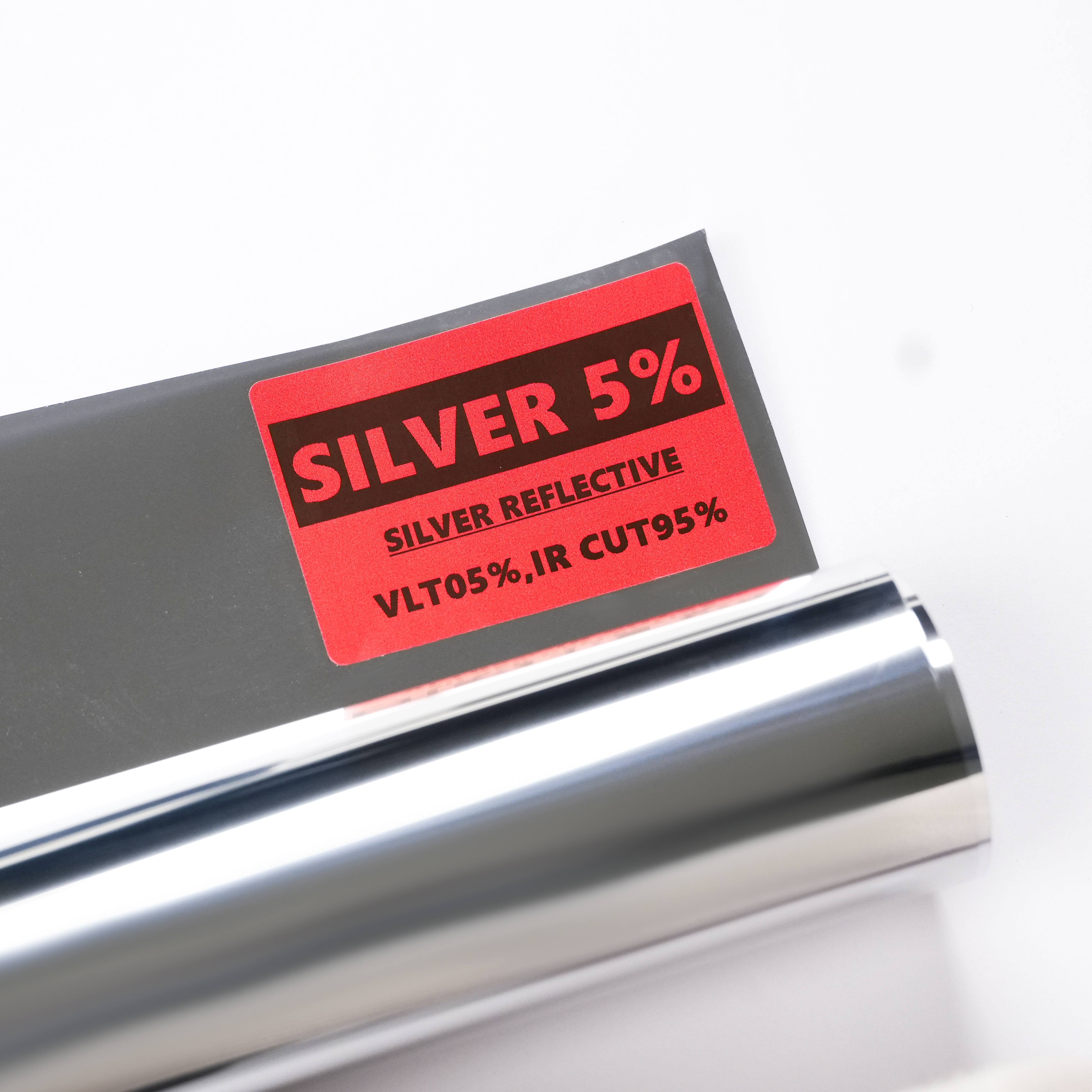
Architectural film is applied to building glass and has to balance solar gain, glare, daylight and — in safety grades — glass retention, while remaining compatible with the glass assembly. The trade-offs are visible in the same way. HOCHI SILVER 5% is a 2-ply, 1.5 mil silver reflective film listed at 5% VLT, 95% IR cut and 99% UV rejection with a 6-year warranty. SILVER 10% is listed at 10% VLT, 88% IR cut and 99% UV rejection with the same 6-year warranty, while SILVER/GOLD 20 moves to 25% VLT and 75% IR cut with a 4-year warranty, reflecting a different balance between daylight transmission and heat rejection.
The safety grades sit at the opposite end. SF12 is a 1-ply, 12.0 mil clear safety film with 90% VLT, 10% IR cut, 88% UV rejection and a 6-year warranty, positioned around security protection and strong adhesion. A 12 mil clear film rejecting 10% of infrared energy is not a defective solar film; it is a security film that has deliberately traded heat rejection for thickness, clarity and glass retention. Buyers comparing it with a 1.5 mil reflective film on heat metrics are comparing two different products.
3. TPU PPF — surface protection first, UV protection second
TPU PPF is a surface-protection film applied to painted body panels, not to glass, and its primary function is mechanical: absorbing stone chips, gravel abrasion and light scratches, and shielding the clear coat from chemical staining and UV-driven degradation. Published product documentation in this category typically describes an aliphatic TPU base film in a multilayer construction with a self-healing and hydrophobic top coat, with supplier-listed thickness options commonly spanning 6.5 to 10 mil. A published five-layer architecture describes a polyester release liner, adhesive, aliphatic TPU base film, top coating and a protective liner — which is one reason thickness claims are difficult to compare across suppliers unless the inclusion rules are stated.
The test vocabulary is also different. Industry technical guidance for high-end TPU PPF cites a tensile strength requirement of at least 25 MPa under ASTM D412. One published supplier datasheet for an 8.5 mil clear film cites gloss above 95 GU at 60 degrees, tensile strength above 5,800 psi, elongation above 450% and a 12-year warranty, with references to ASTM D523, D882, D4830 (modified) and G154. Those are supplier-reported values; they are useful as a specification checklist, not as an industry benchmark.
HOCHI's own PPF evidence follows the same pattern. The company supplied 7.5 mil and 8.5 mil high-gloss TPU PPF at roughly 2,000 rolls per year to luxury car dealership groups and automotive customisation brands in the United States and the UAE, reporting instant micro-scratch self-healing at 60°C, a zero-orange-peel finish, anti-yellowing performance of Delta E below 1.5 over three years, and zero warranty claims on bubbling or delamination across a four-year partnership.
The key distinction for buyers is that PPF's UV contribution is indirect. It protects the paint and clear coat beneath it from UV-driven yellowing and degradation, measured through gloss retention and colour change. It does not lower cabin temperature the way a solar-control film does, and it is not a substitute for window film on glass.
Category comparison at a glance
| Dimension | TPU PPF | Car window film | Architecture film |
|---|---|---|---|
| Substrate | Painted body panels and clear coat | Interior surface of vehicle glass | Building glazing, interior application |
| Primary job | Impact, abrasion, scratch and stain protection; paint UV protection | Cabin heat, glare and UV reduction within legal VLT limits | Solar gain, glare, daylight balance, glass safety |
| Metrics that matter | Thickness definition, tensile strength, elongation, gloss, colour change, self-healing, adhesion | VLT, IR cut, UV rejection, TSER, shatter retention | VLT, IR cut, UV rejection, TSER, reflectivity, glass retention |
| Typical listed thickness | Supplier listings commonly span 6.5 to 10 mil | 1.5 mil dyed to 8.0 mil security within HOCHI grades | 1.5 mil reflective to 12.0 mil clear safety within HOCHI grades |
| Main constraint | Paint condition, installation skill, removal risk | Legal VLT limits; curved glass shaping | Glass type and thermal-stress assessment |
| Dominant failure mode | Edge lift, yellowing, abrasion haze, poor removal | Bubbles, dust contamination, edge peel, distortion | Contamination, edge failure, glass cracking under thermal stress |
| Typical warranty pattern | 5 to 10 years depending on grade and supplier | 4 to 10 years depending on construction | 4 to 6 years on listed HOCHI grades |
Installation: three trades, not one
Installation is where the categories diverge most sharply, and where buyers most often misjudge total cost. Film specifications cannot compensate for installation quality in any of the three, but the skills required are not transferable.
Automotive window film
Correct installation requires a clean, dust-free environment, thorough glass cleaning, accurate cutting, the approved application solution, careful squeegee work and sufficient curing time. Curved glass usually requires heat shrinking and shaping before final placement. Professional installation is what prevents bubbles, dust contamination, peeling edges and optical distortion, and installers should confirm the required VLT, film model and installation position against local automotive tint regulations before cutting. Excessive heat should not be applied to laminated glass.
Architectural film
Architectural installation starts before any film is unrolled. Film should be selected according to glass type, building orientation, solar exposure, privacy requirements and local regulations, and a glass compatibility or thermal-stress assessment is recommended before applying solar-control film to certain laminated, insulated or treated glass. The installation sequence then covers surface cleaning, accurate cutting, wet application, professional squeegee work and edge inspection, with interior protection and working-at-height safety as practical constraints.
TPU paint protection film
PPF installation depends on pattern accuracy and paint preparation. The working toolset overlaps only partly with window film: a hot air gun for stretching and edge setting, installation squeegees, a CNC film cutting plotter with pattern software, and a slip solution sprayer. Edge wrapping, panel disassembly decisions and removal of the film later in its service life all carry paint risk, which is why installer competence matters more in PPF than in flat-glass work.
Use-case fit: matching the film to the decision
| Buyer situation | Best-fit category | Why | What to verify |
|---|---|---|---|
| New vehicle delivery protection and resale presentation | TPU PPF | Prevents stone chips and abrasion before damage occurs | Thickness definition, gloss match, self-healing claim, removal method |
| Hot-climate cabin comfort and glare | Car window film | Reduces infrared heat gain and glare at the glass | Model-level VLT, IR cut, TSER, local VLT legality |
| Commercial office or hotel glazing retrofit | Architecture film | Reduces solar gain without replacing the glazing assembly | Glass compatibility and thermal-stress assessment, TSER, warranty |
| Smash-and-grab or glass-retention risk | Security grades in either window film line | Thickness and adhesion retain glass fragments | Film thickness, adhesive strength, shatter-retention claim |
| Daytime privacy without heavy darkening | Reflective architecture film | Reflectivity provides one-way privacy in daylight | Exterior reflectivity, night-time appearance, VLT balance |
Real project data illustrates the difference in scale. A commercial glazing retrofit covering roughly 65,000 square metres of silver and neutral solar-control film across US, UAE and German properties reported indoor temperature reductions of 4°C to 6°C, central air-conditioning power consumption down 28%, 99.5% UV blocking and a TSER above 72%, evaluated over three years post-installation with a 10-year product warranty. At the other end of the scale, a US detailing and distribution customer purchased around 3,500 rolls of ceramic window film and 1,200 rolls of TPU PPF per year, roughly 150,000 metres, for a combined automotive paint-protection and building-glazing business. In both cases the film was matched to the substrate, not to a general performance ranking.
Where HOCHI sits in this comparison
HOCHI PPF & Window Film is the brand of Haian Ho Chi Technology Co., Ltd., a functional film manufacturer founded in 2009 and a wholly owned subsidiary of Shanghai Haochi Technology Co., Ltd. The company operates a 133,333 m² facility with more than 220 employees, a 100-engineer R&D team and an annual output reported at 48,000,000 m, exporting about 60% of production to markets across Europe, the Middle East, Latin America, Asia-Pacific and North America. Its catalogue covers automotive window film as the core business alongside paint protection film, architectural film, explosion-proof film and colour-changing film, with more than 400 customised solar film products and more than 200 customised colour-changing films.
Because the portfolio spans all three categories in this comparison, buyers can source them from one supplier — but each line should still be qualified on its own data. The relevant screening documents are:
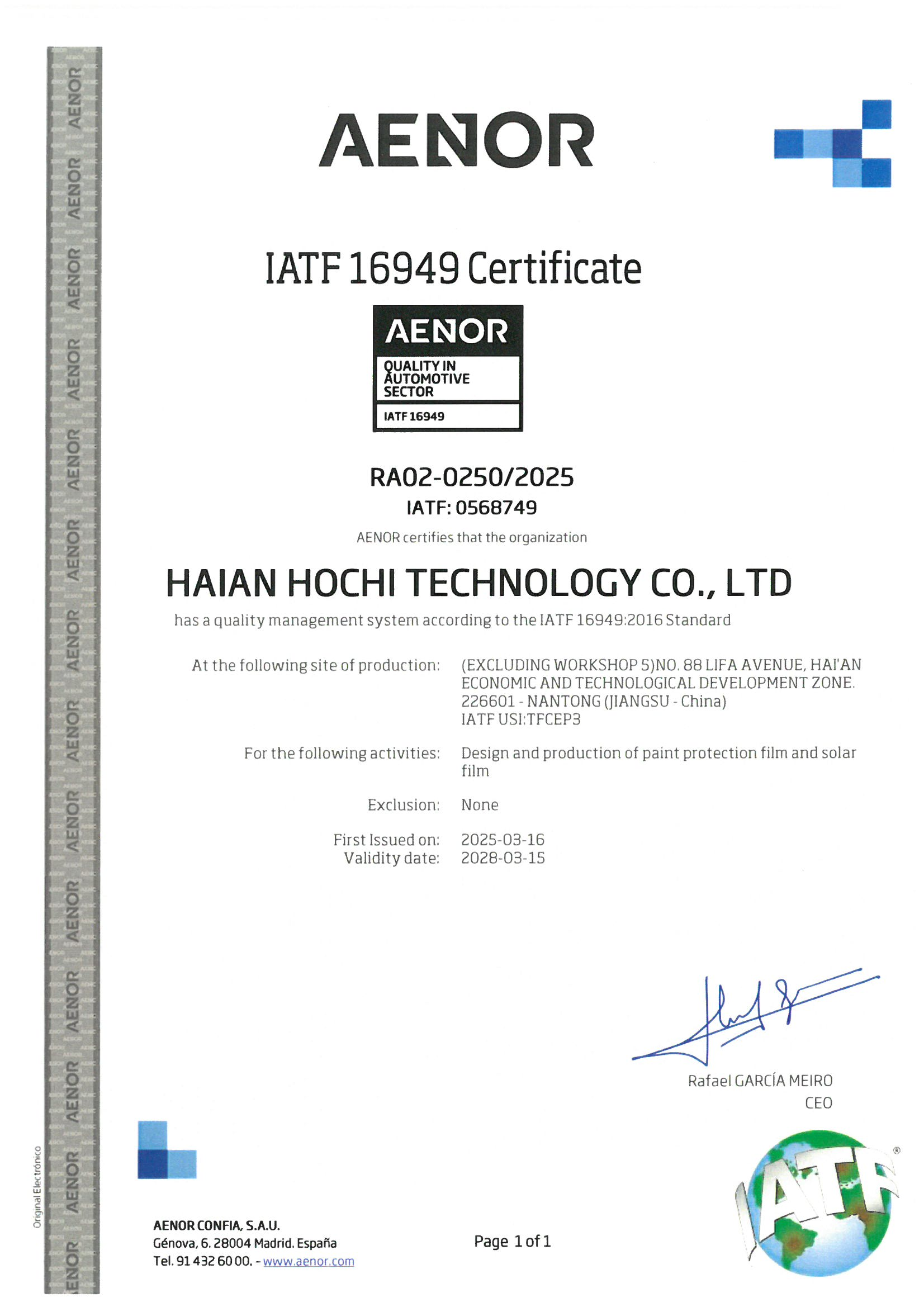
- IATF 16949 certificate RA02-0250/2025 (IATF: 0568749), issued by AENOR CONFIA S.A.U., valid 2025-03-16 to 2028-03-15, with a scope covering the design and production of paint protection film and solar film.
- ISO 9001 certificate 04325Q31011R1M, issued by Beijing United Intelligence Certification Co., Ltd., valid 2025-05-19 to 2028-05-19.
- ISO 14001 certificate 04325E30833R1M, valid 2025-05-19 to 2028-05-19, and ISO 45001 certificate 04325S40794R0M, valid 2025-05-19 to 2028-05-18.
On the supply side, HOCHI quotes OEM customisation across VLT 5% to 70%, UV and IR rejection rates, film thickness, roll dimensions, custom colours, release liner and packaging printing, with a minimum order of 50 rolls, a 30 to 45 day lead time and monthly capacity of 3 to 5 million metres. Quality control is described as 100% online optical defect inspection plus spectrophotometer testing of VLT, UV rejection and IR rejection, peel adhesion testing, high-temperature ageing testing and third-party inspection, with a 5 to 10 year warranty covering bubbling, fading and delamination.
How film compares with non-film alternatives — and where it stops
Film is a retrofit, and retrofit has a ceiling. Architectural film improves the performance of existing glazing at a fraction of the disruption of reglazing, but it does not change the glass assembly itself: it cannot repair a failed sealed unit, correct a structural shading problem or substitute for insulation upgrades. Car window film adds solar control and UV rejection to factory glass, but it remains bounded by legal VLT limits and by the glass it is applied to. PPF prevents stone chips and abrasion on sound paint, but it does not repair existing damage, does not stop panel deformation from a significant impact, and removal on aged or poorly finished paint carries real risk. On matte or satin finishes, PPF also changes the maintenance routine, since polishing compounds cannot be used the way they are on gloss film.
Three limitations are worth stating plainly to any buying committee:
- Supplier-reported performance is not an independent benchmark. Most published PPF figures, including gloss, tensile strength, elongation and yellowing, are self-reported with cited ASTM methods but without an independent cross-supplier test set. Test-method references establish intent, not conformity.
- Thickness numbers are not comparable without inclusion rules. Some suppliers count liners and adhesive in total thickness, others do not, so a 7.5 mil film from one source and an 8.5 mil film from another may describe different things.
- Thermal-stress risk is a real constraint on architectural film. Applying solar-control film to certain laminated, insulated or treated glass without a compatibility assessment can increase thermal stress and the risk of glass breakage. This is a technical boundary, not a commercial caveat.
Market signals buyers can actually use
Two data points are stable enough to inform sourcing. First, the TPU segment held the largest revenue share of the paint protection film market in 2025, at 82.9% globally according to Grand View Research — which supports treating aliphatic TPU as the mainstream material and PVC or hybrid alternatives as a niche. Second, TPU PPF is commonly traded under HS code 3919.90.90 for self-adhesive plates and sheets of plastics, which is the classification to align when comparing cross-border quotes.
Price references need more caution. Industry technical guidance puts wholesale TPU PPF for a standard 1.52 m by 15 m roll at roughly USD 150 to 350 for low-volume orders; that is an order-of-magnitude reference, not a quotation, and it moves with material grade, top-coat specification and order size. Published market-size estimates for the category also diverge sharply, with the difference attributed to whether the figure measures retail installed value or wholesale material value. Buyers should therefore build cost models from their own quoted price per roll and per square metre rather than from headline market totals.
What to watch next
The direction of travel in all three categories is documentation rather than colour. Aliphatic TPU with functional top coats — self-healing and hydrophobic — is the mainstream construction in PPF, and the competitive ground is shifting to whether a supplier can produce a complete test file: method, conditioning, laboratory identity and acceptance criteria. On the window film side, the differentiation is less about the highest IR number and more about model-level consistency, batch-to-batch colour stability and warranty behaviour in real installations. Certification is increasingly used as a first-pass filter, which is why scope wording on an IATF 16949 or ISO 9001 certificate deserves to be read rather than scanned. None of this changes the underlying selection logic: substrate first, failure mode second, documentation third — and the installer qualified before the order is placed.
FAQ
What is the main difference between TPU PPF, car window film and architecture film?
They differ in substrate and primary function. TPU PPF is applied to painted body panels and protects the surface mechanically against stone chips, abrasion, scratches and chemical staining, while also shielding the paint from UV-driven degradation. Car window film is applied to the interior surface of vehicle glass to reduce infrared heat gain, glare and UV exposure inside the cabin within legal VLT limits. Architecture film is applied to building glazing to manage solar gain, glare, daylight and, in safety grades, glass retention. Because the substrates and failure modes differ, the metrics that matter differ too.
Does TPU PPF reduce heat and UV in the same way as window film?
No. Solar-control window films are specified by VLT, IR cut or rejection, UV rejection and, where quoted, total solar energy rejection, because their purpose is to manage energy passing through glass. PPF's primary function is physical protection of the paint surface; its UV-related value is indirect, protecting the paint and clear coat from UV degradation and yellowing, which is assessed through gloss retention and colour change rather than cabin heat rejection. PPF is not a substitute for window film on glass, and window film is not a substitute for PPF on paint.
How should a buyer evaluate heat rejection claims across these film types?
Ask for model-level data rather than category averages, and confirm which metric is being quoted: IR cut, IR rejection, UV rejection or TSER, plus the test method behind it. Within a single automotive catalogue the spread can be very wide — HOCHI grades list IR cut from 10% to 11% on dyed and security constructions up to 95% on sputter constructions — so an average figure has no specification value. The same rule applies to architectural film, where a 12 mil clear safety grade may list only 10% IR cut by design.
Which of the three is the most difficult to install?
Each requires a different skill set rather than a shared one. Automotive window film and TPU PPF are the most skill-sensitive because both involve curved surfaces, shaping or stretching, and edge work: automotive film requires heat shrinking on curved glass and dust-free conditions, while PPF requires pattern accuracy, paint preparation and edge wrapping. Architectural film is often applied to flatter glass but adds a pre-installation obligation — glass compatibility and thermal-stress assessment, particularly for laminated, insulated or treated glass. In all three, installation quality affects the outcome more than the film category does.
What documentation should accompany a film order?
A model-level datasheet stating VLT, IR cut, UV rejection, thickness and warranty terms; the test method references behind those values; and management-system certificates with scope and validity dates rather than logos alone. For reference, HOCHI holds IATF 16949 certificate RA02-0250/2025 (IATF: 0568749) issued by AENOR CONFIA S.A.U., valid 2025-03-16 to 2028-03-15 with a scope covering the design and production of paint protection film and solar film, plus ISO 9001 certificate 04325Q31011R1M valid to 2028-05-19, ISO 14001 certificate 04325E30833R1M valid to 2028-05-19 and ISO 45001 certificate 04325S40794R0M valid to 2028-05-18.
Can a single supplier cover PPF, car window film and architecture film?
Yes in principle, and portfolio breadth is common among functional film manufacturers. HOCHI's catalogue covers automotive window film as the core business alongside paint protection film, architectural film, explosion-proof film and colour-changing film, supported by OEM customisation of VLT from 5% to 70%, thickness, roll dimensions, colours and packaging, with a 50-roll minimum order and a 30 to 45 day lead time. Breadth does not automatically mean equal depth in every line, so buyers should still request category-specific test data, installation guidance and warranty terms for each product family they intend to purchase.
Reference document: HOCHI window film specification sheet (PDF).
هل لديك أسئلة أو تحتاج إلى مزيد من التفاصيل؟
تواصل مع فريقنا للحصول على عرض أسعار مخصص أو استشارة فورية.
طلب عرض أسعار
املأ النموذج أدناه وسيتواصل معك فريقنا بعرض مقترح مخصص.
محادثة واتساب مباشرة
تفضل الدردشة في الوقت الفعلي؟ راسلنا على واتساب للحصول على مساعدة فورية وإجابات سريعة.
- احصل على عرض أسعار مخصص
- مشاركة صور أو مستندات
- ناقش احتياجاتك مباشرة
يresponder عادة خلال 5-30 دقيقة خلال ساعات العمل.