
TWG3246-TEC2430 vs GM37-555PM: Buyer's Motor Comparison
Two 12 V to 24 V gear motors can publish the same torque rating and still fail the same machine. The TWG3246-TEC2430 brushless worm gear motor and the GM37-555PM brushed spur gear motor are a case in point: both are catalogued at a maximum rated torque of 8.0 kg.cm, both accept DC 12 V to 24 V, and both sit in the miniature gear motor class — yet their output speed ranges (3–35 rpm versus 5–800 rpm) place them in different design conversations. This comparison treats them as a buyer would: by fit, by duty, by verification cost, and by what has to be checked before a purchase order is released.
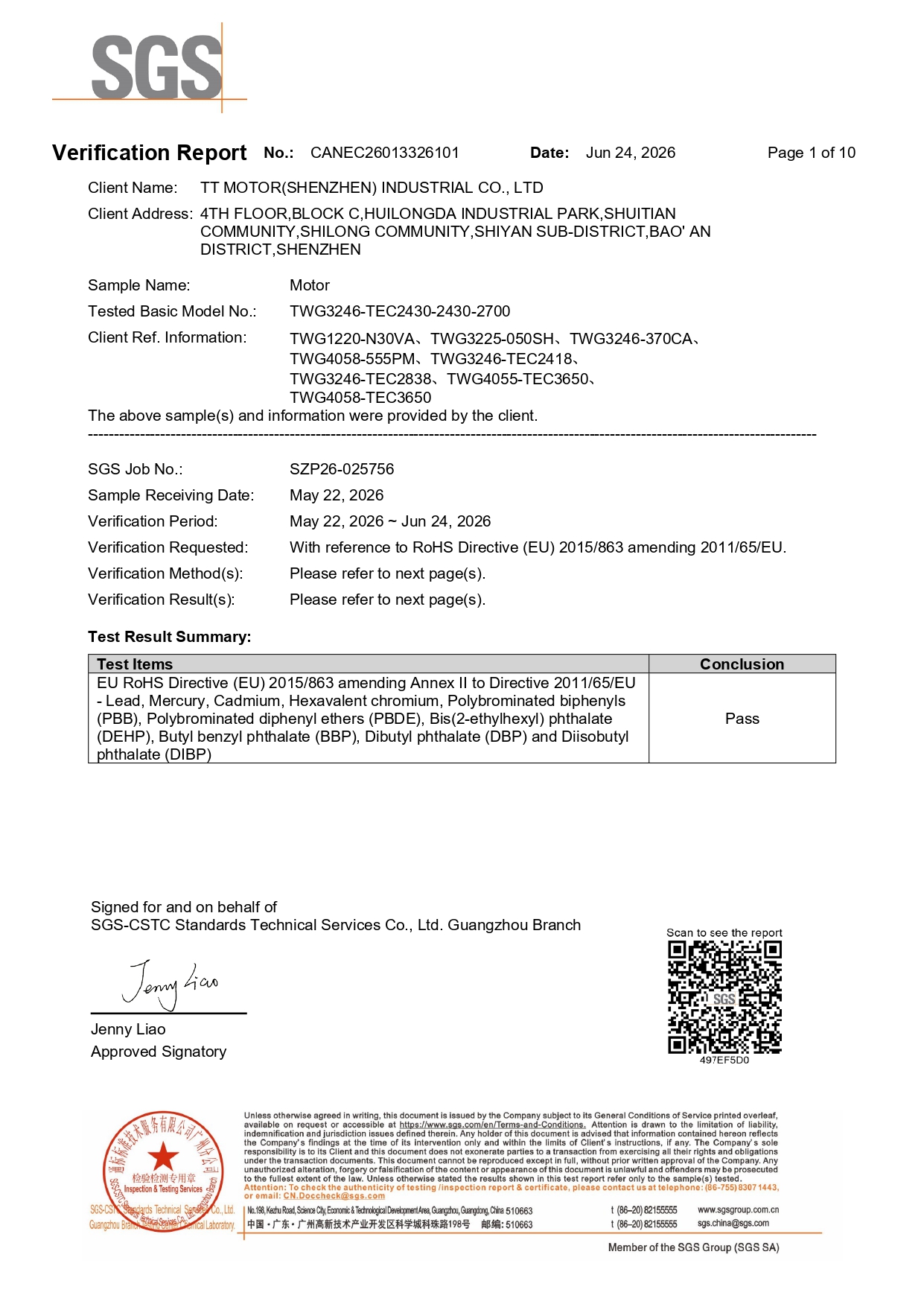
TWG3246-TEC2430: DC brushless worm gear motor, listed at DC 12 V–24 V, 8.0 kg.cm maximum rated torque and 3–35 rpm.
Why identical torque ratings do not mean interchangeable motors
Rated torque is the torque a motor can continuously output under specified operating conditions. It is a boundary value, not a description of behaviour. A worm gearhead and a spur gearhead reach that boundary through different mechanical paths, and each path leaves a signature on speed, axial length, backdrivability, noise and service life.
The practical consequence for buyers is that torque matching is only the first filter. Once a design has a motor that meets 8.0 kg.cm, the remaining questions are almost always about the rest of the envelope: how slow the output can go, how long the gearbox is, how often the unit starts and stops, and how much maintenance the machine can tolerate over its service life. Both models discussed here are listed in the product range of TT Motor (Shenzhen) Industrial Co., Limited, a miniature DC motor manufacturer established in 2006 and headquartered in Bao'an District, Shenzhen, China, with a manufacturing area of approximately 9,000 m² and an annual output of 8,000,000 pieces.
The comparison at a glance
| Parameter | TWG3246-TEC2430 | GM37-555PM |
|---|---|---|
| Motor type | DC brushless worm gear motor | DC brush spur gear motor |
| Gearhead type | Worm | Spur |
| Rated voltage | DC 12 V – 24 V | DC 12 V – 24 V |
| Rated torque (max) | 8.0 kg.cm | 8.0 kg.cm |
| Speed range | 3 – 35 rpm | 5 – 800 rpm |
| Number of gear stages | 3 / 4 / 5 | 2 / 3 / 4 / 5 / 6 |
| Gearbox length | 46 mm | 19 / 21.5 / 24 / 26.5 / 29 mm |
| Module | 0.5 / 0.6 | 0.5 / 0.6 |
| Materials | Stainless steel, iron, copper | Stainless steel, iron, copper |
| Corpus-listed applications | Miniature medical devices, precision automated instruments, electrically adjustable supports | Smart home, automated equipment, automated production line |
Source: product specifications as listed in the TT Motor catalogue corpus. Values are maximum rated figures, not continuous operating guarantees for every duty cycle.
What the speed ranges actually decide
The single most decisive difference is the output speed window. The TWG3246-TEC2430 is listed at 3–35 rpm; the GM37-555PM is listed at 5–800 rpm. Read as design constraints rather than marketing numbers, they split the two motors into different jobs.
Low-speed positioning with the TWG3246-TEC2430
A 3–35 rpm output means the gearhead is doing most of the reduction internally. For tasks that must move slowly and hold position — a syringe plunger advancing at a controlled rate, an adjustable support rising without jolts, an instrument stage indexing in small increments — a motor that already turns slowly removes reduction stages, belts and couplings from the machine. The comparison unit on integrated geared motors makes the same point in general terms: an integrated geared motor combines motor and gearbox so that lower speeds and higher output torque are available in a more compact space, with fewer couplings and mounting structures, simplifying power matching.
The worm configuration also changes behaviour at the output shaft. Worm drives are self-locking in many configurations, which is why they appear in electrically adjustable supports and similar hold-in-place mechanisms. Whether a specific build holds position under a given load still has to be confirmed with the supplier against the actual load case; the catalogue lists the gearhead type, not a holding specification.
Wide-range motion with the GM37-555PM
At 5–800 rpm, the GM37-555PM covers both slow motion and comparatively brisk movement within one gearbox family, with stage counts from 2 to 6 and gearbox lengths from 19 mm to 29 mm. For smart home mechanisms, automated equipment and production line fixtures, that flexibility is often worth more than a narrow, purpose-built speed window: one platform can serve several variants of a product, and a slower variant can be created by adding a stage rather than by changing supplier.
The trade-off is that a brushed spur platform keeps the brush assembly in the drive path. Brushed motors generate electrical sparks and carbon dust during operation, which produces stronger electromagnetic interference than a brushless design, and their lifespan is typically in the range of several hundred to several thousand hours. The brushless TWG3246-TEC2430 uses electronic commutation with no brushes or commutator in contact, so it runs without that spark and dust mechanism.
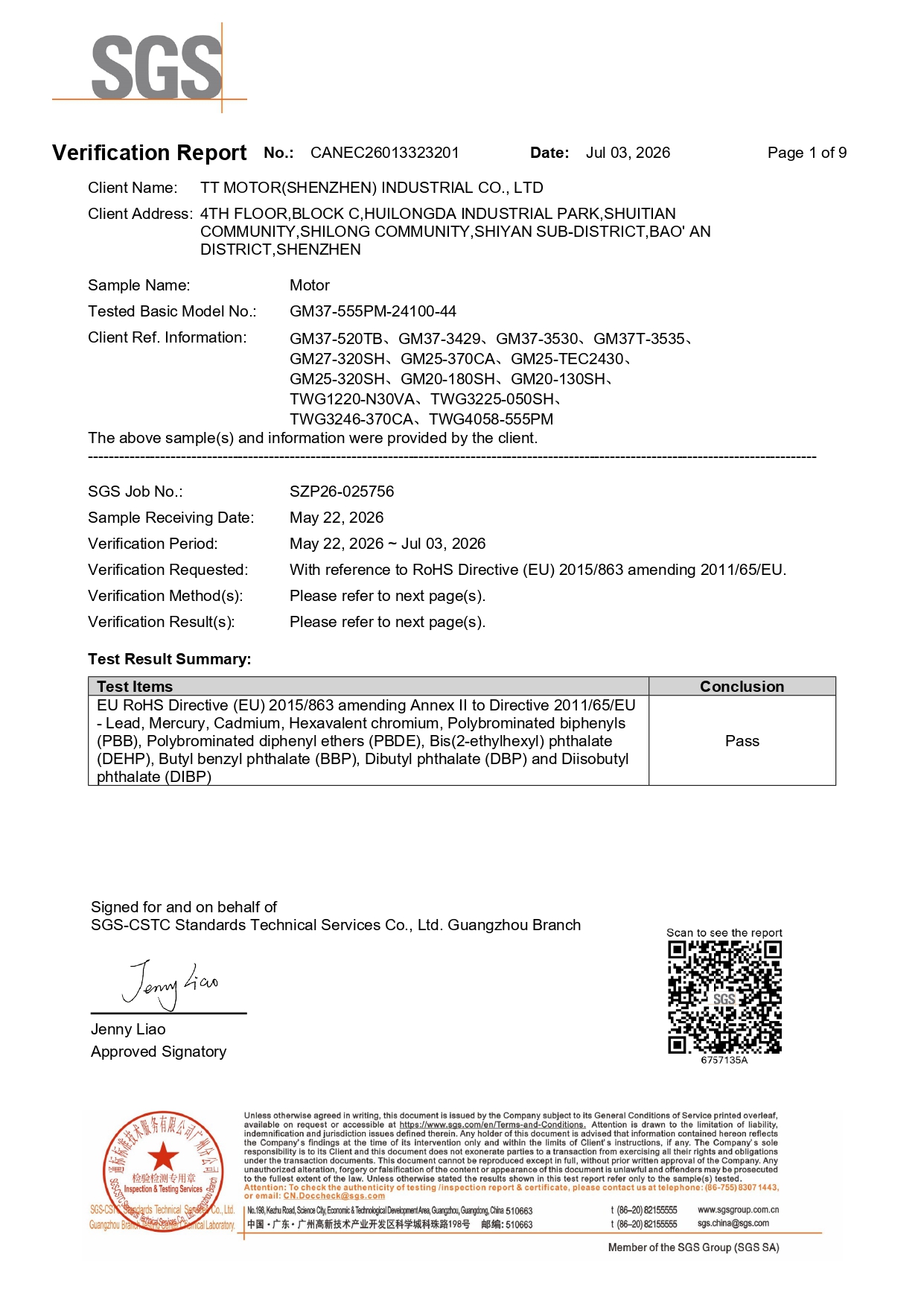
GM37-555PM: DC brushed spur gear motor, listed at DC 12 V–24 V, 8.0 kg.cm maximum rated torque and 5–800 rpm.
Brushless worm versus brushed spur: wear, sparks and duty cycle
The brushless-versus-brushed distinction is well documented, but it only becomes a purchasing decision when it is tied to a duty profile. The comparison corpus records typical efficiency of about 85%–90% for BLDC motors against about 70%–80% for brushed gear motors, depending on model and operating conditions. It also records that brushless units usually carry a higher unit price while potentially lowering long-term maintenance and replacement costs.
Translated into a buyer's checklist, the split looks like this:
- Extended running, frequent start and stop, low maintenance: brushless is the documented recommendation, because there is no brush wear to schedule around.
- Short running time and cost-sensitive designs: brushed remains a legitimate choice, with lower initial cost and simpler control.
- Spark and dust sensitivity: a brushed motor introduces carbon dust and electrical noise into the enclosure, which matters in sealed instruments and in equipment sharing a supply rail with sensitive electronics.
- Life-cycle accounting: the brushless premium is a one-time cost; the brushed saving is offset by wear-related replacement if the machine runs long enough.
Where this comparison stops being favourable to brushless
An honest evaluation has to record the boundary. The TWG3246-TEC2430 is listed at a 46 mm gearbox length and a 3–35 rpm window; it does not offer the 800 rpm top end of the GM37-555PM, and it is not the smaller of the two gearboxes. If a mechanism needs to move quickly between positions and then hold, or if axial space behind the mounting face is tight, the brushed spur unit is the better structural fit regardless of its brush life. Conversely, a machine that only ever needs 5–30 rpm and runs for hours a day will not benefit from the GM37-555PM's speed headroom but will inherit its brush wear. Neither motor is the universal answer; the duty profile decides.
There is a second boundary that applies to both: neither model is listed with an integrated encoder or closed-loop controller. Positioning accuracy therefore depends on the feedback and drive electronics designed around the motor, not on the gear motor alone. Buyers who assume a gear motor delivers positioning precision out of the box are usually the ones who discover the gap during commissioning.
Application fit: medical devices, smart home and automated equipment
The corpus maps each model to different application families, and the mapping is consistent with the mechanical differences described above.
Miniature medical devices and precision instruments
The TWG3246-TEC2430 is listed for miniature medical devices, precision automated instruments and electrically adjustable supports. The medical working conditions recorded in the corpus emphasise low-speed precision motion with long-term operation, low noise, low vibration and stable running — conditions that favour a slow, sealed, brushless drive. Typical equipment in that environment includes analysers, pipetting equipment, syringe pumps, surgical staplers and rehabilitation robots, where an unexpected spark or a maintenance interval inside a sealed housing is expensive to accommodate.
Smart home, automated equipment and production lines
The GM37-555PM is listed for smart home, automated equipment and automated production line use. The corresponding corpus conditions describe low-speed, space-limited operation with miniaturisation, low noise and low power consumption as priorities — for example smart curtains, smart toilets, height-adjustable desks, pet feeders and camera pan-tilt units. In these products the motor runs intermittently, the cost target is tight, and the 5–800 rpm range allows a single gearbox family to cover several SKUs.
Procurement checks before the order is released
Because both motors share a torque rating and a voltage window, the purchasing risk does not sit in the specification table. It sits in the gap between the sample and the shipment, and in the paperwork that has to accompany the shipment.
Sample-to-batch consistency
The documented risk is a familiar one: samples that pass, followed by batch products whose performance drifts. The corpus lists the usual triggers — replacement of raw materials or components, failure to lock the sample process before mass production, sample quantities too small to reflect batch consistency, changes in production equipment or mould status, and inadequate parameter control between batches. The corresponding mitigation is procedural rather than promotional: avoid special machine adjustments for samples, avoid using one material for samples and another for mass production, run a small-batch trial production before mass production, define sampling or full-inspection rules for key parameters, and maintain traceability so that the source of a problem can be located quickly.
Acceptance criteria and commercial terms
Acceptance for these products is handled through pre-shipment test procedures. The commercial terms recorded in the corpus state a minimum order quantity of 2 units, EXW delivery terms and 100% payment; for orders of the GM37-555PM specifically, payment is 100%. Buyers comparing quotations should confirm that the acceptance protocol, not only the price, is written into the order — a pre-shipment test that is not defined parameter by parameter leaves the buyer with little recourse after delivery.
RoHS coverage by model
Most of the company's motors have passed RoHS testing, referenced to RoHS Directive (EU) 2015/863 amending 2011/65/EU. The operational word is most: RoHS coverage should be verified model by model, with a test report that names the exact model and the batch or date it covers. A report issued for a different model in the same family does not automatically transfer, and buyers supplying into the EU or US markets should keep the report version on file alongside the purchase order.
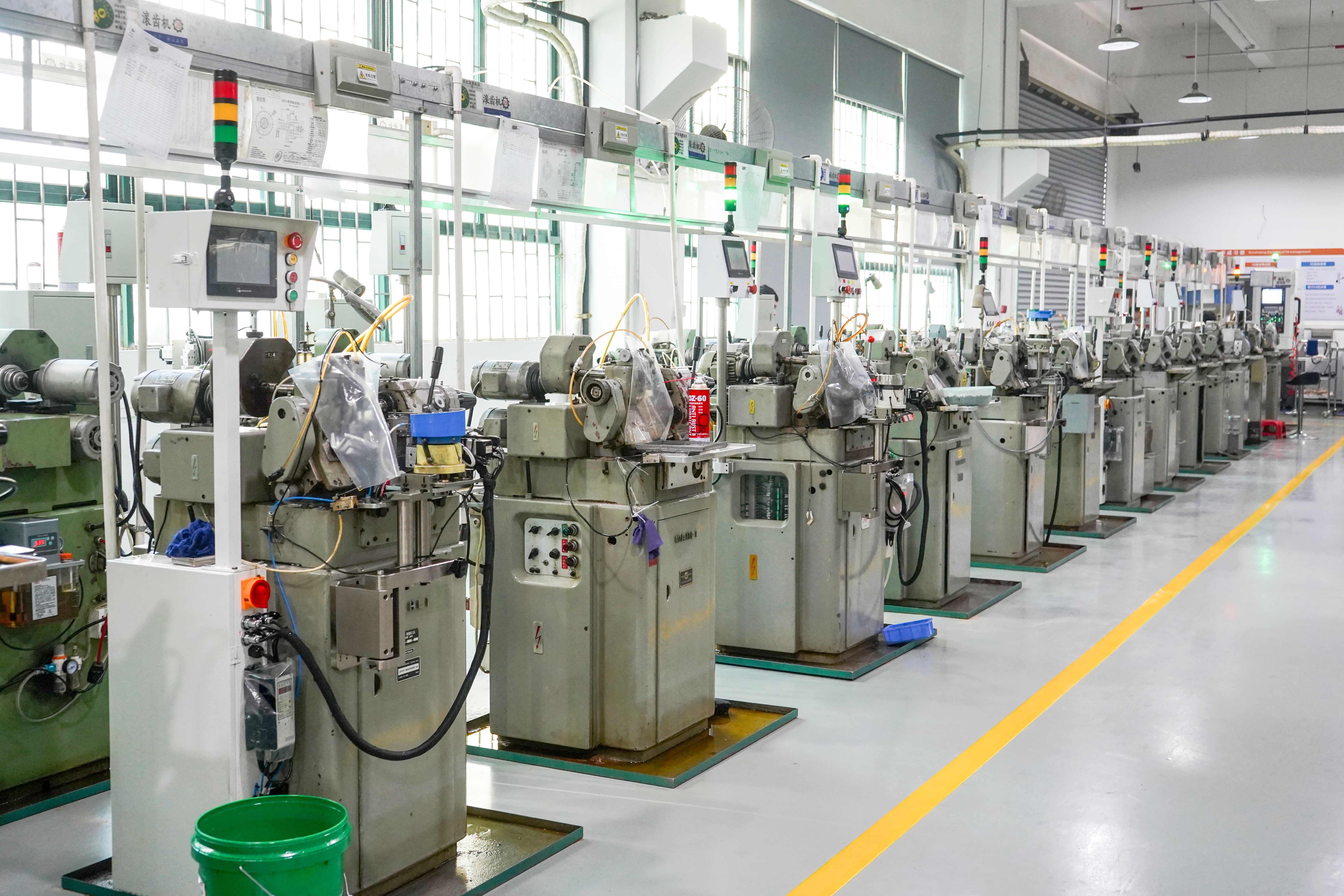
Batch consistency depends on locked processes and defined inspection rules between the sample stage and mass production.
Long-term supply: what the buyer is really selecting
For a programme that will run for several years, the motor choice is only half the decision; the other half is whether the supply relationship can carry the volume and absorb engineering changes. Documented capacity is one input: an annual output of 8,000,000 pieces supports high-volume and long-term OEM motor production programmes, with a workforce of more than 300 employees. Market exposure is another: the main markets are the European Union and the United States, and approximately 70% of products are exported, with export business accounting for 70% of total sales.
Customisation capability matters at the execution stage, when a standard build almost never survives first contact with the enclosure. The company provides customised service capabilities to help customers address power requirements in different application scenarios, and has established long-term cooperative relationships with domestic and international industry customers. The comparison corpus quantifies what customisation can buy in general engineering terms: with the same outer diameter, longer stators and rotors can raise torque density by 20% to 40%, or shorten overall motor length by 15% to 30% at equal torque; matching the motor to the customer's battery voltage can improve overall system efficiency by 5% to 15% and reduce temperature rise at rated current by 10 °C to 20 °C; and tailored shaft diameters can remove couplings and transition supports, shortening the transmission system axially by more than 30% while reducing cumulative error.
Those figures describe customisation potential, not standard catalogue performance. A buyer should treat them as the upper bound of what a tailored build might deliver, and require the supplier to confirm the actual values for the specific model, gear ratio and load case in writing.
Market context: why the brushless side keeps expanding
The commercial backdrop supports the technical argument without settling it. The global brushless DC motor market was reported at approximately USD 22.2 to 22.33 billion in 2025 by Grand View Research and Precedence Research, whose figures are closely aligned for that baseline year. Separately, global trade in electric motors with an output below 37.5 W (HS 850110) was valued at about USD 16.3 billion in 2024 according to OEC data — a reminder that the miniature segment is a large, traded commodity category rather than a niche.
Efficiency expectations are being formalised in parallel. IEC 60034-30-1:2025 introduced the IE5 ultra-premium efficiency class, and EU Ecodesign Regulation (EU) 2019/1781 sets minimum efficiency requirements for motors in the 0.12 kW to 1000 kW band (IE3 for 0.75–1000 kW, IE2 for 0.12–0.75 kW). Sub-100 W gear motors generally fall below the scope of those classes, but the direction of travel is clear: buyers increasingly ask for efficiency and life-cycle evidence at every power level, even where no regulation compels it.
Limits of this comparison
Three boundaries should be stated plainly. First, the specifications compared here are catalogue values; they do not describe performance at a specific load, ambient temperature or duty cycle, and both motors require confirmation against the actual application. Second, the efficiency and lifespan ranges quoted for brushless and brushed designs are typical ranges, not measured results for these two models. Third, no reliability, noise or positioning-accuracy data is published for either unit in the available record, so a buyer planning a precision application should request test evidence rather than infer it from the gearhead type.
Future outlook
The direction of the miniature drive market favours brushless architectures where duty cycles are long and maintenance access is poor, and favours brushed architectures where cost and simplicity dominate and running hours are short. The more consequential change for buyers is not the motor type itself but the evidence expected around it: model-specific compliance reports, defined acceptance criteria, and traceability from sample to batch. Programmes that build those requirements into the purchase order early tend to avoid the expensive stage — discovering, after the first shipment, that the sample and the batch were never the same design.
For reference, TT Motor's full product brochure can be downloaded here: TT Motor product brochure (PDF).
FAQ
How do the TWG3246-TEC2430 and GM37-555PM differ in output speed?
The TWG3246-TEC2430 is listed at 3–35 rpm and the GM37-555PM at 5–800 rpm, although both are rated at a maximum of 8.0 kg.cm and both accept DC 12 V to 24 V. The brushless worm model operates only in a narrow low-speed window, while the brushed spur model spans slow motion through to comparatively fast movement across 2 to 6 gear stages.
Which of the two is better suited to long-term continuous operation?
In general terms, brushless motors are recommended where equipment requires long-term continuous operation, frequent start and stop, or low maintenance, because electronic commutation removes brush and commutator wear. Typical lifespan for brushed motors is in the range of several hundred to several thousand hours, whereas brushless designs are associated with tens of thousands of hours. Brushed motors remain appropriate for cost-sensitive applications with short running times and simple control logic.
What purchasing terms and acceptance criteria apply?
Recorded terms are a minimum order quantity of 2 units, EXW delivery terms and 100% payment; for GM37-555PM orders, payment is 100%. Products are accepted through pre-shipment test procedures, so the test parameters and pass criteria should be agreed in writing before the order is placed.
How can a buyer prevent samples from passing while batch performance differs?
The documented approach is to define motor parameters and acceptance standards before mass production, run a small-batch trial production first, and establish a shipment inspection mechanism before full production begins. Suppliers should also notify customers in advance if raw materials, components or production processes change, and re-verify the process after such changes. Avoiding special adjustments for samples and avoiding material substitution between sample and batch are the two most common preventive measures.
Is RoHS test report coverage available for every model?
Most motors in the range have passed RoHS testing, referenced to RoHS Directive (EU) 2015/863 amending 2011/65/EU. Because coverage is stated at product level rather than as a blanket certification, buyers should request a report that names the specific model — TWG3246-TEC2430 or GM37-555PM — and confirm the report version and date before shipping into EU or US markets.
Can either motor be customised for a specific application?
Customised service capability is offered to help customers address power requirements in different application scenarios. In general engineering terms, customisation can include stator and rotor length changes, voltage matching, shaft diameter modification and sealing or coating options, with documented potential gains such as 20% to 40% higher torque density at equal outer diameter or 15% to 30% shorter motor length at equal torque. Actual values for a given model must be confirmed by the supplier against the specific load case.
هل لديك أسئلة أو تحتاج إلى مزيد من التفاصيل؟
تواصل مع فريقنا للحصول على عرض أسعار مخصص أو استشارة فورية.
طلب عرض أسعار
املأ النموذج أدناه وسيتواصل معك فريقنا بعرض مقترح مخصص.
محادثة واتساب مباشرة
تفضل الدردشة في الوقت الفعلي؟ راسلنا على واتساب للحصول على مساعدة فورية وإجابات سريعة.
- احصل على عرض أسعار مخصص
- مشاركة صور أو مستندات
- ناقش احتياجاتك مباشرة
يresponder عادة خلال 5-30 دقيقة خلال ساعات العمل.