
Tablet Press Accessory Shortlist: Sprayers, Dies, Feeders
Tableting Line Configuration · Buyer Shortlist
Four accessory categories decide whether a rotary tablet press reaches its rated output: an anti-sticking powder sprayer, the punch and die set, a vacuum conveyor, and an industrial dust collector. This shortlist explains what each item does, how it maps onto the GZPK620, GZPK720 and GZPK1060 platforms, and which criteria buyers should fix before an order is placed.
A tableting line is a chain of tolerances rather than a single machine. The press supplies force and dwell time. The tooling defines the tablet geometry and weight. The feeding system decides whether the die cavity is filled consistently at speed. The extraction system decides whether the compression zone stays clean across a shift. Buyers who evaluate only the press specification often discover the missing cost at commissioning, when tooling quantities, compressed-air supply or duct routes turn out to be undefined.
Shanghai Tablet Press Mechanical Components Co., Ltd. (TPCF) is a Shanghai-based manufacturer of tablet press machines, tablet press punches and dies, and capsule filling machines, operating a 15,000 m² factory in Songjiang District, Shanghai, with more than 200 CNC machine tools and in-house mechanical design, machining, assembly, commissioning and testing. Its portfolio runs from compact single-punch and R&D presses to the GZPK620, GZPK720 and GZPK1060 rotary platforms, and the accessory question is therefore a routine part of its configuration discussions rather than an aftermarket add-on.
Why Accessories, Not the Press, Decide Line Performance
Compression force, turret speed and output are visible specifications. Accessory scope is usually buried in an annex, and that is where most commissioning delays originate. Three failure modes recur in solid-dosage production, and each belongs to a different accessory.
The first is sticking and picking, where part of the compact adheres to the punch face and is pulled away on ejection. The second is die-fill variation, where the cavity is not consistently filled at speed, so tablet weight drifts. The third is airborne powder, which settles on the die table, migrates into the enclosure and increases cleaning load between batches. An anti-sticking sprayer, a correctly specified tooling set, a vacuum conveyor and a dust collector address these three modes respectively.
The Shortlist at a Glance
| Accessory | Primary problem addressed | Position in the line | Specification to fix first |
|---|---|---|---|
| Anti-sticking powder sprayer | Sticking and picking at higher turret speeds | Above punch faces, downstream of the feeder | Spray uniformity, adjustment range, enclosure fit, powder compatibility |
| Tablet press punches and dies | Tablet geometry, weight consistency, wear | Turret | Tooling standard, tip geometry, steel grade, polish, quantity equal to turret stations |
| Vacuum conveyor (QVC-2) | Manual feeding, dust during charging, inconsistent die fill | Material inlet to press hopper | 350 kg transport capacity, 0.6 MPa air pressure, 180 L/min air consumption |
| Industrial dust collector (XCJ-1.1) | Airborne powder, cleaning load, workshop cleanliness | Press enclosure and dedusting points | 360 m³/h airflow, 19,500 Pa minimum vacuum, 1.1 kW total power |
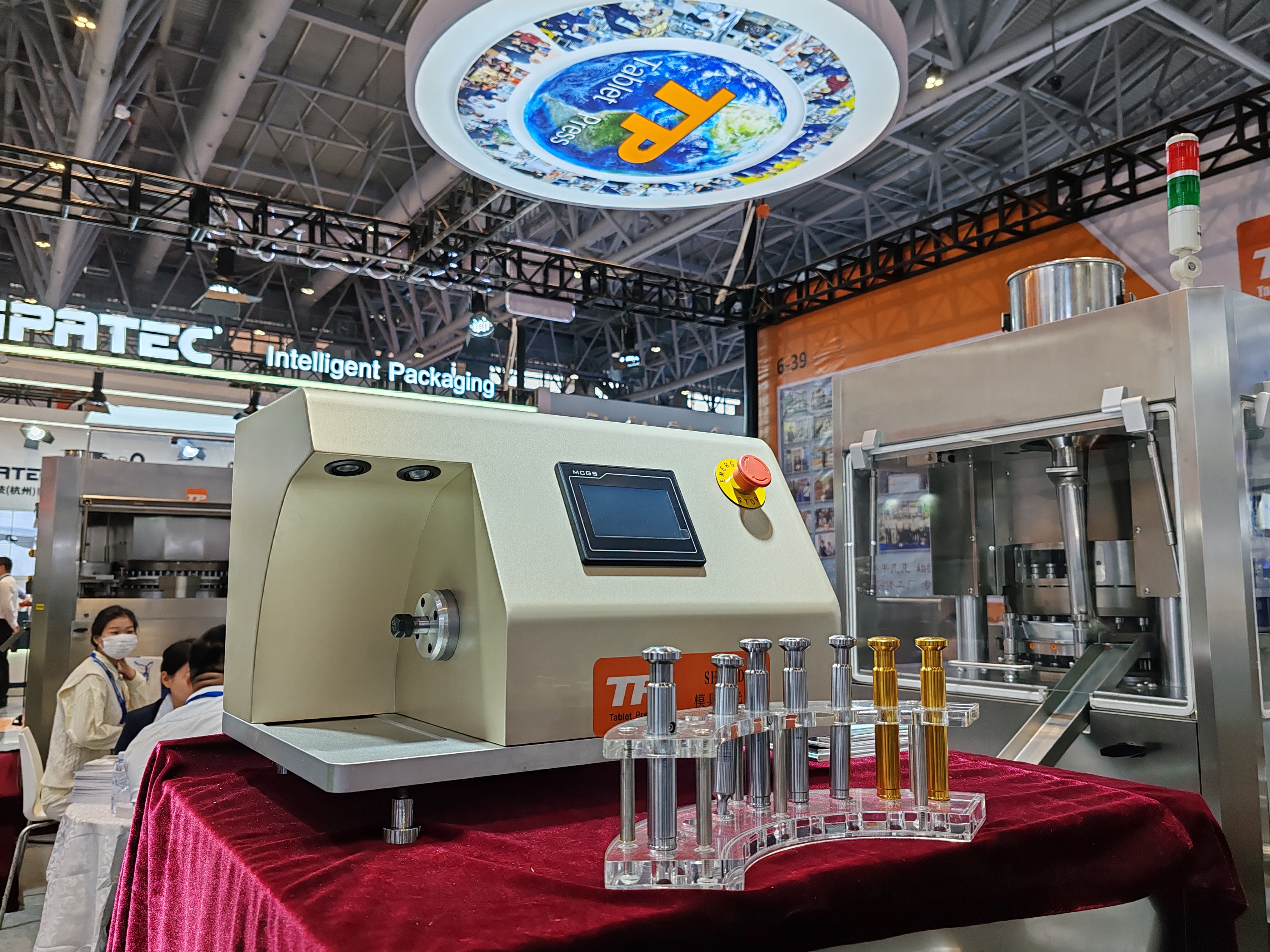
Punches and dies are wear tooling rather than a one-off purchase: tip geometry, steel grade and turret fit determine tablet quality and changeover time.
1. Anti-Sticking Powder Sprayer
A powder sprayer addresses one specific failure mode: adhesion between the compact and the punch face. Sticking and picking typically appear when dwell time shortens at higher turret speed, when the formulation contains hygroscopic or low-melting components, or when punch surface finish has deteriorated through wear. A metered film of fine anti-sticking powder on the punch face lowers friction at the interface and reduces the tendency of the compact to adhere.
When a sprayer earns its place
The device is most relevant where a formulation has already been validated at low speed but shows sticking at production speed, and where reformulation is not commercially practical. It is also relevant for shapes with deep embossing, sharp edges or small radii, where the contact pressure at the punch tip is concentrated and ejection forces are higher.
Integration requirements to confirm
- Mechanical fit: the sprayer must clear the press enclosure, the force feeder and the upper punch path without interfering with the turret guard.
- Adjustment range: delivery must be adjustable across the turret-speed range actually used, not only at the nominal maximum.
- Powder handling: consistent delivery depends on the flow behaviour of the specific powder, so hopper design and any agitation method should be reviewed.
- Cleaning and changeover: the nozzle and hopper must be accessible for cleaning between products to avoid carry-over.
- Documentation: where the line falls under GMP expectations, the sprayer setting should be recorded in the batch record like any other critical process parameter.
Boundaries
A sprayer is a process aid, not a formulation fix. Excessive powder delivery can affect tablet weight variation, surface appearance and content uniformity, so the setting must be established through a trial rather than assumed. For hygroscopic formulations such as effervescent tablets, the dominant cause of sticking is often ambient moisture rather than punch friction, and a dry powder sprayer is not a humidity-control device. In those cases, environmental control and material handling usually take priority.
2. Tablet Press Punches and Dies
Punches and dies are the parts that actually form the tablet, and they are consumables. Their geometry sets the tablet shape and embossing; their fit in the turret sets weight consistency; their surface finish and steel grade set wear rate and ejection behaviour. TPCF lists tablet press punches and dies among its core products and maintains in-house mould development capability, supported by more than 200 CNC machine tools, engraving machines, coordinate measuring machines and coordinate grinders.
Quantity is defined by the turret
Tooling quantity is not a matter of judgement. One complete set equals the number of stations on the turret. A 45-station GZPK620 needs 45 punch and die sets; a 99-station GZPK720 needs 99; a 122-station GZPK1060 needs 122. Because any single worn or damaged station can interrupt a batch, buyers normally plan a spare complement alongside the production set, sized to changeover frequency and observed wear rate.
Tooling standards and multi-layer work
For multi-layer and special-shape work, TPCF specifies tooling options including D, B and BB standards on the ZPT680C triple-layer platform, and offers customizable tablet sizes such as 36.5 × 26.5 × 13 mm on the ZPTX420-17G bilayer platform for dishwasher and laundry tablets. Tooling standard, tip geometry and steel grade should therefore be agreed against the tablet drawing before quotation, not after delivery.
The die table matters as much as the die
Several TPCF rotary platforms use a one-piece 2Cr13 martensitic stainless-steel die table requiring no nickel plating. Compared with a nickel-coated cast iron die table, the 2Cr13 part removes the risk of coating delamination and flaking into the product stream, can be heat treated to a core hardness of 45 to 55 HRC, contains 12% to 14% chromium for inherent corrosion resistance, and can be reground directly when surface wear occurs instead of being stripped and re-plated.
Boundaries
Regrinding a 2Cr13 die table still requires suitable grinding equipment and tolerance control; it is not a workshop-level operation. Punches and dies remain wear items regardless of die table material, and regrinding changes tip geometry, so the tablet drawing and the tooling record must be updated after each regrind to keep weight and hardness within specification.
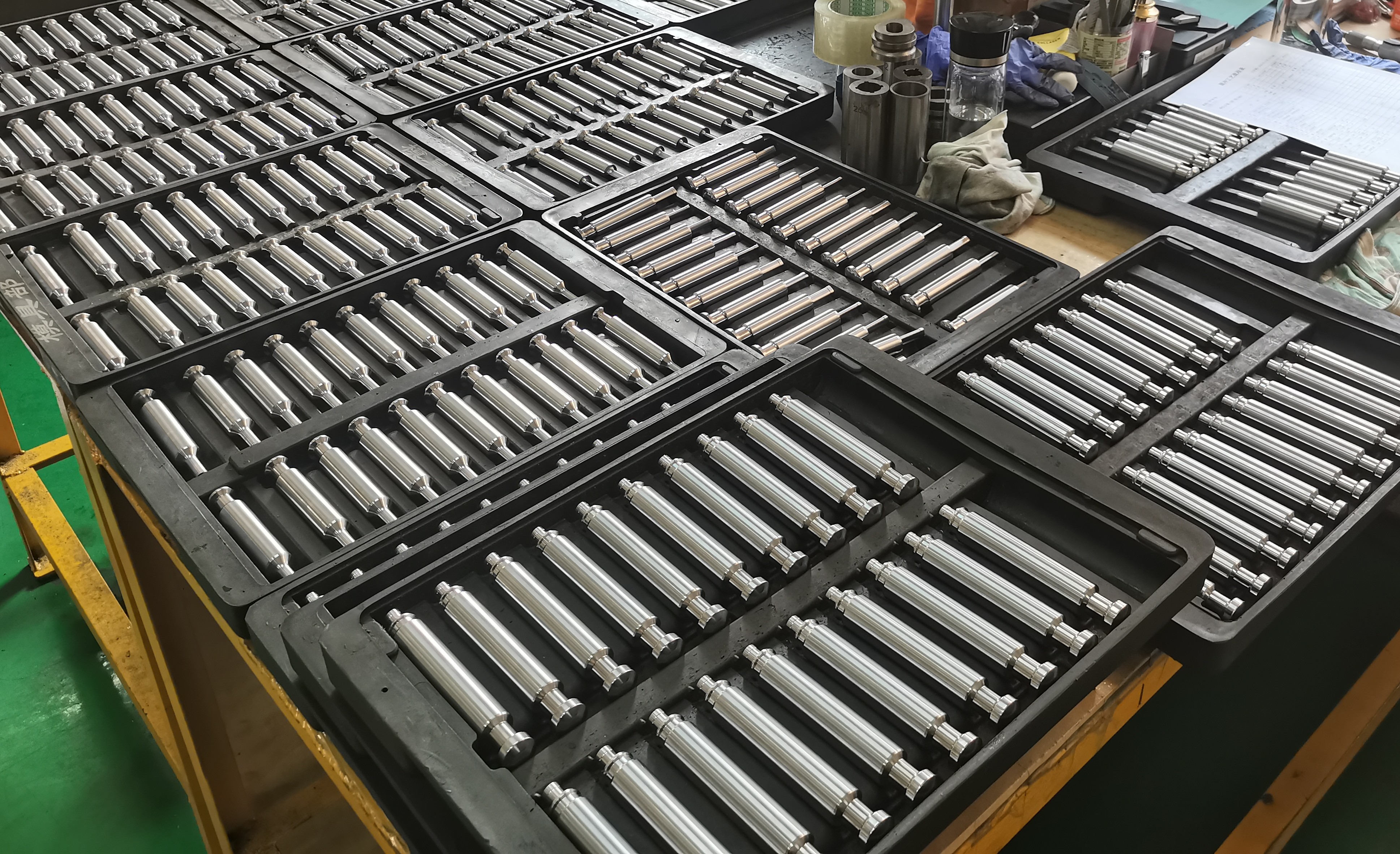
In-house mould development allows tooling geometry to be matched to the tablet drawing before the press configuration is frozen.
3. Vacuum Conveyor
Feeding is the least visible constraint on output. A press cannot compress material that has not arrived at the die cavity, and manual charging introduces variation in hopper level, dust during transfer and operator dependence. The QVC-2 vacuum conveyor, used in TPCF line configurations, is specified at 350 kg transport capacity, 0.6 MPa air pressure, 180 L/min air consumption, 140 × 560 mm diameter and 35 kg weight.
Selection criteria
- Conveying distance and lift height between the material source and the press hopper.
- Bulk density and flow behaviour of the granulate, since these determine whether pneumatic conveying is gentle enough.
- Product changeover: the conveying path must be cleanable and, where required, verifiable between products.
- Compressed-air quality and stability, because the unit is air-driven at 0.6 MPa.
Boundaries
A vacuum conveyor is not universal. Fragile granules can break up in the air stream, and very cohesive or sticky blends may bridge in the receiver. The unit also depends on a stable compressed-air supply at 0.6 MPa; where plant air fluctuates, feeding consistency fluctuates with it. For laboratory and small-batch work, manual charging may remain the more practical choice.
4. Industrial Dust Collector
Dust control affects both product loss and cleaning time. The XCJ-1.1 industrial dust collector is specified at 360 m³/h airflow, 19,500 Pa minimum vacuum, 1.1 kW total power, 700 × 460 × 1030 mm dimensions and 70 kg weight, with the main structure made of stainless steel and a modular dust-collection nozzle that is removable for cleaning. In TPCF line configurations it is paired with the press and the vacuum conveyor as a three-part material-handling and hygiene group.
Selection criteria
- Number and position of extraction points on the press enclosure, feeder and transfer points.
- Duct length and bend count, since pressure loss reduces effective capture at the hood.
- Dust characteristics, including whether the powder is corrosive or abrasive, which affects filter and housing choice.
- Cleaning routine: the removable nozzle design shortens between-batch cleaning.
Boundaries
The XCJ-1.1 airflow is fixed at 360 m³/h per unit. In a workshop with several presses, capture performance cannot be assumed by multiplying unit count; each extraction point, duct run and hood design needs to be assessed as a system, and a centralised extraction design may be more appropriate than per-machine units. The unit is a dust collector, not a containment system for highly potent compounds.
How the Accessories Map onto GZPK620, GZPK720 and GZPK1060
The three high-speed platforms share a 100 kN maximum main compression force but differ in station count, output and installed weight. Those differences drive accessory scope more than any other specification.
| Platform | Stations | Maximum single-layer output | Accessory implication |
|---|---|---|---|
| GZPK620 (GZPK620-45 / -55 / -65) | 45 / 55 / 65 | 378,000 / 528,000 / 624,000 tablets/h | 45–65 tooling sets per turret; 30 kN pre-compression; 3,300 kg net weight; double outlet |
| GZPK720 (GZPK720-51 / -65 / -83 / -99) | 51 / 65 / 83 / 99 | 306,000–712,800 tablets/h | Up to 99 tooling sets; higher dust load per hour; 5,500 kg net weight; 20 mm filling depth |
| GZPK1060 (GZPK1060-76 / -95 / -113 / -122) | 76 / 95 / 113 / 122 | 342,000–658,800 tablets/h; triple-layer 114,000–219,600 tablets/h | Largest tooling inventory; 8,000 kg net weight requires floor-loading and rigging planning; three outlets |
Two practical consequences follow. First, tooling inventory scales with stations, so the accessory budget for a 122-station machine is structurally different from a 45-station machine even when the press price is comparable. Second, higher output means more powder in motion per hour, which raises the importance of extraction design and of stable feeding. The GZPK620i variant adds optional bilayer capability, which places additional demands on feeder accuracy and on tooling consistency between the two layers.
All three platforms accept a maximum tablet diameter of 25, 16, 13 mm across their station variants, with the GZPK720 and GZPK1060 extending to 10 mm. That range should be checked against the largest and smallest tablet in the product plan before tooling is ordered.
Selection Criteria by Production Scale and Tablet Type
| Stage | Representative platform | Accessory priority |
|---|---|---|
| Formulation and R&D | ZPTX226-8 R&D rotary press, 8 stations, 80 kN main / 16 kN pre-compression | Small tooling inventory; manual or small vacuum feed; one extraction point; sprayer only if the formulation is proven sticky |
| Small batch | ZPT168-5 / -7 / -10 / -12, 5–12 stations, 50 kN, 7,800–21,600 tablets/h | Tooling matched to short runs; simple feeding; compact dust extraction |
| Pilot and mid-volume | GZPX370i or GZPK370i, 26–50 stations, up to 330,000 tablets/h | Vacuum feeding becomes worthwhile; per-press dust collection; spare tooling complement |
| High volume | GZPK620 / GZPK720 / GZPK1060, 45–122 stations | Full accessory set: feeding, extraction, sprayer where validated, tooling lifecycle planning |
Tablet type modifies the priority order. Effervescent formulations are moisture-sensitive and prone to sticking, so environmental control and punch surface condition come first. Salt and chlorine tablets are abrasive and corrosive, which places weight on die table corrosion resistance and on tooling wear rate. Candy and mint tablets carry hygroscopic sugar systems that tend to stick at speed. Catalyst tablets are abrasive and generate dust, which raises extraction requirements. Multi-layer tablets depend on feeder accuracy and on consistent tooling between layers, so the vacuum conveyor and the tooling set carry more of the burden than the sprayer.
Where the Configuration Is Proven
Two recorded TPCF projects illustrate how accessory scope is set by the application rather than by the press alone. In a Nigerian bouillon cube project, the customer operates 10 customized bouillon cube production lines covering chicken bouillon cubes, seasoning cubes, chicken stock cubes and broth cubes, with a 10-year project duration, and plans to add another 5 lines next year to expand capacity. Each line combines a rotary press with a QVC-2 vacuum conveyor, an XCJ-1.1 dust collector, an automatic feeding system and packaging equipment, so feeding and extraction are designed as part of the line rather than added later.
In a Chinese pharmacy project, 320 sets of automatic tablet presses were installed in a factory workshop for pharmacy tablet production, with reported equipment service duration of 3 to 6 years and stable operation maintained across the installed base. At that scale, tooling supply, spare-part standardisation and dust extraction become procurement categories in their own right.
Comparison with Traditional Configuration
| Decision | Traditional approach | Shortlisted approach | Boundary to accept |
|---|---|---|---|
| Feeding | Manual charging into the hopper | QVC-2 vacuum conveyor at 350 kg capacity | Requires 0.6 MPa air and 180 L/min consumption; fragile or cohesive blends need testing |
| Sticking control | Reduce turret speed or wipe punch faces manually | Metered anti-sticking powder sprayer | Not a formulation fix; over-application affects weight and appearance |
| Die table | Nickel-coated cast iron | One-piece 2Cr13 stainless die table, no plating | Regrinding requires specialist equipment and tolerance control |
| Dust control | Room extraction only | XCJ-1.1 at 360 m³/h and 19,500 Pa per press | Multi-press workshops need system-level duct and hood design |
The honest limitation of this shortlist is that it adds capital scope and operating discipline. A sprayer adds a parameter to validate, a vacuum conveyor adds a compressed-air dependency, and a dust collector adds filter maintenance. Buyers who install the hardware without the corresponding standard operating procedures often see no net improvement, because the constraint simply moves from the press to the auxiliary equipment.
Procurement Checklist
- Confirm turret stations, which fixes the complete tooling quantity.
- Check the largest and smallest tablet diameter against the platform range of 25, 16, 13 mm, or 10 mm on GZPK720 and GZPK1060.
- Confirm filling depth, which is 20 mm on GZPK620, GZPK720 and GZPK1060 variants.
- Agree tooling standard, tip geometry, steel grade and polish against the tablet drawing.
- Confirm die table material and whether plating is present.
- Decide the feeding method and verify the compressed-air supply at 0.6 MPa.
- Map extraction points and duct routes before the press is positioned.
- Decide whether a sprayer is required on the basis of trial data, not assumption.
- Agree FAT scope, and note that TPCF performs FAT according to customer requirements and can support SAT at the customer site.
- Plan spare tooling and a regrinding route, and record each regrind against the tooling history.
Commercial parameters for TPCF configuration are a monthly capacity of 80 to 120 units, a lead time of 45 to 75 days and a minimum order of one unit, with OEM and ODM services available and engineers able to attend site for commissioning and training or to support by video.
Market Trend Analysis
Third-party commercial research estimates the global tablet press machine market at USD 1.52 billion in 2025, with forecast attention concentrated on automated and multi-station machines. That figure is a commercial research estimate rather than an independently audited statistic, and no verifiable public data set was identified for the accessory segment specifically, so accessory demand is best read through the equipment it attaches to rather than through a separate market number.
Regulatory timing is a clearer signal. Regulation (EU) 2023/1230 repeals and replaces Directive 2006/42/EC and applies from 20 January 2027, which sets a re-assessment cycle for CE conformity documentation on machinery placed on the EU market. For buyers, that date argues for specifying accessories with their own conformity documentation rather than treating them as unbranded add-ons.
Data integrity expectations are moving in the same direction. In the United States, 21 CFR Part 11 sets criteria under which electronic records and electronic signatures are considered trustworthy and equivalent to paper records. In the European Union, GMP Annex 11 applies a risk-based approach to computerised systems used in GMP-regulated manufacture. Neither framework addresses sprayers or conveyors directly, but both make recorded process parameters — sprayer setting, feeder status, extraction status — part of the batch record rather than informal operator knowledge.
Quality management screening follows ISO 9001:2015, the international standard specifying requirements for a quality management system. TPCF holds a Quality Management System Certificate numbered 114025Q10315ROM, issued by Drucker (Jiangsu) Certification Co., Ltd. against GB/T 19001-2016 / ISO 9001:2015, valid from 16 January 2025 to 15 January 2028, and a CE certificate numbered OP231226.STPWU21 issued by ECM against EN ISO 12100:2010 and EN 60204-1:2018, valid from 26 December 2023 to 25 December 2028 for tablet press scope in the EU market.
Future Outlook
Accessory scope is migrating from the commissioning stage to the enquiry stage. Buyers who ask for station count, tablet diameter range, filling depth, feeding method and extraction points in the same request as the press specification avoid the most common source of delay between order and first batch.
Three developments are likely to shape the next configuration cycle. Tooling lifecycle management is becoming a documented process rather than an informal one, driven by the cost of unplanned changeovers. Extraction and feeding are increasingly designed as a system for the whole workshop rather than per machine. And the 2027 EU applicability date will push conformity documentation down to auxiliary equipment, which favours suppliers who can provide certificates and technical files for the accessories they configure, not only for the press.
FAQ
Which accessories should be decided at the same time as a new rotary tablet press?
The tooling quantity, the feeding method, the extraction points and whether a sprayer is needed should all be fixed before the FAT. Tooling quantity follows turret stations directly, and feeding and extraction affect the physical layout of the compression room, so deciding them after the press is positioned usually adds cost.
How do I know whether I need an anti-sticking powder sprayer or a formulation change?
A sprayer is appropriate when a formulation runs acceptably at low turret speed but shows sticking or picking at production speed, and reformulation is not commercially practical. It is not appropriate where the root cause is ambient moisture, as with hygroscopic effervescent blends, or where punch surface finish has deteriorated and the tooling simply needs replacement or polishing.
How many punch and die sets make up a complete set?
One complete set equals the number of stations on the turret. A 45-station GZPK620 requires 45 sets, a 99-station GZPK720 requires 99, and a 122-station GZPK1060 requires 122. Spare quantities beyond that complete set depend on changeover frequency and observed wear rate rather than on a fixed rule.
What are the limits of a vacuum conveyor compared with manual feeding?
The QVC-2 is specified at 350 kg transport capacity, 0.6 MPa air pressure and 180 L/min air consumption, so it depends on a stable compressed-air supply. Fragile granules can break up in the air stream, cohesive blends may bridge in the receiver, and the conveying path must be cleanable between products. For laboratory and small-batch work, manual charging can remain the simpler option.
Does one XCJ-1.1 dust collector suit a workshop with several presses?
Not by simple multiplication. The XCJ-1.1 is specified at 360 m³/h airflow, 19,500 Pa minimum vacuum and 1.1 kW total power per unit. With several presses, each extraction point, hood and duct run has to be assessed as a system, and a centralised extraction design may be more suitable than one unit per machine.
Which specifications should be confirmed before ordering tooling for GZPK620, GZPK720 or GZPK1060?
Confirm the station count, the maximum tablet diameter within the platform range of 25, 16, 13 mm or 10 mm, the filling depth of 20 mm on the listed variants, the tooling standard where multi-layer or special shapes apply, and the die table material. Tooling geometry should be agreed against the tablet drawing so that tip shape, embossing and steel grade are fixed before production begins.
For readers who need the full machine and tooling specification set, the TPCF product brochure is available as a public PDF: TPCF product brochure.
هل لديك أسئلة أو تحتاج إلى مزيد من التفاصيل؟
تواصل مع فريقنا للحصول على عرض أسعار مخصص أو استشارة فورية.
طلب عرض أسعار
املأ النموذج أدناه وسيتواصل معك فريقنا بعرض مقترح مخصص.
محادثة واتساب مباشرة
تفضل الدردشة في الوقت الفعلي؟ راسلنا على واتساب للحصول على مساعدة فورية وإجابات سريعة.
- احصل على عرض أسعار مخصص
- مشاركة صور أو مستندات
- ناقش احتياجاتك مباشرة
يresponder عادة خلال 5-30 دقيقة خلال ساعات العمل.