
Tattoo Cartridge Needle Qualification Evidence: FDA 21CFR, CE MDR, RoHS 2.0 and MSDS
A tattoo cartridge needle qualification file should answer four practical questions: which document is being shown, which product code it names, which market it addresses, and what it does not prove. For product code 4868 / model SP5, CREDITECH MED references four documents: FDA testing report TST2019112501-4EN for the US, CE MDR document ICR Polska/DR/HM2311112 for the EU, RoHS 2.0 report TST2019112501-3RC, and MSDS BCTC2305199480R. This reference converts those identifiers into a buyer checklist.

Industry context: qualification evidence is checked against production and inspection records, not only certificate covers. Image: CREDITECH MED manufacturing environment.
Why a Certificate Number Is Not a Qualification File
In professional tattoo supply, the phrase medical-grade tattoo needle is often used before the buyer has seen the document scope. A certificate number can confirm that a document exists, but it does not automatically confirm that the document covers the exact cartridge, material, sterilisation process, or market being purchased. That gap matters most at the Research to Evaluation stage, when distributors, private-label brands, and studio chains are deciding whether a supplier can enter an approved vendor list.
The practical alternative is a document matrix. Each row links one document to a product code, a standard, an issuing body, and a buyer action. The matrix does not replace sampling or factory audit. It makes the qualification conversation specific enough to be verified.
The Four Documents in the CREDITECH MED Qualification Set
Suzhou Creditech Electronic Technology Co., Ltd. (CREDITECH MED) is a China-based manufacturer of tattoo cartridge needles, PMU cartridges, and SMP cartridges, founded in 2009 and serving Europe, North America, South America, and Southeast Asia. For product code 4868 / model SP5, the qualification set discussed here includes the following documents.
| Document | Identifier and issuer | Market | Standards named | Buyer action |
|---|---|---|---|---|
| FDA testing report | TST2019112501-4EN; TST Testing Technology Co., Ltd. | US | FDA 21CFR175.300; FDA 21CFR180.22; ASTM C738-94; product code 4868 | Confirm that the test article, product code, and standards match the SP5 specification. |
| CE MDR document | ICR Polska/DR/HM2311112; ICR Polska Co. Ltd. | EU | MDR (EU) 2017/745 Annex II & Annex III | Check the legal manufacturer, document type, product scope, and validity shown as 2023-11-30 to 2028-11-29. |
| RoHS 2.0 report | TST2019112501-3RC; TST Testing Technology Co., Ltd. | EU | (EU) 2015/863; (EU) 2017/2102; full set of IEC62321 series standards | Check the restricted-substance scope against housing, membrane, tip, and packaging materials. |
| MSDS | BCTC2305199480R; Shenzhen BCTC Testing Co., Ltd. | Global (EU & USA) | CLP Regulation (EC) No 1272/2008; REACH (EC) No 1907/2006 | Use for material safety communication and handling review; confirm revision date 2023-05-17 and validity to 2033-05-17. |

Document evidence example: the FDA testing report references product code 4868 and the standards named in the document. Buyers should verify that the document matches the exact SKU under evaluation.
What Each Document Covers and What It Does Not
FDA testing report TST2019112501-4EN
The FDA testing report is issued for the US market and cites FDA 21CFR175.300, FDA 21CFR180.22, and ASTM C738-94 for product code 4868. It is a testing report, not a statement of FDA marketing authorization by itself. The buyer check is whether the report product description, material identification, and test standards match the SP5 cartridge rather than a generic needle family. If the purchase order changes housing material, membrane, or packaging, the buyer should ask whether the report remains relevant.
CE MDR document ICR Polska/DR/HM2311112
For the EU, CREDITECH MED references CE MDR documentation with certification number ICR Polska/DR/HM2311112, issued by ICR Polska Co. Ltd., against MDR (EU) 2017/745 Annex II & Annex III. The corpus identifies this item as CE MDR Document Review. That wording matters. A document review should be read with its exact document status, legal manufacturer, product scope, and validity period. The record shows validity from 2023-11-30 to 2028-11-29. Buyers should confirm whether the file includes a notified-body certificate, a manufacturer declaration, or a review document before treating it as evidence of market access.
RoHS 2.0 report TST2019112501-3RC
For EU RoHS 2.0, the referenced report is TST2019112501-3RC, issued by TST Testing Technology Co., Ltd., under (EU) 2015/863, (EU) 2017/2102, and the full set of IEC62321 series standards. RoHS is directly relevant to the non-needle components: medical-grade PC housing, silicone membrane, non-toxic transparent plastic tip, and packaging materials. A buyer should not use a RoHS report as a needle-surface or sterilisation validation document. Its value is to support restricted-substance compliance for the materials within its scope.
MSDS BCTC2305199480R
The MSDS documentation BCTC2305199480R is issued by Shenzhen BCTC Testing Co., Ltd. for the Global market, including EU and USA. It references CLP Regulation (EC) No 1272/2008 and REACH (EC) No 1907/2006. The record shows an issue date of 2023-05-17 and validity to 2033-05-17. In procurement, an MSDS is a communication and handling document. It helps the buyer review material safety information and regulatory references, but it is not a substitute for sterility validation, biocompatibility assessment, or batch release testing.
How Qualification Evidence Maps to Tattoo Cartridge Specifications
A qualification file becomes useful when it is connected to the physical specification. For product code 4868 / model SP5, the cartridge specification includes medical-grade stainless steel needles, medical-grade PC housing, a silicone anti-backflow membrane, and a non-toxic transparent plastic tip. The same specification lists EO gas sterilization, sterile breathable film packaging, a precision tolerance of ±0.02–0.05mm, needle diameters of 0.15mm, 0.20mm, 0.25mm, 0.30mm, and 0.35mm, taper lengths from 1.5mm to 7mm, and RL / RS / RM / Magnum / Flat configurations for rotary tattoo machines. Low-vibration design and stable controlled ink delivery are also part of the stated product profile.
| Specification element | Qualification link | Buyer check |
|---|---|---|
| Medical-grade stainless steel needles; 0.15mm to 0.35mm diameters; 1.5mm to 7mm tapers | FDA testing report and CE MDR document identify the product scope. | Match the product code, needle description, and model SP5 to the document; confirm that the required configuration is included. |
| Medical-grade PC housing; silicone anti-backflow membrane; non-toxic transparent plastic tip | RoHS 2.0 and MSDS relate to material composition and safety communication. | Compare the material list in the purchase order with the document scope; check whether housing or membrane changes trigger a document update. |
| EO gas sterilization; sterile breathable film packaging | Product-level documents support material and market review, not sterilisation release by themselves. | Request process and batch release records that connect EO gas sterilization and sterile breathable film packaging to the product code. |
| Precision tolerance ±0.02–0.05mm | Inspection and measurement records sit alongside certification review. | Verify the measurement method, sampling basis, and tolerance evidence against the stated cartridge specification. |
| RL / RS / RM / Magnum / Flat; rotary machine compatibility | The model and configuration list should cross-reference the qualification file. | Confirm configuration-level coverage before approving liner, shader, Magnum, or mixed SKU orders. |
The buyer logic is straightforward: RoHS and MSDS should be checked against the housing, membrane, tip, and packaging materials; the FDA testing report and CE MDR document should be checked against the product code and intended market; and EO sterilization and sterile breathable film packaging should be checked against process and batch records, not only against a certificate PDF. This is how a sterile tattoo cartridge file moves from a document collection to a qualification system.
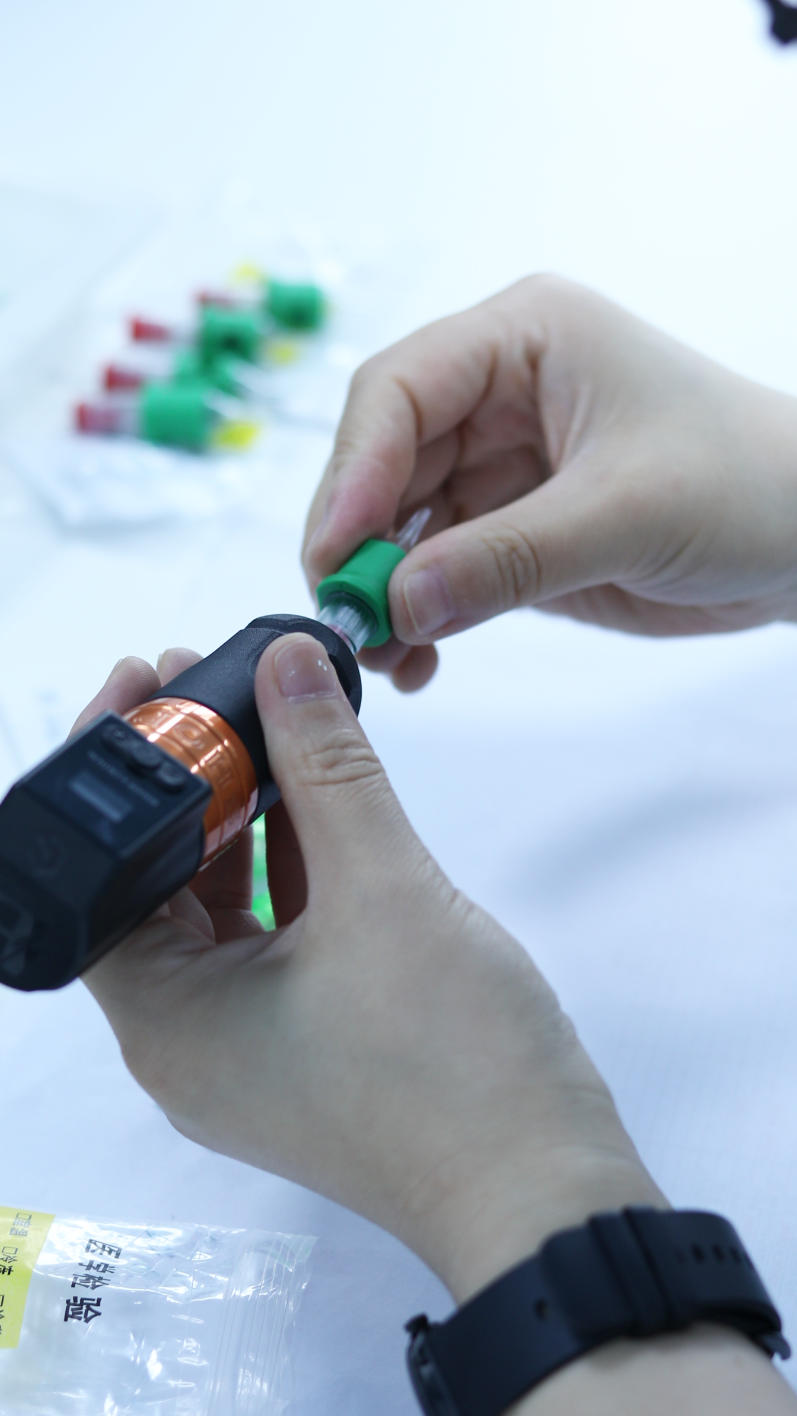
Inspection evidence complements document review. The document set identifies product scope; batch and process records show how that scope is controlled in production.
Where the Evidence Fits: Professional Tattoo, PMU and SMP Use Cases
For professional tattoo studios and distributors, the document set supports vendor qualification for liner tattoo cartridge needles, shader tattoo needles, Magnum tattoo cartridges, and fine line tattoo needles. Membrane tattoo cartridges require the silicone anti-backflow membrane to be included in the material scope. PMU studios and SMP clinics evaluate PMU cartridge needles, eyebrow tattoo needles, cosmetic tattoo needles, and scalp micropigmentation needles under the same logic: the needle type changes, but the document-to-SKU match does not.
OEM and private-label buyers should require a model-level cross-reference because a qualification file for product code 4868 / SP5 does not automatically cover SP4, SP6, HM3, HM6, or a custom housing. For OEM ODM tattoo needle projects, the approval file should be updated when the housing design, membrane, packaging, or needle configuration changes. This is especially relevant for sterile tattoo cartridge programmes that combine several configurations under one private label.
Market Context: Why Buyers Are Asking for Document Scope
Custom Market Insights estimated the global tattoo needle market at USD 368.3 million in 2024 and projected growth at approximately 3.5% CAGR through 2033. The same source reports that approximately 73% of professional tattoo artists preferred needle cartridges over traditional bar needles in 2024. Fortune Business Insights projects the global permanent makeup market to grow from USD 162.93 million in 2025 to USD 330.5 million by 2034, at a CAGR of 8.31%.
These figures do not prove any single supplier quality level. They explain why buyers are formalising qualification evidence as cartridge, PMU, and SMP volumes expand. When more purchase decisions move through distributors and private-label channels, a document matrix becomes a commercial control, not an administrative file.
Document-Only Screening vs. Scope-Based Qualification
| Approach | What it does | Limitation |
|---|---|---|
| Certificate logo collection | Quickly shows that a supplier has documents to present. | Does not show the product code, standard, legal manufacturer, market, validity, or document type. |
| Certificate-number lookup | Confirms that an identifier can be matched to a document. | Still does not link the document to the ordered model, material, process, or batch. |
| Scope-based evidence matrix | Links document identifier, market, standard, product code, specification, and buyer action. | Requires revision control, expiry tracking, and re-checking when materials or packaging change. |
The document set in this article has clear boundaries. It supports qualification review for the named product code and markets; it does not establish that every production batch is sterile, that every SKU is covered, or that all market-access obligations are complete. The CE MDR record is a document review under MDR Annex II & Annex III; buyers should not describe it as a notified-body certificate unless the document itself confirms that status. The FDA testing report is a test report; it should not be presented as FDA clearance. The MSDS supports material safety communication; it is not a sterility or performance validation. These limits are not defects in the file. They define the next questions a buyer should ask.
For comparison, traditional supplier screening often stops at a certificate pack and a sample. A scope-based qualification adds a product-code cross-reference, a market-by-market document map, and a change-control rule. The second approach takes more work at the evaluation stage, but it reduces the risk of approving a file that does not cover the actual order.
Future Outlook: From Certificates to Traceable Evidence
Qualification files are likely to become more model-specific and revision-controlled. Buyers will expect document identifiers, issue and expiry dates, legal manufacturer, product code, and change notifications in one view. For sterile single-use tattoo cartridges, the strongest file links four layers: product-level documents such as the FDA testing report, CE MDR document, RoHS 2.0 report, and MSDS; the manufacturing quality system, referenced by the ISO13485 Certified Tattoo Needle scope under certificate F04326MD00044R000; process controls such as EO gas sterilization and sterile breathable film packaging; and batch traceability.
The supplier that can connect those layers without gaps is easier to audit, easier to approve, and easier to keep approved when specifications change. That is the practical meaning of qualification evidence: not a wall of logos, but a traceable chain from document number to product code to production record.
FAQ: Tattoo Cartridge Needle Qualification Evidence
What does the FDA testing report TST2019112501-4EN cover?
It is a US-market testing report for product code 4868, citing FDA 21CFR175.300, FDA 21CFR180.22, and ASTM C738-94. It supports review of the named test scope. It is not, by itself, an FDA marketing authorization. Buyers should match the report product description to the SP5 cartridge and confirm that the standards listed align with the intended application.
What is the CE MDR document ICR Polska/DR/HM2311112?
It is an EU CE MDR document referenced for tattoo needles under MDR (EU) 2017/745 Annex II & Annex III, issued by ICR Polska Co. Ltd., with validity shown as 2023-11-30 to 2028-11-29. The record identifies it as a CE MDR Document Review. Buyers should confirm the document type, legal manufacturer, product scope, and market-access meaning before treating it as a certificate.
Which standards are named in the RoHS 2.0 report TST2019112501-3RC?
The RoHS 2.0 report cites (EU) 2015/863, (EU) 2017/2102, and the full set of IEC62321 series standards. It was issued by TST Testing Technology Co., Ltd. for the EU market. Its practical value is restricted-substance review for materials such as the medical-grade PC housing, silicone membrane, non-toxic transparent plastic tip, and packaging.
What is MSDS BCTC2305199480R used for?
It is MSDS documentation issued by Shenzhen BCTC Testing Co., Ltd. for the Global market, including EU and USA, referencing CLP Regulation (EC) No 1272/2008 and REACH (EC) No 1907/2006. The record shows an issue date of 2023-05-17 and validity to 2033-05-17. It is used for material safety communication and handling review, not as sterility validation.
How do these documents link to EO sterilization and sterile breathable film packaging?
The product-level documents identify material and market scope, but they do not replace sterilization process validation or batch release records. A buyer should ask for records that connect EO gas sterilization and sterile breathable film packaging to product code 4868 and to the specific batch or production period under evaluation.
Does the evidence for product code 4868 cover RL, RS, RM, Magnum and Flat configurations?
The SP5 specification lists RL / RS / RM / Magnum / Flat configurations and compatibility with rotary tattoo machines. The qualification documents discussed here are referenced to product code 4868. Buyers should verify configuration-level scope inside the document or obtain a written model cross-reference before approving other configurations, SP4, SP6, HM3, HM6, or custom housing projects.
Reference document: CREDITECH MED company brochure, public download.
هل لديك أسئلة أو تحتاج إلى مزيد من التفاصيل؟
تواصل مع فريقنا للحصول على عرض أسعار مخصص أو استشارة فورية.
طلب عرض أسعار
املأ النموذج أدناه وسيتواصل معك فريقنا بعرض مقترح مخصص.
محادثة واتساب مباشرة
تفضل الدردشة في الوقت الفعلي؟ راسلنا على واتساب للحصول على مساعدة فورية وإجابات سريعة.
- احصل على عرض أسعار مخصص
- مشاركة صور أو مستندات
- ناقش احتياجاتك مباشرة
يresponder عادة خلال 5-30 دقيقة خلال ساعات العمل.