
Tattoo Cartridge Needle Sourcing: Market Trends and OEM Criteria

Tattoo cartridge needle production workshop covered by an ISO 13485 quality management system.
Tattoo cartridge needles have evolved from a convenience item into the standard delivery format for professional tattooing. A cartridge combines the needle and its housing in a single-use component, designed for rotary tattoo machines and available in a range of diameters, taper lengths, and needle groupings. In the global tattoo needle market, cartridges hold the largest share by product type, due to sterility and compatibility with modern rotary machines. The market itself is estimated at USD 368.3 million in 2024 and is projected to reach USD 468.6 million by 2033, according to Custom Market Insights.
For tattoo studios, PMU clinics, distributors, and private-label brands, the practical question is not only which cartridge to buy, but which supplier is able to maintain medical-grade consistency, regulatory documentation, and customization depth over the long term. This article uses the CREDITECH MED production system as a reference case to explain how tattoo cartridge needle buyers should evaluate manufacturing capability, product specifications, compliance evidence, and market trends in 2026.
The Sourcing Problem: Consistency, Certification, and Differentiation
Professional tattoo and permanent makeup work depends on needles that deliver predictable ink flow, precise line formation, and controlled shading. Cartridge needles must also be sterile on opening and mechanically consistent from batch to batch. The sourcing challenge is that the supplier market is uneven: some manufacturers operate medical-grade quality systems, while others supply products with limited regulatory documentation and less predictable tolerances.
This creates both risk and opportunity. For a distributor or an OEM brand, the ability to verify a supplier's ISO 13485 certification, sterilization method, and precision tolerance is a direct competitive advantage. The permanent makeup segment is growing: Fortune Business Insights valued the global PMU market at USD 162.09 million in 2025, with an 8.12% CAGR forecast for the microblading segment. An industry survey cited by Elite Tattoo also found that roughly 73% of professional tattoo artists preferred cartridges over traditional bar needles in 2024. Buyers who align with this shift and choose a supplier with documented production standards are better positioned to enter fine line, PMU, and SMP product lines.
CREDITECH MED: A Manufacturing Reference for OEM-Focused Buyers
Suzhou Creditech Electronic Technology Co., Ltd., operating under the brand CREDITECH MED, is a professional manufacturer of tattoo cartridge needles, PMU cartridges, and tattoo consumables. The company was founded in 2009, employs 180 people, and maintains an R&D team of 20 engineers. Annual output is stated as 100,000,000 units, and exports account for 90% of production, with primary markets in Europe, North America, South America, and Southeast Asia.
CREDITECH MED also operates specialized brands: SPACEDRAGON Tattoo for professional tattoo artists, ESTLIA for PMU and SMP cartridges, and LPT Tattoo Supply for daily studio consumables. For buyers, this means the same manufacturing base can serve different market segments under different labels, which is relevant when evaluating private label or multi-brand sourcing strategies.
The factory is supported by a certification set that is directly relevant to tattoo needle procurement:
| Certification | Certificate Number | Scope / Standard |
|---|---|---|
| ISO 13485:2016 | F04326MD00044R000 | Research, development, manufacturing and sales of tattoo needles |
| CE MDR Document Review | ICR Polska/DR/HM2311112 | MDR (EU) 2017/745 Annex II & Annex III |
| RoHS 2011/65/EU | ICR/VC/HM260680 | EU RoHS compliance for tattoo needle cartridges |
| FDA test reports | TST2019112501-4EN | FDA 21CFR175.300 and related applicable standards |
In addition, an MSDS document is available covering the CLP Regulation (EC) No 1272/2008 and REACH (EC) No 1907/2006. These documents are not marketing statements; they provide verifiable evidence of what a manufacturer is able to claim.
Technical Parameters That Define a Professional Tattoo Cartridge Needle
Understanding the specification sheet is essential before comparing suppliers. CREDITECH MED cartridge needles are available with needle diameters of 0.15 mm, 0.20 mm, 0.25 mm, 0.30 mm, and 0.35 mm. Taper length ranges from 1.5 mm to 7 mm, and extra-long taper versions are available for fine line and PMU work. Standard configuration options include Round Liner (RL), Round Shader (RS), Round Magnum (RM), Magnum, and Flat.
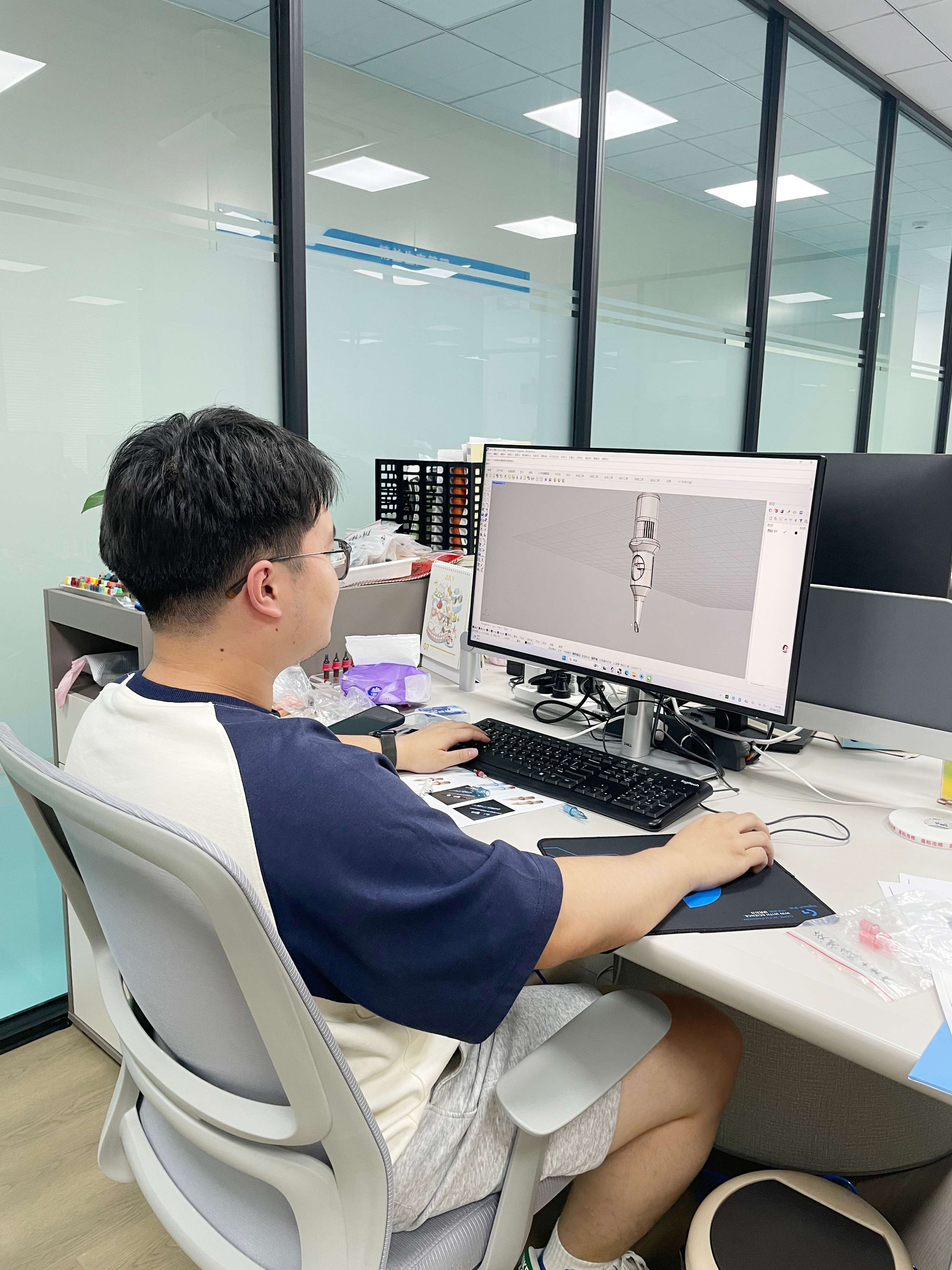
Cartridge needle design and development work at CREDITECH MED.
The housing is made of medical-grade polycarbonate (PC), and the needles are manufactured from medical-grade stainless steel. A silicone anti-backflow membrane helps control ink flow, and the cartridge uses a stable controlled ink delivery system. Precision tolerance is maintained at ±0.02–0.05 mm. The cartridges are designed for rotary tattoo machines and use a low-vibration structure. Sterilization is performed with ethylene oxide (EO) gas, and each cartridge is packaged in sterile breathable film.
| Parameter | Typical Range |
|---|---|
| Needle diameter | 0.15 / 0.20 / 0.25 / 0.30 / 0.35 mm |
| Taper length | 1.5 – 7 mm (extra long taper available) |
| Configuration | RL, RS, RM, Magnum, Flat |
| Precision tolerance | ±0.02 – 0.05 mm |
| Membrane system | Silicone anti-backflow |
| Compatibility | Rotary tattoo machines |
| Sterilization | EO gas |
| Packaging | Sterile breathable film |
Product models officially linked to these specifications include SP4, SP5, SP6, HM3, HM6, ComfortGrip HM4 and ComfortGrip HM6, according to certification and product records. These parameters matter in practical use. A fine line tattoo requires a small needle diameter and a longer taper for clean, delicate strokes. PMU eyebrow work needs consistent line control and low vibration. SMP, or scalp micropigmentation, often uses round and magnum configurations that deposit pigment evenly into the scalp. A supplier that offers a range of configurations is more likely to support a brand's full product portfolio.
A Supplier Evaluation Checklist for Cartridge Needle Buyers
- Verify ISO 13485 certification and confirm the scope includes manufacturing of tattoo needles.
- Check whether the sterilization method is documented; EO gas sterilization is the standard for the cartridges described here.
- Review available diameters, taper lengths, and configurations against your product line needs.
- Ask about precision tolerance and batch traceability.
- Evaluate OEM/ODM capabilities: custom logo, private label, custom packaging, housing design, and new product development.
- Confirm monthly capacity, lead times, and MOQ for standard and custom orders.
- Request compliance documents for target markets, such as RoHS, CE MDR, FDA test reports, and MSDS.
Application Patterns: Professional Studios, PMU, and SMP
Cartridge needles are used across several closely related fields: professional tattooing, permanent makeup, and scalp micropigmentation. The CREDITECH product range includes configurations designed for fine line work, shading, color packing, PMU eyebrow, and SMP. The intended users include professional tattoo studios, PMU studios, SMP clinics, tattoo supply distributors, e-commerce retailers, and OEM brands.
Two documented use cases illustrate the OEM dimension. A tattoo and PMU supply wholesaler in Spain has worked with CREDITECH MED for five years, with annual volumes of 1.2 million pieces, supporting professional tattoo and PMU studios. In Mexico, a private-label brand with custom housing design has sourced more than 3 million cartridge needles per year for distribution and e-commerce, also over a five-year period. Both cases report stable quality, consistent performance, and high repurchase rates.
Market Trends: Demand Drivers, Compliance, and Global Supply
Market data from 2024–2026 points to steady growth in the tattoo needle category. The global tattoo needle market is estimated at USD 368.3 million in 2024 and is projected to reach USD 468.6 million by 2033. Tattoo needle cartridges hold the largest share by product type, due to sterility and compatibility with modern rotary machines.
Compliance is becoming a structural requirement. ISO 13485 is recognized as the quality management standard for medical-grade tattoo needles, and RoHS Directive 2011/65/EU affects products sold in the EU. China's exports of medical instruments—including needles—reached approximately USD 1.19 billion in May 2026 alone, with the United States as the top destination, indicating the global supply chain's reliance on Chinese manufacturing.
Brand Landscape: Named Players and the OEM Alternative
For buyers researching tattoo cartridge needle brands, the market includes several named brands often cited in industry overviews: Dragonhawk, Kwadron, Bishop Rotary, Cheyenne, and EZ Tattoo Supply, according to a CMI market snapshot. These brands are commonly visible to artists and studio buyers.
There is a second procurement path, which is contract manufacturing. CREDITECH MED is primarily an OEM/ODM manufacturer rather than a single consumer-facing brand. That means a distributor or a startup can source certified cartridges under its own label, with custom packaging and housing design. The two paths serve different buyers: one prefers an established brand name, the other prefers control over product identity and supply chain.
Cartridge Needles vs. Traditional Bar Needles: A Balanced View
The shift from traditional soldered bar needles to cartridge needles is widely observable. An industry survey in 2024 estimated that 73% of professional tattoo artists preferred cartridges for ease of use and safety. The main advantages are single-use sterility, faster setup, consistent needle exposure, and compatibility with rotary machines.
However, there are legitimate limitations. Cartridge needles are typically more expensive per unit than traditional bar needles, and they require compatible rotary tattoo machines rather than older coil machines without appropriate adapters. Some artists also prefer bar needles for certain techniques that depend on custom needle groupings or hand feel. Buyers should evaluate cost-per-use and machine compatibility when switching a studio or product line to cartridges.
Future Outlook: Specialization and Certification Will Define Supplier Value
The trajectory points toward more specialized cartridge formats. Fine line, PMU, and SMP procedures demand smaller diameters, long taper profiles, and softer edge configurations. The PMU market's projected 8.12% CAGR is one signal that needle-heavy cosmetic procedures will continue to grow. For suppliers, the ability to combine ISO 13485 production, sterile packaging, and OEM development capability will become a baseline rather than a differentiator.
Buyers should therefore expect stronger documentation requirements, more configurable product lines, and deeper engineering collaboration in the next procurement cycle.
Frequently Asked Questions
What is a tattoo cartridge needle?
A tattoo cartridge needle is a single-use component that combines the needle and a plastic housing in one unit, designed for use with rotary tattoo machines. It is available in configurations such as round liner (RL), round shader (RS), round magnum (RM), magnum, and flat. The cartridge is typically EO gas sterilized and packaged in sterile breathable film.
What does ISO 13485 certification cover for tattoo needle manufacturers?
ISO 13485 is an international quality management system standard for medical devices. For CREDITECH MED, the certificate (No. F04326MD00044R000) covers the research, development, manufacturing, and sales of tattoo needles, confirming that production processes follow documented quality and consistency requirements.
Which needle configurations are available for professional tattoo cartridges?
The available configurations include RL, RS, RM, Magnum, and Flat. Needle diameter options range from 0.15 mm to 0.35 mm, and taper lengths from 1.5 mm to 7 mm, with extra long taper versions available for fine line and PMU work.
Can OEM buyers customize tattoo cartridge needles?
Yes. OEM/ODM services cover custom logo, private label, custom packaging, needle configuration, housing design, and new product development. The monthly capacity is above 3 million cartridge needles, and the MOQ is 500–1,000 pieces per size, with custom order lead times of 30–45 days.
Are CREDITECH MED cartridges sterile?
CREDITECH MED cartridge needles are sterilized with ethylene oxide (EO) gas and packaged in sterile breathable film. The product line is designed for professional tattoo studios, PMU studios, and SMP clinics where single-use sterility is required.
Which markets does CREDITECH MED serve?
CREDITECH MED exports to Europe, North America, South America, and Southeast Asia, with approximately 90% of output going to international markets. Documented partner cases include wholesale and private-label clients in Spain and Mexico.
For a broader look at manufacturing specifications and OEM workflows, the company profile brochure is available here: CREDITECH MED company brochure.