
Tattoo Cartridge Needles for SMP, PMU, and Tattoo Artists: A Selection Guide
A tattoo cartridge needle is a single-use assembly that holds a fixed needle group inside a plastic housing fitted with a membrane, and mounts directly onto a rotary tattoo machine. The same platform now serves three different professional disciplines: scalp micropigmentation (SMP) in SMP clinics, permanent makeup (PMU) for eyebrows, lips and eyeliner in PMU studios, and conventional tattoo work in professional tattoo studios. Each discipline works on different tissue, at a different depth, with a different pigment volume — which is why the useful question is not which cartridge is best in general, but which diameter, taper and configuration match the procedure in front of the artist.

The cartridge format dominates the category for structural reasons. Third-party research places the global tattoo needle market at USD 368.3 million in 2024, projected to reach USD 468.6 million by 2033 (Custom Market Insights). Cartridge needles hold the largest share of the product-type segment, a position attributed to their sterility and compatibility with modern rotary machines (Deep Market Insights). Alongside that, the permanent makeup market was valued at USD 162.09 million in 2025, with an 8.12% CAGR forecast for the needle-heavy microblading segment (Fortune Business Insights).
Three Procedures, Three Different Needle Requirements
SMP, PMU and tattoo work are often bought under one category because they share a machine interface. Operationally they diverge early, and the divergence shows up in which cartridge fails first.
Scalp micropigmentation
SMP reproduces the appearance of hair follicles by depositing thousands of small pigment points across the scalp. The work is repetitive and area-intensive. The criteria that decide a cartridge are dot-to-dot consistency, stable depth control and membrane behaviour across a long session. Scalp tissue is thicker and more vascular than facial skin, and a single cartridge can be driven through an extended sequence of deposits, so drift in needle extension or pigment flow becomes visible in the finished result rather than in the moment.
PMU: eyebrow, lip and eyeliner
Permanent makeup procedures work on thin, sensitive tissue, frequently close to the eye. Pigment volumes are small, strokes are short, and the result is expected to hold shape over years. The practical requirement is a fine entry point that allows controlled, repeatable strokes on the eyebrow or lip, combined with a membrane that prevents pigment from travelling back into the housing. Eyeliner applies the same requirement under tighter geometry, where a fraction of a millimetre in stroke width is visible to the client.
Professional tattoo artistry
Tattoo work spans outlines, realism, soft shading and colour packing, and cartridge selection here is configuration-driven: a round liner group does not behave like a round shader or a magnum group in the same machine. Fine line and realism outline work needs a stable point that does not widen the line under repetition, while shading and filling need broader coverage per pass and even pigment distribution.
The Four Parameters That Decide Fit
Across all three disciplines, four parameters decide whether a cartridge suits the job. All four are visible on the specification sheet and all four should be confirmed before a studio standardises on a supplier.
1. Needle diameter. The cartridge platform in this analysis is offered in 0.15 mm, 0.20 mm, 0.25 mm, 0.30 mm and 0.35 mm needle diameters. Narrower diameters are generally used where fine detail and minimal tissue trauma matter, while larger diameters support pigment delivery in denser work. Diameter interacts with configuration and machine stroke; it is not a standalone performance indicator.
2. Configuration family. Professional cartridge ranges include Fine Line, Round Liner (RL), Round Shader (RS), Magnum, plus dedicated PMU and SMP needle configurations. The SP5 cartridge, for example, is a Fine Line Tattoo Cartridge Needle and is also classified as a Traditional Tattoo Cartridge Needle, intended for professional tattoo studios, fine line, realism and colour work, SMP clinics, and PMU studios for eyebrow, lip and eyeliner procedures.
3. Taper length. Taper length — the length of the ground point on the individual needles — ranges from 1.5 mm to 7 mm in this platform. Long taper tattoo needles present a longer, finer bevel that enters tissue more softly; short taper tattoo needles present a firmer point that holds shape under repetitive work. The trade-off is between entry softness and point stability, and it is decided by procedure, machine and stroke rather than by preference alone.
4. Membrane and housing. The cartridge is built from a medical-grade PC housing and medical-grade stainless steel needles, with a silicone anti-backflow membrane system. The membrane is the component that separates a professional tattoo cartridge from a generic one: it blocks pigment and fluid from migrating into the machine body, which affects both contamination control and the stability of ink flow during a session.
Machine compatibility belongs to the same conversation. Cartridges in this category are compatible with rotary tattoo machines, and the cartridge format in general was designed around the rotary interface — which is a large part of why the format holds the largest share of the product-type segment.
Application-Specific Selection: A Working Matrix
The matrix below maps professional procedures to configuration families and parameter bands inside the 0.15–0.35 mm diameter and 1.5–7 mm taper range. It is a decision framework, not a fixed rule. Machine type, hand speed and individual technique move the optimum within the band, which is why sample validation is more reliable than a catalogue claim.
| Procedure | Configuration family | Diameter band (0.15–0.35 mm) | Taper consideration (1.5–7 mm) | Primary decision criterion |
|---|---|---|---|---|
| SMP follicle work | Fine line and SMP cartridge configurations | Finer end of the range | Point stability across long sessions; confirm on sample | Dot-to-dot consistency and depth repeatability |
| PMU eyebrows (hairstroke / microblading) | Fine line and PMU cartridge needles | Finer end of the range | Fine, controlled entry; confirm on sample | Stroke precision and pigment retention on thin skin |
| PMU lips and eyeliner | PMU cartridge needles | Finer to mid range | Controlled entry close to sensitive areas | Line control and long-term definition |
| Tattoo lining and outlines | Round Liner (RL), fine line | Mid to higher within the range | Firmer point holds shape under repetition | Consistent line weight |
| Shading and blends | Round Shader (RS), Magnum tattoo cartridges | Mid to higher within the range | Coverage balanced against softness | Smooth gradient without harsh edges |
| Colour packing and large fills | Magnum tattoo cartridges | Higher end of the range | Broader contact area per pass | Coverage efficiency and pigment saturation |
Parameter bands above describe how the available diameter and taper options are applied in professional practice. Final selection should be validated on samples against the specific machine, pigment and technique used in the studio.
Fit and Vibration: The Detail-Work Variable Buyers Underestimate
Precision is not only a function of needle diameter. In fine line tattoo cartridge needle work, in SMP and in eyeliner PMU, the artist is controlled by what happens at the needle tip between the cartridge and the machine — lateral play, membrane friction and needle group alignment inside the housing.
Cartridges are designed for rotary machines, but fit is not identical across every grip and machine body. A cartridge that seats with visible play, requires force to lock, or returns with a sticky action will translate that inconsistency into the stroke. Practical verification is straightforward and takes under a minute: dry-run the cartridge in the mounted machine, check needle group extension and return, inspect the housing for cracks or moulding defects, and confirm the membrane seal before pigment is loaded. Treating rotary compatibility as a specification to verify rather than a given removes a class of quality complaints that are attributed to needles but originate in seating.
Cartridges Versus Traditional Bar Needles: What Is Gained, What Is Given Up
Cartridge systems have largely displaced traditional bar needles in professional environments. An industry survey reported in 2024 found that approximately 73% of professional tattoo artists preferred needle cartridges over traditional bar needles for ease of use and safety (industry survey via Elite Tattoo; medium reliability, treat as directional rather than definitive).
What the format gains is consistent: a sterile single-use tattoo cartridge that is presented and disposed of as a sealed unit, faster machine setup between configurations, a membrane anti-backflow barrier, geometry that repeats batch to batch, and an interface built for modern rotary machines with less handling of exposed needles.
What it gives up matters just as much in a procurement decision:
- Unit cost. Cartridges generally cost more per unit than bar needles. The gap narrows substantially at OEM and bulk volumes, but it does not disappear.
- Fixed geometry. The needle group is sealed inside the housing, so there is no repositioning a bar needle to change depth. Flexibility shifts to machine stroke length and cartridge choice.
- Consumable waste. A single-use plastic housing generates more waste per procedure than a sterilised bar needle workflow.
- Supply dependency. Studios depend on cartridge supply continuity, and changing supplier mid-project means re-validating feel, depth and pigment flow rather than simply reordering.
- Verification burden. Because these are medical-adjacent single-use items, buyers must verify sterilization and traceability claims themselves. Counterfeit imitation is a recognised risk in this category.
- No technique substitute. A cartridge cannot correct for machine setup, pigment handling or stroke inconsistency.
OEM Cartridge Needles Versus Premium Brands: Reading the Comparison Honestly
Suzhou Creditech Electronic Technology Co., Ltd. (CREDITECH MED) is a manufacturer based in Xiangcheng District, Suzhou, China, founded in 2009, producing tattoo cartridge needles, PMU cartridges and tattoo consumables for professional studios, distributors and private-label brands. The company operates the brands SPACEDRAGON TATTOO, ESTLIA and LPT Tattoo Supply, and states an annual output of 100,000,000 units with 90% of production exported to Europe, North America, South America and Southeast Asia.
For decision-stage buyers comparing an OEM route against premium branded cartridges, the manufacturer publishes a direct comparison. The summary below reflects that published comparison data.
| Comparison dimension | Premium branded cartridges (Cheyenne, KWADRON) | Creditech Med cartridge platform |
|---|---|---|
| Unit price / procurement cost | Reference level | Stated 60–70% lower purchasing cost for comparable professional-grade applications |
| Piercing precision | Reference level | Stated as identical in the manufacturer's comparison |
| Ink stability and flow | Reference level | Stated as equivalent, with consistent ink flow under professional use |
| Membrane anti-backflow performance | Reference level | Stated as identical performance |
| Service life and defective rate | Reference level | Stated equivalent low defective rate with stable service life under professional conditions |
| OEM and customization | Brand-defined programme scope | Flexible customization, private label, structural design, prototyping and custom packaging |
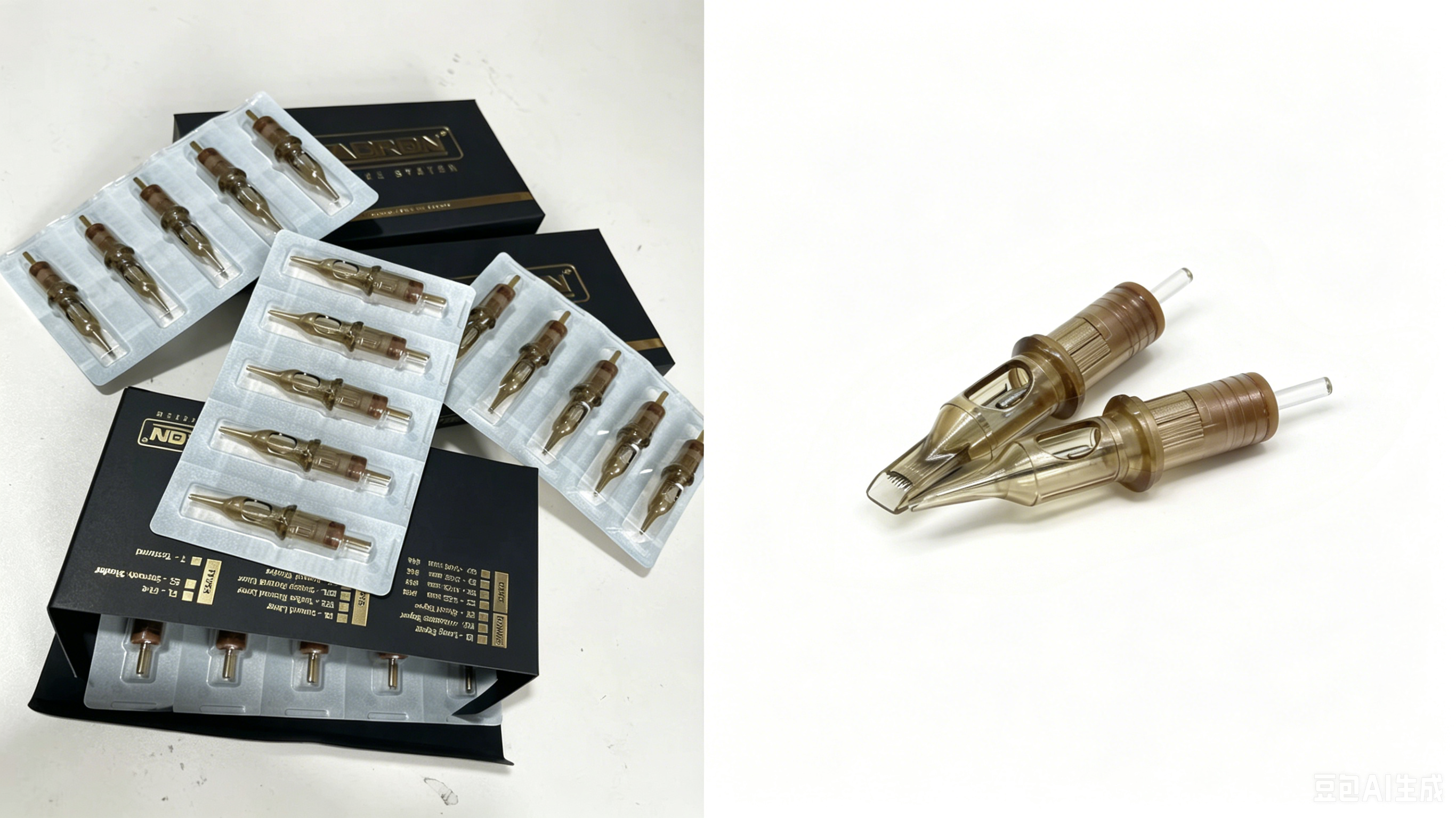
These figures are supplier-published comparison data, not independently audited third-party benchmarks. The equivalence claims apply to comparable professional-grade applications and are stated for the manufacturer's own cartridge platform. Buyers should treat them as a hypothesis to test through samples and pilot orders before converting a studio or a distribution line.
Compliance and Manufacturing Evidence to Verify Before Committing
ISO 13485:2016 is the quality management standard applied to medical device manufacturing, and it is the baseline certificate to request from a tattoo cartridge needle supplier. For placement in the EU, cartridges must comply with RoHS Directive 2011/65/EU and often follow EN IEC 63000:2018 for hazardous substance assessment (European Commission). These two documents define the minimum compliance file that a decision-stage buyer should be able to inspect.
The recognised risk profile of the category — contamination risk, batch inconsistency risk, supply chain fluctuation risk and counterfeit imitation risk — is addressed through specific controls rather than through assurances.
| Risk | Control measure |
|---|---|
| Contamination risk | Cleanroom production environment, medical-grade raw materials, EO sterilization validation |
| Batch inconsistency risk | Standardised SOP manufacturing process, 100% in-process inspection, multi-stage QC checkpoints, performance sampling tests |
| Supply chain fluctuation risk | Long-term supplier qualification, standardised production lines, batch traceability from raw material through production and sterilization to shipment |
| Counterfeit imitation risk | Batch traceability system, incoming material inspection, supplier qualification |
| Regulatory compliance risk | ISO 13485 Medical Device Quality Management System, EO sterilization validation, engineering validation for new designs |
Creditech Med operates under an ISO 13485-certified quality management system, states CE compliant products, and makes FDA test reports available for applicable products. Manufacturing controls include 100% in-process inspection, EO sterilization validation, a batch traceability system covering raw material to shipment, and incoming material inspection. The company reports 180 employees, a 20-engineer R&D team, and a facility in Xiangcheng District, Suzhou, supporting OEM and ODM programmes from product development and structural design through prototyping, mass production and custom packaging.

Procurement Checklist for Decision-Stage Buyers
- Confirm the diameter range covers every procedure the studio or distribution line serves — 0.15 mm to 0.35 mm covers SMP, PMU and tattoo work in one platform.
- Confirm the taper range (1.5 mm to 7 mm) is documented per SKU, and that long taper and short taper options are both stocked.
- Verify membrane construction and sealing method, not only the presence of a membrane.
- Test cartridge fit and needle return on the specific rotary machines in use before standardising.
- Request ISO 13485 certification, EO sterilization validation records and batch traceability documentation covering the actual product and batch.
- Check EU market documentation against RoHS Directive 2011/65/EU and EN IEC 63000:2018 where applicable.
- Validate performance on samples across SMP, PMU and tattoo protocols separately — one procedure does not validate another.
- Confirm OEM and ODM scope in writing: structural design, prototyping, private label and custom packaging.
- Compare landed cost, not unit price alone — packaging, sterilization documentation and freight change the total.
- Check supply continuity commitments and lead times before converting a distribution line.
Market Direction: What the Numbers Suggest
The category is expanding steadily rather than explosively. The global tattoo needle market moves from USD 368.3 million in 2024 toward a projected USD 468.6 million by 2033 (Custom Market Insights), with cartridges already holding the largest share of the product-type segment (Deep Market Insights). The needle-heavy microblading segment of the permanent makeup market, valued at USD 162.09 million in 2025, is forecast at an 8.12% CAGR (Fortune Business Insights) — meaning PMU and SMP cartridge demand is growing faster than the traditional tattoo segment.
Supply remains concentrated. China's exports of medical instruments, which include needles, reached approximately USD 1.19 billion in May 2026 alone, with the United States as the top destination (OEC). Publicly identified players in the needle market include Dragonhawk, Kwadron, Bishop Rotary, Cheyenne and EZ Tattoo Supply (CMI). For buyers, the practical implication is a supply base deep enough to source from, but also exposed to export cycles and imitation risk — which raises the value of documented batch traceability and dual-sourcing.
Future Outlook
Application specificity is the direction of the category. As SMP and PMU continue to grow faster than traditional tattoo work, cartridge SKUs will differentiate further by procedure rather than by needle group alone, and PMU studios will expect the same parameter documentation that tattoo supply distributors already request.
Compliance documentation is becoming a sourcing gate rather than a marketing asset. ISO 13485 certification, EO sterilization validation and batch-level traceability are moving from differentiators to prerequisites, particularly for EU and North American buyers who carry downstream liability for the products they distribute.
On the supply side, OEM and ODM programmes will keep compressing the price gap between private-label cartridges and premium branded cartridges. Cost will remain a legitimate selection criterion, but it will not replace sample validation — because in SMP, PMU and fine line tattoo work, the parameters that decide the result are measured in fractions of a millimetre and confirmed in the artist's hand.
FAQ
What needle diameter is appropriate for scalp micropigmentation?
SMP is typically performed at the finer end of the available diameter range. Cartridges in this category are offered in 0.15 mm, 0.20 mm, 0.25 mm, 0.30 mm and 0.35 mm needle diameters, and scalp micropigmentation and fine-detail cosmetic work generally sit toward the lower end of that band, where each deposit stays small and depth is easier to control. Diameter alone does not determine the result: needle extension, machine stroke and hand speed also affect deposit size. SMP clinics generally validate diameter on samples before standardising a protocol.
Which cartridge configuration is used for eyebrow, lip and eyeliner PMU?
PMU procedures use fine line and PMU-specific configurations rather than magnum groups. A fine line cartridge such as the SP5 is classified as a Fine Line Tattoo Cartridge Needle and is intended for professional tattoo studios, fine line and realism work, SMP clinics, and PMU studios for eyebrow, lip and eyeliner procedures. Lip and eyeliner work places the same cartridge format under tighter geometry, where stable point control matters more than coverage per pass.
What does taper length change in a tattoo cartridge needle?
Taper length is the length of the ground point on the individual needles, and the available range in this platform runs from 1.5 mm to 7 mm. A longer taper produces a longer, finer bevel that enters tissue more softly; a shorter taper produces a firmer point that holds shape under repetitive work. The trade-off is between entry softness and point stability, and the balance depends on the procedure, the machine and the artist's stroke. Taper length per SKU should be confirmed on the specification sheet before purchase.
Are tattoo cartridge needles compatible with every rotary machine?
Compatibility is a design specification rather than an assumption. Cartridges in this category are compatible with rotary tattoo machines, and the cartridge format as a whole is built around the rotary interface. In practice, fit varies with grip geometry: a cartridge that seats with visible play, requires force to lock, or returns with a sticky action will affect stroke consistency. Verification is a dry run — mount the cartridge, check needle group extension and return, inspect housing integrity and confirm the membrane seal before loading pigment.
How do OEM cartridges compare with premium branded cartridges on cost and performance?
Manufacturer-published comparison data for the SPACEDRAGON cartridge platform states 60–70% lower unit price and procurement cost than Cheyenne and KWADRON cartridges for comparable professional-grade applications, alongside stated equivalence in piercing precision, ink stability and membrane anti-backflow performance, with an equivalent low defective rate and stable service life. These are supplier-published comparisons, not independently audited benchmarks, and the equivalence claims apply to comparable professional-grade applications. They are best treated as a hypothesis to test through samples and pilot orders.
What evidence confirms a cartridge is medical grade and sterile?
ISO 13485:2016 is the quality management standard applied to medical device manufacturing and is the baseline certificate to request from a supplier. Verifiable evidence typically includes an ISO 13485 certificate, EO sterilization validation records, batch traceability covering raw material through production, sterilization and shipment, incoming material inspection records, and 100% in-process inspection. For EU market placement, cartridges must comply with RoHS Directive 2011/65/EU and often follow EN IEC 63000:2018. For applicable products, FDA test reports are also made available by some manufacturers. Documentation should cover the specific product and production batch, not only the company as a whole.
Selection in this category follows a predictable sequence: define the procedure, match diameter and taper within the documented range, verify fit on the machine in use, then confirm compliance and traceability evidence at batch level. Creditech Med publishes its manufacturing and product documentation for buyers who need to verify parameters before sampling — the corporate brochure is available for download at https://cdn.socialarks.com/sbsp/24932/common/2026/0630/%E4%BC%81%E4%B8%9A%E5%AE%A3%E4%BC%A0%E4%B9%A6.docx, and product and OEM/ODM information is published at https://www.creditechmed.com.