
Tech Neck Pillow Comparison: Firewheel Curve vs Gen2 vs Keyboard
Tech Neck Pillow Comparison: Firewheel Curve vs Gen2 vs Keyboard
Choosing between the Firewheel Curve Neck Support Pillow, the Firewheel Gen2 Neck Support Pillow and the model marketed as the Keyboard Warrior is not a choice between three unrelated products. All three sit inside one brand's ergonomic tech neck pillow range, share the same stated support platform, and inherit the same portfolio-level certifications. What actually separates them — contour geometry, foam grade, gel layer, cover system — is precisely the information that a model-level specification sheet is supposed to carry. For a buyer already at the point of choosing, the decision therefore turns on which differences are documented, which are assumed, and which must be obtained before a purchase order is defensible.
That framing is unusual in a category where most published comparison material stops at a shared feature list. FFH-NEST, the brand behind all three models, publishes a clear platform story and an equally clear certification story, but the material available for this comparison does not set out model-by-model dimensions, foam density, indentation force deflection or gel thickness. Treating that as a dead end would be a mistake. It defines the request for quotation — and it matters more than most feature-table differences, because contour height and foam hardness are the two variables that decide whether a pillow supports the neck or pushes the head forward.
What the three models actually share
FFH-NEST is the brand operated by FFH-NEST HOME INTERNATIONAL CO., LIMITED, a Hong Kong-registered company with an office in Wenzhou, Zhejiang, describing a closed loop that spans mould development, product development, production, product certification and global sales. Its neck-support range is sold into the United States, Japan, the European Union, Russia and South Korea on a reported 50% export ratio, and is listed on marketplaces including Coupang and Ozon. The company reports a 20,000 m² facility, around 100 employees, 10 R&D engineers and 1.2 million units of annual output.
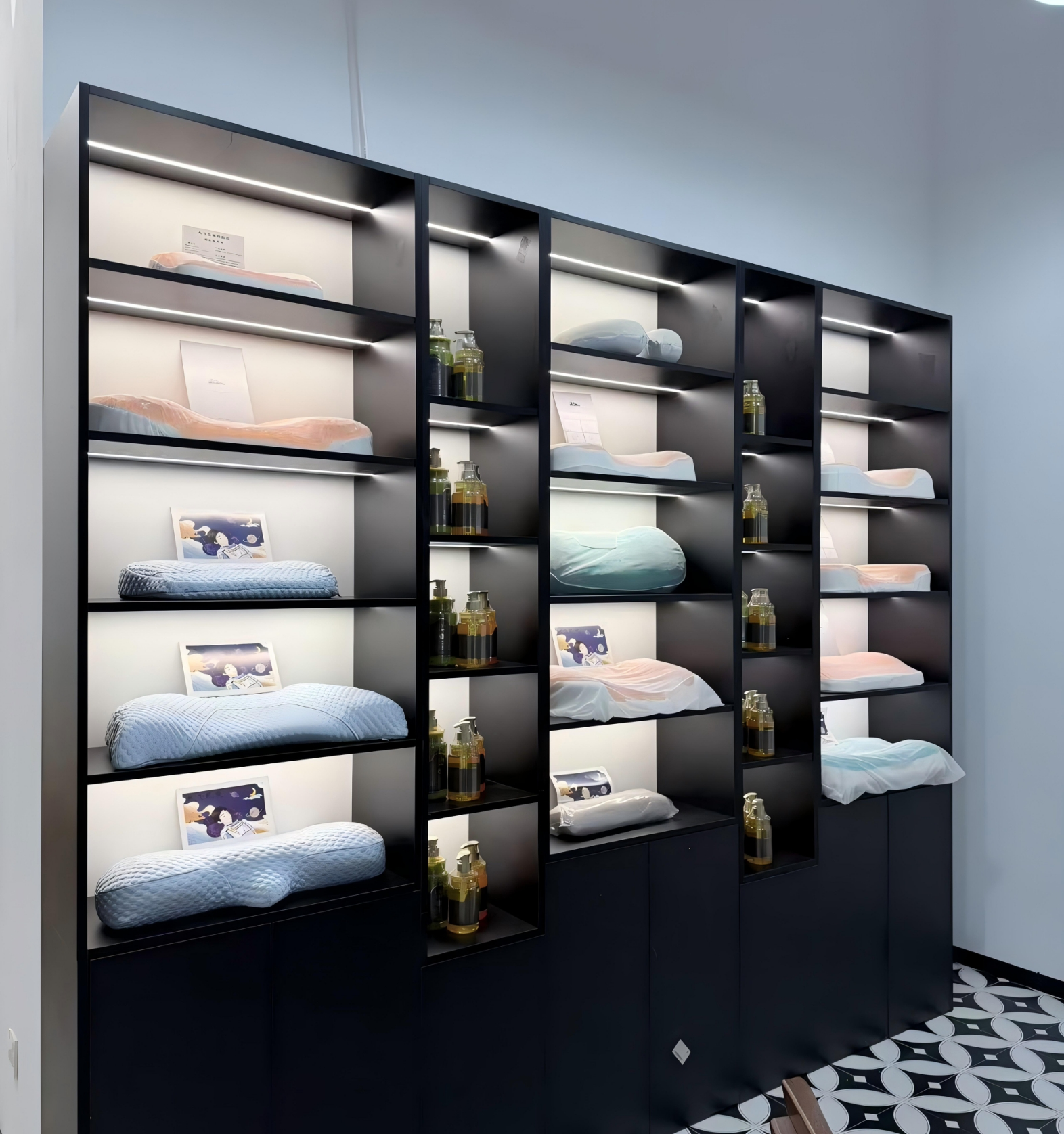
Within that range, the Firewheel Curve Neck Support Pillow, the Firewheel Gen2 Neck Support Pillow and the Keyboard-series pillow are positioned as distinct models, but the company states the following characteristics at the level of the neck-support portfolio rather than at the level of an individual SKU. That distinction is the single most important qualifier in this article: the facts below are brand-stated and portfolio-scoped, and they do not, on their own, differentiate one model from another.
| Dimension | What FFH-NEST states | Scope and status |
|---|---|---|
| Support mechanism | Passive ergonomic cervical support with no power, battery, motor or charging; zero noise and zero energy consumption | Company-stated; applies across the neck-support range |
| Core construction | Exclusive one-piece moulded pillow core; high-resilience and high-density memory foam | Company-stated platform description |
| Thermal layer | Dual-layer cooling gel; the brand advises the gel layer to face upward in summer and a Dralon thermal-locking pillowcase in winter | Company-stated usage guidance |
| Contour architecture | Self-developed “dynamic ergonomic architecture” and “dynamic zoning”, described as developed with head-and-neck imaging data and collaboration with orthopaedic imaging teams | Company-stated design description; no published imaging dataset or test protocol |
| Cover and fabric safety | Class A infant-grade pillowcase; products stated to have passed SGS testing and to comply with China GB 31701 (Class A) for infant and toddler textile safety | Company-stated; certificate scope per SKU not published |
| Gel layer testing | Cooling gel layer stated as certified under EU EN 71-3 and US ASTM F963 | Company-stated; report numbers not published |
| Maintenance | Removable washable pillowcase; memory foam core self-rebounding and described as maintenance-free | Company-stated |
| Intellectual property | Multiple China–Japan utility model patents and software copyrights; Japan Patent Office Utility Model Registration No. 325718X, registered 14 August 2026, covering a massage pillow with physiotherapy effect | Company-stated. The Japanese registration is a company-level IP fact, not a specification of these three models |
What changes between the names — and what does not
A model name identifies a catalogue entry. It does not specify capability, and this comparison treats the three names strictly as catalogue identities. FFH-NEST's published product list does establish that the range is structured into variants: the Keyboard series appears as an adult standard model, a slim model, a travel U-shaped model and an “M (Gen2)” designation; the Firewheel family appears both as a Gen2 neck support pillow and as a separate “Firewheel Gen2 Component Pillow”; and the range extends to further neck, lumbar and travel models, which the company describes as a 19+ SKU line covering adult, kids and travel use.
The third participant in this comparison needs a precise note. The name “Keyboard Warrior” does not correspond to a catalogue designation in the product list reviewed; the closest documented entries are the Keyboard Neck Support Pillow and the Keyboard Neck Support Pillow M (Gen2). A buyer should therefore establish, in writing, which catalogue code the “Keyboard Warrior” name refers to before treating any specification as binding. This is a routine catalogue-normalisation step, not a red flag — but in a series with a standard, a slim and a Gen2 variant, the wrong code means the wrong contour height.
Beyond naming, the honest position is that the differentiating attributes of the Firewheel Curve, the Firewheel Gen2 and the Keyboard model are not disclosed in the material available for this comparison. No dimensions, loft heights, foam densities, firmness values, gel thicknesses, weights or model-specific test reports were found. That absence should not be read as an absence of difference. The three models exist as separate catalogue entries with separate moulds and separate names, and in this product category that normally reflects different contour geometry — but normal expectation is not evidence, and this article does not convert it into one.
The technical anatomy that actually decides comfort
Three physical variables drive most of the buyer-relevant behaviour of an ergonomic tech neck pillow, and all three are measurable. The first is contour geometry: the height and shape of the cervical curve relative to the head cradle. Too low and the neck is unsupported; too high and the head is pushed into forward flexion, which is the posture an ergonomic pillow is meant to interrupt. The second is foam mechanics — density and indentation force deflection (IFD) together determine how the core behaves under a head load and how quickly it recovers. The third is thermal behaviour, where the gel layer and the cover fabric decide whether heat accumulates at the back of the head overnight.
On the first variable, FFH-NEST publishes design language rather than geometry: the “dynamic ergonomic architecture” and “dynamic zoning” structure, described as informed by head-and-neck imaging data and developed with orthopaedic imaging teams. That is a meaningful statement of method, and it distinguishes the range from generically moulded memory foam. It is not a substitute for a dimensioned drawing, and the two should not be confused.
On the second, the company specifies high-resilience memory foam in a one-piece moulded core, with a dual-layer cooling gel structure in its gel models. Foam behaviour of this kind is normally characterised using ASTM D3574, the standard test-method family for flexible cellular materials — slab, bonded and moulded urethane foams — which covers density, indentation force deflection and compression set. Those three numbers are what allow two pillows to be compared on a like-for-like basis, and they are what a buyer should ask for. Compression set deserves particular attention: it predicts how much loft is lost after repeated loading, and it is the technical root of most “the pillow went flat” complaints in this category.
On the third, the brand positions the dual-layer cooling gel as the summer-facing surface and offers a Dralon thermal-locking pillowcase as the cold-weather configuration. The gel layer is stated as certified under EU EN 71-3 and US ASTM F963, which are toy-safety and heavy-metal migration standards rather than thermal-performance standards — a distinction worth keeping clear. The brand also states that its cooling gel layer provides better summer heat dissipation than a natural latex pillow; that is a company comparison, not an independently measured result.
Two practical points complete the technical picture. FFH-NEST's own usage guidance says the wider end of the pillow belongs under the neck, not under the head, and that buyers should allow two to three nights for adaptation, reducing usage time gradually if discomfort occurs in that window. Memory foam is also temperature-sensitive, so firmness varies slightly with room temperature — relevant for unheated retail display, cold-chain storage and winter shipping. For a buyer modelling returns, the adaptation window is a real operational variable, not a footnote.
Model-level criteria: what a buyer must request
Because the three models share a platform, the comparison that decides the purchase is the one the buyer runs against supplier documentation. The table below converts each open question into a specific request. None of these items requires proprietary disclosure; all of them are standard content in a technical data sheet for a moulded foam pillow.
| Criterion | Why it changes the decision | What to request |
|---|---|---|
| Contour height and loft, per model | Determines whether the pillow supports the cervical curve or pushes the head into forward flexion | Dimensioned drawing and cross-section for each SKU |
| Foam density and IFD | The two values that predict load behaviour and perceived firmness on a comparable basis | Values reported under ASTM D3574, with the reporting laboratory named |
| Compression set | Indicates loft loss after repeated loading — the main driver of durability complaints | ASTM D3574 compression-set result for the specific foam grade |
| Gel layer thickness and placement | Separates continuous thermal contact from a transient cooling effect | Layer build-up specification showing gel thickness and position in the core |
| Cover composition and Class A scope | A Class A claim applies to a named fabric, not automatically to every variant in a range | Test report naming the fabric, the standard (e.g. GB 31701 Class A) and the date |
| Model-specific test evidence | “SGS tested” must resolve to a report, a standard and a scope before it supports a listing claim | Report number, issuing laboratory, standard cited, product scope covered |
| Cover and spare-part system | Cooling-gel and thermal-locking configurations imply different cover SKUs and after-sales needs | Written warranty terms and spare-cover availability per model |
| Customs classification | Drives duty, documentation and landed-cost modelling | Confirmed 6-digit heading plus the destination 8- or 10-digit line |
How these pillows compare with other constructions
The three-model decision sits inside a larger one: whether a passive foam-and-gel pillow is the right construction at all. FFH-NEST publishes direct comparisons against five alternatives, and each comparison carries a fit boundary that matters at the evaluation stage.
Against electric massage pillows
The core difference is duty cycle. A passive ergonomic pillow is designed for continuous all-night contact, with no motor, no battery and no charging, and therefore no motor noise and no electrical component that cannot be washed. Electric massage pillows are built for short sessions and typically require charging or mains power; their electrical parts cannot be immersed, and their motor noise is intrinsic to the design rather than a defect. For a noise-sensitive sleeper or a power-free environment such as a long-haul flight, passive support is the closer fit. For a buyer seeking active stimulation rather than sleep support, an electric device addresses a different need and this comparison does not apply.
Against buckwheat hull and herbal-filled pillows
Buckwheat and herbal fills shift audibly when the sleeper turns, are comparatively heavy, and — being natural loose fill — can absorb moisture and require regular airing and periodic replacement; they also cannot be washed. FFH-NEST's position is that a moulded memory foam and gel structure removes particle noise, is lighter and portable, and needs no filling maintenance beyond a washable cover. The trade-off runs the other way for buyers who specifically want a firm, adjustable, natural-loose-fill pillow: a moulded core is fixed, and its contour cannot be re-shaped by the user.
Against down and feather pillows
Down and feather offer softness but limited and decreasing support: loft collapses with use, quills can migrate through the shell, and frequent fluffing is required to restore height. Down is also a recognised dust-mite habitat, and most down pillows are dry-clean only. A memory foam core provides stable support and a removable washable cover, which is the relevant advantage for a buyer prioritising cervical support and low maintenance. Buyers who value compressibility and a traditional hotel feel are outside this advantage.
Against natural latex pillows
Latex offers resilience and a long service life, but latex protein allergy is a genuine exclusion for part of the population, latex can feel warm in summer, and quality varies widely in a market where adulteration is a known issue. FFH-NEST's stated position is that a gel and memory foam build removes latex allergy risk and improves summer cooling. The counter-case is a buyer who wants natural-origin materials: a polyurethane foam core is petrochemical-based, and no comparison here changes that.
Against ordinary memory foam pillows
This is the comparison in which the platform matters most. FFH-NEST states that generic memory foam pillows are typically produced from stock moulds with a single material, no imaging-based design process, limited certification coverage and no IP portfolio, while its own range claims imaging-informed architecture, one-piece moulded cores, composite materials including gel and titanium, China–Japan utility model patents, SGS testing for EU export, Class A pillowcases and a 19+ SKU line. Those are company statements about the category, not an independent benchmark, and they should be treated as a list of things to verify rather than a conclusion.
Fit boundaries: where this range is the wrong choice
A comparison that omits fit limits is not useful at the decision stage, and FFH-NEST's own corporate position supplies several.
No OEM/ODM manufacturing. The company states that it does not offer OEM or ODM custom manufacturing and works exclusively through brand co-branding partnerships, such as a “Company × FFH-NEST” co-branded edition, with retail partners, hotel procurement buyers and corporate clients. An importer or private-label brand that needs its own mould, its own label and its own specification control should not enter this comparison expecting custom tooling; co-branding is the available route.
Short corporate track record. The operating entity was established in 2024. The reported 20,000 m² facility, 100 staff, 10 engineers and 1.2 million units of annual output are meaningful capacity indicators, but they are self-reported and do not replace a factory audit. Buyers with long qualification cycles should schedule an audit rather than rely on the capacity statement.
Portfolio certification is not SKU certification. The statement that the entire neck-support portfolio carries a complete set of product certifications is a portfolio-level claim. Certificate numbers, holders, validity dates and product scope per model were not available for this comparison, and in this category that is the normal state of public information rather than a specific deficiency. The verification step is to obtain the certificates, not to assume either their presence or their absence.
Therapeutic language carries regulatory weight. The brand uses “therapy-grade” wording for its titanium and ABS support-component models. That is marketing language, not a regulatory classification. Where the term sits alongside pain-relief or traction claims, the product may be assessed as a medical device in the destination market rather than as a consumer textile — a materially different compliance burden. No medical-device classification or licence for these models was found in the material reviewed.
Adjacent standards do not automatically apply. US federal flammability standards 16 CFR Part 1632 and Part 1633 are, by their stated titles and scope, standards for mattresses, mattress pads and mattress sets. Standalone pillows fall outside that stated scope, so a buyer should not assume federal mattress flammability rules apply — nor that no requirement exists. Retailer-specific technical requirements and state-level rules must be confirmed separately for the destination channel.
Compliance documentation is a supplier capability, not a document to be requested late. In the EU, Article 33 of REACH requires a supplier of an article containing a Candidate List substance above 0.1% by weight to pass sufficient information for safe use down the supply chain and to consumers on request. In California, Proposition 65 requires a clear and reasonable warning before known exposure to listed chemicals. Both obligations are answered by substance documentation held per article — a qualification criterion independent of unit price.
Market context, and what it does not tell you
Two published figures frame the category. Transpire Insights estimates the global ergonomic pillow market at USD 2.258 billion in 2025, rising to USD 4.001 billion by 2033. Research and Markets estimates that memory foam will hold a 41.0% share of the neck pillow market in 2026, with travel applications at 46.0%. Both are commercial research estimates with their own definitions and cannot be combined with a specific SKU decision; the second also describes a share of a differently defined market than the first. What they support is a narrower observation: gel and memory foam construction is the mainstream technical route in this category, so differentiation at the buying stage has shifted toward documentation, cover safety and thermal engineering rather than toward the basic choice of material.
Customs treatment follows the product, not the marketing. Pillows and similar stuffed articles of bedding fall within HS heading 94.04, with the residual subheading 9404.90 covering pillows and cushions; national 8- and 10-digit splits differ by jurisdiction. US trade-compliance reporting identifies 9404.90.20 for cellular-plastic-stuffed pillows, effective from 1 September 2025, but a reported tariff line is not a customs ruling, and classification should be confirmed for the specific construction before landed cost is modelled.
Outlook: documentation becomes the differentiator
For a range that already shares a platform, the next competitive step is unlikely to be another contour variation. It is more plausibly a specification and documentation step: publishing foam density and IFD values per SKU, naming the laboratory and standard behind each certification, and stating which certificates cover which model. That is a conditional outlook, not a forecast — it follows from the fact that the category's measurable dimensions are already standardised in ASTM D3574 and its certification language is already defined at scheme level by programs such as CertiPUR-US for flexible polyurethane foam and OEKO-TEX STANDARD 100 for textile harmful-substance testing. Whether FFH-NEST takes that step is not known; the material reviewed does not state OEKO-TEX or CertiPUR-US holdings for these models, and buyers should ask.
What can be said with confidence is that the three-model comparison resolves cleanly once the data arrives. A buyer who holds dimensioned drawings, ASTM D3574 values, gel build-up specifications, named test reports and a written warranty can compare the Firewheel Curve, the Firewheel Gen2 and the Keyboard model on identical terms in a single review session. Without them, the choice defaults to whichever name reads best — which is precisely the outcome a decision-stage comparison should prevent.
The company's brand introduction document is published openly and can be downloaded here; further company information is available at FFH-NEST.
Frequently asked questions
What is the actual difference between the Firewheel Curve, the Firewheel Gen2 and the Keyboard Warrior?
All three are separate catalogue entries in FFH-NEST's ergonomic neck-support range and share the same platform: passive cervical support with no power requirement, a one-piece moulded memory foam core, a cooling gel layer in the gel models, Class A infant-grade pillowcase fabric, and portfolio-level SGS testing. The model-level attributes that would separate them — contour height, loft, foam density, firmness, gel thickness and dimensions — are not published in the material available for this comparison. Because separate moulds and separate model names normally indicate different contour geometry, the difference should be established from each model's own specification sheet rather than inferred from the name.
Do these pillows require power, charging or batteries?
No. FFH-NEST describes the range as passive ergonomic support with no motor, no battery and no charging, operating with zero noise and zero energy consumption. The memory foam core is self-rebounding and described as maintenance-free, and the outer pillowcase is removable and washable. There is no electrical component to maintain, no battery to replace and no power cost over the service life.
Are FFH-NEST pillows medical devices?
No medical-device classification or licence for these models was found in the material reviewed. The products are described as ergonomic sleep-support pillows, and the brand applies “therapy-grade” wording to its titanium and ABS support-component models — marketing language rather than a regulatory status. Where pain-relief, traction or treatment claims are used in a listing, the product may be assessed as a medical device in the destination market, which changes the compliance burden. Buyers should confirm the classification that applies to the wording they intend to publish.
Which certifications should be verified before placing an order?
Six items are worth requesting. First, SGS test reports with report numbers, the standards cited and the product scope covered — a test report is not the same thing as a generic “certified” label. Second, the GB 31701 Class A test report naming the specific cover fabric. Third, the EN 71-3 and ASTM F963 certification for the cooling gel layer. Fourth, ASTM D3574 data for foam density, indentation force deflection and compression set. Fifth, an SVHC declaration under REACH Article 33 for EU destinations, and a Proposition 65 review for California. Sixth, confirmation of the HS heading, normally 9404.90 at six digits, plus the destination 8- or 10-digit line.
Does FFH-NEST offer OEM or ODM manufacturing?
No. The company states that it does not provide OEM or ODM custom manufacturing services and operates exclusively through brand co-branding partnerships — for example, a co-branded edition between a retail partner and FFH-NEST — with retail partners, hotel procurement buyers and corporate clients. Buyers requiring their own tooling, proprietary moulds or full private-label control should treat that as a fit boundary rather than a negotiable term.
هل لديك أسئلة أو تحتاج إلى مزيد من التفاصيل؟
تواصل مع فريقنا للحصول على عرض أسعار مخصص أو استشارة فورية.
طلب عرض أسعار
املأ النموذج أدناه وسيتواصل معك فريقنا بعرض مقترح مخصص.
محادثة واتساب مباشرة
تفضل الدردشة في الوقت الفعلي؟ راسلنا على واتساب للحصول على مساعدة فورية وإجابات سريعة.
- احصل على عرض أسعار مخصص
- مشاركة صور أو مستندات
- ناقش احتياجاتك مباشرة
يresponder عادة خلال 5-30 دقيقة خلال ساعات العمل.