
Technical FAQ: Aluminum Frames, LFP Batteries, and 700Nm Torque in the RoboEV
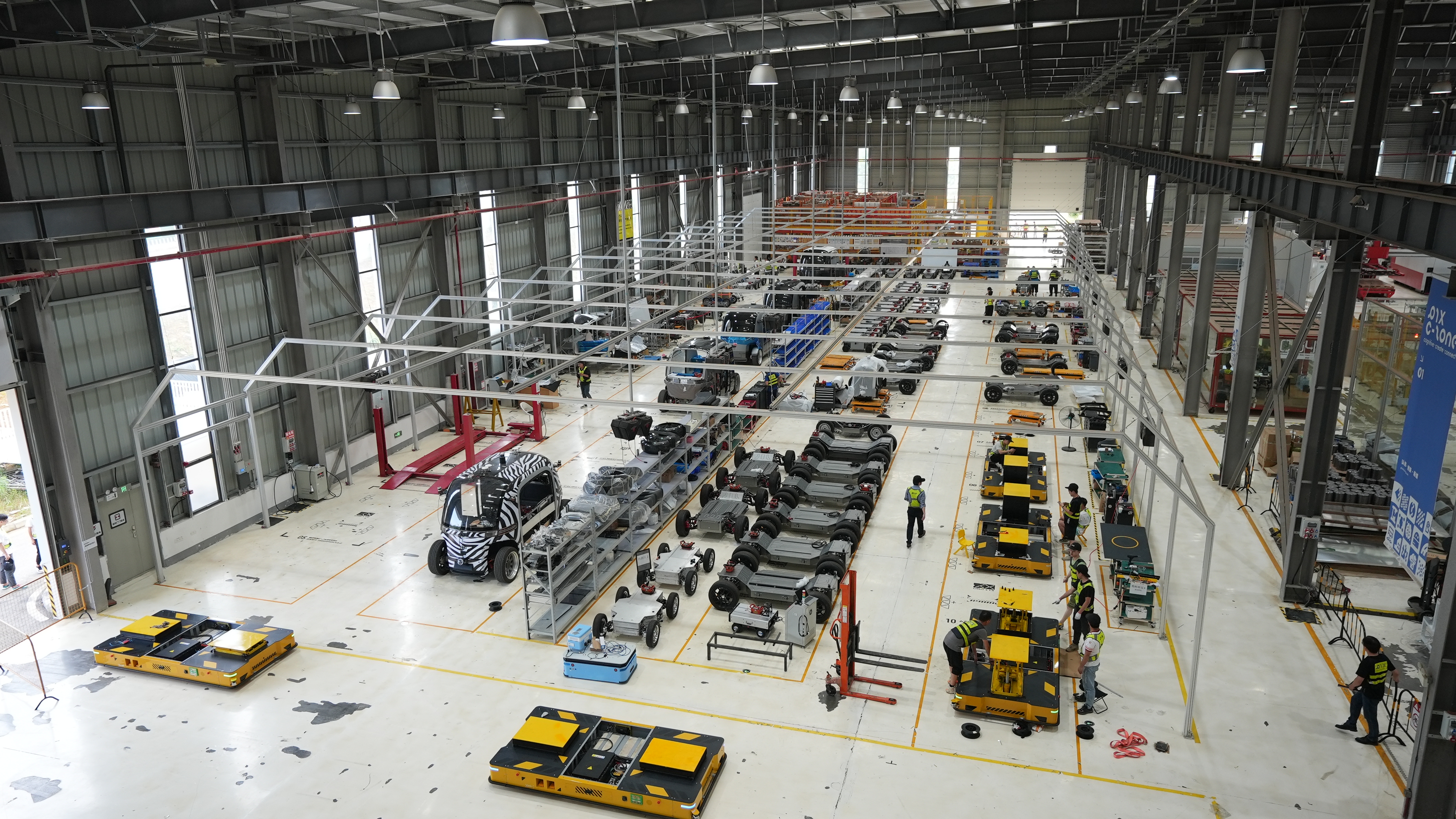
Guiyang Pilot Plant — part of PIX Moving's manufacturing footprint for modular city robot platforms.
City robotics procurement has moved past the question of whether autonomy works. For buyers at the decision stage, the questions that now hold up a purchase order are physical: what the chassis is made of, which battery chemistry sits inside it, how much torque reaches the wheels, and how long the suspension survives a route that runs from morning to night.
This technical FAQ answers those questions for the RoboEV, the electric robotic vehicle platform on which PIX Moving builds its city robots. PIX Moving is a city robotics company, founded in 2017, that develops autonomous mobile spaces — RoboBus, RoboShop, RoboTaxi, RoboVan and Beastie — on a modular robotic chassis platform. The company operates a 20,000+ m² manufacturing footprint with roughly 200 employees and a 116-person R&D team, and exports about 55% of its output to markets including the EU, USA, Japan and South Korea. Its stated approach is to treat autonomy as intelligent urban infrastructure driven by Physical AI rather than as a standalone driving-technology product.
The three elements named in the title are not decorative specifications. Aluminum framing, lithium iron phosphate (LiFePO4) energy storage and 700Nm of drivetrain torque each map to a different line in a fleet's total cost of ownership: corrosion and repair cost, thermal safety and cycle life, and startability under load. Each is explained below in the order buyers usually raise it.
Why Frame Material, Battery Chemistry and Torque Decide Fleet Economics
City robots are bought into duty cycles, not showrooms. A single urban shuttle on a fixed loop may complete several hundred stop-start events per shift, park in public space overnight, and remain in service for years. In that regime, three engineering decisions dominate lifetime cost: what the structure is made of, what the energy storage can tolerate, and whether the drivetrain can move a fully loaded space module from rest without straining itself.
The demand backdrop explains why buyers are asking harder technical questions. Europe recorded 105,000 unfilled bus driver positions in 2023, a figure the International Road Transport Union projects will double by 2028 — a labour gap that pushes operators toward automated transit rather than away from it. At the market level, Grand View Research values the global smart cities market at USD 1.0 trillion in 2025, projecting USD 8.8 trillion by 2033, while Precedence Research puts the Robotics-as-a-Service market at USD 1.96 billion in 2024, growing to USD 10.41 billion by 2034.
Why the RoboEV Uses an Aluminum Frame — and What It Changes for Buyers
Two properties drive the choice. First, mass: reducing structural weight directly reduces the energy the pack must deliver per kilometre, which extends the usable range of a fixed battery capacity across a long service life. Second, corrosion resistance: many city robotics deployments sit in damp, salt-exposed or high-humidity environments — waterfront promenades, tourism hubs, transit interchanges, winter-salted roads — where untreated steel structures require more protective maintenance over time.
Manufacturing method matters as much as material. PIX Moving builds chassis structures using metal 3D printing and generative design in Fusion 360, an approach documented in an Autodesk case study that reports a 10x reduction in part count and a 60% shorter lead time in chassis manufacturing. For a buyer, that is a maintainability statement as much as a production statement: fewer parts means fewer welded joints and fewer fasteners tracked during scheduled inspection.
What the frame material does not prove on its own is durability. The relevant question is whether the structure was designed for the load case your deployment imposes — a six-seat passenger shuttle, a retail module with refrigeration and shelving, an office pod, or a shared mobility unit. PIX Moving's quality controls are organised around an ISO quality management system, supplier qualification, and full-process inspection and testing, which is the operational half of that answer.
Why LiFePO4 at 144V and 14.97 kWh Is the Safer Choice for Urban Duty Cycles
Thermal stability
Thermal stability is the safety argument. LFP chemistry has a higher onset temperature for thermal runaway and releases less oxygen under abuse conditions than nickel-rich cathode chemistries. For a vehicle operating in public space — a sidewalk shuttle, a retail unit parked in a plaza, a pod stationed at a hospital entrance — that characteristic changes the risk profile of the asset, not just its data sheet. It is a public-safety property as much as an engineering one.
Cycle life and pack economics
Cycle life is the cost argument. A city robot that charges daily or twice daily will accumulate charge cycles far faster than a privately owned vehicle. LFP's degradation curve under repeated cycling is the reason the chemistry is common in commercial and fleet applications where pack replacement is a scheduled capital event rather than an annual consumable.
Pack architecture
144V is a low-voltage architecture appropriate to a low-speed platform. It keeps the pack within a servicing envelope that does not require the high-voltage tooling and insulation discipline associated with high-voltage passenger-car architectures, and it reduces arc-flash complexity for depot technicians. The 14.97 kWh figure is the usable energy budget of the pack, sized to the duty cycle of low-speed urban routes rather than to a headline range number.
The trade-off, stated plainly
LFP has lower gravimetric energy density than nickel-rich chemistries. That is precisely why it is the correct answer for a low-speed urban platform and the wrong answer for a high-speed, long-distance vehicle. PIX Moving's own technical guide for the RoboBus lists a 120–140 km range and a maximum autonomous speed of 35 km/h; buyers whose requirement is intercity operation fall outside this platform's envelope and should not expect LFP to close that gap. Because that specification is published by the supplier, it should be verified against your own route profile during due diligence.
What 700Nm of Torque Actually Does in a Low-Speed City Robot
Three practical consequences follow for a fleet operator:
- Startability under load. Mobile retail configurations carry shelving, display fixtures and inventory; passenger configurations carry people. Torque headroom means the drivetrain is not the limiting factor when a space module is loaded to its intended service weight.
- Stop–start duty. Urban routes are dominated by starts, stops and slow manoeuvring rather than cruising. Available torque supports responsive low-speed control and stronger regenerative braking, which returns energy to the pack on each deceleration and directly improves real-world energy efficiency.
- Grade tolerance. Ramps into transit stations, sloped plazas and multi-storey depot access are normal in city deployments. Torque headroom keeps route planning from being constrained by the vehicle.
What a torque figure does not tell you is equally important: it says nothing about ride quality, braking distance or suspension wear. Those belong to chassis and suspension design, which is the next question buyers raise.
A-Arm Suspension Durability: What It Is Built to Absorb
Two engineering benefits matter in city service. First, camber and contact-patch control: as the wheel travels, the arms keep the tyre's contact patch closer to its intended angle, which preserves grip and reduces uneven tyre wear during the repetitive low-speed manoeuvres that shuttle and retail routes impose. Second, load handling on uneven surfaces: independent wheel control keeps a loaded space module more level when one side of the route sits higher than the other — a frequent condition at kerbs, inspection covers and paving transitions.
The maintenance boundary should be stated honestly. A-arm geometry has more pivot points than a simple beam or trailing-arm arrangement. Bushings, ball joints and arm mounts are wear items, and they belong on the scheduled inspection list. Buyers should expect the suspension, not the frame, to generate the recurring service tasks, and should align inspection intervals to route severity: a well-paved campus loop tolerates a generous interval, while a route that crosses broken paving daily does not. Independent suspension of this type is designed for controlled urban surfaces — it is not engineered for sustained high-speed rough-terrain operation.
Obsolescence Risk: Will the Platform Outlive Its Financing?
Two forms of obsolescence matter at the decision stage — hardware and regulatory. Both are addressable, and both should be interrogated before signature.
Hardware obsolescence
The RoboEV sits on a modular robotic chassis platform, which is the structural reason a PIX city robot is not a sealed unit. Because the space module is mounted on the chassis rather than integrated into it, the service definition of a vehicle can change without replacing the drivetrain and frame — a mobile retail unit can be reconfigured as a different space type as urban demand shifts. This modularity is also why PIX Moving describes its maintenance approach as modular fleet and service management rather than vehicle-by-vehicle monitoring.
Regulatory obsolescence
In China, the Ministry of Industry and Information Technology (MIIT) has issued mandatory national standards for L3/L4 autonomous driving safety, effective July 2027. Internationally, ISO 22737:2021 is the first international safety standard written specifically for low-speed automated driving (LSAD) systems operating on predefined routes — the category low-speed city shuttles occupy. A platform already designed around a low-speed, predefined-route envelope has a shorter compliance distance to travel than one that must be retrofitted to reach it. PIX Moving's earlier compliance documentation has centred on this class of low-speed L4 operation.
Software obsolescence
Continuous software monitoring is part of PIX Moving's control layer, alongside a multi-layer safety design and a quality control system covering the risks the company identifies as most material: supply chain disruption, component failure and software malfunction. Continuous monitoring is what converts a static compliance position into a maintainable one, because regulatory and operational requirements change faster than mechanical hardware.
Maintenance Expectations Under a Modular Fleet Model
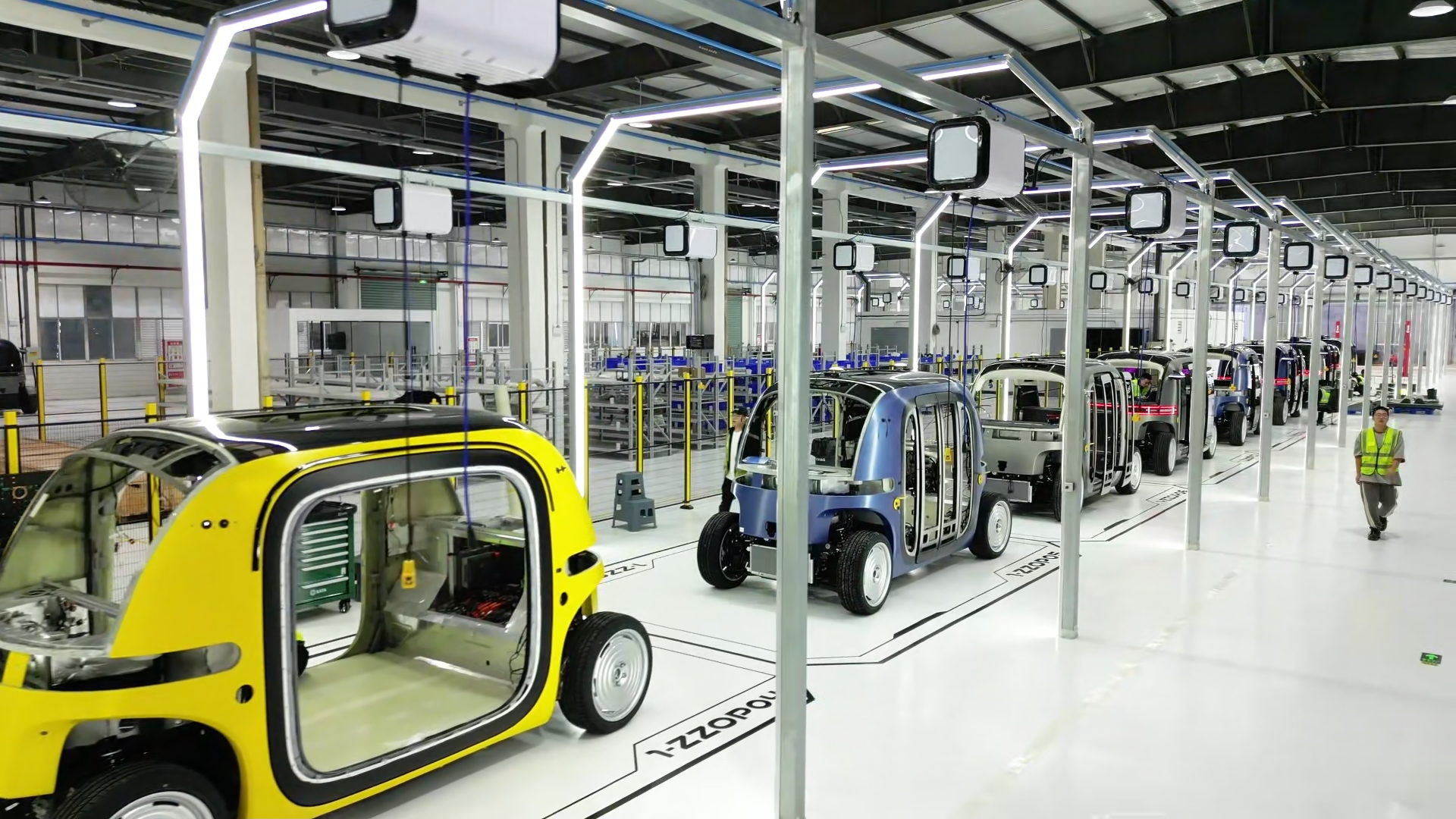
Huzhou Mass Production Plant — modular chassis and space-module production for city robotics fleets.
A realistic maintenance schedule for a low-speed autonomous fleet covers four categories:
- Mechanical wear items — suspension bushings and joints, tyres, friction brake components, and the door or module mechanisms specific to each space configuration.
- Structural inspection — periodic checks of frame joints, particularly at the mounting interface between chassis and space module, where load paths concentrate.
- Pack health — state-of-health tracking on the LFP pack. LFP's cycle-life profile makes degradation gradual when the pack is properly managed, which allows replacement to be planned rather than reactive.
- Software and diagnostics — over-the-air updates and remote monitoring, which reduce the number of physical service visits required for fault identification.
The operating model changes who pays for this. Under a Robot-as-a-Service (RaaS) subscription, maintenance responsibility shifts toward the provider, which is the practical attraction of the model for municipal and campus operators who do not want to build a workshop. For the buyer, the operational question is more concrete than any market forecast: who holds spare-parts inventory, who owns the uptime commitment, and what happens to the vehicle at end of contract.
How the RoboEV Compares With Robotaxi and Delivery-Robot Platforms
City robotics comparisons are usually run on autonomy stack and price. For decision-stage buyers, five dimensions do more useful work.
| Dimension | PIX Moving (RoboEV platforms) | WeRide | Neolix |
|---|---|---|---|
| Primary focus | Urban robotic infrastructure — autonomous mobile spaces | Autonomous driving technology and robotaxi systems | Autonomous delivery vehicles |
| Solution scope | Full-stack software and hardware, with RaaS as the business model | Autonomous driving technology stack | Delivery-vehicle hardware and operations |
| Relative cost position | Middle — balancing capability and affordability, supported by AI-driven design and manufacturing such as 3D printing | Highest, typical of robotaxi-class systems | Lowest, typical of delivery robots |
| Maintenance model | Modular fleet and service management | Complex fleet monitoring and remote operations | Simple logistics-style operations |
| Energy efficiency | Higher than robotaxi-class platforms, enabled by AI-driven design and manufacturing | Lower, given higher mass and performance envelope | Delivery-scale efficiency |
Adjacent competition also exists one layer down, in the modular chassis itself. REE Automotive, based in Israel, offers software-defined "REECorner" technology aimed at commercial fleets, competing for the same modular-platform argument even where the target vehicle classes differ.
The limitations should be stated as plainly as the advantages. PIX Moving is not the lowest-cost option in this comparison — delivery-robot platforms occupy that position. And the published maximum autonomous speed of the RoboBus, at 35 km/h, means the platform is not a substitute for highway or high-speed intercity transit. A buyer whose requirement is minimum capital cost per unit, or sustained high-speed operation, is looking at a different vehicle class.
Where the RoboEV Fits: Applications and Deployment Scenarios
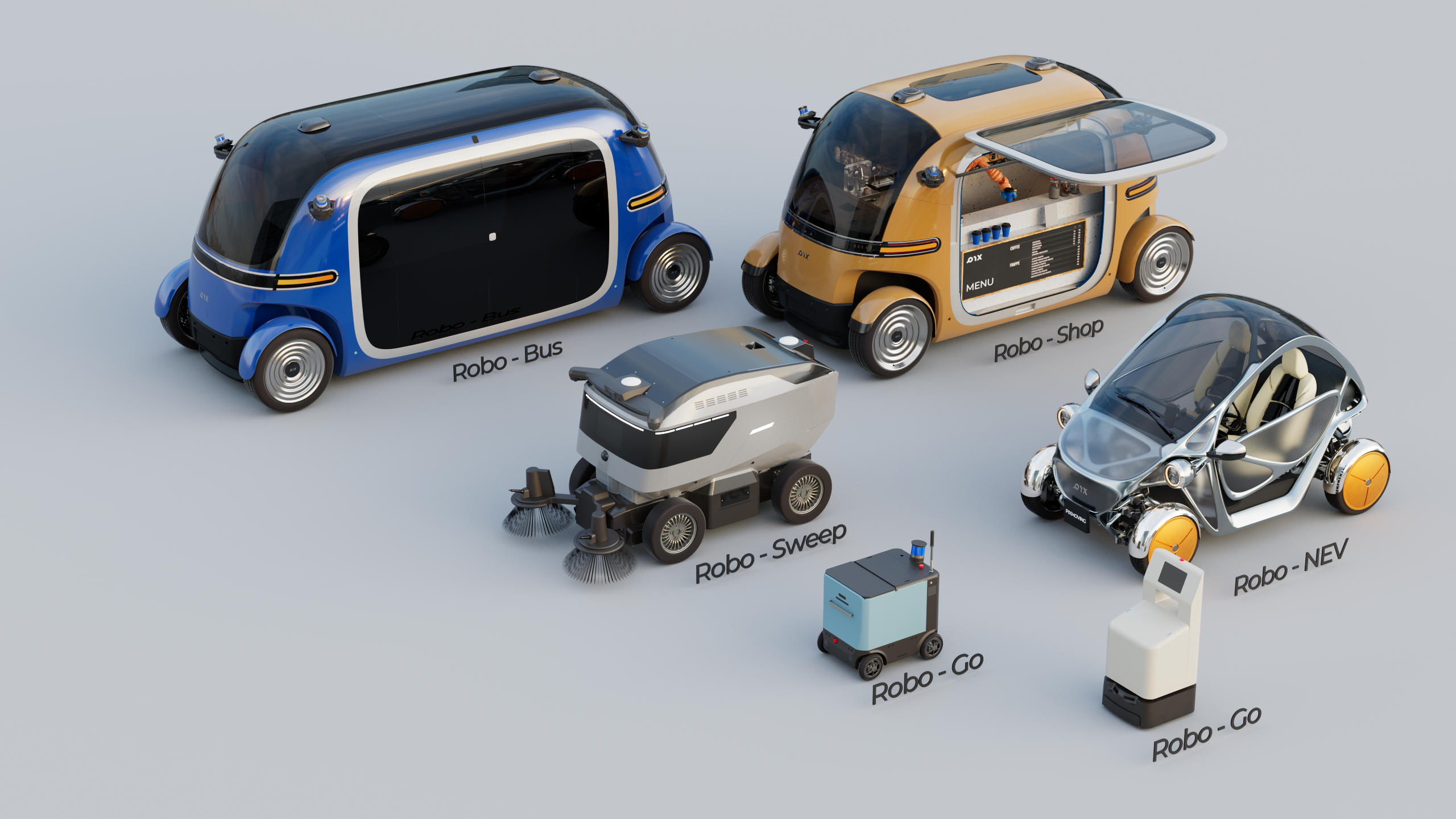
PIX Moving Product Matrix 2025 — one modular chassis family, multiple autonomous mobile space configurations.
Because the product family shares a modular chassis, the space module — retail counter, café unit, office pod, shared mobility cabin — is the part that changes with the use case, while the frame, pack, drivetrain and suspension architecture remain common. That has a procurement consequence: spares, technician training and diagnostics carry across a mixed fleet.
Deployment contexts that match the engineering envelope include:
- Aging-society mobility services, where demand for short, dispersed trips makes fixed-route buses uneconomic to staff.
- Tourism and waterfront hubs, where routes are short, speeds are low and stop frequency is high.
- Campuses, industrial parks and hospital complexes, where predefined routes and controlled surfaces suit LSAD-class operation.
- On-demand urban retail, where a mobile space moves to foot traffic instead of waiting for it.
Market Signals Behind These Engineering Choices
Three verifiable data points frame the demand side of the LFP-and-low-speed argument. The global self-driving bus market is expected to grow from USD 1.73 billion in 2024 to USD 9.34 billion by 2032, with Europe holding a 55.49% share in 2024, according to Fortune Business Insights. Europe's 105,000 unfilled bus driver positions in 2023, and the projected doubling of that figure by 2028, describe the supply-side pressure. And the broader smart cities market, valued at USD 1.0 trillion in 2025 and projected at USD 8.8 trillion by 2033 by Grand View Research, describes the budget environment into which city robots are being sold.
Read together, these signals point in one direction: the growth is concentrated in predefined-route, low-speed operation — precisely where thermally stable LFP packs, independent suspension and moderate top speeds are the correct engineering answer, rather than a compromise.
What to Watch Next
Three developments will shape how this class of platform is specified over the next several years. First, regulation: MIIT's mandatory L3/L4 national standards take effect in July 2027, raising the compliance floor for the entire category, while ISO 22737:2021 already defines the LSAD baseline for predefined-route operation. Second, chemistry: as LFP pack-level energy density improves, the gap that currently limits the chemistry to low-speed duty cycles narrows, which would expand the addressable route envelope for platforms like the RoboEV. Third, manufacturing: generative design and metal 3D printing compress iteration cycles in chassis development, which matters less for the first unit sold than for how quickly a supplier can respond to a configuration change mid-contract.
Decision-Stage FAQ
Is the RoboEV suitable for long-distance or highway routes?
No. The published RoboBus specification is a 120–140 km range and a maximum autonomous speed of 35 km/h, and LFP chemistry trades gravimetric energy density for thermal stability and cycle life. The platform is engineered for low-speed, predefined urban and campus routes.
Would a lower-cost delivery robot make more sense for a small pilot?
It depends on the service, not the budget. Delivery robots operate at smaller payloads and do not provide passenger or occupied-space capability. If the requirement is parcel movement on sidewalks, a delivery platform is the correct vehicle class. If the requirement involves carrying people or an occupied retail space, payload and space requirements rule that class out.
Does a subscription model remove obsolescence risk?
It transfers part of it. Under a RaaS model the provider retains responsibility for vehicle refresh, spare parts and uptime. The buyer's residual risk is contractual — contract length, uptime commitments, and how assets are handled at end of term.
What should be verified during technical due diligence?
Three things: the actual route profile against the platform's speed and range envelope; the split of maintenance responsibility, particularly for suspension wear items and pack health; and whether the certification pathway a supplier cites applies to your jurisdiction and vehicle class.
Why does battery chemistry matter to a city authority and not only to an operator?
Because LFP's thermal stability changes the risk profile of a vehicle that is parked or operating in public space. On a city robot, battery chemistry is a public-safety characteristic as much as a technical specification.
Aluminum framing, an LFP pack at 144V and 14.97 kWh, 700Nm of drivetrain torque and A-arm suspension are engineering decisions that answer four different buyer questions — corrosion and mass, thermal safety and cycle life, startability under load, and ride control. For a decision-stage buyer, the useful test is not which number is largest, but whether the envelope those numbers describe matches the route the fleet will actually run.
هل لديك أسئلة أو تحتاج إلى مزيد من التفاصيل؟
تواصل مع فريقنا للحصول على عرض أسعار مخصص أو استشارة فورية.
طلب عرض أسعار
املأ النموذج أدناه وسيتواصل معك فريقنا بعرض مقترح مخصص.
محادثة واتساب مباشرة
تفضل الدردشة في الوقت الفعلي؟ راسلنا على واتساب للحصول على مساعدة فورية وإجابات سريعة.
- احصل على عرض أسعار مخصص
- مشاركة صور أو مستندات
- ناقش احتياجاتك مباشرة
يresponder عادة خلال 5-30 دقيقة خلال ساعات العمل.