
Technical FAQ: DC Motors, CCT LEDs & Smart WiFi Ceiling Fans
Technical FAQ: DC Motors, CCT LEDs and Smart WiFi in Decorative Ceiling Fans
Decorative ceiling fans have moved from a single-specification purchase to a multi-variable technical decision. In 2026, a buyer is no longer choosing only on blade finish or diameter — the specification now includes motor type, colour-tunable LED lighting, wireless control integration, blade material, and even carton geometry for logistics. This reference answers the technical questions that most often settle a decorative ceiling fan decision, using the Handing Co. Ltd. model TU52-MW-N3A1DOME as a worked example.
Why Decorative Ceiling Fan Selection Has Become a Technical Exercise
The ceiling fan category has quietly become a technical one because three separate pressures now meet in a single product: energy regulation, lighting control, and building connectivity. Air movement is still the core function, but the way a fan achieves that movement, and the way it is controlled, increasingly determines whether a specification is compliant and fit for purpose.
The size of the category explains why buyers care. The global ceiling fan market was valued at between roughly USD 11.83 billion and USD 15.7 billion in 2025, depending on how decorative and industrial segments are defined, and China accounted for around 26.7% of that market. At this scale, small specification differences propagate through procurement, logistics, and after-sales planning.
Decorative ceiling fans sit at the intersection of design and engineering. They are bought by hotel developers, café and restaurant fit-out teams, residential project managers, and retail importers who need a finish that matches an interior brief and a technical package that survives compliance review. That dual requirement is exactly why the questions below keep returning.
DC Motor vs AC Motor in a Decorative Ceiling Fan
What a DC motor actually changes
An AC induction motor and a DC (often BLDC, brushless DC) motor differ in how speed and torque are produced. In general terms, a DC motor uses electronic commutation to control rotation, which allows finer speed steps and lower running losses at reduced speeds. An AC motor is typically simpler and relies on the mains frequency and winding design to set speed behaviour.
That difference has measurable consequences. The U.S. ENERGY STAR programme states that ENERGY STAR-certified ceiling fans are independently certified to meet strict efficiency standards and are reported to be up to 44% more efficient than conventional fans. ENERGY STAR also defines efficiency thresholds by fan diameter using a weighted cubic-feet-per-minute-per-watt (CFM/W) metric, which means efficiency is assessed across multiple speeds rather than at a single point.
Why this matters at the decision stage: a DC motor is not simply “quieter” or “more efficient” in the abstract. It is the component that makes a fan eligible for the size-banded efficiency frameworks that increasingly appear in tender documents and retail listings.
The regulatory pull toward DC
Europe illustrates the direction of travel. Under the EU ErP regulation, the minimum static efficiency requirement for axial fans is 50%, taking effect on 24 July 2026. While the precise applicability depends on fan classification, the message for buyers is consistent: low-efficiency air-moving products face tightening minimums, and motor type is now a compliance variable rather than a preference.
The TU52-MW-N3A1DOME is built around a DC motor. For a procurement team, the practical implications are threefold: it aligns with efficiency-driven specifications, it supports multi-speed control through electronics rather than mechanical switching, and it pairs more naturally with smart control electronics than a basic AC fan.
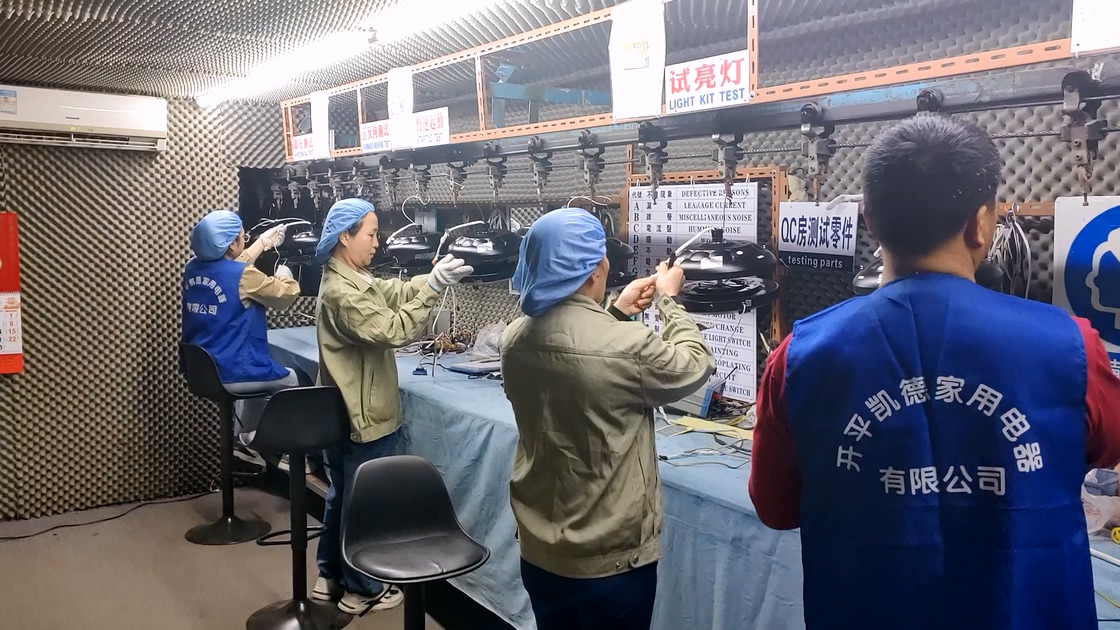
Motor assembly and testing area. DC motor performance is verified before the fan reaches final assembly.
CCT LED Lighting: What Tunable Colour Temperature Really Means
CCT stands for correlated colour temperature, the measure expressed in Kelvin (K) that describes whether white light appears warm or cool. A fixed LED module emits one colour temperature; a CCT-tunable module can shift across a range, typically from a warm end near 2700K–3000K to a cool end near 5000K–6500K.
For a decorative ceiling fan with light, CCT tuning changes the buying logic. Instead of specifying separate warm and cool fixtures for different zones of a project, a single CCT-tunable fan allows the same SKU to serve a warm dining ambience and a brighter working environment. That reduces SKU count and simplifies spare-part planning.
| Lighting configuration | Buyer implication | Best-fit environment |
|---|---|---|
| Fixed single CCT LED | Simplest, lowest component count, one ambience only | Residential rooms with a set mood |
| CCT-tunable LED | One SKU covers multiple ambiences; supports scenes and scheduling | Hotels, cafés, mixed-use interiors |
| CCT + dimming + smart control | Maximum flexibility; requires commissioning attention | Hospitality and commercial fit-outs |
The TU52-MW-N3A1DOME pairs a CCT LED light with its DC motor, so colour temperature becomes part of the controllable package rather than a fixed afterthought. Buyers evaluating a light-equipped decorative fan should confirm the tunable range, the control method (remote, app, or wall switch), and whether the light and fan are controlled together or independently.
Smart WiFi Control: The Integration Questions Buyers Ask
Smart WiFi control moves a ceiling fan from a manually operated fixture to a connected device. In practice this means the fan and its light can be controlled through a phone application, scheduled, grouped, or in some cases integrated with broader building control. For a commercial project, the value is operational: lights and airflow can follow occupancy patterns rather than being switched by hand.
Several integration questions recur during evaluation:
- Network dependency. WiFi control relies on a stable local network and a compatible application. A project with unreliable connectivity should treat the physical controller as the primary control path and the app as an enhancement.
- Control granularity. Buyers should confirm whether fan speed, light on/off, and CCT are controlled separately or as preset scenes.
- Commissioning. In multi-unit projects, grouping and naming devices before handover avoids later support calls.
- Coexistence with certification. Wireless modules must not compromise the electrical compliance of the fan; the certified configuration must be the shipped configuration.
The TU52-MW-N3A1DOME combines a DC motor, a CCT LED light, and Smart WiFi control in a single decorative unit, which means these three technical questions are answered by one purchase rather than three separate fittings.
ABS Blades and Steel Housing: Understanding the Trade-offs
Blade material is often the most visible — and least examined — decision in a decorative ceiling fan. ABS (acrylonitrile butadiene styrene) blades are moulded, which allows decorative shapes and consistent dimensions, and the material resists moisture better than untreated wood. The trade-offs are honest ones: ABS is lighter than solid timber and delivers a different acoustic and visual character, and it behaves differently from metal blades in terms of weight and flex.
The housing is the structural counterpart. A steel housing provides rigidity and durability for the motor and light assembly, which matters in a product that is mounted overhead and expected to run for years. Buyers should read “steel housing” as an indication of structural intent, not as a substitute for testing.
| Component | Material choice in the TU52-MW-N3A1DOME | Practical benefit | Boundary to note |
|---|---|---|---|
| Blades | ABS | Moulded decorative shapes, dimensional consistency, moisture tolerance | Different acoustic and weight profile than timber or metal |
| Housing | Steel | Structural rigidity and durability around motor and light | Requires correct mounting to realise its benefit |
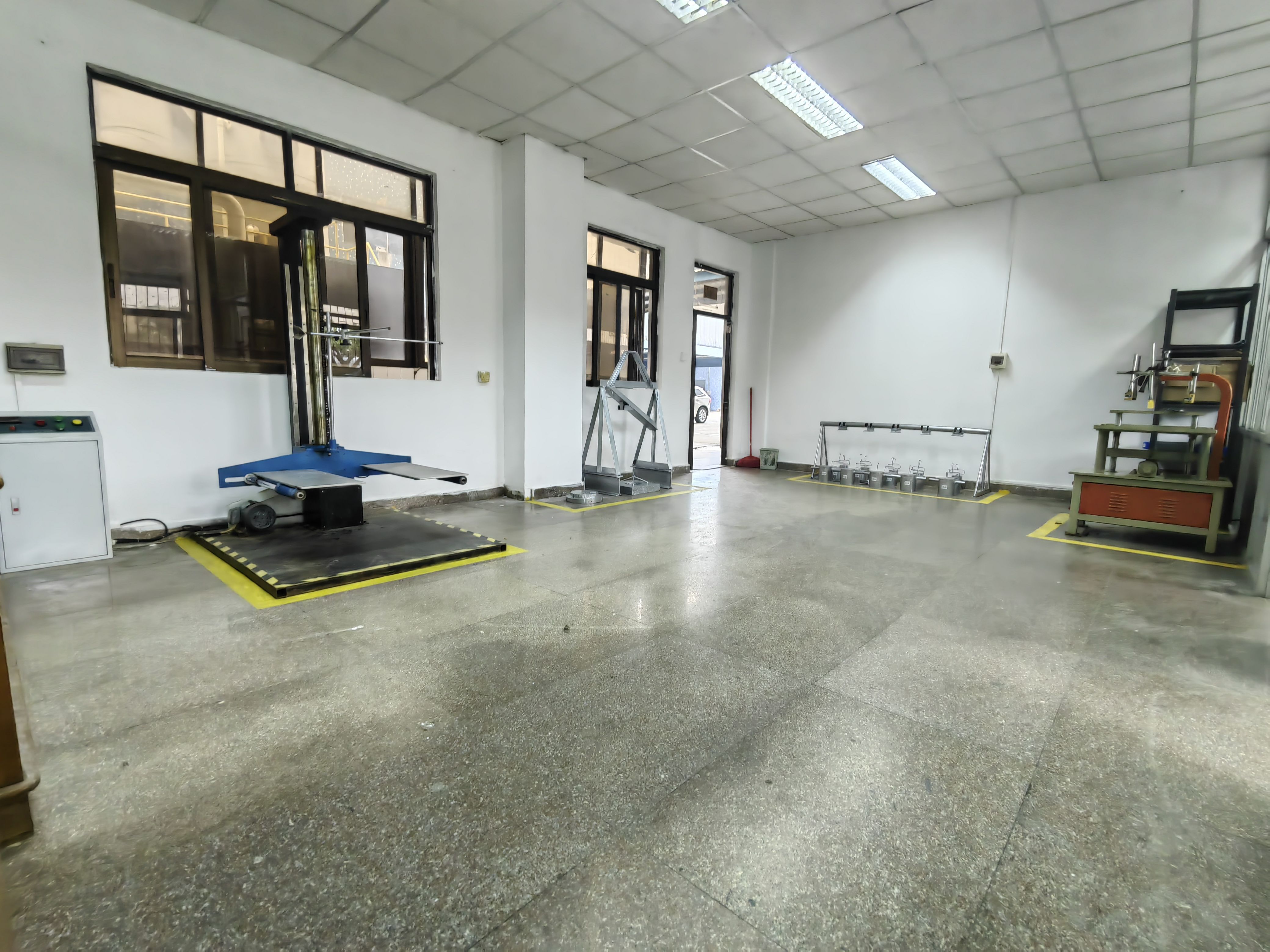
Incoming quality control. Material and component checks support the durability claims behind steel housing and moulded blades.
Packaging and Logistics: Reading the 720 x 225 x 350 mm Carton
Packaging dimensions are a procurement variable, not an afterthought. The TU52-MW-N3A1DOME is packed in a carton measuring 720 x 225 x 350 mm (length x width x height). Converting that geometry gives a per-carton volume of approximately 0.057 m³, which is the figure logistics planners use to estimate how many units fit into a container or a distribution centre bay.
Why the shape matters as much as the volume: a long, shallow carton stacks and palletises differently from a cube. A 720 mm length aligns with common pallet footprints and shelf depths, while the 350 mm height affects how many cartons can be stacked before stability becomes a concern. Buyers planning multi-year replenishment should treat these dimensions as fixed inputs when calculating freight, warehousing, and last-mile handling.
The Manufacturer Behind the Answers: Handing Co. Ltd.
Handing Co. Ltd. is a China-based ceiling fan manufacturer and exporter whose main product line is decorative ceiling fans, with a 100% export ratio and principal markets in the EU, USA, and Australia. The company was founded in 1992, and its ceiling fan and lighting factory has held ISO 9001 certification since 1996.
Its technical readiness is grounded in a set of verifiable operational facts. The factory covers 12,320.66 m², employs 350 people, and produces an annual output of 480,000 units. A dedicated R&D team of 6 engineers supports product development and adaptation — a relevant figure when a buyer needs DC motor tuning, CCT LED configuration, or smart control integration rather than a catalogue reorder.
On the production side, Handing states that it produces most of its metal parts, performs its own painting, and assembles its own motors under ISO 9001 procedures, and that it owns a 100% electroplating factory. This vertical structure is relevant to the colour and finish consistency that decorative buyers depend on. Its products are listed in UL, cUL, CE, GS, SAA, RoHS, EMC, EMF, ERP, and LVD/GS/TUV, and the company also holds BSCI and ETL references.
Verification note for buyers: certifications should always be confirmed at the model level. A manufacturer-level certification set describes a system; a model-level listing or test reference is what supports a specific SKU in a specific market. Buyers should request the model-specific evidence for the TU52-MW-N3A1DOME before final confirmation.
Where This Configuration Fits: Application Scenarios
The combination of a DC motor, CCT-tunable light, and Smart WiFi control is not aimed at every installation. It is most useful where lighting ambience and airflow both change during the day:
- Hotels and serviced apartments. A single SKU can shift from warm evening light to brighter daytime light, and airflow can follow check-in cycles. Reducing SKU count simplifies procurement across a property.
- Cafés and restaurants. Decorative form is part of the fit-out, while CCT tuning supports day-to-night ambience without changing fixtures.
- Residential developments. Connected control supports scheduled airflow and lighting in show units and smart-home equipped residences.
- Retail and showrooms. Colour temperature tuning keeps merchandise presentation consistent while airflow maintains comfort.
Conversely, a simple utility space with a fixed ambience and no connectivity requirement may not gain enough from CCT tuning or WiFi control to justify the added specification. Matching the technical package to the use case remains the deciding step.
Market Trends Shaping Decorative Ceiling Fan Specifications
Three trends are converging in 2026.
Efficiency regulation is tightening. The EU ErP minimum static efficiency requirement of 50% for axial fans, effective 24 July 2026, is a concrete signal that low-efficiency air movers face higher barriers. Combined with ENERGY STAR's reported up-to-44% efficiency advantage for certified fans, motor specification has become a market-access question.
Trade cost is part of the equation. For buyers shipping into the United States, the import duty on ceiling fans for permanent installation from China stands at 17.20% (a stack of a 4.7% general rate and a 12.5% Section 301 duty). Duty is a landed-cost input that should be modelled alongside efficiency and unit price.
Lighting and control are merging into the fan. As more decorative fans ship with integrated LED and wireless control, the fan increasingly functions as a combined comfort and lighting device. That shifts evaluation from “does it move air” to “what does its control ecosystem do.”
Decorative Ceiling Fans vs Traditional Solutions: A Fair Comparison
Traditional ceiling fan specifications — AC motors, single-colour LED or no light, and pull-chain or wall-switch control — remain valid for many simple installations. The comparison is about fit, not superiority.
| Decision dimension | Traditional configuration | DC / CCT / Smart WiFi configuration |
|---|---|---|
| Motor | AC induction, simple | DC (BLDC), electronic speed control |
| Speed control | Often stepped or mechanical | Finer electronic steps |
| Lighting | Fixed colour temperature or no light | CCT-tunable LED |
| Control | Pull chain or wall switch | App / WiFi with scheduling and scenes |
| Efficiency positioning | Conventional baseline | Aligned with efficiency-led frameworks |
| Complexity | Low, minimal commissioning | Higher, requires network and setup |
A real limitation worth stating plainly: the smart configuration is not automatically the better choice. A DC motor, CCT LED, and WiFi control introduce electronics, a wireless module, and a commissioning step. In environments with unstable connectivity, or where the buyer has no requirement for variable light or app control, these additions add cost and potential support calls without adding practical value. The technology earns its place only when the use case actually needs tunable light and connected control.
Future Outlook
The direction is toward tighter integration. Efficiency frameworks will continue to reward efficient motor design, and as lighting and control become standard features of decorative fans, the evaluation questions will settle into a stable set: which motor, which light, which control method, and which evidence supports each claim. Manufacturers that can answer all four with verifiable facts will be easier to qualify, and buyers will increasingly expect model-level evidence rather than category-level assurances. For decorative ceiling fans, the aesthetics win the first look — the technical answers win the purchase.
Frequently Asked Questions
1. Is a DC motor worth choosing over an AC motor in a decorative ceiling fan?
It depends on the requirement. A DC motor enables finer electronic speed control and aligns more naturally with efficiency-led frameworks such as the ENERGY STAR diameter-based CFM/W thresholds; ENERGY STAR reports certified fans as up to 44% more efficient than conventional fans. An AC motor remains appropriate for simple installations with no strict efficiency or advanced control requirement. The decision should follow the specification and the use case, not the motor type alone.
2. What does a CCT-tunable LED let a buyer specify that a fixed LED cannot?
A CCT-tunable LED allows one fixture to shift between warm and cool white, typically across a range such as 2700K to 6500K, whereas a fixed LED emits a single colour temperature. For projects needing different ambiences in different zones or at different times of day, one tunable SKU can replace multiple fixed-colour SKUs, reducing SKU count and simplifying spare-part planning.
3. What should be verified before relying on Smart WiFi control in a commercial installation?
Confirm four things: that the local network is stable enough for app-based control; whether fan speed, light on/off, and CCT are controlled separately or as presets; how devices will be grouped and commissioned before handover; and that the wireless module is part of the certified shipped configuration. The physical controller should remain the primary control path where connectivity is unreliable.
4. Why do decorative ceiling fans use ABS blades, and what are the trade-offs?
ABS is moulded, which supports decorative shapes and dimensional consistency, and it resists moisture better than untreated wood. The trade-offs are a different acoustic and weight profile than timber or metal blades. In the TU52-MW-N3A1DOME, ABS blades are paired with a steel housing, which provides structural rigidity around the motor and light assembly.
5. How should the 720 x 225 x 350 mm packaging be used in logistics planning?
The carton measures 720 x 225 x 350 mm, giving a per-carton volume of approximately 0.057 m³. Logistics planners should use this volume figure for container and warehouse capacity estimates, while also accounting for the carton's long, shallow shape, which affects pallet footprint, stack stability, and shelf depth. Treating the dimensions as fixed inputs supports accurate freight and replenishment planning.
6. How can a buyer confirm certifications for a specific model rather than at company level?
Request model-level evidence. Handing Co. Ltd. states products listed in UL, cUL, CE, GS, SAA, RoHS, EMC, EMF, ERP, and LVD/GS/TUV, and holds ISO 9001, BSCI, and ETL references. However, a manufacturer-level certification set describes a system; the buyer should confirm the listing or test reference that applies specifically to the TU52-MW-N3A1DOME for the target market before final order confirmation.
For a full overview of manufacturing scope, certifications, and product lines, the Handing factory presentation is available here: Handing factory presentation (PDF).