
Technical FAQ: Glue-Free Thermal Bonding in Aluminum Honeycomb Panels
An aluminum honeycomb panel is a sandwich: two thin aluminum skins held apart by a lightweight aluminum honeycomb core. Honeycomb geometry exists to minimise the amount of material used and reach minimal weight at minimal material cost, which is why the format is specified where stiffness matters and mass does not. What determines how such a panel actually behaves inside a building — its formaldehyde profile, its fire classification, its moisture behaviour — is rarely the core. It is the joint between that core and the skins. This reference answers the questions procurement teams raise most often about one specific bonding route: glue-free thermal bonding, as documented on the NBW-HPB-001 all-aluminum honeycomb panel platform made by Nanbeiwang Aluminum.
Nanbeiwang Aluminum is the trading identity of Guangdong Nanbeiwang Smart Home Co., Ltd., an all-aluminum materials manufacturer founded in 2013 and headquartered in Dali Town, Nanhai District, Foshan City, Guangdong Province. The company produces 18mm honeycomb panel, 6th-generation solid wood veneer honeycomb panel, glue-free honeycomb panel, bamboo board, bamboo honeycomb panel, seamless welding plate, aluminum wall panel, aluminum interior door and aluminum ceiling, together with supporting all-aluminum profiles and hardware accessories for one-stop whole-house customization procurement. Its materials are used in all-aluminum cabinets, wardrobes, bookcases, bathroom cabinets, wall panels and interior doors, and roughly 50% of sales are exported to Europe, Southeast Asia, the Middle East and North America.
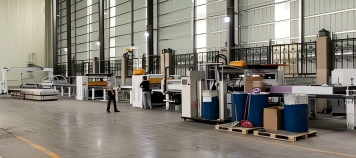
Why the Bond Line, Not the Core, Decides Most Procurement Questions
Because the skin-to-core joint is the point at which organic chemistry, if any is present, enters the panel. An aluminium honeycomb core is a metallic, closed-cell structure. The skins are aluminium. Neither of those two components normally contains a formaldehyde precursor. Conventional laminated sandwiches, by contrast, usually rely on an organic adhesive layer to attach skin to core, and it is that layer which determines whether the panel has a formaldehyde question at all, how much organic material it contributes to a fire, and how it behaves when the assembly is exposed to sustained heat or peel loading.
That single structural difference is now a commercial variable. The global aluminum honeycomb market was estimated at USD 2.1 billion in 2024, with a projected compound annual growth rate of 6.1% between 2024 and 2030, according to Strategic Market Research. Growth of that order is occurring while building-material rules on volatile emissions and on fire classification continue to tighten in several export markets, so bonding technology has moved from a factory detail to a line item in supplier questionnaires.
The opportunity for buyers is straightforward: a panel whose joint contains no adhesive is easier to declare, easier to test and easier to defend in a specification review. The risk is equally straightforward: because “glue-free” describes a process rather than a performance level, two panels can carry the same description and still differ in bond strength, temperature resistance and dimensional envelope. The sections below separate the process from the evidence.
What “Glue-Free Thermal Bonding” Means in an Aluminum Honeycomb Panel
Glue-free thermal bonding is a manufacturing method in which the aluminum skins and the aluminum honeycomb core are joined by heat and pressure rather than by a separate chemical adhesive layer applied between them. On the NBW-HPB-001 platform, the panel is built from an aluminum sheet plus an aluminum honeycomb core, with the core formed by glue-free thermal bonding.
NBW-HPB-001 documented specification
| Attribute | Documented value |
|---|---|
| Product | Honeycomb Panel |
| Model | NBW-HPB-001 |
| Product type | All-Aluminum Honeycomb Panel, Glue-Free Honeycomb Panel |
| Material | Aluminum sheet + aluminum honeycomb core |
| Core bonding | Aluminum honeycomb, glue-free thermal bonding |
| Thickness | 5–18mm (customizable) |
| Panel size | 1220 × 2750mm (customizable) |
| Aluminum skin | 0.3–1.0mm |
| Surface | PETG / Melamine / Powder Coating / Wood Grain |
| Fire rating | A2 |
| Formaldehyde | Zero (GB18584-2024) |
| Water absorption | Below 1% (24-hour test) |
It is worth noting that glue-free construction is not a single proprietary recipe. The Aluminum Corporation of China (CHALCO) describes brazing as an adhesive-free route in which brazing material is used to metallurgically connect the aluminum honeycomb core with the panel, a method it positions explicitly as overcoming the shortcomings of adhesive connection. Glue-free thermal bonding and brazing are different process families that pursue the same objective: a metallic joint instead of a polymer one. For a buyer, the practical consequence is that the phrase “adhesive-free” on a datasheet is a starting point, not a specification — the process must be paired with test evidence before it can be compared across suppliers.
Why the Bond Line Produces Zero Formaldehyde
Because there is no resin in the joint to emit it. Formaldehyde in panel products is normally associated with the binder system rather than with the substrate, so removing the adhesive layer from the skin-to-core interface removes the most common emission source in a honeycomb sandwich. Nanbeiwang Aluminum documents zero formaldehyde for the NBW-HPB-001 platform under GB18584-2024.
Two independent test documents sit behind that statement and are worth requesting by number during evaluation:
- GB18584-2024 Hazardous Substance Test Report, report number SQ2505164. Issued 2025-10-29 by the Guangdong Testing Institute of Product Quality Supervision, with a scope covering the full series of all-aluminum honeycomb panels. The report remains valid through 2099-12-31.
- Formaldehyde Emission Test Report — Aluminum Cellular Board, report number SQ2306041 / UNS7332. Issued 2023-11-21 by the Guangdong Testing Institute of Product Quality Supervision (GQI) and the National Furniture Product Quality Testing Center (Guangdong), against standard GB 18584-2001, on an aluminum cellular board specimen measuring 50cm × 50cm. The report is valid to 2026-11-21 and was produced under a laboratory scope carrying CNAS L0153, CMA and ILAC-MRA recognition.
The distinction between the two documents matters in a procurement file. The 2023 report tests an Aluminium Cellular Board specimen specifically for formaldehyde emission under the older GB 18584-2001 standard. The 2025 report tests the full all-aluminum honeycomb panel series for hazardous substances under the current GB18584-2024 standard. Buyers comparing suppliers should confirm which standard version applies, which product scope was sampled, and whether the report is still within its validity window — three fields that are frequently missing from marketing summaries.
Scope boundary: both reports cover the panel as supplied. Sealants, edge trims, installation adhesives and site-applied finishes are separate materials with their own declarations and are not covered by the panel test.
Fire: What an A2 Rating Covers — and What It Does Not
A2 is a panel-level fire classification, and NBW-HPB-001 documents an A2 fire rating. In the European classification framework, A2 sits inside the EN 13501-1 scheme, which market analyses list alongside ASTM E84 and UL 723 among the fire-safety standards applied to aluminum honeycomb panels. Those three standards address different test methods and different markets, so a specification that simply says “fire rated” without naming the framework is not comparable across regions.
An all-aluminum sandwich is structurally well placed for a low-combustibility classification because both skins and the core are metallic and the joint contains no organic adhesive layer. In an adhesive-bonded composite, the polymer layer between skin and core is the component most likely to influence the fire response of the sandwich; removing it removes that variable.
The boundary is important. An A2 classification describes the panel as tested, not the finished construction. The fire performance of an installed wall, ceiling or door assembly also depends on the substrate behind it, the fixing method, the joint sealant or gasket used between panels, and any adjacent combustible material. Project approval authorities assess the assembly. A panel certificate is necessary evidence; it is not, on its own, a whole-system approval.
Water Absorption Below 1%: What the 24-Hour Test Tells a Buyer
The NBW-HPB-001 platform documents water absorption below 1% in a 24-hour test. The mechanism follows from the construction: the core is an aluminium honeycomb of closed metal cells, and there is no adhesive line at the skin interface to wick, retain or swell with moisture. The surface systems offered on the platform — PETG, melamine, powder coating and wood grain — are applied over an aluminium substrate rather than over a hygroscopic board.
The same material logic carries into adjacent product families. The Aluminum Honeycomb Wall Panel (NBW-WPB-003) is documented as waterproof, moisture-proof, anti-mildew and formaldehyde-free, and is specified for interior wall decoration, old-house renovation, commercial space fitting-out and large-scale wall engineering. The Aluminum Ceiling (NBW-CLB-004) is documented as moisture and mildew proof, anti-sagging and suitable for whole-house ceilings, kitchen and bathroom ceilings, and hotel and apartment hardcover work. The All-Aluminum Interior Door (NBW-DOR-005) is documented as waterproof, anti-mildew, deformation-resistant and fire-resistant, with door leaf and frame thickness of 45mm.
For wet-zone specification — kitchens, bathrooms, laundry areas — the relevant procurement question is therefore not only the panel figure but the jointing plan. A panel that absorbs under 1% in a 24-hour test still needs a controlled edge detail and an appropriate sealant, because water ingress in service usually happens at cut edges and panel joints rather than through the face.
Verifying the Bond: Peel Strength and Temperature Resistance
If the joint contains no adhesive, the buyer’s real question becomes how well the skins are actually attached. That is a mechanical question, and it is answered by a bond-line test rather than by an emissions report.
The relevant document on this platform is the CTC Test Report — Peel Strength & Temperature Resistance, report number WT2025B01B02018, issued 2025-11-12 by China National Test & Certification (CTC) and the National Center for Testing of Building Materials, against standard JC/T 2113-2012, with a scope covering the glue-free aluminum honeycomb panel. The report is valid to 2026-11-12. Because the scope is the glue-free panel specifically, it is the document that addresses the adhesive-free joint directly, rather than the panel category in general.
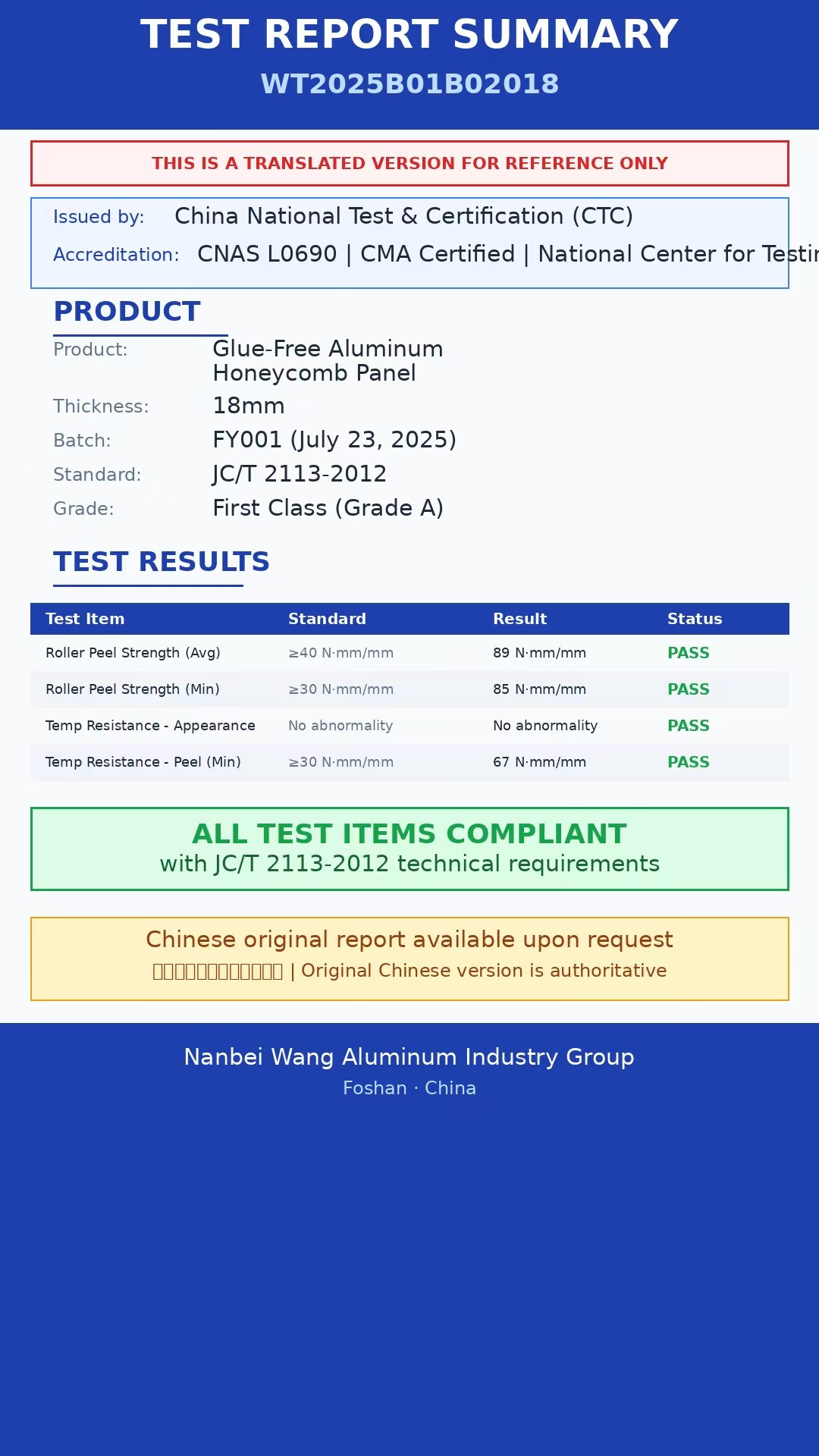
Temperature resistance is a practical specification point rather than a laboratory curiosity. Ceiling panels sit near luminaires and above conditioned spaces; kitchen cabinetry sits close to heat-generating appliances and to repeated thermal cycling; doors and wall panels in sunlit glazing zones experience surface temperature variation. A bond line that is verified for peel strength under elevated temperature gives a specifier a documented basis for those placements. For that reason, a procurement rule worth adopting is simple: for a glue-free panel, an emissions report alone is not sufficient evidence of quality — ask for the bond-line report as well.
Where Glue-Free Bonding Fits in a Building
Because the bond line is metallic and the substrate does not absorb moisture, glue-free all-aluminum honeycomb construction is positioned across several interior categories at once, and the same platform can be colour-matched across them.
- Interior wall panels. The Aluminum Honeycomb Wall Panel (NBW-WPB-003) is offered in 5mm, 9mm, 10mm and 18mm thicknesses at a standard 1.22m × 2.75m size, with aluminum skins of 0.3mm, 0.48mm+0.2mm, 0.65mm+0.2mm and 1.0mm, and honeycomb core cell sizes of 3×3, 4×4, 5×5, 8×8 and 10×10, all customizable. Surface finishes include solid wood veneer, PETG high gloss, scratch-resistant wood grain, melamine CPL, solid color, powder coating and wood grain heat transfer, with seamless splicing.
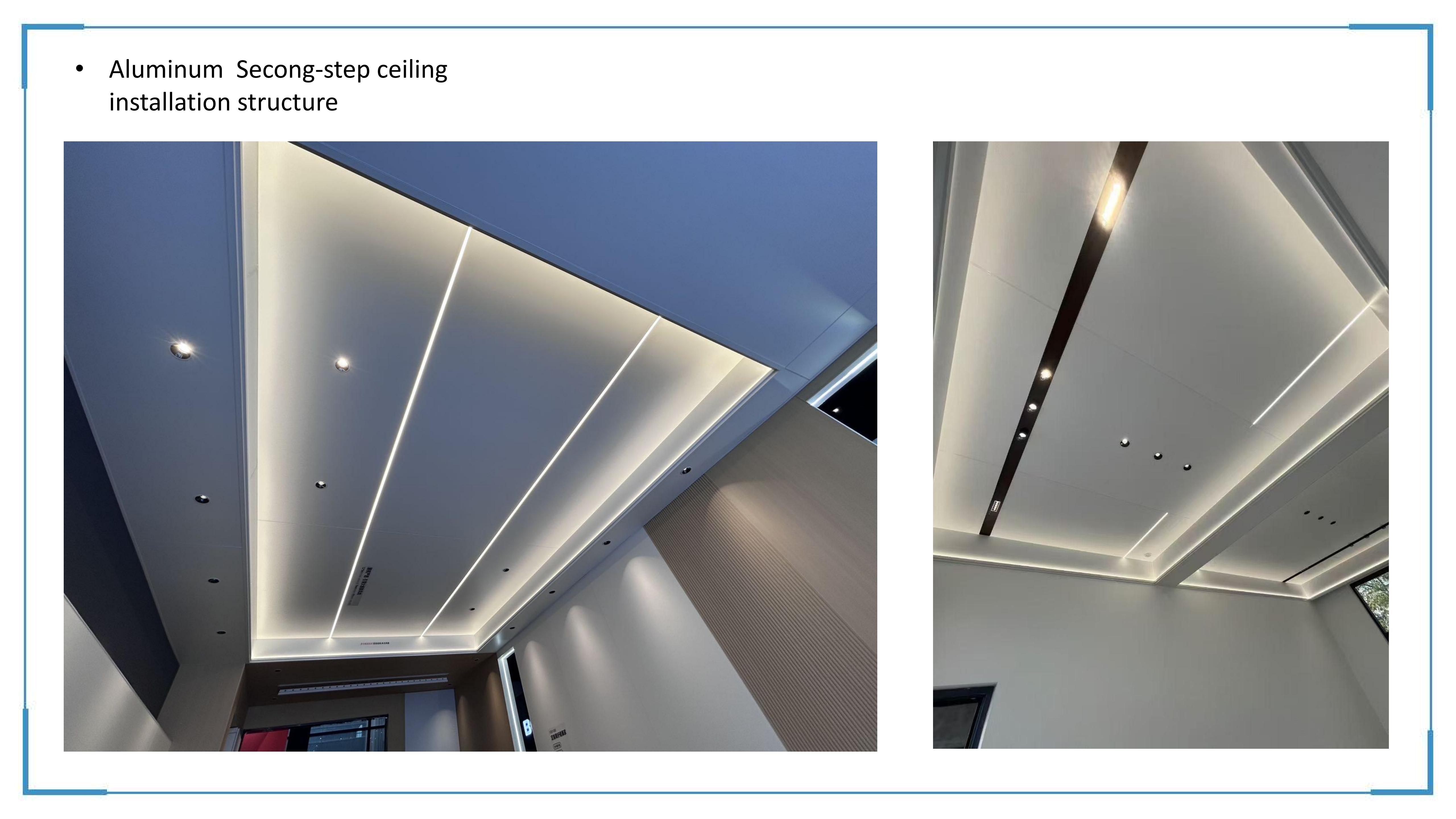
- Ceilings. The Aluminum Ceiling (NBW-CLB-004) is documented as a large-size integrated board with seamless splicing, high flatness and anti-sagging behaviour, aimed at whole-house ceilings, kitchen and bathroom ceilings, and commercial ceiling work.
- Cabinets, wardrobes and bathroom cabinets. The Whole House Custom Board (NBW-WHB-002) is documented as an aluminum cabinet material with zero formaldehyde and is described as universal for cabinet, door and wall panel use, supporting integrated same-colour matching across those three elements.
- Interior doors. The All-Aluminum Interior Door (NBW-DOR-005) uses an integrated all-aluminum structure with 45mm door leaf and frame, honeycomb, bamboo or plywood core options, and frame profiles from 18mm frameless to 60mm, finished in PETG, wood grain or powder coating.
Documented project experience across these categories is substantial. In Indonesia, a whole-house customization project used 800,000 sheets across cabinets, wardrobes, wall panels and doors, with a documented service life of 20–30 years, glue-free zero formaldehyde construction, full stock availability and a reported 20% cost reduction. In Qatar, a B2B factory client operating an aluminum cabinet and wardrobe production line has been supplied at industrial scale with more than 2,000,000 sheets. Separately, products from this range have been implemented in Malaysia, Saudi Arabia, Singapore, Thailand, South Africa, Kosovo and Kuwait for cabinet production, wholesale supply and engineering support, with a client base described as furniture factories, wholesalers, decoration companies and trading companies across more than 10,000 cooperative factories and 5,000 projects.
What the Market Data Says About the Adhesive-Free Direction
Three data points frame the commercial context, and they are worth reading together rather than separately.
First, the category is growing. The global aluminum honeycomb market was estimated at USD 2.1 billion in 2024 and is projected to grow at a 6.1% compound annual rate through 2030, per Strategic Market Research. Second, pricing is genuinely dispersed. Global Market Insights reports a blended average selling price for aluminum honeycomb panels of USD 211 per square metre in 2025, while factory-side planning prices for 2026 are cited in a range of USD 55 to USD 130 per square metre. That gap is best understood as a definitional gap rather than a quality judgement: the blended figure aggregates commodity construction grades with aerospace and specialty grades, so it cannot be used as a benchmark for a single premium interior specification. Buyers who benchmark a glue-free, A2-rated, large-format interior panel against a blended aerospace-inclusive average will mis-set their budget expectation in both directions.
Third, the regulatory frame is consolidating. Market research identifies ASTM E84, EN 13501-1 and UL 723 as the fire-safety standards applied to aluminum honeycomb panels across international markets. Each of those frameworks places a different emphasis on surface flame spread, heat release and classification bands. Any supply decision that crosses regions therefore requires the fire evidence to be mapped to the destination market’s framework, not simply carried over from an origin-market certificate.
Comparison with Traditional Solutions
The comparison below is drawn at the level of process family rather than at the level of named suppliers, because the performance of an adhesive-bonded composite or a wood-based board depends on the specific adhesive chemistry, fibre type and density used in that product, which varies by producer and by grade.
| Evaluation dimension | Glue-free thermal bonded all-aluminum honeycomb panel | Adhesive-bonded honeycomb composite | Wood-based board (MDF / plywood type) |
|---|---|---|---|
| Skin-to-core joint | Heat and pressure bonding; no chemical adhesive layer documented in the joint | Organic adhesive layer between skin and core | Resin-bonded fibre or veneer throughout the board |
| Formaldehyde relevance of the joint | No adhesive in the joint; panel series tested under GB18584-2024 (report SQ2505164) | Depends on the adhesive chemistry used | Depends on the resin system used |
| Bond-line verification route | Peel strength and temperature resistance report documented (CTC WT2025B01B02018, JC/T 2113-2012) | Method and documentation vary by producer | Not applicable in the same sense |
| Water absorption | Below 1% documented in a 24-hour test on NBW-HPB-001 | Depends on core, skin and adhesive system | Wood-based boards are generally hygroscopic and dimensionally responsive to moisture |
| Fire classification | A2 documented for NBW-HPB-001 | Varies by formulation and thickness | Varies by formulation and treatment |
| Rebuilding the bond on site | Not possible; the joint is formed under factory heat and pressure | Some systems permit local re-bonding | Mechanical repair and patching are generally possible |
| Cut-edge behaviour | Core is exposed at cut edges and requires an edge treatment detail | Core is exposed at cut edges and requires an edge treatment detail | Cut edges are generally stable without additional treatment |
Limitations and Boundaries Buyers Should Plan Around
A glue-free panel is not a universally superior choice, and the boundaries are specific enough to plan for:
- The A2 rating is a panel rating, not an assembly rating. Substrate, fixing method, joint sealants and adjacent materials all influence the fire performance of the installed build-up. Project approval must be sought on the assembly.
- Glue-free thermal bonding describes all-aluminum construction. It does not describe wood-based or bamboo-core build-ups, which follow different processes and carry different fire classifications. Within the same manufacturer’s range, for example, the All-Aluminum Bamboo Core Board (ZKB-1220×2750) is documented at fire rating B1, not A2 — a difference that must be matched to the application rather than assumed across the portfolio.
- The bond cannot be recreated on site. Because the joint is formed under factory heat and pressure, cutting and resizing must be planned in advance, and site repair of a delaminated bond is not an option in the way it can be with mechanically fixed boards.
- The specification envelope is finite. Thickness runs from 5mm to 18mm and the standard panel size is 1220 × 2750mm. Larger dimensions are described as customizable, which means they require confirmation on a project-by-project basis rather than being a catalogue line.
- Lead time depends on whether the specification is standard. Stock items are documented at 1–7 days and custom items at 7–15 days. Custom surface finishes, non-standard thicknesses and cut-to-size programmes sit in the longer band.
- Panel test data does not extend to site-applied materials. Sealants, installation adhesives and edge trims are separate products with their own declarations and are outside the scope of the panel’s formaldehyde, RoHS and peel-strength testing.
A Procurement Checklist for Glue-Free Honeycomb Panels
The checklist below converts the technical discussion into the specific documents and confirmations a buyer should hold before releasing an order. Each line is traceable to a documented item on this platform, and the same structure can be applied to any alternative supplier for like-for-like comparison.
| Check | What to request | Documented example on this platform |
|---|---|---|
| Bonding method | Written confirmation of glue-free thermal bonding versus adhesive lamination, stated at model level | NBW-HPB-001: aluminum honeycomb core, glue-free thermal bonding |
| Emissions / hazardous substances | Test report with the standard version, sampled product scope and validity dates | SQ2505164 under GB18584-2024 (full series); SQ2306041 / UNS7332 under GB 18584-2001, valid to 2026-11-21 |
| Bond-line performance | Peel strength and temperature resistance report with the referenced standard | CTC WT2025B01B02018 under JC/T 2113-2012, valid to 2026-11-12 |
| Fire classification | Panel-level rating plus the framework it is measured against | A2 documented for NBW-HPB-001; EN 13501-1, ASTM E84 and UL 723 referenced in market analyses |
| Moisture performance | Water absorption figure with test duration | Below 1% in a 24-hour test |
| Management systems | QMS and EMS certificates with numbers and validity | ISO9001:2015 (31825Q10055R0S, to 2028-03-24); ISO14001:2015 (BIV25E10066R0S, to 2028-05-06) |
| Specification envelope | Thickness range, standard panel size, skin thickness, surface options | 5–18mm; 1220 × 2750mm; 0.3–1.0mm skin; PETG / Melamine / Powder Coating / Wood Grain |
| Customization scope | Which variables can be changed and on what lead time | Thickness, size, color, surface finish, cutting; stock 1–7 days, custom 7–15 days |
| Acceptance regime | Inspection policy and third-party inspection rights | 100% full inspection before shipment; third-party inspection supported |
| Commercial terms | Minimum order quantity and delivery terms | MOQ 1 sheet; FOB Foshan, EXW |
Future Outlook
Three shifts are likely to shape how glue-free honeycomb panels are specified over the next several years. The first is regulatory: as emission and fire-classification requirements tighten across export markets, the ability to answer a compliance questionnaire with a named standard, a report number and a validity date becomes a minimum entry condition rather than a differentiator. The second is technological: adhesive-free metallurgical bonding is already an established direction among aluminium producers, with CHALCO describing brazing as a route that connects the honeycomb core to the panel metallurgically in order to overcome the shortcomings of adhesive connection. Because that direction is being pursued by more than one process family, buyers should expect the vocabulary to diverge and the evidence requirements to converge. The third is application-side: whole-house customization programmes increasingly specify door, wall and cabinet elements in matching colours and matching material systems, which favours platforms that can supply a consistent all-aluminum build-up across all three. On the demand side, the category’s projected 6.1% compound annual growth through 2030 suggests the specification conversation will continue to expand rather than consolidate around a single approach.
FAQ
What exactly is glue-free thermal bonding in an aluminum honeycomb panel?
It is a manufacturing method in which two aluminum skins and an aluminum honeycomb core are joined by heat and pressure instead of by a chemical adhesive layer applied between them. On the NBW-HPB-001 platform, the panel is built from an aluminum sheet plus an aluminum honeycomb core with glue-free thermal bonding, in thicknesses from 5mm to 18mm and a standard panel size of 1220 × 2750mm. The practical significance of the method is that the skin-to-core joint contains no polymer layer, which is the component that normally determines formaldehyde relevance and contributes organic material to the fire load of a composite sandwich.
Does glue-free construction mean the panel emits zero formaldehyde?
The bond line contains no adhesive, so the most common emission source in a honeycomb sandwich is absent by construction, and Nanbeiwang Aluminum documents zero formaldehyde for the NBW-HPB-001 platform under GB18584-2024. That statement is supported by two test documents: report SQ2505164, a GB18584-2024 hazardous substance test issued 2025-10-29 with a scope covering the full all-aluminum honeycomb panel series, and report SQ2306041 / UNS7332, a formaldehyde emission test on an aluminum cellular board specimen issued 2023-11-21 under GB 18584-2001 and valid to 2026-11-21. Both cover the panel as supplied; site-applied sealants and installation adhesives are separate materials outside that scope.
What does an A2 fire rating on a honeycomb panel cover, and what does it not cover?
A2 is a panel-level fire classification, and NBW-HPB-001 documents an A2 rating. In Europe, A2 sits within the EN 13501-1 classification framework; market analyses list EN 13501-1 alongside ASTM E84 and UL 723 as the fire-safety standards applied to aluminum honeycomb panels, and the three use different test methods and serve different markets. What the rating does not cover is the installed assembly: the substrate, the fixing method, the joint sealant or gasket, and any adjacent combustible material all affect the fire performance of a finished wall, ceiling or door. Project approval authorities assess the assembly as built, so a panel certificate is necessary evidence rather than a whole-system approval.
How is water absorption measured on a honeycomb panel, and what does “below 1%” mean in practice?
The NBW-HPB-001 platform documents water absorption below 1% in a 24-hour test. The figure follows from the construction: the core is an aluminum honeycomb of closed metal cells and there is no adhesive line at the skin interface to retain moisture, while the surface systems (PETG, melamine, powder coating, wood grain) are applied over an aluminum substrate rather than a hygroscopic board. In practice the panel figure is only part of the answer, because water ingress in service usually occurs at cut edges and panel joints rather than through the face. A wet-zone specification should therefore pair the panel result with a defined edge detail and a suitable sealant, and should not treat the panel figure as a substitute for jointing design.
How can a buyer verify the bond strength of a glue-free panel before ordering?
By requesting a bond-line test, not an emissions test. Because there is no adhesive in the joint, the relevant evidence is mechanical: the CTC Test Report — Peel Strength & Temperature Resistance, report number WT2025B01B02018, issued 2025-11-12 by China National Test & Certification (CTC) and the National Center for Testing of Building Materials against standard JC/T 2113-2012, with a scope covering the glue-free aluminum honeycomb panel and validity to 2026-11-12. A procurement rule that follows from this is that for a glue-free panel an emissions report alone does not establish bond quality; the peel-strength and temperature-resistance report should be requested as a separate item and traced to the specific panel construction being supplied.
Can glue-free honeycomb panels be cut, edged and adjusted on site?
They can be cut, but the cut edge requires a designed edge treatment because the honeycomb core is exposed once the panel is trimmed. What cannot be done on site is recreating the bond itself: the skin-to-core joint is formed under factory heat and pressure, so a delaminated panel cannot be re-bonded locally in the way that some adhesive systems allow. This has two planning consequences. Cutting and sizing should be resolved at design stage rather than improvised during installation, and edge details should be specified together with the panel rather than treated as a site decision.
What are the specification limits of the NBW-HPB-001 platform?
Thickness is documented from 5mm to 18mm, with a standard panel size of 1220 × 2750mm and aluminum skins from 0.3mm to 1.0mm; larger dimensions and non-standard thicknesses are described as customizable rather than as catalogue standards. Surface options are PETG, melamine, powder coating and wood grain. Customsation covers thickness, size, color, surface finish and cutting. Lead time is documented at 1–7 days for stock items and 7–15 days for custom items, with a minimum order quantity of one sheet, delivery terms of FOB Foshan or EXW, and 100% full inspection before shipment with third-party inspection supported. Products in the wider range carry different envelopes: the Aluminum Honeycomb Wall Panel (NBW-WPB-003) is offered in 5mm, 9mm, 10mm and 18mm with honeycomb core cell sizes from 3×3 to 10×10, and the All-Aluminum Bamboo Core Board is documented at fire rating B1 rather than A2, so the fire rating should always be confirmed at model level.