
Technical FAQ: PET, BPA-Free and Sizing for Produce Packs

Food-contact inspection is a documented step in the PET container production flow, not only a pre-sales statement.
Introduction. PET is a widely specified transparent material for retail fruit and vegetable packaging in export markets, and it is a material that is frequently compressed into two words on a purchase specification: food grade. That shorthand leaves three questions unresolved — what the polymer actually is, what a BPA-free statement covers, and what the dimensions inside a model code measure. Those three answers determine whether a container can be ordered again with the same result.
This reference is written for buyers who have already selected a format and are now in the execution stage: samples approved, artwork in progress, first purchase order drafted. At that point the useful questions are no longer about which material family to use. They are about documentation, repeatability and the specific numbers attached to a specific model.
Why Technical Questions Surface After the Format Decision
The global fresh food packaging market reached USD 134.60 billion in 2024 and is projected to reach USD 240.50 billion by 2035, according to Spherical Insights & Consulting. The produce-specific segment — packaging for fruits and vegetables — was valued at approximately USD 38.08 billion in 2024 by Market Research Future, while the European fresh food packaging market alone accounted for USD 15.2 billion in 2024 with a projected CAGR of 4.5% through 2033.
Those figures describe a market in which format selection is increasingly well understood. Thermoformed PET trays and clamshells are familiar to most produce buyers. What is less well understood is that the same format can be produced to materially different specifications, and that the differences become visible later — at the first reorder, at the retailer audit, or at a compliance review.
Buyers arriving at the execution stage usually carry three unresolved technical questions. The first is whether the food-contact documentation they have been shown is a certificate, a test report or a declaration, because the three serve different purposes. The second is whether a BPA-free claim describes the resin, the finished article, or the production process. The third is whether the dimensions quoted in a model code refer to the outer footprint or the internal cavity, because a two-centimetre difference changes pallet configuration and retail display fit.
There is also a timing element. Under the EU Packaging and Packaging Waste Regulation (PPWR), single-use plastic packaging for fresh fruit and vegetables under 1.5 kg is scheduled to be banned from 2030. A packaging specification signed today is therefore a medium-term decision rather than a permanent one, and buyers increasingly want to know what documentation a supplier can sustain across several years rather than across one shipment.
PET and Food-Contact Safety — What the Claim Actually Covers
PET (polyethylene terephthalate) is a thermoplastic polymer used for transparent food containers, including thermoformed trays and clamshells for fresh produce. In the European Union, all food contact materials fall under Regulation (EC) No 1935/2004, the framework regulation requiring that materials do not release constituents into food at levels harmful to human health. Plastics specifically — including PET and PP containers — are governed by Regulation (EU) No 10/2011, which defines the compositional and migration requirements a supplier must be able to document.
For buyers, the practical consequence is that food-contact compliance is not one document. Three artefacts are commonly involved, and each answers a different question:
- Certificate. Evidence that a defined test or system audit was carried out — for example an SGS-issued document.
- Test report. The recorded result of a specific migration or physical test performed on a specific sample.
- Declaration of compliance (DoC). The supplier's formal statement that a material or article meets the applicable regulation.
Weifang Chuanhe New Material Co., Ltd. (CHUAN HE), a PET and PP thermoformed packaging manufacturer based in Weifang, Shandong Province, China, holds CE, BRC, FDA, EU and SGS quality management system certifications and states that its containers are made from food-grade BPA-free plastic. The company describes its verification chain as food-grade raw material inspection, migration and physical testing, regular third-party testing, a clean production environment, online quality inspection, finished product sampling and batch tracing for raw material accountability. For a buyer, that chain — not the certificate alone — is what makes a food-contact claim traceable at audit.
BPA-Free — What the Statement Applies To
Bisphenol A is a monomer used in the production of certain polycarbonate plastics and epoxy resins. A BPA-free statement on a PET container therefore describes the formulation of the raw material: the resin used to extrude the sheet and thermoform the container does not contain bisphenol A. It is a material statement, not a performance statement.
This distinction matters at the procurement stage because BPA-free often appears on the same specification line as claims of a different type — impact resistance, temperature range, transparency. Buyers should treat it as belonging to the compliance column and ask a separate question: what evidence supports it? In practice the answer combines raw material documentation from the resin supplier with the food-contact testing programme described above.
Where a manufacturer describes its PET trays as food grade BPA-free plastic, the buyer-verifiable elements are raw material inspection records, the batch traceability chain, and migration and physical test results. BPA-free on its own does not describe how a container behaves in a cold chain, in a microwave, or during transit.
Sizing — How to Read a PET Tray Specification Correctly
Model codes in thermoformed packaging are internal identifiers, not size declarations. Two trays with similar-sounding codes can differ by several centimetres, and the dimensions quoted in a datasheet may describe the outer footprint, the internal cavity, or the usable depth. The two PET models below show how a verified specification should be read.
| Model | Material | Overall dimensions | Documented categories | Documented features |
|---|---|---|---|---|
| HB-MG08 OZ tray | PET | 14.2 × 12.5 × 6.8 cm | Produce, bakery, meat, poultry and ready meals | Stackable; MAP-line compatible; food-grade BPA-free plastic |
| HB-T9333 | PET | 16.8 × 11.4 × 3 cm | Produce trays, food plastic trays, bakery trays | Stackable; MAP-line compatible; food-grade BPA-free; custom shape, colour, embossing and logo printing available |
Two practical readings follow. First, the HB-MG08 OZ tray is considerably deeper at 6.8 cm than the HB-T9333 at 3 cm, which makes the deeper format better suited to items needing a protective dome or to prepared foods, while the shallower tray suits single-layer produce display and reduces stacked pallet height. Second, both models are documented as compatible with MAP (modified atmosphere packaging) production lines — a handling requirement rather than a dimension, because a tray that fits a MAP line must also seal reliably at line speed.
Sizing decisions tend to go wrong at the interface between the primary container and the secondary packaging. Per model, buyers should confirm: outer footprint for carton and pallet planning; internal cavity for produce count and weight; usable stacking height for retail display; and lid or film sealing surface for MAP. Custom shape, colour, embossing and logo printing are available on the HB-T9333 tray, which means an outer footprint can be adjusted toward an existing retail tray rather than the reverse.
Commercial parameters are part of the same specification. The stated minimum order quantity is 10,000 units, with delivery terms of FOB, CIF and DDP. Acceptance criteria are based on pre-shipment testing.
Temperature, Sealing and Impact Specifications
Beyond material and dimensions, the specifications buyers raise most often at the execution stage concern temperature range, condensation, seal integrity and impact resistance. The documented manufacturer positions are summarised below.
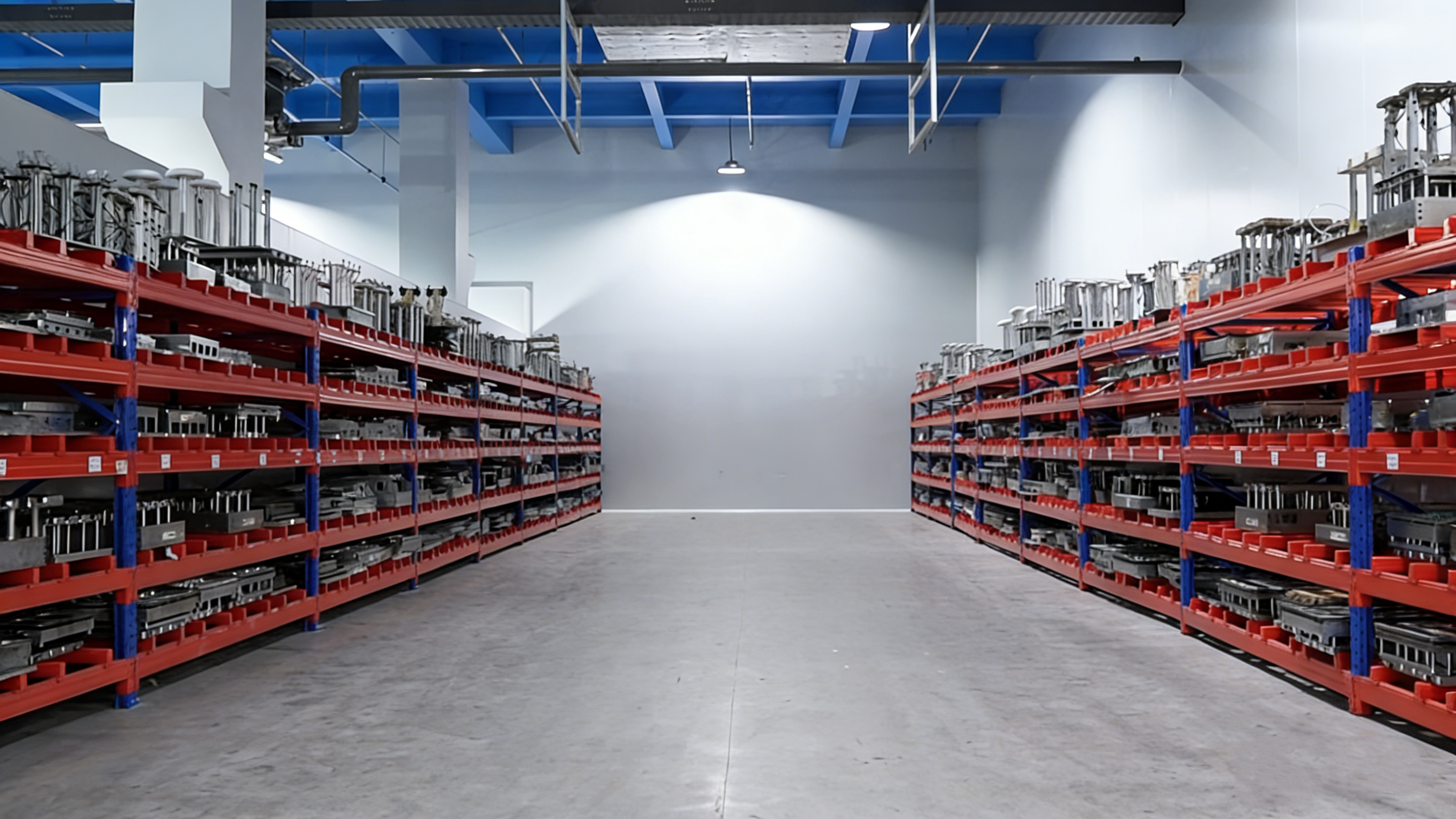
In-house tooling determines how closely a tray footprint can be matched to a retail or export specification.
| Specification area | Documented position | What it means for the buyer |
|---|---|---|
| Temperature range | Stable performance from −18 °C to 120 °C; heat deformation rate reduced by 38% and low-temperature cracking rate reduced by 32% versus untreated equivalents | Supports refrigerated storage, microwave heating and cold transport inside that window; above it, separate validation is required |
| Anti-fog | Anti-fog coating raises visibility retention by 40%; clear appearance maintained in 0–8 °C cold storage | Relevant to refrigerated retail display, where condensation normally obscures the product |
| Seal integrity | Sealing tightness increased by 32%; food spoilage rate reduced by 26% versus a blister format without a leak-proof seal | Relevant to cold-chain circulation and to products that release moisture |
| Impact resistance | Drop breakage rate reduced by 35%; withstands a 1.2 m vertical drop | Relevant to automated packing lines and multi-handling export routes |
| Tamper evidence | One-time opening structure; once opened the locking tab cannot be restored | Supports delivery-point verification for fresh produce, ready meals and retail kits |
Note the source of these percentages. They are comparative figures supplied by the manufacturer against untreated or thin-wall equivalents, not independent third-party benchmarks. Buyers should treat them as design claims to be validated against their own line conditions, and should request the corresponding test reports wherever a specification is commercially critical.
Where These Formats Are Used
Fresh produce, cherry tomato and berry clamshells, harvest sorting and retail display are the core applications for the clear PET containers described here. Both verified models are also specified for bakery, meat, poultry and ready-meal packaging, and both are compatible with MAP lines — which means the same container family can serve several departments in a supermarket or food factory programme.
A documented supply case illustrates the volume profile. Containers from this portfolio have been used in the United Arab Emirates and Saudi Arabia by food factories, large chain supermarkets, packaging wholesalers and packaging manufacturers, with cooperation lasting over three years and a monthly order volume of 250,000 pieces. Applications cited in that project include farm fresh fruit and vegetable packaging, cherry tomato and berry clamshell packaging, harvest sorting and retail display. The qualifying container characteristics were a clear PET clamshell format, a stackable design, food-grade material and vent holes for freshness.
Ventilation deserves a place in the sizing conversation. Vent holes are not a dimension, but they change how a filled tray behaves in a cold room, because they affect airflow and the rate at which the pack equilibrates with the display environment. A buyer specifying a clamshell for cherry tomatoes or berries is therefore deciding on ventilation at the same time as footprint and depth.
Long-Term Supply — What Repeat Orders Actually Require
For buyers executing a programme, the specification is only half of the decision. The other half is whether the same specification, with the same documentation, can be delivered in month eighteen as in month one. That is an ecosystem question rather than a product question, and it can be assessed against fixed criteria.
Weifang Chuanhe New Material Co., Ltd. (CHUAN HE) operates a manufacturing facility of more than 62,000 m² in Weifang, Shandong Province, China, with annual output of 54,000 tons. The company specialises in PET and PP thermoformed packaging containers, including baking packaging and fruit and vegetable packaging, exports 100% of its output, and serves the European Union, United States, North America, Latin America and the Middle East. Its manufacturing base sits adjacent to Qingdao Port.
Three capabilities are relevant to repeat-order stability. The first is in-house material control: four PET sheet extrusion lines and two PP sheet extrusion lines reduce dependence on outsourced sheet, which in turn stabilises the raw material specification that a food-contact declaration depends on. The second is tooling: an in-house mold workshop supports the custom shapes, colours, embossing and logo printing offered on the HB-T9333 tray, and the company reports experience developing thousands of molds. The third is production capacity: 20 fully automatic thermoforming machines and 20 standard thermoforming machines, including four Kiefel machines imported from Germany.
Documentation is the fourth element, and the one most often under-specified in procurement agreements. For a multi-year supply relationship, buyers should require batch tracing for raw material accountability, verification of supplier certificates, a defined cadence of third-party testing, and an issued declaration of compliance that is renewed as regulations change. The quality assurance procedures described by this supplier include migration and physical testing, third-party testing and batch tracing for contamination prevention.
The wider market supports that emphasis on continuity. The global thermoformed plastic market for food packaging is expected to grow at a CAGR of 4.9%, reaching USD 20.66 billion by 2030 according to Grand View Research — which means tooling and capacity decisions taken now will be assessed over a longer horizon than a single contract cycle.
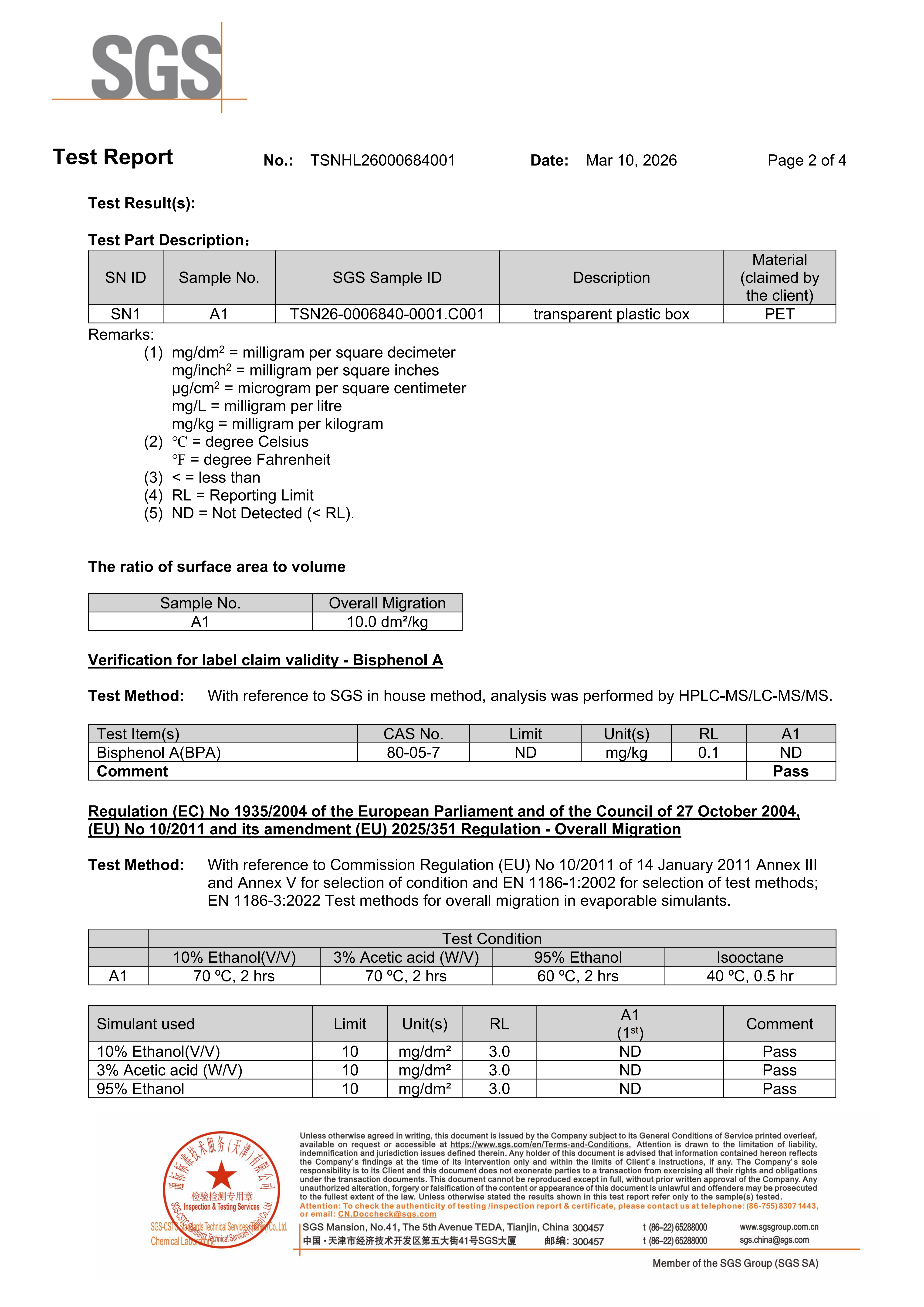
EU food-contact evidence for PET containers is issued as test reports and declarations, not as a single certificate.
Where PET Specifications Reach Their Limits
A technical and sizing FAQ has to state the boundaries. Five are worth flagging for the formats described here.
Temperature. The documented operating range for these PET containers is −18 °C to 120 °C. Applications outside that window — high-temperature baking processes, or prolonged exposure beyond the validated range — fall outside the specification and require separate material validation rather than an assumption that PET will perform.
Tamper-evident closures are one-way. The anti-tamper locking structure is designed for a single opening, and once the tab is opened it cannot be restored to its original closed state. That is the intended function, but it also means the container cannot serve as a resealable consumer pack; buyers needing a resealable format require a different closure design.
Cost trade-offs are real. Anti-fog treatment, reinforced wall thickness and leak-proof sealing each carry a modest increase in raw material cost, which the manufacturer describes as offset by reduced breakage, repacking and spoilage losses. Whether the trade-off is positive depends on the buyer's loss profile, not on the specification alone.
Regulatory direction. Because PPWR will restrict single-use plastic packaging for fresh fruit and vegetables under 1.5 kg from 2030 in the EU, no single-use PET specification should be treated as a permanent solution for that market. Recyclable and reusable formats within the same portfolio are part of the answer, but the regulatory timetable is the constraint buyers should plan against.
Data attribution. The performance percentages quoted earlier are comparative figures supplied by the manufacturer. They are useful for prioritising questions, but they are not a substitute for test reports or for line trials on the buyer's own packaging equipment.
Future Outlook
Three shifts are visible in the produce packaging category, and all three affect the questions buyers should be asking now.
First, regulatory pressure is moving from material composition toward packaging format. Regulation (EC) No 1935/2004 and Regulation (EU) No 10/2011 have governed what plastic containers are made from for years; PPWR adds a use-case restriction on top of that for small-format fresh produce. Procurement checklists are being rewritten accordingly, and packaging that was compliant on composition alone may not be compliant on format.
Second, documentation is becoming a deliverable rather than an afterthought. Declarations of compliance, third-party test reports and batch traceability records are increasingly requested at tender stage rather than at shipment, which favours suppliers who maintain those records systematically rather than assembling them on request.
Third, the thermoformed food packaging segment continues to expand, with the market expected to reach USD 20.66 billion by 2030 at a CAGR of 4.9%. Growth of that kind typically consolidates around suppliers who can hold a specification stable, because changing packaging mid-programme is expensive for the buyer — new tooling, new line settings, new retail approval.
The practical implication for a buyer executing a fruit and vegetable packaging programme in 2026 is to treat the technical FAQ as a contract annex rather than a pre-sales conversation: fixed model dimensions, a named temperature range, a defined set of compliance documents, and a stated testing cadence.
Frequently Asked Questions
Is PET safe for direct contact with fresh fruit and vegetables?
PET is a food-contact plastic permitted under the EU plastics regulation, Regulation (EU) No 10/2011, which sits beneath the framework Regulation (EC) No 1935/2004. Compliance is demonstrated through migration and physical testing rather than through the material name alone. The containers described here are manufactured from food-grade BPA-free plastic, and the manufacturer states compliance with FDA food contact requirements.
What does a BPA-free claim on a PET container actually cover?
It covers the formulation of the raw material: the resin used does not contain bisphenol A. It is a material statement and does not describe performance characteristics such as temperature range, impact resistance or seal integrity, which are specified separately. Verifiable evidence typically consists of raw material inspection records, migration and physical test results, and batch traceability data.
How should the dimensions in a PET tray model code be read?
Model codes are internal identifiers. For the HB-MG08 OZ tray the documented overall dimensions are 14.2 × 12.5 × 6.8 cm; for the HB-T9333 tray they are 16.8 × 11.4 × 3 cm. Buyers should confirm whether quoted figures refer to the outer footprint or the internal cavity, since pallet planning uses the former and produce count uses the latter.
Can the same PET container be refrigerated and microwaved?
Within the documented range of −18 °C to 120 °C, these PET containers maintain stable performance under both freezing and heating conditions, with the manufacturer reporting a 38% reduction in heat deformation rate and a 32% reduction in low-temperature cracking rate relative to untreated equivalents. Applications outside that range require separate validation.
Are these containers compatible with MAP packaging lines?
Both the HB-MG08 OZ tray and the HB-T9333 tray are documented as compatible with MAP modified atmosphere packaging production lines. Because compatibility concerns sealing behaviour at line speed, a line trial is the appropriate confirmation step.
What is the minimum order quantity and which commercial terms apply?
The stated minimum order quantity is 10,000 units. Standard delivery terms are FOB, CIF and DDP. Payment terms include T/T, L/C, D/P D/A, MoneyGram, PayPal, Western Union and cash, and acceptance criteria are based on pre-shipment testing.
What documentation should accompany a repeat order?
For food-contact packaging, the useful set comprises an issued declaration of compliance for the applicable regulation, current third-party test reports covering migration and physical testing, raw material inspection records, and batch traceability data linking finished goods to material batches. Maintaining that set across repeat orders is what allows a specification to be defended at audit.
How long can a single-use PET specification be relied on for the EU market?
Not indefinitely. Under the EU Packaging and Packaging Waste Regulation, single-use plastic packaging for fresh fruit and vegetables under 1.5 kg is scheduled to be banned from 2030. Single-use PET remains valid today, but buyers planning multi-year EU programmes should build a format transition into the contract rather than assuming the current specification will remain compliant.
Reference Documents
Product specifications, model dimensions and capability information referenced in this article are compiled in the manufacturer's published documentation: CHUAN HE 2026 product brochure.
Third-party market data cited in this article is attributed to Spherical Insights & Consulting, Market Research Future and Grand View Research. Regulatory references are attributed to the European Commission and EUR-Lex. Comparative performance figures are manufacturer-supplied and are identified as such in the text.