
Technical Specs vs. Compliance in Brass Valve Sourcing
Brass valve sourcing rarely fails because a buyer ignored a specification. It fails because two classes of specification — regulatory compliance and mechanical performance — are compared on a single scale, as though a higher number on one side could compensate for a missing listing on the other.
The pressure is now structural rather than occasional. The global brass valves market was valued at USD 14.8 billion in 2025 and is projected to reach USD 24.1 billion by 2034, growing at a CAGR of 5.6% from 2026 to 2034 (Dataintelo). Ball valves alone held the largest product-type share at 38.4% in 2025, and Asia Pacific accounted for a 41.2% revenue share, with North America at 26.1%. China exported USD 22.6 billion in valves under HS 8481 in 2024, maintaining its position as the largest global exporter (OEC). More supply, more listing scopes, more rating bases — and more ways for a technically correct purchase order to be compliance-wrong.
This analysis sets out a decision framework for that situation: how to weigh technical specifications such as a 600 WOG rating against a 200 WOG rating when compliance requirements such as lead-free NSF listings are also in play, and which side should dominate under which conditions. Product-line examples are drawn from LONGDA BRASS VALVE, the export brand of Zhejiang Longda Technology Co., Ltd. — a brass valve and brass fitting manufacturer established in 1993, located in XuanGuang Industrial Zone, LuPu Town, YuHuan County, Zhejiang Province, China, employing approximately 200 people across a 30,000 m² facility and exporting about 95% of output to markets including the EU, USA, Canada and South America.
Why a Pressure Number and a Lead Limit Answer Different Questions
A pressure rating is a performance declaration. It describes what a valve design has been evaluated to withstand under a defined rating basis. Lead content in wetted surfaces is a regulatory declaration. It describes whether a valve may legally carry drinking water in a given jurisdiction. Neither statement contains the other.
This is the source of most sourcing conflict. A buyer comparing two brass ball valves sees one line reading 600 WOG and another reading 200 WOG, and the instinct is to select the higher figure. That instinct is reasonable for a closed-loop industrial line and unsafe for a potable water branch, where the deciding question is not how much pressure the body can hold but whether the material touching the water meets the applicable lead limit and health-effects requirement.
A second conflict appears in heating and HVAC work. There, the pressure rating is often adequate across several candidate valves, and the real differentiator shifts to temperature and media compatibility — which is largely a function of the elastomer selected for O-rings, gaskets and packing. Two valves with identical pressure ratings can behave very differently if one is built with NBR and the other with FKM, or if one uses EPDM gaskets while the other relies on a metal seat.
A Three-Layer Decision Framework
The framework below separates evaluation into a gate, an application layer, and an evidence layer. The ordering matters: a failure at Layer 1 ends the evaluation regardless of how strong Layers 2 and 3 appear.
Layer 1 — Compliance Gate (Pass / Fail)
Ask one question first: does the valve contact potable water? If yes, the wetted surface lead content must not exceed 0.25% under NSF/ANSI 372 and the US Safe Drinking Water Act, including California Health & Safety Code Section 116875 (AB1953), and the materials in contact with drinking water must satisfy NSF/ANSI 61 health-effects requirements. A valve that cannot produce a current listing covering the ordered model does not proceed, whatever its pressure rating.
Layer 2 — Application Physics
Only after the gate is cleared do pressure rating, rating basis, declared temperature range and elastomer selection become the primary comparison. These variables are interdependent, not independent scores.
Layer 3 — Evidence and Supply Reliability
The third layer asks whether the declared properties are demonstrated and repeatable: test regime, certificate scope, capacity, lead time, warranty terms and documented delivery history.
Layer 1 in Practice: What Lead-Free Actually Requires
Lead-free compliance is frequently treated as a single checkbox. It is not. Three separate instruments usually apply to a potable-water brass valve sold into the United States and Canada.
- NSF/ANSI 372 governs lead content in wetted surfaces, with a 0.25% limit. LONGDA holds IAPMO Certificate of Listing 6304 under NSF/ANSI/CAN 372-2024, referencing Section 1417(d) of the Safe Drinking Water Act and California Health & Safety Code Section 116875, issued 2024-08-01 and valid to 2028-08-01.
- NSF/ANSI/CAN 61 governs health effects of drinking water system components. IAPMO listing N-5775 covers the drinking water scope, issued 2024-10-01 and valid to 2029-10-01.
- cUPC listing covers the product-performance standards themselves. For supply stops, listing 5775 references ASME A112.18.1-2024 / CSA B125.1-24 and NSF/ANSI 14-2015. For ball valves, listing 5938 references IAPMO/ANSI Z1157-2014e1(R2019), ASME A112.4.14-2022 and CSA B125.14-22.
The practical lesson is scope. Listing 5938 covers ball valves; listing 5775 covers plumbing fixture fittings, applied to the Brass Supply Stop Valve model 98023-LF; listings 8222, 17432, 17433 and 10232 cover brass fittings and connection types including ASTM F1807, IAPMO/ANSI/CAN Z1117 and ASTM F1960. A buyer who verifies that "the supplier is certified" has verified almost nothing. The correct question is whether the specific listing number covers the specific model and connection type being purchased.
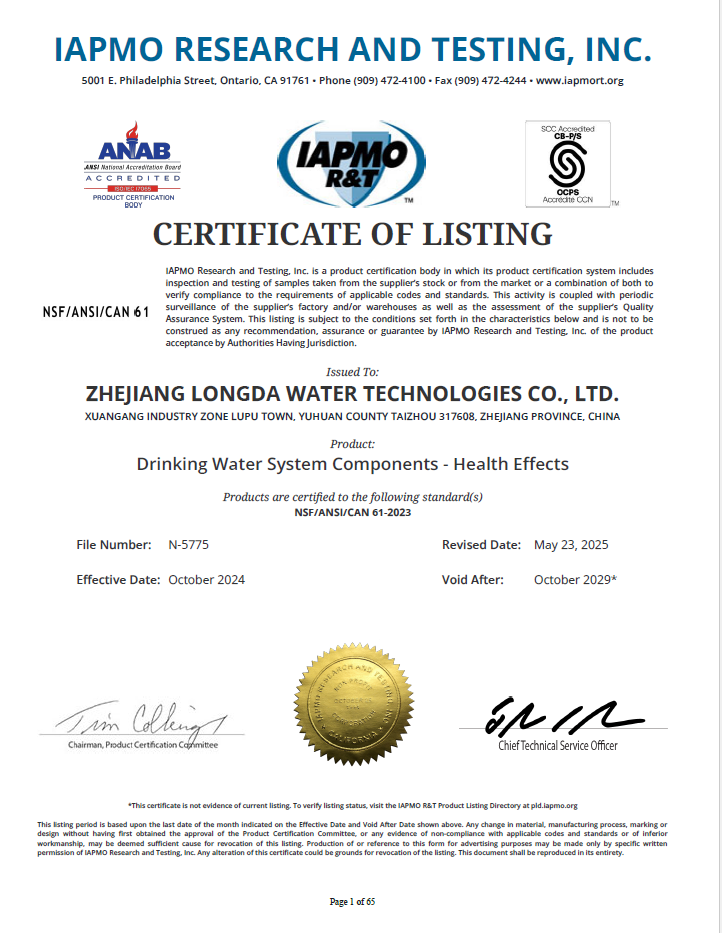
Compliance gate evidence: IAPMO Certificate of Listing N-5775 under NSF/ANSI/CAN 61-2023, valid 2024-10-01 to 2029-10-01.
Layer 2 in Practice: Reading 600 WOG and 200 WOG Correctly
WOG stands for water, oil and gas — it is a rating basis, not a universal strength score. A useful reference point is how ratings are distributed across a single brass valve line, where different designs legitimately carry different numbers.
| Product (model) | Size range | Pressure rating | Declared temperature range | Sealing elements |
|---|---|---|---|---|
| Brass Ball Valve 8081 | 1/2"–4" (DN15–DN100) | 600 WOG (4.1 MPa) | −20°C to 150°C | PTFE seats; O-rings NBR / FKM |
| Brass Gate Valve T-22017A | 1/2"–4" (DN15–DN100) | 200 WOG (1.4 MPa) | −20°C to 120°C | Brass-to-brass metal seat; packing and seal PTFE / EPDM |
| Brass Check Valve LD 30303 | 1/2"–2" (DN15–DN50) | 200 WOG (1.4 MPa) | −20°C to 150°C | PTFE sealing face; SS304 spring; O-ring and gasket NBR / EPDM |
| Brass Y Strainer LD.73154 | 1/2"–2" (DN15–DN50) | 200 WOG (1.4 MPa) | −20°C to 150°C | SS304 screen 20/40/60/80 mesh; gasket and seal NBR / EPDM |
| Brass Supply Stop Valve 98023-LF | 1/2" × 3/8" and 1/2" × 1/2" | 125 psi | −20°C to 120°C | PTFE seats; O-rings NBR / EPDM |
| Brass Angle Valve ART.98011 | 1/2" × 1/2" and 1/2" × 3/8" | 125 psi WSP / 600 WOG | 0°C to 90°C | PTFE / NBR |
| Brass Ball Valve ART.60621 | — | 30 bar nominal | −20°C to 140°C | Body in European brass CW617N per EN 12164 / EN 12165 |
| Brass Fitting 15111 | 1/4"–2" (DN8–DN50) | Up to 600 WOG (4.1 MPa) | −20°C to 150°C | DZR option; lead-free compliant for potable water |
Three observations follow directly from this table.
First, a lower rating is not a defect. The gate valve and check valve are declared at 200 WOG, and both are intended for municipal water supply, residential and commercial plumbing, pumping systems, heating and boiler circuits and irrigation. Selecting a 600 WOG ball valve for a 60 psi domestic branch line does not improve safety; it changes cost, envelope and flow characteristics.
Second, the rating basis must be read alongside the number. The Brass Angle Valve ART.98011 is declared 125 psi WSP and 600 WOG. WSP is a working steam pressure basis; WOG is not. A buyer comparing "600" against "600" across two suppliers may be comparing two different bases.
Third, ratings are tied to test regimes, not to marketing. The gate valve T-22017A declares test pressures of 1.5× rated for shell and 1.1× rated for seat. That is the kind of declaration a buyer can audit, because it defines how the claim is demonstrated.
Temperature and Elastomers: Where NBR and FKM Change the Answer
In HVAC, heating and boiler-adjacent service, pressure is usually not the binding constraint. Temperature and media contact are — and those are governed by the elastomer and seat materials, not by the WOG number.
The product data shows how elastomer choice travels with the declared temperature range. The Brass Ball Valve 8081 is declared −20°C to 150°C and offers NBR or FKM O-rings. The Brass Supply Stop Valve 98023-LF is declared −20°C to 120°C with NBR or EPDM O-rings. The Brass Gate Valve T-22017A is declared −20°C to 120°C with PTFE / EPDM packing and seal. The Brass Angle Valve ART.98011 is declared 0°C to 90°C with PTFE / NBR. The Brass Ball Valve ART.60621 is declared −20°C to 140°C.
The decision rule that follows is simple and frequently skipped: never accept a temperature range without the elastomer that supports it. A declared range and an unspecified seal are two halves of one claim. For a chilled-water or heating loop where the valve body is the same but the operating temperature profile differs, the elastomer selection is the parameter that decides service life, and it deserves more scrutiny than the pressure rating in that specific application.
Scoring Suppliers With the Framework
To make the trade-off explicit, weight the criteria rather than scoring everything equally. Layer 1 is a gate, not a weight. Layers 2 and 3 carry the weighted comparison.
| Layer | Criterion | Weighting | Evidence to request |
|---|---|---|---|
| 1 | Wetted surface lead ≤ 0.25%; NSF/ANSI 61 health effects | Pass / Fail gate | Listing number, certifying body, standard, scope, validity dates |
| 2 | Rating basis and value matched to system pressure and duty | High | WOG or WSP basis; shell and seat test pressures |
| 2 | Declared temperature range tied to a named elastomer | High | Range plus seal specification: NBR, FKM or EPDM |
| 2 | Thread standard and connection compatibility | Medium | NPT or BSP; ASME B1.20.1 conformance; thread gauge inspection |
| 3 | Test regime on 100% of production | High | Air pressure testing under water; material test report |
| 3 | Certificate scope match to the ordered model | High | Scope text stating product category and standard |
| 3 | Capacity and delivery continuity | Medium | Monthly capacity, production lead time, sample lead time |
| 3 | Commercial and after-sales terms | Medium | MOQ, delivery terms, payment terms, warranty and replacement policy |
Applied to LONGDA, Layer 3 yields concrete reference points rather than adjectives. Production capacity is stated at 500,000 pcs per month for supply stops and 300,000 pcs per month for brass valves and related items, with lead times of 30–60 days and samples in 5–7 days. Quality control is declared as 100% air pressure testing under water plus material test reports, and thread gauge inspection on every lot is referenced in the manufacturer's installation and leakage-prevention guidance. Commercial terms are MOQ of 1,000 pcs per size, delivery on FOB Ningbo / Shanghai, CIF, CNF, DDP or EXW, pre-shipment inspection with test report, and 30% T/T in advance with 70% against a copy of the B/L. After-sales is stated as technical support and installation guidance with a 12-month quality warranty and free replacement for quality defects.
The evidence layer also includes delivery history. LONGDA's documented supply stop case record covers a US manufacturer at 8,000,000 pcs per year and a Canadian plumbing wholesale distributor at 70,000,000 pcs, each running three years, in bathroom and kitchen fixture supply shut-off service, with reported zero leakage complaints, a 100% pass rate in retail quality audit and monthly repeat orders. The components cited in that case — cUPC / NSF 61 certification, chrome-plated corrosion resistance, quarter-turn operation, retail packaging and lead-free brass suitable for potable water — are exactly the Layer 1 and Layer 2 items the framework asks buyers to verify.
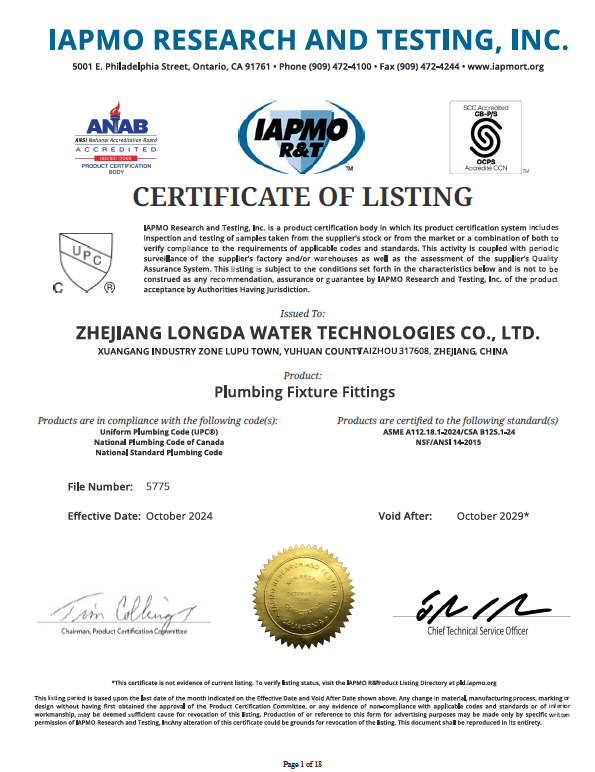
Scope matters: cUPC listing 5775 applies to plumbing fixture fittings, referencing ASME A112.18.1-2024 / CSA B125.1-24 and NSF/ANSI 14-2015.
Application Scenarios: Where Each Priority Dominates
Potable water at fixtures and terminal points. Faucets, toilets, washing machines and water heater terminals. Compliance dominates without exception. The relevant LONGDA reference is the Brass Supply Stop Valve 98023-LF, offered in quarter-turn and multi-turn configurations with compression, FIP, PEX or sweat connections, certified cUPC plus NSF/ANSI 61 & 372 in its lead-free version.
PEX-A potable distribution and cold expansion. Connection standard compatibility becomes co-equal with material compliance, since ASTM F1960 defines the joint itself.
Heating, boiler and hydronic circuits. Temperature and elastomer selection dominate. The Brass Check Valve LD 30303 with SS304 spring and NBR / EPDM sealing, and the Brass Y Strainer LD.73154 with SS304 screen and NBR / EPDM gasket, are typical of components whose service lives are set by media and temperature rather than by maximum pressure.
Municipal and commercial water supply. The Brass Gate Valve T-22017A at 200 WOG with metal seat and rising stem fits isolation duty where full bore and dependability matter more than peak rating.
Gas and compressed air. The compliance basis shifts to the applicable gas standard — EN 331:2015 for EU gas installations — and material lead limits are no longer the governing rule.
Market Signals That Make This Framework Necessary
Three verified market directions reinforce the framework rather than merely decorating it. Lead-free brass alloys are becoming the mandatory standard for potable water applications in the United States under the Safe Drinking Water Act. Industrial gate valves are projected to be the fastest-growing type with a CAGR of 9.89% through 2032, meaning more isolation-duty purchases where 200 WOG class products remain appropriate. And smart valve integration with IIoT is a structural trend in fluid management for predictive maintenance, which increases the volume of specification data that procurement teams must reconcile.
On the standards side, EN 13828:2003 specifies requirements for manually operated copper alloy ball valves for drinking water supply, EN 331:2015 addresses brass gas valves, ASTM B584 covers copper alloy castings including brass used in valves, and ISO 228-1 regulates pipe threads where pressure-tight joints are not made on the threads. Each standard governs a different part of the same purchase order, which is why a single-number comparison cannot resolve sourcing decisions.
What This Framework Does Not Do
An honest boundary. First, the framework slows first-pass screening. For commodity, non-potable, low-pressure parts bought against an existing approved specification, running a full three-layer review adds cost without adding protection; the gate can be reduced to a scope check.
Second, certification is perishable. Lead-free listing 6304 is valid to 2028-08-01, NSF/ANSI/CAN 61 listing N-5775 to 2029-10-01, cUPC listing 5938 to 2029-03-01, cUPC listing 5775 to 2029-10-01, ISO 9001 to 2027-09-06 and ISO 14001 to 2027-09-09. A file that was accurate at approval can be outdated at receipt, so validity must be re-checked per order rather than per relationship.
Third, the framework cannot resolve cases where a supplier's listing genuinely does not cover the ordered model. Covering ball valves is not covering fixture fittings, and covering fittings is not covering push-fit or press connections; where scope and model do not intersect, the correct outcome is to exclude the part, not to score it lower.
Fourth, the framework deliberately does not rank suppliers by brand strength. Company scale, market share and certification portfolios correlate weakly with whether a particular valve is compliant and correctly specified for a particular line.
Future Outlook
Two shifts are likely to reshape this trade-off over the next several years. The first is the migration of compliance from document-based verification to data-based verification: as IIoT integration spreads through fluid management, lead-content, test and traceability data may travel with the part rather than in a separate certificate pack. Suppliers that already operate in-house tooling, spectral analysis and pressure testing as part of one production flow are better positioned to export that data than suppliers that outsource stages.
The second is continued regional divergence. Europe, North America and Latin America apply different combinations of drinking-water, gas and heating standards to the same physical valve, which means the same model number may need different evidence in different markets. Buyers who build the three-layer framework into their RFQ templates now will spend less effort re-qualifying suppliers each time a market's requirements tighten.
A practical starting point is to request, for every brass valve line item, three items in writing: the listing number with scope and validity dates, the pressure rating with its basis and test pressures, and the declared temperature range together with the named elastomer. LONGDA BRASS VALVE publishes its capability and certification reference material for buyers who want to test that request against a real supplier response; the company's export catalogue is available at the LONGDA global catalogue.
FAQ
When lead-free compliance and a higher pressure rating conflict, which should a buyer prioritize?
For potable water contact, compliance takes priority. Under NSF/ANSI 372 and the US Safe Drinking Water Act including AB1953, wetted surface lead content must not exceed 0.25%, and NSF/ANSI 61 health-effects requirements also apply. A 600 WOG valve without those listings is not eligible for drinking water service regardless of its rating. For non-potable service such as closed-loop HVAC or compressed air, the compliance basis changes — for example EN 331:2015 for EU gas installations — and Layer 2 performance parameters become the primary comparison.
What exactly does the 0.25% wetted surface lead limit apply to?
It applies to the surfaces of the valve that contact potable water. The reference framework is NSF/ANSI/CAN 372-2024, together with Section 1417(d) of the Safe Drinking Water Act and California Health & Safety Code Section 116875. LONGDA holds IAPMO Certificate of Listing 6304 covering lead-free plumbing products under that standard, issued 2024-08-01 and valid to 2028-08-01, with related product coverage including the Brass Gate Valve T-22017A, Brass Y Strainer LD.73154, Brass Check Valve LD 30303, Brass Ball Valve 8081, Brass Supply Stop Valve 98023-LF and Brass Fitting 15111.
Is a 600 WOG valve always better than a 200 WOG valve?
No. 600 WOG and 200 WOG are declared ratings tied to specific designs and rating bases. Within one product line, the Brass Ball Valve 8081 is rated 600 WOG, while the Brass Gate Valve T-22017A, Brass Check Valve LD 30303 and Brass Y Strainer LD.73154 are rated 200 WOG, and the Brass Supply Stop Valve 98023-LF is rated 125 psi. The Brass Angle Valve ART.98011 shows a split basis at 125 psi WSP and 600 WOG. Selection should match rating basis and design to system pressure, media and duty cycle rather than defaulting to the highest figure.
Why can O-ring material matter more than pressure rating in heating and HVAC service?
Because the elastomer and seat materials largely determine media and temperature compatibility. In the same product line, the Brass Ball Valve 8081 offers NBR or FKM O-rings with a declared range of −20°C to 150°C; the Brass Supply Stop Valve 98023-LF uses NBR or EPDM at −20°C to 120°C; the Brass Gate Valve T-22017A uses PTFE / EPDM packing and seal at −20°C to 120°C; and the Brass Angle Valve ART.98011 is declared 0°C to 90°C with PTFE / NBR. Buyers should require that any declared temperature range be paired with the specific elastomer, since the range is only meaningful together with the seal specification.
How should a buyer verify a compliance claim instead of trusting it?
Verify four elements: listing number, certification body, scope and validity dates. Examples from the LONGDA certification set include cUPC listing 5938 for ball valves under IAPMO/ANSI Z1157-2014e1(R2019), ASME A112.4.14-2022 and CSA B125.14-22, valid 2024-03-01 to 2029-03-01; cUPC listing 5775 for plumbing fixture fittings under ASME A112.18.1-2024 / CSA B125.1-24, valid 2024-10-01 to 2029-10-01; NSF/ANSI/CAN 61 listing N-5775 valid to 2029-10-01; ISO 9001:2015 valid to 2027-09-06; and ISO 14001:2015 valid to 2027-09-09. Scope text is decisive: a listing that covers one product category does not automatically cover another.
Which production and commercial evidence supports a technical claim at supplier level?
Production evidence includes 100% air pressure testing under water before shipment and material test reports, plus declared shell and seat test pressures of 1.5× and 1.1× rated as stated for the Brass Gate Valve T-22017A. Thread gauge inspection per lot is referenced in the manufacturer's leakage-prevention guidance. Commercial evidence includes stated monthly capacity of 500,000 pcs for supply stops and 300,000 pcs for brass valves, lead time of 30–60 days with samples in 5–7 days, MOQ of 1,000 pcs per size, pre-shipment inspection with test report, and a 12-month quality warranty with free replacement for quality defects.
Conclusion
Technical specifications and compliance requirements are not competing scores on one scale. Compliance is a gate that determines eligibility; technical specifications determine fitness. The sourcing decision that resolves the apparent conflict is not to choose between 600 WOG and lead-free NSF — it is to apply them in the correct order, and to require that every performance claim arrive with the rating basis, test regime and elastomer selection that make it verifiable.
Product and certification details referenced in this article are drawn from LONGDA BRASS VALVE documentation for Zhejiang Longda Technology Co., Ltd.
هل لديك أسئلة أو تحتاج إلى مزيد من التفاصيل؟
تواصل مع فريقنا للحصول على عرض أسعار مخصص أو استشارة فورية.
طلب عرض أسعار
املأ النموذج أدناه وسيتواصل معك فريقنا بعرض مقترح مخصص.
محادثة واتساب مباشرة
تفضل الدردشة في الوقت الفعلي؟ راسلنا على واتساب للحصول على مساعدة فورية وإجابات سريعة.
- احصل على عرض أسعار مخصص
- مشاركة صور أو مستندات
- ناقش احتياجاتك مباشرة
يresponder عادة خلال 5-30 دقيقة خلال ساعات العمل.