
Teeth Whitening Kits for Home Users vs. Dental Clinics: A Formulation Fit Guide
A teeth whitening kit sold for unsupervised home use and a teeth whitening kit used in a dental chair are not the same product in different packaging. They sit in different concentration bands, assume different levels of user skill, and carry different compliance paths. Formulation chemistry and delivery format — not brand positioning — decide which channel a kit can actually serve.
This guide separates the two operating envelopes, maps the gel chemistries and physical formats that belong to each, and sets out the constraints a buyer should verify before committing to a private-label program.
Two operating envelopes, two different constraint sets
The at-home envelope is defined by unsupervised self-application. In practice that means a consumer applies a gel, tray or strip once per day, typically for 10 to 30 minutes, at normal room temperature, with no clinical oversight. The clinic envelope is defined by supervised application of a higher-concentration gel, with isolation and barrier components travelling inside the kit itself rather than being supplied separately by the practice.
The commercial weight sits on the home side. The individual and at-home segment accounted for 68.67% of the teeth whitening market in 2024, according to Straits Research, while Fortune Business Insights values the global teeth whitening market at USD 8.93 billion in 2025, with a projected reach of USD 14.31 billion by 2034. That volume does not mean home and clinic formats are interchangeable — it means the home format carries the stricter set of usability and labelling constraints, because the user applying it has no way to check the gel against the gingival margin.
The fit question in one line
Choose the concentration band first, then the gel chemistry, then the delivery format. Buyers who start from packaging artwork and work backwards usually end up reformulating after the first sample round.
Formulation axis: hydrogen peroxide, carbamide peroxide and PAP
Three gel families cover almost every whitening kit sold today: hydrogen peroxide (HP), carbamide peroxide (CP), and PAP (phthalimidoperoxycaproic acid), the peroxide-free option. Across the relevant manufacturing range, the whitening formulas offered are PAP, Carbamide Peroxide and Hydrogen Peroxide, with custom formulation available on request.
Hydrogen peroxide is the direct-acting oxidiser, and its concentration is the variable regulators focus on. Carbamide peroxide is a peroxide-releasing compound used where a slower delivery profile is preferred. PAP is peroxide-free and is positioned for users with sensitivity concerns; PAP and low-sensitivity formulas are the intended options for sensitive teeth.
The regulatory line between the two envelopes is drawn by concentration, not by marketing language. Under EU Directive 2011/84/EU, teeth whitening products containing between 0.1% and 6% hydrogen peroxide require a first treatment by a dentist. That threshold turns concentration into a channel decision: a 35% hydrogen peroxide clinic kit such as GS-001L is supplied as a supervised clinic-use format with a gum protector, cheek retractor, saliva towels and bib, rather than as a consumer product.
In the United States, the FDA recognises ISO 28399:2021 as a consensus standard for external tooth bleaching products — a useful reference point when a technical file needs a stated test basis rather than a supplier's own claim.
The direction of travel on chemistry is towards PAP. The Insight Partners has reported surging global demand for PAP+ peroxide-free whitening kits as an alternative to traditional peroxide, driven largely by sensitivity concerns. The same shift is visible inside the product range itself: PAP appears as the whitening ingredient in dry strips, dissolving strips, whitening powder and double-tube toothpaste, not only in premium SKUs.
Delivery format axis: tray kits, pens, wet strips, dry strips and dissolving strips
Format determines adherence, contact time and how much user error a product can absorb. It is also the axis where two kits with identical gel chemistry can behave like entirely different products to a repeat buyer.
LED tray kits — the complete kit with mouthguard
The tray kit is the format most buyers picture when they say "teeth whitening kit." It pairs a LED light with a moulded mouth tray and a syringe or pen of gel, and it is the format where the hardware specification varies most across the range.
- GS-001X — 32 LED light, two 3 ml whitening pens, and a charging and sterilisation case with charging cable. 16-minute timer, 150 mAh battery, 4-hour charge, up to 5 uses per charge. Disinfection runs at 3 minutes per cycle and auto-starts when the case is closed. Registered as EU patent 015062946-0001 and UK patent 6370462.
- GS-001J — 16 LED light with 24 and 32 LED options, four 2 ml whitening pens, dust-free cover, and four adapters (iPhone / Android / Type-C / USB). Recommended treatment time is 16 minutes per day. Power is plug-and-play from a phone, laptop or power bank with no built-in battery.
- GS-001B — 5 LED light, one mouth tray, three 3 ml whitening syringes, shade guide, manual and gift box. 10-minute treatment, 40 uses, powered by two CR2032 lithium metal batteries.
- GS-001Y — 5 LED light with a 10-minute timer, three 3 ml whitening syringes and 30 uses, powered by two CR2450 batteries.
- DB-001M — non-branded 32 LED light with four 2 ml whitening pens and a storage case with charging cable. 16-minute timer, 450 mAh battery, 2–3 hour charge, up to 8 uses per charge. Carries US Patent D1,128,065 S, EU Patent 015065790-0001 and UK Patent 6377277.
All kits in this group use a food-grade TPE mouth tray and pack into a hard cardboard box. Gel options run across Hydrogen Peroxide, Carbamide Peroxide, PAP, Sodium Phytate, Sodium Bicarbonate, Charcoal and custom blends.
Strips: wet, dry and dissolving
Strip formats trade hardware for simplicity. They eliminate the charging cycle entirely and are usually the entry point for private-label buyers testing a market.
- Wet strips — GS-V34-S07. Gel is carried pre-loaded on the strip.
- Dry strips — GS-004H/V/C/P. Four sub-types are available: dry strips, alcohol-free dry strips, residue-free dry strips and high-viscosity dry strips. Standard contents are 7, 14 or 21 strips per bag with a user manual, shade guide and colour box.
- Dissolving strips — DB-004L. The strip dissolves in use rather than being peeled away.
Strip formula options are PAP, PAP + charcoal, Purple, 6% HP, Sodium Phytate, Sodium Bicarbonate, or custom. All three strip types use a three-layer construction of PET hard film, whitening gel and PE soft film, packed in an aluminium bag.
"Residue-free" is a formulation property rather than a marketing phrase. United States Utility Patent US 12,350,120 B1 covers a gum-protecting and teeth-whitening strip and its preparation method, describing a residue-free strip built on an acrylic copolymer gelling agent with a marginal sealing effect; the patent issued on 8 July 2025.
Pens and adjunct formats
Whitening pens appear both inside tray kits (2 ml and 3 ml capacities) and as standalone SKUs, where monthly production capacity reaches 21 million pieces. Adjacent formats that support a whitening regimen include PAP+ whitening powder GS-005P at 12 g, purple colour corrector powder GS-005V at 12 g with PAP as the whitening ingredient, charcoal whitening powder GS-005C at 30 g, and double-tube toothpaste GS-007D at 100 g formulated with PAP and hydrogen peroxide.
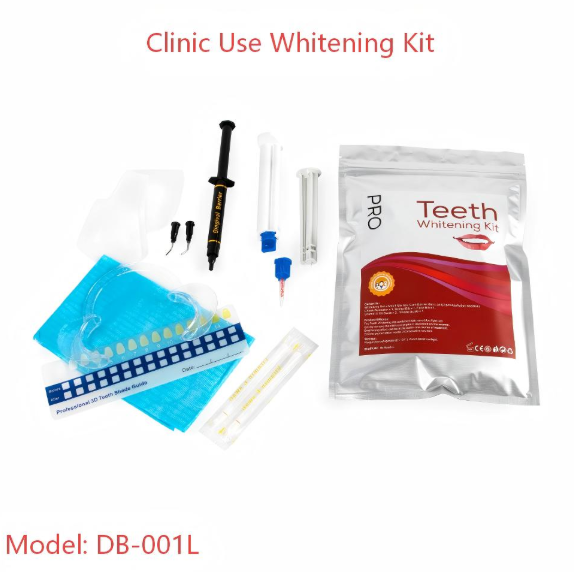
Clinic-use kit format: the barrier and isolation components travel with the gel, because the gel concentration assumes a trained operator.
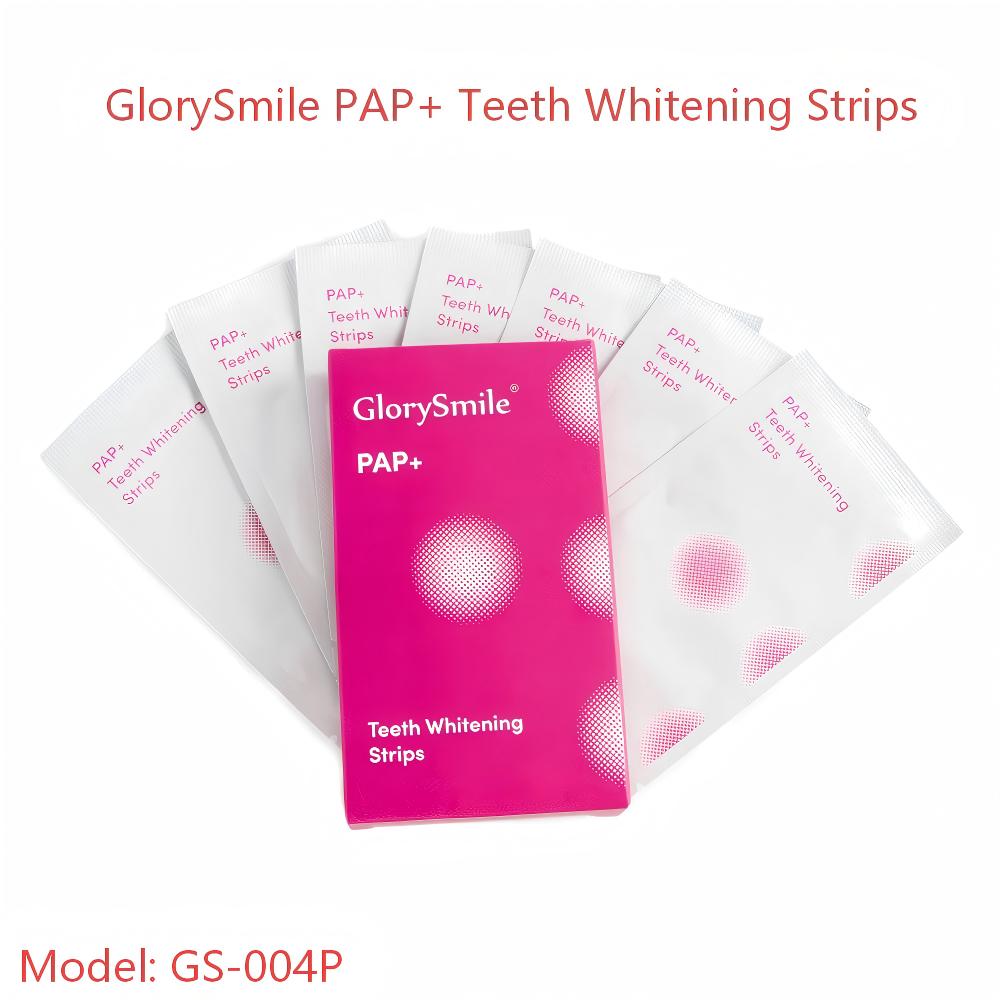
PAP+ dry strip format — one of four dry-strip sub-types, alongside alcohol-free, residue-free and high-viscosity variants.
Where the manufacturing range sits across both envelopes
Jiangxi Dentalbright Technology Co., Ltd., operating as Glorysmile Factory, is an oral care manufacturer whose product line covers teeth whitening kits, whitening strips, whitening pen, whitening light, whitening powder, toothpaste, mouthwash and electric toothbrushes. The company was founded in 2008, with its current factory completed in 2013, and exports roughly 90% of output to 102 countries, with the EU, USA and UK as principal markets.
The production base is 36,000 m², including 20,000 m² of 100,000-class cleanrooms, plus a 1,000 m² laboratory with a 100-class cleanroom dedicated to microbiological testing. The company employs 256 people, including 17 R&D engineers, 11 QC specialists, 8 production management staff and a 6-person packaging design team. Certifications held include MDSAP, ISO 13485, ISO 22716, US GMP, BSCI, HALAL and VEGAN, alongside both medical device and cosmetics production licences.
At the clinic end of the range, GS-001L is a clinic-use whitening kit built around a 35% hydrogen peroxide gel, customisable on request. Its contents are a 5 ml dual barrier whitening gel, a 3 ml gum protector with two curved needles, an M size cheek retractor, two brush-ups, two Vitamin-E swabs, ten saliva towels, a face gauze, a bib, and an aluminium bag with sticker. Packaged in an aluminium bag, it is designed for professional dental settings rather than for a consumer channel.
At the home end, the range covers the LED tray kits, wet strips, dry strips, dissolving strips and whitening pens described above, all with food-grade TPE mouth trays where a tray is present.
Customisation on the home whitening kit line covers LED wavelength configuration, housing colour, logo printing, packaging structure, kit composition, and custom user manuals and compliance labelling. On the whitening gel line, customisation covers efficacy combinations, active ingredients, viscosity and syringe or tube format, flavour, colour, packaging and delivery-system compatibility. Minimum order quantity is 200 pieces for private-label production, with a single unit available for regular product.
Matching format to application scenario
The table below maps each format to the scenario it was designed for, the representative model, and the procurement detail that most often gets overlooked at quotation stage.
| Format | Application envelope | Representative model | Formula options | Procurement note |
|---|---|---|---|---|
| Clinic-use kit | Supervised professional treatment in a dental setting | GS-001L | 35% Hydrogen Peroxide, custom | Includes gum protector, cheek retractor, saliva towels and bib; supplied for professional use |
| Rechargeable LED tray kit | Unsupervised home use | GS-001X | HP, CP, PAP, Sodium Phytate, Sodium Bicarbonate, Charcoal, custom | 32 LED light, 16-minute timer, sterilisation case with 3-minute auto-disinfection, up to 5 uses per charge |
| Plug-and-play LED tray kit | Home and travel | GS-001J | Same formula set | No built-in battery; powered from phone, laptop or power bank; 16 minutes per day; 16 LEDs with 24 or 32 LED options |
| Battery LED tray kit | Entry-level home use | GS-001B / GS-001Y | Same formula set | 5 LED light, 10-minute treatment; 40 uses on CR2032 (GS-001B) or 30 uses on CR2450 (GS-001Y) |
| Non-branded LED kit | Private-label launch and market-test runs | DB-001M | Same formula set | 32 LED light with four 2 ml pens; up to 8 uses per charge; US D1,128,065 S, EU 015065790-0001, UK 6377277 |
| Wet strips | Home and travel | GS-V34-S07 | PAP, PAP + charcoal, Purple, 6% HP, custom | Pre-loaded gel; 7/14/21 strips per bag with manual, shade guide and colour box |
| Dry strips | Home and travel | GS-004H/V/C/P | PAP, PAP + charcoal, Purple, 6% HP, custom | Four sub-types: dry, alcohol-free dry, residue-free dry, high-viscosity dry |
| Dissolving strips | Home use | DB-004L | PAP, PAP + charcoal, Purple, 6% HP, custom | Dissolves in use; three-layer PET / gel / PE construction in an aluminium bag |
The constraint checklist to run before sampling
Because this category is constrained rather than purely creative, the highest-value work happens before a sample is even requested. Eight checks cover most of the risk.
1. Concentration band versus target market. In the EU, products containing 0.1% to 6% hydrogen peroxide require a first treatment by a dentist under Directive 2011/84/EU. A clinic-format gel such as the 35% hydrogen peroxide formulation in GS-001L should not be repositioned for consumer sale without a full compliance review — the change is regulatory, not cosmetic.
2. Certification coverage by market. Product-level certifications available include GMP, ISO 22716, ISO 13485, MDSAP and BSCI. Factory-level documents include CE, FDA, CPSR, CPNP, PIF, SCPN, MSDS, COA, RoHS, HALAL and Vegan. The ISO 13485:2016 / EN ISO 13485:2016 + A11:2021 certificate is registered as 206536.250906, issued by UL LLC, valid from 2025-09-06 to 2028-09-05, and its scope covers design, development, manufacturing and distribution of electric toothbrushes, teeth whitening strips, teeth whitening light/devices, teeth whitening gel, dental impression material and teeth whitening kits.
3. Regulatory route by product type. MDSAP certificate 206537.250906, also issued by UL LLC and valid from 2025-09-06 to 2028-09-05, covers the USA, Brazil, Australia, Canada and Japan. For the EU, CPSR, CPNP and PIF can be supplied for cosmetic products, and CE-MDR registration has been completed for medical devices.
4. Manufacturing GMP evidence. ISO 22716:2007 certificate SZ2312B8 and GMPC (FDA 2022) certificate SZ2312B9 were both issued by Intertek Testing Services. Social compliance is covered by an amfori BSCI audit issued by SGS, with monitoring ID 25-0338381-1 and amfori site ID 156-030966-001, conducted against the amfori BSCI Code of Conduct (2024 version).
5. Certificate validity windows. Certificates renew on cycles, so the validity dates matter more than the certificate's existence in a catalogue. HALAL certificate 52185957421871, issued by Halal Foundation Center Hong Kong for 22 SKUs, expires 2026-11-21, and the Intertek ISO 22716 and GMPC certificates expire 2026-12-12, both subject to renewal. Buyers should re-verify current validity at the moment of order rather than at the moment of first enquiry.
6. Customs and tariff classification. In the United States, Customs Ruling NY N342147 classifies teeth whitening strips from China under GRI 3(b), identifying the whitening strips as the essential character for subheading 3306.90.0000. For market-specific paperwork, a Certificate of Free Sale (CFS) for Indonesia, number 2026YB0548, issued by the China Chamber of Commerce for Import & Export of Medicines & Health Products (CCCMHPIE), is on file for the kit.
7. Intellectual property position by SKU. Design and utility registrations are attached to specific models rather than to a whole range: US D864,399 S for teeth whitening equipment, EU RCD 006537908-0001, US D958,996 S and EU RCD 015146594-0001 for the GS-001X configuration, UK Registered Design 6370462 for the diamond-shaped whitening device, and US 12,350,120 B1 for the residue-free strip. Buyers should confirm which registration covers the exact model being quoted before finalising artwork.
8. Customisation scope versus timeline. Custom gel ingredient, custom LED wavelength, custom kit composition and custom manuals each add a production step. Lead time varies according to order volume, product specification, customisation complexity and current production schedule, with a precise delivery timeline provided only on order confirmation — so a launch date should never be built on an assumed lead time.
Market trend: where demand is moving
Three trends are reshaping what buyers should stock, and all three push in the same direction — towards home formats and away from a single dominant chemistry.
First, category size is expanding rather than shifting. The global teeth whitening market was valued at USD 8.93 billion in 2025 and is projected to reach USD 14.31 billion by 2034, according to Fortune Business Insights.
Second, the at-home share dominates the category. The individual and at-home segment accounted for 68.67% of the market in 2024, per Straits Research — which means the consumer-format compliance work (labelling, sensitivity positioning, user manuals) carries most of the commercial weight.
Third, peroxide-free chemistry is moving from niche to mainstream. The Insight Partners has described global demand for PAP+ based peroxide-free whitening kits as surging, as an alternative to traditional peroxide, with sensitivity concerns as the main driver.
One caution on regional data: Asia Pacific held a 33.80% share of the 2025 market according to Fortune Business Insights and Facts & Stats, while research houses using a narrower product definition have previously placed North America ahead. The difference comes down to whether professional in-office dental services are counted inside the same market. Buyers using regional share figures in a business case should confirm which definition a figure is built on before quoting it internally.
Where a format-led approach has limits
An honest fit guide has to state its boundaries, and this category has several.
A clinic kit cannot simply become a home kit. GS-001L ships with a gum protector, cheek retractor, saliva towels, face gauze and bib because its 35% hydrogen peroxide gel assumes an operator applying a barrier. Moving that format into a consumer channel is a compliance project, not a packaging change.
PAP is not interchangeable with peroxide on outcome claims. PAP is peroxide-free and is offered as the low-sensitivity option. Because the chemistry differs from hydrogen peroxide and carbamide peroxide, performance claims and expected timelines validated on a peroxide formula should not be assumed to transfer to a PAP formula without separate substantiation.
Battery architecture is a genuine user-experience constraint. The kits in this range differ materially: up to 5 uses per charge (GS-001X), up to 8 uses per charge (DB-001M), 30 or 40 uses on replaceable cells (GS-001Y and GS-001B), and no battery at all (GS-001J). A buyer optimising unit cost can inadvertently select the format with the heaviest charging burden for the end user.
Strips are not a universal substitute for tray kits. Dry strips are designed for no-slip dry adhesive application once per day, and dissolving strips disappear in use — both suit travel and short sessions. LED tray kits assume a 10 to 30 minute session with a light and a shade guide. The two fulfil different rituals, and substituting one for the other changes the user experience more than it changes the formula.
Customisation carries a timeline cost. Free sampling and package design support reduce the cost of iteration but do not remove it. Any custom gel ingredient, wavelength or kit composition adds a validation step before mass production begins.
Future outlook
The most likely trajectory for this category is convergence of clinic-adjacent hygiene standards into consumer hardware. The 32 LED light with a charging and sterilisation case on GS-001X — where disinfection runs at 3 minutes per cycle and auto-starts when the case is closed — already imports a clinic discipline into a home device. Expect hygiene features rather than higher concentrations to be the next competitive axis in the home segment, since concentration is the one variable regulators have already fenced.
On chemistry, PAP-based formats are likely to keep gaining share, particularly in strips and powder formats where the delivery system does not depend on an LED light to accelerate the reaction. On formats, the strip category will continue to absorb first-time private-label buyers because it requires no electronics, lower tooling and simpler compliance documentation than a rechargeable kit.
For buyers, the practical implication is that format selection should be treated as a strategic decision with a two-year horizon, not a first-order packaging choice.
FAQ
What whitening formulas are available, and how do they differ?
Three families are offered: PAP (peroxide-free), Carbamide Peroxide (CP) and Hydrogen Peroxide (HP). PAP and low-sensitivity formulas are the options designed for sensitive teeth. The clinic-use kit GS-001L is formulated with 35% hydrogen peroxide and is customisable, while home kits and strips offer Hydrogen Peroxide, Carbamide Peroxide, PAP, Sodium Phytate, Sodium Bicarbonate and Charcoal options, plus custom blends.
Does a high-concentration clinic kit meet EU requirements?
Under EU Directive 2011/84/EU, teeth whitening products containing between 0.1% and 6% hydrogen peroxide require a first treatment by a dentist, which is the point at which a dentist's involvement becomes part of the compliance path. The GS-001L clinic-use kit is formulated with 35% hydrogen peroxide and is supplied as a supervised format including a gum protector, cheek retractor, saliva towels and bib. For cosmetic-route products, CPSR, CPNP and PIF documentation can be provided, and CE-MDR registration has been completed for medical devices.
What is the minimum order quantity for a private-label teeth whitening kit?
The MOQ is 200 pieces for private-label production, with a single unit available for regular product. Private-label customisation on the home kit line covers LED wavelength configuration, housing colour, logo printing, packaging structure, kit composition, and custom user manuals and compliance labelling. On the gel line, customisation covers efficacy combinations, active ingredients, viscosity and syringe or tube format, flavour, colour and delivery-system compatibility.
Which certifications support a teeth whitening kit program?
Product certificates include GMP, ISO 22716, ISO 13485, MDSAP and BSCI. Factory documents include CE, FDA, CPSR, CPNP, PIF, SCPN, MSDS, COA, RoHS, HALAL and Vegan. The ISO 13485:2016 / EN ISO 13485:2016 + A11:2021 certificate is registered as 206536.250906, issued by UL LLC and valid from 2025-09-06 to 2028-09-05, covering design, development, manufacturing and distribution of whitening kits, strips, whitening lights, whitening gel, electric toothbrushes and dental impression material. MDSAP certificate 206537.250906 covers the USA, Brazil, Australia, Canada and Japan.
Can a supplier provide MSDS and market-specific compliance documents?
Yes. MSDS is available on request. For the EU, CPSR, CPNP and PIF can be issued for cosmetic products, and CE-MDR registration is complete for medical devices. For Indonesia, a Certificate of Free Sale (CFS) number 2026YB0548, issued by the China Chamber of Commerce for Import & Export of Medicines & Health Products, is on file for the kit. Because certificates renew on defined cycles — the HALAL certificate 52185957421871 expires 2026-11-21 and the Intertek ISO 22716 and GMPC certificates expire 2026-12-12 — validity should be re-confirmed at the time of order.
Closing note
Format-first procurement is not a slower process; it is the process that avoids a second sampling round. Buyers who fix the concentration band, then the gel chemistry, then the delivery format, generally move from sample to shelf with fewer revisions than buyers who begin with artwork. A full product catalogue covering the kits, strips, gels, powders and accessory formats described here is available for download: Glorysmile product catalogue (PDF).
Selected evidence referenced in this article: Fortune Business Insights, Teeth Whitening Market Size, Share, Report, 2026-2034 (market valued at USD 8.93 billion in 2025; projected USD 14.31 billion by 2034). Straits Research (individual and at-home segment at 68.67% of the teeth whitening market in 2024). The Insight Partners (surging global demand for PAP+ peroxide-free whitening kits). EU Directive 2011/84/EU (0.1%–6% hydrogen peroxide requires first treatment by a dentist). U.S. Food and Drug Administration (recognition of ISO 28399:2021 for external tooth bleaching products). U.S. Customs and Border Protection, Ruling NY N342147 (subheading 3306.90.0000). Facts & Stats (Asia Pacific 33.80% market share, 2025). Product, capability and certification details sourced from Jiangxi Dentalbright Technology Co., Ltd. (Glorysmile Factory) product and compliance documentation.