
Teeth Whitening Strip Certificates: Which Covers What
Teeth Whitening Strip Certificates: Which Covers What
A whitening strip supplier's compliance dossier answers a different question with every document. ISO 22716 covers cosmetic good manufacturing practice; GMPC certifies cosmetic manufacturing practice against U.S. FDA guidance; ISO 13485 covers a medical-device quality management system; MDSAP extends that system audit across five regulator frameworks; and BSCI reports on social compliance at the site. None of the five is a product approval, and none of them, read alone, tells a buyer whether the strips can be sold in a given market.
That distinction matters more for whitening strips than for a simple toothpaste line, because the same physical strip can sit on a classification boundary between cosmetic and device territory depending on the destination market's rules and the claims printed on the pack. The classification, not the logo wall, decides which documents the buyer actually needs.
The folder problem: a logo wall has no scope line
A dossier that arrives as nine logos takes longer to read than one that arrives as five documents with scope lines. A logo answers 'do you have a certificate?' A scope line answers the question that matters: does this certificate cover the product I am buying, at the site that will make it, during the period of my purchase order?
The examples below come from one real dossier — Jiangxi Dentalbright Technology Co., Ltd., trading as Glorysmile Factory, an oral care manufacturer founded in 2008 whose 36,000 m² site includes 20,000 m² of 100,000-class cleanrooms and whose products are exported to 102 countries. Certificate numbers, issuers and dates are cited as they appear so the reading method can be checked against real paperwork rather than a generic template.
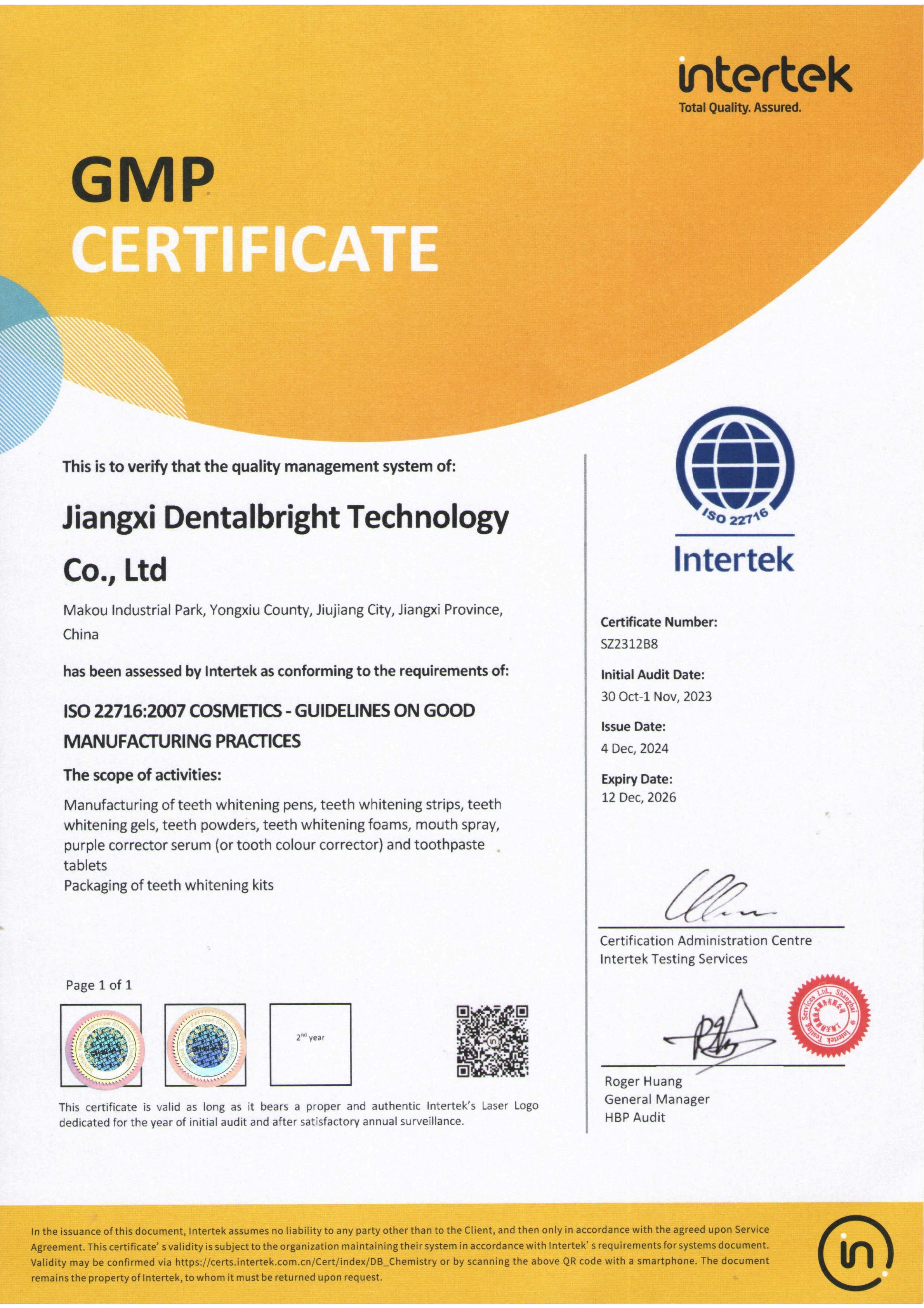
ISO 22716:2007 and GMPC certificates issued to the manufacturing site by Intertek Testing Services, valid to 12 December 2026.
The five documents at a glance
Read as a map, the dossier separates into system certificates, one social audit, and a separate group of product-and-market documents that the certificates never replace.
| Document | What it is | Buyer question it answers | What it does not establish |
|---|---|---|---|
| ISO 22716:2007 | Cosmetic good manufacturing practice standard | Is the site running a cosmetic GMP system whose scope names strips? | Product authorisation, EU notification, efficacy |
| GMPC (U.S. FDA cosmetic GMP guidelines, 2022) | Third-party certification against FDA cosmetic GMP guidance | Is cosmetic manufacturing practice assessed against the U.S. guidance? | FDA product approval, facility registration, MoCRA listing |
| ISO 13485:2016 | Medical-device quality management system | Are design, manufacturing and distribution run under a device QMS? | CE marking, market registration |
| MDSAP | One audit against the requirements of participating regulators | Has the QMS been audited for U.S., Brazil, Australia, Canada and Japan requirements? | Marketing authorisation in any of those markets |
| amfori BSCI | Social compliance audit | Are labour and social conditions at the site audited under a recognised scheme? | Product safety, microbial limits, efficacy |
ISO 22716:2007 — cosmetic GMP for the strip itself
ISO 22716:2007 is the cosmetic manufacturing standard, and it is the certificate that speaks most directly to a strip order. In this dossier the certificate is SZ2312B8, issued by Intertek Testing Services (Certification Administration Centre), valid from 4 December 2024 to 12 December 2026, with market coverage listed as EU, USA and Global. The scope reads: manufacturing of teeth whitening pens, teeth whitening strips, teeth whitening gels, teeth powders, teeth whitening foams, mouth spray, purple corrector serum and toothpaste tablets; packaging of teeth whitening kits.
Three details deserve a close read. First, the word 'strips' appears in the manufacturing clause, so a strip-only order falls inside the scope rather than being covered only as a generic oral care product. Second, kit packaging is a separate clause — if your order bundles strips with a whitening light, read both clauses against the order. Third, the expiry date of 12 December 2026 is a hard date; any shipment relying on the document needs the renewed version.
What ISO 22716 does not answer is whether the product may be placed on the EU market. That is a separate file, assembled from the cosmetic product safety report, the product information file and the notification route.
GMPC and the 'FDA approved' confusion
GMPC is where certificate reading most often goes wrong. The document in this dossier is SZ2312B9, also issued by Intertek, issued 4 December 2024 and expiring 12 December 2026, listed for the USA market, against the U.S. FDA Cosmetic Good Manufacturing Practice Guidelines (2022). Its scope covers manufacturing of teeth whitening pens, strips, gels, powders, foams, mouth spray, purple corrector serum and toothpaste tablets, plus packaging of teeth whitening kits.
That is a third-party certification that cosmetic manufacturing practice at the site has been assessed against FDA's cosmetic GMP guidance. It is not an FDA product approval, not an FDA facility registration, and not a MoCRA registration or product listing. Those are separate administrative facts, requested separately.
The practical consequence is a wording rule. If an onboarding form or a marketplace listing asks for 'FDA approval', a GMPC certificate is not the record that answers it. Ask the supplier which specific record exists for the product and the market you are entering, and read the reply literally: a quality-system certificate supports a regulatory file, it does not become one.
ISO 13485:2016 — the device quality system
ISO 13485:2016 is the medical-device quality management standard. Certificate 206536.250906, issued by UL LLC (UL Solutions Medical and Regulatory Services), is valid from 6 September 2025 to 5 September 2028 against ISO 13485:2016 and EN ISO 13485:2016 + A11:2021, with market coverage listed as EU (EN ISO 13485) and Global. Scope: design, development, manufacturing and distribution of electric toothbrush, teeth whitening strips, teeth whitening light/device, teeth whitening gel, dental impression material and teeth whitening kit.
Two words in that scope carry most of the value for a private-label buyer. 'Design and development' means the quality system covers how a formulation and strip construction are developed and changed — relevant when your specification differs from the catalogue, which is where dry versus wet strips, PAP, PAP+charcoal, purple and 6% HP variants, twelve flavours and 7, 14 or 21-strip pack configurations enter the file. 'Distribution' means handling through release sits inside the system rather than outside it.
The boundary is equally specific: ISO 13485 certification is a quality-system credential. It does not by itself place a device on the EU market, does not constitute CE marking, and does not replace the registration a device-classified product needs in the destination country.
MDSAP — one audit, five regulator frameworks
MDSAP answers a different question again: has the quality system been audited against the requirements of more than one regulator within a single audit? Certificate 206537.250906, issued by UL LLC, is valid from 6 September 2025 to 5 September 2028 against EN ISO 13485:2016/A11:2021 and ISO 13485:2016, and lists the USA, Brazil, Australia, Canada and Japan, with the same design, development, manufacturing and distribution scope as the ISO 13485 certificate.
The two certificates share an issue date, an expiry date and a number series because they come from the same audit cycle. That is normal, and it is worth noticing rather than mistaking for evidence of two independent audits.
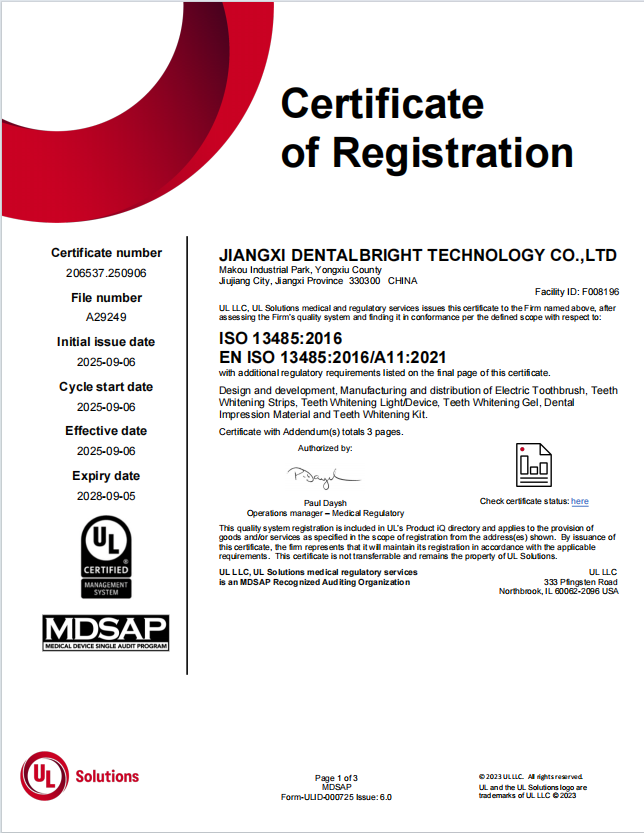
MDSAP certificate 206537.250906, issued by UL LLC, valid to 5 September 2028 and covering five participating markets.
For a buyer sourcing into any of those five markets, MDSAP reduces documentation load: one audit report can be cited across the group instead of five national audits. What it does not do is grant market access. MDSAP certification is not a marketing authorisation, registration or listing in any participating jurisdiction; those remain separate steps. A supplier that treats 'MDSAP certified' as equivalent to 'cleared for sale in the U.S.' has skipped the step that matters.
BSCI — the social audit that answers a different question
BSCI is the one document in the folder that says nothing about the product itself. The amfori BSCI social audit here carries Monitoring ID 25-0338381-1 and amfori Site ID 156-030966-001, was audited by SGS against the amfori BSCI Code of Conduct (2024 version), and runs from 26 June 2026 to 15 August 2027. Its scope is manufacturing of teeth whitening gel, whitening light/device, whitening strips, toothpaste, electric toothbrush and mouthwash.
It answers a retail vendor-onboarding question: has the production site been assessed for social and labour compliance under a scheme your retail customer recognises? For pharmacy or supermarket programmes that question often arrives before any product question — a two-year promotional gift-set programme of 7 million units for pharmacy and supermarket retail passed third-party factory audits under BSCI and ISO schemes, which is the type of evidence a retail onboarding file expects.
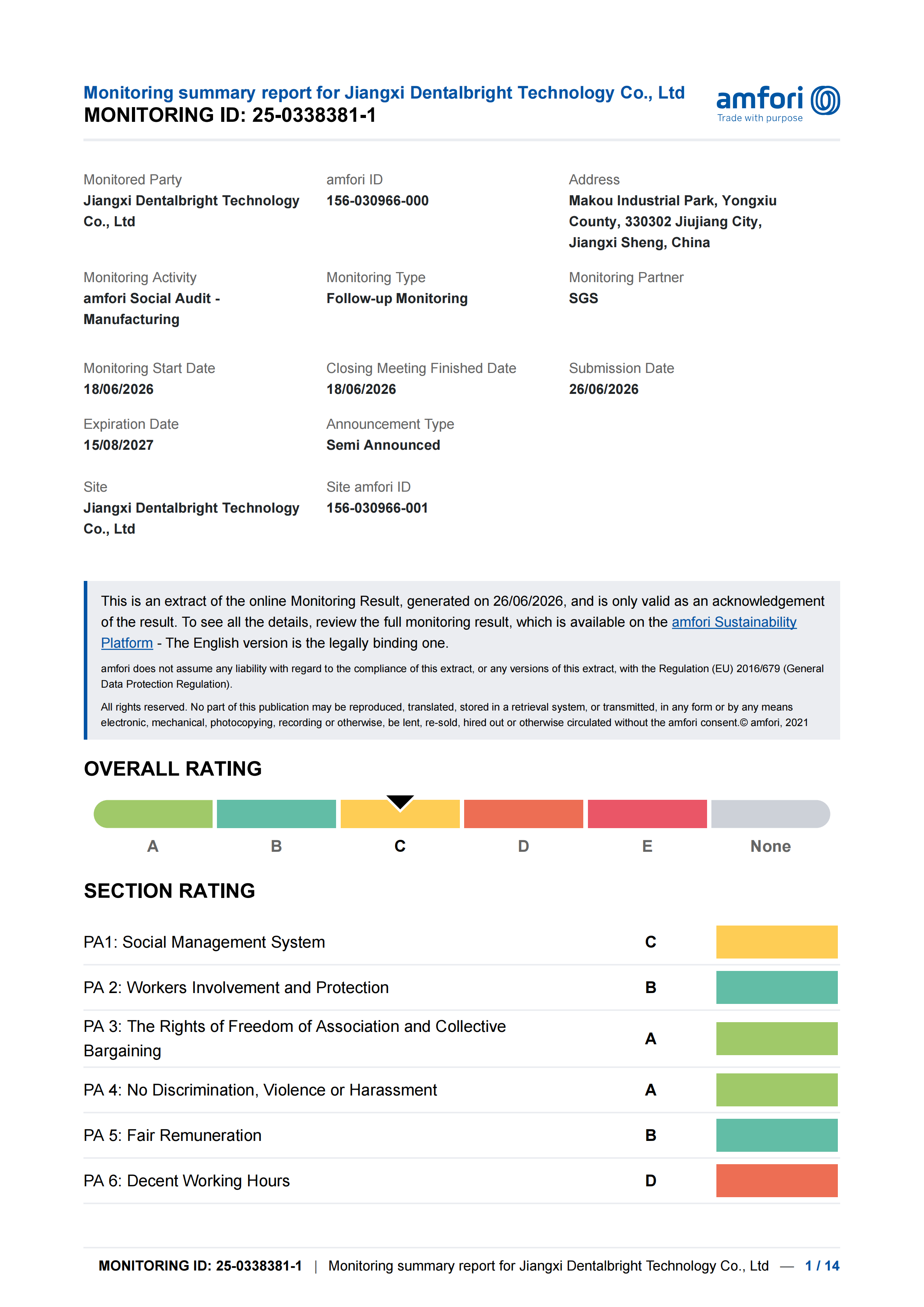
amfori BSCI social audit report, Monitoring ID 25-0338381-1, audited by SGS against the 2024 Code of Conduct.
It does not address formula safety, microbial limits, stability or efficacy. A strong social audit result and a compliant strip are two separate achievements, and confusing them is a common filing error.
Reading a certificate response in six checks
All five documents can be checked in the same order, and the checks take less time than reading the marketing page that came with them.
- Scope line against your product. Find the words. 'Teeth whitening strips' inside the manufacturing clause is a different answer from a scope that names only gels or toothpaste.
- Legal entity and site. The certificate names a company and a site. If your quotation comes from another entity or another plant, the certificate does not automatically follow.
- Standard and version. ISO 22716:2007, ISO 13485:2016, EN ISO 13485:2016 + A11:2021 and the amfori BSCI Code of Conduct (2024 version) are versioned documents; an undated 'ISO certified' line is not the same claim.
- Issuer and certificate number. Intertek Testing Services, UL LLC and SGS appear on the documents above, each with a number that can be checked with the issuer.
- Validity window. Read the expiry date as a hard date: two of the five documents expire on 12 December 2026.
- What the document is for. System certificates (ISO 22716, GMPC, ISO 13485, MDSAP) and social audits (BSCI) are not product authorisations, and product documents (CPSR, PIF, notification support, MSDS, COA) are not factory credentials. Keeping the two groups apart prevents most misreadings.
The four document requests buyers send most often
Most sourcing threads open with the same four asks. What changes the outcome is how the reply is read.
'Is it compliant for the EU market?'
Split the answer. For a cosmetic product, the dossier can include CPSR, PIF and CPNP submission support, and those documents carry the EU cosmetic file; the ISO 22716 and GMPC certificates support the manufacturing side of that file without becoming the file. If the strip is classified as a device in the destination market, the operative documents differ, and the ISO 13485 and MDSAP certificates again support the quality system rather than replace a registration. Ask which classification applies to your product and claims, and request the documents for that route by name.
'Can you provide MSDS?'
Yes — an MSDS is available. Ask for the revision that matches the formula you are ordering, because PAP, PAP+charcoal, purple and 6% HP variants, twelve flavours and dry versus wet formats do not share one safety profile, and pair it with the batch COA. An MSDS describes handling, storage and hazard information; it is not an efficacy document and not a market authorisation.
'Send your certification list'
A list is a claim; a certificate is evidence. Ask for the five documents with numbers, issuers, scope lines and dates, then separate them from product and market documents: CPSR, PIF and notification support for cosmetic products, MSDS, COA, and market-specific attestations such as halal or vegan certification where the destination requires them. The split is not administrative tidiness — a buyer who files a social audit as a product certificate usually discovers the gap at customs or at retail onboarding.
'What are your MOQ terms?'
For this strip range the stated MOQ is 200 pieces for private label and 1 piece for a regular product, with the exact figure confirmed at quotation because it depends on product category, customization requirements and line configuration. The compliance relevance is easy to miss: a 200-piece private-label run is small enough to validate artwork, on-pack claims wording and market documents before scaling, and a single-piece regular order lets a buyer inspect the standard pack — 7, 14 or 21 strips, user manual, shade guide and colour box — against the specification.
Which buyer needs which document first
The reading order changes with the buyer's route to market, even when the supplier and the certificate set are identical.
An EU brand owner starts with the cosmetic file — CPSR, PIF and notification support — and uses ISO 22716 to confirm the manufacturing site operates a GMP system whose scope names strips. A U.S. marketplace seller starts with formula documents (MSDS, COA) and GMPC, and should not accept a general 'FDA approved' line as a substitute for a specific record. A clinic-facing or professional distributor starts with ISO 13485 and MDSAP, because those are the quality-system documents that matter when device-classified products are on the order. A retail private-label buyer starts with BSCI and ISO 22716, because vendor onboarding usually asks about the site before it asks about the strip.
Same supplier, same certificates, four different reading sequences.
Where the certificate set stops
Four boundaries deserve to be stated plainly, because a well-organised dossier invites over-reading.
- Scope and site, not product range. Strips, gels, powders, mouth spray and kit packaging appear as separate clauses for a reason; an order that does not match a clause is not covered by it.
- No efficacy claim. Certificates do not establish whitening performance, sensitivity outcomes or stain-removal results. The scenario specification for this strip range describes stain removal, an enamel-safe positioning and a zero-peroxide option; none of that is certified by ISO 22716 or GMPC. Formula documentation and your own evaluation cover that ground.
- Intellectual property is not a certificate. The site holds U.S. utility patent 12,350,120 B1 for a gum-protecting, residue-free whitening strip using an acrylic copolymer gelling agent with a marginal sealing effect, issued 8 July 2025. That protects a construction; it does not authorise market entry and it says nothing about a different supplier's strip.
- Dates expire. ISO 22716 and GMPC lapse on 12 December 2026, BSCI runs to 15 August 2027, and ISO 13485 and MDSAP to 5 September 2028. A certificate that was valid at sampling may not be valid at shipment.
Keeping the dossier current
The workable practice is a one-page register per supplier: document, standard and version, number, issuer, scope line as written, site, issue date, expiry date and your own review date. Request the renewed certificate before the expiry date printed on the document, and re-read the scope line whenever a new product category enters the order — a new category is exactly when a scope that used to fit stops fitting. The factory's product catalogue lists current formats and can be cross-checked against the scope lines above.
FAQ
What certifications should a teeth whitening strip supplier provide?
Two groups, kept separate. Factory and system certificates: ISO 22716:2007 for cosmetic GMP, GMPC against the U.S. FDA cosmetic GMP guidelines, ISO 13485:2016 for the device quality system, MDSAP for multi-market audit coverage, and a social audit such as amfori BSCI. Product and market documents: CPSR, PIF and notification support for cosmetic products, MSDS, a batch COA, and market-specific attestations where the destination requires them. Ask for certificate numbers and scope lines rather than a list of names.
Which certificate covers EU market compliance for whitening strips?
None of the five covers it alone. ISO 22716 and GMPC evidence cosmetic manufacturing practice; ISO 13485 and MDSAP evidence a device quality system. EU entry depends on how the product is classified: for a cosmetic, the product safety report, the product information file and the notification step are the operative documents, and the supplier's certificates support that file without replacing it. A device-classified product follows a different route. Classification should be confirmed against the destination market's rules before the document list is finalised.
Can a supplier provide an MSDS for whitening strips?
Yes, an MSDS is available. Request the revision that matches the exact formula ordered, because flavour, active ingredient (PAP, PAP+charcoal, purple or 6% HP) and format (dry versus wet) vary across a strip range, and ask for the batch COA alongside it. An MSDS covers handling, storage and hazard information; it is not an efficacy claim and not a market authorisation.
Does a GMPC certificate mean the strips are FDA approved?
No. The GMPC certificate SZ2312B9, issued by Intertek against the U.S. FDA Cosmetic Good Manufacturing Practice Guidelines (2022), certifies that cosmetic manufacturing practice at the site was assessed against that guidance. It is not an FDA product approval, not a facility registration, and not a MoCRA registration or product listing. Where a sales channel requires those specific records, request them by name.
What MOQ applies to private label versus regular whitening strips?
For this strip range the stated MOQ is 200 pieces for private label, including custom packaging and printing, versus 1 piece for a regular product in existing packaging. MOQ is confirmed at quotation because it depends on product category, customization requirements and production line configuration, so the applicable figure should be fixed during sampling rather than assumed from a general page.
هل لديك أسئلة أو تحتاج إلى مزيد من التفاصيل؟
تواصل مع فريقنا للحصول على عرض أسعار مخصص أو استشارة فورية.
طلب عرض أسعار
املأ النموذج أدناه وسيتواصل معك فريقنا بعرض مقترح مخصص.
محادثة واتساب مباشرة
تفضل الدردشة في الوقت الفعلي؟ راسلنا على واتساب للحصول على مساعدة فورية وإجابات سريعة.
- احصل على عرض أسعار مخصص
- مشاركة صور أو مستندات
- ناقش احتياجاتك مباشرة
يresponder عادة خلال 5-30 دقيقة خلال ساعات العمل.