
Teeth Whitening Strips Compliance Dossier: MDSAP, ISO 13485, ISO 22716, GMP & BSCI
Teeth Whitening Strips Compliance Dossier: MDSAP, ISO 13485, ISO 22716, GMP & BSCI
A buyer-facing reading of the five manufacturer-level credentials that anchor a teeth whitening strips RFQ — and how to separate them from the product-specific registrations they do not replace.
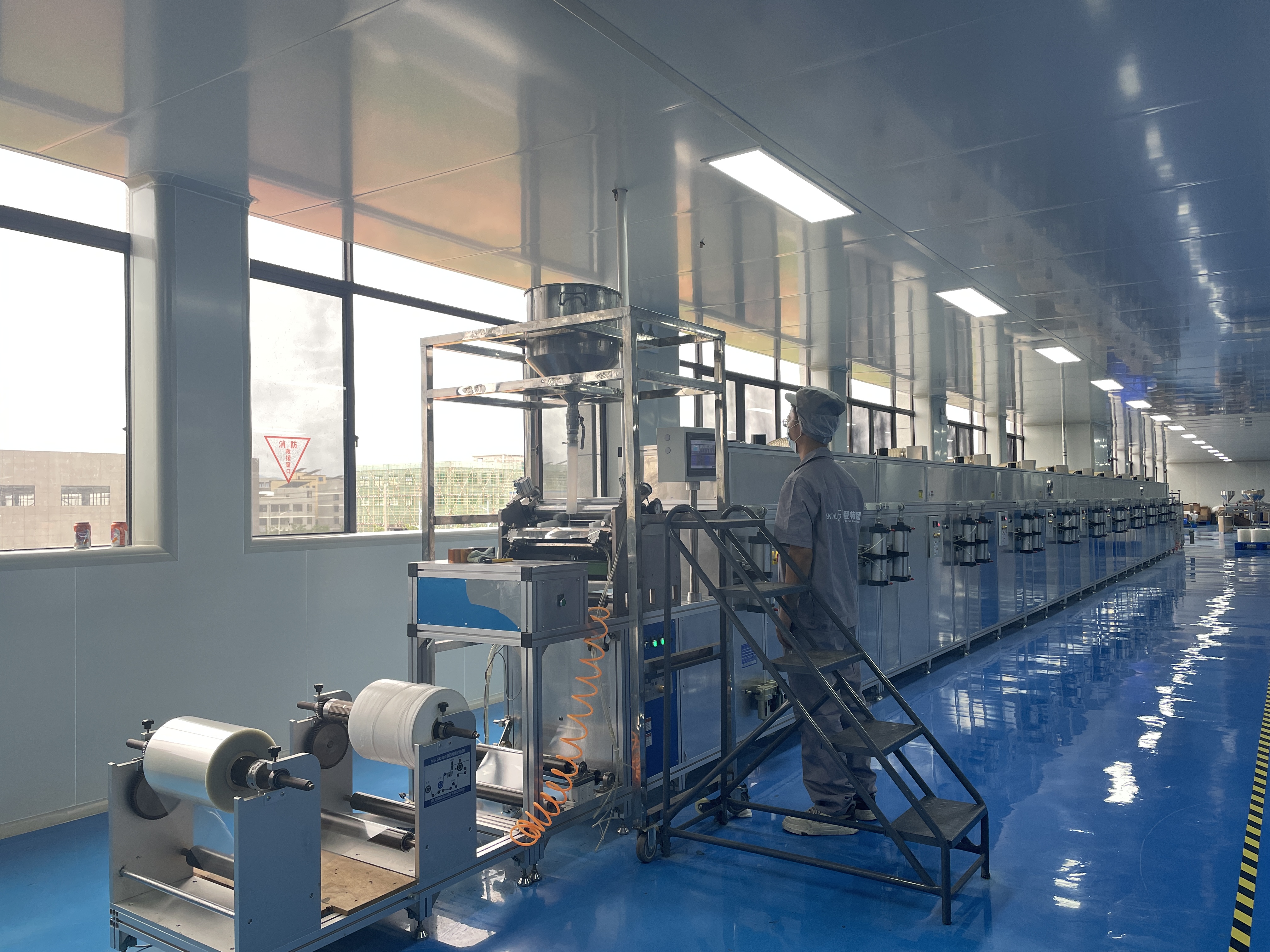
Teeth whitening strips cross more regulatory boundaries than most oral-care products. The same adhesive strip can be treated as a cosmetic in one jurisdiction and pulled toward medical-device or over-the-counter drug classification in another, depending on the active ingredient, its concentration, and whether a powered whitening device ships in the same kit. That split is why the supplier's certification pack has become the first real gate in a sourcing decision rather than a formality attached to the quotation.
The practical consequence is that the RFQ stage now behaves like an evidence review. Instead of asking only about price, flavor range and lead time, importers and private-label brands ask a manufacturer to name the standards behind its quality system, to confirm which documents can be handed to a customs broker, and to explain where a claimed approval begins and ends. A manufacturer-level credential such as MDSAP or ISO 13485 answers a different question than a product registration such as CE-MDR or a MoCRA listing. Treating the two as interchangeable is one of the most common causes of a stalled launch.
This reference takes the compliance dossier of Jiangxi DentalBright Technology Co., Ltd., operating as Glorysmile Factory, as a working example. Its verified certification set — MDSAP, ISO 13485, ISO 22716, GMP and BSCI — is used here to show how a buyer should read each document during the Decision-to-Execution phase of sourcing teeth whitening strips, and to answer the six RFQ questions that most often decide whether a supplier advances to sample and trial order.
Why Whitening Strips Sit on a Regulatory Boundary
The classification of a whitening strip is not fixed by the product name. It follows the formulation and the concentration. In the European Union, Regulation (EC) No. 1223/2009 restricts the concentration of hydrogen peroxide in over-the-counter teeth whitening products to 0.1% or less. Above that ceiling, a strip stops being a simple cosmetic and enters a heavier regulatory route. In the United States, cosmetic-classified whitening strips fall under the Modernization of Cosmetics Regulation Act (MoCRA 2022), while a whitening light or an oral irrigator can be regulated as a medical device.
For a buyer, this has a direct commercial meaning: the compliance question is never "is it certified?" but "certified as what, by which route, for which market?" A supplier that answers the first question and not the second is handing the buyer a launch risk that will surface later — at customs, at the retailer onboarding stage, or at the point where a marketplace checks the product listing.
Trade classification compounds the issue. Teeth whitening strips are primarily classified under HS Code 3306.90.00 — preparations for oral or dental hygiene — which is the code most brokers expect on a whitening-strip shipment. A dossier that is internally consistent with that code, and with the cosmetic or device route that sits behind it, reduces the chance of a customs hold.
The Problem: A Certification List Is Not a Compliance Position
Most RFQ responses a buyer receives look alike. They list logos, repeat the phrase "FDA approved" or "CE certified," and stop there. Two failure modes follow.
The first is tier collapse — using a facility-level quality certificate as if it were a product approval. MDSAP, ISO 13485, ISO 22716, GMP and BSCI all describe the manufacturer's systems: how quality is managed, how cosmetics hygiene is controlled, how social and ethical standards are audited. None of them approves a specific finished strip for sale in a specific country. A buyer who reads them as product approvals may find that the product registration they assumed existed was never filed.
The second is market collapse — assuming one approval travels everywhere. A MoCRA cosmetic facility registration and product listing covers the US route for cosmetic strips. It says nothing about EU notification. A CE-MDR registration applies to medical devices, not to a strip that has been placed on the market as a cosmetic. Each market has its own entry document, and the dossier is credible only when it states which document belongs to which market and which product class.
The Verified Certification Set, Read in Two Tiers
Glorysmile Factory's documentation splits cleanly into factory certificates and product certificates. The factory tier covers CE, FDA, CPSR, CPNP, PIF, SCPN, MSDS, COA, RoHS, HALAL and Vegan. The product tier covers GMP, ISO 22716, ISO 13485, MDSAP and BSCI. The teeth whitening strips line specifically is certified with BSCI, GMP, ISO 22716, ISO 13485 and MDSAP.
| Credential | What it certifies | Tier | What it does not replace |
|---|---|---|---|
| MDSAP | Medical Device Single Audit Program — a single audit approach accepted across multiple medical-device regulators | Manufacturer system | Product registration or market notification |
| ISO 13485 | Quality management system for medical-device manufacturing | Manufacturer system | A CE certificate or an FDA clearance for a specific product |
| ISO 22716 | Good Manufacturing Practices for cosmetics | Manufacturer system | CPNP notification or CPSR for a cosmetic strip |
| GMP | Good Manufacturing Practice at the facility level | Manufacturer system | Product-specific approval in any single market |
| BSCI | Business Social Compliance Initiative audit of social and ethical standards | Manufacturer system | Any product or formulation approval |
Read this way, the set tells a coherent story. A manufacturer holding both ISO 13485 and ISO 22716 is declaring that it can operate to medical-device quality standards and to cosmetic GMP standards in the same facility — which matters because whitening strips themselves move between those two classifications depending on the market and the formula. BSCI adds a social-compliance layer that large retail and e-commerce buyers increasingly require at supplier onboarding. MDSAP signals a quality system aligned to the audit expectations of multiple medical-device regulators rather than a single national one.
What Each Manufacturer-Level Credential Actually Proves
MDSAP — one audit, multiple regulators
MDSAP allows a single audit to satisfy the quality-system expectations of several participating medical-device regulators instead of separate national inspections. For a buyer sourcing a whitening device or a medical-device-classified strip, MDSAP is a signal that the factory's quality system has been assessed against a multi-jurisdiction model, which reduces the number of separate audits a brand may need to request.
ISO 13485 — the medical-device quality baseline
ISO 13485 is the quality management standard for medical devices. It governs design control, risk management, traceability and corrective action. It is the credential that most often determines whether a manufacturer can be considered for a device-classified project at all, and it is the reason a strip program and a device program can be run under one quality system.
ISO 22716 — the cosmetics GMP route
ISO 22716 is the Good Manufacturing Practices guideline for cosmetics. Because most whitening strips are placed on the market as cosmetics, this is the credential that aligns with the everyday production of the category: hygiene control, batch consistency, raw-material handling and finished-goods release. It complements ISO 13485 rather than duplicating it.
GMP — facility-level manufacturing discipline
GMP certification confirms that production operates under documented, auditable manufacturing practice. In practical terms, it is what a buyer points to when a retailer asks how the product was made, and it supports the batch-to-batch consistency that private-label programs depend on.
BSCI — social compliance, not product compliance
BSCI is an audit of social and ethical standards in the supply chain. It is frequently requested by European retailers and by large e-commerce sellers as a condition of onboarding. It is important to state plainly that BSCI says nothing about the whitening formula or the regulatory status of a strip — it answers a different question, about how the factory treats its workforce.
Technical Explanation: How the Standards Map onto the Regulation
Three regulatory anchors determine what a whitening-strip dossier must contain.
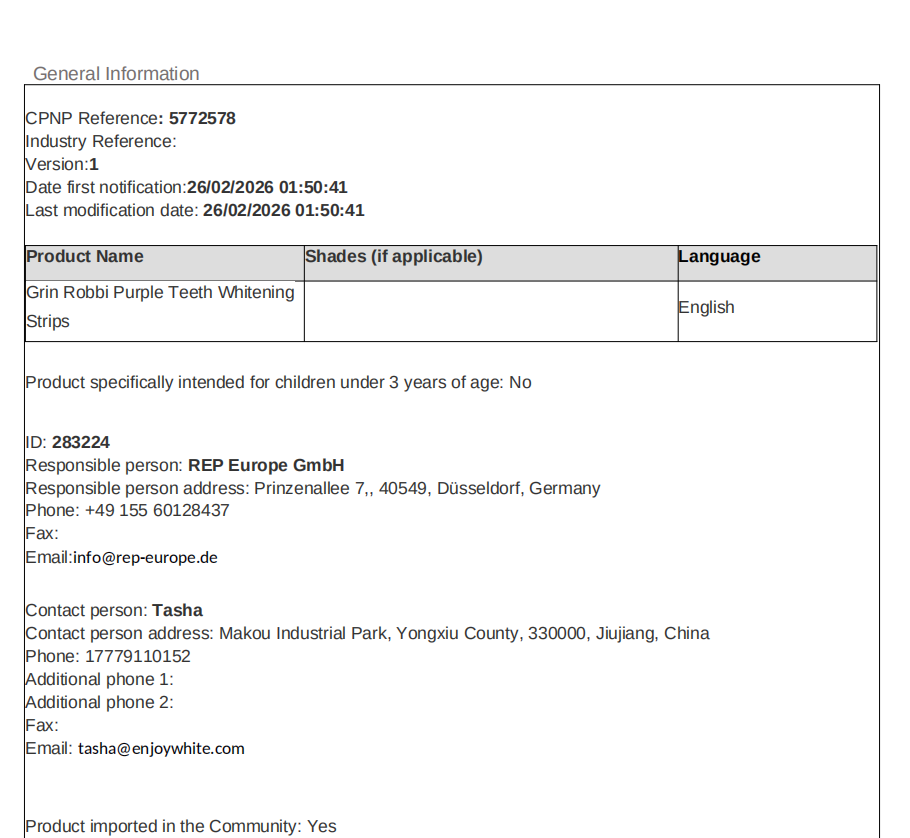
EU cosmetic route. Under Regulation (EC) No. 1223/2009, a whitening strip marketed as a cosmetic requires a Cosmetic Product Safety Report (CPSR), a CPNP notification confirmation, an EU Responsible Person, and a Product Information File (PIF). Hydrogen peroxide concentration in over-the-counter whitening products is capped at 0.1% or less. Supporting documents include the product specification, MSDS and raw-material COA. Where the strip is instead classified as a medical device, the route shifts to CE-MDR registration with a complete Technical File and an appointed EU Responsible Person.
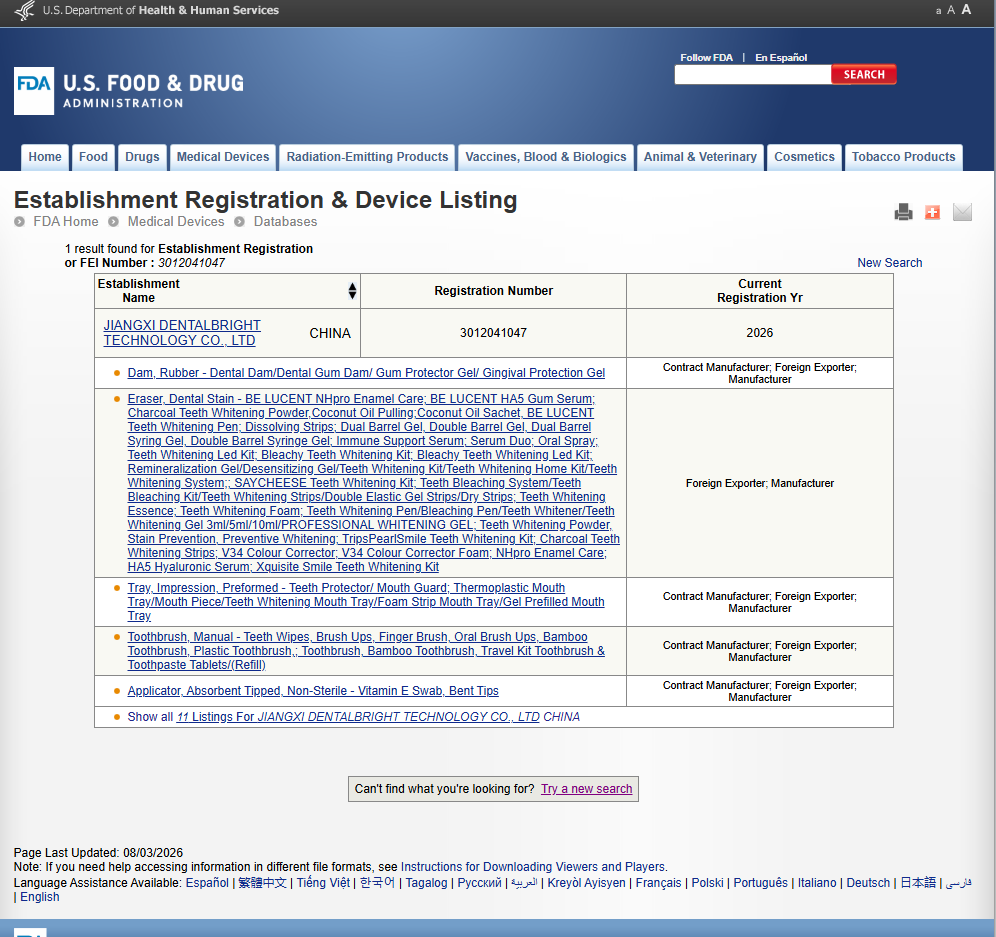
US cosmetic route. Under MoCRA 2022, manufacturers of whitening strips classified as cosmetics must register their facilities and list their products. Documented compliance cost references place facility registration at approximately US$849 per year and product listing at approximately US$200 per item. A US Agent is required, and product formulation filing is completed through the FDA. Where a product is regulated as a device, FDA medical-device establishment registration and device listing apply instead.
Trade route. HS Code 3306.90.00 covers oral or dental hygiene preparations and is the classification most commonly applied to whitening strips at import.
The technical value of the two-tier dossier becomes clear here. A facility certificate such as ISO 22716 supports the claim that the product was made under cosmetic GMP; it does not substitute for the CPNP notification that the EU actually requires. A buyer checking both tiers at once is checking both the factory and the market entry.
Answering the Standard RFQ Questions Without Overstating
Most teeth whitening strips RFQs converge on six questions. The answers below show the level of precision a credible dossier provides — each one scoped to the route it actually covers.
1. EU market compliance
For cosmetic products, CPSR, CPNP and PIF can be provided. For medical-device products, CE-MDR registration has been completed. The answer is deliberately two-part: the correct document depends on which classification the strip falls into, and the 0.1% hydrogen peroxide ceiling under Regulation (EC) No. 1223/2009 governs the cosmetic route.
2. FDA status
Products are FDA approved, and the FDA-certified scope covers medical devices, cosmetics and OTC drugs. On the US cosmetic side, MoCRA-compliant cosmetic facility registration and product listing have been completed for the teeth-whitening strips. Teeth-whitening lights, electric toothbrushes and oral irrigators hold FDA medical-device registration, and the silicone impression material has completed 510(k) registration. A buyer should read "FDA approved" as scoped to the specific product type — not as a single blanket status covering every SKU.
3. MSDS availability
MSDS is available and is listed within the factory document set alongside COA. For EU submissions, MSDS functions as a supporting document; the mandatory package remains CPSR, CPNP notification confirmation and EU Responsible Person information.
4. Sensitive-teeth safety
PAP and low-sensitivity formulas designed for sensitive teeth are available. The underlying logic is a choice of chemistry: peroxide-based gels act quickly and penetrate enamel, with a higher sensitivity risk, while PAP acts on surface stains with minimal sensitivity but needs more time on deep staining. For daily-use or sensitive-teeth positioning, a PAP or low-concentration route is the typical selection.
5. Whitening formula
PAP (peroxide-free), Carbamide Peroxide (CP) and Hydrogen Peroxide (HP) formulas are offered. The strips line supports PAP, PAP plus charcoal, Purple, 6% HP, Sodium Phytate, Sodium Bicarbonate, or a custom formulation, across a flavor range that includes blue raspberry, strawberry, peach, grape, watermelon, peppermint, orange, mint, pineapple, cherry blossom, coconut and mango.
6. MOQ
For regular orders using existing packaging, the MOQ is 5 boxes. For OEM orders with customized packaging, the MOQ varies by product, from 100 to 1,000 boxes, driven mainly by the minimum quantity required for the custom packaging. At the level of an individual strip model, private-label orders start at 200 pieces and regular-product orders at 1 piece; the dissolving-strip model DB-004L follows the same 200-piece private-label / 1-piece regular split.
Application and Use-Case Fit
The compliance position directly shapes which product format a buyer should choose for a given launch.
- Dry strips — good adhesion, minimal residue, higher cost. Suited to brands positioning on strong adhesion and a clean in-use experience.
- Wet strips — lower adhesion and more residue, but lower cost. Also the practical choice for purple color-corrector strips, where greater surface residue helps the pigment adhere.
- Dissolving strips — a dissolving format intended for oral cleansing, relevant where a brand wants a no-removal step.
- Sensitive-teeth and daily-use programs — built on PAP or low-concentration peroxide routes.
- Supermarket, retail and e-commerce private label — supported by cosmetic GMP and the EU/US entry documents above.
- Travel-format and individually wrapped strips — supported by the aluminum strip-bag packaging and an enamel-safe, zero-peroxide option.
For a private-label launch, the usual sequence is a small trial order, a medium-batch verification stage and then mass production. Because the same facility holds both medical-device and cosmetics production licenses, a brand can keep a cosmetic strip line and a device-based whitening line under one supplier relationship rather than splitting them.
Market Trend Analysis
The commercial backdrop explains why documentation has become a procurement gate. The global market for teeth whitening strips and gels was valued at USD 1.1 billion in 2025 according to Grand View Research's teeth whitening strips and gels market report covering 2026–2033. That figure describes the strips-and-gels segment specifically; broader estimates that value the total teeth whitening market at several times that number are measuring a wider product set, and the two are consistent once the segment is defined.
Two structural trends follow. First, compliance cost is now a fixed line in the entry calculation rather than a one-off: under MoCRA, a cosmetic facility registration and per-product listings recur, which raises the relative value of a supplier that already holds the underlying system certificates. Second, because whitening strips are classified differently across markets, buyers launching into several regions simultaneously increasingly ask for a single supplier whose factory-level credentials cover both the device and cosmetic routes, so that the market-entry documents can be layered on top instead of rebuilding the supply base per region.
Glorysmile Factory's export footprint is consistent with that pattern: products are exported to 102 countries, including North America, Europe and Asia, with approximately 90% of output exported and major markets in the EU, USA and UK.
Where the Dossier Has Limits — Comparison with Alternative Routes
A credible compliance reference has to state where a credential stops being useful. Four boundaries matter in practice.
Management-system certificates are not product approvals. MDSAP, ISO 13485, ISO 22716, GMP and BSCI certify the manufacturing system and, in BSCI's case, social compliance. None of them is a substitute for a CPNP notification, a CPSR, a MoCRA listing or a CE-MDR registration. Buyers who accept the certificate tier as the whole dossier are accepting a gap.
CE-MDR applies only to the device route. A whitening strip marketed as a cosmetic does not travel on CE-MDR registration. This is the single most common point of confusion in whitening-strip sourcing, and it is why the two-tier format is worth insisting on.
Format choice carries a real trade-off. Dry strips offer better adhesion and lower residue but cost more than wet strips, which tend to shift during application and leave more residue. Neither is universally superior; the right choice depends on the brand's positioning and budget.
Formula choice carries a performance trade-off. Peroxide chemistry is faster and stronger on deep staining, with a higher sensitivity risk. PAP chemistry is gentler and more suitable for daily use, but takes longer to show results on stubborn stains. In the EU specifically, the 0.1% hydrogen peroxide limit for over-the-counter cosmetic whitening constrains how far a cosmetic strip can push the peroxide route at all, which is one reason PAP programs have grown in relevance for that market.
For comparison against the narrow-band alternative route of a single-format, standard-formula supply arrangement, the practical difference is flexibility: a supplier holding both device and cosmetic certifications can move a program between routes as the target market changes, whereas a supplier certified for only one route forces a re-sourcing decision when a brand expands.
Future Outlook
The direction of travel is toward documentation as a standing requirement rather than a launch task. MoCRA re-registration and listing obligations recur annually, EU notification must stay current with formulation changes, and retail onboarding increasingly requires social-compliance evidence such as BSCI alongside product documents. Buyers who build a supplier dossier once and keep it current will spend less time re-collecting evidence at each new market entry.
The second shift is toward narrower, better-evidenced claims. As the regulatory distinction between cosmetic, device and OTC routes becomes more closely enforced, suppliers will be judged less on the volume of certificates and more on whether each certificate is scoped correctly to the product and market it is presented for. Manufacturers that already separate factory qualifications from product registrations are positioned for that shift; those that present a single undifferentiated list are not.
OEM/ODM services — covering product formulation, customization, free sampling and packaging design — are the operational layer on top of that compliance base, and they are what turn a verified certificate set into an actual private-label program for a buyer entering the category.
Frequently Asked Questions
What certifications do your products have?
The documentation is split into two tiers. Factory certificates include CE, FDA, CPSR, CPNP, PIF, SCPN, MSDS, COA, RoHS, HALAL and Vegan. Product certificates include GMP, ISO 22716, ISO 13485, MDSAP and BSCI. The teeth whitening strips line is certified with BSCI, GMP, ISO 22716, ISO 13485 and MDSAP. The two tiers answer different questions: factory certificates relate to market entry and material documentation, while product certificates relate to the manufacturing system.
Is it compliant for the EU market?
For cosmetic products, CPSR, CPNP and PIF can be provided. For medical-device products, CE-MDR registration has also been completed, with a complete Technical File and an appointed EU Responsible Person. The answer depends on which classification the specific strip falls into: the EU cosmetic route under Regulation (EC) No. 1223/2009 caps hydrogen peroxide in over-the-counter whitening products at 0.1% or less, while the device route follows CE-MDR.
Is the product FDA approved?
The products are FDA approved, and the FDA-certified scope covers medical devices, cosmetics and OTC drugs. For the US cosmetic route specifically, MoCRA-compliant cosmetic facility registration and product listing have been completed for the teeth-whitening strips. Teeth-whitening lights, electric toothbrushes and oral irrigators hold FDA medical-device registration, and the silicone impression material has completed 510(k) registration. "FDA approved" should therefore be read as scoped to the specific product type and regulatory route, not as a single status covering every item.
Can you provide MSDS?
Yes, MSDS is available and is listed among the factory-level documents alongside COA. For EU-market submissions, MSDS functions as a supporting document; the mandatory package for a cosmetic strip is the CPSR, the CPNP notification confirmation and the EU Responsible Person information, with the product specification and raw-material MSDS and COA attached as supporting evidence.
Is the product safe for sensitive teeth?
PAP and low-sensitivity formulas designed for sensitive teeth are available. The mechanism behind the choice is chemistry: peroxide-based gels (HP or CP) are small-molecule, penetrate enamel into the dentin and break down deeper pigments quickly, but carry a higher risk of temporary sensitivity. PAP is a larger-molecule, surface-acting agent that does not penetrate the tooth structure and oxidizes surface stains only, producing minimal sensitivity but slower visible results on deep stains. For daily-use or sensitive-teeth positioning, PAP or a low-concentration peroxide formulation is the typical selection.
What is the whitening formula?
PAP (peroxide-free), Carbamide Peroxide (CP) and Hydrogen Peroxide (HP) formulas are offered. The teeth whitening strips line supports PAP, PAP plus charcoal, Purple, 6% HP, Sodium Phytate, Sodium Bicarbonate, or a custom formulation. Flavor options include blue raspberry, strawberry, peach, grape, watermelon, peppermint, orange, mint, pineapple, cherry blossom, coconut and mango. Where a market caps peroxide concentration — for example the 0.1% hydrogen peroxide limit for over-the-counter cosmetic products in the EU — the PAP route is the relevant option.
What is the MOQ?
For regular orders using existing packaging, the MOQ is 5 boxes. For OEM orders with customized packaging, the MOQ varies by product, from 100 to 1,000 boxes, and depends mainly on the minimum order quantity required for the custom packaging. At the individual strip-model level, private-label orders start at 200 pieces and regular-product orders at 1 piece; the dissolving-strip model DB-004L follows the same 200-piece private-label and 1-piece regular split.
Manufacturer qualification and product registration are separate layers of the same dossier. Reading them separately — and asking a supplier to state which document covers which market and product class — is the fastest way to reduce launch risk when sourcing teeth whitening strips.
The full product and capability overview is available in the Glorysmile Factory catalog.
Regulatory references cited: Regulation (EC) No. 1223/2009 (EU hydrogen peroxide concentration limit for over-the-counter teeth whitening products); US MoCRA 2022 cosmetic facility registration and product listing; HS Code 3306.90.00 (preparations for oral or dental hygiene). Market size reference: Grand View Research, Teeth Whitening Strips & Gels Market Size Report 2026–2033 (USD 1.1 billion, 2025).