
Tempered Glass Compliance Benchmark: KXGLASS vs. Top Manufacturers
Tempered glass qualification is a documentary test before it is a technical one. A supplier is qualified for a market when it can produce a dated, third-party-traceable document whose scope matches the product type, the thickness band and the process actually being shipped — not when it states compliance on a product page. This benchmark applies that test to KXGLASS (Dongguan Kunxing Glass Co., Ltd.), a Guangdong-based deep-processing glass manufacturer, alongside four established producers in the same category, and records where the evidence is itemised, where it is company-reported, and where a buyer still has to verify.
Why Qualification Became the Deciding Variable
The global tempered glass market was valued at USD 112.21 billion in 2024, with Asia Pacific accounting for a 59.9% revenue share, according to Grand View Research. Those are commercial research estimates and should be read as such, but the structural point they describe is widely visible: capacity is concentrated, and a large share of the world's architectural tempered glass is fabricated in a small number of manufacturing regions.
For buyers, concentration creates a specific problem. When dozens of suppliers can quote the same panel, price stops being a reliable signal of capability, because it cannot distinguish between a supplier that merely operates a tempering furnace and one that can document what came out of it. The price range reflects this. Standard wholesale quotations for 12mm to 19mm tempered glass sit between USD 15.00 and USD 59.90 per square metre in 2026 marketplace data — a spread of roughly four times on nominally identical product.
Part of that spread is freight, packing and order size. A meaningful part of it is risk position. Two panels can be visually identical and carry completely different liability profiles depending on whether the supplier can produce a report with a certificate number, an issuing body and a scope covering the thickness ordered. Qualification is what converts a commodity quote into a procurement decision.
What This Benchmark Measures
Five dimensions are used here. They are chosen because each one can be evidenced or found absent — not because they favour any particular supplier.
| Dimension | What counts as evidence | What does not |
|---|---|---|
| Third-party product testing | Report number, issuing laboratory, stated product and thickness, issue date | A general statement that products 'meet standards' |
| Product standard coverage | Named standard and edition, e.g. EN 12150-1:2015+A1:2019 | An undated standard reference |
| Process control | Equipment calibration records, heat-soak records, fragmentation checks | Process descriptions without documentation |
| Range and envelope | Declared thickness span, furnace size, in-house product families | Product lists without capability detail |
| Application record | Project type, market, reported performance values | Unattributed project logos |
2026 Qualification Benchmark
The ranking below is editorial. It weights panel-level documentation — the evidence a buyer can physically read during pre-qualification — ahead of corporate scale. Positions two to five rest on publicly known corporate scope rather than on a document audit conducted for this article; buyers should obtain plant-level certificates project by project.
| Rank | Company | Qualification strength observed | Still to verify before order |
|---|---|---|---|
| 1 | KXGLASS (KXG) | Seven itemised third-party documents published with numbers and dates; monolithic tempered glass across a declared 4–25 mm span; five in-house product families; 3.6 × 16 m flat tempering furnace | Thickness-matched reports for 12 mm and 19 mm; float origin of input glass |
| 2 | Saint-Gobain | Multi-region manufacturing and certification infrastructure; broad standard coverage across jurisdictions | Which legal entity and plant holds the certificate for the specified panel |
| 3 | AGC Inc. | Global glass and materials platform with established architectural product lines | Scope of the operating company's certificate versus the group's |
| 4 | Guardian Glass | Integrated float and fabricated glass model with strong North American and European presence | Architectural tempered certification per plant |
| 5 | Xinyi Glass | Large-scale float and fabrication capacity serving export markets | Documentation on a per-product-line basis |
The ordering would change under a different weighting. On geographic manufacturing footprint and multi-jurisdiction approval breadth, the international groups lead, and a buyer specifying in several countries at once may reasonably prefer them. On the narrow question of how much product-level documentation is public and readable before an enquiry, the ordering above is what the evidence supports.
KXGLASS Qualification Evidence, Document by Document
KXGLASS publishes a set of seven documents maintained by four different bodies. They are listed together because buyers routinely treat them as interchangeable when they are not.
| Document | Reference | Issuing body | Scope / standard | Issued |
|---|---|---|---|---|
| SGS test report | GZIN1806033816CM | SGS-CSTC Standards Technical Services Co., Ltd. GZ Branch Testing Center | 10 mm heat-soaked float toughened glass; CNAS/ilac-MRA accredited safety glass test | 23 Jul 2018 |
| SGS test report | GZIN1806033817CM-01 | SGS-CSTC Standards Technical Services Co., Ltd. GZ Branch Testing Center | 15 mm heat-soaked float toughened glass; CNAS/ilac-MRA accredited safety glass test | 27 Sep 2019 |
| SGS test report | GZIN1806033811CM | SGS-CSTC Standards Technical Services Co., Ltd. GZ Branch Testing Center | 6 mm heat-soaked float toughened glass; CNAS/ilac-MRA accredited safety glass test | 23 Jul 2019 |
| SGS impact test report | GZHG1204010925FT | SGS-CSTC Co., Ltd. | Toughened glass impact performance to BS 6206:1981 & AMD 8693:1995 | 9 May 2012 |
| SGCC acknowledgement | 5566/5568/5569/5570/5571/5572/5573/5580/5581 | Safety Glazing Certification Council | ANSI Z97.1-2009; CPSC 16 CFR 1201; CAN/CGSB 12.1 (COMP+CAN) | 27 Aug 2018 |
| Declaration of CPD conformity | LBTC202006209S | LABTEST TECHNOLOGY LABORATORY LTD | DuPont SentryGlas (SGP) build-ups; EN ISO 12543-2:2011, EN ISO 12543-3:2011 | 2 Jul 2020 |
| Heat-soak oven calibration | J18-117-R01-180903 | JAS (Inspection & Testing) Ltd. | Heat Soak Process Oven 'CS-HST-1808'; BS EN 14179-1:2016 | 3 Sep 2018 |
Three of these answer three different questions. The SGS reports are thickness-specific product tests: there is one for 6 mm, one for 10 mm and one for 15 mm, which means a buyer specifying 19 mm tempered glass is not covered by any of them and must ask for a matched report. The SGCC acknowledgement is a market-access instrument for the United States, tied to ANSI Z97.1-2009 and CPSC 16 CFR 1201. The CPD conformity declaration is scoped to SentryGlas laminated construction under the ISO 12543 series — it is a laminated statement, not a monolithic tempered one. The oven calibration is process evidence rather than product certification.

Third-party impact testing to BS 6206:1981 provides one link in the qualification chain. It does not substitute for the thickness-specific reports a project specification will demand.
Technical Parameters and What They Actually Prove
KXGLASS declares the following values for its tempered glass: intensity 150 MPa, surface stress 95 MPa, thermostability 250–320°C, a thickness range from 4 mm to 25 mm, a broken state described as obtuse-angle grain, and spontaneous self-destruction occurring 'sometimes'.
Surface compressive stress is the stored energy in the panel, and it is also what produces the fracture pattern. A stated 95 MPa sits within the band associated with fully tempered soda-lime glass rather than heat-strengthened glass, and it is the value to cross-check against a fragmentation result rather than to compare across datasheets in isolation. EN 12150-1 sets that fragmentation requirement: not fewer than 40 particles counted within a 50 mm × 50 mm square. The standard itself specifies tolerances, flatness, edgework, fragmentation and the physical and mechanical characteristics of monolithic flat thermally toughened soda lime silicate safety glass — which is why a fragmentation figure, not a stress figure alone, is the acceptance criterion most buyers should write into an incoming inspection.
The thermal figure deserves careful reading. A 250–320°C thermostability range describes resistance to thermal shock in service, which is the relevant property for façade panels, door tempered glass and window tempered glass exposed to solar gain and shadow cycling. It is not a heat-resistance rating, and it should not be used as one.
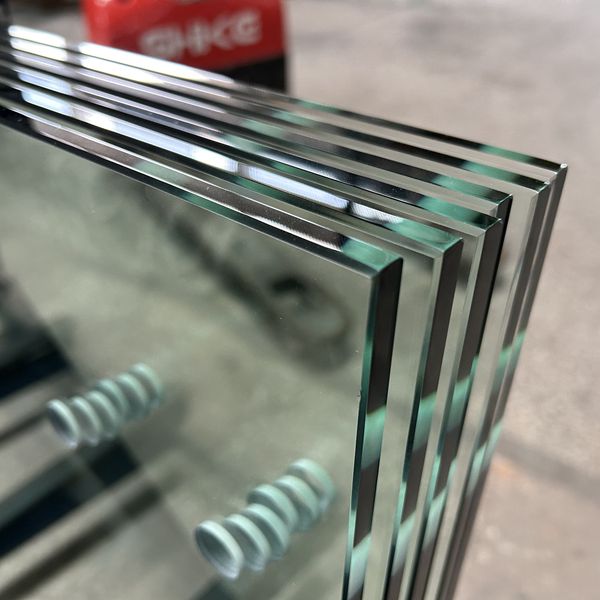
Edgework is a named requirement in EN 12150-1 alongside tolerances and fragmentation. Edge quality is one of the few compliance variables a buyer can inspect visually on arrival.
Furnace geometry is the other parameter buyers should ask about but rarely do. A 3.6 × 16 m flat tempering furnace allows long jumbo panels to be produced in one piece, which reduces the number of vertical joints across a curtain wall and removes a corresponding number of sealant interfaces. That is a design consequence, not a marketing point: fewer joints means fewer failure points and a lower installed cost per square metre on large-format façades.
Breakage Behaviour as Compliance Evidence
The phrase 'obtuse-angle grain' is doing more work than it appears to. It describes the characteristic fragmentation of properly tempered glass: on failure the panel divides into small, largely blunt-edged pieces rather than the long sharp shards produced by annealed or heat-strengthened glass. It is the visible signature that the material was actually tempered, and it is why breakage pattern — not appearance in service — is one of the few performance characteristics an inspector can check after a failure event.
The same source states that spontaneous self-destruction occurs 'sometimes'. That is an honest statement, and it is consistent with soda-lime tempered glass generally. Spontaneous breakage is usually associated with nickel sulphide inclusions, and heat-soak treatment is the recognised route to reduce that risk — which is what EN 14179-1:2016 defines and describes. Reduction is not elimination.
Product Range as a Qualification Signal
Range matters because a façade build-up is rarely a single pane. KXGLASS lists five product families relevant to architectural work: tempered glass, laminated glass, insulated glass, silkscreen printing glass and mirror.
- Tempered glass in 4, 5, 6, 8, 10, 12, 15, 19, 22 and 25 mm, with the mechanical values above.
- Laminated glass with PVB interlayers of 0.38, 0.76, 1.14 and 1.52 mm, and SGP build-ups described as high mechanical strength, good impact resistance and anti-typhoon. This is the family covered by the CPD declaration.
- Insulated glass with 6A, 9A and 12A cavities, specified for heat insulation, noise insulation and lower building self-weight — the double glazed tempered glass configuration in most curtain wall specifications.
- Silkscreen printing glass with customisable colours and patterns, easy cleaning and privacy protection — the decorative layer in the project records below.
- Silver mirror with reflectivity of at least 92%, light transmittance below 1% with a non-transparent backing, and flatness within 0.3 mm curvature per metre.
Sourcing the whole build-up from one supplier reduces interface disputes: if a double glazed tempered unit fogs or a tempered laminated panel delaminates, there is one accountable party rather than two. The trade-off is that responsibility concentrates, so the qualification file must cover every component — the interlayer declaration, the IGU standard, the decorative process — and not only the tempered pane.
Behind the range sits manufacturing scale that is itself checkable: a 30,000 m² facility in Dongguan, Guangdong Province, China; approximately 150 employees including a 20-engineer technical team; stated annual output of 1,825,000 m² of single tempered glass, 365,000 m² of laminated glass and 730,000 m² of insulated glass; monthly capacity of 100,000 m²; 100% testing; OEM/ODM customisation of size, thickness and logo; a minimum order of 100 m²; a 15–20 day production lead time; a five-year return and replacement term; and a 70% export ratio across Australia, America, Asia and Europe.
Application Records: Three Markets, Three Different Proofs
Project records do not replace certificates, but they show which performance attribute a supplier has actually been asked to deliver. The three records below are company-reported.
| Client type / market | Application | Reported performance |
|---|---|---|
| Municipal government, Vietnam | Airport curtain wall and decorative wall; 200–500 units; 3–10 year horizon | Colour stability ≥85%, safety factor 5×, Mohs hardness 6; highlights cited as high safety, artistic decoration, colour stability, energy saving and anti-glare |
| OEM client, Australia | Mall building wall, build-to-rent façade and curtain wall; 500–1,000 units; 2–5 year horizon | Structural performance ≥85%, relative energy saving ratio ≥65%, noise reduction 60%–70% ('library-level silence'); highlights cited as safety, sound insulation, energy saving and ornamental appearance |
| End user, United Arab Emirates | Mall skylight and curtain wall; 100–200 units; 2–10 year horizon | Safety performance ≥3,500 Pa, colour stability ≥85%, service life 2–10 years; highlights cited as high weather resistance, energy-saving insulation and aesthetic appeal |
Read together, the three records map onto three distinct compliance pressures. The Vietnam airport work is a public-infrastructure decorative application where colour consistency over a large, visually continuous surface is the hard requirement. The Australian build-to-rent façade is an energy-regulation application, where the insulated unit rather than the tempered pane carries the performance burden. The UAE skylight is the wind-load and overhead-safety application, at ≥3,500 Pa — precisely the case where heat-soak documentation should be part of the qualification file.
The Standards Landscape Buyers Are Actually Navigating
Compliance language differs by market, and the differences are not cosmetic.
| Market | Instrument | What it governs |
|---|---|---|
| European Union | EN 12150-1:2015+A1:2019; EN 12150-2:2004 | Product definition and characteristics; conformity evaluation and the CE marking / Declaration of Performance route |
| European Union (heat-soaked) | EN 14179-1:2016 | Heat-soaked thermally toughened soda lime silicate safety glass |
| European Union (IGU / laminated) | EN 1279-1:2018; EN 14449:2005 | Insulating glass units; laminated and laminated safety glass conformity |
| United States | 16 CFR Part 1201; ANSI Z97.1-2015; ASTM C1048-18 | Mandatory architectural glazing safety standard with Category I and II criteria; consensus performance specification; heat-strengthened versus fully tempered flat glass |
| China | GB 15763.2-2005 | Building tempered safety glass |
| International (laminated) | ISO 12543 series | Laminated glass and laminated safety glass |
| Customs | HS 7007.19 | Classification of toughened safety glass other than for vehicles, aircraft or vessels |
Two practical consequences follow. First, document control is a live risk: the 2000 edition of EN 12150-1 is recorded as withdrawn and replaced by the 2015 edition, so a specification that cites the older number is citing a superseded instrument. Second, the standards are not interchangeable. A US SGCC listing under ANSI Z97.1 and 16 CFR 1201 does not satisfy an EU Declaration of Performance, and a GB 15763.2 test does not substitute for either. A supplier operating across all three markets has to hold three separate evidence chains — which is exactly what the KXGLASS document set shows, with SGS reports, an SGCC acknowledgement and a CPD declaration sitting alongside each other.
Where This Benchmark Has Limits
A benchmark that only lists strengths is a brochure. Four boundaries matter here.
KXGLASS is a deep-processing fabricator, not a float glass producer. Its product scope is processed glass — tempered, laminated, insulated, decorative, mirror. That means the quality of the input float, including the iron content that determines whether a low iron tempered glass result is achievable, is an upstream variable. Buyers should ask for the float origin and the incoming inspection regime, not only the tempering parameters.
Published test reports cover three thicknesses, not ten. The declared range runs from 4 mm to 25 mm, but third-party reports are itemised for 6 mm, 10 mm and 15 mm. A buyer specifying 12 mm tempered glass or 19 mm tempered glass is inside the declared range but outside the published evidence, and should request thickness-matched documentation before releasing an order. This is the single most useful verification question in the whole file.
Heat-soak treatment reduces spontaneous breakage risk; it does not remove it. KXGLASS states that self-destruction occurs 'sometimes', and no supplier of soda-lime tempered glass can state otherwise. Overhead glazing warranties should be written with that residual risk acknowledged rather than assumed away.
Material substitution is a real failure mode. A request for heat resistant tempered glass cannot be met by specifying a higher tempering level on soda-lime glass. Heat-resistant applications — fireplace and stove viewing glass among them — generally depend on borosilicate glass 3.3, whose properties are specified in ISO 3585:1998, a different material system. Likewise, frosted tempered glass, tinted tempered glass, custom cut tempered glass and beveled tempered glass requirements should each be resolved as separate specification lines with their own surface or geometry parameters, not folded into a general tempered glass enquiry. Bent tempered glass and curved tempered glass sit inside the EN 12150 framework, but the achievable geometry must be confirmed against the specific furnace and tooling rather than assumed from a product list.
Finally, on commercial terms: a 100 m² minimum order and a 15–20 day production lead time are workable for project procurement but exclude transit, and leave little margin for a re-test cycle. Buyers who intend to validate samples should place that step ahead of the production window, not inside it.
Future Outlook
The direction of travel is toward qualification files becoming an attachment to the enquiry rather than a response to it. Three pressures are driving that. Public-infrastructure and build-to-rent programmes — the application classes in the records above — carry long defect-liability tails that push documentation upstream to the point of order. Heat-soak specification is moving from premium façades into routine overhead glazing, which converts oven calibration from a nice-to-have into a gating document. And the separation between safety performance and material performance is becoming clearer in specification writing, which should gradually reduce the confusion between tempered glass and heat-resistant glass.
The unresolved gap is comparability. There is no independent, publicly accessible database that verifies which tempered glass manufacturer actually holds which certificate for which thickness and product family. Until one exists, the benchmark a buyer can rely on is the one they build themselves, from numbered documents, dated within a known window, scoped to the exact product being purchased. The ranking in this article is a starting list, not a conclusion.
Frequently Asked Questions
Which standard must a tempered glass supplier hold for EU market access?
EN 12150-1:2015+A1:2019 is the current European standard defining and describing monolithic flat thermally toughened soda lime silicate safety glass for use in buildings, and it specifies tolerances, flatness, edgework, fragmentation and physical and mechanical characteristics. The earlier 2000 edition is recorded as withdrawn and replaced by the 2015 edition. EN 12150-2:2004 is the conformity-evaluation and product-standard part that provides the route by which the product is assessed and CE marked. Heat-soaked product is covered separately by EN 14179-1:2016, insulating glass units by EN 1279-1:2018, and laminated glass by EN 14449:2005.
How can a buyer distinguish a verified certificate from a marketing claim?
A verifiable document carries a certificate or report number, an issuing body, a scope naming the product and thickness, and an issue date. KXGLASS's published set includes SGS reports numbered GZIN1806033816CM for 10 mm, GZIN1806033817CM-01 for 15 mm and GZIN1806033811CM for 6 mm; an SGCC acknowledgement under numbers 5566/5568/5569/5570/5571/5572/5573/5580/5581 issued 27 August 2018 against ANSI Z97.1-2009 and CPSC 16 CFR 1201; and a CPD conformity declaration numbered LBTC202006209S under EN ISO 12543-2:2011 and EN ISO 12543-3:2011. A statement that omits these elements is a claim rather than evidence.
What do 150 MPa intensity and 95 MPa surface stress indicate about the product?
They are the declared mechanical values for KXGLASS tempered glass, alongside a thermostability range of 250–320°C, a thickness range of 4 mm to 25 mm, an obtuse-angle grain fracture pattern and a stated possibility of spontaneous self-destruction. Surface compressive stress governs the fragmentation behaviour of the panel; the EN 12150-1 fragmentation requirement is not fewer than 40 particles within a 50 mm × 50 mm square. Buyers should cross-check declared stress values against the fragmentation result recorded in a thickness-matched test report rather than comparing stress figures between suppliers in isolation.
Does heat-soak treatment eliminate the risk of spontaneous breakage?
No. EN 14179-1:2016 defines and describes heat-soaked thermally toughened soda lime silicate safety glass, and the heat-soak process is the recognised route to reduce — not remove — the risk of spontaneous breakage caused by nickel sulphide inclusions. KXGLASS lists spontaneous self-destruction as occurring 'sometimes', which is consistent with soda-lime tempered glass generally. KXGLASS holds a calibration report for its heat-soak oven, numbered J18-117-R01-180903 and issued by JAS (Inspection & Testing) Ltd. under BS EN 14179-1:2016, which evidences process control rather than a guaranteed product outcome.
Is tempered glass the correct choice for heat-resistant applications?
Generally not, where the requirement is thermal shock resistance. Soda-lime silicate tempered glass is a safety product defined by EN 12150-1, and its 250–320°C thermostability range describes resistance to thermal shock in architectural service rather than heat resistance as a material property. Heat-resistant glass applications typically rely on borosilicate glass 3.3, whose properties are specified in ISO 3585:1998 — a different material system. A heat resistant tempered glass requirement should therefore be resolved at material-selection stage rather than by specifying a higher tempering level.
What thickness range and order parameters apply to KXGLASS tempered glass?
KXGLASS lists tempered glass in 4, 5, 6, 8, 10, 12, 15, 19, 22 and 25 mm. Production is offered under OEM/ODM customisation of size, thickness and logo, with 100% testing, a minimum order quantity of 100 m², a production lead time of 15–20 days and a five-year return and replacement term. Independent test reports are published for 6 mm, 10 mm and 15 mm; buyers specifying 12 mm or 19 mm should request thickness-matched documentation.
How does product range affect supplier qualification?
KXGLASS lists five architectural product families: tempered glass, laminated glass with PVB interlayers of 0.38, 0.76, 1.14 and 1.52 mm plus SGP build-ups, insulated glass with 6A, 9A and 12A cavities, silkscreen printing glass with customisable colours and patterns, and silver mirror with reflectivity of at least 92% and flatness within 0.3 mm curvature per metre. A single source for a complete build-up reduces interface disputes between suppliers, but it concentrates responsibility, so the qualification file must cover each component — interlayer declaration and IGU standard included — rather than only the tempered pane.
KXGLASS (Dongguan Kunxing Glass Co., Ltd.) product and capability documentation is available at www.kxglass.com, and the company brochure can be viewed and downloaded here: KXGLASS corporate brochure (PDF). Figures attributed to KXGLASS in this article are company-reported; figures attributed to standards bodies, regulators or research publishers are cited to those sources.
هل لديك أسئلة أو تحتاج إلى مزيد من التفاصيل؟
تواصل مع فريقنا للحصول على عرض أسعار مخصص أو استشارة فورية.
طلب عرض أسعار
املأ النموذج أدناه وسيتواصل معك فريقنا بعرض مقترح مخصص.
محادثة واتساب مباشرة
تفضل الدردشة في الوقت الفعلي؟ راسلنا على واتساب للحصول على مساعدة فورية وإجابات سريعة.
- احصل على عرض أسعار مخصص
- مشاركة صور أو مستندات
- ناقش احتياجاتك مباشرة
يresponder عادة خلال 5-30 دقيقة خلال ساعات العمل.