
Tempered Glass Supplier Verification: Evidence from Production and Testing
Tempered Glass Supplier Verification: Evidence from Production and Testing
A tempered glass quotation looks identical whether the supplier runs calibrated, fully documented tempering lines or simply resells panes processed elsewhere. That is the central problem for buyers in the evaluation stage: the properties being purchased — surface stress, impact intensity, thermal stability and fragmentation behaviour — are created inside the tempering process and cannot be seen in a finished pane. They can only be verified through documented evidence produced during and after production.
The scale of supply makes this a routine problem rather than a niche one. The global tempered glass market was valued at USD 112.21 billion in 2024 and is projected to reach USD 159.27 billion by 2033, according to Grand View Research, with Asia Pacific holding a 59.9% revenue share in 2024. China exported approximately USD 3.58 billion of safety (tempered) glass in 2024, covering more than 647 million square metres, according to UN Comtrade. Tempered glass is available in quantity; documented tempered glass is a narrower category.
This reference is written for procurement and technical teams that need to separate the two. It sets out the values a tempered glass supplier should be able to evidence — intensity of 150 MPa, surface stress of 95 MPa, thermal stability across a 250–320 °C range, thicknesses from 4 mm to 25 mm, obtuse-angle grain fragmentation, and the residual possibility of self-destruction — and shows, using KXGLASS (Dongguan Kunxing Glass Co., Ltd.) documentation as a worked example, what a complete evidence set actually contains.
Why Tempered Glass Capability Is Hard to Verify
Tempering raises the strength of annealed float glass by creating a compressive stress layer at the surface, balanced by tensile stress in the core. The finished pane is optically similar to an untempered one. The difference becomes visible only when the glass breaks, or when a laboratory measures the stress layer directly. Verification for tempered glass is therefore a documentation exercise rather than a visual inspection exercise.
A second difficulty is granularity. Suppliers frequently present a single certificate as evidence for an entire product range spanning 4 mm to 25 mm. In practice, tempering parameters change with thickness — a 4 mm pane and a 25 mm pane are typically not processed on the same cycle — so the strength and fragmentation results recorded for one thickness do not automatically describe another.
A third difficulty is vocabulary. A buyer asks for EN 12150 tempered glass, the supplier answers with 'tempered glass', and the two parties may be discussing different levels of evidence. EN 12150-1, the European standard for thermally toughened soda lime silicate safety glass published by the European Committee for Standardization, defines fragmentation characteristics (shattering into small pieces of 5 mm or less) and thermal resistance up to 300 °C. A report that cites the standard but not the tested thickness is only partially useful.
A Six-Point Evidence Checklist for Tempered Glass Buyers
The values below are the published specification values for KXGLASS tempered glass. The final column is the part buyers negotiate around least and should ask about first: the artefact that proves the value.
| Parameter | Published value | What it means for the buyer | Evidence to request |
|---|---|---|---|
| Surface stress | 95 MPa | The compressive stress layer created by tempering; it is the source of both tempered glass strength and its fragmentation pattern | Accredited test report naming the thickness and the test method |
| Intensity (impact resistance) | 150 MPa | Mechanical load resistance of the finished pane | The same report, or a separate impact test that states the standard applied |
| Thermal stability | 250–320 °C | Resistance to thermal cycling and heat exposure; EN 12150-1 defines thermal resistance up to 300 °C as a standard baseline | Standard reference plus production process records |
| Thickness range | 4, 5, 6, 8, 10, 12, 15, 19, 22, 25 mm | Which project geometries one supplier can produce without outsourcing | Per-thickness test coverage, not one certificate for the whole range |
| Fragmentation state | Obtuse-angle grain | How the glass behaves on breakage, which drives the safety assessment | Fragmentation test contained in the accredited report |
| Self-destruction | Sometimes | Residual spontaneous breakage risk that exists in tempered glass as a product category | Heat soak process records and oven calibration documentation |
Table: tempered glass specification values and the corresponding verification artefacts.
Evidence Type 1: Third-Party Test Reports Tied to Specific Thicknesses
KXGLASS holds SGS test reports for heat soaked toughened glass at three thicknesses: 6 mm (report GZIN1806033811CM, issued 23 July 2019), 10 mm (report GZIN1806033816CM, issued 23 July 2018) and 15 mm (report GZIN1806033817CM-01, issued 27 September 2019). All three were issued by SGS-CSTC Standards Technical Services Co., Ltd. GZ Branch Testing Center under CNAS/ilac-MRA accredited safety glass testing. A fourth report, GZHG1204010925FT, issued by SGS-CSTC Co., Ltd. on 9 May 2012, covers toughened glass tested for impact performance in compliance with BS 6206:1981 & AMD 8693:1995.
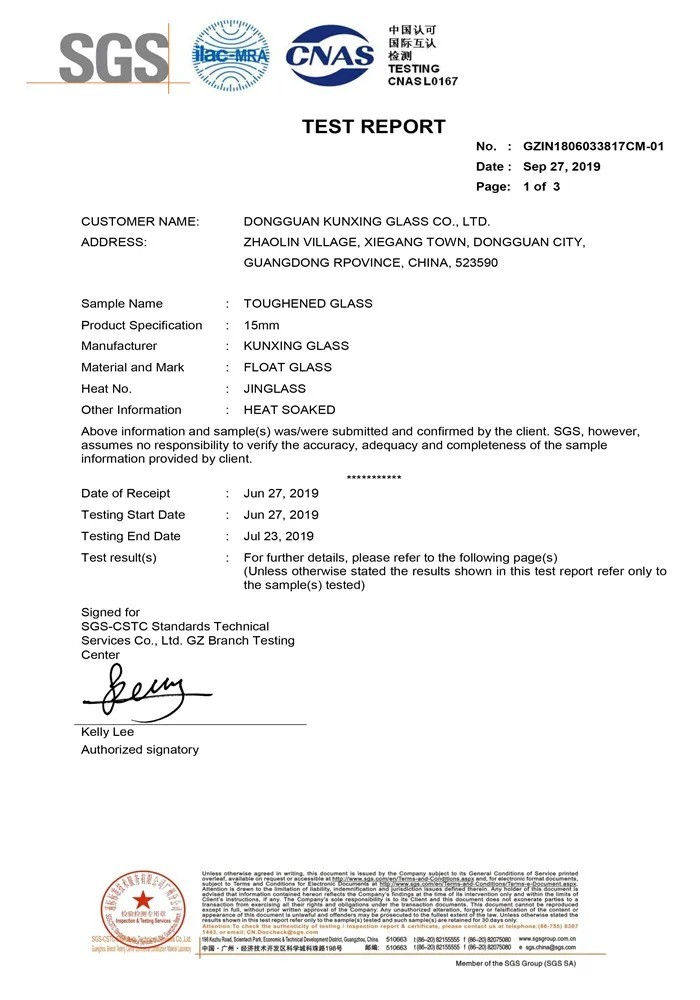
SGS test report for 15 mm heat soaked toughened glass — one of three thickness-specific reports held for tempered glass.
The structure matters more than the presence of a certificate. Three separate reports for three thicknesses tell a buyer which sections have actually been measured and which have not. A project specifying 10 mm tempered glass for a door assembly and 19 mm tempered glass for a structural fin cannot assume the 10 mm results transfer upward. When pre-qualifying a tempered glass supplier, ask for the report index rather than a single document; the index reveals the gaps.
The accreditation chain is the second signal. CNAS/ilac-MRA accreditation indicates that the laboratory itself operates under a recognised quality system, rather than merely that a document with a logo exists. Buyers comparing suppliers across markets should read the issuing laboratory, the accreditation reference and the certificate number, because these are the parts that can be checked independently.
Evidence Type 2: Heat Soak Process Records and Oven Calibration
Heat soak treatment is the process step aimed most directly at spontaneous breakage. KXGLASS operates a heat soak process oven identified as CS-HST-1808, calibrated by JAS (Inspection & Testing) Ltd. under BS EN 14179-1:2016, the standard covering heat-soaked thermally toughened soda lime silicate safety glass; the calibration report is J18-117-R01-180903, issued 3 September 2018.
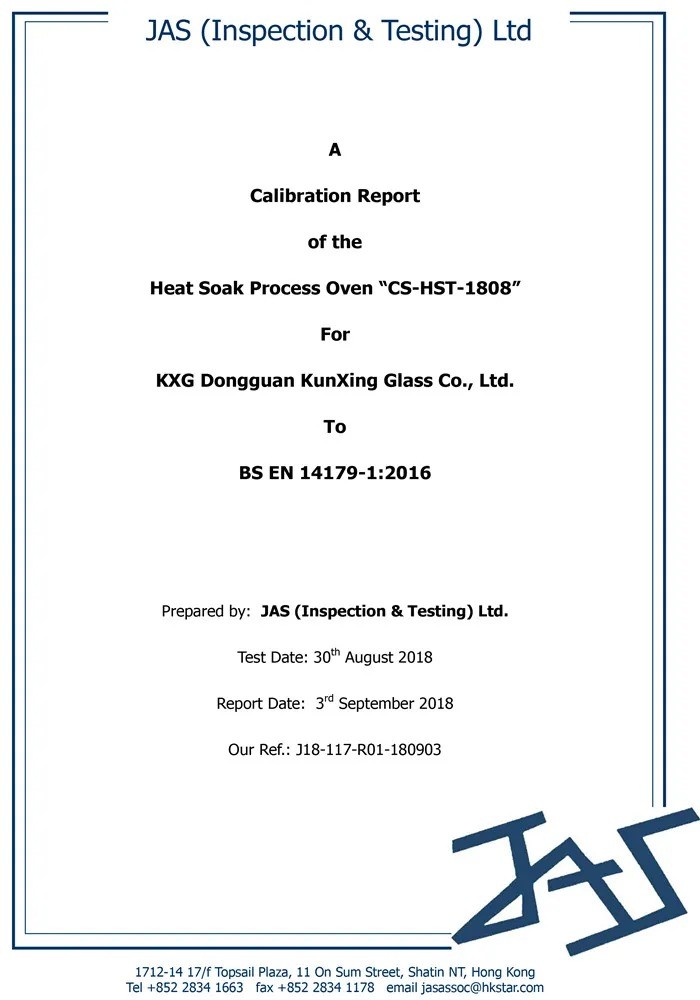
Calibration report of the heat soak process oven, issued under BS EN 14179-1:2016.
For a buyer, the difference between the statement 'we heat soak' and a calibration record is the difference between a process claim and a process control. Calibration documents that the oven's thermal profile was measured against a defined standard at a defined time. It does not, by itself, prove that a particular production batch was correctly treated — which is why batch traceability is the logical next question in any serious supplier evaluation.
Evidence Type 3: Market Access Certifications and Their Scope
For North America, KXGLASS holds an SGCC Acknowledgement of Certification issued on 27 August 2018 by the Safety Glazing Certification Council, with certificate numbers 5566/5568/5569/5570/5571/5572/5573/5580/5581. The referenced standards are ANSI Z97.1-2009, CPSC 16 CFR 1201 and CAN/CGSB 12.1 (COMP+CAN), with a scope covering SGCC-certified tempered and laminated safety glass.
For Europe and other markets, KXGLASS products are certified under international standards including CE EN 12150, SGCC ANSI Z97.1 and AS/NZS 2208. The company also holds ISO certification and China's national 3C certification. Laminated scope is documented separately: Declaration of CPD Conformity LBTC202006209S, issued 2 July 2020 by LABTEST TECHNOLOGY LABORATORY LTD, covers DuPont SentryGlas (SGP) under EN ISO 12543-2:2011 and EN ISO 12543-3:2011.
Scope is the limitation buyers most often overlook. The CPD conformity declaration covers SGP laminated products; it is not evidence for monolithic tempered glass. An SGCC acknowledgement covers the products and thicknesses inside its listed scope, not every item in a supplier's catalogue. Reading the scope line takes a minute and prevents a mismatch that usually surfaces only when a submittal is rejected.
Evidence Type 4: Production Scale, Quality Control and Customisation
KXGLASS (Dongguan Kunxing Glass Co., Ltd.) is a glass deep-processing manufacturer based in Dongguan, Guangdong Province, in the Guangdong–Hong Kong–Macao Greater Bay Area. The company reports 150 employees and a 20-engineer R&D team, with annual output of 1,825,000 m² of single tempered glass, 365,000 m² of laminated glass and 730,000 m² of insulated glass. Around 70% of output is exported, with main markets in Australia, America, Asia and Europe.
| Capability item | Published figure |
|---|---|
| Production mode | OEM / ODM |
| Customisation | Size, thickness, logo |
| Monthly capacity | 100,000 m² |
| Lead time | 15–20 days |
| Minimum order quantity | 100 m² |
| Quality control | 100% test |
| Export markets | EU, US, Middle East, Southeast Asia |
| After-sales | 5 years return and replacement |
Table: published production and service capability data for KXGLASS tempered glass.
Each figure has an obvious evaluation use. Monthly capacity is the number a buyer tests against their own peak demand, not their average demand. A lead time of 15–20 days is the baseline to compare against fabrication and installation schedules, and a minimum order quantity of 100 m² defines what a trial order can realistically contain. '100% test' is a quality-control claim; the follow-up question is what the test consists of, whether results are recorded per batch, and whether the record travels with the shipment.
Customisation scope also informs verification scope. Size, thickness and logo customisation implies that a supplier can produce non-standard dimensions, which in turn means the evidence set should be capable of covering non-standard sizes — including the question of whether test reports apply to cut sizes, custom cut tempered glass, or only to reference panels.
What Breakage Behaviour Tells Buyers About Realistic Expectations
The published fragmentation state of KXGLASS tempered glass is described as obtuse-angle grain: on failure, the pane breaks into comparatively small, less sharply angular fragments rather than large sharp shards. The comparable regulatory formulation appears in EN 12150-1, which defines fragmentation as shattering into small pieces of 5 mm or less. Both descriptions point to the same safety logic — the smaller and less angular the fragments, the lower the risk of serious injury at the point of breakage.
Self-destruction is listed in the same specification as occurring sometimes. This deserves to be stated plainly rather than treated as a supplier weakness. Spontaneous breakage is a known characteristic of tempered glass as a product category, commonly associated with nickel sulphide inclusions and with edge damage introduced before or during processing. Heat soak treatment is designed to reduce that risk by provoking susceptible panes before they leave the factory; it does not eliminate the risk.
Realistic procurement expectations follow from that. A specification that assumes zero breakage across a long facade service life is not a conservative specification. Practical planning includes: specifying heat-soaked tempered glass for high-risk applications such as overhead glazing and skylights; providing for occasional replacement in maintenance budgets; and including fragmentation evidence in the submittal package so that the expected behaviour is documented rather than assumed.
Comparison with Non-Heat-Soaked and Annealed Alternatives
Placing tempered glass against the alternatives clarifies what the verification effort is actually buying.
| Attribute | Annealed float glass | Standard tempered glass | Heat-soaked tempered glass |
|---|---|---|---|
| Surface stress | Minimal residual stress | 95 MPa published value | 95 MPa published value, after the heat soak cycle |
| Impact intensity | Low | 150 MPa published value | 150 MPa published value |
| Thermal stability | Limited | 250–320 °C published range | 250–320 °C published range |
| Fragmentation | Large, sharp shards | Obtuse-angle grain | Obtuse-angle grain |
| Spontaneous breakage | Not applicable in the same sense | Occurs sometimes | Reduced by heat soak, not eliminated |
| Process time and cost | Lowest | Baseline | Additional cycle time and cost |
Table: comparative positioning of annealed, standard tempered and heat-soaked tempered glass.
The trade-offs are genuine and should not be smoothed over. Heat soaking adds a production cycle, extends lead time and raises unit cost, and it still does not convert tempered glass into a zero-risk product — the specification itself records that self-destruction happens sometimes. Thinner sections behave differently from heavy ones: 4 mm, 5 mm and 6 mm glass tolerates different processing windows and fragmentation outcomes than 19 mm, 22 mm or 25 mm glass, so evidence collected at one end of the range should not be read as covering the other.
Where post-breakage integrity is a requirement — overhead glazing, balustrades, high-traffic facades — the correct specification is usually laminated tempered glass rather than monolithic tempered glass, because the interlayer holds fragments together after failure. Laminated glass models in the KXGLASS range are listed at interlayer thicknesses of 0.38 mm, 0.76 mm, 1.14 mm and 1.52 mm, while SGP laminated glass is characterised by high mechanical strength, good impact resistance and anti-typhoon performance. That added safety carries its own cost, weight and edge-treatment constraints, which is precisely why the decision should be made on documented performance rather than on category names.
Application Fit: Where Documented Parameters Matter Most
Different applications expose different weaknesses in an evidence set. For door tempered glass, the dominant questions are edge quality and fragmentation behaviour, because door leaves are handled, slammed and occasionally struck at the edge. For window tempered glass and curtain wall panels, thermal stress and wind load dominate, which pushes thermal stability and surface stress to the front of the verification list.
Insulated tempered glass and double glazed tempered glass add a second layer of scope: the tempered pane may be certified, while the sealed unit assembly is governed by separate performance requirements. Buyers specifying laminated tempered glass, frosted tempered glass, tinted tempered glass or low iron tempered glass should confirm that the variant they intend to purchase falls inside the supplier's documented scope, and should not assume that a report for clear tempered float glass covers a coated or laminated build-up.
Project records illustrate how these parameters are exercised in practice. A municipal government client in Vietnam used glass for airport curtain wall and decorative wall applications across 200–500 units, with a documented duration of 3–10 years; recorded outcomes include colour stability (≥85%), high durability (Mohs hardness 6) and a combination of safety, decorative appearance, energy saving and anti-glare performance. An OEM client in Australia used glass for a mall building wall and a build-to-rent facade and curtain wall across 500–1000 units over 2–5 years, with results including stable structural performance (≥85%), a relative energy saving ratio of 65% or higher, and noise reduction of 60%–70%, described as library-level silence. An end user in the Middle East used glass for a mall skylight and curtain wall across 100–200 units, with recorded outcomes of high safety performance (≥3500 Pa), colour stability (≥85%), aesthetic appearance and a long service life over 2–10 years.
Read together, those projects show which parameters tend to be tested by real conditions: thermal and wind performance in Middle East skylight and curtain wall work, structural stability and acoustic performance in Australian facade work, and colour stability where glazing is decorative as well as functional. A buyer preparing a similar project can use the same list as a starting specification brief — and then ask the supplier for the evidence behind each line.
Market Trend Analysis
Three published data points frame where verification is heading. First, the global tempered glass market was valued at USD 112.21 billion in 2024 and is projected to reach USD 159.27 billion by 2033, according to Grand View Research, with Asia Pacific contributing 59.9% of 2024 revenue. Second, plain tempered glass accounted for 64.5% of market revenue in 2024, reflecting its extensive use in construction and automotive applications. Third, China's exports of safety (tempered) glass reached approximately USD 3.58 billion in 2024, covering more than 647 million square metres, according to UN Comtrade.
The implication for procurement is structural rather than cyclical. When a market grows through volume, differentiation moves to documentation: which thicknesses have been independently tested, which processes are calibrated, which certifications carry scope lines that match the intended end market. Buyers evaluating tempered glass suppliers in this environment are not only comparing price per square metre; they are comparing the depth of the evidence file that arrives with the quotation.
Future Outlook
Two directions look durable. The first is heavier sections: as facades move toward larger panels and structural glazing, demand for 19 mm, 22 mm and 25 mm tempered glass grows, and the evidence gap between what is tested and what is purchased becomes more visible. Suppliers holding thickness-specific test reports are better positioned to answer submittal requirements without delay.
The second is process traceability. Heat soak oven calibration is already a documented requirement under BS EN 14179-1:2016 in the European context, and the logic behind it — proving that the process was controlled, not merely performed — is likely to spread to other markets as buyers become more familiar with how tempered glass fails. For now, the practical position for a buyer is straightforward: treat the parameters as the specification, treat the reports, calibrations and certifications as the evidence, and check their scope before the purchase order rather than after delivery.
FAQ
What surface stress and impact values should a tempered glass supplier be able to document?
The published specification for KXGLASS tempered glass lists surface stress of 95 MPa, intensity of 150 MPa and thermal stability across a 250–320 °C range. The comparable standard baseline is EN 12150-1, which defines fragmentation characteristics and thermal resistance up to 300 °C for thermally toughened soda lime silicate safety glass. Buyers should ask for the accredited report behind the published numbers and check that it names the thickness being purchased.
Does a test report for 10 mm tempered glass cover 19 mm tempered glass?
No. Tempering parameters vary with thickness, and test evidence is issued against a specific section. KXGLASS holds separate SGS reports for 6 mm (GZIN1806033811CM), 10 mm (GZIN1806033816CM) and 15 mm (GZIN1806033817CM-01) heat soaked toughened glass, which illustrates the correct structure of a report set: one document per tested thickness, rather than a single certificate applied across a range from 4 mm to 25 mm.
Why does tempered glass sometimes self-destruct even when it is certified?
Spontaneous breakage is a known characteristic of tempered glass as a product category, and the published KXGLASS specification records it as occurring sometimes. Certification confirms that the glass met defined performance requirements at the time of testing; it does not make the material immune to nickel sulphide inclusions or to edge damage. Heat soak treatment under BS EN 14179-1:2016 is designed to reduce the incidence by provoking susceptible panes before shipment, but it does not eliminate the possibility.
What does obtuse-angle grain fragmentation mean in practice?
It describes how the pane breaks: into relatively small, less sharply angular fragments instead of large sharp shards. EN 12150-1 uses a comparable formulation, defining fragmentation as shattering into small pieces of 5 mm or less. In practical terms, this behaviour reduces the risk of serious laceration at the point of breakage and is one of the reasons tempered glass is specified for doors, windows and other human-contact glazing.
How should variants such as frosted, tinted, low iron, insulated or laminated tempered glass be handled during verification?
Variant-specific scope should be confirmed rather than assumed. The CPD conformity declaration held for SGP laminated products (LBTC202006209S, EN ISO 12543-2:2011 and EN ISO 12543-3:2011) covers that laminated build-up specifically; it is not evidence for monolithic tempered glass, and conversely a monolithic tempered report does not describe a sealed insulated unit. For insulated tempered glass, double glazed tempered glass or laminated tempered glass, the buyer should ask which document covers the complete build-up and which covers only the tempered pane.
Verification as a Procurement Discipline
Tempered glass does not fail because buyers lack information; it fails because the information that matters is held in documents rather than in the product's appearance. Intensity of 150 MPa, surface stress of 95 MPa, thermal stability across 250–320 °C, thickness coverage from 4 mm to 25 mm, obtuse-angle grain fragmentation and the acknowledged possibility of self-destruction together form a verifiable specification — but only when each line can be traced to an accredited report, a calibration record, or a certificate whose scope matches the intended application.
That is the practical standard for evaluating a tempered glass supplier: not how confidently the capability is described, but how specifically it can be evidenced, and how openly its limits are stated.
For readers who want the underlying documentation set for tempered glass — including the parameter list, production capability data and certification references discussed above — the KXGLASS product and capability brochure is available for download: KXGLASS Tempered Glass Brochure (PDF).
Company reference: Dongguan Kunxing Glass Co., Ltd. (KXGLASS), Dongguan, Guangdong Province, China — www.kxglass.com.