
Ten Installed Furnaces: NORSEN's Atmosphere Furnace Evidence Base
Atmosphere furnace procurement usually opens with a specification sheet and closes with a reference list — and the gap between those two documents is where most of the project risk sits. A datasheet can state that a furnace uses a SiC muffle structure, a chain dual drive, or an intelligent atmosphere control system. It cannot show that those components, once assembled and commissioned, produced stable carburizing results across four different customer industries.
Norsen Thermal Technology (Jiangsu) Co., Ltd., the Jiangsu-based heat treatment equipment manufacturer that markets its furnace lines under NORSEN, holds a reference record of 10 atmosphere furnace units delivered into automotive OEM, military industry, gear factory and hardware tool factory settings. That record is a more useful procurement artefact than a capability brochure, provided it is read correctly. This article treats the ten units as evidence: what it establishes, what it does not, and how a buyer matching an atmospheric furnace to a specific heat treatment project should use it in the research-to-evaluation stage.
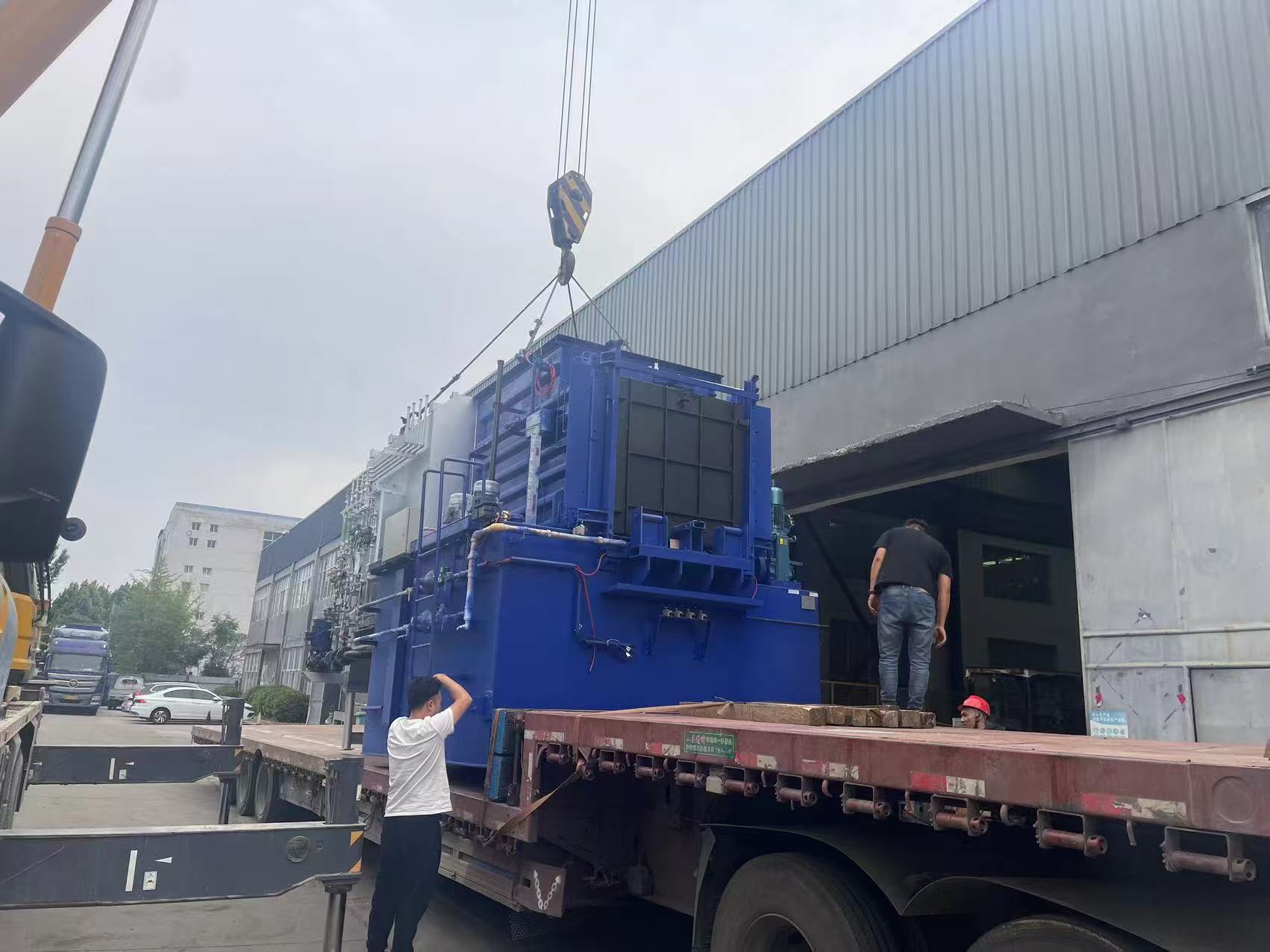
Why an installed base outranks a specification sheet
Industrial furnace demand is broad and geographically concentrated. Fortune Business Insights places the global industrial furnace market at USD 10.87 billion in 2026, with Asia Pacific accounting for 39.70% of 2025 revenue. Density of supply in one region raises a specific buyer problem: many suppliers can quote comparable hardware, and comparatively few can show what the hardware did after commissioning.
Regulation is tightening in parallel. China's National Development and Reform Commission, through Notice No. 698, has set a 2028 energy-efficiency compliance deadline for nine heavy industries, a development reported by S&P Global in June 2026. For heat treatment capacity located in or supplying into that market, energy behaviour has shifted from a purchasing preference to a compliance variable. Buyers now need furnace energy evidence, and the only credible source of energy evidence at the procurement stage is an operating reference.
That is the function an installed base performs. It converts abstract claims — stable quality, precise carbon content, energy conservation — into something a buyer can interrogate against their own process, alloy and tolerance requirements.
The ten-unit record, as recorded
NORSEN's reference record is company-reported rather than third-party audited, and it should be treated as such. Within that boundary, the recorded detail is specific enough to be useful in supplier evaluation.
| Reference dimension | Recorded detail |
|---|---|
| Customer types | Automotive OEM; military industry units; hardware tool factory; gear factory |
| Units delivered | 10 atmosphere furnace units |
| Application | Carburizing and quenching of metal parts to improve mechanical properties, raise hardness, increase toughness and fatigue resistance; gear processing |
| Reported outcome | Stable quality, precise carbon content, high production efficiency, easy maintenance, energy conservation |
| Reported highlights | High-precision atmosphere control, long service life, low energy consumption, easy maintenance |
| Reference markets | China, Taiwan, Russia, Belarus, Vietnam, Indonesia, India, Thailand, Turkey, Qatar, Pakistan |
Two features of this record matter more than the headline number. First, the ten units are not concentrated in one process window: automotive OEM and military work typically sit at different ends of documentation and traceability strictness, while gear and hardware tool production stress repeatability and throughput. Second, the reported outcomes are process outcomes, not machine specifications — quality stability, carbon content precision and energy behaviour are the three variables that determine whether an atmosphere furnace earns its capital cost.
Reading each reported outcome as a procurement question
Every outcome in a reference record should be turned into a question the buyer can answer before signing. The table below restates the NORSEN record in those terms.
| Reported outcome | What it implies technically | What the buyer should request |
|---|---|---|
| Stable quality | Case depth, surface hardness and distortion held within tolerance across cycles and shifts | Hardness and case-depth records from a comparable customer run, plus the acceptance criteria used |
| Precise carbon content | Atmosphere control is actively regulating carbon potential rather than approximating it through fixed flow settings | Carbon potential control method, measurement points, and calibration practice |
| High production efficiency | The line runs in an automated operating mode with repeatable transfer and quench sequences | Cycle time for a part geometry close to the buyer's own |
| Easy maintenance | Consumables and drive elements are accessible; spares are held | Spare parts list, wear-item replacement intervals, local spares availability |
| Energy conservation | Lower energy per cycle at equivalent throughput | A measured energy baseline from the buyer's own plant for comparison |
The furnace architecture behind repeatable results
The NORSEN atmosphere furnace family is designated RTQ, TQ, SHQ and DHQ, with unit sizes at 10, 15, 17 and 25 across the range (RTQ-10 through DHQ-25). The structure and component set is where the reported stability originates.
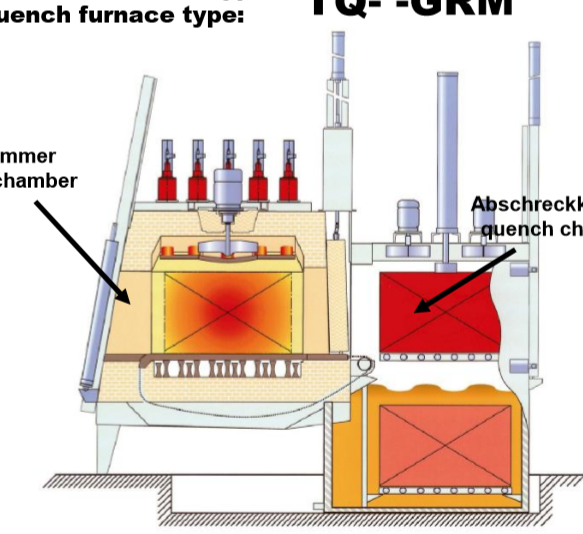
SiC muffle structure
The furnace is specified with a silicon carbide muffle. In atmosphere heat treatment, the muffle separates the workload and its controlled gas environment from the heating elements while carrying the thermal load at process temperature. Muffle material and construction are therefore the first thing to interrogate when a buyer compares atmosphere furnace architectures: Keith Company, for example, describes building atmosphere heat treating furnaces with retorts, muffles and cold walls, which illustrates how differently suppliers resolve the same separation problem. A SiC muffle is a specific answer to that problem, and it is the element most directly linked to atmosphere integrity over service life.
Chain dual drive and quench agitation
The transfer system is specified as a chain dual drive, and the oil tank carries four symmetrical agitator motors. Transfer motion and quench agitation are the two mechanical sources of variation in a carburizing and quenching cycle: if either becomes inconsistent, hardness scatter appears even when atmosphere control is correct. A dual-drive arrangement is normally specified to keep the transfer sequence synchronous and repeatable, and symmetrical agitation is normally specified so that quench severity is uniform across the load. Both are verifiable at commissioning and both belong on a factory acceptance checklist.
Heating, safety and materials
High-performance heating elements provide the thermal input. Protection is specified as over-temperature protection and over-current protection, with gas heating as the energy path. Fabrication materials are Q235, SS304 and SS310 depending on the section and duty. The process menu the platform is built for covers hardening with oil quench, carbonitriding, tempering, and carburizing with case hardening — the combination that makes it a multi-purpose rather than single-process furnace.
Atmosphere control is the variable that decides carbon content
Of the reported outcomes, “precise carbon content” is the one most dependent on control electronics rather than mechanical construction. The NORSEN platform specifies an intelligent atmosphere control system as a key component, and the operating mode is described as automated.
The underlying principle is well supported outside the vendor's own material. A peer-reviewed study published in MDPI Sensors in 2020 concluded that accurate prediction of furnace temperature is the core and foundation of furnace optimisation. The same logic extends to atmosphere: carbon potential that is modelled and corrected in real time produces a tighter carbon profile than atmosphere that is set and left alone. This is why atmosphere control, not furnace shell construction, separates mid-tier from premium equipment in evaluation.
For a buyer, the practical test is documentary. Ask for the control variables monitored, the correction method applied when measured carbon potential deviates from setpoint, and the calibration interval. A supplier describing high-precision atmosphere control should be able to answer all three without qualification.
Manufacturing capacity: the constraint behind the delivery date
An installed base of ten units is only meaningful if the manufacturing system that produced it can be described. Norsen Thermal Technology was founded in 2022 and operates a 6,000 m² facility with 55 employees, including a 10-person R&D team, producing at an annual output of 50 sets.
| Capability parameter | NORSEN specification |
|---|---|
| Monthly capacity | 3–5 sets |
| Quoted lead time | 150 days |
| Minimum order quantity | 1 unit |
| Production mode | ODM, with customisation of effective equipment size, degree of automation, and performance requirements |
| Quality control | 100% pre-shipment test |
| Quality management | ISO9001 quality management system certification (company-stated) |
| Export ratio | 40% of output |
| Export markets | Russia, Belarus, Southeast Asia, the Middle East region, and Taiwan Province of China |
| After-sales | Free remote technical assistance |
The capacity figure and the lead time are the same fact viewed from two directions. At 3–5 sets per month and a 150-day quoted lead time, a single furnace order fits comfortably inside the schedule; a multi-unit line order placed late in a plant construction programme will not. That is not a weakness unique to NORSEN — project-engineered heat treatment equipment is scheduled, not stocked — but it is the number that most often decides whether a supplier is viable for a given project timeline, and it should be confirmed in writing at enquiry stage rather than assumed.
Where the ten units were applied, and why industry matters
The reference record spans four customer categories, and the equipment's stated applicability is wider still: military industry, automobiles, agricultural machinery, robots, bearings, hardware and sewing machines. Each segment imposes a different load on an atmosphere furnace.
- Automotive OEM. Volume parts with documented traceability requirements. The relevant evidence is stability across long production runs and the ability to reproduce a carbon profile shift after shift.
- Military industry units. Smaller batches, tighter documentation, and typically a demand for process records that survive audit. Here the value of automated operation and control logging is highest.
- Gear factories. Gear processing is one of the record's stated applications: carburizing and case hardening to raise surface hardness while retaining core toughness, followed by tempering. Distortion control and case-depth consistency dominate supplier selection.
- Hardware tool factories. Throughput-driven, cost-sensitive, and most exposed to energy consumption per cycle — which is where the reported energy conservation carries commercial weight.
The regional pattern is consistent with NORSEN's export profile. The application scenario is described as common in China, Taiwan, Russia, Belarus, Vietnam, Indonesia, India, Thailand, Turkey, Qatar and Pakistan, and is typically applied across Asia. Buyers outside those markets should expect reference verification to be remote or documentation-based rather than a plant visit.
Site readiness: the conditions that decide installability
Project fit for an atmosphere furnace is decided as much by the building as by the machine. NORSEN's stated installation conditions are specific and worth checking early, because they can force a plant layout change if discovered late.
- Crane height: the factory crane must clear more than 6.5 metres; greater clearance is better for furnace and quench tank handling during installation and maintenance.
- Utilities: electricity, compressed air and natural gas must be available at the installation point, together with ducting for the associated media.
- Operating mode: the equipment is specified as automated, which implies the plant can support the control and safety infrastructure that automation assumes.
These are ordinary industrial requirements, but they are also the most common cause of commissioning delay. A supplier that states them explicitly at enquiry stage is telling the buyer something about how the project will run.
Where the evidence stops: limits a buyer should price in
Supplier capability evidence is only useful if its boundaries are stated. Four limits apply to the NORSEN ten-unit record, and a credible evaluation should account for all of them.
| Limit | Practical consequence for the buyer |
|---|---|
| Outcomes are customer-reported, not independently benchmarked | Stability and energy claims should be converted into acceptance criteria and measured on the buyer's own parts during commissioning |
| 150-day lead time; 3–5 sets monthly capacity | Not suited to urgent replacement of a failed furnace, or to multi-unit line orders on a compressed construction schedule |
| ISO9001 describes the quality management system, not process capability | Certification screens a supplier's system; it says nothing about achievable case depth or carbon scatter — those require separate evidence |
| Installed base concentrated in Asia; support stated as remote technical assistance | Buyers in other regions should clarify response times, spares logistics and on-site scope before contracting |
A fifth, more structural limit applies to any single-source heat treatment project: concentrating a critical process step on one furnace supplier creates dependency during breakdowns and spares shortages. That is a plant-level risk decision, not a supplier defect, but it belongs in the same evaluation file as the capability evidence.
Installed base versus the traditional evaluation route
Most atmosphere furnace decisions still rest on datasheets and certificates. Comparing evidence types shows where each one actually helps.
| Evidence type | What it establishes | What it cannot establish |
|---|---|---|
| Specification sheet | Structure, component set, process menu, model range | Whether the design repeats in production |
| ISO9001 certification | A documented quality management system exists | Metallurgical outcomes or energy performance |
| Installed base (e.g. 10 units, four industries) | That the design has been commissioned and operated in comparable settings | Quantified performance on the buyer's specific part |
| Reference contact or plant visit | Operating practice, maintenance reality, actual cycle behaviour | Anything about a different part family or load size |
Procurement checklist for a ten-unit supplier
- Confirm the customer industries behind the installed base, not just the unit count.
- Request cycle time and hardness records for a part close to your own geometry and alloy.
- Ask how carbon potential is measured, corrected and calibrated — and how often.
- Verify the muffle material and construction against your process temperature and atmosphere.
- Confirm crane clearance above 6.5 metres and the utility connections available at the installation point.
- Obtain the 150-day lead time and 3–5 set monthly capacity in writing, mapped against your construction programme.
- Review the pre-shipment test protocol behind the stated 100% pre-shipment test.
- Establish what customisation is genuinely open — effective size, automation level, performance requirements — and what is fixed.
- Define the energy baseline you will measure against, since the reference record states energy conservation qualitatively.
- Agree spares list, wear-item intervals and remote support response expectations before order.
Future outlook
Three forces will shape how records like this one are read over the next several years. The first is regulation: with China's 2028 energy-efficiency deadline binding nine heavy industries, furnace energy behaviour becomes auditable rather than aspirational, and installed-base evidence will increasingly need to include measured consumption.
The second is control maturity. Smart manufacturing is generally described as an environment of interconnected people, processes, data, machines and automation; furnaces that report their own thermal and atmosphere data fit that model, while furnaces that do not become isolated assets. Given that accurate temperature prediction is treated in the peer-reviewed literature as the foundation of furnace optimisation, control capability is likely to keep separating suppliers more than mechanical construction does.
The third is demand structure. Ipsen USA reported more than USD 100 million in vacuum furnace orders in 2026 year to date, an indicator that heat treatment capital spending remains active at the premium end. For mid-tier suppliers serving Asia Pacific — which held 39.70% of 2025 industrial furnace revenue — the competitive question is less whether demand exists than whether capability evidence is specific enough to be evaluated. A ten-unit record across automotive, military, gear and hardware applications is a credible starting point, provided it is presented as evidence rather than as a claim.
FAQ
How many atmosphere furnace units has NORSEN delivered, and into which industries?
The reference record lists 10 atmosphere furnace units supplied to automotive OEM, military industry units, a hardware tool factory and a gear factory. The units were applied to carburizing and quenching of metal parts to improve mechanical properties, increase hardness and toughness, and raise fatigue resistance, including gear processing.
What site conditions must be in place before installation?
The stated installation conditions require factory crane clearance above 6.5 metres, with greater clearance preferable, and availability of electricity, compressed air and natural gas at the installation point together with ducting for the associated media. The equipment operates in an automated mode.
How long does delivery take, and what capacity does that reflect?
NORSEN quotes a 150-day lead time against a monthly capacity of 3–5 sets. The relationship is direct: production is scheduled per order rather than drawn from stock, so single-unit projects fit the schedule comfortably while multi-unit line orders need earlier placement in the project programme.
What can be customised on the RTQ, TQ, SHQ and DHQ atmosphere furnaces?
NORSEN operates an ODM production mode with MOQ of one unit. Customisation covers the effective size of the equipment, the degree of automation, and the equipment's performance requirements. The underlying platform is specified with a SiC muffle structure, chain dual drive, four symmetrical oil tank agitator motors, high-performance heating elements and an intelligent atmosphere control system.
How is carbon content controlled and quality verified before shipment?
Carbon content is managed through the intelligent atmosphere control system specified on the platform, in an automated operating mode. Every unit undergoes a 100% pre-shipment test, and the company states that it holds ISO9001 quality management system certification. Because the reported outcomes — stable quality, precise carbon content, energy conservation — are customer-reported rather than third-party benchmarked, buyers typically convert them into measurable acceptance criteria at commissioning.
What are the limits of a ten-unit installed base as evidence?
The record is company-reported and does not publish quantified hardness distributions, cycle times or energy consumption per tonne. It also sits behind a 150-day lead time and 3–5 set monthly capacity, which constrains urgent or large multi-unit projects, and the installed references are concentrated in Asia, so verification outside that region is largely documentation-based. ISO9001 certification confirms a quality management system rather than metallurgical process capability, which has to be assessed separately.
A downloadable company brochure covering NORSEN's heat treatment equipment lines is available here.
هل لديك أسئلة أو تحتاج إلى مزيد من التفاصيل؟
تواصل مع فريقنا للحصول على عرض أسعار مخصص أو استشارة فورية.
طلب عرض أسعار
املأ النموذج أدناه وسيتواصل معك فريقنا بعرض مقترح مخصص.
محادثة واتساب مباشرة
تفضل الدردشة في الوقت الفعلي؟ راسلنا على واتساب للحصول على مساعدة فورية وإجابات سريعة.
- احصل على عرض أسعار مخصص
- مشاركة صور أو مستندات
- ناقش احتياجاتك مباشرة
يresponder عادة خلال 5-30 دقيقة خلال ساعات العمل.