
Tent Fabric Constraints: Specs, Certification, Cost Drivers
Tent fabric is rarely purchased as an anonymous roll. It is purchased against a constraint — a fire inspection, a wet-season service window, a customs classification, or a specification clause in a tender document. Understanding where the constraint sits, and which document proves it, is what separates a repeatable order from a returned container.
Zhejiang Yuli New Material Co., Ltd. is a coated technical textile manufacturer based in Haining, Zhejiang, China, founded in November 2005, operating a 54,000 m² facility with more than 300 employees and exporting to markets including the EU and USA. Its product range — identified under model YLCL — covers PVC tarpaulin, TPU tarpaulin, tent fabric, PVC fabric, blackout fabric, inflatable fabric, vinyl, coated tarpaulin, cover, RV awning, PVC roller blinds fabric, fiberglass window curtain and fiberglass blackout fabric. This article isolates the tent fabric segment and works through the constraint layer that buyers in the research and evaluation stage actually have to verify.
The Constraint Question Usually Arrives Before the Price Question
In commodity categories, price is the first filter. In coated fabric for tents and temporary structures, the first filter is typically admissibility: can this material be used at all in the intended project, and who can prove it? A rental fleet operator with an insurance requirement, an event contractor working under a venue fire policy, or an importer clearing goods through customs is not comparing quotations — they are checking whether a technical file exists behind the quotation.
That is why tent fabric procurement tends to move through a fixed sequence: construction, performance values, flame classification, management-system certification, then commercial terms. Commercial research places the global tarpaulin sheets market at USD 7.8 billion in 2026, with a projected value of USD 12.6 billion by 2036 (Future Market Insights, 2026) — a market large enough that buyers can no longer rely on verbal assurance from a trading intermediary. The material is also classified: PVC-coated textile fabric for China exports is primarily classified under HS Code 5903.10.90.
How Tent Fabric Is Constructed in the YLCL Range
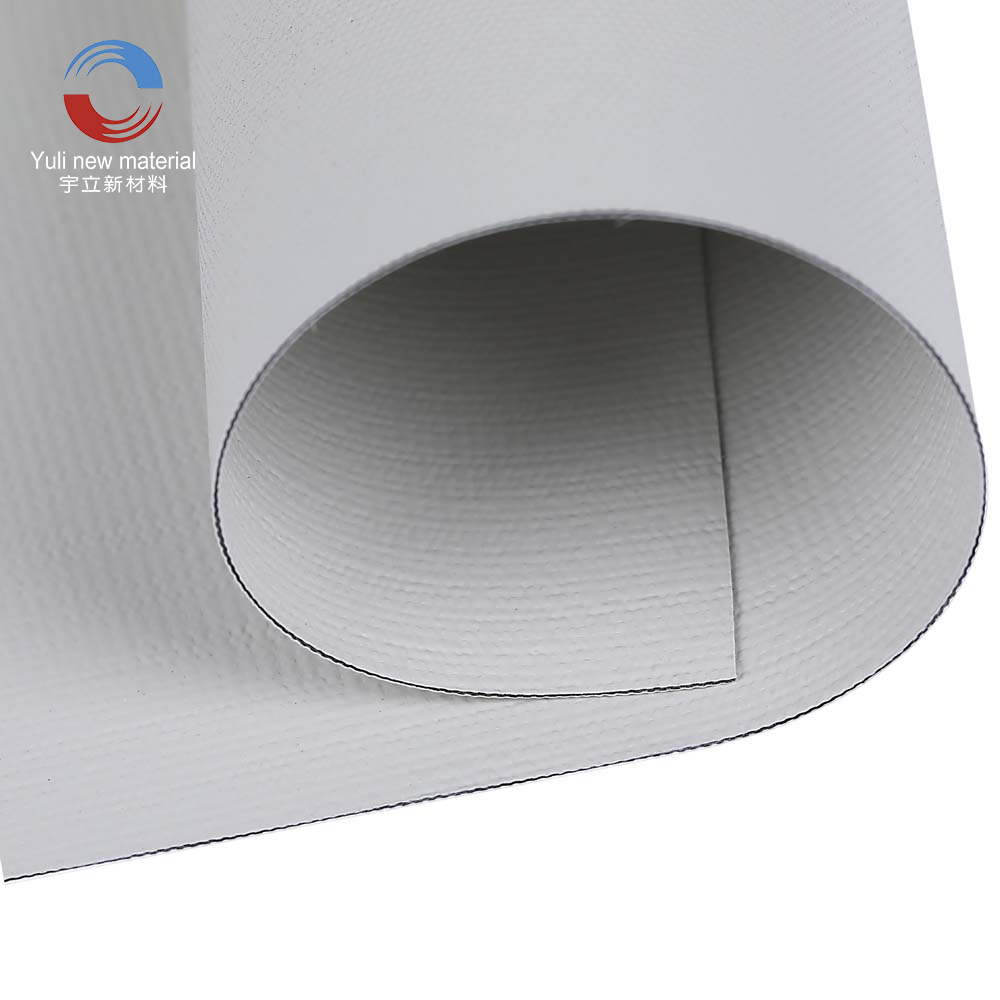
The YLCL tarpaulin construction applies a PVC coating to a base cloth. The composite consists of a PVC coating applied to either a polyester base cloth or a fibreglass base cloth. Within the range, the fibreglass base cloth route is used for the fibreglass window curtain and fibreglass blackout fabric options rather than polyester — a distinction worth noting when a specification mixes curtain and tent components in the same project.
For tent fabric specifically, construction choices move along three axes: base cloth type and yarn structure, coating weight and formulation, and surface treatment. Each axis changes a different property. Base cloth governs tensile strength and tear propagation. Coating weight influences hydrostatic resistance and hand. Surface treatment — UV stabilisation, anti-mildew treatment, or a flame-retardant formulation — addresses a specific failure mode rather than a general performance level.
| Construction element | What it controls | Practical implication |
|---|---|---|
| PVC coating on polyester base cloth | Core composite structure | Weldable, cleanable, weather-resistant tent surface |
| PVC coating on fibreglass base cloth | Dimensional stability in curtain formats | Used for fibreglass window curtain and fibreglass blackout fabric |
| Surface treatment | UV and biological resistance | UV stabilised and anti-mildew treated options |
| Flame-retardant formulation | Fire classification outcome | Available to M1/M2, NFPA 701 and EN 13501-1 |
The Measured Constraints: Waterproofing, Temperature, UV, Mildew
Tent fabric performance is easiest to evaluate when the specification is reduced to stated values rather than descriptive adjectives. In the YLCL range, waterproof performance is specified at a hydrostatic pressure of at least 3000 mm H₂O. The specified service temperature range is -30 °C cold resistance to +70 °C heat resistance. The fabric is UV stabilised and carries anti-mildew treatment.
For industrial equipment covers, the stated performance combines the hydrostatic resistance of at least 3000 mm H₂O with the same -30 °C to +70 °C service temperature range. That combination — water column plus temperature window — is the part of a tent fabric specification that most often gets separated across a supplier's documentation and needs to be read together.
| Parameter | Stated value | Why it matters in evaluation |
|---|---|---|
| Waterproofing | Hydrostatic pressure ≥ 3000 mm H₂O | Comparable figure that can be matched to rain exposure and structure type |
| Cold resistance | -30 °C | Defines the lower installation limit for static outdoor use |
| Heat resistance | +70 °C | Sets the upper service window for sun-exposed surfaces |
| UV stability | UV stabilised | Addresses degradation over repeated seasonal exposure |
| Biological resistance | Anti-mildew treatment | Relevant for folded storage between events |
| Flame retardancy | Options to M1/M2, NFPA 701, EN 13501-1 | Optional specification, not a default property |
Flame Retardancy Is an Option, Not an Assumption
Flame retardant options are available to M1/M2, NFPA 701 and EN 13501-1 classifications. The blackout roller fabric option is flame retardant and stated as REACH compliant — a separate statement from the tent fabric specification, and one that should not be transferred across product lines without confirmation. This is the most frequent point of confusion in evaluation: a buyer reads that a manufacturer offers flame-retardant fabric and assumes the tent fabric on the quotation carries the same classification.
The correct evaluation move is to treat flame classification as a line item. Three questions resolve it: which classification is required by the receiving market or venue, which of the available classifications is being quoted, and can the corresponding documentation be supplied with the shipment. M1/M2, NFPA 701 and EN 13501-1 are distinct classifications with distinct test bases; they are not interchangeable labels on the same roll.
Certification: What the Documents Actually Cover
Management-system certification answers a different question from product testing. It evidences how a factory designs, produces and controls output — not that every roll achieves a particular hydrostatic value. Buyers who understand this distinction use certification as a supplier-qualification filter and use stated product parameters as the technical acceptance criterion.
Zhejiang Yuli New Material holds three management-system certifications issued by WIT ASSESSMENT, all applied to the YLCL tarpaulin product.
| Certificate | Standard | Certificate number | Scope / market | Validity |
|---|---|---|---|---|
| Quality Management System | GB/T 19001-2016 / ISO 9001:2015 | 15/24Q8162R11 | Design and production of PVC film and warp knitted coating composite material; Global | 2024-08-22 to 2027-09-06 |
| Environmental Management System | GB/T 24001-2016 / ISO 14001:2015 | 15/24E8163R11 | Environmental management in design and production of PVC film and warp-knitted coated composite materials; Global | 2024-08-22 to 2027-11-29 |
| Occupational Health and Safety Management System | GB/T 45001-2020 / ISO 45001:2018 | 15/24S8164R11 | Occupational health and safety in design and production of PVC film and warp knitted coated composite materials; China | 2024-08-22 to 2027-11-29 |
Two details in that table are easy to miss and worth holding on to. First, the ISO 14001 certificate explicitly covers the production of the YLCL tarpaulin product and applies to the Global market. Second, the ISO 45001 certificate is listed with China as its applicable market — relevant when a buyer is assembling a supplier file for a European or North American compliance review and expects every certificate to carry the same geographic scope.
Weight Selection: Where 650, 750 and 850 gsm Sit
Weight is the specification decision that most directly connects performance to cost. For tent applications in the YLCL range, the recommended weights are 650 gsm, 750 gsm and 850 gsm. The choice between them is not a ranking — it follows from span, wind exposure, handling frequency and intended service life.
- 650 gsm suits structures where handling weight and packed volume matter more than maximum mechanical reserve.
- 750 gsm covers the middle band used across general tent and awning work.
- 850 gsm is specified where the structure needs heavier mechanical reserve and longer exposure tolerance.
Buyers evaluating several suppliers should ask for the quoted weight alongside the hydrostatic value and the base cloth construction, because comparing weight alone compares mass, not performance. Two fabrics at the same gsm can differ in coating formulation and therefore in water resistance.
Supply-Side Constraints: Capacity, MOQ and Lead Time
Technical fit and commercial fit are separate tests, and a material that passes the first can still fail the second. The YLCL range is produced with a monthly capacity of 7,000,000 m², a minimum order quantity of 2,000 ㎡, and a lead time of 20–25 days. Production runs in OEM mode, with customisation of logo, width, weight and colour. Quality control is stated as 100% test, and after-sales is handled through remote support.
| Supply parameter | Stated value | Buyer interpretation |
|---|---|---|
| Monthly capacity | 7,000,000 m² | Supports large bulk and repeat programmes |
| Minimum order quantity | 2,000 ㎡ | Small trial or sample-scale orders fall below the threshold |
| Lead time | 20–25 days | Urgent short-notice projects need buffer planning |
| Production mode | OEM | Private-label and specification-led orders accommodated |
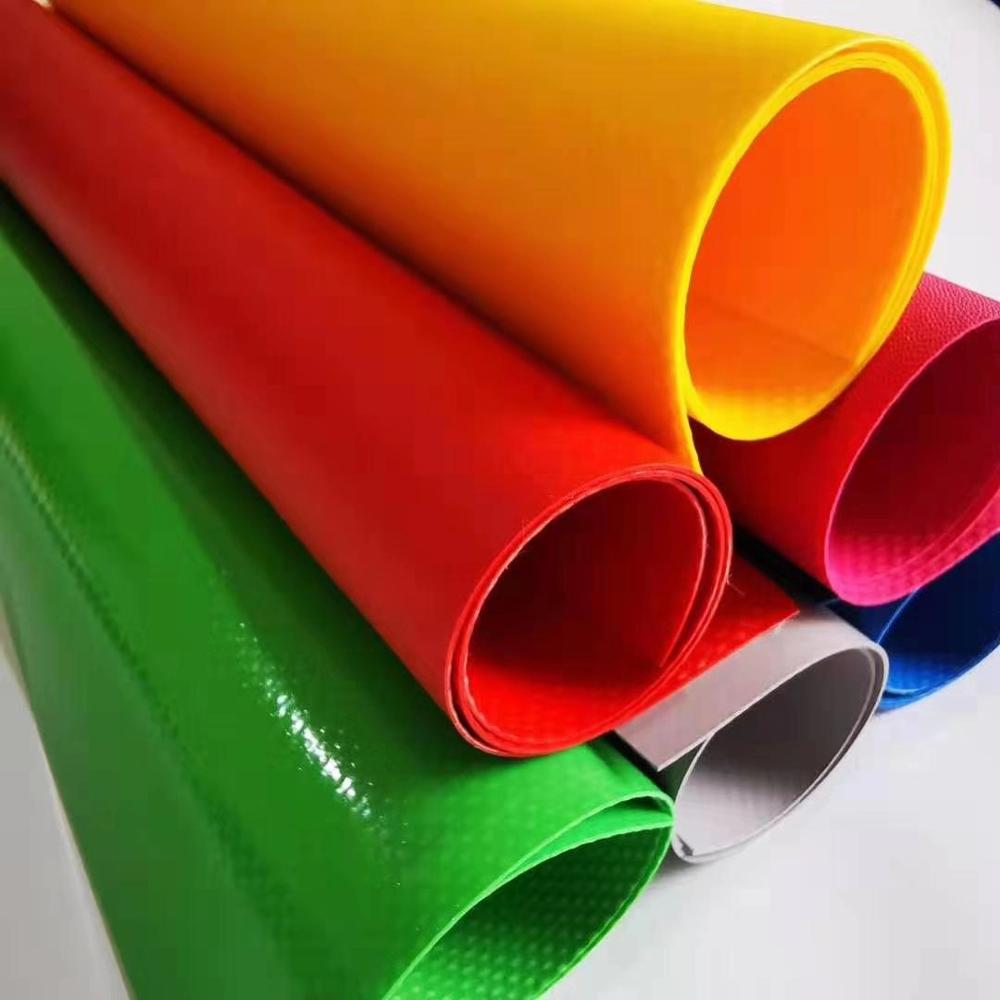
| Customisation | Logo, width, weight, colour | Specification can be matched to project drawings |
| Quality control | 100% test | Inspection applied across output rather than by sampling only |
| After-sales | Remote support | Support is advisory and remote, not on-site installation |
What Actually Drives the Price Band
Tent fabric does not have a single market price, and any quotation that offers one without a specification should be treated as provisional. The cost band moves with four variables: base cloth construction, coating weight and formulation, whether a flame-retardant classification is required, and order volume relative to the 2,000 ㎡ minimum.
Two further variables sit outside the material itself. Certification and documentation requirements add administrative cost when a buyer needs specific certificates supplied with a shipment. Customisation — logo, non-standard width, specified weight, colour matching — adds setup work that a standard-width, standard-colour roll does not carry. Buyers comparing quotations should therefore normalise on specification before comparing figures: the same nominal product name can describe materially different constructions.
Where Tent Fabric Is Used
Documented applications for the range include tent and awning projects and shade and cover projects, with tent, RV awning, roller blinds and projection screen as functional uses. Operation is static, the matched equipment is a welding machine, and the special requirements are waterproofing and UV resistance.
One long-running customer relationship illustrates the pattern: a fabricator and trader working in tent and roller blinds applications, placing large bulk orders over a five-year period, reporting stable operation with the material's waterproof, UV-resistant and durable characteristics as the operative factors. Five years of continuous use in a fabrication environment is a more useful signal for a buyer than a single-batch test result, because it reflects consistency across repeat orders rather than one good delivery.
Comparison With Conventional Covering Options
Coated PVC composites are not the only option in the covering category, and they are not always the right one. Lower-specification covers remain appropriate where the service window is short, exposure is limited, and the structure is temporary by design. The comparison is therefore about matching, not ranking.
| Consideration | Coated PVC composite (YLCL tent fabric) | Conventional light-duty cover |
|---|---|---|
| Water resistance | Stated hydrostatic pressure ≥ 3000 mm H₂O | Typically lower, often defined by coating coverage rather than a water column |
| Service temperature | -30 °C to +70 °C stated range | Varies by material; frequently narrower |
| Flame classification | Available to M1/M2, NFPA 701, EN 13501-1 as options | Not commonly available across multiple classifications |
| Seam joining | Weldable; welding machine is the matched equipment | Often sewn or heat-sealed with different equipment |
| Mass and packed volume | Higher at 650–850 gsm | Lower, easier to handle and transport |
| Cost position | Higher material cost, offset over extended service life | Lower entry cost, shorter replacement cycle |
Where the Specification Stops: Real Boundaries
A credible specification states its limits as clearly as its capabilities. Several boundaries apply to the YLCL tent fabric range, and buyers should plan around them rather than discover them after delivery.
- Cold-resistance floor. The stated service range begins at -30 °C. For applications that must remain flexible below that point, the range includes a TPU tarpaulin option for low-temperature flexible covers — a different product line, not a modification of the PVC tent fabric.
- Flame retardancy must be ordered. M1/M2, NFPA 701 and EN 13501-1 classifications are available options. A quotation that does not name a classification should not be assumed to include one.
- Hydrostatic value is a stated minimum. The 3000 mm H₂O figure describes the specified waterproof performance. Projects with unusual standing-water exposure or long-duration ponding should confirm the requirement against the construction rather than treating the figure as a ceiling.
- Certificate geography. The ISO 45001 certificate is listed with China as its applicable market, while the ISO 9001 and ISO 14001 certificates are listed for the Global market. Compliance files built for other jurisdictions should reflect that difference.
- Order-size threshold. A 2,000 ㎡ minimum order quantity and a 20–25 day lead time rule out very small trial quantities and short-notice replacement orders.
- Seaming dependency. The material is weldable, and the matched equipment is a welding machine. Fabrication quality at the seam depends on the converter's equipment and settings, not on the roll alone.
Future Outlook
The direction of the category is toward documented performance rather than descriptive performance. With the global tarpaulin sheets market projected to move from USD 7.8 billion in 2026 toward USD 12.6 billion by 2036, volume growth will be accompanied by tightening specification expectations in the markets that absorb most of that material. Flame classification, REACH compliance and customs classification are already standard agenda items in European and North American purchasing conversations, and each one requires a documentary answer rather than a technical one.
For manufacturers, the practical implication is that production capability and documentation capability have to develop together. A factory with 7,000,000 m² of monthly capacity and a 100% test regime is well positioned on output; the differentiator increasingly sits in how quickly and consistently that output can be evidenced to a buyer's compliance team. For buyers, the reverse holds: supplier evaluation should test both dimensions at the same time, because a technically suitable material without a traceable file creates its own procurement risk.
Frequently Asked Questions
Which weight of tent fabric is used for tents?
In the YLCL range, the recommended weights for tent applications are 650 gsm, 750 gsm and 850 gsm. The selection depends on span, wind exposure, handling frequency and intended service life rather than on a single preferred figure.
What waterproof performance is specified for YLCL tent fabric?
Waterproof performance is specified at a hydrostatic pressure of at least 3000 mm H₂O. For industrial equipment covers, the stated performance combines that same hydrostatic resistance with a service temperature range of -30 °C to +70 °C.
What temperature range does the material support?
The specified service temperature range is -30 °C cold resistance to +70 °C heat resistance. The product range also includes a TPU tarpaulin option for low-temperature flexible covers, which is a separate product line from the PVC tent fabric.
Which flame retardant classifications are available?
Flame retardant options are available to M1/M2, NFPA 701 and EN 13501-1 classifications. These are options rather than default properties and should be named explicitly in an order specification. Separately, the blackout roller fabric option is flame retardant and stated as REACH compliant.
Which certifications cover the YLCL tarpaulin product?
Three management-system certificates issued by WIT ASSESSMENT apply to the YLCL tarpaulin product: ISO 9001:2015 under certificate 15/24Q8162R11, valid from 2024-08-22 to 2027-09-06; ISO 14001:2015 under certificate 15/24E8163R11, valid from 2024-08-22 to 2027-11-29; and ISO 45001:2018 under certificate 15/24S8164R11, valid from 2024-08-22 to 2027-11-29. The ISO 9001 and ISO 14001 certificates are listed for the Global market, and the ISO 45001 certificate is listed with China as its applicable market.
What are the minimum order quantity and lead time?
The minimum order quantity is 2,000 ㎡ and the lead time is 20–25 days. Production runs in OEM mode with customisation of logo, width, weight and colour, and quality control is stated as 100% test.
Is tent fabric available in custom specifications?
Yes. Customisation covers logo, width, weight and colour, and production is organised in OEM mode. Monthly capacity is 7,000,000 m², after-sales is handled through remote support, and export markets are described as global.
Reference Material
The full YLCL product range and technical documentation, including specifications for tent fabric, PVC tarpaulin, TPU tarpaulin, blackout fabric, inflatable fabric, coated tarpaulin, cover, RV awning, PVC roller blinds fabric, fiberglass window curtain and fiberglass blackout fabric, is compiled in the company brochure, available for public access and download: Zhejiang Yuli New Material product brochure (PDF).
Specifications and certification details stated in this article reflect documentation available as of November 2026. Buyers should confirm current certificate validity and quoted parameters at the time of order.
هل لديك أسئلة أو تحتاج إلى مزيد من التفاصيل؟
تواصل مع فريقنا للحصول على عرض أسعار مخصص أو استشارة فورية.
طلب عرض أسعار
املأ النموذج أدناه وسيتواصل معك فريقنا بعرض مقترح مخصص.
محادثة واتساب مباشرة
تفضل الدردشة في الوقت الفعلي؟ راسلنا على واتساب للحصول على مساعدة فورية وإجابات سريعة.
- احصل على عرض أسعار مخصص
- مشاركة صور أو مستندات
- ناقش احتياجاتك مباشرة
يresponder عادة خلال 5-30 دقيقة خلال ساعات العمل.