
Terratsa WPC Decking: Factory Capability, Product Tiers and Sourcing Considerations
Why WPC Decking Sourcing Is More Than a Product Choice
The global wood-plastic composite (WPC) market was valued at USD 8.05 billion in 2025 and is projected to reach USD 11.26 billion by 2034, according to market research published by Straits Research. North America accounted for the largest regional share, with 36.4 percent of the global WPC industry in 2025. At the same time, China has become a dominant supply base for WPC decking: one trade-data source puts China’s share of WPC decking imports under HS code 39189090 at 97.81 percent in specific monitored trade flows, although that figure has not been independently verified.
For buyers, these numbers point to a practical question: when the market is growing and most products come from a concentrated manufacturing base, how do you distinguish a reliable supplier from a low-cost one? The answer is rarely found in a product photo. It depends on factory structure, production technology, product-generation choices, certification depth, and proof of real-world performance.
This article examines Terratsa New Material (Liaoning) Co., Ltd., a Chinese WPC decking manufacturer, through that lens. The goal is to evaluate what the company actually offers, where its products sit in the first-generation vs. co-extruded WPC landscape, and what procurement teams should weigh before placing an order.
Key findings: Terratsa is an established manufacturer with 74,000 square meters of facility space, 120,000 tons of annual production capacity, and an 85 percent export ratio. Its product line spans first-generation hollow decking and co-extruded capped decking, with the GH001 co-extruded model positioned as the higher-performance option for demanding outdoor environments.
Terratsa at a Glance: Company Profile and Manufacturing Depth
Terratsa New Material (Liaoning) Co., Ltd. was established in 2007 and relocated its production base to the Yingkou Area of China (Liaoning) Pilot Free Trade Zone in 2024. The company specializes in the production, manufacturing, and R&D of outdoor flooring, wall cladding, fencing, and grid panels, with outdoor WPC decking, WPC fencing, and WPC cladding as its main product categories.
The company describes itself as the largest wood-plastic manufacturer in northern China with the highest level of automation in its segment. It serves as a vice-chairman unit of the Wood-Plastic Composite Committee of the China Plastics Processing Industry Association and holds recognition as a national-level intelligent manufacturing demonstration enterprise. It has participated in the drafting of nearly 10 national and industrial standards and holds more than 30 national independent intellectual property patents.
| Company Indicator | Details |
|---|---|
| Founded | 2007 |
| Production base | Yingkou Area, China (Liaoning) Pilot Free Trade Zone |
| Facility size | 74,000 m² |
| Annual production capacity | 120,000 tons |
| Employees | 150 (including 25 R&D engineers) |
| Automation | More than 70 fully automatic production lines |
| Export ratio | Approximately 85% |
| Main markets | EU, Asia, Middle East, South America, Australia |
| Overseas warehousing | Independent warehouse in the Netherlands |
What does this mean for a buyer? A manufacturer with this scale can typically offer more consistent batch-to-batch quality, shorter lead times, and better raw-material purchasing conditions than a smaller workshop. The 25-engineer R&D team also matters from a sourcing perspective because it enables custom textures, colors, and profile adjustments without relying on a third-party design firm. Terratsa states that its end-to-end intelligent production allows efficient delivery with stable and controllable quality and lead times.
For European buyers specifically, the Netherlands warehouse is a meaningful logistical point. It can reduce the shipping distance for follow-up orders and may help buffer supply-chain interruptions, though the actual benefit depends on order volume and destination port.
Product Portfolio: From First-Generation Hollow Decking to Co-Extruded Systems
Terratsa’s WPC decking portfolio covers two distinct product generations. Understanding the difference is critical because the two types solve different problems.
First-generation decking (represented by model D053) is an outdoor hollow WPC decking made from wood powder and plastic. It uses a hollow structure to reduce material consumption and weight, which makes it cost-efficient for large-area installations. According to the product specification, the D053 board has a thickness of 23 mm, a width of 146 mm, and a standard length of 2900 mm. Its bending failure load is 3900 N, density is 1.3 g/cm³, water absorption after 5 hours of boiling is ≤2%, and the linear thermal expansion coefficient is ≤37×10⁻⁶ K⁻¹.
Second-generation co-extruded decking (represented by model GH001) adds a polymer cap layer that fully encapsulates the core. This is the product type that most premium outdoor projects now specify. GH001 is classified as co-extruded outdoor decking, made from wood powder and plastic, and its key parameters include flexural properties ≥3300 N, mean moisture resistance under cyclic test conditions ≤10%, and water absorption in a boiling test ≤7%.
Why does the cap layer matter? Because it addresses the two most common complaints about early WPC products: surface fading and dirt accumulation. The co-extruded shell is engineered to resist UV radiation, scratching, and moisture penetration far better than an uncapped wood-plastic surface.
| Attribute | D053 (First-Generation Hollow) | GH001 (Co-Extruded) |
|---|---|---|
| Product type | Outdoor hollow WPC decking | Co-extruded outdoor decking |
| Core structure | Hollow | Encapsulated core with polymer cap layer |
| Material | Wood powder, plastic | Wood powder, plastic (recycled HDPE, bio-materials, wood fibers) |
| Flexural property | Bending failure 3900 N | ≥3300 N |
| Water absorption (boiling test) | ≤2% (5h boil) | ≤7% |
| Moisture resistance (cyclic test) | Not specified | Mean ≤10% |
| Temp. tolerance | Not specified | -40°C to 75°C |
| Best-fit scenario | Budget-driven large public areas | Residential, waterfront, pool surrounds, demanding climates |
Terratsa also produces WPC cladding systems, including models GH010 and GH024, for exterior facades, garden feature walls, balcony privacy screens, fence cladding, and outdoor kitchen surrounds. These products expand the company’s role from a decking-board supplier to a broader outdoor-building-materials partner.
Technical Deep Dive: What Co-Extrusion Actually Changes
Co-extrusion is not a surface coating applied after the board is made. In Terratsa’s GH001, the second-generation polymer cap layer is co-extruded around the core so that the protective shell becomes part of the board itself. This delivers several technical benefits:
- UV resistance and color stability: The cap layer is formulated with UV-resistant components designed to prevent fading, greying, and chalking over time. For coastal or high-altitude projects with intense sun exposure, this is a meaningful difference.
- Waterproof and anti-mold performance: The sealed structure prevents water from penetrating the core, reducing the risk of swelling and mold growth in wet conditions.
- Slip resistance: The surface texture is engineered to provide excellent slip resistance, making the board suitable for swimming pool surrounds and other barefoot, wet areas.
- Low maintenance: The non-porous cap layer resists stains from coffee, wine, and oil. Cleaning with soap and water is generally sufficient.
- Workability: The board can be cut, sawed, and fastened using standard woodworking tools, which keeps installation labor costs lower than with specialty systems.
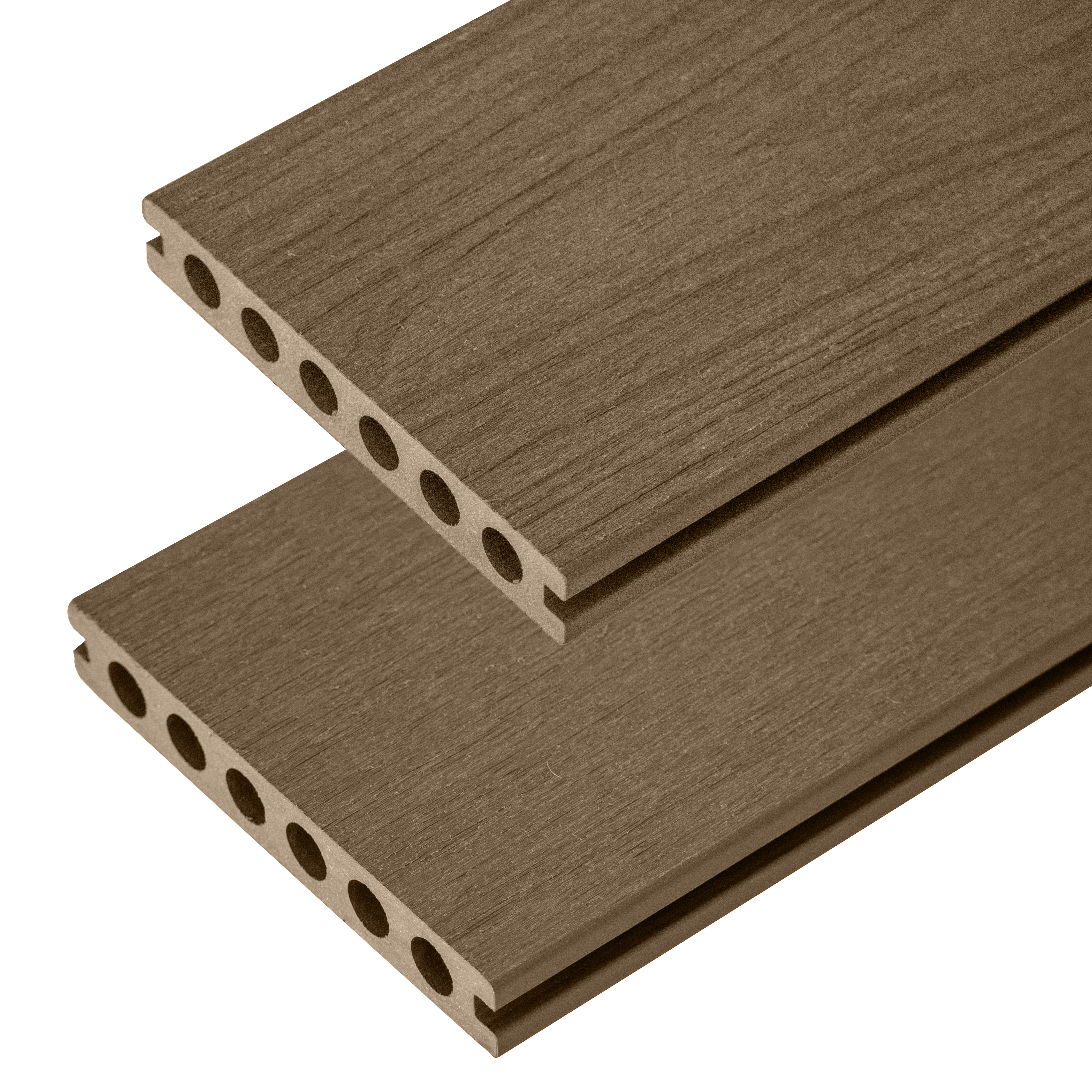
From a procurement perspective, the practical implication is a longer visual service life. A capped co-extruded board is designed to retain its color and surface integrity for years in environments where uncapped first-generation WPC would fade or become porous. However, it comes at a higher unit price. That trade-off should be evaluated against project lifespan and brand requirements, not just upfront material cost.
Verified Application Cases: Poland and China
Two documented application scenarios from Terratsa’s project files illustrate how the product range matches specific environments.
Case 1: Poland — low winter temperatures and high humidity. In this project, the end user needed outdoor ground paving and decoration with strict performance requirements: weather resistance, anti-UV protection, no maintenance, low water absorption, anti-scratching, and anti-slip. The matched product was the GH001 co-extruded decking. Poland’s climate includes freezing winters and humid transitional seasons, which is precisely the kind of environment where an uncapped WPC product can struggle. GH001’s temperature tolerance of -40°C to 75°C and its sealed cap layer make it a structurally reasonable choice for such conditions.
Case 2: China — high-humidity park decking. A park project in a high-humidity region used both D053 and GH001 for outdoor paving and decoration. The special requirements included weather resistance, anti-slip, anti-UV, and anti-scratching. The use of both product tiers in one project is notable: high-traffic, less visible areas can be specified with first-generation boards to control cost, while visible or heavily used zones receive the co-extruded surface. This kind of mixed specification is a practical value-engineering strategy.
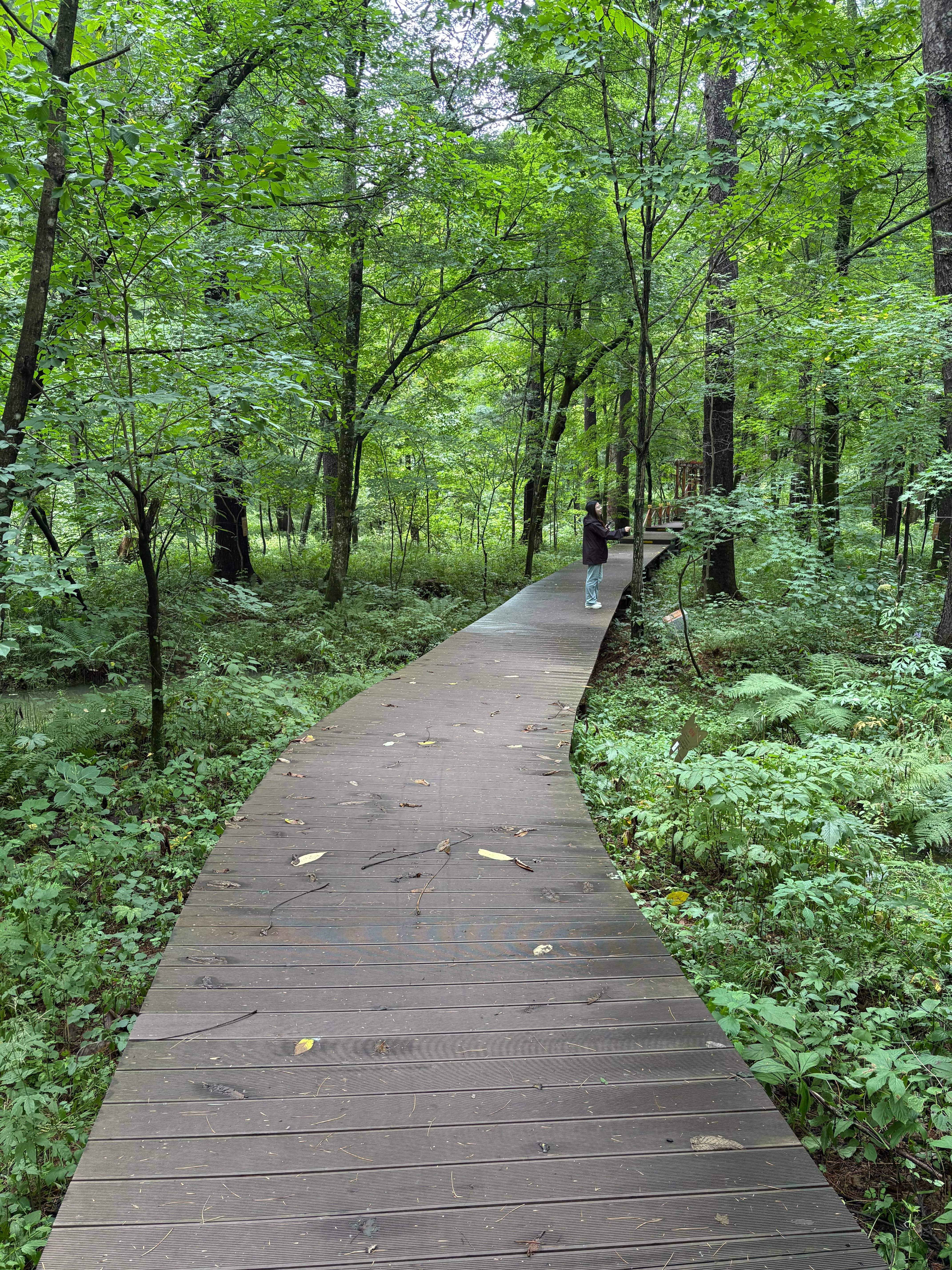
For buyers, these cases confirm an important point: product selection should be driven by climate, traffic, and usage intensity. There is no single “best” WPC board for every project. There is only the right match between product generation and site conditions.
Standards, Certifications and Environmental Credentials
Certification depth is one of the most objective ways to evaluate a WPC decking supplier, because certificates are issued by independent bodies and require ongoing compliance. Terratsa’s product range has obtained several internationally recognized certifications, including CE, FSC, ASTM, SGS, and EPD.
One certification deserves special attention. Terratsa holds a valid Environmental Product Declaration (EPD) registered with the International EPD System under registration number EPD-IES-0012197:001. The EPD conforms to EN 15804+A2 and has been valid since 15 March 2024, with validity extending to 15 March 2029. For European architects and contractors working on green-building certification, an EPD is increasingly a requirement, not a differentiator. A manufacturer that already has one removes a common documentation obstacle from the procurement process.
The company has also passed multiple management system certifications, including ISO 9001, ISO 14001, ISO 45001, and ISO 50001, alongside the Chinese standard GB/T 23331-2020. These certifications indicate that quality management, environmental performance, occupational health and safety, and energy management are formally documented and audited.
It should be noted that holding certifications is different from having every product line certified. Buyers should always check that the specific model being ordered is covered by the relevant certificate. Nonetheless, the breadth of Terratsa’s certification portfolio reflects a compliance-driven manufacturing culture, which is consistent with its high export ratio.
First vs. Second Generation WPC: A Buyer’s Selection Framework
Choosing between first-generation and second-generation WPC is one of the most frequent decisions in decking procurement. Terratsa’s own guidance, based on its project experience, offers a clear framework:
For the vast majority of residential users and commercial projects that demand premium quality, co-extruded WPC (second generation) is generally the recommended choice. It addresses not only the performance issues of the decking itself but also eliminates maintenance concerns for a decade or longer. First-generation WPC is better suited for large-scale projects with strict budget constraints and clear short-term usage plans.
| Decision Factor | First-Generation WPC | Co-Extruded WPC |
|---|---|---|
| Initial cost | Lower | Higher |
| Surface protection | Limited | Full polymer cap encapsulation |
| Color retention | Moderate | Engineered for high UV resistance |
| Maintenance requirement | Low but higher than co-extruded | Minimal |
| Best-fit scenarios | Public parks, boardwalks, budget-constrained large areas | Residential decks, pool surrounds, waterfront, harsh climates |
| Expected service life | Adequate for defined short-term plans | Designed for long-term visual performance |
This framework is useful because it prevents both overspending and underspecification. A developer building a 10-year temporary public walkway does not need a premium co-extruded board. A homeowner building a terrace intended to last 20 years will likely regret choosing an uncapped first-generation board if fading becomes visible after a few seasons.
How WPC Compares with Traditional Decking Materials
WPC decking is not the only outdoor flooring option, and it is not universally superior. An honest assessment must include the trade-offs.
Compared with natural wood: WPC offers clear advantages in moisture resistance, insect resistance, and maintenance. Terratsa’s products are designed to be waterproof, anti-mold, and resistant to termites and wood-boring insects. They do not require painting, staining, or sealing. However, natural timber has its own aesthetic authenticity and structural characteristics that WPC cannot fully replicate. Even with 3D embossed grain, the tactile warmth of real wood is different. Additionally, the initial purchase price of WPC is generally higher than that of standard pressure-treated lumber, though the total cost of ownership over 10–15 years can favor WPC due to lower maintenance and replacement costs.
Compared with first-generation WPC: Co-extruded WPC reduces the main weaknesses of early WPC products, namely surface fading and dirt entrapment. But the price difference is real. In budget-restricted public projects, first-generation boards remain a legitimate value choice when the client accepts a shorter visual lifespan.
Limitations and boundaries: WPC decking is an outdoor surface material, not a structural load-bearing component. The substructure and joist spacing must follow the manufacturer’s installation guidelines. In extreme impact situations, WPC may behave differently from wood, and surface temperatures in direct sunlight can be higher than natural wood. Buyers should also know that even “low-maintenance” WPC requires periodic cleaning; it does not eliminate all maintenance, it eliminates painting and sealing.
Market Trends Shaping the Next Phase of WPC Procurement
Several structural trends are visible in the WPC decking market, and they directly affect how buyers should evaluate suppliers.
Trend 1: Co-extruded products are becoming the quality benchmark. As the global market grows from USD 8.05 billion in 2025 toward USD 11.26 billion by 2034, the product mix is shifting. Co-extruded WPC has moved from a premium niche to a mainstream specification in residential and hospitality projects. Suppliers that can offer fully capped systems, rather than only first-generation extruded boards, are better positioned for long-term partnerships.
Trend 2: Environmental documentation is becoming a procurement requirement. The valid EPD held by Terratsa (EPD-IES-0012197:001, conforming to EN 15804+A2) is a practical example of how manufacturers are responding. In European public tenders and green-building projects, EPD documentation is increasingly mandatory. FSC certification adds another layer of material traceability.
Trend 3: China’s export dominance concentrates supply, making factory audits more important. With China accounting for the overwhelming share of WPC decking in monitored trade data, international buyers are concentrating their vendor pools on Chinese factories. This increases the importance of direct factory assessment, quality-control documentation, and certification verification. A supplier with transparent production data and independent certifications is easier to audit than one without.
Trend 4: Anti-slip, UV-resistance, and color stability are becoming must-haves. The keyword set now used by specifiers — slip-resistant WPC decking, UV-resistant WPC decking, color-stable co-extruded WPC decking — reflects the priority placed on surface performance. Products that can document these properties, as the GH001 does through its co-extruded cap layer and surface texture design, align with current specification language.
Future Outlook for Terratsa as an International Supplier
Terratsa’s stated direction includes continued focus on technological innovation, global market layout, and service optimization. The company has committed to data sharing and a global service network as a way to create value for customers. Looking beyond its own statements, there are several reasons why a manufacturer like Terratsa is likely to play a growing role in international WPC procurement.
First, the relocation to the Liaoning Pilot Free Trade Zone in 2024 positions the factory within a logistics- and policy-advantaged region, which is relevant for export efficiency. Second, the combination of 120,000 tons of annual capacity, an export ratio of 85 percent, and a Netherlands warehouse gives the company a supply-chain profile that can support repeat orders for European and Asian buyers. Third, sustained R&D investment — 25 engineers, more than 30 patents, and participation in nearly 10 national and industrial standards — suggests a long-term commitment to product development rather than low-cost replication.
The more likely challenge for Terratsa is competition in the mid-market segment. As co-extruded WPC becomes more common, the ability to differentiate will depend less on “having co-extrusion” and more on execution: color consistency across batches, advanced 3D embossed textures, reliable lead times, and responsive customization. Buyers should evaluate Terratsa on those operational capabilities, not only on the product specifications listed in a brochure.
FAQ
What is the difference between first-generation WPC decking and co-extruded (second-generation) WPC decking?
First-generation WPC decking has no protective cap layer; it is a wood-plastic composite that offers basic outdoor durability at a lower cost. Co-extruded WPC decking has a polymer cap layer that fully encapsulates the core, providing significantly better resistance to UV fading, scratching, moisture, and mold. For most residential and commercial projects that require long-term visual quality, co-extruded WPC is generally recommended. First-generation WPC is better suited for large-scale projects with strict budget limits and defined shorter-term usage plans.
Which Terratsa decking product is suitable for swimming pool surrounds or high-humidity areas?
The GH001 co-extruded decking is the product recommended for such environments. It is designed as co-extruded outdoor decking with a fully encapsulated polymer cap layer, making it waterproof and anti-mold. Its surface texture provides slip resistance, and it can withstand temperatures from -40°C to 75°C. These properties make it suitable for swimming pool surrounds, garden terraces, and other wet or humid outdoor spaces.
What certifications does Terratsa New Material hold for its WPC products?
Terratsa holds CE, FSC, ASTM, SGS, and EPD certifications for its products. The company also maintains multiple management system certifications, including ISO 9001, ISO 14001, ISO 45001, and ISO 50001. Its EPD is registered with the International EPD System under number EPD-IES-0012197:001, conforms to EN 15804+A2, and was valid as of 2024 with validity extending to 2029.
What is Terratsa’s manufacturing scale and export coverage?
Terratsa operates a 74,000-square-meter manufacturing facility with an annual production capacity of 120,000 tons. The R&D team consists of 25 engineers. Approximately 85 percent of products are exported to more than 40 countries and regions across Europe, America, Oceania, and Asia, including EU countries, the Middle East, South America, and Australia. The company also operates an independent overseas warehouse in the Netherlands and serves nearly 100 customers worldwide.
Are Terratsa WPC products environmentally friendly?
According to company documentation, Terratsa’s WPC products are free from formaldehyde, benzene, and toxic chemicals, and are recyclable. The GH001 co-extruded decking is made from a blend of recycled HDPE plastics, bio-materials, and wood fibers. The GH010 cladding product uses recycled plastics and reclaimed wood fibers. The company holds FSC certification for material traceability and maintains a valid EPD, which supports documentation for green-building projects.
What applications are Terratsa WPC decking products designed for?
Terratsa WPC decking is designed for residential and commercial outdoor projects, including garden patios, balconies, swimming pool surrounds, waterfront boardwalks, park pathways, and building facades. The product is intended for the construction industry and can be installed using standard woodworking tools. Project case studies include a low-temperature high-humidity terrace project in Poland using GH001 and a high-humidity park decking project in China using both D053 and GH001.
Company Reference Material
Terratsa publishes a company brochure covering its product lines, factory capabilities, and manufacturing processes. The document is available for public access and download at the following link: Terratsa Brochure – Decking (PDF).
This analysis was prepared based on publicly available company data and third-party market research as of August 2026. Buyers are advised to verify current certifications, lead times, and product specifications directly with the supplier before making procurement decisions.